
Representations of Knowledge in a Program for Solving Physics Problems
Proceedings of the Fifth International Joint Conference on Artificial Intelligence. Representation of Knowledge. Pages 286-290.
© 1977 International Joint Conferences on Artificial Intelligence
Abstract
A computer program which solves physics problems stated in English is described in terms of the knowledge which is used to transform one type of representation into another. The English sentences of the problem statement are progressively transformed into a semantic network form, a language-free internal model of the objects in the problem and their attributes and relationships, a set of canonical object frames which interpret actual objects as canonical objects (such as a point mass), a geometric model, a set of equationand a picture model. The general notion of a canonical object frame, which abstracts a subset of the properties of an object to form a representation of a canonical object whose interactions with related canonical objects can be formally modelled, is discussed as a method of organizing problem-solving programs.
- Bobrow, D. G. "Natural Language Input for a Computer Problem-Solving System", in Minsky (ed.) Semantic Information Processing, Cam- bridge: M.I.T. Press, 1968.
- Bobrow, D. G. and Winograd, T. "An Overview of KRL, a Knowledge Representation Language", Cognitive Science, Vol. 1, No.1 (Jan. 1977).
- Charniak, E. "CARPS, a Program which Solves Calculus Word Problems", M.I.T. report MAC-TR- 51, 1968.
- Charniak, E. "Toward a Model of Children's Story Comprehension", M.I.T A.I. Lab Report AI TR-266, Dec. 1972.
- Minsky, M. "A Framework for Representing Know- ledge", in Winston (ed.) The Psychology of Computer Vision, New York: McGraw-Hill, 1975.
- Novak, G. S. "Computer Understanding of Physics Problems Stated in Natural Language", Technical Report NL-30, Computer Science Department, The University of Texas at Austin, 1976.
- Novak, G. S. "Computer Understanding of Physics Problems Stated in Natural Language", American Journal of Computational Linguistics, Microfiche 53, 1976.
- Schank, R. C. and Colby, K. M. (eds.) Computer Models of Thought and Language, San Francisco: W. H. Freeman, 1973.
- Simmons, R. F. "Semantic Networks: Their Computation and Use for Understanding English Sentences",' in Schank and Colby (eds.), 1973, 10. Woods, W. A. "Transition Network Grammars for Natural Language Analysis", Comm, ACM, Vol, 13, No. 10 (October 1970), pp. 591~06. Knowlerl~e Repr.-6: Novak
References were extracted automatically from the PDF and may contain errors.
Full text extracted automatically from the PDF; figures, tables and equations may differ. The PDF is the version of record.
1. INTRODUCTION
This paper describes the representations of knowledge used by a program which solves physics problems stated in English. Rather than using a single uniform representation, the program uses a number of different representations, each of which is specialized for a particular task, e.g., lan guage syntax, language semantics, representing objects and their attributes and relationships, representing objects as canonical objects used in physics, modelling geometry, and solving equa tions. Many of these representations are based on the notion of frames [Minsky 75). The use of spe cialized representations simplifies many of the processes which must be performed by the program; however, it requires that the program be able to translate between the various representations when necessary. Procedural knowledge is required to convert one representation into another, since it frequently happens that information which is es sential in the target representation is unspeci fied or is specified only implicitly in the source representation; inferences are required to fill in such information. Specialized representations allow procedures to be attached to particular types of representations, both to convert them to other types and to solve problems which are asso ciated with the specialized area. In this paper, we discuss the ways in which these techniques are used to coordinate the many kinds of knowledge which are necessary for solving physics problems.
* Present Address: Artificial Intelligence Lab
Stanford Research Institute Menlo Park, CA 94025
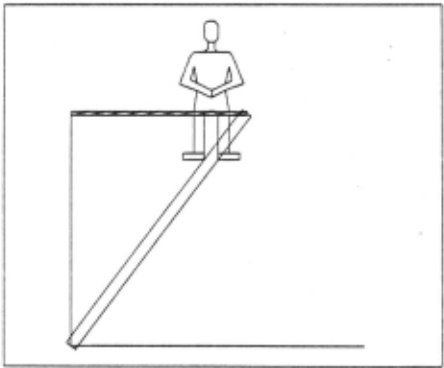
(THE FOOT OF A LADDER RESTS AGAINST A VERTICAL WALL AND ON A HORIZONTAL FLOOR! (THE TOP OF THE LADDER IS SUPPORTED FROM THE ~ALL BY A HORIZONTAL ROPE 30 FT LONGJ (THE LADDER IS SO FT LONG . ~EI�HS 100 LB ~ITH ITS CENTER OF GRAVITY 20 FT FROM THE FOOT . AND A !50 LB MAN IS 10 FT FROM THE TOPJ (DETERMINE THE TENSION IN THE ROPE!
ANSWER: 120.00000 LB
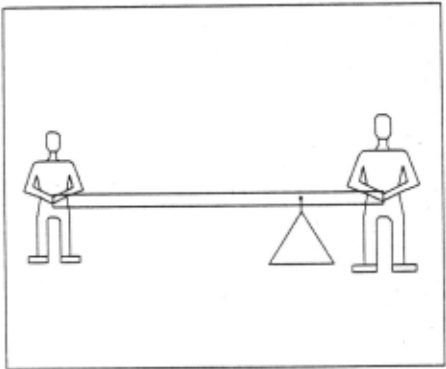
P2 SCHAUM PAGE 12 NUMBER 4
(WHERE MUST A WEIGHT BE HUNG ON A POLE . OF NEGLIGIBLE WEIGHT . SO THAT THE BOY AT ONE END SUPPORTS 1/3 AS MUCH AS THE MAN AT THE OTHER ENOl
ANSWER: (TIMES LENGTH76 7. SOOOOE-ll FROM THE BOY WHERE LENGTH76 IS THE LENGTH OF THE POLE
Figure 2.
2. OVERVIEW OF THE PROGRAM
The program, which we call ISAAC for ease of reference, is able to read, understand, solve and draw pictures of physics problems stated in Eng U.sh. Representative examples of the class of problems solved by the program are shown in Figures 1 and 2. The program has solved a total of twenty problems in the area of rigid body sta tics, most of which were taken verbatim from high school and college physics texts.
The understanding and solution of such a prob lem proceeds in several distinct steps. The first step is, of course, the understanding of the Eng lish sentences of the problem statement. The sentences are parsed into a case-structured seman tic network form by an augmented transition net grammar, which is aided by a large number of se mantic programs. Semantic processing is inter woven with the parsing process. Structures pro duced by the parser, which initially correspond closely to syntactic forms, are made progressively more semantic as the parsing proceeds. One major semantic process is referent identification, in which a phrase is identified with the object or relationship to which it corresponds in the pro gram's developing model of the problem. A second major semantic process is the identification of a t ype of conceptual entity (such as a location or attribute) which is referenced by a phrase. Pro cedures associated with each type of semantic frame allow inferences to be made to fill "slots" in the semantic frame whose values are unspeci fied; for example, the phrase "at one end" impli~ citly references an unspecified physical object, whose identity must be inferred to complete the meaning of the semantic frame. The final step in the semantic processing of a sentence is the execu tion of the verb semantics. At the time when the semantic routine for a verb is executed, the case arguments of the verb will typically be represented as semantic frames (as opposed to syntactic phrases); this representation greatly simplifies the processing of verbs. Execution of verb seman tics typically causes the transfer of new informa tion to existing objects in the internal model of the problem, or causes the creation in the model of new objects and relationships.
After all of the sentences of the problem state ment have been read and processed semantically, fue information conveyed by the sentences will have been transferred to a language-free internal model, and the structures produced in parsing the sen~ tences will have been discarded, The internal model contains representations of pljysical objects (e.g., ladders, ropes, and persons), features or aspects of objects (e.g., ., locations), and relation ships among objects (e.g., attachment relations),
In order to solve the physics problem, it is necessary to associate a Canonical Object Frame with each physical object in the problem, A Canon ical Object Frame is an idealization or abstraction of certain features of an actual object, such as a rigid body or a point mass. Physical laws are de fined in terms of these idealized canonical objecG, which only approximate the behavior of real cbje:ts. The canonical object frame to be used for an cbject depends on . the object's context; thus, a person might be modelled as a pivot when carrying a plank, or as a point mass when sitting on a plank. There are procedures associated with each type of canon~ ical object which test for the presence of neces sary features and make appropriate inferences for features which are missing, For example, if the weight of a rigid body is unknown, it is assumed to be zero; if the length is unknown, the assump tion is made that the object must have a finite length, and a symbolic constant is created to re present the length.
A geometric model is created to relate thepos~ tions of the objects in the problem to a common coordinate system. Knowledge of the prototypical geometry of each object is used to create a com posite geometric model by combining the geometric models of individual objects at points of attach ment. In some cases, this requires mapping fea tures of objects (such as the distance between two points) into a formal system (such as a tri angle), solving a problem in the formal system, and mapping the results back to the original ob ject (for example, defining the size of an object based on the computed distance between two points on the object).
After canonical object frames have been selected for each object and the geometric model has been constructed, equations are written to describe the interactions of the objects according to physical laws. These equations are solved by a small sym bolic manipulation package, and an answer to the question asked in the problem statement is gener ated from the equation solutions.
The last step performed by the program is the generation of a picture model and a diagram of the problem, The picture model is similar to the geo metric model; however, it is necessary to deter mine reasonable sizes in the drawing for objects which have no geometric size (for example, a per son who is modelled as a point mass), and to infer reasonable points of attachment when they are un specified (for example, the point of attachment for a person whose canonical object frame is PIVOT is assumed to be HANDS). Finally, the composite drawing must be scaled to fit the available pic ture area,
3. UNDERSTANDING ENGLISH SENTENCES
Parsing .of the English sentences of the problem statement is controlled by an Augmented Transition Network Grammar [Woods 70]. Rather than using a grammar interpreter, the grammar is implemented directly as a set of LISP functions, using a set of small system functions to control movement of the scanner and to provide automatic backup when an attempted parsing fails. The grammar functions in the parser build structures whiqh represent the ~ontent of the phrase being parsed, or make changes to already existing structures, In addition, the parsing functions frequently make calls to semantic routines; a grammar function may fail on semantic grounds even though it succeeded in parsing tne desired syntactic construct.
The structures produced by the parser initially bear a strong resemblance to Semantic Networks as used by Simmons [Simmons 73], These structuresare not produced for all syntactic constructs, butonly for those which represent larger units of meaning (primarily noun phrases and verb phrases), As the parsing continues, the parse structures are made progressively more semantic and less syntactic, until finally the meaning of a phrase is extracted and incorporated into the internal model or into the semantic structure of another phrase; there after, the parse structure is no longer used (with the exception of possible later use for finding pronoun referents). Rather than being representa tions of the meanings of phrases, these parsestruc tures may be considered to be temporary structures where the information provided by the syntactic parsing may be stored in a readily accessible form until sufficient context has been collected to allow the semantics of the phrase to be determined The form and use of the parse structures are shown later in this section, where the complete proces sing for an example sentence is outlined, As the processing of a noun phrase proceeds, the phrase will generally be identified as an instance of a Semantic Frame. The semantic frame designa tion specifies the type of conceptual entity de noted by the phrase, e.g., PHYSENT (physical ent:lty) ATTROF (attribute-of), or LOCPART (location/part). In addition, the semantic frame contains "slots" for the "arguments" of the frame; for example, the Attribute-Of semantic frame contains slots for the name of the attribute (e.g,, LENGTH) and there ferent object (that is, the object in the internal model of the problem) with which the attribute is associated. If the values of essential slots in the semantic frame are not specified explicitly in a sentence, procedures associated with the semantic frame can.· examine the internal model of the problem and make the inferences necessary to fill in the missing values. Such inferences are frequently required when, for example, a location is named without the object with which it is associated, as in "the center" or "one end". Thus, the procedures associated with a semantic frame perform the dual functions of determining when a conceptual entity is incompletely specified and providing specialist programs to complete the specifications by making appropriate inferences.
The use of semantic frames greatly simplifies the processing required for "higher-level" semantic routines which reference multiple phrases, such as the semantic routines for verbs and prepositions. A single type of conceptual entity, such as a loca tion, may be denoted by a variety of syntactic forms; by identifying the type of conceptual entity and collecting the arguments of the semantic frame into a standard form (making inferences as re quired), all of these syntactic forms are converted to an identical semantic frame form. Thus, the higher-level semantic routines may directly access the attributes of the conceptual entity without being concerned with the syntactic form which was used to specify that entity.
Phrases in a sentence frequently refer, either explicitly or implicitly, to objects in the pro gram's developing model of the problem. Referent Identification is the process of determining the object(s) in the internal model to which a phrase refers. The referenced "object" may be a physical object, an attribute of a physical object (such as a location), or a relationship (such as an attach ment between two physical objects); there is a set of specialist routines for identifying referents of each type , Referent identification is in gen eral a very difficult problem [Charniak 72]; even in the microworld of physics problems, the .Pro cesses for identifying referents are fairly com plex, First, it is necessary to determine whether a phrase refers to an existing object in the model, or whether a new object must be created and added to the model. If the model contains more than one possible referent, it is necessary to select the correct one(s); this selection may be specified in the sentence by means of an attribute value ("the left end" ... "the other end"), or an intensional description ("the load", i.e. , the object which is being carried). When the referent identification process is complete, the "referent" which is re turned is a list of the objects in the internal model to which the phrase refers. The various semantic frame forms have slots for the referent of the semantic frame and/or the object the seman tic frame is about, e.g., the object whose attri bute is referenced, In many cases, the referent constitutes the entire meaning of the phrase; thus, a phrase like "one end of a pole" has a meaning in isolation (even though it is not an acceptable sentence), namely, the pointer to the location ob ject in the internal model to which the phrase re fers. Once again, the use of semantic frames and the referent identification process relieve higher level semantic routines of the burden of knowing how a referent was specified; these routines need only deal with the pointer to the referent object in the internal model.
The structures produced by the parser and the structures created in the internal model in re sponse to .an example sentence are shown in Figures 3 and 4, respectively, Each word which is under lined represents a LISP GENSYM atom; the columns below the atom names are the indicator/value pairs from the atom's property list. The numbered state ments below describe the sequence of events in pnr cessing the example sentence; the numbers shown in the Figures correspond to this sequence, and indi cate the position of the scanner as the sentenceis parsed, or the time at which atoms are created or new information is added to their property lists.
- 1, The initial noun phrase "one end" is parsed, producing the structure TOKl with its first four properties.
- 2,3 The prepositional phrase parser causes the noun phrase "a pole" to be parsed, producing the structure TOK2 with its first four pro perties.
- The phrase "10 ft long" causes a modifier to be added to TOK2.
- 5, The preposition semantics routine for OF is called with TOKl and TOK2 as arguments, By means of a discrimination net using tests on these arguments, this particular instance of the use of OF is classified as being of the form "<location> OF <object>",
- 6, The function IDRFNT is called to identify the referent of "a pole", This causes TOK2 to be assigned the Semantic Frame PHYSENT (Physical Entity), and causes the object POLE3 to be added to the internal model. POLE3 is added to TOK2 as its referent.
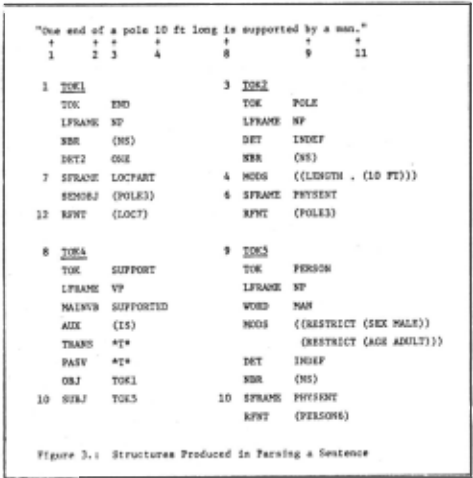
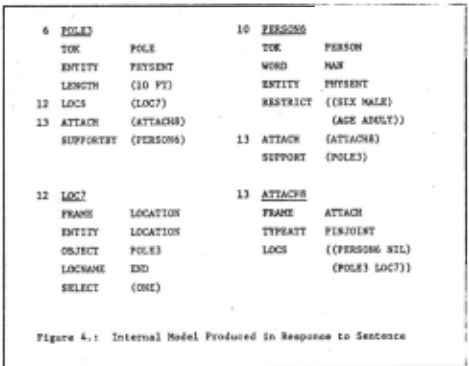
- 7. The semantic routine for OF next assigns the Semantic Frame LOCPART (Location/Part) to TOKl and fills the Semantic Object slot of this frame with the referent of the phrase which was the object of the preposition, i.e., the list (POLE3). Note that since the mean ing of TOK2 has been extracted and used, TOK2 is .no longer a part of the parse structure.
- The verb phrase parser is called (with TOKl as the syntactic subject argument). Since the verb phrase is passive, TOKl is attached to the verb token structure TOK4 as the OBJ case argument.
- The prepositional phrase parser causes the noun phrase "a man" to be parsed, generating the structure TOKS. "Man" is defined in terms .'of an underlying concept ("person") with modifiers.
- The preposition semantics routine for BY calls IDRFNT to identify the referent of a "man";
j
this causes TOKS to be assigned the Semantic Frame PHYSENT, and causes a new object PERSON6 to be added to the internal model as its referent.
- The verb semantics for the verb SUPPORT are called; the form this routine sees a structure of <physent> SUPPORT <locpart>.
- 12 , The location object LOC7 is added to the internal model and specified as the referent of TOKl.
- The semantic routine for the verb SUPPORT calls the function IDATT to identify an attachment relation between POLE3 at location LOC7 and PERSON6 (location unknown); this causes the creation of the attachment rela tion ATTACH8 .
4. CANONICAL OBJECT FRAMES
A Canonical Object Frame represents an idealiza tion of an actual object as a canonical object whose behavior approximates the behavior of the idealized aspects of the actual object. For example, in a physics problem, a man standing on a plank might be modelled as a Point Mass canonical object. A canonical object frame does not repre sent a superset of the actual object (typically represented by an !SA link in semantic networks), but rather represents a "view" of the object in the sense of [Bobrow and Winograd 77]. In a large A.I. system, a complex object such as a person might be modelled by a variety of canonical object frames, each of which would represent some aspect of the person; in our microworld of physics prob lems, each object is modelled (within a single problem) as a single canonical object . The types of canonical object frames which may be used to represent an object depend upon its context ; a person would be modelled as a Pivot object when carrying a plank rather than standing on it.
In order to model an object using a canonical object f rame, it is necessary to select the ap propriate frame, and then to abstract the charac teristics of the object which are required for the frame representation. Selection of the pro per frame is done by specialist programs for the type of problem area (in this case, physics pro b-. lems). The specialist programs know what types of canoni cal objects might be appropriate representa tions for each type of actual object; selection of the proper one is done by examining the context of the object (e.g , , how many objects it is attached to, whether it supports something or is supported or is attached to something that supports some thing, etc.).
In general, a mapping function is required to abstract the features of an object for use in its corresponding canonical object frame. The neces sary features may be specified implicitly, or in a different form from that which is needed, or they may not be specified at all, For example, in the problem shown in Figure 2, the length of the pole and the weight of the weight are unspecified; the values of these necessary attributes must be in ferred (in this case, by creating symbolic con stants for them) in order to complete the canonical obj ect frame representations. A second set of mapping functions may be needed to translate the results of reasoning processes performed on the canonical objects into the form required for the "actual" object representations, and to propagate the consequences of the new results.
The advantage of viewing an actual object as a canonical object is that canonical objects inter act with each other in precisely specified ways. The information about the actual object which may be used in an attempt to solve a problem is re~ stricted to those aspects of the object which were abstracted to form the canonical object frame, which greatly reduces the size of the problem space compared to a uniform representation in which all information is equally accessible. In addition, specialist procedures may be attached to a canonical object frame type to specify the inter actions with other canonical objects and to solve special problems which occur frequently. In the physics problem solver, the interactions of canon~ ical objects obey physical laws which are expres sed as equations; these laws include those taught in physics texts (e.g., the laws of rigid body statics) as well as other physical laws which are "obvious" (e.g., the tension forces exerted at the ends of a rope are equal in magnitude, nonnegative, and directed toward the center of the rope). The specialist procedures associated with each type of canonical object examine the objectts relation ships with other objects and write equations which describe the interactions of the objects; solution of the set of generated equations yields the an swer to the problem.
As an example of the use of Canonical Object Frames, ·consider the man standing on the ladder in the problem of Figure 1 , The problem statement says only that ''a 150 lb. man is 10 ft. from the top"; in order to solve the problem correctly, the program must determine what role the man plays in this particular problem. It~inadequate to as sume that a man will always play a single role, since in the problem of Figure 2 the man is carry~ ing the pole rather than standing· on it. In order to choose the correct Canonical Object Frame, the context of the man is examined: he is attached (in some way) to the ladder, which is known to be sup ported at two points; therefore, the ladder is assumed to support the man, and a "point mass" Canonical Object Frame is chosen. Choosing the correct Canonical Object Frame is essential to solving a problem correctly: if the wrong one is chosen, it is likely to cause unsolvable equations to be written, or to cause essential information to be left out of the equations, so that the answer will be wrong.
The use of Canonical Object Frames is an impor tant respect in which this program differs from the earlier programs STUDENT [Bobrow 68] and CARPS [Charniak 68]. In STUDENT, which solved algebra word problems, the words or phrases between key words were directly reduced to algebraic variables, without any analysis of the meanings of the words (in fact, nonsense words could be used). In CARPS, which solved calculus word problems, equations were associated directly with object names (for example, x 2 + y 2 = 1 2 was associated with LADDER). These direct associations caused these earlier programs to fail on problems which were otherwise within their abilities because an object played a 11 role~' different from the one which the program assumed , By the use of Canonical Object Frames, ISAAC separates the role played by an object from the representation of the object itself, so that a single object can play different roles in differ ent contexts. Parts or features of an object may be abstracted. For example, the imaginary line between two points on a ladder may form one side of a triangle; it is not necessary that the entire ladder be a side .
5. GEOMETRIC MODEL
In order to write equations describing the in teractions of the objects in a physics problem, it is necessary to construct a geometric model which relates positions on objects to a common coordin ate system. Geometric models for individual ob jects are constructed by using prototype geometric models for each type of object; a prototype geome try is parameterized by the rotation of the ob ject, the offset of the object relative to a larg er geometric model, and scale factors for the x and y coordinates. Given the relative positions of locations on an object in the prototype geome try, it is easy to calculate the coordinates of a location on an "actual" object using simple vector geometry.
The composite geometric model is constructed from the individual geometric models by requiring that the coordinates of two points attached to each other be equal; thus, if an object is to be added to the composite model, it is only necessary to recalculate its offset so that its point of attachment will have the coordinates of the cor responding point in the composite model. However, if several objects are connected so that they form a triangle, and the sizes or rotations of some of the objects are unknown, this simple method is in adequate. In this case, it is necessary to map the known line segment lengths and angles into a canonical triangle form, solve the triangle, and map the results back to give the desired rotations and object sizes.
6. CONCLUSION
The program for solving physics problems which is described in this paper makes frequent use of the notion of frames [Minsky 75], In our imple mentation, frames may be considered to be inter pretations or "views'·' of other objects, which then allow problem solving by specialist programs which know how to deal with the canonical objects repre sented by the frames; a diagram and example of this· process are shown below.
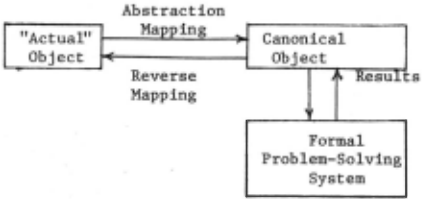
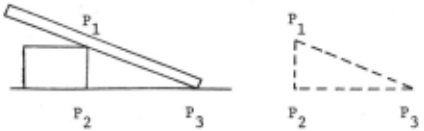
In this hypothetical example, the "abstraction mapping" creates representations of line seg ments (none of which, presumably, existed in the original representation) to form a canonical triangle model; the triangle can then be solved by a specialist program for triangles, and the result can be mapped back into the orignial re presentation (e.g., by defining the x coordi nate of P 1 if the coordinates of P are known).
The noEion of canonical object trames is a powerful technique for constructing problem solving systems. By separating the recognition and abstraction processes from the formal prob lem solving system, it allows the latter to be written cleanly and efficiently, without regard for the specifics to which it may be applied. An existing formal problem-solving system may be used with a new type of object simply by adding a routine to interpret the new object as the appropriate canonical object, By restricting access to both procedures and data, the canon ical object frame reduces the size of the prob~ lem space with which the problem solver must contend, and keeps irrelevant knowledge from being accessed,
This notion of the abstraction of a small number of properties of an .actual object to form a representation of a canonical object is basic to the sciences and to engineering. Indeed, major scientific advances (e.g., coordinate geometry, Newtonian mechanics, atomic theory, phrase-structure grammar) have generally been accompanied by the introduction of new types of canonical objects with which the theories deal, Laws such as those of Newtonian mechanics derive their great power from their ability to predict the behavior of ~ physical object on the basis of only a few attributes, e.g., the object's mass and ·the resultant of the forces on it, The practices of engineering are heavily based upon the use of canonical object models; for example, an integrated circuit is described in terms of at least seven canonical models: a logic model, a geometric model and topology model of the cir cuit package, a thermal model, a timing model, a power consumption model, and a circuit model (which in turn is expressed in terms of canonical objects such as transistors and lumped resistan ces).
We believe that the organization of knowledge in terms of canonical object frames with associ ated specialist procedures for solving problems in particular areas is basic to a variety of disciplines (not only physics and engineering, but also such disciplines as medicine and law), and that it has considerable potential for arti ficial intelligence programs as well. The nature of the procedures which recognize an actual object as an instance of a canonical object and construct the mappings between the model of the object and the canonical object frame is an important area for future research.
@inproceedings{ijcai1977p65,
  title     = {Representations of Knowledge in a Program for Solving Physics Problems},
  author    = {Novak, Gordon S.},
  booktitle = {Proceedings of the Fifth International Joint Conference on
               Artificial Intelligence, {IJCAI-77}},
  publisher = {International Joint Conferences on Artificial Intelligence},
  editor    = {Raj Reddy},
  pages     = {286--290},
  year      = {1977},
  note      = {Representation of Knowledge},
  url       = {https://ijcai.org/proceedings/1977/65},
}
TY - CPAPER TI - Representations of Knowledge in a Program for Solving Physics Problems AU - Novak, Gordon S. T2 - Proceedings of the Fifth International Joint Conference on Artificial Intelligence, IJCAI-77 PB - International Joint Conferences on Artificial Intelligence PY - 1977 SP - 286 EP - 290 UR - https://ijcai.org/proceedings/1977/65 ER -Copied
Machine-readable versions of this paper, for tools and AI agents:





