
Detection of Elliptic and Linear Edges by Searching Two Parameter Spaces
Proceedings of the Fifth International Joint Conference on Artificial Intelligence. Vision. Pages 700-704.
© 1977 International Joint Conferences on Artificial Intelligence
Abstract
The Hough transformation can detect straight lines in an edge-enhanced picture; however, its extension to recover ellipses requires too much computing time. This paper proposes a modified method which utilizes two properties of an ellipse in such a way that it iteratively searches for clusters in two different parameter spaces to find visible ellipses, then evaluates their parameters by the least means squares method.
- Duda R. 0. and Hart P. E., "Use ot the Hough transformation to detect lines and curves in pictures," Commus. Ass. Comput., Vol.l5, ppll-15, March, 1972.
- Falk G., "Interpretation of imperfect data as a three dimensional scene," Artificial Intelligence, Vol.3, pplOl- 114, no.2, 1972.
- Griffith A. K., "Edge detection in simple scene using a priori information," IEEE Trans. Comput., Vol.C-22, pp371-381, no. 4, 1973.
- Hough P. V. C., "Method and means for re- cognizing complex patterns," U.S. Patent 3 069 654, Dec., 1962.
- Kimme C., Ballard D. and Sklansky J., "Finding circles by an array of accumula- tors," Commus. Ass. Comput., Vol.l8, ppl20-122, Feb., 1975.
- O'Gorman F. and Clowes M. B., "Finding picture edges through collinearity of feature points," IEEE Trans. Comput., Vol.C-25, pp449-455, Apr., 1976. IJCAI
- Shapiro D. S., "Transformation for the computer detection of curves in noisy pictures," Computer Graphics and Image Processing, Vol.4, pp328-338, 1975.
- Tsuji S. and Nakamura A., "Recognition of an object in a stack of industrial parts," Proc. of 4th IJCAI, pp811-818, 1975. - Vlslon-9: Tsuji IJCAI
References were extracted automatically from the PDF and may contain errors.
Full text extracted automatically from the PDF; figures, tables and equations may differ. The PDF is the version of record.
DETECTION OF ELLIPTIC AND LINEAR EDGES BY SEARCHING TWO PARAMETER SPACES
Saburo Tsuji and Fumio Matsumoto Department of Control Engineering Osaka University Toyonaka, Osaka 560, Japan
since necessary memory space and com puting time grow exponentially with the number of parameters. For example, de tection of circles requires a three dimensional array of accumulators, and a modification of the algorithm is neces sary to recover the circular arcs in a reasonable time [Kimme 75].
This paper describes how we can modi fy the paramerization technique so as to recover both linear and elliptic edges, which are important cues for analyzing scenes containing artificially con structed objects. We can easily detect and erase long straight lines in an edge enhanced picture; then the problem is how to efficiently detect ellipses {each of which has five unknown parameters) in a set of feature points on curved or short linear segments. Instead of utilizing a five-dimensional array of accumulators, we sequentially search for clusters in two different parameter spaces; one for finding the approximate positions of centers of ellipses and selecting candi date feature points for an easily detect able ellipse, and the other for testing whether the candidates are exactly on the ellipses or not. There exist interac tions between different patterns when one maps edge points into the parameter spaces. As the result, ellipses with many edge elements sometimes mask weak clusters cor responding to other ellipses. Therefore, the computer vision system iteratively searches for an easily visible ellipse in a set of feature points in an edge-en hanced picture from which edge points of the recovered long straight lines and el lipses have been erased.
DETECTION OF ELLIPSES
The direct application of the Hough transformation to the detection of ellip tic objects in a digitized picture re quires a five-dimensional array of accumu lators; the array is indexed by five para meters specifying the location, shape, and orientation of an ellipse. Itsusuage, however, is impractical because of ex cessing computing time. An idea for over coming the difficulty is as follows: instead of the time consuming process of mapping each edge point in the picture into the five-dimensional parameter space, we sequentially examine clusters in both a two-dimensional and a one-dimensional space, by utilizing two well known pro perties of an ellipse, and efficiently
ABSTRACT
The Hough transformation can detect straight lines in an edge-enhanced pic ture; however, its extension to recover ellipses requires too much computing time. This paper proposes a modified method which utilizes two properties of an ellipse in such a way that it itera tively searches for clusters in two dif ferent parameter spaces to find visible ellipses, then evaluates their parameters by the least means squares method.
INTRODUCTION
Analysis of a scene containing many complicated-shaped objects is a current problem of computer vision. Since the usual line finders fail to extract a reliable line drawing from the scene, Falk and Griffith have proposed methods which identify each object in a blocks world by utilizing input data and ex ternal constraints so as to suggest and test hypotheses on the scene [Falk 72], [Griffith 73]. In order for a computer vision system to analyze more complex pictures containing real objects such as telephones, cups, or industrial parts, their heuristics have been modified as follows: {1) search for simple familiar patterns such as polygons and ellipses in strong feature points in the pictures, {2) select models of objects whose fea tures contain these patterns, {3) test the validity of the models by examining whether weak feature points around the patterns satisfy the proposed models [Tsuji 75].
Line finding methods utilizing the Hough transformation are useful to find polygons, especially partly occuluded ones, because they utilize global pro perties of edge points [Hough 62], [Duda 72], [Griffith 73], [O'Gorman 76]. Duda and Hart also discussed possibilities of ex tending their methods to find curves in the picture [Duda 72] , and Shapiro ana lyzed the performance of the transfor mation method to detect curves in noisy pictures [Shapiro 75]. Direct applica tion of the parameterization, however, is limited to curves with a small number of parameters, say two or three at most,
This work was supported in part by Grand In-Aid for Scientific Research from the Ministry of Education, Japanese Govern
ment.
select a small number of candidate edge points for an easily visible ellipse. Next, the five unknown parameters of the best fitting ellipse to the candidates are evaluated by the least mean squares method.
Erasing Long Straight Lines in Edge Enhanced Picture
We preprocess a digitized input pic ture to find edge points by applying a simple gradient operator to every point in the picture and thresholding it, and we thus obtain an edge-enhanced picture E in which each edge element is character ized by its location (x,y) and quantized direct.ion e which ranges between 0° and 360° (the distinctness of the edge point is not used in the following process). Next, the edge points are arranged in a set {ee} of edge lists: the edge list ee is a collection of edge points of a direction e. Now the line finding method [O'Gorman 76] detects sets of collinear edge points in E and registers them in a list of straight lines, however some of them may belong to ellipses. Straight lines longer than a threshold are con sidered not to be parts of the elliptic arcs, and their edge points are erased from E and {e 9 } in order to simplify the following algorithm for detecting el lipses.
Detection of Centers of Ellipses
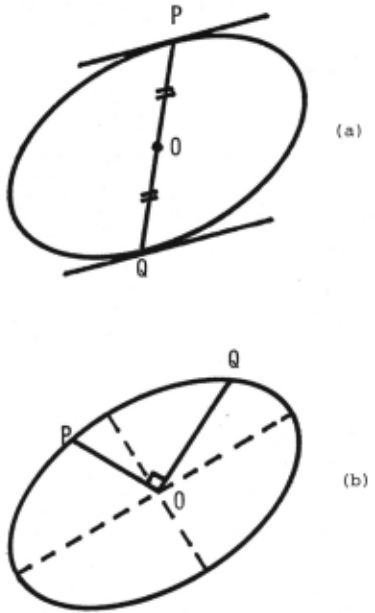
Let us consider two parallel tangents at P and Q to an ellipse (see Fig.l (a)). A simple property, namely that P and Q are at equal distance from the center 0 of the ellipse, is useful for finding locations of ellipses in E by a two dimensional accumulator array {a }; the array is indexed two parameters x,y (x,y) specifying the location of an ellipse. For each pair of edge points (x 1 ,yl) and (x ,y ) in an edge list ee (a ool ection of 2 ed~e points having an orientation e), an accumulator at ((x 1 +x 2 )/2, (y 1 +y 2 )/2) is incremented by one. After ali pairs of the set { e e} are processed in this way, the array is locally averaged by using a 3x3 neighborhood. Thus, the accumulator corresponding to the center of a complete ellipse has a count approximately pro portional to the length of its circum ference.
Now, we search for the accumulator a with the highest count, whose indTtgs specify the location of the center of an easily visible ellipse (or concen tric ellipses), and then select all pairs of edge elements which increased a in the above-mentioned process, as m,ncan didates for the ellipse. The process of erasing ~ong straight lines is necessary before applying this center-finding al gorithm because two parallel lines gene rate a mountain ridge, considerably dis- Fig.l Two properties of an ellipse. (a) OP=OQ, if two tangents are parallel. (b) (l/OP2)+(1/0Q2)=1/R2=constant, if LPOQ=90~
turbing the peak-finding process, in the array.
Testing Candidates for the Ellipse and Evaluation of Its Parameters
Let C be the set of the selected can didates for the ellipse. The above-men tioned center-finding procedure simply collects edge points such that they are on symmetrical curved or linear segments to the point (m,n) in E; therefore a mem ber in c is not always on an ellipse. Application of the least mean squares me thod to fitting an ellipse to C is likely to give an unsatisfiable result, espe cially when there exist concentric el lipses, because the fitting process is significantly disturbed by the symmetri cal patterns not on one ellipse. Thus we must select from the candidates the edge points which lie exactly on an el lipse by utilizing a property of an el lipse, and then apply the fitting process for evaluating accurate parameters.
Consider two points P and Q on an el lipse such that LPOQ=90°, where 0 is the center of the ellipse (see Fig.l(b)). It is easy to prove the property that for an ellipse.

Now, a one-dimensional accumulator array { a. } is used to test the candi dates. '~-We assume that 0 is located at (m,n) obtained by the center-finding algorithm. If any two points P and Q in C satisfy /POQ=90°+ 6 ( 6 is a thres hold value), then the- accumulator cor responding to R evaluated by (1) is incremented by one. After processing all members in C in this way, we obtain a histogram of R, which gives us valu able information on ellipses in C ; mul tiple prominent peaks in it suggest the existence of concentric ellipses in C (however the number of the ellipses is less than that of the peaks in most cases), or we would decide that there is no visible ellipse in C , if the histo gram contains only low hills.
Mutual interactions between edge points on the concentric ellipses gene rate significant false peaks in the histogram, sometimes higher than the peaks corresponding to true ellipses. The smallest ellipse in C is examined first, because the count in the accumu lator corresponding to it is less sensi tive to this interference. We select all pairs of edge points, contributing to the leftmost peak in the histogram, and then evaluate five parameters of the best fitting ellipse to these edge points by the least mean squares method. The fitting process is judged to be a failure if the edge points in E cover only a small fraction of this ellipse. Otherwise, it is considered a success, and the edge points on the recovered ellipse are excluded from E, C and {e } in order to eliminate their interacti~n with other ellipses. The candidate testing process is iterated by calcu lating a new histogam of R in updated C and examining the leftmost peak in it, until the histogram does not contain any prominent peak.
The above-mentioned procedure for testing candidates is iteratively ap plied to all prominent clusters in the two-dimensional accumulator array to re cover all visible ellipses in the pic ture. Finally, we test whether each short line in the list of straight lines belongs to the recovered ellipses or not. Since the edge points on these el lipses have been excluded from the up dated edge-enhanced picture E , we dis card the line from the list if the edge points still remaining in E are not or sparsely distributed on the line; other wise it qualifies for a straight line.
EXPERIMENTAL RESULTS
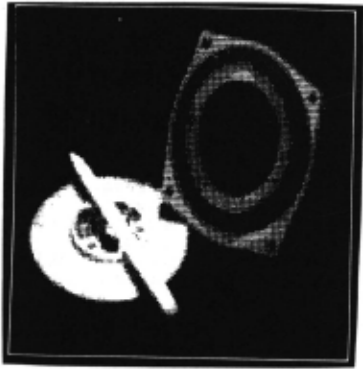
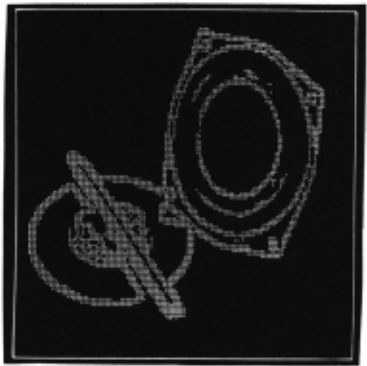
The following example shows some of the features of the ellipse-finding al gorithm. Fig.2 (a) shows a 128xl28 digi tized picture with 64 gray levels, which contains three parts of a gasolineengine; two cylindrical parts and a rod. A simple gradient operator using a 3x3 win dow [O'Gorman 76] with a noise threshold of 30 is applied to obtain an edge-en hanced picture. Fig.2 (b) shows the re sult, which contains 2643 edge points.
(b)
Fig.2 Input picture.
- (a) A 128 by 128 digitized picture, containing three industrial parts.
- (b) An edge-enhanced picture of (a) .
Setting the quantization step of e at 6°, we classify the edge points into 30 groups (edge lists). At this point, the line finding algorithm is applied, and all linear segments are detected.
Now let us consider how we can select the threshold for discriminating long straight lines from flat portions of el lipses. The maximum length L of a flat portion of an ellipse describWd by (x/a) 2 + (y/b) 2 = 1 is
Considering the size of the picture is 128 by 128, we expect a <SO. Therefore, not highly concentric ellipses (a<b) do not include linear segments longer than 20. Thus we register longer segments than 20 in the list of straight lines, and erase their edge points. The edge list and E now contain 1993 edge el~ments.
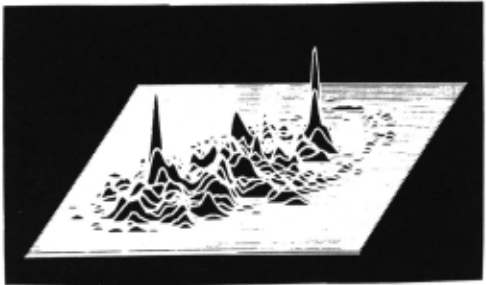
Next, the ellipse-finding algorithm is applied. After all pairs of the edge points in every edge list are mapped into the two-dimensional (128 xl28) array of accumulators, the array is locally ave raged using a 3x3 neighborhood. The con tents of these accumulators are displayed in Fig.3; there exist two prominent clust:ers higher than a noise threshold of 100.
After all pairs of edge points, which contributed to the highest (left) peak in Fig.3, are selected as candidates for ellipses, we apply to them the candidate testing algorithm, whose first step is to calculate the _histogram of R of the candidates. The result is illustrated in Fig.4 (a). Since the number of edge points on an ellipse depends on the size of the ellipse, it seems reasonable to use a threshold function which is propor tional to R, for suppressing noises in the histogram, and lSR is used in this experiment. After application of this threshold function, a peak finder detects the single prominent peak in Fig.4 (a), and then the least mean squares method can easily fits elliptic arcs to the edge
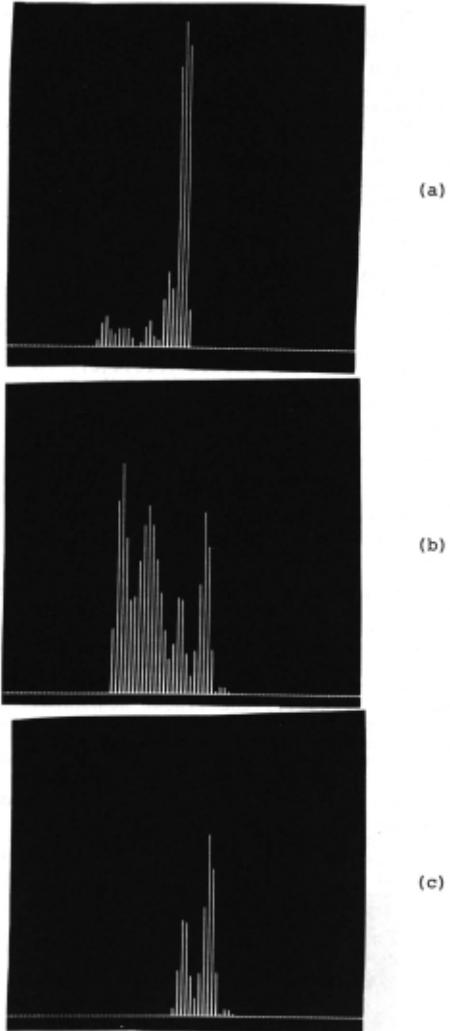
- Fig.4 Contents of the one-dimensional array of accumulators.
- (a) Histogram of R for the cluster of the left peak in Fig.3.
- (b) Histogram of R for the cluster of the right peak in Fig.3.
- (c) Histogram of R after erasing the edge points on the ellipse corres ponding to the leftmost peak in (b).
points of the peak. Selection of another threshold function with a smaller coef ficient does not influence the finally obtained ellipses, but much computing time is wasted by processing low peaks and rejecting them as noise.
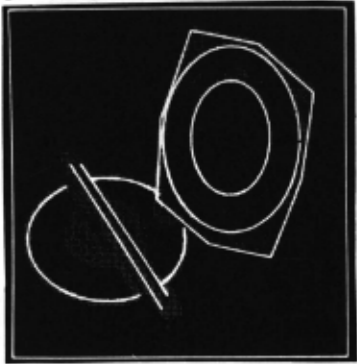
Fig.4 (b) shows another histogram of R, obtained for the second peak in Fig.3, in which we can observe three prominent peaks and a medium peak. Edge points contributing to the left peak are selected as qualified members for the smallest el lipse in C, and then the least mean squares method fits an ellipse to them, which corresponds to the inner ellipse on the cylindrical part at the right side in the input picture. Erasing the edge points on that ellipse from the set C of candidates, we again calculate a new his togram of R. The result (Fig.4(c)) im plies that the second peak in Fig.4 (b) is a false one, generated by the interac tion of the recovered ellipse with the other, because the peak disappears as a result of erasing the edge points contri buting to the adjacent peak. Since the left peak in the new histogram happens to be lower than the threshold function of lSR, we examine the right peak and detect the outer ellipse on the right part. If a lower threshold function-, say lOR, is used, then the left peak which corresponds to the elliptic arcs between the two el lipses is examined, but the peak is judged to be a false one because the edge points in E cover only a small fraction of el lipses evaluated by the least mean squares method. Finally, the linear segments, which are judged as parts of the recovered ellipses, are discarded from the list of lines, and we obtain the result displayed in Fig.S.
The procedure is programmed in FORTRAN, and the total computing time on a mini computer PDPB/E (12kw of core memory, 24kbytes of buffer memory, and 1.8Mw disk memory) is about 13 min 20 sec: 2 min 10
sec for calculating the gradients and storing them in the disk, 1 min 40 sec for detecting the linear segments, _and 9 min 30 sec for recovering the ellipses and evaluating their parameters. This computing time seems rather long; however, we pay more attention to the ratio of the time for recovering the ellipses to that for recovering the straight lines, since the computing time depends on the ability of the computer used. The ratio 6:1 for our example seems to be acceptable when we consider the complexity of the shapes of ellipses.
DISCUSSION
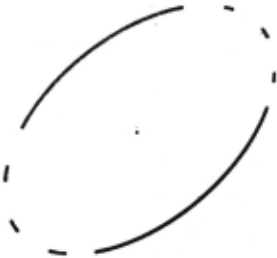
The proposed method seems to be satis factory for extracting the global features of the artificially constructed objects. Although it can detect some of partially hidden ellipses, such as the elliptic arcs on the object at the left side in Fig.S, there are many counterexamples. A partially obscured ellipse is not detect able if it contains a less number of edge points symmetrical to the center of the ellipse than the threshold for finding peaks in the two-dimensional array. Setting the threshold at a lower level is not effective, because it can add few el lipses to the result while much computing time is wasted by examining a large number of weak clusters in the array. An example of another class of undetected ellipses is shown in Fig.6. We can recover a clus ter corresponding to the center of the el lipse; however, the number of the edge points which have partners mapped together in the one-dimensional accumulator array is very small, so that the method mis- perceives the elliptic arcs as noise.
Another difficulty arises when we apply the method to a picture containing very large or highly concentric ellipses. Flat portions of the ellipses are erased
..
\ from the edge-enhanced picture before applying the ellipse-finding algorithm, because they satisfy the conditions for the long straight lines. However, the other parts of the ellipses are generally detected as sets of elliptic arcs, there fore we could improve the method by adding a function for finding straight lines which connect these elliptic arcs, and then fitting again an ellipse to the edge points on them.
Fig.6 An example of elliptic arcs con taining few pairs of edge points mapped in the histogram of R.
Finally, let us briefly study on the computation required for detecting el lipses using the approach of Duda and Hart, who have shown that the computation required for obtaining lines increases with the number of edge points in the pic ture [Duda 72]. Suppose that the en hanced picture E has n edge points after erasing the long straight lines from it. If we detect ellipses by searching the five-dimensional parameter space for clusters, then the computation required for mapping each edge element into the space is proportional to d 4 , where dis the number of quantization of a parameter. Thus, the computation required for de tecting ellipses is proportional to nd 4 .
The computing time of the proposed method is spent in searching the two para meter spaces and evaluating parameters of the ellipses. If the distribution of the directions of edges is uniform in [0° ,180°), then an edge list has n/d 8 elements, where d is the number of quantization of a. T~erefore, n2j2d~ pairs of each edge list are mapped in the two-dimensional array, and the total number of mapping parallel edge elements is n 2 /2d · In order to obtain edge elements c~ntributing to the prominent peaks, this mapping process is repeated again, thus time t for the center-finding process is approximately proportional to n2jd 8 · On the other hand, mapping into the one-dimenaional space and evaluating parameters is done on much smaller numbers of candidates than n; thus the ratio of the computing time t 2 of this process to t 1 will become very small for large n.
When we simply compare n 2 /d withnd 4 , superiority of the proposed met~od over the direct application of parametrization is apparent. However, pictures with many edge points requires too much computing time, so that we must make n as small as possible. One idea for decreasing n is to apply a thinning operator to the edge enhanced picture before mapping into the parameter spaces.
@inproceedings{ijcai1977p167,
  title     = {Detection of Elliptic and Linear Edges by Searching Two Parameter Spaces},
  author    = {Tsuji, Saburo and Matsumoto, Fumio},
  booktitle = {Proceedings of the Fifth International Joint Conference on
               Artificial Intelligence, {IJCAI-77}},
  publisher = {International Joint Conferences on Artificial Intelligence},
  editor    = {Raj Reddy},
  pages     = {700--704},
  year      = {1977},
  note      = {Vision},
  url       = {https://ijcai.org/proceedings/1977/167},
}
TY - CPAPER TI - Detection of Elliptic and Linear Edges by Searching Two Parameter Spaces AU - Tsuji, Saburo AU - Matsumoto, Fumio T2 - Proceedings of the Fifth International Joint Conference on Artificial Intelligence, IJCAI-77 PB - International Joint Conferences on Artificial Intelligence PY - 1977 SP - 700 EP - 704 UR - https://ijcai.org/proceedings/1977/167 ER -Copied
Machine-readable versions of this paper, for tools and AI agents:
 Welcome
 Future Conferences
 AI Journal Division
 IJCAI Proceedings
 About IJCAI
 IJCAI Awards