
Some Aspects Of Sensory Instrumentation For Robots And Manipulators
Proceedings of the Fourth International Joint Conference on Artificial Intelligence. Robots And Productivity Technology. Pages 771-773.
© 1975 International Joint Conferences on Artificial Intelligence
Abstract
Some concepts of the functional organimation of the sensory systems in men and animals are considered, that can serve as a basis for design of artificial sensory systems for robots. The paper describes a human tactile system, a device simulating the tactile function, algorithms for form recognition by sense of touch and the results of the experimrnts with such an artificial tactile system
- N.Wiener, J.B.Wiesner, E.E.David, L.Levine. Operation "Pelix". Quart. PrQgr. Repts, Cambridge, 1951.
- P. TOMOBJA. Pom. 8BTOM8TlA9CKOro ynpa:e- JieHHR B IIPOT~m!P~B.HHJI. Tpy,IP>~ ll KOHI'- pecc8 m>AR, BIDrnTI'I, M., I965. .3. Moxyoc'l':eeHH81I pyxa, lll_Q_~eY&JI JIOI'II- ~ecKBY yoTpoAcTBON. BKHHTH J 86544. llepe:eo.n cT. X.HHoya 11s ayp.B8Jla "ReA- ooxy TO ceftre", I968, T.7, J I2. 4. Control program ETL-robot 1 artifi- cial intelligent robot. Japan, Bl8ct- ron. Eng., No. 51.
- T.Goto, K.Takeyaau, T.lnoyama, R. Shimomura. Compact packing by robot with tactile sensors. Proc. 2nd • In:*ern. Symp. on Industrial Robots, May 16-18, 1972, IIIRI, Chicago, Ill., 149-159.
- S.~da, L.Cordella, N.Ivacevic. Visu- al-tactile symbiotic system for ste- reometric pattern recognition. 2nd Intern. Joint Cont. on J.rtificial Inttlligence, London, 1971, p~.365- .375lpyccKB! nepe:eg~ :e c6.: "MHTerpaJI»- HHe po6oTY". ~ "MHp", 1973, 297=-313).
- A.D.lliHeA.n;ep, B.t.!ypa:eJieB, E.M.Bo~ KKHIIITeAa, ll.H.KOJI9CHJIKOB8 • .ltaT1DIKH .D;aB- JieHJIH liS 3JI9KTponpOBO.D;HHX IIOJIHMepHUX M8TepHaJIOB. llpii60pH II CKCT9NH ynpa:e- JI9HKR, ~ 2, 19?2, 40-41.
- A.D.illHel~ep, E.M.KaaaeB, B.r.OcTanqyK. 0 B03MOmiOCTII npBNeHe.HJIUI OXeN, BHIIOJI- HeHHHX H8 O.D;HOTJIIIIHHX BH1DICJiliT9J.ll,HiiX 3JI9MeHT8X, .D;JIH U9Jieft paCIIOSH&88H11R I'I yiipaBJI9HBR IICIIOJIHJIT9~HHMJI N9X8HH3M8- NII. MaTepHaJIH IY KOH4J~me.HUJPJ no 611o- HBRe. M., 1973, T.6, ~7-!50.
- B.C.I'yt>Wmme~, A.D.IIIHeibtep, E.M.Ka- aae:e, E:B.I'ypqmome~. TarrBJil,HOe o~:ecTBJieBie UaHJIIIyJIXTopo:e. Hs:eecTBH AlfCCCP, cep. T~ecKaR RH6epHeTII- Ka, ~II.6, M., I974, 70-79. Table 1 Recognition of the local types Surface Answer Peak Peak 1~ Sphere Plane C7linder Edge Curvilinear edge Human finger Pig. 1 Sphere Plane 18~ 82% 84~ 16~ Trajecto~ of the
References were extracted automatically from the PDF and may contain errors.
Full text extracted automatically from the PDF; figures, tables and equations may differ. The PDF is the version of record.
1. Introduction
In design robot-like devices adap$ ~le to different envirouaents and per foraing different tasks we must first of all enable these devices to perceive the information on the external world; in other wirds such devices must posses· artificial sensory systems.
The results of sensory systems studies in man and animals allow us to lay down some general principles of or ganization and functioning for such sys tems. These principles can serve as a basis for development of hardware ana logs of natural aensory systems. !mong these principles the followings should be mentioned.
- The development of concepts about one's surraundings and one' a own state the system uses the information delivered simultaneously by different senses (hearing, vision, touch, etc.), interacting in perception and processing of this information.
- Combination of sensory and motor activity, or the ability of senaory sys tems to perform active search of neces sary information through appropriate mo tions (looking round, touching, etc.). The capacity of independent motion (eye movements, etc.).
- ). Multilevel organization of the sensory data proceasing which permits on the one hand, the lowest level detec tors to of recognize the elementary fea tures essential for the recognition of the object and, on the other hand, to discard the useless, nonessential infor mation.
4. A well-defined structural orga nization of the receptors-receptive fields.
J.ND IU.NIPULJ.TORS
V.S.Gurfinkel', A.Yu.Sbneider, B.V.Gurfinkel',
E.II.Kanaev, S.V.Pomin
Institute for !Dfo~ation Transmission Problema, USSR Academ7 of Sciencea
8-a Aviamotornqa st. , Moscow B-24, USSR
5. The variability within wide li mits, of the sensitivity thresholds with the task and the state of the en vironment (illumination level, noises,
etc.). There is no doubt that for human beings vision is the principal way for perception of the information about the external world. Hearing is essential too, especially in communication (speech recognition). Other sense organs inclut ingtouch, are generally considered to be less important. But .this is not quite true especially for touch. Perhaps of the importance of tactile information is under estimated. Because loss of sight or hearing occurs rather frequent ly, while complete loss of tactile per ception is a rare phenomenon and as a rule is accompanied by the loss of ac tor activity as well. In this situation the motor behavior is out of the ques tion. Because of this inseparability of motor and tactile functions we are inclined to consider the latter as some inherent property and therefore to un derestimate its importance.
But in reality, in many situations, especially in performing minute and very precise movements, such as screwing nuts, assemblage of llllall mechanisms, etc., the sense of touch is very import ant and cannot be substituted by vision. One .can carry out such tasks rather
easily even without any visual control.
The foregoing discussion makes it evident that design of manipulators capable of a wide range of functions re quires coordinated work of at least three subsystems motor, visual and tactile.
But as a first step it is necessa ry to work out some approximation of each of these subsystems separately. Since, on the one hand, the motor cont rol and perception of visual informa tion are much more advanced than design ing artificial tactile systems and, on the other hand, the latter is no lees important, we decided to concentrate our efferts first on the problems of artificial tactile sense and form re cognition by tactile perception.
artificial tactile systems is "sensebi-
The first objective in design ot.
lization" of the prothesis of extremiti es. As early as in the fourtiee N.A.Bern etein pointed out the importance of the eensibilization of lege prothesis. Later seneibilization of artificial wrist was suggested b¥ N.Wiener (1) and otterwarde by R.Tomovic (2). These projects had were of theiretical rather than practi cal importance. It was only with design and improvement of manipulators that the artificial tactile systems became a prac tical proposition.
There are now a number of devices for tactile recognition of the form. These devices fall quite naturally in two groups, devices for the recognition of the shape in the course ot a single grasping of the object by manipulator or an artificial wrist, and devices tor active tenacious probing of the object by the sensitive element moving along its surface.
The first group includes the pro jects accomplished at the Tok.Jo Univer sity (3), Waeeda University (4), Hitachi Co {5) and some others. Transducers of the "on-off" type were used in all these projects. The experiments show that even with a very limited act of objects (two types only, bars and cylinders) the rate of recognition is not high, and even a slight change in the size of the objects can affect the results very strongly.
Active feeling of the surface was realized by S.Aida and others (6). An artificial finger with four sensory ele ments of the "on-oft" type can move along the surface that is being explored. In the case of the lose of the contact with the surface a special algorithm of search starts.
By changing the coordinates and orientation of the finger one can ob tain the information on the shape of the object. The authors of the project de velop this system as a part of a symbio tic tactile-visual recognizing system with the visual part playing the majn role. This tactile system per se does not seem to be very effective, because it performs only random probing of the surface instead of purposeful search of its most informative elements.
2. Primifi Transducers and Orsanlz~on of the Receptive Pield
An effective system incorporating the general principles considered above should, in our opinion, be corrobo·ated by study of published data, and (1) in corporate transducers which can detect the amount of pressure (i.e. of "propor tional" type) which are much more in formative than the "on-off" type; (2) ensure the functional interaction of the transducers, or provide an artificial recepti~e field. Thus we can, as it will be shown later, organize purpose-ful rather than random search of the infor mative elements of the surface.
It is well-known from differential geometry that the local description of the surface element can be given in terms of its curvature in different directions, passing through the given point by find ing the so-called principal curvatures. The algorithms, described below,· are ap proximative implementation of this mathe matical method.
For the calculation of the curva ture of surface in a given direction it is necessary to have the data at least from three points belonging to this di rection. i system of 9 transdurers, or ganized in a 3 x 3 - matrix estimates the local curvature of the surface in four directions simultaneously. Having this in mind we chose a 3 x 3 matrix con sisting of proportional pressure trans ducers to serve as an elementary recep tive field. A special conductive polymer was used as a sensitive element (7).
3. Recognition of Primary Features ot Surfue Elements
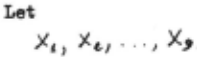
be the data from the transducers of the tactile matrix, applied in a point to the surface in normal direction. Let us introduce the quantities

i · 1' 2' 3' 4.
Let us consider the quantities
These quantities are second differences, or discrete analogs which represents the surface. Therefore they specify the cur vat'ure of the surface in four directions. Note that the change of the intensity of pressing the receptive matrix to the sur face change the values of X, · .Proportion ally, so the relatione among ~- do not depend on the grasping effort in the ar· ficial wrist or manipulator.

where ~~~1 i 1 s the value of $;,- in the direction, ortogonal to the direction in which ~~ ,,. is obtain··· We may consider these va~uee as an approximative analog of principal curvatures of the surface in a given point.
Let us refer to the element of the surface as directed if f .... ,"' differs es sentialy from ~.-.t' . The examples of the directed surfaces are a cylinder, cone, edge, etc. A plane as sphere, etc. are nondirected surfaces. Therefore the value of the ditference ~.tt - ~·,..."' give us the first dichotomy for the sur faces: directed and nondirected surface·. For the directed surfaces, when ~ ...... de termines the direction we can tell cylin ders from edges using the value of ~ ·· t and we can tell an edge from a curv1ll. near edge using ~ ,..;., · In the class of nondirected surfaces we distinguish a plane, sphere and peak.(zertex} by the mean curvature, i, e .l.~ ~ · .
Practically the\xperiments with recognition were staged only for the con vex surfaces, But, if we pay a~tention not to the absolute values of ~, alone but to their signs too, we can classify concave and saddle-like surfaces in the same process. The procedure described above is easily programable, But it was of some interest to realise this algo rithm (to increase of the speed od res ponse) by a special analog preprocessor, Such a device has been manufactured and tested (8). But the accuracy of the de finition of the local types of surfaces was not high in this case, For instance, for the cylinder and sphere it was mere ly 35-50%, This result was partly due to the tactile matrix, which was not pre cise enough, but mostly to the low cal culation accuracy. Nevertheless we think that the principle of preprocessor detec tion of the primary features of the sur face elements in the process of tactile recognition deserves detailed investiga
tion, Computer taplementation of the same algorithm gaTe a much higher accuracy. The results of the experiments with classification of the surface using a LOCAL program, for the "Minsk-22" com puter are presented in Table 1. The ave rage error for the 6 elements, present ed in this Table is about 12%, This ac curacy depends mainly on the accuracy of the tactile matrix. Using more pre cise sensitiTe elements can improve the reliability of the recognition up to 95-100%,
t· Shape Recognition by Simul aneous Grasp
Experiments with classification of objects with simultaneous grasp by a two-finger mui.pulator with two tactile matrices of the type described above were staged, Five types of objects of different size were used: cubes, sphe res, cylinders, cones and pyramids (9), The orientation of the objects was ar bitrary,
Fora recognition was carried out by a system of three units, Two of these processed the information from two tac tile matrixes with the "U>CAL" program and th4! third one compared the output signals of these two and classified the objects, A list of all possible objects and their features were introduced in the computer memory beforehand, Experi ments with this program which was called the srstem of passive tactile recogni tion (SPTR) has demonstrated that this system is sufficient for the classifi cation of simple basically different ob jects, But for the recognition of comp lex objects this system does not work, To obtain more acurate results one needs either more tactile matrices (receptiTe fields) to grasp the object or an addi tional algorithm for actiTe search of lacking data (or successive probing of the object),
~· ~ Recognition by Active ouc tiona
The algorithm of the recognition operates in several steps. A list of the objects to be classified and their local teatures must be introduced in the computer memory beforehand, After the contact of the tactile matrix with the surface of the objects to be recog nized, the "LOCAL" program dete:rmines the local type of the surface element, The processing of these data leads to a Q7pothesis on a possible shape of the object; the feature is determined in terms of which the Q7pothesis should first of all be tested and an instruc tion is generated which dictates the mo tion of the tactile matrix! looks like MOVE IN DIRECTION and is d splayed, Because the interaction of the manipula tor with the tactile system was not com pletely tasted, the tactile matrix was moved by the experimenter rather than by the manipulator, The tactics of suc cessive touching the surface .elements was developed on the .lcnowledge of human way of solving the problem of determin ing the shape by moving with one finger along the surface of the object,
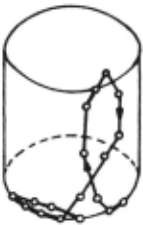
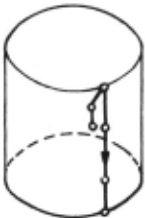
The above program referred to as a system of active tactile recognition (SATR) was experimentally tested on a limited number of objects such as a sphere, cube, cone cylinder, pyramid of widely different sizes (e,g, cylinder sizes ranged from 15 through 120 mm). The recognition accuracy ranged from 90 through 100%, SATR has confirmed the utility of this tactics whereby charac teristic features are actively sought instead of probing the entire surface, Fig. 1 shows the finger path in probing a cylinder and Fig, 2 the computer-gene rated path,
Conclusion
The experiments carried out in our laboratory show that even with a rather primitive equipment it is possible to make a satisfactory working system of artificial tactile sensing for manipu lators, We think that following basic principles may be useful,
1, Using proportional transducers which are more informative than the "on off" type,
2, Organisation of a group of trans dusers in a unified sensory system of the tactile matrix,
J, Organization of the process of active search of the most infor.mative surface elements,
Further sophistication of the sys tem must include the improvement of the tactile matrix, complete automation of of the process of active touch moveaente, experiments with more diverse objecte.
It is ve~ likely that further re searches of the interaction of a aanipu lator tactile system with a motor system and with artificial vision will give rise to new problema in development of artificial tactile systems.
Referencee
- N.Wiener, J.B.Wiesner, E.E.David, L.Levine. Operation "Pelix". Quart. PrQgr. Repts, Cambridge, 1951.
- P. TOMOBJA. Pom. 8BTOM8TlA9CKOro ynpa:e JieHHR B IIPOT~m!P~B.HHJI. Tpy,IP>~ ll KOHI' pecc8 m>AR, BIDrnTI'I, M., I965.
- .3. Moxyoc'l':eeHH81I pyxa, lll_Q_~eY&JI JIOI'II ~ecKBY yoTpoAcTBON. BKHHTH J 86544. llepe:eo.n cT. X.HHoya 11s ayp.B8Jla "ReA ooxy TO ceftre", I968, T.7, J I2.
- Control program ETL-robot 1 artifi cial intelligent robot. Japan, Bl8ct ron. Eng., No. 51.
- T.Goto, K.Takeyaau, T.lnoyama, R. Shimomura. Compact packing by robot with tactile sensors. Proc. 2nd · In:*ern. Symp. on Industrial Robots, May 16-18, 1972, IIIRI, Chicago, Ill., 149-159.
- S.~da, L.Cordella, N.Ivacevic. Visu al-tactile symbiotic system for ste reometric pattern recognition. 2nd Intern. Joint Cont. on J.rtificial Inttlligence, London, 1971, p~.365.375lpyccKB! nepe:eg~ :e c6.: "MHTerpaJI» HHe po6oTY". ~ "MHp", 1973, 297=-313).
- A.D.lliHeA.n;ep, B.t.!ypa:eJieB, E.M.Bo~ KKHIIITeAa, ll.H.KOJI9CHJIKOB8 · .ltaT1DIKH .D;aB JieHJIH liS 3JI9KTponpOBO.D;HHX IIOJIHMepHUX M8TepHaJIOB. llpii60pH II CKCT9NH ynpa:e JI9HKR, ~ 2, 19?2, 40-41.
- A.D.illHel~ep, E.M.KaaaeB, B.r.OcTanqyK. 0 B03MOmiOCTII npBNeHe.HJIUI OXeN, BHIIOJI HeHHHX H8 O.D;HOTJIIIIHHX BH1DICJiliT9J.ll,HiiX 3JI9MeHT8X, .D;JIH U9Jieft paCIIOSH&88H11R I'I yiipaBJI9HBR IICIIOJIHJIT9~HHMJI N9X8HH3M8NII. MaTepHaJIH IY KOH4J~me.HUJPJ no 611o HBRe. M., 1973, T.6, ~7-!50.
- B.C.I'yt>Wmme~, A.D.IIIHeibtep, E.M.Ka aae:e, E:B.I'ypqmome~. TarrBJil,HOe o~:ecTBJieBie UaHJIIIyJIXTopo:e. Hs:eecTBH AlfCCCP, cep. T~ecKaR RH6epHeTII Ka, ~II.6, M., I974, 70-79.
Table 1
Recognition of the local types of the surfaces
| Answer | Surface | Peak Sphere | Plane | C7linder | Edge | Curvilinear edge |
|---|---|---|---|---|---|---|
| Peak | 1~ | 18~ | ||||
| Sphere | 82% | 2~ | ||||
| Plane | 84~ | 6~ | 2~ | |||
| C7linder | 16~ | 88~ | 12~ | |||
| Edge | 4% | 80% | 8~ | |||
| Curvilinear edge | 6% | 92% |
Trajecto~ of the sensor's aotion
Tactile matrix Pig. 2
@inproceedings{ijcai1975p122,
  title     = {Some Aspects Of Sensory Instrumentation For Robots And Manipulators},
  author    = {Gurfinkel, V. S. and Shneider, A. Yu. and Gurfinkel, E. and Kanaov, E. and Fomin, S.},
  booktitle = {Proceedings of the Fourth International Joint Conference on
               Artificial Intelligence, {IJCAI-75}},
  publisher = {International Joint Conferences on Artificial Intelligence},
  editor    = {Patrick Winston and Carl Hewitt},
  pages     = {771--773},
  year      = {1975},
  note      = {Robots And Productivity Technology},
  url       = {https://ijcai.org/proceedings/1975/122},
}
TY - CPAPER TI - Some Aspects Of Sensory Instrumentation For Robots And Manipulators AU - Gurfinkel, V. S. AU - Shneider, A. Yu. AU - Gurfinkel, E. AU - Kanaov, E. AU - Fomin, S. T2 - Proceedings of the Fourth International Joint Conference on Artificial Intelligence, IJCAI-75 PB - International Joint Conferences on Artificial Intelligence PY - 1975 SP - 771 EP - 773 UR - https://ijcai.org/proceedings/1975/122 ER -Copied
Machine-readable versions of this paper, for tools and AI agents:





