
Reduction of Enumeration in Grammar Acquisition
Proceedings of the Second International Joint Conference on Artificial Intelligence. Pages 546-551.
© 1971 International Joint Conferences on Artificial Intelligence
Abstract
The learner of a language is able to acquire a grammar on the basis of finite linguistic data, within stringent constraints of time and memory. The learner selects one out of the infinitely many grammars which are compatible with the data. The require ment of feasibility implies a reduction in the number of hypotheses which are compatible with the data, so that the learner can quickly select the best grammar (based on some evaluation measure) out of the hypotheses. Our grammar acquisition model applies to a non trivial subset of context-free grammars, for which the enumeration of potential hypotheses is greatly reduced to a point where a computer program for grammar acquisition becomes feasible. The availability of structure descriptions in the data not only contributes to a reduction of enumeration, but also results in a grammar which is "strongly adequate". As the sample is enlarged and tends to the source language, the grammar acquisition identifies the source grammar in the limit.
- discussion of ~he problem. Many ~hanks are due ~o ~he reviewers of ~he manu- scrip~ for ~heir many cri~icisms and su~ ges~ions.
- REFERENCES (1) CHOMSKY, N., "Aspec~s of ~he theory of syn~ax", MIT Press, Cambridge, Mass., 1964.
- FELDMAN, J.A., "Some decidabilhy re sul~s on gramma~ical inference and complexi~y", AI MEMO n. 89, S~anford Universi~y, S~anford, 1969.
- 3} BIERMANN, A.W. and FELDMAN,J.A., "A . survey of resul~s in gramma~ical in- ference", Proc. In~. Conf. on Fron- ~iers in ;a~~ern recogni~ion, Hono- lulu, Jan. 18-20,1971.
- BAR-HILLEL, Y., "Language and infor- ma~ion", Addison-Wesley, Reading, Mass., 1964.
- CRESPI-REGHIZZI, S., "The mechanical acquisi~ion of precedence grammars", Thesis, Universi~y of California, School of Engineering, Los Angeles, 1970.
- 6} CRESPI-REGHIZZI, S., "An effec~ive model for grammar inference", Proc. IFIP Congress, Ljubljana, 1971-.---- (7)
- GOLD, M., "Language iden~ifica~ion in ~he limi~", Infer. and con~rol, 10, 447-474, 1957. Session No. 13 Computer Understanding n (Representation)
References were extracted automatically from the PDF and may contain errors.
Full text extracted automatically from the PDF; figures, tables and equations may differ. The PDF is the version of record.
1. INTRODUCTION
An acquisition theory for language must contain according to Chorr.sky (1):
(i) an enumeration of the class {y.}of possible sentences; 1
(ii) an enumeration of the class {s.}of
a way of evaluating and selecting possible alternative grammars.
possible structural descriptions; 1 (iii) an enumeration of the class {G. }of possible grammars; J (iv) specification of a function (i,j)·f wh ich specifies the structure sf assi gned by any grammar G. to any sentences y.; ] (~)
A model for language acquisition at tempts to model language learning, or mo re precisely the learning of linguistic "competence". In a very abstract version, the model is an algorithm which works on certain primary linguistic data, and pro duces a grammar.
This paper presents a model for langua ge acquisition which operates on the fol~ lowing primary data:
a) a finite sample of sentences, and
b) their structural descriptions;
c) non-sentences identified as such.
We note that the availability of struc ture (item b)) differentiates this model from other current studies on the acquisi tion of grammar (2) (3). -
The knowledge of structure, prior to
- Work supported by Consiglio Nazionale delle Ricerche .
- ·· The first part of this study was done in the Dept.of Computer Science, Uni versity of California, Los Angeles.
the acquisition of a grammar, ca n be de fended on three grounds. First a child learning a language has stress and intona tion information available to him and - this could be interpreted as a ty;e of structural information. Second, if our grammars describe the base component(deep structure) of a language, then there is an intimate relation between structure and meaning, the structure being a prere quisite for understanding a sentence. The widespread belief the there must be a par tially semantic basis for the acquisition of syntax then implies the availability of some structural information to t b e learner of the language. Third availa bility of structure greatly red~ces the number of alternative possible grammars . . . and 1nsures that the acqu1red grammar ge nerates sentences wit h structures consi~ stent with their meanings.
Given the data, a model could consider the enumeration (iii) of attainable gram mars, and test their compatibility with the data a), b) and c). The test is possi ble because of (iv). -
The model then selects one of the com patible grammars by means of the evalua tion measure (v). A more accurate model should also explain the gradual develop ment of an appropriate hypothesis, and the continual accretion of linguistic com petence, rather than just considering the idealized instantaneous moment of acquisi tion of the correct grammar. -
~e note with Chomsky that different e valuation measures will assign different ranks to alternative hypotheses regarding the language of which the primary data are a sample. Hence choice of an evalua tion measure for grammars amounts to de ciding which generalizations about lan guage are significant.
The class of possible hypotheses must be limited, if a realistic theory of syn tax acquisition is to be developed. How~ ever, the limitation must still yield a class of grammars that is adequate in strong (and a fortiori weak) generative capacity. But beyond this, the require ment of feasibility is the major con straint of the model.
I shall have very few words to add to Chomsky's formulation of the problem, mainly for carrying further the formali zation. My concern was for (1) delimiting a class of grammars which proved adequate in strong generative capacity, and defin ing a strategy for (2) reduction of pos~ sible hypotheses, and for (3) selecting a unique grammar. There is some similari ty between the grammars that we are going to describe, and Bar-Hillel's (4) catego rial gr ammars. -
A model similar to the one that we s hall describe - although of reduced sco pe - proved its feasibilit y on the compu ter (5)(6). -
Following Gold (7), Feldman (2), Cre spi -Reghizz i (5)(6) and Biermann (3),con sider a context-free source rammar GS - and a source language LS = L(GS . _
The parenthesis grammar G I is de rived from G = (VN,VT,P,S) by reptacement of every productio~ A·u, u in V - V~ , wne re , V = VN U VT ' wlth the parenthes1zed product ion A -+[u] , where "[" and "]' are not in ~T · ~~ote t hat "renaming produc tions" 1.e. productions such as A·B ,where B is a nonterminal , are not parenthesized.
!:.!.~m p 1 e
Gl: S·P.S IHa
H·bP.Ia
[Gl] : S·~)s] I [Ha]
1!-+[bH] [a J A structura l information sequence ISof language ~S is the ordered set:
IS= f s 1 ,s, ... ) where so is in L([Gs]>, and every ~ent ence of the Iatter language occurs sooner or later, perhaps with rep~ titian , in L .
~e note t~at IS provides items a) and t) of the primary ddta. The information sequence could start wit h the strings: Il = i [ [a] a],[ [b[b[aJ J J a] ,
[ [a= [a] [ [a] a J J J ,
.. lterna tively, we shall write [[a]a] as a a .
Si;:;ilarly , we introd 'JCe a roegati ve in fcr':1at ion se quence :rs de fined as an enume raci er. of all the non-sentences:
Ns ={ nl,n2, ... } v P = v Tu { [. ]l 0 where n is in v· L i p - s.
A positive sample St ={s 1 ,s 2 , ··. ,st}
and a negative sample M = { n ,n , ... ,n } compose the primary datA avaitabfe to the model at the discrete time t. At each time t we are interested in ouserving the gram mar G which is output by the grammar ac~ quisition device to account for the sam ple S and M · G must meet two require mentstfor co~patibility with the data: 1) L( [Gtj);?St 2) L([Gt)nMt =~
If the model has to account for the in creasing linguistic skill of the learner we have to cons~der t~e g~ammars Gtl'Gt 2 ' ... , at success1ve tlme 1nstants
t 1 ,t 2 , ... corresponding to samples
Stl , St 2 · ·.,. We shall expect the gues ses of the algorithm to become closer to the source language, as the sample is en larged.
The model is said to identify the sour ce grammar G 5 in the limit if there is a time t' such that for t >t 1 , a nd for any information sequences IS , NS : 3) G : G t t' 4) L([Gt]) = L([G 5 J>.
In other words, identification in the limit implies that there are primary data S , M , t>t', which cause the model to se l~ct ~ grammar which is not later changed and is strongly equivalent to the source grammar. This must be true for any infor mation sequences for that source grammar.
Two results, due to Gold (7), should be me ntioned.
Theorem 1 - Let C be a class of decidable grammaxos (i.e. grammars for which it is decidable whether a string is generat ed by the grammar). Then, if GS is in C there is an algorit hm which identi fies G in the limit.
Theore~ 2 - Let C be a class of gr ammars which generate all the finite languages and any one infinite language. Assume the primary data consist only of a positive informati on sequence. Then, if Gs is in C there exists no algorithm for t~e class C which is able to identify GS in the limit.
As a special case of 7heorem 1, context free languages are identifiable in t he li mit, if sentences and non-sentences (iden tified as such) are given. If the latter are not available, Theorem 2 implies that not even finite state languages can be identified in the limit.
~e note that the proof of the first theorem is based on the fact that gramma~ are enumerable, and on t he possibility of testing 1) and 2) f o r a dec i dabl e gr~mmar. Such a proof does not lend itself to a feasi=le grammar acqu isi tion method for context-free grammars, because of the astronomical number of grammars to be te sted.
2. A CHARACTERIZATION OF POSSIBLE GRAM HARS
In a previous work (5)(6) we have in troduced a subclass of context-free gram mars, termed free operator precedence - grammars, for which identification in the limit is possible when only positive in formation is available . In this sequel we discuss an extension of these concepts,to include more ~eneral classes of language~
We shall first define a fa~ily of clas ses of gram~ars(k-distinct grammars)which cover the entire spectrum of context-free languages.
When a further restriction on the form of productions is imposed we obtain the family of k-distinct and k-homogeneous grammars, whose strong generative capaci ty does not cover the full spectrum of - context-free languages,although our new grammars are able to account for self-em bedding, nesting and other features re- quired for natural languages.
For each class of grammars in the fami ly,identification in the limit - without knowledge of non-sentences - is theoreti cally possible and practically feasible~
We now introduce some new definitions. Let G = (VN,VI,P,S) be a context-free grammar, and et Vp = VTU {[,]}.
Define the left prof~le of order k of a string x in v+ as:
y in v ; , $ is not in V p}
Similarly, the right profile of order k of a string x is:
: VU, X
in
Example :
For the previous Gl we have
| X | L 1 (x) | L 2 (x) R 1 (x) | R 2 (x) |
|---|---|---|---|
| HS [ | [a,[b | J | a],]] |
| Ha [ | [b,[a | a | y |
| bH b | b[ | J | a],] J |
| a I a | a~ | a | $a |
The k-profile of a nonterminal A is de fined as:
8) Pk(A) : (~ Lk(xi) union is performed for A~xi in the production ~ Rk(xi)),where the every production set.
A gramnar is k-distinct iff, for any two nonterminals A, P: Pk(A) = Pk(E) implies A = B.
Example:
Gl is 1-distinct since :
It is obvious that if a grammar is k distinct, it is also m-distinct, for an y m> k.
Let G ~ (VN,VT,P,&), and suppose that for A, B 1n VN:
Vp }: T 2 · In this case we say that G has no dupl~cated product ions. It would be easy to prove that every c.f. grammar has a strongly equivalent grammar with no du plicated productions and we can restrict our attention to non duplicated grammars without loss of generality.
Next we prove that any context-free grammar with no duplicated productions is k-distinct for some k>O.
Theorem 3 - G is k-distinct for some k>O.
Proof - Let u be the shortest string whic h is in TA but not in TB' and let j = u +1. Then uf is in L.(x.), for sor.:e A-+x. in p; Since u$ is notJin~ L.(y.) for any ~ther production B-+y., it f6116ws that P.(A) r P.(B). In the §arne way determine J j for arty pair A, B in VN, and let k be the lara est of the inteJers thus determined. Then G is k-distinct .
Non-terminals of a k-distinct grammar are uniquely characterized by their k-pro files, which can be used as standard na- ~ for nonterminal characters.
Example:
Gl is 1-di~tinct and can be rewritten as follows· :
- For the sake of readibility Pk(A) as < ... ; ... > we write
I ~ is obv i ous ~ h a~ ~he se~ of non~ermi na l names f or an y k-dis~inc~ grammar of f ini ~e ~erm i n al vocabulary is fini~e. I~ follows ~ha~
Th eo rem 4 - The class of k-dis~inc~ grammars wi~h s~andard non~ermi na l names and wi~h righ~ par~s of bounded l e ng~h, over a fi n i~e ~erminal alphabe~ VT' i s f in i~e .
Proof - f o r a ny produc~ i on A· x we have --- lxl ~n, for some n> O. Bu~ ~here a r e f i ni~e ly man y stri n~ s of lenf,t h n~l over ~h e f i n i ~e se~ VPU 1 se~ of non"termi na !s o f a k- d istinct era ~nar }
3. f... GRA:.l :iAR ACQw i SI 7I :):; ALGOREE:!
7~e algorithm t o ~e ~e scr i ~e d is able to id e n ~if y in ~he l i mi t a subclass of k di s ~in c~ grammars, whi c h we will define a f ~ er p resen~ i ng ~he a l gori~hm.
Con sid er a sampleS of L 5 , and le"t s=a 1 a 2 ... a n be a s~rlng of St. Enclose s b e ~ wee n special delimi "ters a = J. and a 1 = ~ . Th e algori~hm is soge how simi l~ t- t o a s yn ~ax analyzer, and makes use of a pu s hdow n s~ack where all scanned sym bol s are copi ed and renamed Q 0 1 ... Q. ~ Provision s f o r d e~ec~ i ng erro?s ln ~he 1 s t ri ~g s ( e. ~ . non-balancing bracke"ts)ceuld be easily added.
Cc~m e n ~ a l gori~ h m for ~he cons~ruc~ion of a--k - d is t inc~ grammar from a s"tring s;
Q 0 : = a 0 ; i := 0 ; h : = 1 ;
Ll: if a h ;. ".1." ~ h e n
begin i : = : = i ~ 1
if Qi = "]' ~
L2:begin j : = j - 1;
i f Q j
;. " [" ~ h e n .i::. .!2. L 2 ;
Qj : = pk ( Q j~l · ... 0 i-l) ;
C rea~e ~ h e produ c~i o n "<pk( Q j~l···
·· Q. 1) > · Q. 1" ·· Q. 1";
i
l- J ~
: = j ~ ~ o Ll
end e l se ~ ~o Ll ;
l -
end
c ~ e a t e t he produc~ion 'S·Qi';
It is bes~ seen f rom an example ~ha~ t he gr a mmar G. co n stru c ~ed by ~he algori t hm from ~ h e §~rings. is comp a~ible wi~h s 1 . , i. e., s . is in Ltrc .J>. l ~ l Lxa.npl. e
Applying t he algorit hm ~o s 1 =!a, we de riv e t he 1- d istinc~ grammar G 1 :---
In te rm e d ia~e
s t e ps
[[a] a]
L <a ; a>. a]
s
<a a> ... a a>
<a a>a
s
<[
a>
or in a more readable form
In order ~o comple~e ~he grammar ac quisi~ion process, ~he algori~hm is ~hen applied ~o ~he sen~ences s 1 ,s 2 , ··· ,s of ~he sample 5 , yielding ~he grammars~� 1 , G 2 , ··· ,�~. :r~x~ ~he union is performed :
. : : o~e ~ha~ ~he grammars G 1 , G 2 , ··· , � ~ have non-disjoin~ nont erminal vocabula ries.
Consider t h e sample 5 3 ={ ! a, b b !~ ! ! ! a} from ~he grammar c 1 .
Carrying on ~he example, from t h e se cond sen~ence 5 2 = b baa we derive c 2 :
G 2 : <a a>· a
<b J >·b<a ; a>
<b J >·b<b ;]>
<[ a>·<b ;]> a
ve G3 :
5 . <[ ; a>
and, finally, from = ! !
G .
3 .
<a a> · a
<[; a>· <a ; a>a
<[;]>·<a ; a><[; a >
<[;]-<a ; a><[;]>
5 . <[;]>
A · a
c
bA
c · bC
B · Ca
5 B
! a we deri
A . a
B A a
D AB
D AD
5 D
The union G I = G 1 U 3 G2 U G3 is :
G I
3
A
B ·
c
D
5
a
Aal ca
bAibC
AB IAD
B I D
Examining G) we see ~hat � ~ is c om~ati ble wi~h 5 3 , bu~ that L<Cc 3 ] ) c: L(LGl]> since for ins~ance b ! ! ! a i s not ge-
nerated by G)· Consider i ng now a larger sample
5 5 = 5 3 vf~ ~, ve ~he grammar c5 as b a a a} , we deri-----
Gl 5
A ·
B
c
D
5
a
Aalca
bA i bC
AfiiADics lc D
BID
This grammar is s~ronel y equi valen~ ~o Gl,
53
and ~he grammar acquisi~ion procedure is 1:hus comple't:ed.
Any grammar produced by 'the preceding algori't:hm is k-dis~inc't:, and, in addi1:ion has 1:he following proper't:ies:
(1) There are no renaming rules, excep't: for s~A, A in VN;
(2) for any 't:WO al~erna~ives A~x, A~y,whe reA is in VN- S, pk(x) = pk(y). -
Defini't:ion : a grammar having proper~ies (1) and (2) is called k - homogeneous .
Consequen't:ly, ~he hypo~heses space for 'this grammar acquisi~ion model consis't:s of 1:he class of k-dis~inc~ and k-homogeneous grammars ( shor't:ened 't:o k-d. h.). We already know from Theorem 3 't:ha~ any c.f. grammar has a s1:rongly equivalen't: k-dis't:inc't: form.
I't: would be easy to prove 'that any con 't:ext-free grammar admi1:s a k-homogeneous s't:rongly equivalen't: form. Wha't: is more re levan't: 1:0 our discussion is ~ha~ 'there are con't:ex"t:-free grammars which do no't: admit a s't:rongly equivalent k-d.h. grammar, i.e. a grammar 1:hat is simultaneously k-distinc't: and k-homogeneous. An example is provided by 1:he grammar G2
.:;2
S Ha
H ~ Sa I a
which genera1:es these~ {a 2 n l n = 1,2, .·. } wi't:h a leftlinear structure. G2 is 1-dis't:inc't: but no't: !-homogeneous, because p 1 ( Sa ) = ( { [ } ; {a } ) "I p 1 (a ) = ( {a } ; {a } ). Any a't:temp~ 1:0 render G2 !-homogeneous (by split't:ing H~sa l a into H ~sa, H ~a) will alter 1:he profiles in such ~ way 't:~at 'the new grammar is no longer 1-dis't:inct. The same can be shwon 1:0 be 'true for any order k of profiles.
On 1:he other hand we notice tha't: 'the sa me language is generated wi1:h a differen't: struc't:ure by 1: he 1-d. ~ . grammar G3 :
G3 :
S ~ aHiaK
H ~ a
K Sa
We do no't: know how 1:0 charac't:erize in general the languages wh ich cannot be str~ gly genera't:ed by k-d.h. grammars. from pre li~inary observations i't: seems 'that 'these languages are not 1:00 relevant to na't:ural (or programming)languages, as is 1:he case with {a2nln = 1,2, ... } , and tha't: res1:ric 1:ion of the hypothesis space 1:0 the class of k-d.h. languages is hopefully no't: 1:00 severe. An accurate examina1:ion of 1:his crucial point is the main targe't: of our f~ 't:Ure investigations.
Assume now that the so~rce language LS admits a k-d.h. grammar Gs. If 'the order k of the source grammar is known , 1:he algo rith~ will selec't: at any instant 't: jus't: one grammar out of 'the k-d.h. gram~ars which are compatible wiTh S . The selec1:ion of The grammar is perfor~ed by 1:he algori't:hm wi1:h a criterion which leads TO identifi ca't:ion in The limiT from a positive sam ple. The selected grammar generates The smalles't: language among the k-d.h. gram mars which are compa1:ible with 't:he sample.
Lemma 4 - LeT G :G(S )be 1:he k-d.h.gramm~ derived Ey 't:h~ algori't:hm from 'the sample S .Then There is no o't:her k-d.h. grammar 't: G' such Tha't:: S L([G ']l L([GT]l.
Proof : The productions of G are clearly ------ necessary for any k-d.h. grammar in order TO generaTe S · Therefore G' may differ from G only byTsome additional produc't:ions, 4nd iT follows 'that L([G'JP 2 L([G ]l.
Our ~ain result can now he proved.
Theorem 5 - LeT ST be a sample from a posi't:ive informa1:ion sequence Is, where L 5 is generated by a k-d.h . gra~ mar G . Le't: G be The k-d. h. grammar con STruc~ed by Tte algorithm from S . Then . T

thaT is the algoriThm identifies G 5 in 1:he limit ·
Proof LeT n be an upper bound on The leng't:h of any produc1:ion in G 5 · from 't:he facTs That 1) the class of k-d. h. grammars with productions of bounded length has finite cardinali't:y, and 2) G generates 1:he smallest language among t~e grammars of the previous class which are compatible wi't:h S , i't: follows that there is a Time 1:' and A sampleS' w~ic h causes 'the algorithm To derive a 't: gra~mar wh ic h is not later changed and is strongly equi valenT TO G · -
We noTe ~hat we are able to identify a language in The limit without knowled g e of a nega1:ive informaTion sequence. The paradox, with respecT ~o Gold's Theorem 2, comes from The fact that The class of k-d.h. grammars wiTh produc't:ions of bound ed length does noT generate all fi n ite - languages. --
We now discuss the case that the source language is k-d.h., but The order k is un known. In 1:his case we make use of nons en Tences, provided by a negative sample M ~ in order 1:0 discard the r,rammars produc~ d by the previous algorithm which are not compatible wiTh The nega1:ive sample. The algoriThm is The followinP-:
comment acquisiTion of a k-d.h. grammar for a source language of order k unknown. A posiTive sample S and a ne gaTive sample M are given; t L: k := 1 ; t
G : = k-d. h. grammar derived from S by pr~ vlous algorithm; ~
if L ( [ G ]l n M "i ~ Then t T
begin
k : = k + 1;
~ to L;
end;
In this case identification in the li mit is still possible but a negative in formation Ns is needed in order to deter mine the value of k which a priori is un known.
Example
The source language is defined by the grammar G4 :
It can be computed that L4 is a 2-d.h. language. Consider the positive sample 5 4 :
{a b
!!!!:::::!!!-. =.....- m - = a
=- a a b , a a b , a a a a b}
Assume k = 1, and derive a 1-d.h. gra~ mar from the four sentences of s 4 :
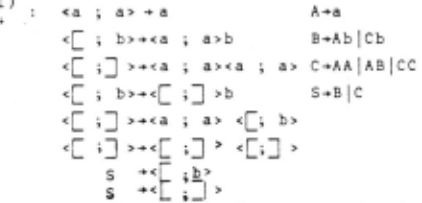
Suppose now ~ha~ a negative sample is gl ven : Ml = {~ ~} = {nl}
S . . . L ( [G ( ~ ) ]l , h . . 1 . 1nce n 1 1s 1n ~ t 1s 1mp 1es t hat a 1-d.h. hypothesis is not adequate. In other words �(~) . , which defines the smallest language in the 1-d.h. class, over-generalizes the sample s 4 .
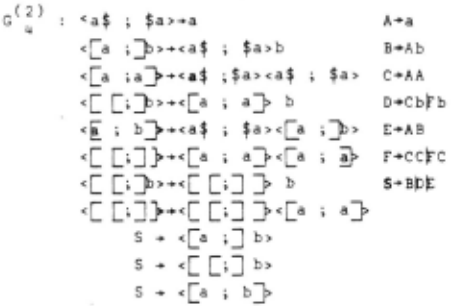
Consequently, we consider the 2-d.h. grammar derived from 5 4 :
It can be verif~yd that n 1 = !_! is not generated by G ~ , which can be assumed as the current hypothesis. Actually, iden tification of G4 is not yet complete. If the positive sample were enlarged, the al gorithm would eventually derive a 2-d.h. grammar which is strongly equivalent to G4.
The last case to be discussed occurs when there is no integer k such that Gs is k-d.h.Then any attempt of identifying G 5 by means of our algorithm will fail.The current hypothesis of order k derived by the algorithm from any positive sample can always be falsified by 1uitable enlar gement of the negative sample against - which the grammar is tested.
3. CONCLUSION
If we compare our results with Chomsky's formulation of the problem of grammar acquisition, we see that we are far from a fully satisfactory solution, since the class of k-distinct, k-homoge neous grammars that we have considered does not cover the full spectrum of con text-free languages, much less that of Chomsky's transformational grammars.
On the positive side, the class of grammars for which we have provided a so lution does not seem less adequate than context-free grammars for modeling lin guistic competence, since self-embedding and nesting can be accounted for.
Our approach aimed at studying a learn ing situation where the language acquisi7 tion device uniquely determines a grammar from given primary data, which consist of a sample of sentences and structure de scriptions. Following this step, the gram mar can be tested for over-generalization against a set of non-sentences. If any non-sentence is accepted by the grammar, the learning device steps up a parameter which enlarges the class of attainable grammars, and determines a grammar in the enlarged class. The procedure always con verges to the source grammar, if the lat ter falls in the hypotheses space that we have already mentioned.
Perhaps the most significant result of this study is the definition of a suffi ciently limited - and still interesting - class of grammars, ar.d the use of pri mary data which include structure descri£ tions in order to reduce the number of grammars whic h , at a certain moment, are compatible with the available data.
A simple strategy selects an appropria te "minimal" grammar which can be extended, if necessary,as additional input sentences are added to the sample.
4. AKNOWLEDGEMENT
I am gratefull to Dr.ing. P. Della Vigna ~nd F. Schreiber for their valuable discussion of ~he problem. Many ~hanks are due ~o ~he reviewers of ~he manu scrip~ for ~heir many cri~icisms and su~ ges~ions.
5. REFERENCES
- CHOMSKY, N., "Aspec~s of ~he theory of syn~ax", MIT Press, Cambridge, Mass., 1964.
- FELDMAN, J.A., "Some decidabilhy re sul~s on gramma~ical inference and complexi~y", AI MEMO n. 89, S~anford Universi~y, S~anford, 1969.
- (3} BIERMANN, A.W. and FELDMAN,J.A., "A. survey of resul~s in gramma~ical in ference", Proc. In~. Conf. on Fron ~iers in ;a~~ern recogni~ion, Hono lulu, Jan. 18-20,1971.
- ( 4) BAR-HILLEL, Y., "Language and infor ma~ion", Addison-Wesley, Reading, Mass., 1964.
- CRESPI-REGHIZZI, S., "The mechanical acquisi~ion of precedence grammars", Thesis, Universi~y of California, School of Engineering, Los Angeles, 1970.
- (6} CRESPI-REGHIZZI, S., "An effec~ive model for grammar inference", Proc. IFIP Congress, Ljubljana, 1971-.----
- GOLD, M., "Language iden~ifica~ion in ~he limi~", Infer. and con~rol, 10, 447-474, 1957.
@inproceedings{ijcai1971p57,
  title     = {Reduction of Enumeration in Grammar Acquisition},
  author    = {Crespi-Reghizzi, Stefano},
  booktitle = {Proceedings of the Second International Joint Conference on
               Artificial Intelligence, {IJCAI-71}},
  publisher = {International Joint Conferences on Artificial Intelligence},
  editor    = {D.C. Cooper},
  pages     = {546--551},
  year      = {1971},
  url       = {https://ijcai.org/proceedings/1971/57},
}
TY - CPAPER TI - Reduction of Enumeration in Grammar Acquisition AU - Crespi-Reghizzi, Stefano T2 - Proceedings of the Second International Joint Conference on Artificial Intelligence, IJCAI-71 PB - International Joint Conferences on Artificial Intelligence PY - 1971 SP - 546 EP - 551 UR - https://ijcai.org/proceedings/1971/57 ER -Copied
Machine-readable versions of this paper, for tools and AI agents:





