
On the Problems of Time, Retrieval of Temporal Relations, Causality, and Co-Existence
Proceedings of the Second International Joint Conference on Artificial Intelligence. Pages 531-544.
© 1971 International Joint Conferences on Artificial Intelligence
Abstract
Intelliqent question-an!'!•.-lerino nroaraMS no !'lOre than r.etrie.,e •ra···· nata: they !'lake ~e~uctive in~erences in or~er to return all vAli~ res~nns~c;. The., renort looical inconsistencies, oossihly at the nata inout n~Ase. C:i~ilarl•,, !'lOre in~ormation i!'! reC'luestecl from the uc;eT i ~ a question aske~ nrow•c; to he lll"hil"''uouc:. ~ question-answerinl"'' SVStem 0~ t~P. above tyr>P hilS heP.~ n~Sil"''ner'! llnn imolementen. 'Fiesir'!e!'! retTievinn exnlicit ann imolicit te..,noral r.elllti. o~c;, t~e sv"ltem ~isco•1er!'! potentially causal relAtionc:;hin!'! N~ich also Sllti . s~v r'!i~~er~nt ti..,e restrictions. Que"ltions concernino a aeneralizecl conceot of co-existence can also he answere~. It is hooerl that oroarams of a si~i. lar nature '"ill heco!"~ of l'IUCh nraamatic U!'!e to researc,ers in ohysics, c~emistry, bioloqv, ann so on, in e••aluatinl"'' comnlex, interrelated exnerimental nata. C:everal arlditional anolications ~or t~is tvoe o~ oroarams are mentionen, ranaino from nrohlems in criminoloqy to air traffic control. The Associative 'ie!'lorv, Paralle 1 Process inn Lanouaqe, ,&Jfi>'DJ,- II, '""'q ~ouncl rat~er sati!'l ~actory ~or the orniect. It is finally sunaestecl that the c;vc;te!" heino describer'! coulr'! serve as a comoonent to a comnlex coanitive l"ec~anis~.
Full text extracted automatically from the PDF; figures, tables and equations may differ. The PDF is the version of record.
.II.R~T~ACT
Intelliqent question-an!'!·.-lerino nroaraMS no !'lOre than r.etrie.,e ·ra···· nata: they !'lake ~e~uctive in~erences in or~er to return all vAli~ res~nns~c;. The., renort looical inconsistencies, oossihly at the nata inout n~Ase. C:i~ilarl·,, !'lOre in~ormation i!'! reC'luestecl from the uc;eT i ~ a question aske~ nrow·c; to he lll"hil"''uouc:.
~ question-answerinl"'' SVStem 0~ t~P. above tyr>P hilS heP.~ n~Sil"''ner'! llnn imolementen. 'Fiesir'!e!'! retTievinn exnlicit ann imolicit te..,noral r.elllti. o~c;, t~e sv"ltem ~isco·1er!'! potentially causal relAtionc:;hin!'! N~ich also Sllti. s~v r'!i~~er~nt ti..,e restrictions. Que"ltions concernino a aeneralizecl conceot of co-existence can also he answere~. It is hooerl that oroarams of a si~i. lar nature '"ill heco!"~ of l'IUCh nraamatic U!'!e to researc,ers in ohysics, c~emistry, bioloqv, ann so on, in e··aluatinl"'' comnlex, interrelated exnerimental nata. C:everal arlditional anolications ~or t~is tvoe o~ oroarams are mentionen, ranaino from nrohlems in criminoloqy to air traffic control. The Associative 'ie!'lorv, Paralle 1 Process inn Lanouaqe, ,&Jfi>'DJ,-II, '""'q ~ouncl rat~er sati!'l ~actory ~or the
orniect.
It is finally sunaestecl that the c;vc;te!" heino describer'! coulr'! serve as a comoonent
to a comnlex coanitive l"ec~anis~.
There is an ove~"helmino ahunnance of comnlex events in ·real· life. One minht look uoon science as A mechanisT" to helo escane from the unexplainecl chaos. The basic assumntion o~ the recluctivist i"l inherent in all scientific in,estinationc; -- the existence of (simnle) la·-1c; that
govern natural n~enomena.
In the internretation of scienti~ic data, workinn hyootheses are ~ormen t~At are baser'! on orima facie relatione; bet·-teen patterns of events. The ~iscovery of causality calls for t~e testinn o~ these
workina hyoot~eses unner a wine variety of conr'!itinns. "'~e looic o~ t~e concent o~ causAlity reouires that the scientic:;t c;houln, ~irst o~ all, sort out orer'!ecnssnr-succec;so'l"' relations.··· It ;;ee"'s ohvionc:; ·. ,~·m hnne l"'lasc;ec; of. ti'l'"e relevAnt nata are to be analvzecl, t~e co..,.,uter. s~ouln co~e to the scientist's aiel in t~is non-trivial task. Yet, the oasc:;aoe of til"'le, one of t~e !'lOSt salient o~ human exneriences, hac; received relati,ely little . stuclv in '1Uestion ans··rerino orooramq. The ti."'e variable is at t~e heArt of nracticallv all o~ysical, bioloo1cal, ann nsyc~oloaical event!'!. It is, t~ere~oTe, the funnamen\al variable in everv ·nrocess-nescriotive· monel. ····
·The worl< reporter! here \vas surmortecl by t~(! ·rational Scienc(! l"'oun"ation ~rant t:':.T-
··Both authors worked on the "P."lil"''n of t~e svc;te,..,. ThP. ~irc;t aut""lor (~1.~.7.1:'.) suaaest(!d and elaborated the subiect matter an" Has resnonc;i~le "or t~e ·. ,ritin'"' of t'1is paper. 'tany refinements ann i.,.,~rovements arP. nuP. to t'"1P. SP.con" ant~or (n.c.), ,.,~o ~.'\S also done all the prooraml'1ina. ~n enlaraen Vl'!rsion o~ t~i.c; ·o~or", in t~P. ~orrn of a ~1aster' s Project, ~.ri 11 be suhl'1i tten to the ~tatP. l1ni "er.si tv o~ ~Te··· York at l"u~falo in partial fulfilment o~ the requirements of Davin Chen's M.S. d~nree.
···certain oaradoxical re"lult'5 of the theorv of rP.lativity, t~at ·.o~ouln b~ of no concern to us here, renn~r it possible to sP.nA sinnal"l in~o t~e oast. ~ee, ~or exal'lnle, Y. P. Terletskiy: l'araooxes in the Theorv o~ Relativity (TrA!lsl. R. Hoffmann: Plenum Publ. Corp.: New York, 196R).
····Accordin~ to the usual distinction l"aoe hy Syst~l""S Theory (see, ~or examnle, Simon [4)), syste~l'1s can often be describe~ b·· t'"D tvnP.'1 o~ I'IOOP.ls. The state descriotive l"'lodel tells ho·-t a syste!'1 bP.have"l no'"", ··rhere<~s t~e orocP.ss-r!P.scriotive model provides in~orrnation a"l to how ann throuqh what stanP.s it ""las rle,elonecl from an initial con~iguration t;o the current one. The l"ltter is U"lually morP. ·1aluahle, not onlv bec.ause it enables the researcher to extrapolate to the future but, also, because it aives
insia~t into the mechanisms operatin~ within the svc;tel'l.
f')N THF. ~~O'FII,F.HC: ()1:' 't'I''tF. 1 ~F."'ntF.''IIJ, ()1:' "'t::'m()T>_JI.!, ~F.L.JI.TTONC: 1 C.II.TT~Z.LI'I'Y 1 1\"l!") CO-F.XTC:'t'r"lf"'F'·
"lichnlAs ''· l:'incUeT anr'! navir'! Chen·· ~eoartment o~ Co~uteT C:cience, State TTniversity of "lew Vorl-: at Ru~~alo 422fi P.inqe Lea 'loa~, .1\Jnher!'!t, ·r.v. 111~2fi: UC:.II.
The ore!'lent '"ork i!'l aiMen at all oossible temnoral relation!'l between time deoendent events an exnannahle but well-de4'iner'! universe. T:he framework of a cateaorical structure is built r'!urina t~e inout p~ase. ~s more ann more question!'l are asked, this frame·,rork is filler'! u9 with directly aiven ann inferred data, an~ relations bet,.,.een the"l. This fact and many ot~er asoect!'l of the project are in analoqv '"ith human coqnition alt~ouqh no attemot was made to simulate the latter. Inconsistencies and missinn in4'orrnation are niscovered and reoorter'! back to the user. (~is!'linrr information is mani4'e!'lter'!, in an indirect manner, bv returninn a laraer set of ans·.,.er!'l.) The obiectives of t~is '"ork Nere briefly ciescrihed in [ 1).
Finally, we note that '"e r'!o not wish to enter the realm of philosonhy in this work. The meanina ann the role of time, in the abstract sense, are beyond the scope of the!'le investiaations.
O"l TP~E-I)F.~F.:NnF:NT F."F:N'!'S ~ND TF.~~O'DAL ~ELATIONS
We shall not be concerner'! ~ere wit~ stochastic ohenoMena. (As Einstein said: ·The near God does not nlay ~"ith dice".) The blurrinrr effect of nrobahility cUstrihutions is replaceci by the follo,.,ina paraniqm:
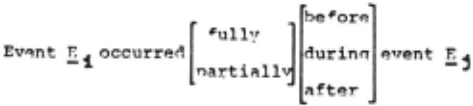
where mP.Mbers of the second bracket May assuMe either attrihute o4' the first brac":et. ·~eaninnful exaMnlec;, can be fonn,., for each of the einht (=2 ) nossihle cases. The r'!ic;tinction betNeen relevancy and !~relevancy is inr'!eer'! use4'ul !'ltnce chronoloaical data in real li4'e are o4'ten incoMoletely r'!e4'iner'! hecausP. of a lack o4' in~orMation, measureMent errors, con4'lictina data sources, etc.
~urther, nartial snecification o4' chronoloqical data can be rriven in the 'irrelevant' case b·· savinrr
Let us no'" c'lefine two tvne!'l of
events:
.u ( 1) .7\ noint event takes nlace momentarily. However., lt!'l ef4'ect, '-'thich is not necessarily continuou!'l to the event, MAY be la!'ltinn. For exal"19le, 'to wake un' is a ooint event (althouah sorne peonle Mav r'!i!'lanree with this ··· ) ann its e4'fect 'to be awake' is lastinCT. 0r, ',John start!'l readina' i!'l, aaain, a noint event '"hich is follo,.,er'! bv a lastina action. It is more di4'ficult. to find a ooint event 'Yith no subsequent effect. A moot one is, for exaMOle: 'He deciner'! not to do anythinn'.
(2) 1>. duration e'.rent has distinct startinn and f1n1sh1nn times, and a duration bet,.,een the two. There are a fe·.-1 excentions. F.xnlicit or L~olicit truth state,.,ent!'l often do nnt ha"e st.artinn ann finishinn time!'l, Unless one accents relininu!'l teachinnc; or t~e ~in ~ana theorv of coc;molonv, the ·wor.ln· ~as no startinn tt,.,e.
In or~er to he realistic ahout siMultane~_ tv, ·.·te ha,e asc;umer'l a '1UaT'Iti7.e~ time !'lCale. In t~e comnnter oroaram dec;criher'l later, one minute is the s~ortec;t Mei'lsnrable ti"'e intP.rval. ('!'his renresentc; no restriction hecause a de4'inable, i'lrhitrarv .time unit is also available: see later.) "'urt~er, ··re have consi~ere~ the ti~~ co-orr'!inate UT'I~oun~en in hot~ rHrectionc;.
"'or t,e sak~ o4' som~ ~ic;cuc;sion, let uc; ar'!oot in this sect~on the convention that lo~"P.!' cas"! lP.tterc; ref'er to ti"'e ooint.c; an~ un~er casP. lett"!rs to ti~e inter,al!'l. The letter 'e' will have a soecii'll !'lirmi4'icance, e '"ill r'!enote a noint f!W!nt l'lnr'! E a duration event.
Sunnose ~1 t;~~lt:ec; nlace at !. 1 and ~ 2 at !_ 2 · Ne can th~n say
Su~oose hoth e, i'IT'I~ ~ occurre~ dur;_nrr '~', th;~~t is !.i"· !2 E !· Th"'n e3, rell'ltP.r'l to !.3, MU!;t ha""' occurred nnrTnn !_, i4' (·.,ea": conr'!iti.nn)
!,1 < !.2 4'or all !.1 E ! 1 and all !.~ E !2.
Nhen T 1 i!'l nP.ithP.T he4'ore T., nor a~tf!r T.,, tnere is a nartial or full overlan~bP.t:,<~P.en the!". Let s denote start~_nn times, f finis~inrr times and D duration!'l. '·7e t'lien have with these events
'Parti11l ov~rll'l~ ic; 4'onn~ bet·.,een i'ln~ !:.~ PI ~,
for
(~om~ of the <. selectively bv icmore this nO\" simolicity.) sinns could be reolaced < or ~ but we shall f'or the sake of notational
Full overlao occurs Hf
The t1"0 events are contirruous iff
for
In thP. above dPf'initions, all oarametP.rs aooear to he time-relevant. In the case of' aryoroximate time soeci fications, ..... hethcr ahsolute or relati.,e to other e,ents, the syste"' must make orooer allo·-1ances for the c"'anq~s in t"'e retrieval locric.
nne can estahlish a si~le lorrical svstem, on the h~sis o1' t"'e nr~,ious definitions, usintr standard f'irst-order predicate calculus olus axioms ~ith rerrard to transitivity, irref'lexivit·,, and existence of Predecessors ~nd successors. This ~n~hles the syst~m to ma~e simrylifications on ~nd in~er.ences concernincr temooral relations between an, t·"o of three or mor~ ewmts.
It has been our intention to alloH a most creneral innnt mode. '!'h~ data to he used s"'ould be c"'ec~ed for consistencv at a staae as earlv as oossible. ~t t~e beainnintr of the nrocrram, the s~~leton of a comolex, hierarchical ~nd rnl~tional data structure is estahlished. This would then be filled in as ne~d arises throunh the '"luestions asked. '·7e have not 1'ro·.·rned uoon redundancv in stored information ~henever it shortened or simoli~ied orocessintr.
'1anv difficult decisions had to ._,e made in retrard to inryut mode, internal reoresentation, data manioulation, search 9roc~sses, etc. ~"!verill ti,.,es, ·-1e h~d to crive uo a certain ~venne ~nd start on another one. The 1'ollo~-'inn renrescmts the current state o1' affair<;, Hhich ,,,, ra" imnrove and ex?and yet.
The oronram maior comonn~nts, data structurina ans··l~rintr nh~se. discussed hrieflu. i!'l divided into thre€ the inout ohase, the ohase, and the question ~hese will no1" be
( 1) The inont n'hase is ·oti t'h th:o:-PP tvne!'l oJ' in*ormation: concerned
(a) The user defines the symbolic comonnents o~ a., e,ent: in the form
'"here l"V"'~"" i<J a reserved ~·lord to denote S"l"'hnlic s,.,ecificatinn: ~,T~'"''· ST"'T'T··, '"'PT"'I", Ll':~Jr:Tfl are !'l"mhol ic names of' the event, its startinn and fini.shin" time, and its duratinn, rPsnP.ct~Yel··.
(b) ~hP. nser also set<J uo tem,..,oral relati_nnc; lJet··IEl~n symhol icallv dellner:l tt.-.e 'Tilant:itiec; h~· the .,renicates
flerP., t"'e firc;t stl'ltP"'Pnt Meilns that "'1 i.e; t~e l'lntncpd·n~ of T~, ~~ic"' is ~e ant·cP.n~nt:~ '!'1, et:c.:--t~e seconn one "'P.I'Ins thl'lt i!'T, ~?, T1, · ·· are errni_tt'!"''"'n'"a'-: and tor;;;;' t"'r;:'d one thilt T1, ~ T1, ··· ;n·p circa-e'1nit~m.,oral. ("'!le '!""s rP.? ... .- o.,l., to-t{."'e oointc; in casP nf
:II:''T"'"' · ) (c) ~"inall·t, the inout ohac;e hi nne; thP. ti.l"'"" n~ra..,n.t.,.r.s of the e·.1ents, alr~al'!v S"mhol ·.cl'lllv sn,..ci ~len, tn numP.rical valneo;. ~P"''!!'al ,.,nsc;~_hi. U.ties eyi.st here. '~e can ei. t~,.,. uc;e "natural" unite; (for a ti"'e onint, for examnlP., 1971') - f)f':CF.'I~:pn - 31 11 o' cloc~ - 11'1 ,.,;_n'ltes, 1"ritt~n in the oroner ~nrmat), or "dP.fined" u.,itc; the zero onint ann lrmnt"' of ·. .,"'ich are ilr._,i_ trari ly c;et ...,., t"'e n-;er to c;ui t, o;ay, nart~cull'lr e~oerim~ntal conditione; (a time oeriod, ~nr eYal"'nle, ~70 units lona). In onn bnd" n~ in ~ormat i..on, the t···o cannot be mixed.
'F'urt"'.,.r, '·lhn.thP'" natural or OP.~ined units are usen, a t~me quantity can be nnmeric~ll" so~ci1'ipn either directlu, in ahsnlute termc;, or inni_.-ectly, i.P.. rel~t;_.,.,. to ~nothP.r ti"'e quantity. "erh~lize~ evam.,les n1' t"'is are: '~vent 1\ start·il 1'i ·mits hP~nrP. ti"'e noint '!'~', or 'r:v.,.nt C is 4 ~ da··c; lnntror tnan inter"l'll nc; '7'
SnmP. ~~e.,ts ~r~ n~n~nd here. Since t"'n. nn,.,ho.- n~ da··c: i.n a vear ( c1'. lP.ao """l'lrc:) ~n~ +:~~ nn,.,he.- n~ d~·tc: in "' mo"lt~ ar~ not COl"' ~tilnt:, ··rh<>nr>,.,.r a t { "'"" i nt~r,a l i_c; tn 1-)"! ni . .-nctl·· s.,,..ci. ~i. f.!~ in cn..,bin.,.d units (SI'I", """"''"c:, "'nnt~c:, il;l'·c;, ~n,.Jrs, "'{·m·tP.c;), t~" 11'ler l"'u-::t n"!~i.nP. 1'1 numm'/ ,.,~nt ~;~~ stl\rtinn a"n ~~n~~~in" ti~ec; sn dnte~"';· ""~ t'-l'lt q .. 'l nt.tr~ti. nn ic; t~~ ri.nht on~.
There ~re ei~~t Mo~e~ of inn\rect s~ecification, a~ in~icaten hy an in~ut para~ter. The rP.liotti,re ti,.,~ lennt~ t~at ha!; to he a~den to or subtracted f'roJ"' another time quantity can be ,.,i,r-m in
minut~~, hours, days, months, years packe~ year.-month-day-hour-m\nutP. J"'One, packen mont"t-nay Mone, ann
packen dav-rninnte J"'one.
In t~e last three casec:;, t~e an~ition or su~traction starts at the ri~htMost unit ann nroceens to t~e lef't, f'or the sake of' unaM~i~uity. Proner. care ~~s been taken o~ the transition bet··men the .'Tulian ann r.renorian calen~ars, the ·missinn· year het1-1een 1 B.c. ann 1 'II..!). , ann similar idiosyncrasies.
"'here is an iMnortant 1 J"'Ul timt~O!; .. , re~erven 1-1ord, m:::vrl\. In the in~ut nhac;o, it denotes an---ri='relevant t~ . ..,"! '1111mti.tv, for which no nuMerical s~ecificatinn i.e; to be exnecten. Ne I·IOnln .,nt, ~or. e~nM...,le, for time noints ~7\ ann T~
CEOUI, nr.url\, Tl'l, "'n)
sayin., that they both <Ire irrele,ant (but not e'1ui te,.,oora 1 ! ) T'l~L"'A c<~n also b~ mtt ;tirectly, in lieu o~ ~.,,..,~ol i.e naJ"'~ of an ev~nt beinq asked a~out. ExaMnles to follow will J"'ake this noint clear.
~ested snecifications are also possible. A verhalizen P.Y.aMnle of' thi.s is: 'Event 7\ starten 20 Minutes before the event enned that ~tar.ten at q a.M.'
The first stane of checkinn ~or inconsi~tencies i5 done as soon as pos~ihle nurint1 the innut nhasn. Contradiction!; ma? occur within or hctwnen the SVfllholicly and nuMP.ricall v ,.,i w'!n nata. If founn, the~e are reporten hack to the user ann the proqraM abort~.
~inally, if. one of the thr.ne tiMn quantities, character.izino a duration event, startinn time, f.inic:;hinn tiJ"'n ann lene1th, is Missin("(, it i~ COMlltefl ann recorded at this stane. In t"te cases in which nartial chronological inf'orMation i~ given in terms of restrictions, lon~est or. shortest possible tiMe lennths are COMnuten and ano~onriately Marken 1-1'1-tenevcr possible.
(2) The data structurin("( P'l-tase transforMs the 1nout information into an exnandable format, which is narticularly suitable for the last phase, durinn w'l-tich questions are as ken and ans1o~ered.
~oMe of the ~LIP list structures estahlis'l-ten initially are exoanned, soMe others are transcribed into a sequence of content-addressable and oarallelProcessable ~1~PL-II ~elations (see (2] or [1]) ann then nestroyen. P.vents are c'l-taPa~t~ri~~~. i~~i,\nn~ll~ ~n~ cnll"!cti""'l", i.n r~'""r"!n~" tn e~r.~ ot'1"!r. 'TU"'"!Pi .cAl an~ "''"'~ol i.e ~~til 1\r"! uc:;o~ to n~n~P~t~ in'""~onc~~ ~n~, anain, inconc::~c;t~nci"l~ /\~.. ~t~r.ov"!r~~ ~n~ r"!...,nrt~~ hC\~: to t~~ u~~r.
( 3) T~e 1"~c:;t i.nn-anc::· ··~ri_ nn ,.,.,1\c:;~ conr;i.sts o~ t···o nartr;. Th~ *1r~t one 1s tho .1\·tli!,VZ"'"· It ili.o;o:;ectr; each 111~~tion ann eY.nannc:; it intn its ele~entarv co,.,non~nt:'=l. Thn 7\'Tli. T,Y~"n is ~c;scntii!.llv a r~cnr·d_,e T)PO~r>~ur~ i"l '~ie··r nf' t~~ ~act t'1at co ... nle:v, nnr;t~-" 'l1l"'"lti.on~ can· alc;o ""' a'l):~ - 1 · T~e snr.nn~ ,.,~rt i. c; an ~Yec11t ;_ ""! r.outtne th~t Ci!ll-; in ~n~-:i~l ~u~ct:innc; ~or aac~ 1u~c::tinn cn~nnn~nt. T~ac:; a f'unr.ti_nnc; CAn ~~ ~;_ ,,;_ A.-.A intn ~i"r> ,..ron...,.,:
- (a) '"n r"tri'""" t'1~ S''"'"'nl; c n~"'"'l o~ th~ '"lta~t4n" ti,.,~, '~n{o:;S~n" ti ..... ~n ~ l~nnt'1 o .. a ni ... ~n ~""nt.
- (b) '"o ~Stl'l....,li-;'1 ···h"!+-."er i!. nnr.ti.r.·1laJ'" P"!l~ti. on ')~t···~"!l t'-'n t i "'" l]llant5.tiec:; (OOtntc; or flUT.I'It i_nn) OP t··rn ,..,~nt:c:; i.s tn1"!. ,.,n nnsc:;i."'le P~l<ltinn s ar~ a'3 '"olln···c:;.
- (i) ~"!t"P.P.n t:··ro ti .... ~ nnint'>: one t'-"'"' ~nint ic:: h"!'"nr~, at t"" c;a,.,~ ti."'" as, or at: ~~ont t"" Sl!."'" t i_ ..... ~s t '1P. othf'r onP.:
- (ii) ~~t··Y~nn t·ro ti.., .. Auratinns: onP. t~-"'~ -"ur.i!.tinn is lonnl'!r ti-tan, of' e'lnal lennt'l-t a~, n'" a'bout ~1ual lennth as, or s'l-torter thl'ln t'1~ othnr one:
(iii) betl,·een a ti"'e noint ann_ an ew~nt: the tiMe noint is e:vactlv or about at the saMe ti,.,e i!.S tht'! e,~nt's startinn fini.s'1inn ,.,oint: it nccurr~A b ... ~orP.: durinn or aftr-r. thf' l'!""!nt:
(i,) het··re"m a ~nration ann an e"f'nt: t'l-te ~nrati.nn is lon,.or ti-tan, of ,..'lual l~nnth ac;, or o .. ahnut 1"'1111!1.1 lt'!nnt'l-t ac;, or s'l-torter ti-tan t~~ e·~nt:
(v) .,et··Te"!n t··rn ew'!ntc:;:
one e·rf'nt ic; ni!.rtiall·, , co.,..~l~t:~lv ant~ce~ent: n~ t'l-te ot'l-t~P: it cn-f'xic;tc; w~th (i.e., ...,~rti . nll, nr co,..nl~t~)v n,~rlanc:;), cr"rer.s t'kf.! ot~~r: it is cnnti_nUOU"l to, idf'ntir.al to, about iA"!nti.cal tn, lonnf'r than, of erTual lPnnth as, o~ ahout e']ual lennt'l-t a~, or shorter than the other one.
If one of' the time 111l"lnti.tie-; or e\·ents is !'IT'lf'Ci ~if'n as n,;L"'~, t'l-ten all entitiec:;, either on a list-s;:;;;c:l.fif'A. b, the user or in the universe of the svc:;te,.., are searche~ f'nr those that satisfy t'l-te ~iven relation. nn the ot'l-ter hann, if a relation is soP.cifie~ a~ n~L~~ t'1P.n all vali~ relations between the ~ entities are r~trie,e~.
- (c) To finn the extre.,.,um (extrf'J"'a)
of' certain conditions. The latter can he earliec:;t, latest: lone1est, short~st: clnsest.
The first two refer to the pos~ihle ranoe of (irrelevant) time ooint~. The next t t-'O refer to tiMe ~uratior.s or events with one or t'"o irrelevant liMitinrr P.n~ ooints. The last con~ition, 'closest', Mav refer to tiMe points, in which case there is no aMhirruity. Ho\<7ever, the user may also look for an event (or events) \..rhose lenath is the closest to a qivP.n duration. 0r else, he May soecifv one event and look for another one that has the maximum lenath of overlao with the aiven event. If there are several, which for examole comoletely cover the latter, the system can select the shortest event of these.
- In aeneral, all ootentially acceptable ans,,ers are returne~ when the information availahlP. is not sufficient to ~ecide on their acceptability.
- (d) To establish chains of events where the mode of cha~n~nrr must satisly certain restrictions, such as
- the successive events contiauous, i.e. the finishina antecedent is the startino successor: must be time of the time of the
the successive events must nartially or comoletely overlao each other:
- either the startinrr or the finishinrr times, ~oecifiable by oarameters, must be con~ecutb·e 1..rith ~uccessive e'·ents:
- the same as above but certain time durations at least Must elaose between consecutive startina or finishinq times (cf. oroblems of causality) J -
- ·(e) To ans·,er questions concernina a generalize~ conceot of co-existence. There are, say, three ~ets of events given. The proaram will fin~ a subset of the first set, each meMber of '"hich must co-exist (partial or coMPlete overlao) with at least one member of the secon~ set of events and Must not co-exist (disjoint events) with any Member of the third set. Or, more aenerally, ,.,e can look for a subset of the first set, each MeMber of which Must co-exist with at least one member of an arbitrary number of sets and must not co-exist with anv sinale member of another arbitrary numner of other sets of events.
Finally, ,.,e note two additional tyoes of side conditions that can be soecified for the results. These are
the loqical conditions:
for all on a r~st soecifie~ or anywhere in-me system (cf. the universal quantifier) ,
find one (cf. the existential quantifier),-
Boolean AND, OR and NOT of sets of events: and
the time conditions:
- the result~nq tiMe quantity or event must occur before or after a certain time point, .
before, durinq or after an event, within a certain time lenqth.
Prorrramminrr was done nn a cnc with which ~LTP an~ A·~PL-IT. have re~i~ent on the svqtem disk. nnlv suhoronrams are calle~ into the core are needed in the n~ooraM. ~he total occunie~ leqq than 1<;\: core "'8MOrv. runninn tiMP., o' cour'le, dP.oend'l on si~e o' the data ba'IP. and nn co.,..,..,lexitv (levels of nP.'Itinn) of ~uestinn'l . a'I~P.d. 640(), been those that code The the the the
"'ith a Mod .. ratl'>lv 'li~ .. d data base and qUe'ltinn!'l of tl-te tvoe belo···, an ans·.o1er was obtained on the averane in less than half a SP.cond i' tl-te in'orMatinn Nas dirP.ctlv availahle. H~<7ever, i' lonical inferences concerninrr nested qu"stions had to be made, an~ thP. data structure ha~ to be uo~atP.~, the time rertui.re~ for an anSI.,.er mav take as lonq a'l 40 secon~s (see later).
- To illustrate the notation to be eMnloye~ by the user, we oive a list of si"'Ple '!UP.stions an~ a feH nested ones. We nnte that thP. saMe '!Uestion can often be 'orMulated in sP.··eral different ways.
- Coul~ the start of event cause event ~ 2 ?
('IU"L"'PTJ'P,BF.'F'f/J~'F','P, (~T1\~'T'T·4,E1) ,F.,F.2).
- Here P Meanq that the startinn time o' event E 1 -is a tiMe ooint an~ E means that F. 2 T~ an event.
- {2) Does event E co-exist (oartial or co111nlete overla,.,) wltu event ~":! ?
(~F.LT~U'P,Cf/JEXT~'T',E,E1,E,E2).
- Coul~ the coMPletion of event ! 1
- iMme~iatelv cauqe event ~ 2 ? ( 'P.ELT~UF., C!I'NTTr,tJF', F., E 1 , F., E2) ·
- Is event ! 1 lonaer t~an event '"U ~2?
(~F.LT~TJF.,L~r.ER,E,E1,E,E2).
- ~ich events are such that
- (a) their start coul~ cause event ! 1 ? (RF.LT'~>UF.,FIEFp!R"F:,'P, (STA~TI'1,DF.:L~~) ,E,E1):
- (b) they co-exist with event ~ 1 ? (~F.LT'Pt1F., Cp!EXI~T, E, O'~"L'!'A, E, E 1) :
- (c) their coT'!">letion could cause event ~ 1 ?
(RELTl>UF.,FIE'PQIRF.,P,(FINTIH,DF.LTA),E,E1)J
- (d) their duration is lonaer than that of event ~ 1 ?
((~LTRUE,L~~F.~,E,DELTA,E,E1).
- Are there sequences of events [(a) only consecutive, (b) onlv contiquous, or (c) also overlaooina] that lead to event ~1· an~ if so, Nhich ones? (N.B. chain of causally connected events.)
- (a) (CHAIN, C~SECUTIVE, 1"INTIM,STARTI'I,E1) :
- (b) (CHAIN ,C9'"1TII";UE ,E1) :
- (c) (CHAIN,(I!VERLAP,E1).
- Given three sets of events,
- {E1t {E11· E12· E1m},
{E2) {E21· E22· ··· F.2nl·
{E3) {1':31· E32, ··· F.3p}·
fin~ a subset {~4} of {~1}, such that each of its ~embers co-ex1sts (nartial or comolete overlan) with at least one ~e~ber of { E 2} { and does not co-exist with any ~~mher-of ~3}. Notationally,
{ E 4 ~ : .. { E 1 ~ ~ {F. 2 ~ "" · { E ,}.
(C91EXISTF.NC, (F.1 1 ,E12, ··· ), (E21 ,E22, ··· ),
(BUTN?f'J" ,E3 1, E32, ··· )
or
( (E 1 , E 1 1 , E 12, ··· ) , (E2, E2 1 , E2 2, ··· ) , (F. 3, E 31 ,
E32, ··· ) , (C9lEXISTEtlC, E 1, E2, (BUTN?'T, E3) ) )
- From amona a set of events {E 1\: {E 11 , E 12 , ··· } , which events last shortest and lonqest?
(FXT~E·~J·I, E, L91'H'iF.~'l', (F.11 , E 1 2, ··· ) ) :
an~
(F.XT~>E~'1, E, SH9'~TF.~T, (E 1 1 , E 12, ··· ) ) ·
- Fro~ amonq a set of events{E 1} {E 11· E 12· ··· }, ~~hich event starts or finishes earliest or latest?
(1"XT~F!''!J'I, !', Eli.PLif:S'J", ( ( ~':'11. 'P.TI'1, F. 1 1) ,
(~T .l\~TIH,E1 :?) , ··· ) ) :
(F.XT~E'fti'1,P, LATES"', ( (S"''\~TT'I, F.1 1) ,
("'I"l"'IP~, E1 2) , ··· ) ) :
(EXTRE''IU''· !' ,LJ\TF.~T, ( ("'nTTP1,E11),
("'IN'I'TH1 E1?.), · · ·)) ·
- F'om amon~ a set o~ events {Et!! { E 11 .· Eu, · .J, which event lac;ts cloqest to a t1T'Ie 1nter·.ral?
(EXT1:>.R'"U'·,E,CL9'SE~"' ,D,R, (F.1 1 ,E12, ··· )),
where ~ is the na~e o~ a certain ti~ duration-an~ D in~ic~tes ~uration.
( 11) Ne can restrict no~f!n-tial Causal relationshios betwef'!n t·-10 tWents, !;_1 an~ ~ , bv sayln" that !2 .,.,uqt start or flnish at least t 1 ? ti~e units after E1 starts or finis~es. ~u~~ose there is a ~atrix o~ restrictinns ~iven, II !.i-111 , where the ele~ent !f; is the m1n ~um ti~e l'!urati.on thAt muC;t elaoqe between, for exa~le, the ~inishi. nrT ti~e o~ ew!nt ~ an~ the startin" ti~e o~ E; for the t···o events to he causallv connect~r'l. The follo··1in" will .,ror'luc"! all notentiallv causal chains o~ this tvoe lea~ino to event R.
··· ),(T12,T11, ··· T1R,T21,T23, ··· T2R, ··· T31,
T32, ··· T3R, ··· ) ,R).
("'e note that work is not co~.,leten on the ans1o~er to t"lis tyne o~ tJuestion.)
(12) Which event!'! ta'Y.e nlace between the enn of e·rent ~ 1 and thP. start of event ~?
( (I'l"'~F.C"':t''iJIN (RF.J,'I''DTTF., At.l'J"r, 'P, (1"PTTP1, F.1) , P,
or
(~'!'1\'PTT··,r.?.)))) ·
liec; E,, (11) Which is the loni'Test event that bet··1een the ~ini.shinrr ti~e of event l'ln"' the startin" ti~e o~ event E.,?
(f':T'!-T"'I'·,n~L"'.I\) ,P, (S'r~M1:'1,E2)))).
- su.,nose t))l'!rP. !lre t·.,o sets of events, M~"'her~ o~ which co-exist with evEmts !:_ 1 anr'l £~· resnectivelv. "'in'! the te,.,noral rel!lti.on between the fin\~hin" ti~e o# thl'! latest event (i.e. the one that en"'s th~ latest) in the #irst ~et an"' the qtarttn" ti.MP. o~ the earliest e,ent (i.e. the on~ that startc; the el'lrliest) in t~"! se~on"' s~t.
C~EXI~T,E,DF.LTA,E,F.2)))).
A ~P.w rnore noints are to be not~~ here . The SP.t-t~eoretic function~
can be nest~d in any of the que~tion forl"'~ . "'he function
(".1\LT!T::, '!'.I'\, "''R, · · · )
retrie"e'> nu!"'eri.cal values of an in~e~inite nul"'he~ o~ til"'P. pnints an~/or durat i.nn'>. ')'he '1""1bolic names o~ thes~ rnay hP. r~~ .. renc<!~ in~i.rP.ctly in a nester'! for""!. "'or e~arnnle, i ~ ,.,e wi'>~ to ~in~ the durations of e·~nts T1 ant'! T2, ant'! the tiMes of occurrence of t~ose noint events that ha.,nP.ne~ be~ore ooint event "1, we out
("'I.LTTr., T 1 , T?. 1 (~T-:T."'"IT"' 1 1\'T"'"' 1 T>, D"'L"'?\, 'I) 1 "1 t)
''!hP.n~"er e~act "llllll"!'> arP. not a"llilal-ole, a set o~ rnuti.nec; ic; call~~ urynn to col""'lute t~" ..,o~c;;, ">le ti."'P. ranaP. of t~P. to"'e ..,oinl:~ or ~urat,nn~ in,oiveA. "'he ~nllo···inro ~ia,..ral"' i\1'\~ P.YC"rnts fro"' "' co,.. .. nlt,.,. out"'lnt r,.,..,,.l"!~ent a run wit~ a ~~all ~ata l-oa~e:
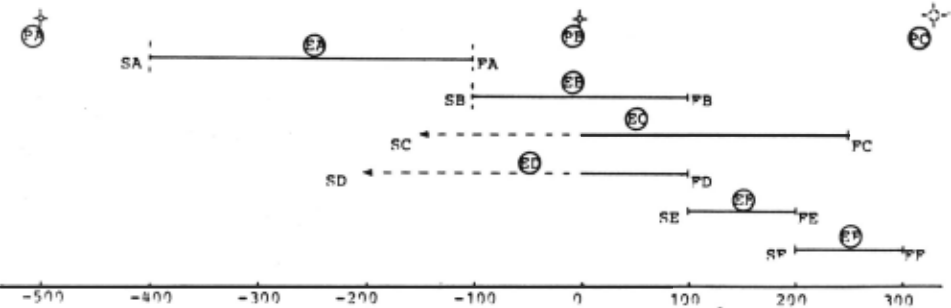
Event names are encirle~. There are three point events, PA, T>'R, an, PC, an, six duration events, EA, E'R, EC, ED, EF., an~ E'~". The fnllo··ri.n" svMbolic an, numerical soecifications are to be aiven to the sy'>tern:
ANTE: (PA,SA); (SD,FA~SB,PB) J ('F'F,PC) J (~D,SC,FA).
~: (FB,FD,SE) J ('F'E,S'F'). CEQUI: (FA,SB). tthose marked with an asterisk are values computed bv the svqtern. )
THE FOLLOWING FACTS A~E GIVEN TC THE SYSTEM I
SIX EVENTS ANO THREE TI"E POINTS ARE INVOLVED IN THE FOLLONING EXAMPLE. THE QUESTIONS ARE NOT NECESSARILY MEANINGFUL, THEY ARE USED TO CEHONSTRATE WHAT THE SYSTEM CAN DO.
(WHICH, I~ THE LIST FORM, lS l)
( 0 ( FVENT ,EA ,SA ,FA ,LA) CEVENT ,EB,SB,FB,L 8) CEVENT ,EC,SC, FC, LC) CEVENT,EO,SO,Fu,LD> lEVENT,EE,SE,FE,LE> lEVENT,EF,SF,FF,LF> >·(The SLIP system requires an asterisk at the end of everv list structure to be inputted.)
WE WANT TO INPUT THE LEAST AMOUNT OF IHFOR"ATION O~LY. IN ORCER TO SEE HOW THE SYSTEH COI'!BINES ABSlRACT CSYHBOLICJ AND NUMERICAL INFORHATICN, SOME OF TKt ENTITIES WILL BE GIVEN NUMERICAL VALUES.
ME DEFINE 3 TIHE POI"TS PA, PB, lNO PC FOR REFERENCE. PA ANTECEOES THE STUTJNG Til£ OF EVENT EA. Tit£ POINT SO ANTECEDES fA THAT ANTECEDES 58 nuT ANTECEOES P8. TKE FINISHING Tl"£ OF EVENT EF OCCU.S BEFORE PC. FB, FD, AND SE ARE E~I·TEMPCRAL TIM! POINTS. FA AND S! ARE CIRCA·EQUI·TEMPORAL. FE IS EQUlTEMPO.Al TO SF. TIME POINTS SOt SC, AND FA ARE IN THIS CHRONOLOGICAL ORDER. SE, FE, FC, LF, PA, AND PB MILL BE ltiVEN NUMERICAL VALUES.
CNHICH, IN THE LIST FORH, IS I)
((PA,PB,PCJCANTE,PACSTARTIH,EAJ)CANTE,SD,FA,SB,PBJCANTE,CFINTIM,EFJPC) CEQUI,FB,FD,SE) CCEQUI,FA,SBJ CECUI,FE,SFJ CA~TE,SO,SC,FA) )·THE FOLLOWING IS THE TABLE OF RECOGNIZED EWE HTS.
EVENT EA HAS BEEN DE F INEO MITH STARTIH SA, F INTIM FA AND LENCiTH LA. E ~NT EB HAS BEE~ DEFINED WITH STU TIM S8, FINnM FB AND LENGTH Lie EVENT EC HAS BEEN DEFINED WITH START IH sc, FINTIH FC AND LENGTH LC. EVENT EO HAS BEEN DEFINED WITH ST AATIH so, FINTIM FD AND LENGTH LO. EVENT EE HAS BE Ell DEF IN£ 0 WITH STARTIH SE, FINTIH FE AND LENGTH LEo EVENT EF HAS BEEN DEFINED lfiTH START IH SF, F INTIH FF ANC LENGTH Lfo~ollowinq this, the system orints out five li~t structures: ANTE (prece~ence ordering), LSTEQ (equitemooral), LSTCEO (circa-equite~ooral), TPL (recoqnize~ time points), and TDL (recognized time durations). For the ~ake o~ brevity, the~e are omitted here. The relevant t~ooral relations are then tran~~erre~ to t~e Si~ulate~ Associative Memory.
THE FOLLOWING AsgGNMENT OF NUMERICAL VALUES IS RECOGNIZED.
| PA R PB | -500 |
| SE SE HAS VALUE 100. FE | 100 zoo |
| FE HAS VALUE 200. | |
| FC R PA | 750 |
| SF R SF | 0 |
| LF LF HAS VILUE 100. | 100 |
| PB | 0 |
| P9 HAS VAlUE a. | |
| PA HAS V lLUE -500. FC HAS VALUE 250. | -o |
| ~0-MORE IT IS FOUND THAT FE HAS VALUE 100. | |
| IT IS FOUND THAT FO HAS VALUE 100. 200. | |
| IT IS FOUNO THAT SF HAS VALUE | |
| IT IS 100. | |
| FCUNO THAT LE HAS VALUE | |
| IT IS FOUNO THAT FF HAS VALUE 300. |
The above is partly the echo of the inout, partly value~ in~~rre~ by the sy~tem. Next, a chronological orderinq of ti~e points (list NAL) i~ nrinte~ but i~ omitte~ here.
THE NEXT QU~STION IS I FINO POSSIBLE CHAINS OF NON-OVERLAPPING AND CO~SECUTIVE EVENTS THAT LEAD TO EVENT EF. !WHICH, IN Jlo£ LIST FCRH, IS U CCHAik,CONSECUTIV,FINTIH,STARTIH,EF) l· ONE OF THE POSSIBLE CHAINS IS I EA, EF. ONE OF THE POSSIBLE CHAINS IS 1 EA, EB, EF. CNE OF THE POSSIBLE CHAINS IS 1 EO, EF · NC MORE CHAIN. ~E HAVE SPENT 27.79~0 SECONDS ON THIS QUESTICN. THE NEXT QUESTION IS I FINO POSSIBLE CHAINS OF CVERLAPPING EVENTS THAT LEAD TO EVENT EF. !WHICH, IN THE LIST FORM, IS I) CCHAIN,CVERLAF,EF) )· ONE OF THE POSSIBLE CHAINS IS 1 EC, EC, EF. t- C t'ORE CHAIN. WE HAVE SPENT 18.0&80 SECONDS ON THIS QUESTION. THE NEXT QUESTION IS I FINC POSSIBLE CHAINS OF CONTIGUOUS EVENTS THAT LEAD TO EF. I~HICH, IN THE LIST FCRM, IS I) (CHAa,CONTIGUE,EFl ) · ONE OF THE POSSIBLE CHAINS IS I EB, EE, E F. ONE :>F THE POSSIBLE CHAINS IS I EO, ::E, EF. H MORE CHAIN. ~E HAVE SPENT ~2.7980 SECONDS ON THIS QUESTICN. LTcT .Ll TIM~ POtNT~ THAT ~NTECEnE Pr. ANn ARE ANTEr.EDE~ dy PA. IW~l(':Ht I~ T"'4E t fST FO~M, IS I)
THE NEXT QUESTION IS I FROH AI'ICNG EVENTS EC,EB,EE,EP,EA, AND EF, SELECT THOSE THAT CO-EXIST WITH Et! OR EC. FROH THIS �~OUP, DELETE THE EARLIEST CNE CF THOSE THAT ARE COMPLETELY ANTECEOEU BY EVENT EA. (WHICH, IN THE LIST FORH, IS I) ( (NOT (COEXISTENt CEC,EB,EE,ED,EA,EF> CEB,EC)J CEXTREMUM,EARLIEST,E,UELTRUE, COMPANTE,E,EA,E,DELTA) ) ))· THE FOLLCWING IS THE ANSWER I [F, EA, EO, EE, EC. WE HAVE SPE~T 37.8020 SECONDS CN THIS QUESTION. THE NEXT QUESTION IS I FINO THOSE EVENTS TI"AT STAAT AFTER STARTING TII'IE OF EA AND NHO~ FINISHING TIME IS COVERED BY E.VENT EC. (WHICH, IN THE LIST FCRH, IS ll ( C INTSECTION ( REL TRUE ,BEFORE ,P CSTARTIH ,EA>E,OELT A) CRELTRUEtBETWEEN, P CFINT IH, OEL.TA>,E,EC> l l· THE FOLLOWING IS THE ANSWE~ I EE, EB. liE HAVE SPENT H.88c0 SECO~OS ON THIS QUESTlCN. THE NEXT CUESTION IS I FINO THE LONGEST ANC THE SHORTEST EVENTS OF EB,EC,EE,EF, AND EOo (WHICH, IN THE LIST FORI1, IS ll CEX,EB,EC,EE,EF,EO>CUNION CEXTREI'IUH,LCNGEST,E,EX>CEXTREMUM,SHORTEST,E,EX> ))· THE FOLLOWING IS THE ANSWE~ 1 EF, EE, EO, EC. WE HAVE SPENT ~.57&0 SECOhOS ON THIS QUESTION. THE NEXT QUESTION IS I FINO VALUES OF TII'IE POINT FA, OF THOSE TIME POINTS THAT OCCUR AFTER PA, AND Of THOSE TIHE DURATIONS THAT ARE EQUAL TO OR LONGER THAh LE (THE LENGTH OF EVENT [E). (WHICH, IN THE LIST FORH, IS I)
(VALl. E ,PA, IREL TRUE, ANTE,P ,PA,P ,OEL TAl C IIELT RUE ,EQUAL, 0 ,LE, 0, DELTA) CRELHUE,LONGER,O,OELTA,O,CLENTH,EE> ) ) >·
THE FCLLCWINGS ARE THE ANSWERS I THE VALUE OF PA IS -500. THE RANGE OF VALUE OF SA IS FROH -500 TO 0. T"'E RANGE OF VALUE OF FA IS FROH -500 TO 0. T ... E RANGE OF VALUE oF sa IS FROH -500 TO o. THE VALUE OF FB IS 100. THE RANGE OF VALUE OF SC IS FROH -INFINITY TO o. Tt-;E VALUE OF FC IS 250. THE RANGE OF VALUE OF so IS FROH -INFINITY TO o. H·E VALUE OF FO IS 100. THE VALUE OF SE IS 100. THE VALUE OF FE IS 200. THE VALUE OF SF IS zoo. H€ VALUE OF FF IS 3 oo. THE VALUE OF PB IS o. HE RANGE OF VALUE OF PC IS FROH 300 TO INFINITY · THE VALUE OF LE IS 100. THE VALUE OF LF IS 1 oo. THE ~AN�E OF VALUE OF LB IS FROH 100 TO &0 0. THE RANGE OF VALUE OF LC IS FROH 250 TO INFINITY. THE RANGE OF VALUE OF LO IS FROH 100 TO INFINITY · WE HAVE SPE"'T 11.7760 SECCNCS CN THIS QUESTICN. HE NEXT CUESTION IS I FROM AMC~� EVENTS EA, EC, EO, EE, ANO EF, SELECT THOSE THAT CO-EXIST WITH EVENTS EC OR EC AND 00 NOT CC-EXIST WITH EVENT EE. !WHICH, IN THE LIST FORH, IS I) CCOEXISTENC,CEA,EC,EO,EE,EFI CEO,EC> IBUTNOT,EBI l >· THE FOLLOWING IS THE ANSWER I EF, EE, EC, EA. wE HAVE SPE~T 43.&5&0 SECCNOS ON THIS QUESTION. THE NEXT QU~STION IS I T~IS EX~~PLE DEHCNSTRATES ~CME FURT ... ER USE OF THE FUNCTIONS EXTREHUH AND UNION. I WH IC H, IN THE Ll S T FORM , I:, I) I !UNION IEXTREHUH,LONGEST,O, IRELTRUE,LONGER,D,OELTA,E,EF> ) , IEXTREMUM,EARLIEST ,P, ISA, ISTARTIH,EC) CFINTIH,EFI ,SO,SBI ) IEAtEF,EB) )· THE FOLLOWING IS THE ANSWER I EB, EF, EA, SA, LO, LC, LB. w E HA v E s p E"' T 2.4400 SECONDS CN HIS QUESTION. NC 1"0!<£ C'JESTICI\, FRCCESS TFRMlNATES, To illustrate naee-tlme ~neci~ication, a data ba~e ~i~ilar to t~e one in the first examole was used wit'fot di~~erent values. t-Ie have, ~or instance, SE 1960 01 01 (Januarv 1, 1960), FF 1960 12 11, LE = 11;5 (COT""onterl: 1960 lean year) SF 1960 12 31, FF = 1971 5 1, 3772 ~av~ (etnht renular and two lean year~, t~e five first months in 1971)THE FOLL:J WING 'SS IG t-HE NT CF t-Ut'E RIC Ill V~LLES IS RECOGt-IZEC. F. 1~1t001010000 8 PA HAS VALliE 194o00101COOO. PB 195001010000 8 PB I'IA5 VHI.E B5U0101000C. FC 1~7001010DOO 8 FC HAS VALLE 1970010100C.C. SE 19&001010000 8 SE HA ~ VAL t.;E 19&U010100C.C. FE 19&H2310000 8 FE l-iAS VH\,;E 1<.lf01231000C. F F 1'::710~010000 8 FF HA ~ VALUE 19710~010000. NO- MORE -o · IT IS FOUIIID THAT Fl:l HAS VALUE H EOOl 01000 0. IT IS FCUiiC TH A 1 FC H4 S VALUE 19tCC10HOOu. IT IS FOUND TH~T s~ l-AS VHLE 1~[012310000. IT IS FCUI\0 Tt-IIT LE I-AS V!ILI.f 3£5(((0. IT IS FOU~O THH LF HAS VALUE 377200JO. Tf,E NEXT QUESTION IS I FINO VALLES CF ll"E FCI~T F~, CF Tt-CSE TI~E PCINTS TI-AT CCCUR AFTER FA, ANC OF TI-OSE TIME CURATION~ Tt-~T ARE ECUA~ TC OR LC~�ER THA~ LE (li-E LENGTH OF EVENT EEl. CIIHICH, IN THE LIST FCf<H, IS I) ( II A LI.J E, FA, C R E L T R LE ,AN lE, P, PA , P, CELT A l C HL T f<U E, EQUAL 1 0 1 LE, O, CELT A l CRELHuE,LONGER,O,OELTA,C,CLENTH,EEl l l >· HE FCLLOIOINGS AI<E THE ANSI!EI<S I THE VALUE Cf FA IS 191t001Q10000. 11-E RANGE OF VALUE CF SA IS FI'CI' 1C!lt0U1010000 TC 195001010000. THE RANGE OF VAL lJE OF FA IS FROM 194<001010000 TO 195001010000. THE RANGE OF VALUE CF se IS FRCH 19lt001010000 TO 195CC1010000. TI-E VALUE OF FB IS 1<.l£001U10000. THE V IILI,;E CF FC n 197001D100CO. TI-lE V ALI.E OF FO IS 1C:E001010000. THE VALUE CF SE IS 19EO 010 100CO. HE VALUE OF FE IS 1C:E012S10000. THE VAL I.E OF SF 15 196012310000. HE VALUE OF FF IS 1971051J10000. HE VALUE OF Pe I~ 1<.l~001010000. THE RANGE CF V ALt.;E CF FC IS HCI' 1137105010000 TC It.FINIT Y. THE VALUE OF LEIS H50000. HE RANGE OF VALt,;E CF LB IS FRCH 365~0COO TO 73050000. THE RANGE OF VALUE OF LC IS HC" 73050000 TC INFINITY. THE RANGE OF VALliE OF LD IS FROH 3E5~0000 TO INFINITY. THE VALUE OF LF IS 37f20000.WE HAVE SPE~T H..l~~O SECO~:JS C~ T"'IS Qt:EnlCN.
NO HO~E QUESTION, PROCESS TE~MINATES.
FURTHER RESEARCH PLANNED
Besides tidying up some parts of the code, other things can yet be done. There appears to be two interestinq lines of attack within the framework -of this proiect.
First, we could investigate statistically defined associative structures. In other words, the more often a particular pattern of events is followed by another pattern of events, the more likely it is that a causal relationship connects the two. Positive and negative reinforcement processes could lead to hypotheses of different strenaths. Cyclic or near-cyclic events should also be at work.
The second area of possible further investiqations would be with reference to natural lanquage input/output in a reasonably large subset of Enalish. ~ome preliminary studies have already been conducted by Adrian Walker and one of the present authors (N.V,F,). It is, however,
too early to report on these now.
As possible apolications, a number of interesting ideas have come to our mind. Manv crimes are committeo with, and their temoorary success depends on, solit second precision (at least accordinq to TV writers), Alibis may also depend on certain critical, hiqhlv time-dePenoent events. One miqht use this tyne of proqram to Prove whether a particular crime could have been committed by a certain individual or several crimes bv the same person, etc,
Turnina to more mundane ideas, air traffic control must be exercised under dynamically chanaing conditions, The program at hand could serve as a component to a computerized system. The on-line optimization of traffic liaht timina in a metropolitan environment mav also incoroorate some of our ioeas, The sc~eduling of reconnaissance missions is
anot~er potential area of aonlication.
Tofe also note here that this croiect is closely related to the crohlems of Critical Path ~ethods and PERT, (~ee, for examcle, [ 5) , ) Ne may sometime look into the cossihility of establishinq a link
between the two fields of ~tudy,
Finally, it shoulo be nointed out that intelligent machines will necessarily have to evaluate dynamically changing environments. In order to act in an optimum manner, they must make hycotheses on causal relationships, It is suaqested t~at the cognitive structure of such machine~ would contain processes similar to those described in this oa?er.
ACKNOWLED�F~1F.'-TT
The authors aopreciate the referee's comments, and his pointinn out the rich and excitinq world of the calculus of tenses, an~ the loaic of chanae, action and norms. (See Refs. [6)-(13).)
REJ:'F.R'P."TCE~
- [1) Findler, N.V.: A survey of seven proiects usinn the same lanquaoe (In N. v. Fin~ler ann R. Meltzer (Eds,): ProceP.~inns of the ~ir~t Advanced ~tudy Institute on Xrtil1clal Inteii!nence an~ Heuristic broaramm1nn. td{nhurah Onlversity Press: Ed!nhurah, Great Britain, 1971)
- (2] Fin<'Uer, ~T.V. ancl '"· R. McKinzie: On a new tool in Arti·icial Intelliaence research (Proc. ~irst Tnt. Conf. on Arti·icial Intelllaence, DO, z5q-z7o, Nastun<Tton, n.c., 1969)
- [3) F'inoler, N.v., .r. L. !'faltz and H ·· T. Rernstein: Four ~iah Level F.xtension~ of f'O'DT'DNT T": SLfTi, Alfflnt-I!, 'f'b.f.F.'f'AAN, anA svHMtMr. (to be ou611sfie?l bv scartan Books: Ne1-1 York, late 1971)
- Simon, H.A.: The ~ciences of the Arti·icial ('-1.I.T. Press: Cambrl?fqe,
- 1 1as s · , 1 9 6 9 )
- [5) Moder, 3,3, ano C,R. Philios: Proiect 'ianacre"lent with CP'I and "F.'DT (Relnhoid: Ne·., York, 1964)
- [6) Bull, R,A.: An alqehraic studv of tense loaics with linear time (~. of ~ymh. Logic, 33, on. 27-19, 1968) [7) Castafle?la, H.N.:-The loaic of chanae, action, ano nnrl'ls (:T, of Phil., g, oo.
- 133-344, 1965)
- [R) T.Jricrht, G.H. von: The loaic of A sketch [In Re~cher, N. The r,oaic of necision ano CUnivers1ty o/ Plttsburah Pittshurah, 1961;)) action (F.d.): ~ction Press:
- navioson, n.: The locrical form of action sentence~ [ihi~J
- [1n] Evans, c.n.: States, acttuities and performances (Au!'!trala~ian .'T. of "Dhil., 45, on. 291-3n8, 1967)
- n11 Prinr, A.~.: Time ann ''ooalitv (Claren~on Pres~: Oxforo, 1q57)
- Prior, A.N.: !'ast, ~resent and ~uture (Claren~on Pr~~s: Oxfor?l, 1967)
- Retc~enbach, H.: Elements of ~ymbolic Loaic (The Free Press: Ne1-1 York, 1947) f.soecially Section 51.
The Secono Great Train Rohherv
Chie~ Insoector Joshua Haaqertv of Scotlano Yaro loor.ed strainht into the face o~ his Proarammer-Analyst, Hiss Eleanore Lan"lev. He coulo hardly
con~oun~ h i ~ ~rustration:
- All riqht, we are stuck. This is the first time my intuition has failed to qive any b ····· sianal at all. If vou think it may help to have a run o~ that Findler-Chen oroaram with our data, I don't care - let's try it.
- Listen carefully. I am qivina you all the essential information we are certain about. Well, let me tell it to you from the beainnina.
- The Bank of England was to transfer some qold bullions, worth the sum of !140, 000,000, to its secret ··tanchester vaults. The armoured lorries, un~er the expert leadership of the newly hire~ security chief, Mr. H. ~cNauqhton, oicked up the shipment at 4:25 p.m. Some of the lorries, carryinq a fake loa~ of liaht metal, went direct to Victoria ~tation. They stopped on the way for exactly 14 minutes in order to synchronize their arrival at the station with the other group of lorries that followed a carefully designed indirect route. However, as ~r. McNaughton tells us, the second qrouo aot into a bit of a traffic iam and arrive~ at Victoria Station only at 6:28p.m., nine minutes later than scheduled.
- -By 6:37P.m., both the real an~ the fake loads were safelv sittina in the armoured carriage under the close watch of McNauahton's ten touqhest auard~.
- The exoress train left riaht on time, at 6:49p.m., to reach ~anchester at 9:17 o.m. However, exactly six minutes after the train rolled out of Birminqham station, at 8:23 o.m., it screeched to a sudden stop. Two maske~ qanqsters held up the loco enqineer at qun ooint. At the same time, one of them poure~ tear qas
THE FOLLCWING FACTS ARE GIVEN TO THE SYSTE!t I
THE (WHICH, IN THE LIST F~H, IS IJ C DAY-OF-ROB) CEVENT ,SHIFT-REAL ,DELTA rDEL TA ,L-SFT·REAL) CEVEN T, SHIFT -FAKErDEL TA, DELTA, L·SFT·F AI(£) CE VENT t L CRY-REA Lr 5-L CRYREAL ,F -L ORYREAL rL -L ORYREAU CEVENT,LORY-FAKErS-LORYFAKErf-LORYFAKE,L-LCRYFAKE) CEVENT,DELAY-LORY,OELTA,OELTA,L-DELALORY) CEVENT,HCLD-UP,S-HCLOUP,F-HCLCUP,L-HOLDUP) CEVE~T,WAIT-VlCT,S-WAIT,F·WAIT,L··AIT t (EVENT,SFT-ON-TR,S-SFT-CN,F-SFT-ON,L-SFT-ON) )· FOLLCWING IS THE TABLE OF RECO�~IZEO EVE~TS. EVENT SHIFT-REAL HAS BEEN DE FINED WITH STARTIH DELTA , FINTIH DELTA AND LENGTH L-SFT·REAL, EVENT SHIFT-FAKE HAS BEEN DEFINED WITH STAICTIH DELTA ' FINTIM DELTA AND LENliTH L-SFT·FAKE. EVENT LORY·REAL HAS BEEN DEFINED MITH STARTIM S-LORYREAL, FINTIM F-LORYREAL AND LEN6TH L-LORYREAL, EVENT LCRY·FAICE HAS BEEN DEFINED MITH STARTIM S·LORYFAICEt FINTIM f-LDRYFAKE AND LENGTH L-LORYfUE, EVENT DE LAY-LCRY HAS BEEN DEFINED WITH STARTIH DELTA , FINTIM DEL U AND LENiiTH L-DELALOIIY, EVENT ICILD ·UP HAS BEEN OE FU£0 WITH STARTIM S-HCLDUP FINTIH F-HOLDUP AND LEN liTH L-HOLDUP EVENT WAIT-VICT HAS BEEN OEFINEO WITH STARTIH S- NAIT , FINT 111 F· WAIT AND LENGTH L-WAI T EVENT SFT-ON-TR HAS BEEN DEFINEC ~lTH STARTIH S-SFT-oN , FINUH F-SFT-ON AND LENI>TH L-SFT-ONinto t"'~ airconrUtionin" ~uct o~ t"'e armoure~ carria"e· As a re~~on~e to the threat o~ exolo~in" the whole train with it~ o~sq~n"P.rs, t~P auar~~ rP.lease~ the s~eci~l ~oor~ that cnul~ be ooene~ onlv from in~i~e. ~~o other aanasters tran~~P.rren aonarentl" onlv the real bullionq to a waitin" lorry at a terri~ic sneen so th~t the train was able to continue it~ innrney at 1!:28 o.m.
- Luckily, the enaineer of the train memori~~~ the licenqe olate numher of the hol~un lorrv. It was foun~ aban~onen some 150 mile~ 'awav in a little forest. The con~itinn o~ the road~ leadina to this soot i~ such that the lorrv could not have reached the nlacP. in less than ~ hours and 17 minutes. · Thev should have transferred the loot here into a biaaer bus, iu~qina bv the tvre orint"· Rut, lo· ann beholn, we foun~ there nnthina else than another s~t o~ fake bullion~!
- Oh, another n\P.CP. o~ in~ormation - ad~e~ the Chie· Inqnector with some anorehension in his voice.
- We have ma~e some time-and-motion studie~. It ta~e~ at least R minutP.~ to tranqfer t"'~ real stuf~ from one lorrv to another. while the liahter, fake loan can be shi~t~~ in ahout ~ minutes.
- That i~ all r kno·., an~ r ~oubt vou can net more sene;~ out o~ this with your bloomina arev boxe~.
·Us ~ Lan!'fley looken unoerturben and ootimi~tic. She sat down at the keyounch to oronuce a ~e"' carn!l, which she then attache~ to the enn · of a small box of ounche~ car~s ann snbmitted the lot to the ~cotlann vard's friennly comouter. Out came the ans·.~ers:
THE FOLLOWING ASS! GNMENT OF NUHE RICAL VALUES IS RECOGNIZED.
| DAY-OF-ROB | 197901010000 6 | |||||
| DAY·OF-RCB L -SFT -FAKE HAS VALUE | 197901010000. 1 | 5 | ||||
| L·SFT•FA KE HAS VALUE | 5. | 8 1 | ||||
| L·SFT·REAL L·SFT•REAL S·LCRYREAL HAS VAt.UE | R | CAY-OF-ROB | 8. | 425 9 | ||
| S-LORYREAL F·LORYI£AL R HAS VALUE DAY-OF-MOB | 197901010425. | 628 9 | ||||
| F•LORYRE~L S·LORYFAKE R HAS VALUE OAY•OF-ROB | 197901010628. | 425 9 | ||||
| S·LORYFAKE HAS VALUE | 1979010101t25. | 619 9 | ||||
| F -L OR YF A I( E ~ DAY-OF-ROB | 197901010619. | |||||
| F-LORYFAICE HAS VAL.UE | 9 1 | |||||
| l-DELALORY L·OELALCI'Y S-HOL OUP R HAS VALUE 0 AY·OF-ROB | 9. | 523 9 | ||||
| S•HOLOUP F·HOLOUP I< HAS VALUE DAY·OF-MCB | 197901010823. | 5 28 9 | ||||
| F -HOL OUP S·WAIT R HAS VALUE DAY· OF-~ OB | 1 9 7 90 1 010 82 8. | 637 9 | ||||
| S-WAIT F-WAIT HAS VAL:.JE | R | DAY-OF-ROB | 197901010637. | &49 9 | ||
| F-W Ail HAS VALUE | 197901010&~+9. | &28 9 | ||||
| 5-SFT-ON R S-SFT-ON F-SFT-ON DAY-OF -MOB HAS VALUE | R | DAY-OF-ROB | 197901010&28. | &3 7 9 | ||
| F-SFT-ON HAS VALUE | 19791110106~7. | -o • | ||||
| 123. | ||||||
| NC-I'ORE IT IS | FOUND THAT | L·LCRYREAL HAS | VALUE | |||
| IT IS FOU-.D | THAT | L·LORYFA'<E | HAS VALUE | 114. | ||
| IT IS | FOuND THAT | L·HDLDUP | HAS VALUE | 5. | ||
| IT IS | FOUND THAT | L-WAIT | HAS VALUE | 12. | ||
| IT IS | FOU'-40 THAT | L-SFT-ON | HAS VALlJE | 9. | ||
T~E NEXT CUESTICN IS I
WHEN COLLO TRANSFER OF REAL BULLlONS TAKE PLACE J
(WHICH, IN THE LIST FOR~, IS ll
(REL TRUE, SHORTE{,D, lLENTH ,SHIFT-REAL> ,E ,DELT ·1 l ·
THE FOLLOWING IS THE ANSWER I
SFT-CN-Tq , WAIT-VICT , DELAY-LORY, LORY-FAKE , LCRY·REAL ·
loE HAVE SF::NT · 0880 SECONJS ON THIS UUE~TION.
NO MORE Q:.JESTIO~, Pf<OCESS TERMINATES.
Miss Lanaley went back to the Chie~ and casuallv remarken:
I a~ sur~ you alr~a~v hav~ a ·o~arrant to arrP.<;t '1r. '1c'Jauahton.
@inproceedings{ijcai1971p56,
  title     = {On the Problems of Time, Retrieval of Temporal Relations, Causality, and Co-Existence},
  author    = {Findler, Nicholas V. and Chen, David},
  booktitle = {Proceedings of the Second International Joint Conference on
               Artificial Intelligence, {IJCAI-71}},
  publisher = {International Joint Conferences on Artificial Intelligence},
  editor    = {D.C. Cooper},
  pages     = {531--544},
  year      = {1971},
  url       = {https://ijcai.org/proceedings/1971/56},
}
TY - CPAPER TI - On the Problems of Time, Retrieval of Temporal Relations, Causality, and Co-Existence AU - Findler, Nicholas V. AU - Chen, David T2 - Proceedings of the Second International Joint Conference on Artificial Intelligence, IJCAI-71 PB - International Joint Conferences on Artificial Intelligence PY - 1971 SP - 531 EP - 544 UR - https://ijcai.org/proceedings/1971/56 ER -Copied
Machine-readable versions of this paper, for tools and AI agents:





