
ORBIT: Optimal Recommendation Framework for Boarding with Interpretable Timelines
Proceedings of the Thirty-Fifth International Joint Conference on Artificial Intelligence. Demo Track. Pages 8423-8426.
https://doi.org/10.24963/ijcai.2026/971
Keywords
- AI: Multidisciplinary Topics and Applications
- AI: Planning and Scheduling
Abstract
Determining when to leave for the airport is a complex problem shaped by flight delay risk, traffic, weather, airport congestion, and passenger-specific constraints. Existing services rely on isolated delay estimates or simple travel time calculations, failing to capture real-time context. We propose ORBIT, a decision-support system that generates personalized leave-by recommendations by integrating predictive models with real-time operational signals. The system combines user input normalization, real-time data acquisition, Transformer-based delay prediction, and LLM-based reasoning to jointly account for statistical forecasts and dynamic factors like congestion, previous-leg propagation, weather, traffic, and airport processing times. Instead of a standalone delay estimate, ORBIT produces an actionable and interpretable departure plan. We implement ORBIT as an interactive system and demonstrate its applicability. A video demo is available at https://youtu.be/fZX42jceIM4.
- [Andreou et al., 2023] Andreas Andreou, Constandinos X Mavromoustakis, Jordi Mongay Batalla, Evangelos K Markakis, George Mastorakis, and Shahid Mumtaz. Uav trajectory optimisation in smart cities using modified a* al- gorithm combined with haversine and vincenty formulas. IEEE Transactions on Vehicular Technology, 72(8):9757- 9769, 2023.
- [Doshi-Velez and Kim, 2017] Finale Doshi-Velez and Been Kim. Towards a rigorous science of interpretable machine learning. arXiv preprint arXiv:1702.08608, 2017.
- [Fleurquin et al., 2013] Pablo Fleurquin, José J Ramasco, and Victor M Eguiluz. Systemic delay propagation in the us airport network. Scientific reports, 3(1):1159, 2013.
- [Gorishniy et al., 2021] Yury Gorishniy, Ivan Rubachev, Valentin Khrulkov, and Artem Babenko. Revisiting deep learning models for tabular data. Advances in neural in- formation processing systems, 34:18932-18943, 2021.
- [Koster et al., 2011] Paul Koster, Eric Kroes, and Erik Ver- hoef. Travel time variability and airport accessibil- ity. Transportation Research Part B: Methodological, 45(10):1545-1559, 2011.
- [Pyrgiotis et al., 2013] Nikolas Pyrgiotis, Kerry M Malone, and Amedeo Odoni. Modelling delay propagation within an airport network. Transportation Research Part C: Emerging Technologies, 27:60-75, 2013.
- [Radford et al., 2023] Alec Radford, Jong Wook Kim, Tao Xu, Greg Brockman, Christine McLeavey, and Ilya Sutskever. Robust speech recognition via large-scale weak supervision. In International conference on machine learning, pages 28492-28518. PMLR, 2023.
- [Rebollo and Balakrishnan, 2014] Juan Jose Rebollo and Hamsa Balakrishnan. Characterization and prediction of air traffic delays. Transportation research part C: Emerg- ing technologies, 44:231-241, 2014.
- [Schäfer et al., 2014] Matthias Schäfer, Martin Strohmeier, Vincent Lenders, Ivan Martinovic, and Matthias Wilhelm. Bringing up opensky: A large-scale ads-b sensor network for research. In IPSN-14 proceedings of the 13th inter- national symposium on information processing in sensor networks, pages 83-94. IEEE, 2014.
- [Small et al., 2005] Kenneth A Small, Clifford Winston, and Jia Yan. Uncovering the distribution of motorists' pref- erences for travel time and reliability. Econometrica, 73(4):1367-1382, 2005.
- [Sternberg et al., 2017] Alice Sternberg, Jorge Soares, Diego Carvalho, and Eduardo Ogasawara. A review on flight de- lay prediction. arXiv preprint arXiv:1703.06118, 2017.
- [Team et al., 2024] Gemini Team, Petko Georgiev, Ving Ian Lei, Ryan Burnell, Libin Bai, Anmol Gulati, Garrett Tanzer, Damien Vincent, Zhufeng Pan, Shibo Wang, et al. Gemini 1.5: Unlocking multimodal understand- ing across millions of tokens of context. arXiv preprint arXiv:2403.05530, 2024.
- [Vaswani et al., 2017] Ashish Vaswani, Noam Shazeer, Niki Parmar, Jakob Uszkoreit, Llion Jones, Aidan N Gomez, Łukasz Kaiser, and Illia Polosukhin. Attention is all you need. Advances in neural information processing systems, 30, 2017.
- [Xiong et al., 2020] Ruibin Xiong, Yunchang Yang, Di He, Kai Zheng, Shuxin Zheng, Chen Xing, Huishuai Zhang, Yanyan Lan, Liwei Wang, and Tieyan Liu. On layer normalization in the transformer architecture. In Inter- national conference on machine learning, pages 10524- 10533. PMLR, 2020.
- [Yang et al., 2023] Zhanji Yang, Xiaolei Kang, Yuanhao Gong, and Jiansheng Wang. Aircraft trajectory predic- tion and aviation safety in ads-b failure conditions based on neural network. Scientific reports, 13(1):19677, 2023.
- [Yao et al., 2022] Shunyu Yao, Jeffrey Zhao, Dian Yu, Nan Du, Izhak Shafran, Karthik R Narasimhan, and Yuan Cao. React: Synergizing reasoning and acting in language mod- els. In The eleventh international conference on learning representations, 2022.
References were extracted automatically from the PDF and may contain errors.
Full text extracted automatically from the PDF; figures, tables and equations may differ. The PDF is the version of record.
1 Introduction
Existing airport departure planning services typically rely on single-source static estimation or simple travel time calculation, and therefore do not fully capture real-time operational context or personalized mobility constraints [Rebollo and Balakrishnan, 2014]. In practice, the optimal leave-by time is jointly determined by flight delay risk, traffic conditions, weather factors, airport congestion, and passengerspecific characteristics [Small et al., 2005]. Considering any one of these components in isolation is insufficient for reliable decision support in real-world travel scenarios.
To address these limitations, we propose ORBIT, a decision-support system that generates personalized leave-by recommendations by jointly considering flight delay factors and integrated mobility context, including traffic, weather, and airport operations [Pyrgiotis et al., 2013; Sternberg et al., 2017]. ORBIT is structured as a multimodal pipeline combining user input processing, real-time data acquisition and normalization, gemini-based flight delay regression [Team et al., 2024], and large language model (LLM)-based reasoning integration. Instead of providing a standalone delay estimate, the system delivers an actionable departure plan that accounts for both predictive uncertainty and operational constraints.
The contributions of this work are threefold. First, we integrate Transformer-based delay prediction [Vaswani et al., 2017] with real-time signals and LLM explanations. Second, we personalize ground access and airport processing using user location, transportation mode, and baggage profile [Koster et al., 2011]. Third, we provide an explainable interface that decomposes leave-by recommendations into temporal components [Doshi-Velez and Kim, 2017].
2 SystemDesign
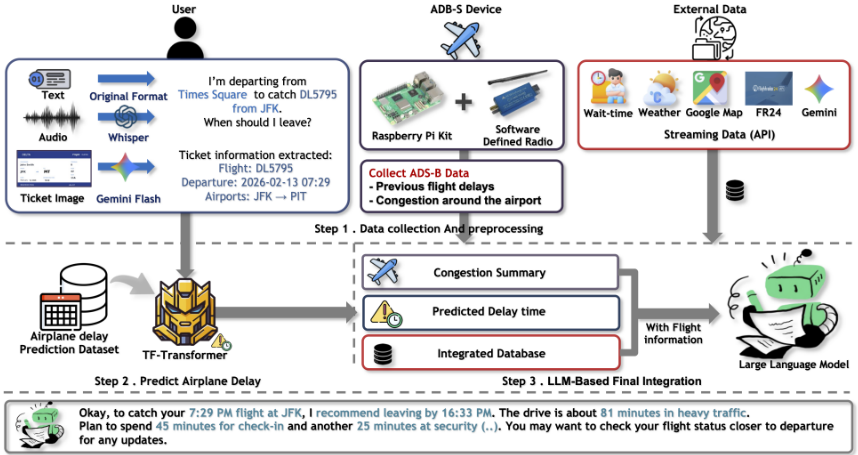
The system follows a four-stage pipeline: USER INPUT → DATA COLLECTION & PREPROCESSING → DELAY PREDICTION → LLM INTEGRATION. The objective of the system is to compute a recommended leave-by time by jointly accounting for the likelihood of flight departure delay and the time required for ground travel and airport-side procedures. We designated John F. Kennedy International Airport (JFK) in New York as the primary target airport, as it is a high-traffic hub with diverse operational conditions.
2.1 User Input Collection
The system collects the following user inputs to produce a personalized recommendation: origin address, flight number, airline code, departure and arrival airports (International Air Transport Association, IATA codes), scheduled departure time, transportation mode (Driving/Transit/Walk/Bicycle), checked baggage status, and terminal/gate information.
User inputs are supported through three channels: Textbased interface entry, Image-based ticket optical character recognition (OCR), and Speech-based input. Ticket images are processed using Gemini-based OCR [Team et al., 2024], and voice input is transcribed using faster-whisper [Radford et al., 2023]. The extracted information is unified into a structured representation for downstream modules.
2.2 Data Collection and Preprocessing
This study uses both offline training data and online operational data. For offline training, we construct delay-prediction features from the Kaggle Airplane Delay Dataset. 1 The core features include airline identity, origin and destination airports, and temporal variables. During online operation, the system collects the following external data sources:
- Regional congestion near the departure airport (Tcongestion). Automatic dependent surveillancebroadcast (ADS-B) data around JFK are collected for multiple days to compute mean and standard deviation statistics [Yang et al., 2023; Sch¨afer et al., 2014]. At runtime, current traffic levels are compared against these statistics, and additional congestion time is applied when traffic exceeds the baseline.
- Previous-leg delay propagation using ADS-B and FR24 (Tpflight). Using ADS-B data, the system estimates remaining flight time based on haversine distance and an assumed 450kt cruise speed [Yang et al., 2023; Andreou et al., 2023]. The discrepancy between expected and observed elapsed time is modeled as propagated [Fleurquin et al., 2013].
- Weather conditions (Google Weather) (Tweather). The Google Weather API is used to assign a weather risk level, and the system adds an additional delay buffer of 0, 15, or 30 minutes accordingly.
- Travel time and route (Google Routes) (Ttraffic). The Google Routes API is used to estimate travel time from
1 https://www.kaggle.com/datasets/shubhamsingh42/flightdelay-dataset-2018-2024
the user's origin to the airport, conditioned on the selected transportation mode.
- TSA wait time and gate walking time (Tairport). TSA (Transportation Security Administration) wait time, walking time, and security-related timing information are retrieved from the JFK airport website. 2
Because ORBIT depends on multiple external sources, it implements caching and fallback strategies to ensure operational robustness. When an API call fails, the system serves stale cache entries when available, or resorts to historical statistics and conservative defaults (e.g., travel time, TSA wait time, weather buffer, and delay estimates) so that the pipeline continues to produce an output.
We define the integrated external time factor as:
2.3 Transformer-based Delay Prediction
This study employs the TF-Transformer [Xiong et al., 2020] to perform regression-based prediction of flight delays (in minutes). Each feature is tokenized and passed through selfattention blocks. The representation of the [CLS] token is then fed into a regression head to estimate the predicted delay time. During deployment, the delay estimation logic is defined as follows. The TF-Transformer prediction output is used to compute Ttpredict [Gorishniy et al., 2021].
2.4 LLM-based Final Integration
In the Streamlit-based implementation, the airport process timeline is computed by backward calculation from the actual departure time.
2 https://www.jfkairport.com/
The predicted departure time Tleave is defined as:
where
- Tactual: Actual scheduled departure time.
- Tfixed: Predefined airport arrival requirement.
- Texternal: Integrated external time factor.
- Ttpredict: Predicted delay from the TF-Transformer.
Here, Tfixed denotes the target airport arrival time (2 hours before departure). It includes a user-adjustable buffer and optional baggage drop time. The extracted trip constraints and computed time components are formatted into a structured prompt, which is provided to the LLM to generate the final leave-by recommendation and explanation [Yao et al., 2022].
3 Implementation
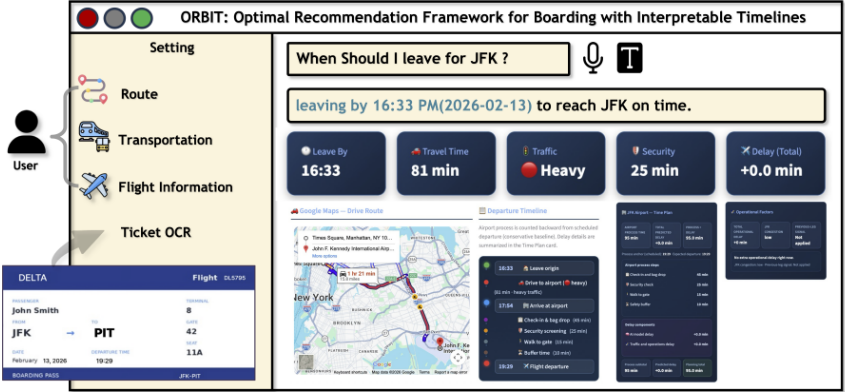
The core output of the framework is the recommended leaveby time, Tleave. Rather than providing a single timestamp, the system presents a visual, itemized decomposition of the major time components to clarify the rationale and dominant factors behind the recommendation. Our code is available at https://github.com/T-Rex-iitp/ORBIT.
3.1 Dashboard
The Streamlit-based dashboard integrates multimodal inputs with explainable outputs. It supports three input modalities: (1) manual text entry of flight information, (2) boarding-pass or ticket image upload with OCR-based automatic extraction, and (3) in-browser voice input with real-time transcription (e.g., "When should I leave to JFK?"). Upon receiving input, the system extracts key entities such as the flight identifier, airport code, and relevant times, then invokes the recommendation engine to generate a structured departure brief.
The dashboard outputs consist of: (i) a visual departure timeline that decomposes the total preparation time into components, (ii) an interactive map displaying the origin-toairport route and, when available, real-time contextual indicators, and (iii) an airport intelligence panel summarizing terminal and gate context, estimated security screening wait time, and current weather conditions. The system also generates a natural-language recommendation that translates the time-budget components into actionable guidance.
3.2 Demo Scenario
In a typical demo run for a passenger departing from JFK, flight information is provided via ticket image upload, manual entry, or voice. The system then (1) estimates the expected delay using an TF-Transformer, yielding a predicted delay component Ttpredict, (2) incorporates operational context such as congestion Tcongestion and previous-leg effects Tpflight, (3) computes origin-to-airport travel time Ttraffic, (4) applies airport process times Tairport including security screening and terminal or gate transfer, and (5) reflects current weather conditions Tweather. Finally, the user is presented with the recommended leave-by time, a natural-language explanation, and an itemized breakdown of the contributing components.
4 Conclusion
This study proposed ORBIT, a multimodal decision support system that addresses flight departure uncertainties and individual mobility constraints. ORBIT integrates Transformerbased delay prediction with real-time operational signals to compute actionable leave-by times. By leveraging LLMs to synthesize heterogeneous temporal factors, the system ensures transparent and interpretable recommendations.
Ethical Statement
The proposed system processes user location data locally for inference and does not store or retain personally identifiable information. When external services (e.g., Google Maps or Weather APIs) are invoked, only non-identifying or coarsegrained parameters are transmitted whenever feasible, and no raw user inputs are persisted beyond the active session. The ADS-B data utilized in this work is publicly available aviation data and is used in compliance with applicable regulations.
Acknowledgements
This work was supported by Institute of Information & communications Technology Planning & Evaluation (IITP) grant funded by the Korea government(MSIT) (RS-202200143911, AI Excellence Global Innovative Leader Education Program)
Contribution Statement
Joonseong Kang, Seung Ha Hwang, Jaehun Bang, and Jiyoung Ko contributed equally to this work. Subeen Park and Jeffrey Gennari are corresponding authors.
@inproceedings{ijcai2026p971,
  title     = {ORBIT: Optimal Recommendation Framework for Boarding with Interpretable Timelines},
  author    = {Kang, Joonseong and Hwang, Seung Ha and Bang, Jaehun and Ko, Jiyoung and Park, Subeen and Gennari, Jeffrey},
  booktitle = {Proceedings of the Thirty-Fifth International Joint Conference on
               Artificial Intelligence, {IJCAI-26}},
  publisher = {International Joint Conferences on Artificial Intelligence Organization},
  editor    = {Diego Calvanese},
  pages     = {8423--8426},
  year      = {2026},
  month     = {8},
  note      = {Demo Track},
  doi       = {10.24963/ijcai.2026/971},
  url       = {https://doi.org/10.24963/ijcai.2026/971},
}
TY - CPAPER TI - ORBIT: Optimal Recommendation Framework for Boarding with Interpretable Timelines AU - Kang, Joonseong AU - Hwang, Seung Ha AU - Bang, Jaehun AU - Ko, Jiyoung AU - Park, Subeen AU - Gennari, Jeffrey T2 - Proceedings of the Thirty-Fifth International Joint Conference on Artificial Intelligence, IJCAI-26 PB - International Joint Conferences on Artificial Intelligence Organization PY - 2026 SP - 8423 EP - 8426 DO - 10.24963/ijcai.2026/971 UR - https://doi.org/10.24963/ijcai.2026/971 ER -Copied
Machine-readable versions of this paper, for tools and AI agents:





