
From Time Series Analysis to Question Answering: A Survey in the LLM Era
Proceedings of the Thirty-Fifth International Joint Conference on Artificial Intelligence. Survey Track. Pages 7900-7909.
https://doi.org/10.24963/ijcai.2026/877
Keywords
- Natural Language Processing: Question answering
- Data Mining: Mining spatial and/or temporal data
Abstract
Recently, Large Language Models (LLMs) have introduced a novel paradigm in Time Series Analysis (TSA), leveraging strong language capabilities to support tasks such as forecasting and anomaly detection. However, these analysis tasks cannot adequately cover temporal language tasks, such as interpretation and captioning. A fundamental gap remains between TSA and LLMs: LLMs are pre-trained to optimize natural language relevance for question answering rather than objectives specialized for TSA. To bridge this gap, TSA is evolving toward Time Series Question Answering (TSQA), shifting from expert-driven and task-specific analysis to user-driven and task-unified question answering. TSQA depends on flexible exploration rather than predefined TSA pipelines. In this survey, we first propose a taxonomy that reflects the evolution from TSA to TSQA, driven by a shift from external to internal alignment. We then organize existing literature into three alignment paradigms: Injective Alignment, Bridging Alignment, and Internal Alignment, and provide practical guidance for flexible, economical, and generalizable selection of alignment paradigms. We finally analyze datasets across domains and characteristics, identify challenges, and highlight future research directions.
- [Bhatia et al., 2024] Gagan Bhatia, El Moatez Billah Nagoudi, Hasan Cavusoglu, and Muhammad Abdul- Mageed. Fintral: A family of GPT-4 level multimodal financial large language models. In ACL, pages 13064- 13087, 2024.
- [Cao et al., 2024] Defu Cao, Furong Jia, Sercan Ö. Arik, Tomas Pfister, Yixiang Zheng, Wen Ye, and Yan Liu. TEMPO: Prompt-based generative pre-trained transformer for time series forecasting. In ICLR, 2024.
- [Chan et al., 2024] Nimeesha Chan, Felix Parker, William Bennett, Tianyi Wu, Mung Yao Jia, et al. Medtsllm: Lever- aging llms for multimodal medical time series analysis. arXiv preprint arXiv:2408.07773, 2024.
- [Chang et al., 2025a] Ching Chang, Yidan Shi, Defu Cao, Wei Yang, Jeehyun Hwang, Haixin Wang, Jiacheng Pang, Wei Wang, Yan Liu, Wen-Chih Peng, et al. A survey of reasoning and agentic systems in time series with large language models. arXiv preprint arXiv:2509.11575, 2025.
- [Chang et al., 2025b] Ching Chang, Wei-Yao Wang, Wen- Chih Peng, and Tien-Fu Chen. Llm4ts: Aligning pre-trained llms as data-efficient time-series forecasters. ACM Transactions on Intelligent Systems and Technology, 16(3):1-20, 2025.
- [Chen et al., 2025] Jialin Chen, Aosong Feng, Ziyu Zhao, Juan Garza, Gaukhar Nurbek, Cheng Qin, Ali Maatouk, Leandros Tassiulas, Yifeng Gao, and Rex Ying. Mt- bench: A multimodal time series benchmark for tem- poral reasoning and question answering. arXiv preprint arXiv:2503.16858, 2025.
- [Cheng et al., 2025a] Mingyue Cheng, Yiheng Chen, Qi Liu, Zhiding Liu, Yucong Luo, and Enhong Chen. Instructime: Advancing time series classification with multimodal lan- guage modeling. In WSDM, pages 792-800, 2025.
- [Cheng et al., 2025b] Yunyao Cheng, Chenjuan Guo, Kaix- uan Chen, Kai Zhao, Bin Yang, Jiandong Xie, Christian S. Jensen, Feiteng Huang, and Kai Zheng. Gaussian process latent variable modeling for few-shot time series forecast- ing. IEEE Trans. Knowl. Data Eng., 37(8):4604-4619, 2025.
- [Ding et al., 2023] Yujie Ding, Shuai Jia, Tianyi Ma, Bingcheng Mao, Xiuze Zhou, Liuliu Li, and Dongming Han. Integrating stock features and global information via large language models for enhanced stock return predic- tion. In IJCAI, 2023.
- [Divo et al., 2025] Felix Divo, Maurice Kraus, Anh Q Nguyen, Hao Xue, Imran Razzak, Flora D Salim, Kris- tian Kersting, and Devendra Singh Dhami. Quants: Question answering on time series. arXiv preprint arXiv:2511.05124, 2025.
- [Duan et al., 2023] Yiqun Duan, Jinzhao Zhou, Zhen Wang, Yu-Kai Wang, and Chin-Teng Lin. Dewave: Discrete EEG waves encoding for brain dynamics to text translation. In NeurIPS, 2023.
- [Feng et al., 2025] Jie Feng, Tianhui Liu, Yuwei Du, Siqi Guo, Yuming Lin, and Yong Li. Citygpt: Empowering ur- ban spatial cognition of large language models. In KDD, pages 591-602, 2025.
- [Gruver et al., 2023] Nate Gruver, Marc Finzi, Shikai Qiu, and Andrew Gordon Wilson. Large language models are zero-shot time series forecasters. In NeurIPS, 2023.
- [Gu et al., 2025] Yile Gu, Yifan Xiong, Jonathan Mace, Yut- ing Jiang, et al. Argos: Agentic time-series anomaly detec- tion with autonomous rule generation via large language models. arXiv preprint arXiv:2501.14170, 2025.
- [Huang et al., 2024] Qihe Huang, Zhengyang Zhou, Kuo Yang, Gengyu Lin, Zhongchao Yi, and Yang Wang. Leret: Language-empowered retentive network for time series forecasting. In IJCAI, pages 4165-4173, 2024. IJCAI
- [Hurst et al., 2024] Aaron Hurst, Adam Lerer, et al. Gpt-4o system card. preprint arXiv:2410.21276, 2024.
- [Jiang et al., 2025a] Yushan Jiang, Kanghui Ning, Zijie Pan, Xuyang Shen, Jingchao Ni, Wenchao Yu, Anderson Schneider, Haifeng Chen, Yuriy Nevmyvaka, and Dongjin Song. Multi-modal time series analysis: A tutorial and survey. In KDD, pages 6043-6053, 2025.
- [Jiang et al., 2025b] Yushan Jiang, Wenchao Yu, Geon Lee, Dongjin Song, Kijung Shin, Wei Cheng, Yanchi Liu, and Haifeng Chen. Timexl: Explainable multi-modal time se- ries prediction with llm-in-the-loop. In NeurIPS, 2025.
- [Jiang et al., 2025c] Zuoyou Jiang, Li Zhao, Rui Sun, Ruo- han Sun, Zhongjian Li, Jing Li, Daxin Jiang, Zuo Bai, and Cheng Hua. Alpha-r1: Alpha screening with llm reasoning via reinforcement learning. arXiv preprint arXiv:2512.23515, 2025.
- [Jin et al., 2024] Ming Jin, Shiyu Wang, Lintao Ma, Zhix- uan Chu, James Y. Zhang, Xiaoming Shi, Pin-Yu Chen, Yuxuan Liang, Yuan-Fang Li, Shirui Pan, and Qingsong Wen. Time-llm: Time series forecasting by reprogram- ming large language models. In ICLR, 2024.
- [Kong et al., 2025] Yaxuan Kong, Yiyuan Yang, Yoontae Hwang, Wenjie Du, Stefan Zohren, Zhangyang Wang, Ming Jin, and Qingsong Wen. Time-mqa: Time series multi-task question answering with context enhancement. In ACL, pages 29736-29753, 2025.
- [Lee et al., 2025] Geon Lee, Wenchao Yu, Kijung Shin, Wei Cheng, and Haifeng Chen. Timecap: Learning to contex- tualize, augment, and predict time series events with large language model agents. In AAAI, pages 18082-18090, 2025.
- [Lee et al., 2026] Jaehoon Lee, Suhwan Park, Tae Yoon Lim, Seunghan Lee, Jun Seo, Dongwan Kang, Hwanil Choi, Minjae Kim, Sungdong Yoo, SoonYoung Lee, Yong- jae Lee, and Wonbin Ahn. Fintexts: Financial text- paired time-series dataset via semantic-based and multi- level pairing. preprint arXiv:2603.02702, 2026.
- [Li et al., 2025a] Huayu Li, Zhengxiao He, Xiwen Chen, Ci Zhang, Stuart F. Quan, William D. S. Killgore, Shu- Fen Wung, Chen X. Chen, Geng Yuan, Jin Lu, and Ao Li. Smarter together: Combining large language models and small models for physiological signals visual inspection. J. Heal. Informatics Res., 9(4):656-685, 2025.
- [Li et al., 2025b] Zechen Li, Shohreh Deldari, Linyao Chen, Hao Xue, and Flora D Salim. Sensorllm: Aligning large language models with motion sensors for human activity recognition. In EMNLP, pages 354-379, 2025.
- [Liang et al., 2024] Yuxuan Liang, Haomin Wen, Yuqi Nie, Yushan Jiang, Ming Jin, Dongjin Song, Shirui Pan, and Qingsong Wen. Foundation models for time series anal- ysis: A tutorial and survey. In KDD, pages 6555-6565, 2024.
- [Liu et al., 2024a] Chen Liu, Shibo He, Qihang Zhou, Shizhong Li, and Wenchao Meng. Large language model guided knowledge distillation for time series anomaly de- tection. In IJCAI, pages 2162-2170, 2024. IJCAI
- [Liu et al., 2024b] Haoxin Liu, Zhiyuan Zhao, Jindong Wang, Harshavardhan Kamarthi, and B. Aditya Prakash. Lstprompt: Large language models as zero-shot time se- ries forecasters by long-short-term prompting. In ACL, pages 7832-7840, 2024.
- [Liu et al., 2024c] Qingxiang Liu, Xu Liu, Chenghao Liu, Qingsong Wen, and Yuxuan Liang. Time-ffm: Towards lm-empowered federated foundation model for time series forecasting. In NeurIPS, 2024.
- [Liu et al., 2024d] Xu Liu, Junfeng Hu, Yuan Li, Shizhe Diao, Yuxuan Liang, Bryan Hooi, and Roger Zimmer- mann. Unitime: A language-empowered unified model for cross-domain time series forecasting. In WWW, pages 4095-4106, 2024.
- [Liu et al., 2024e] Yong Liu, Guo Qin, Xiangdong Huang, Jianmin Wang, and Mingsheng Long. Autotimes: Autore- gressive time series forecasters via large language models. In NeurIPS, 2024.
- [Liu et al., 2025a] Chenxi Liu, Hao Miao, Qianxiong Xu, Shaowen Zhou, Cheng Long, Yan Zhao, Ziyue Li, and Rui Zhao. Efficient multivariate time series forecasting via calibrated language models with privileged knowledge distillation. In ICDE, pages 3165-3178, 2025.
- [Liu et al., 2025b] Chenxi Liu, Qianxiong Xu, Hao Miao, Sun Yang, Lingzheng Zhang, Cheng Long, Ziyue Li, and Rui Zhao. Timecma: Towards llm-empowered multivari- ate time series forecasting via cross-modality alignment. In AAAI, pages 18780-18788, 2025.
- [Liu et al., 2025c] Chenxi Liu, Shaowen Zhou, Qianxiong Xu, Hao Miao, Cheng Long, Ziyue Li, and Rui Zhao. To- wards cross-modality modeling for time series analytics: A survey in the LLM era. In IJCAI, pages 10564-10572, 2025. IJCAI
- [Liu et al., 2025d] Haoxin Liu, Chenghao Liu, and B. Aditya Prakash. A picture is worth A thousand numbers: Enabling llms reason about time series via visualization. In NAACL, pages 7486-7518, 2025.
- [Liu et al., 2025e] Jun Liu, Chaoyun Zhang, Jiaxu Qian, Minghua Ma, Si Qin, Chetan Bansal, Qingwei Lin, Sar- avan Rajmohan, and Dongmei Zhang. Large language models can deliver accurate and interpretable time series anomaly detection. In SIGKDD, pages 4623-4634, 2025.
- [Liu et al., 2025f] Peiyuan Liu, Hang Guo, Tao Dai, Naiqi Li, Jigang Bao, Xudong Ren, Yong Jiang, and Shu-Tao Xia. CALF: aligning llms for time series forecasting via cross-modal fine-tuning. In AAAI, pages 18915-18923, 2025.
- [Merrill et al., 2024] Mike A. Merrill, Mingtian Tan, Vinayak Gupta, Thomas Hartvigsen, and Tim Althoff. Language models still struggle to zero-shot reason about time series. In EMNLP(Findings), pages 3512-3533, 2024.
- [Ni et al., 2026] Juntong Ni, Shiyu Wang, Ming Jin, Qi He, and Wei Jin. Streasoner: Empowering llms for spatio- temporal reasoning in time series via spatial-aware re- inforcement learning. arXiv preprint arXiv:2601.03248, 2026.
- [Oh et al., 2024] Jungwoo Oh, Gyubok Lee, Seongsu Bae, et al. Ecg-qa: A comprehensive question answering dataset combined with electrocardiogram. NeurIPS, 36, 2024.
- [Pan et al., 2024] Zijie Pan, Yushan Jiang, Sahil Garg, An- derson Schneider, Yuriy Nevmyvaka, and Dongjin Song. S2IP-LLM: semantic space informed prompt learning with LLM for time series forecasting. In ICML, 2024.
- [Pan et al., 2025] Qihong Pan, Haofei Tan, Guojiang Shen, Xiangjie Kong, Mengmeng Wang, and Chenyang Xu. LLM-TPF: multiscale temporal periodicity-semantic fu- sion llms for time series forecasting. In IJCAI, pages 6030-6038, 2025. IJCAI
- [Qiu et al., 2023] Jielin Qiu, William Han, Jiacheng Zhu, Mengdi Xu, Michael A. Rosenberg, Emerson Liu, Dou- glas Weber, and Ding Zhao. Transfer knowledge from natural language to electrocardiography: Can we detect cardiovascular disease through language models? In EACL(Findings), pages 442-453, 2023.
- [Reichman et al., 2025] Benjamin Z. Reichman, Xiaofan Yu, Lanxiang Hu, Jack Truxal, Atishay Jain, Rushil Chandru- patla, Tajana Rosing, and Larry Heck. Sensorqa: A ques- tion answering benchmark for daily-life monitoring. In SenSys, pages 282-289, 2025.
- [Tang et al., 2024] Hua Tang, Chong Zhang, Mingyu Jin, Qinkai Yu, Zhenting Wang, Xiaobo Jin, Yongfeng Zhang, and Mengnan Du. Time series forecasting with llms: Un- derstanding and enhancing model capabilities. SIGKDD Explor., 26(2):109-118, 2024.
- [Tao et al., 2024] Xiaoyu Tao, Tingyue Pan, Mingyue Cheng, Yucong Luo, Qi Liu, and Enhong Chen. Hierar- chical multimodal llms with semantic space alignment for enhanced time series classification. ACM Transactions on Intelligent Systems and Technology, 2024.
- [Trabelsi et al., 2025] Mohamed Trabelsi, Aidan Boyd, Jin Cao, and Huseyin Uzunalioglu. Time series language model for descriptive caption generation. arXiv preprint arXiv:2501.01832, 2025.
- [Wang et al., 2025a] Chengsen Wang, Qi Qi, Jingyu Wang, Haifeng Sun, Zirui Zhuang, Jinming Wu, Lei Zhang, and Jianxin Liao. Chattime: A unified multimodal time series foundation model bridging numerical and textual data. In AAAI, pages 12694-12702, 2025.
- [Wang et al., 2025b] Jiahao Wang, Mingyue Cheng, et al. Tabletime: Reformulating time series classification as training-free table understanding with large language models. In CIKM, pages 3009-3019, 2025.
- [Wang et al., 2025c] Jun Wang, Wenjie Du, Yiyuan Yang, Linglong Qian, Wei Cao, Keli Zhang, Wenjia Wang, Yux- uan Liang, and Qingsong Wen. Deep learning for multi- variate time series imputation: A survey. In IJCAI, pages 10696-10704, 2025. IJCAI
- [Williams et al., 2025] Andrew Robert Williams, Arjun Ashok, Étienne Marcotte, Valentina Zantedeschi, Jithen- daraa Subramanian, Roland Riachi, James Requeima, Alexandre Lacoste, Irina Rish, Nicolas Chapados, and Alexandre Drouin. Context is key: A benchmark for fore- casting with essential textual information. In ICML, 2025.
- [Wu et al., 2023] Shijie Wu, Ozan Irsoy, Steven Lu, Vadim Dabravolski, Mark Dredze, Sebastian Gehrmann, Prab- hanjan Kambadur, David Rosenberg, and Gideon Mann. Bloomberggpt: A large language model for finance. arXiv preprint arXiv:2303.17564, 2023.
- [Wu et al., 2026] Xingjian Wu, Junkai Lu, Zhengyu Li, Xi- angfei Qiu, Jilin Hu, Chenjuan Guo, Christian S. Jensen, and Bin Yang. Timeart: Towards agentic time series rea- soning via tool-augmentation. preprint arXiv:2601.13653, 2026.
- [Xie et al., 2025] Zhe Xie, Zeyan Li, Xiao He, Longlong Xu, Xidao Wen, Tieying Zhang, Jianjun Chen, Rui Shi, and Dan Pei. Chatts: Aligning time series with llms via synthetic data for enhanced understanding and reasoning. VLDB, 18(8):2385-2398, 2025.
- [Xue and Salim, 2024] Hao Xue and Flora D. Salim. Promptcast: A new prompt-based learning paradigm for time series forecasting. IEEE Trans. Knowl. Data Eng., 36(11):6851-6864, 2024.
- [Ye et al., 2025] Jiexia Ye, Weiqi Zhang, Ziyue Li, Jia Li, Meng Zhao, and Fugee Tsung. Medualtime: A dual- adapter language model for medical time series-text mul- timodal learning. In IJCAI, pages 7913-7921, 2025.
- [Yu et al., 2025] Xiaofan Yu, Lanxiang Hu, Benjamin Z. Re- ichman, Dylan Chu, Rushil Chandrupatla, Xiyuan Zhang, Larry Heck, and Tajana Simunic Rosing. Sensorchat: An- swering qualitative and quantitative questions during long- term multimodal sensor interactions. Proc. ACM Interact. Mob. Wearable Ubiquitous Technol., 9(3):148:1-148:35, 2025.
- [Zhang et al., 2023] Boyu Zhang, Hongyang Yang, and Xiao-Yang Liu. Instruct-fingpt: Financial sentiment analy- sis by instruction tuning of general-purpose large language models. arXiv preprint arXiv:2306.12659, 2023.
- [Zhang et al., 2024] Xiyuan Zhang, Ranak Roy Chowdhury, Rajesh K. Gupta, and Jingbo Shang. Large language mod- els for time series: A survey. In IJCAI, pages 8335-8343, 2024. IJCAI
- [Zhang et al., 2025a] Juyuan Zhang, Wei Zhu, and Jiechao Gao. Adapting large language models for time series mod- eling via a novel parameter-efficient adaptation method. In ACL, 2025.
- [Zhang et al., 2025b] Zhirui Zhang, Changhua Pei, Tianyi Gao, Zhe Xie, Yibo Hao, Zhaoyang Yu, Longlong Xu, Tong Xiao, Jing Han, and Dan Pei. Timesense: Making large language models proficient in time-series analysis. arXiv preprint arXiv:2511.06344, 2025.
- [Zhang et al., 2026] Jianqi Zhang, Jingyao Wang, Wen- wen Qiang, Fanjiang Xu, and Changwen Zheng. En- hancing large language models for time-series forecast- ing via vector-injected in-context learning. preprint arXiv:2601.07903, 2026.
- [Zhao et al., 2025] Yubao Zhao, Jiaju Kang, Tian Zhang, Puyu Han, and Tong Chen. Ecg-chat: A large ecg- language model for cardiac disease diagnosis. In ICME, pages 1-6, 2025.
- [Zhong et al., 2025] Siru Zhong, Weilin Ruan, Ming Jin, Huan Li, Qingsong Wen, and Yuxuan Liang. Time-vlm: Exploring multimodal vision-language models for aug- mented time series forecasting. In ICML, 2025.
- [Zhou and Yu, 2024] Zihao Zhou and Rose Yu. Can llms understand time series anomalies? arXiv preprint arXiv:2410.05440, 2024.
- [Zhou et al., 2024] Xiaomao Zhou, Qingmin Jia, Yujiao Hu, Renchao Xie, Tao Huang, and F. Richard Yu. Geng: An llm-based generic time series data generation approach for edge intelligence via cross-domain collaboration. In IN- FOCOM, pages 1-6. IEEE, 2024.
References were extracted automatically from the PDF and may contain errors.
Full text extracted automatically from the PDF; figures, tables and equations may differ. The PDF is the version of record.
1 Introduction
Time series are sequential data characterized by temporal dependencies and pattern semantics [Liang et al., 2024]. Time Series Analysis (TSA) has been widely applied across multiple domains, including healthcare [Chan et al., 2024], finance [Ding et al., 2023], IoT [Qiu et al., 2023], weather [Cheng et al., 2025b], and electricity [Pan et al., 2025]. Within these domains, TSA typically involves tasks such as forecasting [Jin et al., 2024], anomaly detection [Liu et al., 2024a], classification [Wang et al., 2025b], and imputation [Wang et al., 2025c]. Recently, Large Language Models (LLMs) have introduced a novel paradigm in TSA, leveraging strong natural language capabilities [Zhang et al., 2024].
∗Corresponding Author
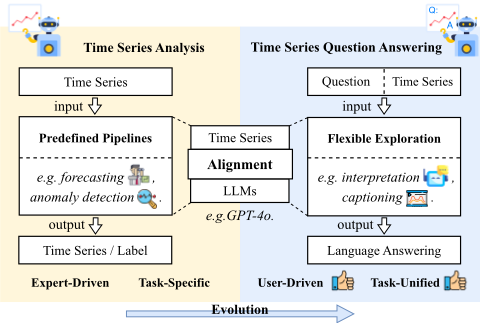
However, these analysis tasks cannot adequately cover temporal language tasks. For example, in database AIOps, Time Series Question Answering (TSQA) provides comprehensive interpretations of performance metrics [Xie et al., 2025]. In time series captioning tasks, TSQA summarizes temporal patterns, structures, and events [Trabelsi et al., 2025]. A fundamental gap remains between TSA and LLMs: LLMs are pre-trained to optimize natural language relevance for question answering rather than objectives specialized for TSA. As shown in Figure 1, TSA is evolving toward TSQA, shifting from expert-driven and task-specific analysis to userdriven and task-unified question answering. TSA relies on predefined pipelines built on task-specific time series modeling. In contrast, TSQA depends on flexible exploration based on task-unified temporal language processing, including indepth interpretation and captioning [Chang et al., 2025a]. After aligning time series with LLMs (e.g., GPT-4o [Hurst et al., 2024]), user-driven TSQA inputs time series and questions and outputs natural language answers, which are more intuitive than the numerical time series or categorical labels generated by expert-driven TSA [Zhang et al., 2024]. The fundamental gap highlights alignment between time series and LLMs as a central challenge, motivating us to propose alignment paradigms that cover the evolution from TSA to TSQA.
The perspectives of representative survey literature are summarized in Table 1. Instead of considering TSA and TSQA in isolation, our survey adopts the evolution perspective from TSA to TSQA and provides an up-to-date overview. Compared with existing surveys, this evolution perspective integrates previously isolated TSA and TSQA research into a unified taxonomy of alignment paradigms in the LLM era.
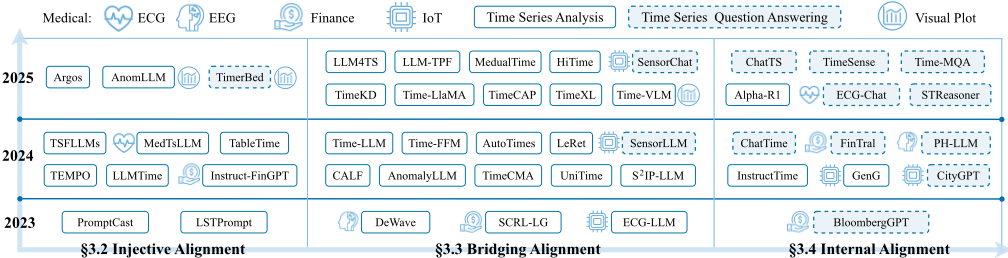
As shown in Figure 2, the taxonomy consists of three alignment paradigms: (1) Injective Alignment injects numerical time series into textual prompts without temporal modification, using frozen LLMs. Temporal modification refers to optimizations that adapt time series to LLMs. (2) Bridging Alignment establishes mappings between numerical time series and prompts, introducing temporal modification while still employing frozen LLMs. (3) Internal Alignment leverages multiple time series representations, including numerical values, visual plots, and structured tables, combining temporal modification with internal LLM components.
The primary contributions are summarized as follows.
- We distinguish and define TSA and TSQA (Section 2).
- We propose a taxonomy of three alignment paradigms, provide practical guidance for paradigm selection, and systematically categorize the relevant literature and maintain an up-to-date GitHub repository 1 (Section 3).
- We analyze datasets from the perspectives of application domains and data characteristics (Section 4).
- We discuss challenges and future directions (Section 5).
2 Preliminaries
2.1 Definitions
A time series is represented as a numerical sequence with temporal order XNumber = ⟨x1, . . . , xS⟩ ∈ RS×N , where S denotes the sequence length and N is the number of variables. Each observation xi at timestep i is an N-dimensional vector.
Textual data is defined as XText = {s1, s2, . . . , sL}, where each symbol si ∈ V is drawn from a predefined vocabulary V, and L denotes the length of the text sequence. Specifically, (1) Textual time series: This type represents numerical time series converted into discrete symbolic sequences, allowing LLMs to process time series in textual form [Liu et al., 2025c]. (2) Natural language: This type is not derived from time series conversion, including domain knowledge, task instructions, questions, and answers.
1 https://github.com/Leeway-95/TSA-TSQA-with-LLMs
| Survey Literature | Perspective |
|---|---|
| Our Survey | TSA&TSQA Evolution |
| [Liu et al., 2025c] (IJCAI'25) | Cross-modality TSA |
| [Jiang et al., 2025a] (KDD'25) | Multi-modality TSA |
| [Zhang et al., 2024] (IJCAI'24) | Pipeline-based TSA |
| [Liang et al., 2024] (KDD'24) | Foundation Model |
2.2 Time Series Analysis with LLMs
These tasks follow a predefined processing with fixed objectives, where LLMs serve as modeling and reasoning components for TSA tasks. In addition to generating corresponding explanations, the objectives and outputs of representative analysis tasks are defined as follows. (1) Forecasting: Given historical observations, LLMs predict future numerical values over a predefined horizon. The output is a numerical sequence with temporal order [Tang et al., 2024]. (2) Anomaly detection: LLMs identify deviations from normal dynamics. The outputs are binary labels (normal and abnormal) and anomaly scores [Liu et al., 2024a]. (3) Classification: LLMs assign each time series to one category from a predefined label set. The output consists of one or more predefined class labels [Cheng et al., 2025a]. (4) Imputation: LLMs infer missing or corrupted values using observed context. The output is a completed numerical sequence with missing entries filled [Wang et al., 2025c]. Formally, given a time series X and contextual information C (e.g., natural language, plots), TSA aims to produce the task-specific output Y :
Where fp(·) refers to a method that uses LLMs with predefined task prefixes, and p denotes the corresponding predefined task prompts, e.g., "predict the next 48 timesteps".
2.3 Time Series Question Answering
In contrast to predefined analysis tasks, TSQA formulates time series understanding as a unified question answering paradigm. This paradigm enables flexible exploration of time series while emphasizing: (1) Deep thinking: analyzing complex temporal semantics and dependencies to derive clear insights [Zhang et al., 2025b]. (2) Action planning: decomposing user queries into goal-oriented steps to generate optimal answers [Chang et al., 2025a]. (3) Tool calling: using external analytical tools or models to perform precise numerical computations, statistical tests, and other operations within the reasoning process [Ni et al., 2026]. Under this paradigm, representative TSQA tasks include: (1) In-depth interpretation: explaining user questions through joint reasoning over temporal patterns, multivariate dependencies, and contextual information. (2) Time series captioning: producing natural language descriptions that summarize temporal patterns, structure, and events [Trabelsi et al., 2025].
Formally, given a time series X, additional contextual information C, and a natural language question Q, the goal of TSQA is to produce the correct answer A:
Where f(·) refers to a method that uses LLMs with Q, and A is a natural language answer that leverages temporal semantics from X and relevant C [Kong et al., 2025].
3 Taxonomy
In this section, we propose a taxonomy with clear boundaries, formal definitions, optimization strategies, and categorize existing literature into three alignment paradigms.
3.1 Overview
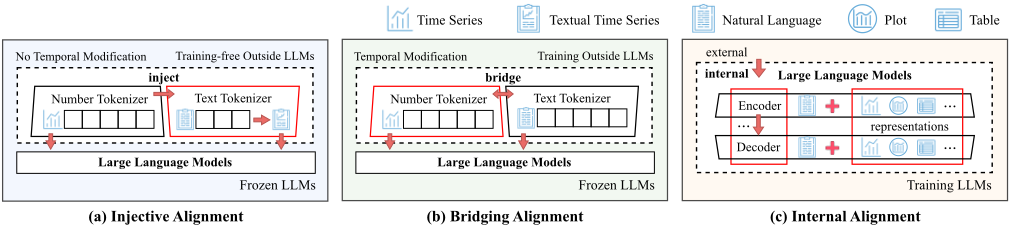
The three alignment paradigms are Injective Alignment, Bridging Alignment, and Internal Alignment. As illustrated in Figure 3, the processes and emphases of each alignment paradigm are as follows: (a) Injective Alignment focuses on textual representations by injecting numerical time series into textual prompts. (b) Bridging Alignment focuses on numerical representations and builds connections between numerical time series and textual prompts. (c) Internal Alignment typically focuses on internal component modifications and multiple time series representations, including numerical values, visual plots, and structured tables. These paradigms cover the existing literature with clear boundaries, and each work can be uniquely assigned to a single category.
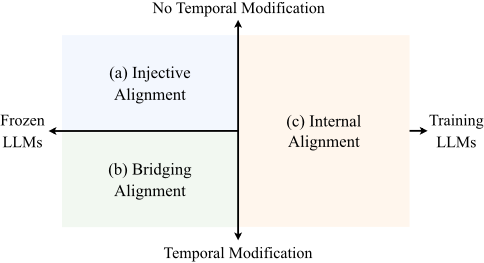
As shown in Figure 4, the horizontal axis indicates whether LLM parameters are trained, and the vertical axis indicates whether temporal modifications are required. Temporal modification refers to adapting time series for LLMs, including both modifications outside the LLM and adjustments to the internal LLM architecture. These two dimensions determine the three alignment paradigms. (a) Injective Alignment involves no temporal modification and adopts frozen LLMs. This design preserves the original LLM parameters. (b) Bridging Alignment introduces temporal modification while still employing frozen LLMs. This design enables joint processing of time series and textual inputs while preserving all parameters of the original LLM. (c) Internal Alignment combines temporal modification with training LLMs through parameter updating to provide native support for time series. Next, we detail the three paradigms along these boundaries.
3.2 Injective Alignment
This paradigm injects information into LLMs by directly encoding XNumber into token embeddings or appending textual time series XText to prompts. This process is defined as Y = fθ(hγ(XNumber),XText), where hγ(·) is an injective method, and fθ(·) refers to frozen LLMs. Beyond original Direct input strategies, two optimization strategies for hγ(·) are In-Context Learning (ICL) and Chain of Thought (CoT).
ICL. This strategy guides LLMs with a few task demonstrations to enhance contextual understanding and reasoning. For instance, LLMAD [Liu et al., 2025e] further improves ICL through diversified demonstrations and robust retrieval, finding that a small mix of positive and negative examples achieves an effective trade-off, as additional demonstrations offer limited gains. LVICL [Zhang et al., 2026] compresses multiple time-series examples into a permutation-invariant context vector and injects it into each LLM layer to elicit in-context learning for improved forecasting while keeping the LLM frozen. Benefits: Effective in data-scarce scenarios and allows low-cost dynamic context switching. Drawbacks: Performance is sensitive to noisy or low-quality examples.
CoT. This strategy activates LLMs for deep thinking by decomposing complex tasks into ordered intermediate steps along explicit logical paths. For example, LSTPrompt [Liu et al., 2024b] divides zero-shot forecasting of TSA into two stages: short-term reasoning for dynamic trends and longterm reasoning for periodic patterns, with periodic revisits to assumptions to enhance temporal adaptivity. TimerBed [Liu et al., 2025d] applies a three-phase reasoning path for TSQA: it first identifies relevant temporal segments; then extracts numerical clues from these segments; it finally synthesizes explainable answers. Benefits: Converts implicit logic into explicit steps, enhancing interpretability and reliability via stepwise self-correction. Drawbacks: Requires predefined steps and incurs additional computational cost due to extra CoT. Practical instructions for Injective Alignment are as follows:
This paradigm is flexible to operate outside LLMs. CoT and ICL are easy to implement across domains, making this paradigm suitable for domain-specific applications. Since its effectiveness depends on prompt quality, practitioners should iteratively refine the design of prompts using domain expertise and LLM feedback.
3.3 Bridging Alignment
This paradigm maps numerical time series and textual prompts, defined as Y = fθ(gϕ(XNumber,XText)), where gϕ(·) is a bridging method and fθ(·) refers to frozen LLMs. Two efficient optimization strategies for gϕ(·) are as follows.
Similarity Retrieval (SR). This strategy aligns numerical and textual representations via similarity. Adapters serve as a bridging space, projecting time series into an embedding space compatible with LLMs. Specifically, gϕ maps time series as gϕ(XNumber) → XText , with ϕ trained using a loss function L. For example, Time-LLM [Jin et al., 2024] introduces a reprogramming space that converts time series into text prototypes, bridging numeric encodings with textual embeddings. Time-CMA [Liu et al., 2025b] encodes time series and text into a shared space using separate encoders, aligns embeddings via contrastive loss, and retrieves time series whose embedding best matches the query. Benefits: Enhances performance via flexible adapters without altering LLM parameters. Drawbacks: Performance depends on adapter quality and incurs computational cost during retrieval.
Low-Rank Adaptation (LoRA). This strategy is a parameter-efficient technique that bridges low-rank updates into pre-trained LLMs, enabling task-specific tuning without altering the model parameters. For instance, HiTime [Tao et al., 2024] applies LoRA during generative instruction finetuning for time series classification, updating a small subset of weights to enable generative reasoning from numeric features. AutoTimes [Liu et al., 2024e] integrates LoRA into its autoregressive forecasting framework, fine-tuning embedding and projection layers while keeping the LLM parameters frozen. Benefits: Parameter-efficient and task-specific adaptation. Drawbacks: Limited performance when the low-rank space is insufficient for complex time-series patterns. Practical instructions for Bridging Alignment are as follows:
This paradigm is economical to operate outside LLMs. Similarity Retrieval and LoRA leverage aligned semantic information, making it effective for capturing timeseries characteristics. Since its effectiveness depends on the quality of adapter modules, practitioners should carefully assess whether the improvements are meaningful.
3.4 Internal Alignment
This paradigm modifies internal components and parameters, defined as Y = f ′θ (dψ1(XNumber), dψ2(XText), . . . ), where {dψ1(·), dψ2(·), . . .} are internal methods that enhance XNumber into X′Number and XText into X′Text , or introduces additional representations. f ′θ (·) denotes training LLMs. Two representative optimization strategies for f ′θ (·) are as follows.
Re-Training (RT). This strategy aligns time series with LLMs by temporal modification and updating parameters. For example, ChatTime [Wang et al., 2025a] treats time series as a foreign language. It normalizes and discretizes continuous signals into symbolic tokens, extends the LLM vocabulary, and performs continual pre-training and instruction tuning to unify temporal and textual modalities. ChatTS [Xie et al., 2025] trains a native time series LLM for TSQA. It synthesizes high-quality temporal descriptions using rule-based generators and attribute selectors, followed by two-stage finetuning to align numerical evolution with language reasoning. Benefits: Enables deep internal alignment between temporal patterns and linguistic representations, and improves multitask adaptability via parameter updates. Drawbacks: Requires substantial training resources and may introduce additional complexity from discretization or synthetic data.
Reinforcement Learning (RL). This strategy aligns LLM behavior with temporal objectives by optimizing decision policies using reward signals derived from sequential outcomes. For instance, TimeSense [Zhang et al., 2025b] treats temporal reasoning as a self-supervised reconstruction task. It uses time-aware objectives to learn temporal order, duration, and dependencies, which implicitly ensure temporal consistency via reinforcement learning. Alpha-R1 [Jiang et al., 2025c] models factor selection as a multi-step decision trajectory and directly optimizes LLM outputs via reinforcement learning. This formulation grounds language generation in long-horizon temporal feedback and aligns reasoning steps with profit-driven sequential outcomes. Benefits: Directly optimizes long-horizon temporal objectives, adapts to dynamic environments, and provides decision interpretability through reward semantics. Drawbacks: Training stability depends on reward design, optimization cost is high, and performance is sensitive to data noise and quality. Practical instructions for Internal Alignment are as follows:
This paradigm is generalizable for internal LLM operation. Re-Training and Reinforcement Learning provide general-purpose improvement for time series understanding and reasoning. Since its effectiveness depends on the dataset and retraining quality, practitioners should focus on data synthesis methods and evaluation metrics.
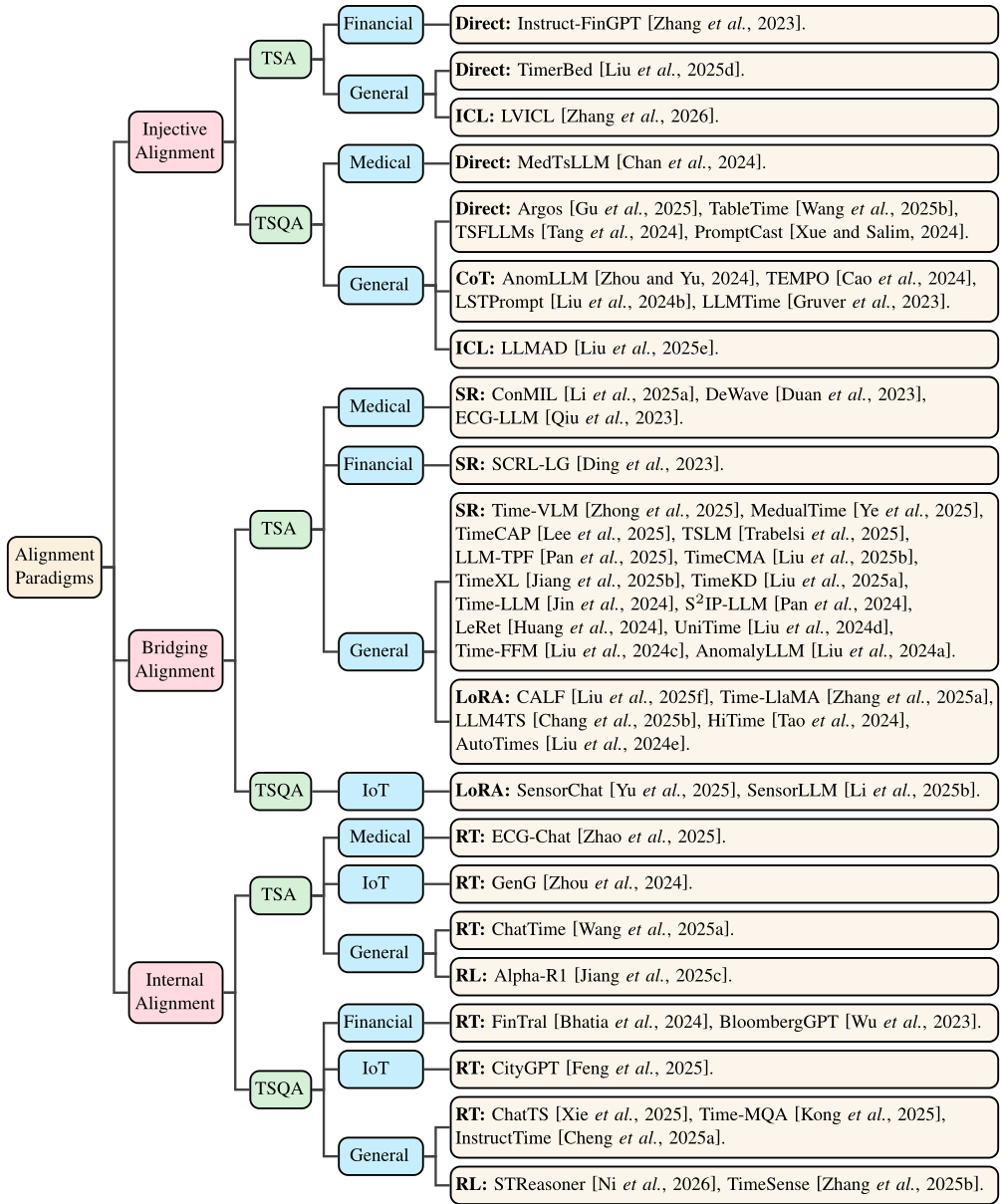
We categorize 50 relevant literature into three groups from TSA to TSQA, as shown in Figure 5. For each work, a comprehensive taxonomy is summarized across four dimensions of Alignment Paradigms, tasks, domains, and optimization strategies. Specifically, we analyze the distribution of Alignment Paradigms in Figure 6(a), including Injective Alignment 26%, Bridging Alignment 50%, and Internal Alignment 24%. We further examine the task distribution in Figure 6(b), which consists of TSA 60% and TSQA 40%. As shown in Figure 6(c), we identify the application domains covered in the literature, including Medical 10%, Finance 8%, IoT 8%, and General 74%. In addition, we focus on the optimization strategies summarized in Figure 6(d), where Similarity Retrieval (SR) accounts for the largest proportion at 36%. We present the yearly evolution trends in Figure 6(e), with TSQA surpassing TSA in growth rate from 2024 to 2025, and Internal Alignment exhibiting the most significant increase. Next, we analyze representative datasets across diverse domains, highlighting how question answering design grounds time series characteristics and drives their evolution.
4 Dataset Analysis
In this section, we introduce representative datasets organized by application domains, as shown in Table 2. Additional datasets are provided in our GitHub repository 2 .
4.1 Overview
We analyze representative datasets from two perspectives: application domains and data characteristics, which respectively determine their semantics and structures. From the domain perspective, existing datasets vary in semantic dependence and regulatory constraints, but they generally require strong interpretability, contextual understanding, and integration of domain knowledge. From the characteristic perspective, existing datasets differ in temporal patterns and spatial multivariate structures. Moreover, time series can be represented in multiple forms, including numerical sequences, textual descriptions, and visual plots, each introducing different trade-offs among fidelity, interpretability, and compatibility.
2 https://github.com/Leeway-95/TSA-TSQA-with-LLMs
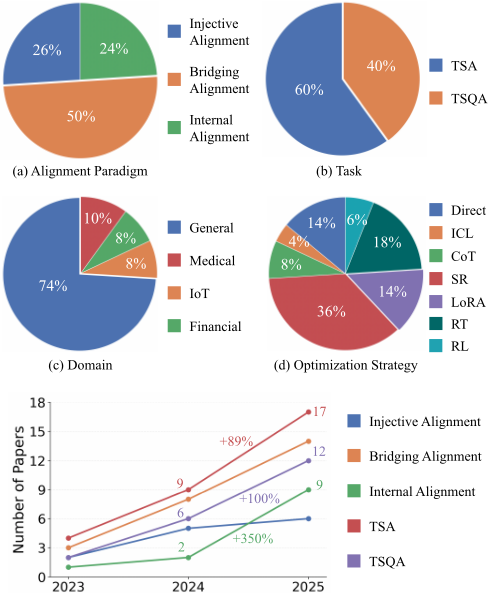
Figure 6: Taxonomy distribution and evolution across dimensions.
4.2 Domain
Time series data span a wide range of domains, covering representative medical, financial, and IoT domains.
Medical data. Medical time series include EEG, ECG, and related signals, which often exhibit strong seasonality and clear outliers. Semantic interpretation relies heavily on domain knowledge, as specific waveforms correspond to physiological states [Duan et al., 2023]. Medical data are typically collected by professional equipment, but they are subject to strict privacy regulations and require transparent reasoning to support clinical decisions [Chan et al., 2024].
Financial data. Financial time series are high-frequency, such as stock prices and trading volumes. They contain pronounced outliers and short-term volatility, while also exhibiting recurring trends relevant to risk assessment and market forecasting [Wu et al., 2023]. Financial data usually rely on external knowledge and operate under stringent market regulations. Interpreting financial time series is often more valuable than predicting exact values [Ding et al., 2023].
IoT data. IoT time series consist of multi-source sensor data that typically show seasonality and infrequent changes due to predefined operating procedures. IoT data are highdimensional and heterogeneous, integrating multiple sensors. Data quality is influenced by sensor type, sampling rate, and hardware-induced noise [Zhou et al., 2024]. Effective TSQA in this domain requires contextual fusion to ensure comprehensive and consistent interpretation [Yu et al., 2025].
| Dataset | Domain | Task | Size | Characteristic |
|---|---|---|---|---|
| ECG-QA[Oh et al., 2024] | Medical | TSQA | 414,348 pairs. | 3 types, 12 variates, 2 modalities. |
| FinTexTS [Lee et al., 2026] | Financial | TSA, TSQA | 100M pairs. | 4 variates, 2 modalities. |
| SensorQA [Reichman et al., 2025] | IoT | TSQA | 5,648 pairs. | 2 types, multivariate, 5 modalities. |
| Time-MQA [Kong et al., 2025] | General | TSQA | 192,843 pairs. | 6 types, multivariate, 2 modalities. |
| CiK [Williams et al., 2025] | TSA | 2,644 pairs. | 5 types, univariate, 2 modalities. | |
| TSandLanguage [Merrill et al., 2024] | TSA, TSQA | 230k pairs. | 10 types, univariate, 2 modalities. |
4.3 Characteristic
Temporal patterns exhibit varying properties over time, including: (1) Outliers, representing deviant signals with anomalous semantics [Zhou and Yu, 2024]. (2) Trend, capturing long-term directional changes over time [Jiang et al., 2025b]. (3) Seasonality, corresponding to recurring semantics at regular intervals [Yu et al., 2025]. (4) Volatility, characterized by irregular fluctuations that obscure meaningful patterns and often require denoising [Pan et al., 2024].
Spatial multivariates introduce temporal complexity, including: (1) Independence, treating variables separately to reduce complexity and avoid spurious correlations [Liu et al., 2025b]. (2) Dependence, capturing inter-variable interactions by considering variables jointly [Pan et al., 2025]. (3) Correlation, representing complex relational structures for coherent and context-aware reasoning [Cheng et al., 2025b].
Beyond temporal patterns and spatial multivariates, multimodal representations provide an additional characteristic. (1) Numerical representation preserves raw time series values and offers advantages: it directly retains precise quantitative information and avoids additional transformation costs. However, numerical data also have limitations: time series are scarce compared to language, and raw values lack explicit semantic meaning [Gruver et al., 2023]. Real-world signals often contain noise, missing values, and sparsity, requiring preprocessing. (2) Textual representation converts time series into natural language descriptions and offers advantages: text provides human-readable semantics that are intuitive and interpretable [Lee et al., 2025]. This format naturally aligns with LLMs. Its main limitation lies in the alignment between the discrete nature of text and the continuous properties of time series signals [Wang et al., 2025a]. (3) Visual representation draws time series as plots, such as line charts, and offers advantages: visual representations explicitly highlight trends, seasonality, and outliers. Visual plots can be aligned with LLMs via zero-shot visual understanding and can supplement or replace numerical or textual representations [Zhong et al., 2025]. Nevertheless, visual plots introduce challenges: low resolution may cause information loss, and fine-grained temporal values are often difficult to recover precisely, limiting quantitative accuracy [Jiang et al., 2025a]. These characteristics jointly form the complexity of temporal semantics and modeling, requiring LLMs to capture temporal dynamics, inter-variable dependencies, and multimodal representations for temporal understanding and reasoning.
5 Challenge and Future Direction
We further discuss the challenges and future directions under the three alignment paradigms proposed in this work.
5.1 Data
The evolution of datasets toward TSQA exposes several structural limitations. (1) Lack of reasoning supervision is a primary bottleneck. Most existing datasets emphasize short answers, while providing little supervision over intermediate reasoning steps or tool usage. Future datasets should explicitly incorporate reasoning traces and expected temporal behaviors to support reasoning [Divo et al., 2025]. (2) Insufficient domain diversity constrains generalized evaluation. Time series have domain-specific variation in sequence length, granularity, noise patterns, and temporal dependencies. Constructing large-scale, multi-domain TSQA datasets with temporal diversity is critical [Chen et al., 2025].
5.2 Task
TSA and TSQA are complementary rather than mutually exclusive. TSA provides effective task-specific solutions, whereas TSQA offers a unified question answering paradigm based on temporal reasoning. This evolution from TSA to TSQA also introduces fundamental challenges. (1) Tasks shift from explicit specification to implicit extraction. TSA assumes clearly defined tasks with specified objectives. In contrast, TSQA identifies the time series problems from user inputs that typically contain underlying temporal semantics. This shift requires models to interpret user intent into appropriate tasks [Tao et al., 2024]. (2) Lack of task tools for TSQA. Although TSQA extends TSA toward a unified question answering paradigm, it often lacks tools explicitly designed for diverse temporal questions, such as time series slicing [Zhang et al., 2025b]. Future TSQA should incorporate dedicated tools or invoke effective TSA models to enhance temporal reasoning [Kong et al., 2025].
5.3 Method
Several challenges arise across optimization strategies. (1) Limited adaptivity. Current methods struggle with complexity and uncertainty. Future approaches should dynamically support long-horizon, multi-scale, and irregular time series under temporal reasoning [Gu et al., 2025]. Incorporating multi-agent mechanisms can further enable planning, tool use, and self-reflection, turning alignment into an adaptive process [Chang et al., 2025a]. (2) Numerical hallucination. Current approaches struggle with numerical hallucination in TSA and TSQA. Discrete tokenization limits sensitivity to continuous values, producing plausible but incorrect reasoning. Future work should investigate how alignment paradigms mitigate this issue [Wu et al., 2026].
6 Conclusion
In this survey, we categorize existing literature into three paradigms, summarize optimization strategies along the evolution from TSA to TSQA, and provide practical guidance for flexible, economical, and generalizable selection of alignment paradigms. We further analyze representative datasets, identify challenges, and highlight future research directions.
Acknowledgments
This work is supported by the National Natural Science Foundation of China (Nos. 62172423 and 62402414) and the Guangdong Basic and Applied Basic Research Foundation (No. 2025A1515011994).
@inproceedings{ijcai2026p877,
  title     = {From Time Series Analysis to Question Answering: A Survey in the LLM Era},
  author    = {Li, Wei and Xie, Zhe and Liang, Yuxuan and Hao, Xinli and Cheng, Yunyao and Pei, Dan and Meng, Xiaofeng},
  booktitle = {Proceedings of the Thirty-Fifth International Joint Conference on
               Artificial Intelligence, {IJCAI-26}},
  publisher = {International Joint Conferences on Artificial Intelligence Organization},
  editor    = {Diego Calvanese},
  pages     = {7900--7909},
  year      = {2026},
  month     = {8},
  note      = {Survey Track},
  doi       = {10.24963/ijcai.2026/877},
  url       = {https://doi.org/10.24963/ijcai.2026/877},
}
TY - CPAPER TI - From Time Series Analysis to Question Answering: A Survey in the LLM Era AU - Li, Wei AU - Xie, Zhe AU - Liang, Yuxuan AU - Hao, Xinli AU - Cheng, Yunyao AU - Pei, Dan AU - Meng, Xiaofeng T2 - Proceedings of the Thirty-Fifth International Joint Conference on Artificial Intelligence, IJCAI-26 PB - International Joint Conferences on Artificial Intelligence Organization PY - 2026 SP - 7900 EP - 7909 DO - 10.24963/ijcai.2026/877 UR - https://doi.org/10.24963/ijcai.2026/877 ER -Copied
Machine-readable versions of this paper, for tools and AI agents:





