
ArogyaSutra: A Multi-Agent Framework for Multimodal Medical Reasoning in Indic Languages
Proceedings of the Thirty-Fifth International Joint Conference on Artificial Intelligence. AI and Social Good. Pages 7183-7191.
https://doi.org/10.24963/ijcai.2026/799
Keywords
- Natural Language Processing: Natural Language Processing
- Agent-based and Multi-agent Systems: Agent-based and Multi-agent Systems
Abstract
Multimodal Large Language Models (MLLMs) have shown promising reasoning capabilities in general domains, yet their performance remains limited in specialized settings such as healthcare, especially in multilingual and low-resource scenarios. This gap is critical in regions like rural India, where patients often express complex medical queries in native Indic languages and rely on multimodal inputs such as medical images. Existing English-centric MLLMs struggle to support such use cases, limiting equitable access to AI-driven healthcare assistance. To address this challenge, we introduce ArogyaBodha, a large-scale multilingual multimodal medical question--answer dataset constructed from eight heterogeneous sources, covering 31 body systems, six imaging modalities, and 21 clinical domains across English and seven major Indian languages. We further propose ArogyaSutra, an actor--critic-based multi-agent framework that integrates tool grounding with dual-memory mechanisms for step-wise, reasoning-aware decision making, and uses stored actor--critic simulation trajectories for distillation. Experiments show that our dataset and framework improve multilingual medical reasoning accuracy across all Indic languages, with ablations validating the contribution of each component. The source code and dataset are available at: https://iitp-cse.github.io/ArogyaSutra/
- [Acharya et al., 2025] Arkadeep Acharya, Akash Ghosh, Pradeepika Verma, Kitsuchart Pasupa, Sriparna Saha, and Priti Singh. M3retrieve: Benchmarking multimodal re- trieval for medicine. In Proceedings of the 2025 Confer- ence on Empirical Methods in Natural Language Process- ing, pages 15274-15287, 2025.
- [Chen et al., 2024] Zhe Chen, Jiannan Wu, Wenhai Wang, Weijie Su, Guo Chen, Sen Xing, Muyan Zhong, Qing- long Zhang, Xizhou Zhu, Lewei Lu, Bin Li, Ping Luo, Tong Lu, Yu Qiao, and Jifeng Dai. InternVL: Scal- ing up vision foundation models and aligning for generic visual-linguistic tasks. In Proceedings of the IEEE/CVF Conference on Computer Vision and Pattern Recognition (CVPR), pages 24185-24198. IEEE/CVF, 2024.
- [Dorfner et al., 2024] Felix J. Dorfner, Amin Dada, Felix Busch, Marcus R. Makowski, Tianyu Han, Daniel Truhn, Jens Kleesiek, Madhumita Sushil, Jacqueline Lammert, Lisa C. Adams, and Keno K. Bressem. Biomedical large languages models seem not to be superior to generalist models on unseen medical data. CoRR, abs/2408.13833, 2024.
- [Ghosh et al., 2026] Akash Ghosh, Tajamul Ashraf, Rishu Kumar Singh, Numan Saeed, Sriparna Saha, Xiuy- ing Chen, and Salman Khan. Carepilot: A multi-agent framework for long-horizon computer task automation in healthcare. In Proceedings of the IEEE/CVF Conference on Computer Vision and Pattern Recognition, pages 9695-9705, 2026.
- [Guo et al., 2025] Daya Guo, Dejian Yang, Haowei Zhang, Junxiao Song, Peiyi Wang, Qihao Zhu, Runxin Xu, Ruoyu Zhang, Shirong Ma, Xiao Bi, et al. DeepSeek-R1 incen- tivizes reasoning in LLMs through reinforcement learning. Nature, 645(8081):633-638, 2025.
- [Hu et al., 2025] Yuan Hu, Chenhan Xu, Bo Lin, Weibin Yang, and Yuan Yan Tang. Medical multimodal large language models: A systematic review. Intell. Oncol., 1(4):308-325, October 2025.
- [Huang et al., 2025] Chao Huang, Zeliang Zhang, Jiang Liu, Ximeng Sun, Jialian Wu, Xiaodong Yu, Ze Wang, Chen- liang Xu, Emad Barsoum, and Zicheng Liu. Directional reasoning injection for fine-tuning MLLMs, 2025.
- [Huang et al., 2026] Xiaoke Huang, Juncheng Wu, Hui Liu, Xianfeng Tang, and Yuyin Zhou. MedVLThinker: Sim- ple baselines for multimodal medical reasoning. In Pro- ceedings of the Fifth Machine Learning for Health Sym- posium, volume 297 of Proceedings of Machine Learning Research, pages 384-398. PMLR, 13-14 Dec 2026.
- [Jiang et al., 2024a] Albert Q. Jiang, Alexandre Sablay- rolles, Antoine Roux, Arthur Mensch, Blanche Savary, Chris Bamford, Devendra Singh Chaplot, Diego de las Casas, Emma Bou Hanna, Florian Bressand, Gianna Lengyel, Guillaume Bour, Guillaume Lample, Lélio Re- nard Lavaud, Lucile Saulnier, Marie-Anne Lachaux, Pierre Stock, Sandeep Subramanian, Sophia Yang, Szymon An- toniak, Teven Le Scao, Théophile Gervet, Thibaut Lavril, Thomas Wang, Timothée Lacroix, and William El Sayed. Mixtral of experts, 2024.
- [Jiang et al., 2024b] Songtao Jiang, Tuo Zheng, Yan Zhang, Yeying Jin, Li Yuan, and Zuozhu Liu. Med-MoE: Mixture of domain-specific experts for lightweight medical vision- language models. In Findings of the Association for Com- putational Linguistics: EMNLP 2024, pages 3843-3860, Miami, Florida, USA, November 2024. Association for Computational Linguistics.
- [Jiang et al., 2025] Yixing Jiang, Kameron C Black, Glo- ria Geng, Danny Park, James Zou, Andrew Y Ng, and Jonathan H Chen. Medagentbench: a virtual ehr en- vironment to benchmark medical llm agents. Nejm Ai, 2(9):AIdbp2500144, 2025.
- [Labrak et al., 2024] Yanis Labrak, Adrien Bazoge, Em- manuel Morin, Pierre-Antoine Gourraud, Mickael Rou- vier, and Richard Dufour. BioMistral: A collection of open-source pretrained large language models for medical domains. In Findings of the Association for Computational Linguistics: ACL 2024, pages 5848-5864, Bangkok, Thai- land, August 2024. Association for Computational Lin- guistics.
- [Lai et al., 2025] Yuxiang Lai, Jike Zhong, Ming Li, Shi- tian Zhao, Yuheng Li, Konstantinos Psounis, and Xiaofeng Yang. Med-R1: Reinforcement learning for generalizable medical reasoning in vision-language models. IEEE Jour- nals & Magazine, 2025.
- [Li et al., 2023] Chunyuan Li, Cliff Wong, Sheng Zhang, Naoto Usuyama, Haotian Liu, Jianwei Yang, Tristan Naumann, Hoifung Poon, and Jianfeng Gao. Llava- med: Training a large language-and-vision assistant for biomedicine in one day. Advances in Neural Information Processing Systems, 36:28541-28564, 2023.
- [Li et al., 2024] Binxu Li, Tiankai Yan, Yuanting Pan, Jie Luo, Ruiyang Ji, Jiayuan Ding, Zhe Xu, Shilong Liu, Haoyu Dong, Zihao Lin, and Yixin Wang. MMedAgent: Learning to use medical tools with multi-modal agent. In Findings of the Association for Computational Linguistics: EMNLP 2024, pages 8745-8760, Stroudsburg, PA, USA, 2024. Association for Computational Linguistics.
- [Li et al., 2025] Feiyang Li, Yingjian Chen, Haoran Liu, Rui Yang, Han Yuan, Yuang Jiang, Tianxiao Li, Edison Mar- rese Taylor, Hossein Rouhizadeh, Yusuke Iwasawa, Dou- glas Teodoro, Yutaka Matsuo, and Irene Li. MKG-Rank: Enhancing large language models with knowledge graph for multilingual medical question answering, 2025.
- [Liu et al., 2023] Haotian Liu, Chunyuan Li, Qingyang Wu, and Yong Jae Lee. Visual instruction tuning. Advances in neural information processing systems, 36:34892-34916, 2023.
- [Maji et al., 2025] Arijit Maji, Raghvendra Kumar, Akash Ghosh, Nemil Shah, Abhilekh Borah, Vanshika Shah, Nis- hant Mishra, Sriparna Saha, et al. Drishtikon: A multi- modal multilingual benchmark for testing language mod- els' understanding on indian culture. In Proceedings of the 2025 Conference on Empirical Methods in Natural Lan- guage Processing, pages 1289-1313, 2025.
- [Mohanty et al., 2025] Anwesha Mohanty, Venkatesh Bal- avadhani Parthasarathy, and Arsalan Shahid. The future of MLLM prompting is adaptive: A comprehensive ex- perimental evaluation of prompt engineering methods for robust multimodal performance, 2025.
- [NLLB Team, 2024] NLLB Team. Scaling neural machine translation to 200 languages. Nature, 630(8018):841-846, 2024.
- [Onyame et al., 2026] Eric Onyame, Akash Ghosh, Sub- hadip Baidya, Sriparna Saha, Xiuying Chen, and Chirag Agarwal. Cure-med: Curriculum-informed reinforcement learning for multilingual medical reasoning, 2026.
- [Pan et al., 2025] Jiazhen Pan, Che Liu, Junde Wu, Fenglin Liu, Jiayuan Zhu, Hongwei Bran Li, Chen Chen, Cheng Ouyang, and Daniel Rueckert. MedVLM-R1: Incentiviz- ing medical reasoning capability of vision-language mod- els (VLMs) via reinforcement learning. In Medical Image Computing and Computer-Assisted Intervention -MIC- CAI 2025. Springer, 2025.
- [Qin et al., 2025] Libo Qin, Qiguang Chen, Yuhang Zhou, Zhi Chen, Yinghui Li, Lizi Liao, Min Li, Wanxiang Che, and Philip S Yu. A survey of multilingual large language models. Patterns, 6(1), 2025.
- [Qiu et al., 2024] Pengcheng Qiu, Chaoyi Wu, Xiaoman Zhang, Weixiong Lin, Haicheng Wang, Ya Zhang, Yan- feng Wang, and Weidi Xie. Towards building multilingual language model for medicine. Nat. Commun., 15(1):8384, September 2024.
- [Riccio et al., 2025] Giuseppe Riccio, Antonio Romano, Mariano Barone, Gian Marco Orlando, Diego Russo, Marco Postiglione, Valerio La Gatta, and Vincenzo Moscato. A multilingual multimodal medical examina- tion dataset for visual question answering in healthcare. In 2025 IEEE 38th International Symposium on Computer- Based Medical Systems (CBMS), pages 435-440, 2025.
- [Schmidgall et al., 2024] Samuel Schmidgall, Rojin Ziaei, Carl Harris, Eduardo Reis, Jeffrey Jopling, and Michael Moor. AgentClinic: A multimodal agent benchmark to evaluate AI in simulated clinical environments, 2024.
- [Sellergren et al., 2025] Andrew Sellergren, Sahar Kazemzadeh, Tiam Jaroensri, Atilla Kiraly, Madeleine Traverse, Timo Kohlberger, Shawn Xu, Fayaz Jamil, Cían Hughes, Charles Lau, et al. MedGemma technical report, 2025.
- [Sun et al., 2025] Haoran Sun, Yankai Jiang, Wenjie Lou, Yujie Zhang, Wenjie Li, Lilong Wang, Mianxin Liu, Lei Liu, and Xiaosong Wang. Chiron-o1: Igniting multimodal large language models towards generalizable medical rea- soning via mentor-intern collaborative search. In Advances in Neural Information Processing Systems, 2025.
- [Surana et al., 2026] Harshul Raj Surana, Arijit Maji, Aryan Vats, Akash Ghosh, Sriparna Saha, and Amit Sheth. Vi- raasat: Traversing novel paths for indian cultural reason- ing, 2026.
- [Tang et al., 2024] Xiangru Tang, Anni Zou, Zhuosheng Zhang, Ziming Li, Yilun Zhao, Xingyao Zhang, Arman Cohan, and Mark Gerstein. Medagents: Large language models as collaborators for zero-shot medical reasoning. In Findings of the Association for Computational Linguis- tics: ACL 2024, pages 599-621, 2024.
- [Wang et al., 2024] Peng Wang, Shuai Bai, Sinan Tan, Shi- jie Wang, Zhihao Fan, Jinze Bai, Keqin Chen, Xuejing Liu, Jialin Wang, Wenbin Ge, et al. Qwen2-vl: Enhanc- ing vision-language model's perception of the world at any resolution, 2024.
- [Xia et al., 2026] Peng Xia, Jinglu Wang, Yibo Peng, Kaide Zeng, Xian Wu, Xiangru Tang, Hongtu Zhu, Yun Li, Shu- jie Liu, Yan Lu, and Huaxiu Yao. MMedAgent-RL: Opti- mizing multi-agent collaboration for multimodal medical reasoning. In International Conference on Learning Rep- resentations, 2026.
- [Zhang et al., 2025] Andrew Zhang, Eric Zhao, Ruirui Wang, Xiuqi Zhang, Justin Wang, and Ethan Chen. Mul- timodal large language models for medical image diag- nosis: Challenges and opportunities. J. Biomed. Inform., 169(104895):104895, September 2025.
- [Zhou et al., 2025a] Guanghao Zhou, Panjia Qiu, Cen Chen, Jie Wang, Zheming Yang, Jian Xu, and Minghui Qiu. Re- inforced MLLM: A survey on RL-based reasoning in mul- timodal large language models, 2025.
- [Zhou et al., 2025b] Zetong Zhou, Dongping Chen, Zixian Ma, Zhihan Hu, Mingyang Fu, Sinan Wang, Yao Wan, Zhou Zhao, and Ranjay Krishna. Reinforced visual per- ception with tools, 2025.
References were extracted automatically from the PDF and may contain errors.
Full text extracted automatically from the PDF; figures, tables and equations may differ. The PDF is the version of record.
1 Introduction
Multimodal large language models (MLLMs) have demonstrated strong performance on vision-language tasks like multimodal summarization, retrieval, visual question answering, etc and have been adapted for medical applications via supervised fine-tuning on curated multimodal instruction datasets [Li et al., 2023; Jiang et al., 2024b; Acharya et al., 2025]. However, most medical MLLMs rely on a direct-prediction paradigm, producing short answers that fail to capture the interleaved image-text reasoning required in real clinical settings. While reinforcement learning approaches such as GRPO aim to elicit reasoning behaviors, their improvements remain constrained by the underlying base models and do not introduce fundamentally new reasoning paradigms [Guo et al., 2025]. Although chain-ofthought supervision could enhance medical reasoning, curating high-quality medical CoT data is costly and lacks standardized evaluation, motivating the need for methods that can both generate and rigorously evaluate step-by-step multimodal reasoning for complex decision making.
Multimodal Medical reasoning research remains largely English- and Chinese-centric, leaving mid- to low-resource Indic languages severely underrepresented and resulting in uneven reliability across linguistic communities [Qin et al., 2025]. While cross-lingual transfer provides partial relief, open-ended multimodal medical reasoning in Indic languages continues to suffer from two persistent failure modes: degraded logical fidelity and unstable language behavior [Onyame et al., 2026]. Existing efforts to improve reasoning through domain-specific supervision are further constrained by benchmarks that are largely monolingual, text-centric, and closed-form, providing limited insight into multilingual multimodal reasoning and cultural consistency [NLLB Team, 2024; Surana et al., 2026; Maji et al., 2025]. As multimodal LLMs are increasingly adopted for clinical education and decision support in diverse linguistic settings, systematic evaluation of step-by-step multimodal reasoning and language fidelity in Indic languages is essential for fairness, reliability, and real-world applicability.
To address this gap, we introduce ArogyaBodha, a largescale multimodal medical reasoning dataset and benchmark curated from eight diverse medical sources. ArogyaBodha spans seven major Indian languages alongside English and covers multiple imaging modalities, encompassing 31 body systems and 21 clinical domains. Each instance consists of an expert-verified multimodal medical query paired with a single unambiguous ground-truth answer, enabling reliable evaluation of both logical reasoning accuracy and language consistency, as well as systematic analysis of cross-lingual generalization under clinically grounded constraints as shown in Table 1.
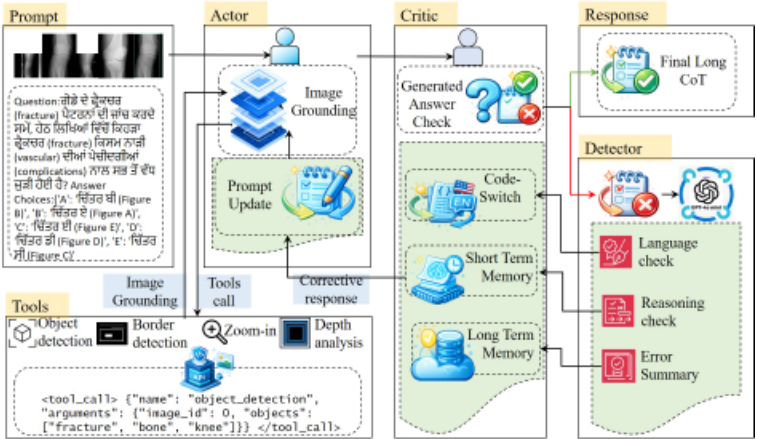
To enable reliable multimodal medical reasoning in Indic languages, we propose ArogyaSutra, an actor-criticbased multi-agent framework that combines tool-based visual grounding with dual-memory mechanisms for step-wise, reasoning-aware decision making over image-text inputs. At each reasoning step t, the Actor, implemented as a multimodal language model, processes medical visual inputs and an Indic-language query, invoking lightweight grounding tools [Zhou et al., 2025b] (e.g., zoom/crop, edge detection, depth analysis, and region-level detection) to extract clinically relevant evidence. Rather than directly producing a final answer, the Actor predicts intermediate semantic reasoning steps. The framework is supported by a dual-memory design: long-termmemory summarizes prior reasoning steps, linguistic formulations, and identified errors (from steps 1 to t-1), while short-term memory captures the most recent prediction error and feedback. The Critic evaluates the Actor's outputs for both medical correctness and language consistency, providing targeted corrective feedback-delivered in English for linguistic errors and in the corresponding Indic language otherwise-which is used to update the memory modules. Through this iterative actor-critic interaction, ArogyaSutra enables transparent, medically grounded, and linguistically stable reasoning, supporting more trustworthy diagnostic explanations across diverse Indic languages.
To summarize, the contributions of this work can be enumerated as follows: Problem Formulation. We formalize a new task of multimodal medical reasoning in Indic languages, where a model must perform step-by-step clinical reasoning over medical images and Indic-language queries to produce medically correct and linguistically consistent answers. Benchmark. We introduce ArogyaBodha, a largescale multilingual multimodal medical reasoning dataset and benchmark covering seven major Indian languages and English. Curated from eight diverse medical sources, it spans 31 body systems and 21 clinical domains, with expert-verified instances and unambiguous ground-truth answers to enable reliable evaluation of reasoning accuracy. Framework. We propose ArogyaSutra, an actor-critic-based multi-agent framework that combines tool-based visual grounding with dual-memory mechanisms for step-wise multimodal medical inference. The framework explicitly tracks and corrects reasoning errors and linguistic inconsistencies through iterative refinement. Evaluation. Extensive experiments across languages, imaging modalities, and clinical domains demonstrate that ArogyaSutra consistently outperforms strong multimodal baselines in both reasoning accuracy and multilingual alignment, highlighting its effectiveness for reliable medical AI in Indic language settings.
Impact for AI for Social Good. ArogyaSutra and ArogyaBodha support equitable healthcare access by enabling multilingual multimodal medical reasoning in low-resource Indic languages. The work aligns with AI for Healthcare, Public Health, and Marginalized Communities by promoting clinically grounded and inclusive medical AI systems.
Stakeholders and Multidisciplinary Collaboration. This work is developed in collaboration with certified medical practitioners for clinical validation of the curated medical questions and answers. Translation quality across seven Indic languages is evaluated using reverse-translation analysis with cosine similarity and BLEU4 metrics to ensure preservation of clinical meaning and linguistic fidelity in multilingual healthcare settings.
| Sl. | Dataset | Records | Processing |
|---|---|---|---|
| 1 | MedXpertQA | 1,982 | Direct |
| 2 | MedTrinity-25M | 576 | Caption, few-shot |
| 3 | MedPix-2.0 | 464 | Report, few-shot |
| 4 | MAMA-MIA | 64 | Caption, few-shot, pa- tient details |
| 5 | BRATS24 | 393 | Caption, few-shot, pa- |
| 6 | PMC-VQA | 1,073 | tient details Direct, filtered |
| 7 | GMAI-MMBench | 164 | Direct, filtered |
| 8 | NEET-PG, FMGE | 391 | Extracted, filtered |
| Total | 5107 |
2 RelatedWorks
2.1 Medical Multimodal andMultilingual Reasoning
Recent training paradigms such as prompt tuning [Mohanty et al., 2025], supervised fine-tuning (SFT) [Huang et al., 2025], reinforcement learning (RL) [Zhou et al., 2025a] ,agentic distillation [Ghosh et al., 2026] have significantly improved MLLMs on complex vision-language reasoning tasks [Chen et al., 2024] and have been increasingly adapted to medical settings [Huang et al., 2026; Sun et al., 2025]. However, robust multimodal medical reasoning remains challenging due to limitations in supervision strategies and dataset quality [Zhang et al., 2025; Hu et al., 2025]. Prior studies show that SFT with final-answer supervision often leads to overfitting and poor out-of-distribution generalization, as observed in Medvlm-r1 [Pan et al., 2025], while structured reasoning approaches such as Medvlthinker [Huang et al., 2026] remain constrained by modality-specific data. RL-based and multi-agent methods, including Med-R1 [Lai et al., 2025] and MMedAgent-RL [Xia et al., 2026], aim to improve robustness through long-form Chain-of-Thought (CoT) distillation, while Chiron-o1 [Sun et al., 2025] achieves effective reasoning via long-CoT SFT with Mentor-Intern Collaborative Search. Multilingual medical reasoning poses additional challenges, as reasoning performance is strongest in English due to data imbalance [Qiu et al., 2024], and enforcing reasoning in low-resource languages often degrades coherence and amplifies degenerative language patterns [Li et al., 2025].
2.2 Agentic Frameworks in Healthcare
Recent work has explored agentic frameworks to enhance medical reasoning in complex clinical settings. MedAgents[Tang et al., 2024] introduces collaborative multiagent discussion to improve zero-shot medical reasoning, while MMedAgent[Li et al., 2024] extends this paradigm using reinforcement learning to optimize coordination between specialist agents and a general practitioner agent. MedR1 [Lai et al., 2025] demonstrates that distilling Chainof-Thought (CoT) reasoning via reinforcement learning improves robustness when high-quality medical supervision is limited. Complementary efforts such as AgentClinic [Schmidgall et al., 2024] and MedAgentBench [Jiang et al., 2025] focus on realistic evaluation environments for medical agents, emphasizing multi-step decision-making and tool interaction.[Ghosh et al., 2026] improve long-horizon medical reasoning by introducing a dedicated dataset and a distillation-based framework for healthcare task automation. Despite these advances, most existing approaches are limited to high-resource languages or modality-specific settings. Our work builds upon these foundations by introducing an agentic, memory-aware multimodal reasoning framework tailored to low-resource Indic language healthcare scenarios. To address these gaps-particularly the lack of multimodal reasoning benchmarks for low-resource Indic languages-we curate a dedicated benchmark, ArogyaBodha. In addition, to enable agentic systems to make informed corrective decisions based on the underlying cause of failure, whether linguistic or logical, we propose a novel Actor-Critic framework, ArogyaSutra, that adaptively governs feedback and reflection during reasoning.
3 Dataset: ArogyaBodha
ArogyaBodha comprises 7 major Indian languages namely Bengali(5,111), Hindi(5,104), Assamese(5,108), Tamil(5,106), Telugu(5,106), Punjabi(5,108), and Marathi(5,107), along with English(5,107) curated and filtered from eight heterogeneous medical sources, resulting in a total of 40,857 samples. These sources include benchmark datasets, medical imaging repositories, and postgraduate medical examination questions from India.
3.1 Curation and Filtration
We build the dataset by combining existing medical reasoning benchmarks with questions from Indian postgraduate medical entrance examinations (NEET-PG and FMGE) as shown in Table (Table 1). This ensures that the data is clinically relevant and covers a wide range of medical topics. To better reflect real-world clinical scenarios, we employ fewshot prompting with GPT-4o-mini by combining patient details, reports, and contextual medical information available in the datasets. To keep the questions challenging, The generated questions are further filtered based on reasoning depth and image-question relevance using Gemini-2.5-Flash. Relevance is evaluated using multiple clinical consistency criteria, including modality appropriateness (e.g., CT, MRI, X-ray), anatomical alignment between image and question, visibility of clinical findings, and overall clinical coherence between the image and the associated question. Only samples that pass the relevance checks are included in the final dataset. Finally, the clinical validity and medical correctness of the multimodal questions and answers are reviewed and verified by medical practitioners.
3.2 Translation
The filtered high-quality questions and options are translated into seven major Indian languages using Gemini-2.5-Pro, which is one of the best-known LLMs for generating highquality translations. This step enables multilingual coverage while preserving the original clinical semantics and reasoning requirements.
| Language | BLEU4 | CosineBack | CosineDirect |
|---|---|---|---|
| Hindi | 0.57 | 0.94 | 0.85 |
| Marathi | 0.50 | 0.93 | 0.81 |
| Tamil | 0.51 | 0.93 | 0.65 |
| Telugu | 0.50 | 0.93 | 0.64 |
| Bengali | 0.51 | 0.93 | 0.62 |
| Punjabi | 0.56 | 0.93 | 0.58 |
| Assamese | 0.49 | 0.93 | 0.50 |
3.3 Translation Analysis
Translation quality is evaluated using reverse translation analysis across seven Indic languages, as summarized in Table 2. Semantic consistency between the original English text and translated medical questions is measured using cosine similarity with SentenceTransformer models, while BLEU4 scores are computed between the original and back-translated English text using NLTK. The results show strong semantic preservation across languages, with CosineBack scores consistently remaining around 0.93-0.94 and higher direct semantic alignment observed for Hindi and Marathi.
To further assess translation quality, 20% of the translated test samples are manually reviewed by medical practitioners proficient in the corresponding regional languages. The evaluators score the translations on a five-point scale based on clinical meaning preservation, medical terminology correctness, semantic consistency, linguistic fluency, and contextual relevance, resulting in an average score of 4.27. This combined automatic and human evaluation framework helps ensure linguistic fidelity, preservation of clinical meaning, and multilingual consistency throughout the benchmark construction process.
4 Framework : ArogyaSutra
While recent multimodal models demonstrate strong perceptual grounding in generic environments, their performance degrades substantially in real-world healthcare systems, particularly in low-resource Indic language settings. To address these challenges, ArogyaSutra introduces a multimodal agentic framework that integrates tool-grounded perceptual reasoning with dual-memory mechanisms comprising shortterm and long-term memory to track prior errors and contextual dependencies across reasoning chains. In addition, ArogyaSutra employs language-aware reflective reasoning to analyze past mistakes and dynamically determine when codeswitching is required, enabling robust interaction with complex clinical software in Indic languages. The overall framework is shown in Figure 1
4.1 Vision Tools Grounding
To enhance the perceptual grounding of medical findings, we focus on four visual tools that are particularly effective for perception-centric tasks. Although a broader set of tools is available, empirical observations show that the model consistently underutilizes them during inference. We therefore integrate these four high-performing tools directly into the MLLM inference loop, enabling tool execution and result incorporation to form a coherent multimodal rollout. Specifically, the toolkit includes: (i) open-vocabulary object detection, which localizes interface elements given a screenshot and textual query; (ii) zoom/crop, which magnifies selected regions for fine-grained inspection; (iii) Edge Detection, which extracts the edges of the objects present in the given image; and (iv) Depth Analysis, which estimates the relative distances, producing a depth map.
4.2 Memory Utilization
Reasoning errors may arise from linguistic ambiguities or incorrect intermediate logic errors. To prevent the agent from repeating such failures, we introduce an explicit memory mechanism that records past errors and guides future reasoning. The memory is structured into two components: a short-termmemory that captures the most recent error, and a long-term memory that summarizes error patterns accumulated over the entire reasoning trajectory. Together, these components enable the agent to account for both immediate mistakes and persistent failure modes when making subsequent decisions. The short-term and long-term memories are represented by the equations below.
4.3 Actor-Critic Framework
ArogyaSutra adopts an Actor-Critic formulation as its core decision module, jointly leveraging tool-based perceptual grounding and temporally accumulated memory. Both the Actor and the Critic are instantiated from the same multimodal backbone, Qwen-VL-2.5-7B, and differ only in their functional roles : action proposal versus action evaluation and their input conditioning. At timestep t, the Actor observes the current interface state ot, task objective g, perceptual context zt, and memory states (MSt ,MLt ), and samples a candidate semantic action:
where πθ denotes the Actor policy and ut represents the proposed action. The Critic, parameterized by ψ, evaluates the proposed action by estimating a scalar confidence score:
where ˆ st reflects the estimated correctness of the action. If ˆ st = 1, the action is accepted, and both memory modules are updated; otherwise, the Critic triggers language-Analysis reflection and emits structured corrective feedback ∆t to guide the subsequent reasoning chain.
Language Analysis Aware Reflection. When the Actor produces an incorrect prediction, the Critic first diagnoses the source of the failure, distinguishing between language understanding errors, such as repeated tokens or incomplete generations, and logical errors in the reasoning chain. If the error is attributed to language instability, the Critic provides reflective feedback in English to stabilize and guide the Actor's reasoning chain to rectify itself. Conversely, if the failure stems from faulty reasoning, the Critic issues the reflection in the corresponding Indic language of the query, enabling more contextually grounded corrective guidance.
| Model | Assamese | Bengali | Hindi | Marathi | Punjabi | Tamil | Telugu | Average |
|---|---|---|---|---|---|---|---|---|
| GPT 4.0 mini | 35.38 | 45.38 | 37.69 | 33.07 | 36.15 | 31.53 | 33.20 | 36.05 |
| GPT 4.0 | 38.40 | 44.60 | 40.10 | 37.80 | 39.20 | 36.90 | 39.10 | 39.30 |
| Qwen3-VL-8B-Instruct | 41.30 | 40.50 | 41.50 | 41.50 | 41.60 | 38.70 | 39.90 | 40.71 |
| Mistral-Small-3.2-24B-Instruct | 40.90 | 42.90 | 44.10 | 43.20 | 40.90 | 41.40 | 42.50 | 42.27 |
| LLaVA-v1.6-34B | 32.09 | 31.45 | 34.44 | 33.66 | 31.70 | 31.31 | 35.42 | 32.87 |
| BioMistral-7B | 25.64 | 25.78 | 28.38 | 25.83 | 24.27 | 27.59 | 26.95 | 26.35 |
| Llama3-OpenBioLLM-8B | 16.10 | 15.60 | 22.20 | 20.50 | 11.70 | 12.10 | 7.70 | 15.13 |
| MedGemma-4B-it | 38.50 | 35.10 | 37.40 | 34.50 | 35.70 | 36.70 | 34.90 | 36.11 |
| MedVLM-R1 | 23.50 | 22.80 | 25.60 | 22.80 | 24.20 | 25.40 | 22.20 | 23.79 |
| Qwen2.5-VL-3B-Instruct | 28.70 | 30.70 | 31.50 | 31.30 | 28.40 | 28.20 | 28.10 | 29.56 |
| Qwen2.5-VL-7B-Instruct | 32.30 | 36.50 | 33.84 | 36.12 | 32.30 | 35.38 | 33.07 | 34.21 |
| ArogyaSutra(Qwen 2.5 VL 3B) | 34.69 | 37.08 | 38.36 | 37.03 | 33.07 | 35.73 | 33.60 | 35.65 |
| ArogyaSutra(Qwen 2.5 VL 7B) | 47.69 | 45.38 | 42.30 | 42.30 | 43.07 | 41.53 | 41.53 | 43.40 |
| Model | Assamese | Bengali | Hindi | Marathi | Punjabi | Tamil | Telugu | Average |
|---|---|---|---|---|---|---|---|---|
| ArogyaSutra(with all components) | 47.69 | 45.38 | 42.30 | 42.30 | 43.07 | 41.53 | 41.53 | 43.40 |
| w/o Critic and Image Grounding | 40.00 | 36.00 | 34.00 | 32.00 | 32.00 | 28.00 | 32.00 | 33.43 |
| w/o Critic | 42.00 | 32.0 | 36.00 | 30.00 | 34.00 | 30.00 | 32.00 | 33.71 |
| w/o Image Grounding | 24.00 | 28.00 | 32.00 | 28.00 | 26.00 | 22.00 | 28.00 | 26.86 |
| w/o code-switch | 30.00 | 32.00 | 26.00 | 24.00 | 28.00 | 24.00 | 24.00 | 26.86 |
Halting Condition. If the actor-critic framework converges to the correct answer within three or fewer reasoning iterations, the resulting reasoning trace is retained. Otherwise, the reasoning process is reset and restarted using a summary of the accumulated errors stored in long-term memory. If the framework fails to reach the correct answer in two consecutive restart cycles, the corresponding data point is deemed unreliable and is removed from the training set.
4.4 Training Strategy
To progressively enhance the Actor's capabilities, we perform code-switched reasoning chain distillation by transferring the Critic's corrective signals into the Actor, thereby removing the need for explicit evaluation at inference time. Specifically, after simulating Actor-Critic rollouts, we construct a Criticrefined dataset D = {(oi, gi, zi,MSi ,MLi , u†i )}Ni=1 , where u†i denotes the Critic-approved action augmented with relevant tool outputs and memory context for the subsequent step.
The Actor is then fine-tuned using supervised learning with the following objective:
During inference, only the distilled policy πθ is retained. Conditioned on the current interface state, task objective, and memory signals, the Actor directly predicts the next semantic action without invoking the Critic. This distillation strategy preserves the Critic's structured reasoning and memoryaware behavior while substantially reducing inference-time overhead.
5 Experimental Setup
This section describes our experimental setups. First section describes implementation details, second section describes evaluation metrics and the last section is for baselines.
5.1 Implementation Details
All experiments were conducted on an NVIDIA A100 80GB PCIe GPU. Models were trained for 3 epochs on an 18k multilingual multimodal dataset with balanced language proportions, requiring approximately 12-15 hours per run. We used PyTorch, Hugging Face Transformers, and Unsloth for efficient training. The learning rate was set to 5 × 10⁻⁴ with 100 warmup steps and a weight decay of 0.01. Training was performed with a per-device batch size of 2 and 4 gradient accumulation steps. We fine-tuned the Qwen2.5-VL7B-Instruct model using Unsloth with gradient checkpointing and 4-bit precision (load in 4bit=True) for memory efficiency. Parameter-efficient fine-tuning was applied to the language, attention, and MLP projection layers, with LoRA rank r = 16, LoRA α = 16, and dropout set to 0.
5.2 Testset Composition
From the curated dataset, we select 130 samples per language to construct the test set, resulting in 910 samples across seven languages. The test set is balanced across data sources, with identical questions used for all languages to enable controlled cross-lingual comparison. Each language's test set comprises 42 samples fromMedXpertQA, 34 from PMC-VQA, 16 from MedPix-2.0, 17 from MedTrinity-25M, 9 from BRATS24, 8 from NEET-PG and FMGE, 3 from GMAI-MMBench, and 1 from MAMA-MIA. We curate a set of 60 multimodal medical queries derived from real-world clinical examinations of the M´edico Interno Residente (MIR) residency exams in Spain [Riccio et al., 2025], each translated into all seven evaluated Indic languages to enable controlled cross-lingual outof-distribution (OOD) evaluation.
| Model | Accuracy |
|---|---|
| Qwen3-VL-8B-Instruct | 49.6 |
| Qwen2.5-VL-3B-Instruct | 38.6 |
| LLaVA-v1.6-34B | 23.3 |
| BioMistral-7B | 36.9 |
| Llama3-OpenBioLLM-8B | 39.3 |
| MedGemma-4B-it | 45.2 |
| MedVLM-R1 | 23.6 |
| Qwen2.5-VL-7B-Instruct (Baseline) | 35.0 |
| ArogyaSutra(Qwen 2.5 VL 7B) | 50.4 |
5.3 Baselines and EvaluationMetric
We evaluate the proposed question set across a diverse range of medical and non-medical multimodal large language models (MLLMs) to ensure a comprehensive comparison. Our evaluation includes vision-language models from the Qwen family[Wang et al., 2024] (Qwen3-VL-8B-Instruct and Qwen2.5-VL-3B-Instruct) to analyze performance across model scales, as well as strong general-purpose MLLMsMistral-Small-3.2-24B-Instruct[Jiang et al., 2024a], and LLaVA-v1.6-34B[Liu et al., 2023] which are not specifically trained for medical reasoning. For domain-focused assessment, we additionally, benchmark medical MLLMs, including BioMistral-7B[Labrak et al., 2024], Llama3OpenBioLLM-8B[Dorfner et al., 2024], MedGemma-4Bit[Sellergren et al., 2025], and MedVLM-R1[Pan et al., 2025]. Among closed source models, we use GPT 4.0 mini and GPT 4.0. All models are evaluated in a zero-shot setting, and performance is measured using choice accuracy as the primary metric.
6 Result and Analysis
We evaluate ArogyaSutra against strong general-purpose and medical-domain multimodal baselines. As shown in Table 3, integrating tool grounding with short- and long-term memory substantially improves multimodal medical reasoning. We further conduct controlled component and robustness analyses on an out-of-distribution benchmark [Riccio et al., 2025] medical questions across multiple Indic languages.
6.1 Research Question
a) How does ArogyaSutra perform compared to baselines? Table 3 shows that ArogyaSutra achieves the best average performance across evaluated languages. The Qwen2.5-VL7B variant achieves the highest average accuracy of 43.40, surpassing the strongest baseline (GPT-4.0 at 39.30) by +4.1 points, with consistent gains across all seven languages. It also significantly outperforms medical-specific models such as BioMistral-7B (23.83 avg) and MedGemma-4B-it (36.11 avg), highlighting a clear advantage over domain-specialized baselines. Notably, ArogyaSutra improves over its base Qwen2.5-VL-7B model by +9.2 points, demonstrating the effectiveness of the proposed approach for robust cross-lingual medical reasoning.
b) How is the performance of ArogyaSutra compared to the baseline models it has been trained on? In Table 3, ArogyaSutra substantially outperforms the baseline models on which it is trained. ArogyaSutra (Qwen2.5-VL-3B) improves the average accuracy from 29.56 to 35.65, yielding a gain of +6.1 points over Qwen2.5-VL-3B-Instruct. More prominently, ArogyaSutra (Qwen2.5-VL-7B) achieves an average accuracy of 43.40, surpassing its base Qwen2.5-VL7B-Instruct model (34.21) by +9.2 points, with consistent improvements across all evaluated languages. This indicates that ArogyaSutra delivers substantial gains beyond its underlying baseline models.
c) How is the performance of ArogyaSutra on out of distribution dataset? Table 5 shows the performance of ArogyaSutra on OOD dataset. On the out-of-distribution (OOD) dataset [Riccio et al., 2025], ArogyaSutra demonstrates strong generalization performance. ArogyaSutra(Qwen2.5VL-7B) achieves an accuracy of 50.4, outperforming its base model Qwen2.5-VL-7B-Instruct baseline (35.0) by a clear margin. It also surpasses large general-purpose MLLMs such as LLaVA-v1.6-34B (23.3), as well as medical-specific models including BioMistral-7B (36.9) and MedGemma-4Bit (45.2). These results indicate that ArogyaSutra exhibits robust reasoning and improved resilience under distribution shift.
7 Ablation Studies
Impact of the Critic Agent and its Components. Removing the Critic significantly reduces performance, with Actor-only variants achieving 33.43%-33.71% compared to 43.40% for the full ArogyaSutra framework (Table 4). Even the grounded Actor-only model underperforms the baseline Qwen2.5-VL7B-Instruct (34.21%). Furthermore, removing tool grounding or code-switching causes the largest performance drop (16.54%), while disabling long- and short-term memory reduces accuracy by 12.83%. These results highlight the importance of reflective error correction, grounding, memory, and adaptive multilingual reasoning in ArogyaSutra.
Impact of Tool Grounding and Memory. Table 6 shows that disabling both components reduces accuracy to 26.86%. Memory alone improves performance to 30.57%, while enabling both achieves the best accuracy of 43.40%, demonstrating their complementary role in multilingual multimodal reasoning.
| Image Grounding | Memory Utilization | Average Output (%) |
|---|---|---|
| 26.86 | ||
| 30.57 | ||
| 43.40 |
8 Qualitative Analysis
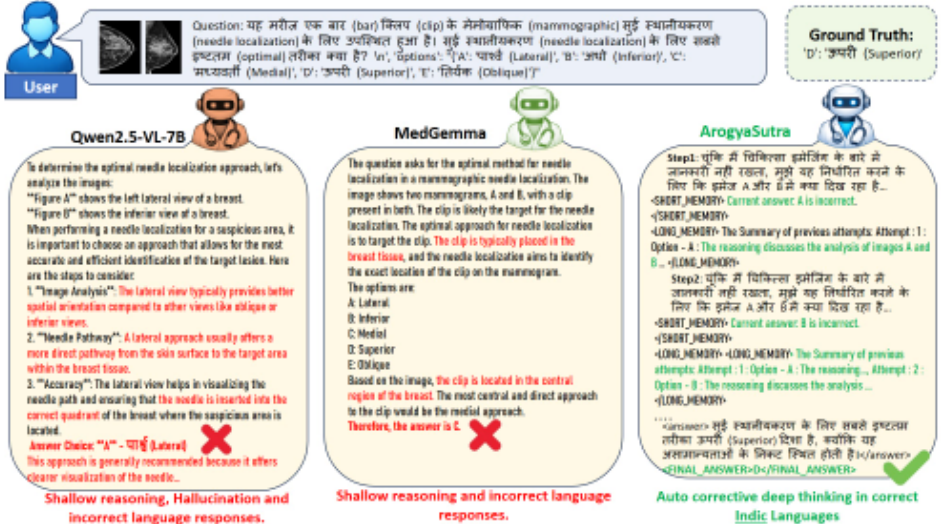
We qualitatively analyze the generated outputs of the proposed model and compare them with two representative baselines: the medical MLLMMedGemma-4B-it and the generalpurpose vision-language model Qwen2.5-VL-7B-Instruct as shown in the Figure 2. Both baselines exhibit shallow reasoning and frequently fail to respond in the input low-resource language (e.g., Hindi). In contrast, ArogyaSutra consistently generates responses in the target language and demonstrates more structured and corrective reasoning. Leveraging the actor-critic framework, the model identifies and revises incorrect intermediate conclusions, progressively eliminating implausible hypotheses. These observations highlight the effectiveness of ArogyaSutra in improving multilingual alignment and reasoning fidelity in multilingual medical settings.
9 Risk Analysis and Limitations
Despite the strong performance of ArogyaSutra and the ArogyaBodha benchmark, several limitations remain. The model may still produce reasoning errors or misinterpret visual evidence, particularly in rare or atypical clinical cases, which poses risks if outputs are misused for real-world decision making. While ArogyaBodha covers seven major Indian languages, it does not capture the full linguistic diversity of India, including low-resource dialects and code-mixed language commonly used in clinical practice, potentially degrading performance under such conditions. Finally, the actor-critic framework depends on the reliability of underlying visual grounding tools and the base multimodal backbone; failures in perception or error attribution can propagate through the reasoning process despite critical feedback.
10 Conclusion
We introduce ArogyaBodha and ArogyaSutra to advance multilingual multimodal medical reasoning in low-resource Indic-language settings, demonstrating consistent improvements over strong general-purpose and medical baselines across languages and imaging modalities. By integrating tool-grounded perception, actor-critic reasoning, memoryaware reflection, and adaptive code-switching, ArogyaSutra enables more reliable and linguistically consistent medical reasoning across diverse Indic languages. Extensive experiments, ablation studies, and out-of-distribution evaluations demonstrate the effectiveness and robustness of the proposed framework. We hope this work encourages future research in trustworthy multilingual medical AI and clinically grounded multimodal reasoning systems for underserved communities.
Ethical Statement
All datasets are anonymized and contain no personally identifiable patient information. All datasets used in ArogyaBodha, including MedXpertQA, MedTrinity-25M, PMCVQA, MedPix-2.0, MAMA-MIA, BraTS 2024, GMAIMMBench, and NEET-PG/FMGE, are publicly available under their respective research, academic, or open-access licenses and are utilized solely for non-commercial research purposes.
Acknowledgments
The authors gratefully acknowledge the Aryabhatta Supercomputing Centre (ASC) at the Indian Institute of Technology Patna, established under the National Supercomputing Mission (NSM), Government of India, for providing the computational resources utilized in this work. The authors also sincerely thank Dr. Muhsin Muhsin from IGIMS and Dr. Priti Singh from IIT Patna for their valuable collaboration and support throughout the project, particularly in the data curation and verification processes.
Contribution Statement
Tanmoy Kanti Halder and Akash Ghosh contributed equally to this work.
@inproceedings{ijcai2026p799,
  title     = {ArogyaSutra: A Multi-Agent Framework for Multimodal Medical Reasoning in Indic Languages},
  author    = {Halder, Tanmoy Kanti and Ghosh, Akash and Baidya, Subhadip and Roy, Arijit and Saha, Sriparna},
  booktitle = {Proceedings of the Thirty-Fifth International Joint Conference on
               Artificial Intelligence, {IJCAI-26}},
  publisher = {International Joint Conferences on Artificial Intelligence Organization},
  editor    = {Diego Calvanese},
  pages     = {7183--7191},
  year      = {2026},
  month     = {8},
  note      = {AI and Social Good},
  doi       = {10.24963/ijcai.2026/799},
  url       = {https://doi.org/10.24963/ijcai.2026/799},
}
TY - CPAPER TI - ArogyaSutra: A Multi-Agent Framework for Multimodal Medical Reasoning in Indic Languages AU - Halder, Tanmoy Kanti AU - Ghosh, Akash AU - Baidya, Subhadip AU - Roy, Arijit AU - Saha, Sriparna T2 - Proceedings of the Thirty-Fifth International Joint Conference on Artificial Intelligence, IJCAI-26 PB - International Joint Conferences on Artificial Intelligence Organization PY - 2026 SP - 7183 EP - 7191 DO - 10.24963/ijcai.2026/799 UR - https://doi.org/10.24963/ijcai.2026/799 ER -Copied
Machine-readable versions of this paper, for tools and AI agents:





