
DIAM: Adaptive Drug Repositioning with Decoupled Biological Mechanism and Instance-Aware Modulation
Proceedings of the Thirty-Fifth International Joint Conference on Artificial Intelligence. AI and Health. Pages 6949-6957.
https://doi.org/10.24963/ijcai.2026/773
Keywords
- Medical knowledge representation: Medical knowledge representation
- Health data mining: Health data mining
- Drug discovery: Drug discovery
Abstract
Drug repositioning has emerged as an attractive drug development strategy with deep learning-based computational methods showing great potential in predicting Drug-Disease Associations (DDAs). However, dominant computational paradigms typically rely on Random Negative Sampling (RNS) and static embedding fusion, leading to two fundamental limitations. First, RNS treats unobserved pairs uniformly, resulting in coarse decision boundaries that fail to distinguish true associations from ambiguous candidates. Second, static fusion applies a monolithic combination of heterogeneous features, failing to adapt to the sample-specific dominance of different biological mechanisms. To address these issues, we propose DIAM, which establishes a mechanism-adaptive paradigm by explicitly decoupling structural and molecular signals. Specifically, DIAM introduces a Dual-Stream Biological Mechanism Decoupling module to construct global structural propagation and local molecular interaction views explicitly. Leveraging these views, we design a biological plausibility score to guide the hard negative sampling, enforcing finer-grained decision boundaries. Furthermore, an Adaptive Residual Gating (ARG) is devised to perform instance-aware modulation, dynamically weighing the contribution of global and local views for each specific pair. Extensive experiments on three benchmark datasets demonstrate that DIAM outperforms seven state-of-the-art methods. A case study on Alzheimer's disease further validates the model's effectiveness in identifying potential candidate drugs for practical application.
- [Aittokallio, 2022] Tero Aittokallio. What are the current challenges for machine learning in drug discovery and re- purposing? Expert opinion on drug discovery, 17(5):423- 425, 2022.
- [Cai et al., 2021] Lijun Cai, Changcheng Lu, Junlin Xu, Ya- jie Meng, Peng Wang, Xiangzheng Fu, Xiangxiang Zeng, and Yansen Su. Drug repositioning based on the hetero- geneous information fusion graph convolutional network. Briefings in bioinformatics, 22(6), 2021.
- [Cui et al., 2025] Hai Cui, Meiyu Duan, Jianyuan Yuan, Zi- wei Ma, and Yijia Zhang. Sign-aware graph contrastive learning for drug repositioning. IEEE Journal of Biomed- ical and Health Informatics, 2025.
- [Davis et al., 2023] Allan Peter Davis, Thomas C Wiegers, Robin J Johnson, Daniela Sciaky, Jolene Wiegers, and Carolyn J Mattingly. Comparative toxicogenomics database (ctd): update 2023. Nucleic acids research, 51(D1):D1257-D1262, 2023.
- [DiMasi et al., 2003] Joseph A DiMasi, Ronald W Hansen, and Henry G Grabowski. The price of innovation: new estimates of drug development costs. Journal of health economics, 22(2):151-185, 2003.
- [Ding et al., 2020] Yijie Ding, Jijun Tang, and Fei Guo. Identification of drug-target interactions via fuzzy bipar- tite local model. Neural Computing and Applications, 32(14):10303-10319, 2020.
- [Gao et al., 2022] Chu-Qiao Gao, Yuan-Ke Zhou, Xiao- Hong Xin, Hui Min, and Pu-Feng Du. Dda-skf: predicting drug-disease associations using similarity kernel fusion. Frontiers in Pharmacology, 12:784171, 2022.
- [Gao et al., 2023] Zihao Gao, Huifang Ma, Xiaohui Zhang, Yike Wang, and Zheyu Wu. Similarity measures-based graph co-contrastive learning for drug-disease association prediction. Bioinformatics, 39(6):btad357, 2023.
- [Gottlieb et al., 2011] Assaf Gottlieb, Gideon Y Stein, Ey- tan Ruppin, and Roded Sharan. Predict: a method for inferring novel drug indications with application to per- sonalized medicine. Molecular systems biology, 7(1):496, 2011.
- [Gu et al., 2022] Yaowen Gu, Si Zheng, Qijin Yin, Rui Jiang, and Jiao Li. Redda: Integrating multiple biological re- lations to heterogeneous graph neural network for drug- disease association prediction. Computers in biology and medicine, 150:106127, 2022.
- [Gu et al., 2025] Yaowen Gu, Si Zheng, Bowen Zhang, Hongyu Kang, Rui Jiang, and Jiao Li. Deep multi- ple instance learning on heterogeneous graph for drug- disease association prediction. Computers in Biology and Medicine, 184:109403, 2025.
- [Hamosh et al., 2005] Ada Hamosh, Alan F Scott, Joanna S Amberger, Carol A Bocchini, and Victor A McKusick. Online mendelian inheritance in man (omim), a knowl- edgebase of human genes and genetic disorders. Nucleic acids research, 33(suppl 1):D514-D517, 2005.
- [Hu et al., 2020] Ziniu Hu, Yuxiao Dong, Kuansan Wang, and Yizhou Sun. Heterogeneous graph transformer. In Proceedings of the web conference 2020, pages 2704- 2710, 2020.
- [Huang et al., 2022] Weihong Huang, Zhong Li, Yanlei Kang, Xinghuo Ye, and Wenming Feng. Drug repo- sitioning based on the enhanced message passing and hypergraph convolutional networks. Biomolecules, 12(11):1666, 2022.
- [Huang et al., 2024] Shuhan Huang, Minhui Wang, Xiao Zheng, Jiajia Chen, and Chang Tang. Hierarchical and dynamic graph attention network for drug-disease associ- ation prediction. IEEE Journal of Biomedical and Health Informatics, 28(4):2416-2427, 2024.
- [Huang et al., 2025] Zhaoyang Huang, Zhichao Xiao, Chun- yan Ao, Lixin Guan, and Liang Yu. Computational approaches for predicting drug-disease associations: a comprehensive review. Frontiers of Computer Science, 19(5):195909, 2025.
- [Knox et al., 2024] Craig Knox, Mike Wilson, Christen M Klinger, Mark Franklin, Eponine Oler, Alex Wilson, Al- lison Pon, Jordan Cox, Na Eun Chin, Seth A Straw- bridge, et al. Drugbank 6.0: the drugbank knowledgebase for 2024. Nucleic acids research, 52(D1):D1265-D1275, 2024.
- [Kola and Landis, 2004] Ismail Kola and John Landis. Can the pharmaceutical industry reduce attrition rates? Nature reviews Drug discovery, 3(8):711-716, 2004.
- [Lei et al., 2024] Song Lei, Xiujuan Lei, Ming Chen, and Yi Pan. Drug repositioning based on deep sparse au- toencoder and drug-disease similarity. Interdisciplinary Sciences: Computational Life Sciences, 16(1):160-175, 2024.
- [Liu et al., 2024] Junkai Liu, Shixuan Guan, Quan Zou, Hongjie Wu, Prayag Tiwari, and Yijie Ding. Amdgt: Attention aware multi-modal fusion using a dual graph transformer for drug-disease associations prediction. Knowledge-Based Systems, 284:111329, 2024.
- [Livingston et al., 2024] Gill Livingston, Jonathan Huntley, Kathy Y Liu, Sergi G Costafreda, Geir Selbæk, Suvarna Alladi, David Ames, Sube Banerjee, Alistair Burns, Carol Brayne, et al. Dementia prevention, intervention, and care: 2024 report of the lancet standing commission. The lancet, 404(10452):572-628, 2024.
- [Luo et al., 2016] Huimin Luo, Jianxin Wang, Min Li, Jun- wei Luo, Xiaoqing Peng, Fang-Xiang Wu, and Yi Pan. Drug repositioning based on comprehensive similarity measures and bi-random walk algorithm. Bioinformatics, 32(17):2664-2671, 2016.
- [Mei et al., 2022] Xin Mei, Xiaoyan Cai, Libin Yang, and Nanxin Wang. Relation-aware heterogeneous graph trans- former based drug repurposing. Expert Systems with Ap- plications, 190:116165, 2022.
- [Meng et al., 2022] Yajie Meng, Changcheng Lu, Min Jin, Junlin Xu, Xiangxiang Zeng, and Jialiang Yang. A weighted bilinear neural collaborative filtering approach for drug repositioning. Briefings in bioinformatics, 23(2):bbab581, 2022.
- [Ni et al., 2023] Qin Ni, Tingjiang Wei, Jiabao Zhao, Liang He, and Chanjin Zheng. Hhskt: A learner-question inter- actions based heterogeneous graph neural network model for knowledge tracing. Expert Systems with Applications, 215:119334, 2023.
- [Oord et al., 2018] Aaron van den Oord, Yazhe Li, and Oriol Vinyals. Representation learning with contrastive predic- tive coding. arXiv preprint arXiv:1807.03748, 2018.
- [Ouyang et al., 2024] Jihong Ouyang, Chang Xuan, Bing Wang, and Zhiyao Yang. Aspect-based sentiment classifi- cation with aspect-specific hypergraph attention networks. Expert Systems with Applications, 248:123412, 2024.
- [Steinbeck et al., 2003] Christoph Steinbeck, Yongquan Han, Stefan Kuhn, Oliver Horlacher, Edgar Luttmann, and Egon Willighagen. The chemistry development kit (cdk): An open-source java library for chemo-and bioinformatics. Journal of chemical information and computer sciences, 43(2):493-500, 2003.
- [Van Driel et al., 2006] Marc A Van Driel, Jorn Bruggeman, Gert Vriend, Han G Brunner, and Jack AM Leunissen. A text-mining analysis of the human phenome. European journal of human genetics, 14(5):535-542, 2006.
- [Wang et al., 2014] Wenhui Wang, Sen Yang, Xiang Zhang, and Jing Li. Drug repositioning by integrating target infor- mation through a heterogeneous network model. Bioinfor- matics, 30(20):2923-2930, 2014.
- [Wang et al., 2023] Ying Wang, Ying-Lian Gao, Juan Wang, Feng Li, and Jin-Xing Liu. Msgca: Drug-disease asso- ciations prediction based on multi-similarities graph con- volutional autoencoder. IEEE Journal of Biomedical and Health Informatics, 27(7):3686-3694, 2023.
- [Wang et al., 2024] Ying Wang, Yingji Li, Yue Wu, and Xin Wang. Exploring multiple hypergraphs for heterogeneous graph neural networks. Expert Systems with Applications, 236:121230, 2024.
- [Yu et al., 2021] Zhouxin Yu, Feng Huang, Xiaohan Zhao, Wenjie Xiao, and Wen Zhang. Predicting drug-disease as- sociations through layer attention graph convolutional net- work. Briefings in bioinformatics, 22(4):bbaa243, 2021.
- [Yuan et al., 2024] Yongna Yuan, Jiahui Liu, Xiaohang Pan, Ruisheng Zhang, and Wei Su. Heterogenous biologi- cal network multi-task learning model for ncrna-disease- drug association prediction. Knowledge-Based Systems, 300:112222, 2024.
- [Zeng et al., 2019] Xiangxiang Zeng, Siyi Zhu, Xiangrong Liu, Yadi Zhou, Ruth Nussinov, and Feixiong Cheng. deepdr: a network-based deep learning approach to in silico drug repositioning. Bioinformatics, 35(24):5191- 5198, 2019.
- [Zhang et al., 2018] Wen Zhang, Xiang Yue, Weiran Lin, Wenjian Wu, Ruoqi Liu, Feng Huang, and Feng Liu. Predicting drug-disease associations by using similarity constrained matrix factorization. BMC bioinformatics, 19(1):233, 2018.
- [Zhao et al., 2023] Bo-Wei Zhao, Xiao-Rui Su, Yue Yang, Dong-Xu Li, Guo-Dong Li, Peng-Wei Hu, Yong-Gang Zhao, and Lun Hu. Drug-disease association prediction us- ing semantic graph and function similarity representation learning over heterogeneous information networks. Meth- ods, 220:106-114, 2023.
- [Zhu et al., 2025] Enqiang Zhu, Xiang Li, Chanjuan Liu, and Nikhil R Pal. Boosting drug-disease association pre- diction for drug repositioning via dual-feature extraction and cross-dual-domain decoding. Journal of Chemical In- formation and Modeling, 65(11):5745-5757, 2025.
References were extracted automatically from the PDF and may contain errors.
Full text extracted automatically from the PDF; figures, tables and equations may differ. The PDF is the version of record.
1 Introduction
Over the past few decades, the traditional model of drug research and development (R&D) has faced significant challenges, characterized by high costs, lengthy development cycles, and high failure rates [Huang et al., 2025]. Statistics indicate that only about 11% of the candidate drugs that enter human clinical trials ultimately receive regulatory approval [DiMasi et al., 2003; Kola and Landis, 2004]. In this context, drug repositioning, which identifies new indications for existing drugs, has emerged as a pivotal strategy to mitigate failure risks and accelerate therapeutic discovery [Lei et al., 2024]. To support this strategy, computational methods, particularly deep learning, have been widely adopted to predict potential DDAs.
∗Corresponding Author.
Despite the promising performance of recent deep learning models, the dominant computational paradigm in DDA prediction still suffers from two fundamental limitations, arising from a mismatch between simplified computational assumptions and complex biological realities: (1) Prevalent methods predominantly rely on random negative sampling [Huang et al., 2024; Liu et al., 2024], which indiscriminately treats unobserved drug-disease pairs as uniform negatives. Since random samples are often topologically distant from true associations, they fail to provide sufficient gradient penalties for ambiguous candidates, reducing the training process to a trivial discrimination against easy negatives. This deficiency causes the resulting decision boundary to remain insufficiently compact, compromising the model's capability to discern fine-grained discrepancies between verified interactions and ambiguous candidates. (2) Existing approaches typically employ a static, monolithic fusion logic (e.g., a fixed dot-product) to integrate heterogeneous biological features [Liu et al., 2024; Wang et al., 2023; Yuan et al., 2024]. This one-size-fits-all strategy fails to accommodate instancespecific heterogeneity, overlooking that the dominant informative view varies dynamically between global structural propagation and local molecular interactions across different drug-disease pairs. Consequently, this rigidity leads to suboptimal representation learning for complex biological associations.
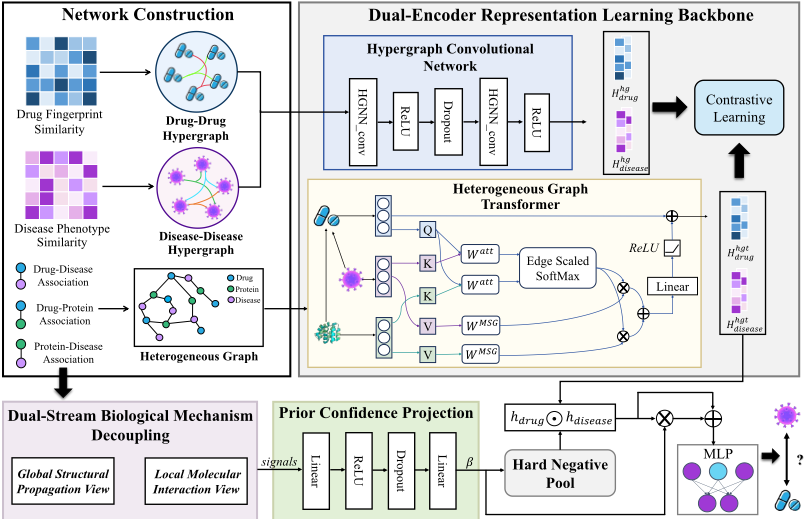
To address these challenges, we propose DIAM, a novel framework that rethinks DDA prediction from the perspective of decoupled biological mechanisms. The overall architecture of DIAM is depicted in Figure 1. Specifically, DIAM first constructs a Dual-Encoder Representation Learning backbone. We employ Heterogeneous Graph Transformer (HGT) and Hypergraph Convolutional Networks (HGCN) to capture heterogeneous structural patterns and high-order correlations, respectively. Distinct from previous approaches that rely on implicit feature propagation, we introduce a DualStream Biological Mechanism Decoupling module to explicitly quantify association evidence into topological propagation signals and target-mediated interaction signals. These decoupled signals serve two critical functions. First, we utilize them to calculate a biological plausibility score, which guides the mining of hard negative samples and forces the model to learn robust decision boundaries. Second, we design an Adaptive Residual Gating to perform instance-aware modulation. This module uses prior confidence projection to dynamically modulate the fusion of the learned representations. Additionally, we integrate a contrastive learning objective to align the semantic spaces of the dual-encoder representations. Finally, the modulated representations are fed into a predictor to infer association probabilities. The main contributions of this study are summarized as follows.
- We propose DIAM, a novel framework that orchestrates a Dual-Encoder backbone with a Dual-Stream Mechanism Decoupling module to synthesize the biological semantics underlying both global structural and local molecular views.
- We introduce two mechanism-driven strategies leveraging the decoupled signals: (1) Hard Negative Sampling, which utilizes biological plausibility scores to identify ambiguous candidates and compel the model to learn finer-grained discriminative features; and (2) Adaptive Residual Gating for instance-aware modulation, which dynamically rectifies the fusion of learned representations.
- Extensive experiments on three benchmark datasets demonstrate that DIAM outperforms the state-of-the-art methods.
2 RelatedWork
2.1 Network Diffusion-BasedMethods
Network diffusion-based methods infer associations by simulating information propagation across heterogeneous biological graphs. Representative works, such as TL-HGBI [Wang et al., 2014] and MBiRW [Luo et al., 2016], utilize update algorithm or random walk algorithms to predict potential drug-disease pairs. Despite offering strong interpretability, these methods are heavily reliant on the network's existing edges. This dependency hinders their ability to capture complex drug-disease associations, particularly with sparse data, limiting their predictive performance.
2.2 Machine Learning-BasedMethods
Machine learning-based methods treat drug-disease association prediction as a classification or regression problem, making predictions by learning patterns from the feature vectors of drugs and diseases. Early works exhibit diverse strategies: PREDICT [Gottlieb et al., 2011] utilizes logistic regression, whereas FBLM [Ding et al., 2020] adopts a fuzzy SVM to model drug-disease relationships. Subsequently, SFRLDDA [Zhao et al., 2023] employs random forests, while DDASKF [Gao et al., 2022] leverages Laplacian Regularized Least Squares (LapRLS) to integrate heterogeneous similarities. However, machine learning-based methods often rely on features extracted by shallow learning frameworks, making it difficult to capture the deep, abstract associations hidden between drugs and diseases, thereby hindering further improvement of prediction performance [Aittokallio, 2022].
2.3 Deep Learning-BasedMethods
Deep learning-based methods leverage complex neural architectures to extract nonlinear representations from biological networks. For example, deepDR [Zeng et al., 2019] employs multimodal deep autoencoders to integrate multiple drug-related network information. In another case, LAGCN [Yu et al., 2021] applies a Graph Convolutional Network (GCN) to learn node embeddings from a heterogeneous network with a hierarchical attention mechanism. Beyond these, REDDA [Gu et al., 2022] learns node representations on a five-element heterogeneous network containing drugs, proteins, genes, pathways, and diseases by combining GNN with multiple attention mechanisms. More recently, AMDGT [Liu et al., 2024] utilizes a dual-graph transformer to learn features from both similarity networks and three-element heterogeneous networks.
3 Methodology
3.1 Network Construction
Association Networks
In this work, three types of associations are considered: drugdisease associations, drug-protein associations, and diseaseprotein associations. These are denoted Ard ∈ RNr×Nd , Arp ∈ RNr×Np , Adp ∈ RNd×Np , where Nr, Nd, and Np represent the number of drugs, diseases, and proteins. Taking Ard as an example, if drug ri and disease dj are confirmed to be associated, the corresponding element Ard ij is assigned a value of 1; otherwise, it is assigned a value of 0.
Similarity networks
For the drug similarity network Sr , we employ the RDKit tool to process the SMILES strings of drugs and compute the fingerprint similarity for each drug, denoted as Srf [Steinbeck et al., 2003]. Furthermore, the Gaussian Interaction Profile (GIP) kernel similarity based on known DDAs is incorporated to supplement the fingerprint similarity when it is insufficient. Specifically, the GIP similarity Srg (ri, rj) between drug ri and rj is calculated as follows:
where IP(ri) represents the corresponding column of drug ri in Ard , and γ ′r is set to 1. The final drug similarity matrix Sr is defined as:
Similarly, the disease similarity network Sd is computed based on Medical Subject Headings (MeSH) descriptors
[Van Driel et al., 2006] and GIP similarity. The protein similarity network integrates sequence similarity and GIP kernel similarity, where sequence similarity is calculated using the cosine similarity measure to compare 3-mer feature vectors. It is worth noting that the GIP similarity for proteins can be calculated from both drug and disease perspectives. Therefore, the two GIP matrices are averaged to derive the final GIP similarity.
3.2 Dual-Encoder Representation Learning Backbone
Heterogeneous Graph Transformer
We employ HGT to learn the interaction patterns between different types of nodes in the heterogeneous graph [Hu et al., 2020; Mei et al., 2022; Ni et al., 2023]. HGT aggregates messages from neighbors N(t) using attention weights specific to the meta-relation ⟨τ(s), ϕ(e), τ(t)⟩. In particular, the intermediate representation at the l-th layer is computed as:
Subsequently, the node embedding is updated via a typespecific linear projection and a residual connection:
Through this process, we obtain contextually enriched representations for drug node Hhgt r and disease nodes Hhgt d . These representations will serve as key inputs for the subsequent association prediction task.
Hypergraph Convolutional Network
To capture high-order correlations beyond pairwise connections, we construct homogeneous hypergraphs Gr and Gd using the K-Nearest Neighbors (KNN) strategy [Huang et al., 2022; Ouyang et al., 2024; Wang et al., 2024]. Using the drug hypergraph as an example, for each drug node v ∈ Vr, a hyperedge ev is formed by grouping v with its K most similar neighbors based on Sr . Since each node generates a unique hyperedge, this results in a square incidence matrix H, defined as:
In the constructed homogeneous hypergraphs, we employ HGCN to encode group-level dependencies. Its feature propagation rule at the l - th layer is defined as:
where X(l) and θ(l) denote the node feature matrix and learnable filter at the l - th layer. Dv, De, and W represent the diagonal matrices of node degrees, hyperedge degrees, and hyperedge weights, respectively. By applying HGCN to the drug hypergraph Hr and the disease hypergraph Hd, we finally obtain high-order embeddings Hhg r and Hhg d .
3.3 Dual-Stream Biological Mechanism Decoupling
Global Structural Propagation View
This global structural propagation view quantifies the topological propagation signal by modeling the global reachability. The core idea is that the association potential of a pair (ri, dj) can be quantified by leveraging the similarity information of its topological neighbors.
Formally, let Nr(j) = {k | Ard kj = 1 ∧ k ̸= i} denote the set of drugs treating disease dj, and Nd(i) = {l | Ard il = 1 ∧ l ̸= j} denote the set of diseases treated by drug ri. We define the topological propagation signal Ctopo(ri, dj) as a two-side weighted aggregation:
where the hyperparameter α ∈ [0, 1] is used to balance the relative contributions of the drug-side and disease-side information.
Local Molecular Interaction View
Complementing the global topology, this view explicitly models the molecular interaction signal driven by shared protein targets. We first define the importance I(t) for each protein target t based on its connectivity degree distributions in Arp and Adp , followed by Min-Max normalization to obtain I norm(t). The specific formula is as follows:
where ϵ1 is a small constant 10-8 to avoid division by zero. Finally, the molecular interaction signal Ctarget(ri, dj) is derived by aggregating the normalized importance of all shared targets that bridge drug ri and disease dj:
3.4 Mechanism-Driven Learning Strategies
Prior Confidence Projection
For the purpose of integrating the prior information with implicit deep representations, we propose the Prior Confidence Projection (PCP) module. Given the normalized topological propagation signal ˆ Ctopo(ri, dj) and the target-mediated interaction signal ˆ Ctarget(ri, dj), PCP projects these mechanism indicators into a unified latent confidence scalar βij:
Hard Negative Sampling
To enforce a finer-grained decision boundary, we design a Hard Negative Sampling strategy that identifies unobserved pairs exhibiting high biological plausibility. We first quantify this plausibility by synthesizing the decoupled signals, weighted by the projected confidence βij, to generate the biological plausibility score W:
Consequently, the hard negative pool Nhard is constructed by filtering unobserved pairs that exceed a plausibility threshold θneg:
During training, negative samples are drawn from Nhard to penalize ambiguous candidates and sharpen the model's discriminative capability.
Adaptive Residual Gating
To overcome the limitations of monolithic fusion strategies and perform instance-aware signal rectification, we propose the Adaptive Residual Gating (ARG) module. ARG adopts a residual enhancement formulation modulated by the projected confidence βij .
Formally, given the base interaction embedding zij = hhgt ri ⊙ hhgt dj , the final rectified representation zfinal ij is computed as:
where λ controls the modulation intensity. This residual gain selectively amplifies biologically plausible signals, thereby enhancing the expressiveness of embeddings.
3.5 Model Optimization
Contrastive Learning
To jointly optimize the heterogeneous graph and the homogeneous hypergraph views, we adopt the InfoNCE loss [Oord et al., 2018] for dual-view contrastive learning. Considering drug nodes as an example, let hhgt ri and hhg ri denote the embedding vectors of drug ri in the two views. The cross-view contrastive loss is designed to maximize the mutual information across views:
where Pri and Nri are the positive and negative sample sets for ri, and τ is the temperature parameter. γc is the balancing coefficient for the cross-view loss.
Complementarily, the intra-view contrastive loss for drug nodes is formulated as follows:
| Dataset | Drugs | Diseases | Proteins | Drug-disease associations | Drug-protein associations | Disease-protein associations | Sparsity |
|---|---|---|---|---|---|---|---|
| Cdataset | 663 | 409 | 993 | 2352 | 3773 | 10734 | 0.0093 |
| Bdataset | 269 | 598 | 1021 | 18416 | 3110 | 5898 | 0.1145 |
| Fdataset | 593 | 313 | 2741 | 1933 | 3243 | 54265 | 0.0104 |
The total contrastive loss for drugs is defined as Lr = L crossr +L intrar. Similarly, the contrastive loss for diseases Ld can be derived.
Joint Optimization Objective
We employ a Multi-Layer Perceptron (MLP) as the decoder, optimizing the supervised task via the cross-entropy loss Lcls. To simultaneously leverage the benefits of self-supervised alignment and supervised association mining, the overall objective function is defined as:
where η ∈ [0, 1] is a hyperparameter that balances the contribution of the contrastive learning task and the classification task to the model's optimization.
4 Experiments
4.1 Experimental Setup
Datasets
We evaluate our proposed DIAM on three public benchmark datasets, each comprising three types of biological entities: drugs, diseases, and proteins, along with their association networks. Table 1 summarizes the dataset statistics. Cdataset[Luo et al., 2016], sourced from DrugBank [Knox et al., 2024] and Online Mendelian Inheritance in Man (OMIM) [Hamosh et al., 2005], contains 663 drugs, 409 diseases, and 2532 drug-disease associations. Bdataset[Zhang et al., 2018], extracted from the Comparative Toxicogenomics Database (CTD) [Davis et al., 2023], includes 269 drugs, 598 diseases, and 18416 drug-disease associations. Fdataset[Gottlieb et al., 2011], obtained from DrugBank and OMIM, comprises 593 drugs, 313 diseases, and 1933 drug-disease associations.
Evaluation metrics
To ensure a comprehensive and fair performance evaluation, we compare DIAM against all baselines using six standard metrics: Area Under the Receiver Operating Characteristic Curve (AUC), Area Under the Precision-Recall Curve (AUPR), Accuracy (ACC), Precision, Recall, and F1-Score. The parameter settings for all baseline models are kept consistent with their papers. All results are reported as the mean ± standard deviation with different random seeds to ensure stability and reproducibility.
Baselines
We compare DIAM with seven state-of-the-art methods, including DRHGCN [Cai et al., 2021], DRWBNCF [Meng et al., 2022], SMGCL [Gao et al., 2023], AMDGT [Liu et al., 2024], MilGNet [Gu et al., 2025], DFDRNN [Zhu et al., 2025], SIGDR [Cui et al., 2025].
4.2 Performance Comparison
We conduct 10-CV on benchmark datasets and compare DIAM with seven state-of-the-art baseline methods. As shown in Table 2, DIAM achieves optimal performance on the majority of evaluation metrics across all three datasets, consistently attaining the best results in AUC, AUPR, Precision, Recall, and F1-Score. For instance, on the Cdataset, DIAM achieves an AUC of 0.9948 and an AUPR of 0.9954, representing relative improvements of 2.61% and 2.49%, respectively, over the second-best model. Similarly, on the Fdataset, it attains an AUC of 0.9935 and an AUPR of 0.9945, outperforming the strongest baselines by 3.18% in AUC and 3.00% in AUPR. On the more challenging Bdataset, DIAM ranks first across all six metrics, achieving an AUC of 0.9861 and an AUPR of 0.9890, which surpass the second-best model by 5.85% and 6.43%, respectively, demonstrating strong robustness even in complex scenarios.
Notably, on both the Cdataset and Fdataset, although DFDRNN attains the highest ACC, its AUPR and F1-Score are markedly lower. This suggests that its high ACC may stem from correctly classifying a large number of negative samples, while it performs poorly in identifying the critical yet scarce positive samples. In contrast, DIAM's superior AUPR and F1-Score demonstrate its robust capability to effectively identify the positive samples. This superiority is quantitatively evident, with DIAM surpassing the second-best baseline by over 2.49% in AUPR and 4.71% in F1-Score on both datasets.
In summary, the outstanding performance of DIAM underscores the effectiveness of our mechanism-adaptive paradigm. Unlike conventional approaches that depend on random negative sampling, DIAM employs hard negative sampling to enhance the model's discriminative capacity. For embedding fusion, DIAM incorporates Adaptive Residual Gating (ARG) for instance-aware modulation. These targeted designs enable the model to more effectively uncover drugdisease associations, ultimately leading to superior and robust predictive performance across benchmark datasets.
4.3 Ablation Study
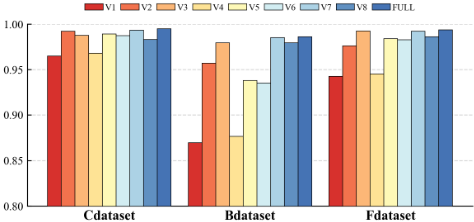
To verify the contribution of each component in DIAM, we compare the full model against eight variants with AUC as the primary metric. The variants are defined as follows: V1 (w/o Decoupling) removes the decoupling module; V2 (w/o Local) and V3 (w/o Global) exclude molecular and structural views, respectively; V4 (w/o HNS) uses random sampling; V5 (w/o ARG) replaces ARG with a standard dot product; V6 (w/o PCP) replaces the PCP with a fixed weight; V7 (w/o CL) removes the contrastive learning objective; and V8 (w/o HGT) replaces the HGT encoder with GAT. The results are shown in Figure 2.
| Dataset | Model | AUC | AUPR | ACC | Precision | Recall | F1 Score |
|---|---|---|---|---|---|---|---|
| Cdataset Bdataset | DRHGCN DRWBNCF SMGCL AMDGT MilGNet DFDRNN SIGDR DIAM DRHGCN DRWBNCF SMGCL | 0.9636 ± 6 × 10⁻³ 0.9382 ± 1 × 10⁻² 0.9323 ± 8 × 10⁻³ 0.9687 ± 5 × 10⁻³ 0.8941 ± 1 × 10⁻² 0.9590 ± 6 × 10⁻³ 0.9635 ± 8 × 10⁻³ 0.9948 ± 1 × 10⁻³ 0.8950 ± 3 × 10⁻³ 0.8819 ± 2 × 10⁻³ 0.8794 ± 3 × 10⁻³ | 0.6213 ± 2 × 10⁻² 0.5631 ± 2 × 10⁻² 0.4744 ± 1 × 10⁻² 0.9705 ± 4 × 10⁻³ 0.2014 ± 3 × 10⁻² 0.6547 ± 2 × 10⁻² 0.9658 ± 8 × 10⁻³ 0.9954 ± 2 × 10⁻³ 0.6042 ± 9 × 10⁻³ 0.5737 ± 1 × 10⁻² 0.5744 ± 9 × 10⁻³ | 0.9932 ± 4 × 10⁻⁴ 0.9926 ± 8 × 10⁻⁴ 0.9879 ± 5 × 10⁻⁴ 0.9056 ± 1 × 10⁻² 0.9839 ± 4 × 10⁻³ 0.9937 ± 2 × 10⁻⁴ 0.9177 ± 9 × 10⁻³ 0.9667 ± 9 × 10⁻³ 0.8964 ± 5 × 10⁻³ 0.8910 ± 7 × 10⁻³ 0.8892 ± 5 × 10⁻³ | 0.6575 ± 4 × 10⁻² 0.6415 ± 7 × 10⁻² 0.4046 ± 2 × 10⁻² 0.8860 ± 1 × 10⁻² 0.2945 ± 2 × 10⁻² 0.7030 ± 3 × 10⁻² 0.9085 ± 2 × 10⁻² 0.9909 ± 9 × 10⁻³ 0.5445 ± 2 × 10⁻² 0.5241 ± 3 × 10⁻² 0.5157 ± 2 × 10⁻² | 0.5814 ± 4 × 10⁻² 0.5063 ± 3 × 10⁻² 0.6185 ± 3 × 10⁻² 0.9313 ± 1 × 10⁻² 0.2628 ± 5 × 10⁻² 0.5699 ± 2 × 10⁻² 0.9293 ± 1 × 10⁻² 0.9420 ± 1 × 10⁻² 0.6043 ± 2 × 10⁻² 0.5841 ± 2 × 10⁻² 0.5777 ± 2 × 10⁻² | 0.6148 ± 2 × 10⁻² 0.5623 ± 2 × 10⁻² 0.4892 ± 2 × 10⁻² 0.9080 ± 1 × 10⁻² 0.2777 ± 6 × 10⁻² 0.6289 ± 6 × 10⁻³ 0.9186 ± 9 × 10⁻³ 0.9657 ± 9 × 10⁻³ 0.5718 ± 6 × 10⁻³ 0.5510 ± 7 × 10⁻³ 0.5443 ± 6 × 10⁻³ |
| Fdataset | AMDGT MilGNet DFDRNN SIGDR DIAM DRHGCN DRWBNCF SMGCL AMDGT MilGNet DFDRNN SIGDR DIAM | 0.9276 ± 4 × 10⁻³ 0.8596 ± 5 × 10⁻³ 0.8947 ± 1 × 10⁻³ 0.9212 ± 4 × 10⁻³ 0.9861 ± 2 × 10⁻³ 0.9491 ± 1 × 10⁻² 0.9228 ± 1 × 10⁻² 0.9190 ± 1 × 10⁻² 0.9617 ± 8 × 10⁻³ 0.9017 ± 2 × 10⁻² 0.9612 ± 4 × 10⁻³ 0.9594 ± 6 × 10⁻³ 0.9935 ± 3 × 10⁻³ | 0.9247 ± 4 × 10⁻³ 0.5111 ± 9 × 10⁻³ 0.6204 ± 6 × 10⁻³ 0.9186 ± 5 × 10⁻³ 0.9809 ± 1 × 10⁻³ 0.5454 ± 3 × 10⁻² 0.4790 ± 3 × 10⁻² 0.4441 ± 2 × 10⁻² 0.9645 ± 6 × 10⁻³ 0.3520 ± 5 × 10⁻² 0.7192 ± 1 × 10⁻² 0.9630 ± 5 × 10⁻³ 0.9945 ± 2 × 10⁻³ | 0.8549 ± 5 × 10⁻³ 0.8730 ± 6 × 10⁻³ 0.8965 ± 1 × 10⁻² 0.8522 ± 6 × 10⁻³ 0.9514 ± 4 × 10⁻³ 0.9910 ± 6 × 10⁻⁴ 0.9897 ± 6 × 10⁻⁴ 0.9867 ± 7 × 10⁻⁴ 0.8952 ± 2 × 10⁻² 0.9867 ± 2 × 10⁻³ 0.9941 ± 1 × 10⁻⁴ 0.9043 ± 1 × 10⁻² 0.9614 ± 1 × 10⁻² | 0.8543 ± 5 × 10⁻³ 0.5034 ± 6 × 10⁻³ 0.5541 ± 6 × 10⁻² 0.8452 ± 1 × 10⁻² 0.9796 ± 4 × 10⁻³ 0.5740 ± 4 × 10⁻² 0.5089 ± 3 × 10⁻² 0.3974 ± 2 × 10⁻² 0.8777 ± 2 × 10⁻² 0.4096 ± 4 × 10⁻² 0.7645 ± 2 × 10⁻² 0.8964 ± 3 × 10⁻² 0.9902 ± 1 × 10⁻² | 0.8557 ± 1 × 10⁻² 0.4571 ± 2 × 10⁻² 0.5904 ± 6 × 10⁻² 0.8626 ± 1 × 10⁻² 0.9220 ± 1 × 10⁻² 0.5380 ± 4 × 10⁻² 0.4775 ± 4 × 10⁻² 0.5447 ± 3 × 10⁻² 0.9193 ± 2 × 10⁻² 0.3902 ± 6 × 10⁻² 0.6275 ± 3 × 10⁻² 0.9157 ± 2 × 10⁻² 0.9322 ± 1 × 10⁻² | 0.8549 ± 6 × 10⁻³ 0.4791 ± 2 × 10⁻² 0.5666 ± 6 × 10⁻³ 0.8537 ± 6 × 10⁻³ 0.9499 ± 4 × 10⁻³ 0.5535 ± 2 × 10⁻² 0.4912 ± 3 × 10⁻² 0.4595 ± 2 × 10⁻² 0.8977 ± 2 × 10⁻² 0.3997 ± 5 × 10⁻² 0.6884 ± 1 × 10⁻² 0.9054 ± 1 × 10⁻² 0.9602 ± 1 × 10⁻² |
Impact of Mechanism Decoupling (V1-V3). V1 suffers the sharpest degradation across all datasets, confirming that decoupled signals are foundational to the model's performance. V2 and V3 further validate that biological signal dominance varies dynamically across datasets.
Efficacy of Sampling and Modulation (V4-V6). The significant drop in V4 confirms that mining hard negatives is essential for sharpening decision boundaries against ambiguous candidates. Moreover, V5 and V6 demonstrate that instanceaware gating effectively enhances the expressiveness of embeddings.
Backbone and Auxiliary Tasks (V7, V8). V7 and V8 confirm the value of cross-view alignment and HGT's superiority in modeling multi-relational dependencies, respectively.
4.4 Parameter sensitivity analysis
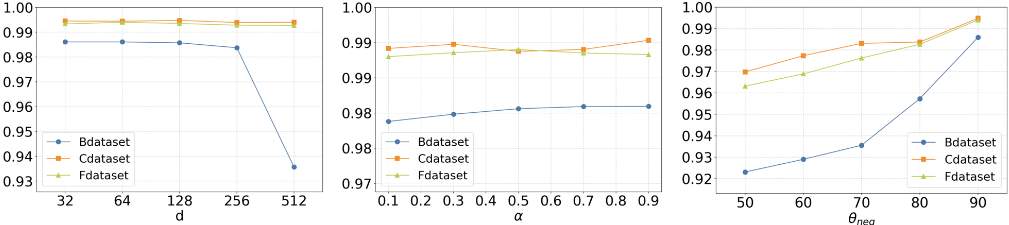
We perform a parameter sensitivity analysis on three key hyperparameters of DIAM using grid search. The model is trained for 300 epochs with a consistent learning rate of 5e3 across all datasets. Optimal values are selected based on AUC. The detailed sensitivity analysis for these three parameters is presented in Figure 3.
Impact of embedding dimension (d). The embedding dimension d determines the capacity of the node feature representations. It defines both the output dimension of the HGT
and the input dimension of the final MLP predictor. We evaluate its impact by testing values from the set {32, 64, 128, 256, 512}. The optimal dimension is 128 for Cdataset and 64 for both Bdataset and Fdataset.
Impact of the structural propagation coefficient (α). The coefficient α balances the relative contributions of the drug-side and disease-side information when computing Ctopo. It is evaluated over {0.1, 0.3, 0.5, 0.7, 0.9}, where the optimal values are 0.3, 0.7, and 0.5 for Cdataset, Bdataset, and Fdataset, respectively.
Impact of the negative sampling threshold (θneg). The negative sampling threshold θneg is set to a value that filters the top percentile of unobserved pairs as hard negatives. We assess its impact over the range {50, 60, 70, 80, 90}. We select 90 as the optimal threshold, since further increases drastically shrink the negative pool and heighten the risk of overfitting on a small subset of samples.
4.5 Effectiveness of Adaptive Residual Gating
To validate the superiority of the proposed ARG module, we compare DIAM against two representative fusion strategy: -concat, which directly concatenates drug and disease embeddings, and -attention, which employs a standard attention mechanism to adaptively assign weights.
As shown in Table 3, DIAM consistently achieves the highest AUC across all datasets. The primary limitation of -concat and -attention is that they fail to incorporate biological semantics for instance-specific modulation. In contrast, DIAM leverages the decoupled signals from both the global structural and local molecular views to guide the fusion, ensuring that the final embedding is adaptively rectified by the biological signals for each drug-disease pair.
| Dataset | -concat | -attention | ARG |
|---|---|---|---|
| Cdataset Bdataset Fdataset | 0.9871 ± 4 × 10⁻³ 0.9397 ± 5 × 10⁻³ 0.9873 ± 3 × 10⁻³ | 0.9831 ± 5 × 10⁻³ 0.9296 ± 5 × 10⁻³ 0.9846 ± 3 × 10⁻³ | 0.9948 ± 1 × 10⁻³ 0.9861 ± 2 × 10⁻³ 0.9935 ± 3 × 10⁻³ |
4.6 Case Study
To assess the model's practical application, we conduct a case study on Alzheimer's Disease (AD). AD is a progressive neurodegenerative disorder with limited therapeutic options [Livingston et al., 2024]. Drug repositioning provides an important avenue for exploring new treatment strategies.
In this study, we rank the candidate drugs from high to low based on their prediction scores and select the top 10 for in-depth analysis. As shown in Table 4, 8 of these top 10 candidates have demonstrated therapeutic potential for AD, according to existing literature evidence.
Tacrolimus ranks first in our predictions. Recent preclinical studies have confirmed it as a strong candidate drug for AD [PMID: 40412360]. As a calcineurin inhibitor (CNI), it targets key AD features like neuroinflammation and glutamatergic disruptions. Preclinical studies have demonstrated its neuroprotective effects: in an acute Aβ1-42 model, tacrolimus prevents cognitive impairment and neurodegeneration. Furthermore, in chronic APP/PS1 mice, it improves social interaction deficits, partially reduces microgliosis, and restores impaired glutamate release and calcium levels.
| Rank | Drugs | DrugBank ID | Evidence (PMID) |
|---|---|---|---|
| 1 | Tacrolimus | DB00864 | 40412360 |
| 2 | Progesterone | DB00396 | 39663597 |
| 3 | Sertraline | DB01104 | 36638595 |
| 4 | Metamfetamine | DB01577 | 32304732 |
| 5 | Prednisone | DB00635 | 8835883 |
| 6 | Vigabatrin | DB01080 | NA |
| 7 | Epoprostenol | DB01240 | NA |
| 8 | Zileuton | DB00744 | 24973121 |
| 9 | Cyclosporine | DB00091 | 40750957 |
| 10 | Dextroamphetamine | DB00721 | 18591575 |
Progesterone ranks second in our list. Existing literature demonstrates its multifaceted neuroprotective potential, such as upregulating BDNF and activating the PI3K/Akt signaling pathway [PMID: 39663597]. However, as this literature also points out, current clinical research conclusions regarding the direct treatment of AD with Progesterone are inconsistent and have not reached a consensus, suggesting its complex mechanisms of action require further investigation. Overall, the fact that 80% of the top-ranked candidates are supported by recent studies validates DIAM's reliability in prioritizing biologically significant candidates for drug repositioning.
5 Conclusions
In this paper, we present DIAM, a mechanism-adaptive framework that rectifies the mismatch between static computational paradigms and dynamic biological realities in drug repositioning. Specifically, we design a Dual-Stream Biological Mechanism Decoupling module to explicitly quantify distinct signals from global structural propagation and local molecular interaction views. Leveraging these decoupled signals, we implement Hard Negative Sampling to enforce finer-grained decision boundaries, and an Adaptive Residual Gating module to perform instance-aware modulation. Extensive experiments on three benchmark datasets demonstrate DIAM's consistent superiority over state-of-the-art methods, while case studies on Alzheimer's Disease validate its reliability in prioritizing biologically significant candidates. In future work, we will extend the depth of this paradigm by integrating multi-omics modalities to construct a comprehensive multi-view biological landscape. Code and datasets are available at https://github.com/Eyre68/DIAM.
Acknowledgements
This work was supported in part by the National Major Science and Technology Projects of China (2024ZD0523903), and the National Natural Science Foundation of China (72342014).
@inproceedings{ijcai2026p773,
  title     = {DIAM: Adaptive Drug Repositioning with Decoupled Biological Mechanism and Instance-Aware Modulation},
  author    = {Xu, Kerui and Xu, Keyuan and Yin, Shuheng and Qiu, Hang},
  booktitle = {Proceedings of the Thirty-Fifth International Joint Conference on
               Artificial Intelligence, {IJCAI-26}},
  publisher = {International Joint Conferences on Artificial Intelligence Organization},
  editor    = {Diego Calvanese},
  pages     = {6949--6957},
  year      = {2026},
  month     = {8},
  note      = {AI and Health},
  doi       = {10.24963/ijcai.2026/773},
  url       = {https://doi.org/10.24963/ijcai.2026/773},
}
TY - CPAPER TI - DIAM: Adaptive Drug Repositioning with Decoupled Biological Mechanism and Instance-Aware Modulation AU - Xu, Kerui AU - Xu, Keyuan AU - Yin, Shuheng AU - Qiu, Hang T2 - Proceedings of the Thirty-Fifth International Joint Conference on Artificial Intelligence, IJCAI-26 PB - International Joint Conferences on Artificial Intelligence Organization PY - 2026 SP - 6949 EP - 6957 DO - 10.24963/ijcai.2026/773 UR - https://doi.org/10.24963/ijcai.2026/773 ER -Copied
Machine-readable versions of this paper, for tools and AI agents:





