
Dual-Channel Semantic-Enhanced Combinatorial Medication Recommendation via Knowledge Distillation
Proceedings of the Thirty-Fifth International Joint Conference on Artificial Intelligence. AI and Health. Pages 6940-6948.
https://doi.org/10.24963/ijcai.2026/772
Keywords
- Treatment recommendation: Treatment recommendation
- Clinical decision support system: Clinical decision support system
Abstract
As a vital task in healthcare, combinatorial medication recommendation aims to generate drug combinations tailored to patient health status.
Precisely capturing the rich semantic information within clinical narratives is crucial for achieving this goal. However, existing approaches primarily rely on isolated identifiers (i.e. patient IDs, drug codes), failing to leverage the inherent semantic associations between patient conditions and medication descriptions. To fill this gap, we propose the Dual-Channel Semantics-Enhanced Network (DCSENet), a novel dual-channel framework that explicitly incorporates context-rich clinical narratives knowledge. DCSENet fine-tunes domain-adapted pre-trained language models (LMs) to capture semantic correlations between patient status and medication narratives. A transformer-based dual-channel decoder decodes the semantic information at the disease-level and the patient-level respectively. The disease-level channel focuses on the natural text semantic associations between diseases and drugs, while the patient-channel provides personalized features. To mitigate the prohibitive computational overhead of the LMs in clinical deployment, we introduce an attention-map-based knowledge distillation mechanism that efficiently transfers semantic knowledge from the LMs into an identifier-based (ID-based) target model. Extensive experiments on MIMIC-Ⅲ and MIMIC-Ⅳ datasets demonstrate that DCSENet outperforms existing state-of-the-art methods in recommendation accuracy while maintaining a low computational cost.
- [Avram et al., 2023] Sorin Avram, Thomas B Wilson, Ra- mona Curpan, Liliana Halip, Ana Borota, Alina Bora, Cristian G Bologa, Jayme Holmes, Jeffrey Knockel, Jeremy J Yang, et al. Drugcentral 2023 extends human clinical data and integrates veterinary drugs. Nucleic acids research, 51(D1):D1276-D1287, 2023.
- [Choi et al., 2016] Edward Choi, Mohammad Taha Ba- hadori, Jimeng Sun, Joshua Kulas, Andy Schuetz, and Walter Stewart. Retain: An interpretable predictive model for healthcare using reverse time attention mechanism. Advances in neural information processing systems, 29, 2016.
- [Clark et al., 2019] Kevin Clark, Urvashi Khandelwal, Omer Levy, and Christopher D Manning. What does bert look at? an analysis of bert's attention. arXiv preprint arXiv:1906.04341, 2019.
- [Cowie et al., 2017] Martin R Cowie, Juuso I Blomster, Les- ley H Curtis, Sylvie Duclaux, Ian Ford, Fleur Fritz, Samantha Goldman, Salim Janmohamed, Jörg Kreuzer, Mark Leenay, et al. Electronic health records to facilitate clinical research. Clinical Research in Cardiology, 106:1- 9, 2017.
- [Devlin et al., 2019] Jacob Devlin, Ming-Wei Chang, Ken- ton Lee, and Kristina Toutanova. Bert: Pre-training of deep bidirectional transformers for language understand- ing. In Proceedings of the 2019 conference of the North American chapter of the association for computational lin- guistics: human language technologies, volume 1 (long and short papers), pages 4171-4186, 2019.
- [Gu et al., 2021] Yu Gu, Robert Tinn, Hao Cheng, Michael Lucas, Naoto Usuyama, Xiaodong Liu, Tristan Naumann, Jianfeng Gao, and Hoifung Poon. Domain-specific lan- guage model pretraining for biomedical natural language processing. ACM Transactions on Computing for Health- care (HEALTH), 3(1):1-23, 2021.
- [Han et al., 2021] Xu Han, Zhengyan Zhang, Ning Ding, Yuxian Gu, Xiao Liu, Yuqi Huo, Jiezhong Qiu, Yuan Yao, Ao Zhang, Liang Zhang, et al. Pre-trained models: Past, present and future. Ai Open, 2:225-250, 2021.
- [Hinton et al., 2015] Geoffrey Hinton, Oriol Vinyals, and Jeff Dean. Distilling the knowledge in a neural network. arXiv preprint arXiv:1503.02531, 2015.
- [Huang et al., 2019] Kexin Huang, Jaan Altosaar, and Ra- jesh Ranganath. Clinicalbert: Modeling clinical notes and predicting hospital readmission. arXiv preprint arXiv:1904.05342, 2019.
- [Jiao et al., 2019] Xiaoqi Jiao, Yichun Yin, Lifeng Shang, Xin Jiang, Xiao Chen, Linlin Li, Fang Wang, and Qun Liu. Tinybert: Distilling bert for natural language understand- ing. arXiv preprint arXiv:1909.10351, 2019.
- [Johnson et al., 2016] Alistair EW Johnson, Tom J Pollard, Lu Shen, Li-wei H Lehman, Mengling Feng, Mohammad Ghassemi, Benjamin Moody, Peter Szolovits, Leo An- thony Celi, and Roger G Mark. Mimic-iii, a freely ac- cessible critical care database. Scientific data, 3(1):1-9, 2016.
- [Johnson et al., 2023] Alistair EW Johnson, Lucas Bulgar- elli, Lu Shen, Alvin Gayles, Ayad Shammout, Steven Horng, Tom J Pollard, Sicheng Hao, Benjamin Moody, Brian Gow, et al. Mimic-iv, a freely accessible electronic health record dataset. Scientific data, 10(1):1, 2023.
- [Kim et al., 2024] Taeri Kim, Jiho Heo, Hongil Kim, Kijung Shin, and Sang-Wook Kim. Vita:'carefully chosen and weighted less' is better in medication recommendation. In Proceedings of the AAAI Conference on Artificial Intelli- gence, volume 38, pages 8600-8607, 2024.
- [Kingma and Ba, 2014] Diederik P Kingma and Jimmy Ba. Adam: A method for stochastic optimization. arXiv preprint arXiv:1412.6980, 2014.
- [Lee et al., 2020] Jinhyuk Lee, Wonjin Yoon, Sungdong Kim, Donghyeon Kim, Sunkyu Kim, Chan Ho So, and Jaewoo Kang. Biobert: a pre-trained biomedical language representation model for biomedical text mining. Bioin- formatics, 36(4):1234-1240, 2020.
- [Li et al., 2025] Yishuo Li, Qi Zhang, Wenpeng Lu, Xueping Peng, Weiyu Zhang, Jiasheng Si, Yongshun Gong, and Liang Hu. Time-aware medication recommendation via intervention of dynamic treatment regimes. In Proceed- ings of the ACM on Web Conference 2025, pages 5161- 5172, 2025.
- [Liu et al., 2024a] Q Liu, X Wu, X Zhao, Y Zhu, Z Zhang, F Tian, and Y Zheng. Large language model distilling medication recommendation model. arxiv. arXiv preprint arXiv:2402.02803, 2024.
- [Liu et al., 2024b] Ruiping Liu, Kailun Yang, Alina Roit- berg, Jiaming Zhang, Kunyu Peng, Huayao Liu, Yaonan Wang, and Rainer Stiefelhagen. Transkd: Transformer knowledge distillation for efficient semantic segmentation. IEEE Transactions on Intelligent Transportation Systems, 2024.
- [Peng et al., 2019] Yifan Peng, Shankai Yan, and Zhiyong Lu. Transfer learning in biomedical natural language pro- cessing: an evaluation of bert and elmo on ten benchmark- ing datasets. arXiv preprint arXiv:1906.05474, 2019.
- [Qiu et al., 2020] Xipeng Qiu, Tianxiang Sun, Yige Xu, Yunfan Shao, Ning Dai, and Xuanjing Huang. Pre-trained models for natural language processing: A survey. Science China technological sciences, 63(10):1872-1897, 2020.
- [Read et al., 2011] Jesse Read, Bernhard Pfahringer, Geoff Holmes, and Eibe Frank. Classifier chains for multi-label classification. Machine learning, 85:333-359, 2011.
- [Shang et al., 2018] Junyuan Shang, Shenda Hong, Yuxi Zhou, Meng Wu, and Hongyan Li. Knowledge guided multi-instance multi-label learning via neural networks in medicines prediction. In Asian Conference on Machine Learning, pages 831-846.
- PMLR, 2018.
- [Shang et al., 2019] Junyuan Shang, Cao Xiao, Tengfei Ma, Hongyan Li, and Jimeng Sun. Gamenet: Graph augmented memory networks for recommending medication combi- nation. In proceedings of the AAAI Conference on Artifi- cial Intelligence, volume 33, pages 1126-1133, 2019.
- [Skou et al., 2022] Søren T Skou, Frances S Mair, Martin Fortin, Bruce Guthrie, Bruno P Nunes, J Jaime Miranda, Cynthia M Boyd, Sanghamitra Pati, Sally Mtenga, and Su- san M Smith. Multimorbidity. Nature Reviews Disease Primers, 8(1):48, 2022.
- [Sun et al., 2020] Zhiqing Sun, Hongkun Yu, Xiaodan Song, Renjie Liu, Yiming Yang, and Denny Zhou. Mobilebert: a compact task-agnostic bert for resource-limited devices. arXiv preprint arXiv:2004.02984, 2020.
- [Sun et al., 2022] Hongda Sun, Shufang Xie, Shuqi Li, Yuhan Chen, Ji-Rong Wen, and Rui Yan. Debiased, lon- gitudinal and coordinated drug recommendation through multi-visit clinic records. Advances in Neural Information Processing Systems, 35:27837-27849, 2022.
- [Tan et al., 2022] Yanchao Tan, Chengjun Kong, Leisheng Yu, Pan Li, Chaochao Chen, Xiaolin Zheng, Vicki S Hertzberg, and Carl Yang. 4sdrug: Symptom-based set- to-set small and safe drug recommendation. In Proceed- ings of the 28th ACM SIGKDD Conference on Knowledge Discovery and Data Mining, pages 3970-3980, 2022.
- [Tan et al., 2024] Jie Tan, Yu Rong, Kangfei Zhao, Tian Bian, Tingyang Xu, Junzhou Huang, Hong Cheng, and Helen Meng. Natural language-assisted multi-modal med- ication recommendation. In Proceedings of the 33rd ACM International Conference on Information and Knowledge Management, pages 2200-2209, 2024.
- [Tang et al., 2019] Raphael Tang, Yao Lu, Linqing Liu, Lili Mou, Olga Vechtomova, and Jimmy Lin. Distilling task- specific knowledge from bert into simple neural networks. arXiv preprint arXiv:1903.12136, 2019.
- [Van Erven and Harremos, 2014] Tim Van Erven and Peter Harremos. Rényi divergence and kullback-leibler di- vergence. IEEE Transactions on Information Theory, 60(7):3797-3820, 2014.
- [Vaswani et al., 2017] Ashish Vaswani, Noam Shazeer, Niki Parmar, Jakob Uszkoreit, Llion Jones, Aidan N Gomez, Łukasz Kaiser, and Illia Polosukhin. Attention is all you need. Advances in neural information processing systems, 30, 2017.
- [Wang et al., 2024] Yanda Wang, Lin Yue, and Ying Li. Topological knowledge enhanced personalized ranking model for sequential medication recommendation. In In- ternational Conference on Advanced Data Mining and Ap- plications, pages 109-124. Springer, 2024.
- [Warstadt et al., 2020] Alex Warstadt, Yian Zhang, Haau- Sing Li, Haokun Liu, and Samuel R Bowman. Learn- ing which features matter: Roberta acquires a preference for linguistic generalizations (eventually). arXiv preprint arXiv:2010.05358, 2020.
- [Wu et al., 2022] Rui Wu, Zhaopeng Qiu, Jiacheng Jiang, Guilin Qi, and Xian Wu. Conditional generation net for medication recommendation. In Proceedings of the ACM Web Conference 2022, pages 935-945, 2022.
- [Xu et al., 2024] Xiaohan Xu, Ming Li, Chongyang Tao, Tao Shen, Reynold Cheng, Jinyang Li, Can Xu, Dacheng Tao, and Tianyi Zhou. A survey on knowledge distillation of large language models. arXiv preprint arXiv:2402.13116, 2024.
- [Yang et al., 2021] Chaoqi Yang, Cao Xiao, Fenglong Ma, Lucas Glass, and Jimeng Sun. Safedrug: Dual molecular graph encoders for recommending effective and safe drug combinations. arXiv preprint arXiv:2105.02711, 2021. IJCAI
- [Yang et al., 2023] Nianzu Yang, Kaipeng Zeng, Qitian Wu, and Junchi Yan. Molerec: Combinatorial drug recom- mendation with substructure-aware molecular representa- tion learning. In Proceedings of the ACM Web Conference 2023, pages 4075-4085, 2023.
- [Zhang et al., 2017] Yutao Zhang, Robert Chen, Jie Tang, Walter F Stewart, and Jimeng Sun. Leap: learning to pre- scribe effective and safe treatment combinations for mul- timorbidity. In proceedings of the 23rd ACM SIGKDD in- ternational conference on knowledge Discovery and data Mining, pages 1315-1324, 2017.
- [Zhang et al., 2023a] Junjie Zhang, Xuan Zang, Hao Chen, and Buzhou Tang. E-hmfnet: A knowledge-enhanced hier- archical molecular representation fusion network for drug recommendation. In 2023 IEEE International Conference on Bioinformatics and Biomedicine (BIBM), pages 1690- 1695. IEEE, 2023.
- [Zhang et al., 2023b] Yingying Zhang, Xian Wu, Quan Fang, Shengsheng Qian, and Changsheng Xu. Knowledge-enhanced attributed multi-task learning for medicine recommendation. ACM Transactions on Information Systems, 41(1):1-24, 2023.
- [Zhang et al., 2025a] Haodi Zhang, Jiawei Wen, Jiahong Li, Yuanfeng Song, Liang-Jie Zhang, and Lin Ma. Sspnet: Leveraging robust medication recommendation with his- tory and knowledge. In Proceedings of the Thirty-Fourth International Joint Conference on Artificial Intelligence, pages 9465-9473, 2025. IJCAI
- [Zhang et al., 2025b] Kai Zhang, Rui Zhu, Shutian Ma, Jing- wei Xiong, Yejin Kim, Fabricio Murai, and Xiaozhong Liu. Kedrec-lm: A knowledge-distilled explainable drug recommendation large language model. arXiv preprint arXiv:2502.20350, 2025.
- [Zheng et al., 2021] Zhi Zheng, Chao Wang, Tong Xu, Dazhong Shen, Penggang Qin, Baoxing Huai, Tongzhu Liu, and Enhong Chen. Drug package recommendation via interaction-aware graph induction. In Proceedings of the web conference 2021, pages 1284-1295, 2021.
References were extracted automatically from the PDF and may contain errors.
Full text extracted automatically from the PDF; figures, tables and equations may differ. The PDF is the version of record.
1 Introduction
Combination medication recommendation systems aim to generate appropriate therapeutic prescriptions by comprehensively assessing a patient's health status. Such prescriptions currently rely heavily on physicians' manual experience. However, the expansion of medical knowledge and complexity in multimorbidity cases [Skou et al., 2022] pose great challenges to clinical decision-making. Fortunately, the widespread adoption of electronic health records (EHRs) [Cowie et al., 2017] has enabled large-scale digitization of clinical narratives, providing a crucial foundation for automated medication-recommendation systems. This vast clinical data repository has fueled robust research interest in AIdriven medication recommendation.
∗Co-corresponding authors.
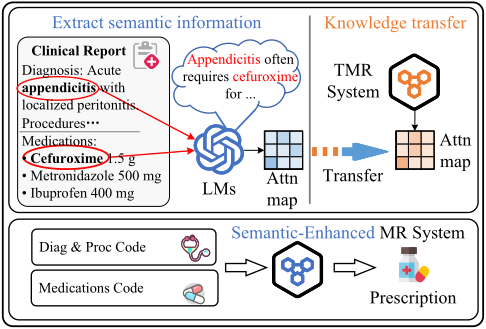
The predominant approach in current medication recommendation systems [Choi et al., 2016; Wu et al., 2022; Tan et al., 2022] is ID-based. These methods primarily focus on architectural designs that attempt to better mimic the clinical decision-making process. However, they face three key limitations: (1) neglecting crucial external knowledge that guides real-world prescribing practices; (2) their reliance on identifiers limiting model generalizability; and (3) the inherent lack of interpretability, which hampers their utility in clinical decision support. Recent advances have explored various strategies to incorporate external knowledge, with three main directions: leveraging clinical entity structures [Wang et al., 2024; Li et al., 2025], integrating drug chemical properties [Yang et al., 2021; Yang et al., 2023], and utilizing knowledge graphs [Zhang et al., 2023b]. Although these approaches have achieved notable performance gains, they largely overlook the rich semantic information embedded in clinical narratives. More recently, some studies [Tan et al., 2024; Liu et al., 2024a; Zhang et al., 2025b] have attempted to address this gap by employing natural language models to extract semantic information from clinical texts. Nonetheless, these efforts remain limited to surface-level semantic encoding, failing to comprehensively capture the complex relationships between medications and patient health status within the textual context.
In this paper, we propose a Dual-Channel SemanticEnhanced Network (DCSENet 1 ) that explores semantic associations between patient health status and medications. As illustrated in Figure 1, our framework employs LMs to extract meaningful semantic relationships from medical narratives. These relationships are modeled into attention maps that explicitly capture and highlight the semantic associations, serving as knowledge bridges. This facilitates the transfer of rich semantic representations to conventional recommendation systems. Consequently, the enhanced system leverages these semantic insights to generate prescriptions based on identifiers. Specifically, DCSENet fine-tunes domain-adapted LMs to effectively capture the semantic relationships between patient health status and medication texts. A dual-channel module further models hierarchical semantic information through disease- and visit-level pathways, fully revealing the semantic associations between patients' health condition texts and medication texts. Subsequently, attention map-based knowledge distillation transfers these semantic features to traditional ID-based recommendation models. This distillation approach transforms the knowledge of clinical texts to ID-based representations, while also reducing the computational overhead associated with LMs. We summarize our main contributions as follows:
- We propose to leverage semantic correlations in texts to enhance drug recommendation systems. Specifically, we fine-tune LMs to effectively extract semantic features from clinical texts and design a dual-channel module for comprehensive modeling of the semantic relationships between patient health conditions and medications.
- We introduce an attention-map-based knowledge distillation method to alleviate the semantic mismatch between clinical narratives and discrete identifiers. This approach effectively transforms the knowledge of textual narratives to ID-based representations.
- Extensive experiments on the MIMIC-III and MIMICIV datasets demonstrate that DCSENet outperforms state-of-the-art baselines in recommendation accuracy, while maintaining competitive computational efficiency.
2 RelatedWork
This section reviews work on medication recommendation and knowledge distillation for language models.
1 https://github.com/ResearchGroupHdZhang/DCSENet
2.1 ID-BasedMedication Recommendation
Existing medication recommendation approaches are predominantly ID-based, focusing on optimizing the recommendation process to improve performance. Many methods formulate this task as a multi-label classification problem. For instance, RETAIN [Choi et al., 2016] employs bidirectional querying; GAMENet [Shang et al., 2019] leverages memory augmentation; DPR-AG [Zheng et al., 2021] uses interactionaware graph induction; 4SDrug [Tan et al., 2022] and SSPNet [Zhang et al., 2025a] adopt a set-to-set paradigm; and DrugRec [Sun et al., 2022] provides causal explanations. Other approaches treat medication recommendation as a sequential decision-making task. For example, LEAP [Zhang et al., 2017] employs a recurrent decoder for sequential drug recommendations, while COGNet [Wu et al., 2022] and VITA [Kim et al., 2024] utilize Transformers [Vaswani et al., 2017] to model sequential medication decisions. Despite their impressive performance, these methods largely neglect external knowledge integration, resulting in suboptimal recommendations with limited generalizability and poor explainability.
2.2 External-Knowledge-EnhancedMedication Recommendation
External knowledge is fundamentally important for achieving optimal medication recommendation. Existing approaches incorporate various forms of external information: SafeDrug [Yang et al., 2021], KE-HMFNet [Zhang et al., 2023a], and MoleRec [Yang et al., 2023] use chemical-structure information; KG-MIML [Shang et al., 2018], TOKEPER [Wang et al., 2024], and MR-DTR leverage clinical entity structures; MedRec [Zhang et al., 2023b] employs knowledge graphs to enhance patient and medication representations. Recently, approaches such as NLA-MMR [Tan et al., 2024] leverage LMs to encode textual information. LEADER [Liu et al., 2024a] and KEDRec-LM [Zhang et al., 2025b] employ LMs to process textual data and utilize knowledge distillation from hidden states to transfer semantic information into smaller models. However, these approaches primarily exploit surface-level semantic information in clinical texts, limiting their ability to comprehensively leverage deep semantic relationships. To better leverage deep semantic relationships, we propose a dual-channel framework that explicitly mines and utilizes rich associations in clinical narratives.
2.3 Knowledge Distillation for LMs
Language models (LMs) exhibit powerful semantic encoding abilities that benefit various downstream tasks [Sun et al., 2020; Xu et al., 2024].Nevertheless, their heavy parameter scale and high computational cost hinder real-world deployment. To tackle this issue, numerous knowledge distillation techniques dedicated to LMs have been explored [Hinton et al., 2015]. For example, DistilledBERT [Tang et al., 2019] transfers BERT knowledge to task-specific models, while TinyBERT [Jiao et al., 2019] uses attention-map distillation to derive a condensed BERT. Recent methods like TransKD [Liu et al., 2024b] further improve distillation via a crossinteraction mechanism to fuse attention maps for cross-stage feature transfer. Motivated by these advances, we propose an attention-based distillation approach to bridge the semantic gap between textual information and identifier embeddings.
3 ProblemFormulation
This section formally defines electronic health records, clinical texts, and the medication-recommendation task.
3.1 Electronic Health Records (EHR)
For a given patient, the health information in the EHR is represented as a sequence of all historical visits, denoted as:
where each visit v(i) encapsulates the clinical data recorded at the t-th encounter and T is the total number of visits. Let Dc denote diagnosis codes, Pc procedure codes, Mc medication codes, Dtxt diagnostic textual descriptions, Ptxt procedural textual descriptions, and Mtxt medication textual descriptions. Each visit v(i) is a tuple comprising diagnosis codes, procedure codes, medication codes, and their associated textual descriptions.
where v(i) dc ∈ Dc, v(i) pc ∈ Pc, v(i) mc ∈ Mc, v(i) dtxt ∈ Dtxt, v(i) ptxt ∈ Ptxt, v(i) mtxt ∈ Mtxt. We denote the entire EHR as V and the set of all patients as P, and define |V| = |P| to fully leverage the EHR information.
3.2 Medication Recommendation Problem
For patient p ∈ P with multiple visits V , provides the diagnoses v(t) d = {d1, d2, ..., dk}, the procedure v(t) p = {p1, p2, ..., pl} and the previously prescribed medications mtp = {m1,m2, ...,mr}. Our objective is to learn a prescription-prediction function f(·) : 2D × 2P ↦→ 2M, that generates a prescription for the given visit,
where ˆm(t) ⊆M is encoded into multi-hot vector.
4 Methodology
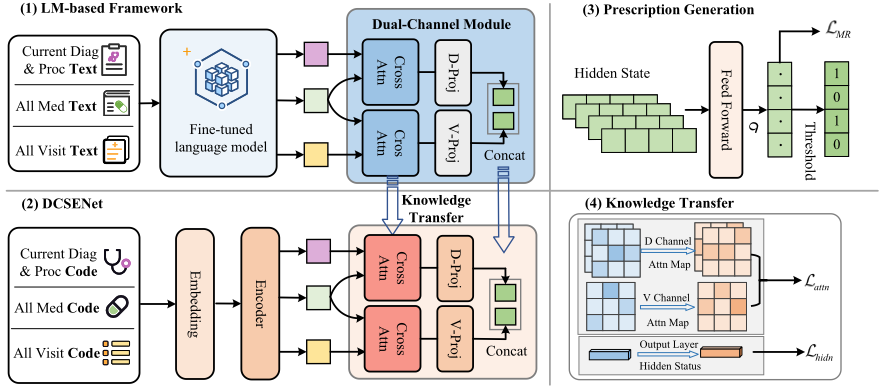
Our model operates in two distinct stages, as illustrated in Figure 2. In the first stage, we fine-tune a language model to extract semantic information from clinical narratives, utilizing dual channels at the disease and visit levels to fully leverage the semantic relationships between patient health status and medications. In the second stage, we enhance the outputlayer hidden state distillation with attention-map-based distillation, transferring semantic knowledge from the LM-based framework to DCSENet.
4.1 LMs-Based Framework
The rich semantic information captured by LMs can effectively enhance downstream tasks [Qiu et al., 2020; Han et al., 2021]. Accordingly, we first fine-tune a language model to adapt it to the medication recommendation task and capture the semantic associations between patient health status and medications narratives. Then, we design a dual-channel module that separately models semantic information at both the disease and visit levels.
Clinical textual description
Drug-disease associations in clinical texts offer prior knowledge for medication recommendation.We extracted drug indication knowledge from DrugCentral [Avram et al., 2023] and built direct links among drugs, diagnoses, and procedures. Using prompt templates, we further organized patients' historical visit records to supply personalized features for medication recommendation. The templates of prompt [Liu et al., 2024a] for constructing the text is shown in Figure. 3. Given the EHR textual description Vtxt of patient p, we partition the former into disease-level and visit-level segments to fully exploit the semantic information related to the patient's health status. At the disease level, we feed the patient's current diagnosis names vtdtxt and procedure names vtptxt . At the visit level, we utilize all of the patient's visits. For i-th visit v(i) , we concatenate the diagnostic text v(i) dtxt , procedural text v(i) ptxt , and medication text v(i) mtxt into a single textual description v(i) txt , noting that the current visit vt does not include any medication text. Then, we can obtain the textual descriptions at the visit level of healthcare vtxt = [v(1) txt , v(2) txt , ..., v(t) txt ].
LMs-based Clinical Narratives Encoder Module
For domain adaptation, we fine-tune the LMs by unfreezing only the final layer while keeping other parameters fixed. The adapted LMs then encode textual clinical data into dense representations. Given a text sequence Text, we obtain its representation Etxt by encoding it through the LMs.
Given the disease-level patient texts v(t) dtxt and v(t) ptxt , the visitlevel text Vtxt, and the textual descriptions vmtxt of all medications, we encode them via the LM to obtain the corresponding feature vectors E(t) dtxt , E(t) ptxt , Evtxt, and Emtxt.
Dual-Channel Semantic Fusion Module
The disease-level textual feature vector contains universal associations between drugs, diagnoses, and surgeries derived from the real world, while the visit-level textual feature vector incorporates patient-specific personalized information. To avoid conflicts between personalized conditions and universal knowledge, we first employ two separate cross-attention modules for modeling, respectively, and then utilize two MLPs (Multi-Layer Perceptrons) to project the information into an appropriate space, thereby resolving discrepancies and fusing the information. Our dual-channel module consists of a disease cross-attention and a visit cross-attention. In the disease channel, the textual medication features Emtxt serve as the query, while the current diagnostic textual features Edtxt and the procedural textual features Eptxt are provided as two separate key-value pairs. In the visit channel, the same Emtxt functions as the query, paired with the visit textual features Evtxt provided as the key-value pair. as the key-value pair. Both channels use a Transformer Encoder (TransEec) [Vaswani et al., 2017] to refine the medication representations Emtxt.
…;
> …;
e3>, …;
e3>, …;
e3> , ….
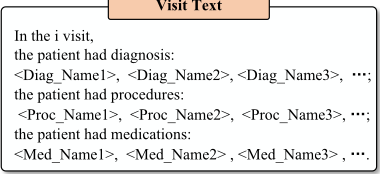
Figure 3: Prompt for medication, diagnose, procedure and visit text.
Subsequently, we project Zdise and Zvisit into an appropriate space and concatenate them to obtain the hidden state of the output layer in the LM-based framework:
4.2 ID-Based Framework: DCSENet
Visit text prompt In the i visit, the patient had diagnosis: <Diag_Name1>, <Diag_Name2>, <Diag_Name3>, …; the patient had procedures: <Proc_Name1>, <Proc_Name2>, <Proc_Name3>, …; the patient had medications: While encoding patient health status and medication texts with LMs effectively captures rich semantic information, this approach also introduces significant redundancy in both data storage and computational complexity. Consequently, deploying such a medication recommendation system in realworld scenarios becomes more challenging. To mitigate this limitation, we design an identifier-based model , DCSENet, and transfer the semantic knowledge from LMs to DCSENet through knowledge distillation.
- <Med_Name1>, <Med_Name2> , <Med_Name3> , …. ID-based encoding
Unlike LM-based frameworks that utilize raw text inputs, DCSENet processes coded clinical information, including diagnoses, procedures, and medications. To represent these codes, we construct three embedding tables: Edc, Epc, and Emc, where each embedding vector corresponds to a diagnosis, procedure, or medication, respectively. For the i-th visit of a patient, we map the associated codes into their respective feature vectors, resulting in diagnosis matrix D(i) c , procedure matrix P(i) c , and medication matrix M(i) c , respectively. Repeating this process across all visits, we obtain sequences {D(1) c ,D(2) c , . . . , D(t) c }, {P(1) c , P(2) c , . . . , P(t) c } and {M(1) c ,M(2) c , . . . ,M(t-1) c } , noting that the final visit does not include medication codes. To align with the visit-level textual input used in LM-based frameworks, we aggregate each feature matrix D(i) c , P (i) c , andM (i) c via summation,
The resulting vectors h(i) diag , h(i) proc and h(i) med are concatenated and passed through a feed-forward network:
where the FF1: R3h → Rh . By aggregating the per-visit representations, we form the visits feature matrix Vc. Subsequently, the sequences D(i) c , P (i) c , Vc and Mc are encoded via a Transformer encoder to obtain the enhanced representations: D(i)′ c , P (i)′ c , V ′ c andM′c .
Dual-Channel Fusion
For effective knowledge transfer, we employ a module architecture similar to the dual-channel textual semantic model module that was used in modeling the textual-information. Then, we can get M ′dise and M ′visit . To fuse the feature information from the two channels, we employ two mapping functions to project the medication features from the two channels into a shared feature space.
where D-Proj and V-Proj denote two distinct feed-forward networks. Subsequently, we concatenate the Zd and Zv:
4.3 Prescription Generation
Given the drug hidden state representation refined from patient health information H we apply a linear projection to H: R2h → R to obtain a multi-hot vector ˆ o:
where FF2 is a feed-forward network. Medications with predicted probabilities exceeding threshold δ in the multi-hot vector ˆmconstitute the final prescription.
4.4 Loss Function
Following prior work, we employ a combined loss to optimize medication recommendation accuracy. For knowledge distillation, we utilize the Kullback-Leibler divergence (KL) [Van Erven and Harremos, 2014] to measure the divergence between attention maps, and cosine similarity to align the hidden states of the output layer.
Medication Recommendation Loss
Consistent with prior work [Yang et al., 2023], we adopt multi-label loss Lbec and cross-entropy loss Lmulti as the loss functions,
where the superscript index (i) represents the i-th component of the vector. We combine these two losses as the overall loss for the medication recommendation task:
where the α is a hyperparameter. Note that only the loss LMR is first used to train the LM-based framework.
Knowledge Distillation Loss
Existing methods [Liu et al., 2024a] perform distillation directly on the hidden states of the medication recommendation model.
where Wh is an alignment projection matrix. However, the semantic representations derived from LM-based medication recommendation models reside in a feature space that is distinct from that of ID-based models. To address this issue, we introduce an attention-based distillation loss. Empirical studies [Clark et al., 2019] have demonstrated that attention weights encode rich linguistic knowledge when processing textual data. The attention-based distillation loss function can be defined as:
where KL(· ∥ ·) denotes the Kullback-Leibler divergence, and n is the number of attention heads. ASi and ATi represent the attention maps from the LM-based framework and DCSENet models, respectively, for the i-th attention head. We perform knowledge distillation on the attention maps within the cross-attention modules of the TransDec for multiple channels, resulting in losses Ldattn (for medicationdiagnose attention), Lpattn (for medication-procedure attention), and Lvattn (for medication-visit attention). These individual channel losses are combined through weighted summation to obtain the overall attention distillation loss:
Merged Loss
The final training objective for the DCSENet is a weighted sum of the LMR and the LKD:
where β is a hyperparameter that balances the two loss.
5 Experiments
We conducted extensive experiments to demonstrate the effectiveness of DCSENet.
5.1 Datasets
We conducted experiments on the MIMIC-III [Johnson et al., 2016] and MIMIC-IV [Johnson et al., 2023]. Following the setting in [Yang et al., 2023; Yang et al., 2021], we split the dataset into training, validation and test as 4 : 1 : 1. The statistical information of the preprocessed dataset is shown in Appendix A.
5.2 Settings
This section details the experimental setup, including hyperparameter configurations, baselines, and evaluation metrics.
Hyperparameter Configuration
Our proposed method is implemented using PyTorch 2.6.0 (with CUDA 12.4 support), which is built on the Python 3.10.16 environment. All experiments are conducted on an Intel Xeon Platinum 8260 server, equipped with 24 CPU cores, 188 GB of RAM, and a single NVIDIA L40 GPU with 46 GB of VRAM. In our model, the embedding dimension for LM-based framework is set to 768. For the compressed DCSENet, this dimension is configured to 64. The optimal hyper-parameters weight α = 0.95, β = 0.9, and the threshold δ = 0.5 are determined based on their performance on the validation set. We train our model with the Adam optimizer [Kingma and Ba, 2014] at an initial learning rate of 1×10⁻⁴ .
| Model | MIMIC-III | MIMIC-IV | ||||||||
|---|---|---|---|---|---|---|---|---|---|---|
| Jaccard↑ | F1↑ | PRAUC↑ | DDI↓ | Avg.#Med | Jaccard↑ | F1↑ | PRAUC↑ | DDI↓ | Avg.#Med | |
| LR ECC | 0.4920 ±0.0028 0.4868 ±0.0031 | 0.6491 ±0.0026 0.6428 ±0.0028 | 0.7552 ±0.0031 0.7382 ±0.0026 | 0.0784 ±0.0008 0.0805 ±0.0007 | 16.4293 ±0.1487 16.0100 ±0.0972 | 0.4395 ±0.0010 0.4172 ±0.0013 | 0.5850 ±0.0010 0.5575 ±0.0014 | 0.7224 ±0.0009 0.7233 ±0.0015 | 0.0764 ±0.0005 0.0754 ±0.0004 | 8.2226 ±0.0278 7.4800 ±0.0346 |
| LEAP GAMENet COGNet VITA | 0.4441 ±0.0027 0.5160 ±0.0020 0.5308 ±0.0018 0.5263 ±0.0016 | 0.6068 ±0.0028 0.6713 ±0.0018 0.6842 ±0.0017 0.6786 ±0.0027 | 0.6475 ±0.0056 0.7642 ±0.0012 0.7699 ±0.0014 0.7623 ±0.0028 | 0.0730 ±0.0008 0.0796 ±0.0004 0.0840 ±0.0005 0.0765 ±0.0008 | 18.8987 ±0.0779 25.4674 ±0.1470 28.2382 ±0.0580 29.2662 ±0.1565 | 0.4085 ±0.0012 0.4480 ±0.0015 0.4682 ±0.0006 0.4716 ±0.0013 | 0.5584 ±0.0013 0.5995 ±0.0015 0.6165 ±0.0006 0.6139 ±0.0013 | 0.5306 ±0.0019 0.7099 ±0.0014 0.6883 ±0.0005 0.6792 ±0.0012 | 0.0673 ±0.0004 0.0838 ±0.0004 0.0713 ±0.0003 0.0796 ±0.0005 | 10.6090 ±0.0554 16.2131 ±0.0934 18.0124 ±0.0384 18.4972 ±0.0613 |
| SafeDrug MoleRec MR-DTR NLA-MMR | 0.5120 ±0.0025 0.5296 ±0.0031 0.5414 ±0.0023 0.5429 ±0.0027 | 0.6685 ±0.0023 0.6837 ±0.0025 0.6942 ±0.0016 0.6958 ±0.0024 | 0.7640 ±0.0027 0.7767 ±0.0021 0.7922 ±0.0028 0.7890 ±0.0016 | 0.0619 ±0.0005 0.0726 ±0.0009 0.0529 ±0.0006 0.0835 ±0.0008 | 20.4573 ±0.1561 21.2022 ±0.1639 19.6641 ±0.1348 22.5158 ±0.1684 | 0.4457 ±0.0012 0.4562 ±0.0019 0.4625 ±0.0015 0.4491 ±0.0044 | 0.5972 ±0.0012 0.6065 ±0.0019 0.6158 ±0.0019 0.6051 ±0.0042 | 0.6917 ±0.0016 0.6929 ±0.0022 0.7008 ±0.0026 0.6921 ±0.0045 | 0.0504 ±0.0003 0.0687 ±0.0004 0.0508 ±0.0007 0.0785 ±0.0006 | 12.3890 ±0.0364 12.9925 ±0.0488 12.5100 ±0.0691 13.6846 ±0.0761 |
| DCSENet | 0.5632 ±0.0010 | 0.7120 ±0.0008 | 0.8048 ±0.0009 | 0.0796 ±0.0002 | 23.8144 ±0.0678 | 0.4823 ±0.0006 | 0.6319 ±0.0006 | 0.7389 ±0.0006 | 0.0846 ±0.0003 | 14.8278 ±0.0333 |
| model | Jaccard | F1 | PRAUC |
|---|---|---|---|
| w/o Diag | 0.5174 | 0.6724 | 0.7675 |
| w/o Proc | 0.5386 | 0.6912 | 0.7886 |
| w/o Dise-channel | 0.4938 | 0.6432 | 0.7422 |
| w/o Visit-channel | 0.5413 | 0.6939 | 0.7819 |
| w/o Distillation | 0.5277 | 0.6822 | 0.7747 |
| w/o Lattn | 0.5444 | 0.6965 | 0.7920 |
| w/o Lhidn | 0.5411 | 0.6933 | 0.7878 |
| DCSENet | 0.5632 | 0.7120 | 0.8048 |
Baselines and Metrics
We select a diverse set of medication recommendation models as baselines to comprehensively evaluate both variants of DCSENet. These include:
- Classical models: Logistic Regression (LR) and Ensemble Classifier Chain (ECC) [Read et al., 2011].
- Traditional ID-based models: GAMENet [Shang et al., 2019], COGNet [Wu et al., 2022] and VITA [Kim et al., 2024].
- Extra-information-enhanced model: SafeDrug [Yang et al., 2021], MoleRec [Yang et al., 2023], NLA-MMR [Tan et al., 2024] and MR-DTR [Li et al., 2025].
We employ three widely-used metrics: Jaccard similarity, F1 score and PRAUC, to verify the accuracy and effectiveness of these models. Due to space constraints, details of the baselines and metrics are provided in the Appendix B.
5.3 Main Result
We compare the performance of DCSENet against the baseline models; the results are presented in Table 1. Overall, DCSENet outperforms all baseline models across three evaluation metrics, Jaccard, F1-score, and PRAUC. Traditional machine learning models such as LR and ECC fail to effectively leverage patients' historical visit information, resulting in lower performance. LEAP exhibits suboptimal performance due to its difficulty in modeling long sequences of patients' visit records. Although GAMENet incorporates a memory module, while COGNet and VITA apply Transformers that are more adept at modeling long sequences, these methods all overlook the critical role of external knowledge, resulting in suboptimal performance. SafeDrug and MoleRec incorporate the molecular structural information of medications, while MR-DTR introduces clinical entity structure information, leading to improved performance. NLA-MMR leverages language models to extract clinical textual information, which substantially enhances its performance; however, it lacks effective utilization of the semantic relationships between patient health status and medications, resulting in only moderate improvements. In contrast, the LM-based framework uncovers semantic associations between patient health status and medications at multiple levels and effectively transfers this knowledge to DCSENet through knowledge distillation. With enriched textual semantics, DCSENet achieves the best overall performance.
| model | Jaccard | F1 | PRAUC |
|---|---|---|---|
| NoLM | 0.5277 | 0.6822 | 0.7747 |
| BERT-base | 0.5451 | 0.6969 | 0.7911 |
| RoBERTa-base | 0.5469 | 0.6985 | 0.7923 |
| ClinicalBERT | 0.5463 | 0.6981 | 0.7912 |
| BioBERT | 0.5555 | 0.7064 | 0.7984 |
| BlueBERT | 0.5493 | 0.7007 | 0.7922 |
| PubMedBERT | 0.5632 | 0.7120 | 0.8048 |
5.4 Ablation Study
To validate the contribution of each component within our model, we conducted a comprehensive set of ablation experiments. The results are summarized in Table 2. Initially, we ablated the diagnostic and procedural information separately; the observed performance degradation confirms that both types of information are crucial for effective medication recommendation. Next, to evaluate the importance of our dual-channel architecture, we ablated the disease channel and the visit channel individually. The results reveal that the disease channel plays a more dominant role, while the visit channel further enhances overall performance. This aligns with the intuition that medication recommendations primarily target the patient's current health status, whereas historical visit records serve as auxiliary information. To assess the effectiveness of knowledge transfer, we first removed the entire knowledge distillation module, which resulted in a significant decline in performance. Additionally, we ablated the individual loss components, Lattn and Lhidn, separately. The results demonstrate that both losses are beneficial to the knowledge transfer process.
5.5 Impact of Different LMs on Performance
To assess how various textual encoding capabilities of different language models (LMs) affect the performance of DCSENet, we conducted experiments using six distinct LMs: BERT-base [Devlin et al., 2019], RoBERTa-base [Warstadt et al., 2020], ClinicalBERT [Huang et al., 2019], BioBERT [Lee et al., 2020], PubMedBERT [Gu et al., 2021], and BlueBERT [Peng et al., 2019]. As shown in Table 3, all variants outperform the baseline model without any LM. BERTbase and RoBERTa-base are general-purpose language models, whereas ClinicalBERT, despite its clinical text adaptation, exhibits relatively lower performance due to its insufficient coverage of extensive biomedical knowledge beyond standard clinical corpora. In contrast, BioBERT, BlueBERT, and PubMedBERT, all pre-trained on large-scale biomedical literature, outperform others in medication recommendation, highlighting the advantage of domain-specific pretraining. Of these domain-adapted models, PubMedBERT delivers optimal performance and is thus chosen as our foundational LM.
5.6 Effectiveness Analysis of Knowledge Transfer
To evaluate the effectiveness of knowledge transfer, we conducted the following experiments:
Attention Map Analysis
To illustrate the effectiveness of our attention-map-based knowledge transfer for medication recommendation, we visualize the attention maps of a representative patient during the distillation process, as shown in Figure 4. LM-based framework effectively captures the associations between diagnoses and medications. For example, diagnosis 568.81 (acute peritonitis) is characterized by a triad of symptoms: severe abdominal pain, signs of peritoneal irritation, and systemic inflammatory response. Correspondingly, the medications-A06A (Laxatives), N02A (Opioids), and N05B (Anxiolytics)-target the primary complications such as gut dysmotility, severe pain, and anxiety/stress. These medication selections represent a common combination in the comprehensive management of acute peritonitis. After knowledge transfer, DCSENet successfully acquires this semantic understanding, with its attention maps showing a high degree of
similarity to LM-base framework. In contrast, the attention maps of the model without knowledge transfer display significant discrepancies, highlighting the effectiveness of the semantic transfer facilitated by our approach.
Parameter Count and Efficiency Analysis
As previously noted, employing LMs as encoders introduces significant computational overhead. The LM-based framework contains 510.22 MB of parameters and requires 453.29
A06A
B05C
A12A
A12C
N02A
N05B
LMs DCSENet No Distillation
1.0
1.0
0.8
0.8
0.6
0.6
0.4
0.4
0.2
0.2
0.0
0.0
NDC : Drug A06A : Laxatives; B05C : Intravenous Solutions;
A12A : Calcium; A12C : Other Mineral Supplements;
N02A : Opioids; N05B : Anxiolytics
ICD9 : Diagnose
573.8 : Other specified disorders of liver;
568.81 : Hemoperitoneum; 584.9 : Acute kidney
failure, unspecified; 458.9 : Hypotension, unspecified
Figure 4: Visualization of attention maps. The horizontal axis dis-
plays ICD-9 diagnosis codes, the vertical axis shows NDC medi-
cation codes, with checkmarks indicating correct recommendations
and crosses indicating incorrect ones.
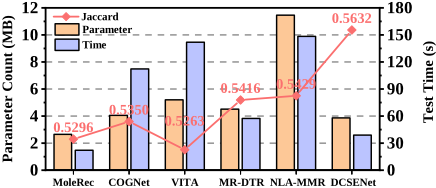
seconds for inference. We compare several strong baseline models. As shown in Figure 5, MoleRec has the lowest computational overhead but exhibits subpar accuracy. COGNet and VITA, which rely on sequential decision processes, incur longer inference times. MR-DTR efficiently encodes clinical entity structures with relatively moderate computational cost while yielding suboptimal performance. NLA-MMR, which heavily leverages LM encoding, introduces substantial additional computational burden. In contrast, our DCSENet transfers LM-based semantic knowledge to an ID-based model, achieving superior accuracy while maintaining low computational costs, demonstrating an optimal balance between performance and efficiency.
6 Conclusion
In this paper, we propose DCSENet, a dual-channel semantics-enhanced framework for medication recommendation. DCSENet leverages language models to capture the semantic information embedded in patient health records and medication-related texts. The disease channel establishes drug-symptom associations, while the visit channel captures heterogeneous patient information; together, they enable accurate personalized medication recommendations. We further adopt a knowledge distillation strategy based on attention maps, which achieves superior knowledge transfer efficacy.Extensive experimental validations on the MIMIC-III and MIMIC-IV datasets consistently demonstrate the superiority of the proposed DCSENet over existing approaches.
Ethical Statement
This study employs the HIPAA-compliant, deidentified MIMIC dataset; its use does not constitute human subjects research under HIPAA rules. Ethical precautions were strictly followed to safeguard participant privacy and rights.
@inproceedings{ijcai2026p772,
  title     = {Dual-Channel Semantic-Enhanced Combinatorial Medication Recommendation via Knowledge Distillation},
  author    = {Wen, Jiawei and Guo, Jiabao and Bai, Zhaohai and Wu, Kaishun and Lin, Ma and Zhang, Haodi},
  booktitle = {Proceedings of the Thirty-Fifth International Joint Conference on
               Artificial Intelligence, {IJCAI-26}},
  publisher = {International Joint Conferences on Artificial Intelligence Organization},
  editor    = {Diego Calvanese},
  pages     = {6940--6948},
  year      = {2026},
  month     = {8},
  note      = {AI and Health},
  doi       = {10.24963/ijcai.2026/772},
  url       = {https://doi.org/10.24963/ijcai.2026/772},
}
TY - CPAPER TI - Dual-Channel Semantic-Enhanced Combinatorial Medication Recommendation via Knowledge Distillation AU - Wen, Jiawei AU - Guo, Jiabao AU - Bai, Zhaohai AU - Wu, Kaishun AU - Lin, Ma AU - Zhang, Haodi T2 - Proceedings of the Thirty-Fifth International Joint Conference on Artificial Intelligence, IJCAI-26 PB - International Joint Conferences on Artificial Intelligence Organization PY - 2026 SP - 6940 EP - 6948 DO - 10.24963/ijcai.2026/772 UR - https://doi.org/10.24963/ijcai.2026/772 ER -Copied
Machine-readable versions of this paper, for tools and AI agents:





