
Leveraging Implicit Contexts via LLM–Graph Fusion for Temporal Knowledge Graph Reasoning
Proceedings of the Thirty-Fifth International Joint Conference on Artificial Intelligence. AI4Tech: AI Enabling Technologies. Pages 6536-6545.
https://doi.org/10.24963/ijcai.2026/727
© 2026 International Joint Conferences on Artificial Intelligence
Keywords
- Advanced AI4Tech: Data-driven AI4Tech
- Advanced AI4Tech: Generative and LLMs-driven AI4Tech
Abstract
Temporal knowledge graph (TKG) reasoning is critical for modeling and forecasting the evolution of real-world events. Existing TKG construction pipelines transform raw text into structured temporal quadruples as graph facts. However, in this process, they often fail to preserve reasoning-relevant contextual semantics from the original corpus that cannot be explicitly represented as graph facts, leaving such implicit contextual information unused by current temporal reasoning models. To address this limitation, we propose a Textual-Temporal Graph Fusion Network (TTGFN), a context-aware framework that leverages implicit contexts from text via LLM-based semantic encoding and fuses it with structure-constrained temporal graph representations for reasoning. To the best of our knowledge, this is the first work to systematically leverage LLMs to reuse previously overlooked implicit contextual information and incorporate it into temporal knowledge graph reasoning, substantially improving model performance. Extensive experiments conducted on three TKG reasoning benchmark datasets demonstrate that TTGFN outperforms the state-of-the-art approaches, with Hits@1 gains of 20.85% on ICEWS14 dataset, 31.14% on ICEWS05-15 dataset, and 24.22% on ICEWS18, respectively.
- [Bai et al., 2025a] Long Bai, Zixuan Li, Xiaolong Jin, Ji- afeng Guo, Xueqi Cheng, and Tat-Seng Chua. G2S: A general-to-specific learning framework for temporal knowledge graph forecasting with large language models. In Wanxiang Che, Joyce Nabende, Ekaterina Shutova, and Mohammad Taher Pilehvar, editors, Findings of the Asso- ciation for Computational Linguistics: ACL 2025, pages 20927-20938, Vienna, Austria, July 2025. Association for Computational Linguistics.
- [Bai et al., 2025b] Long Bai, Zixuan Li, Xiaolong Jin, Ji- afeng Guo, Xueqi Cheng, and Tat-Seng Chua. G2S: A general-to-specific learning framework for temporal knowledge graph forecasting with large language models. In Wanxiang Che, Joyce Nabende, Ekaterina Shutova, and Mohammad Taher Pilehvar, editors, Findings of the Asso- ciation for Computational Linguistics: ACL 2025, pages 20927-20938, Vienna, Austria, July 2025. Association for Computational Linguistics.
- [Cai et al., 2023a] Borui Cai, Yong Xiang, Longxiang Gao, He Zhang, Yunfeng Li, and Jianxin Li. Temporal knowl- edge graph completion: A survey. In Edith Elkind, editor, Proceedings of the Thirty-Second International Joint Con- ference on Artificial Intelligence, IJCAI-23, pages 6545- 6553. International Joint Conferences on Artificial Intelli- gence Organization, 8 2023. Survey Track. IJCAI
- [Cai et al., 2023b] Borui Cai, Yong Xiang, Longxiang Gao, He Zhang, Yunfeng Li, and Jianxin Li. Temporal knowl- edge graph completion: a survey. In Proceedings of the Thirty-Second International Joint Conference on Artificial Intelligence, pages 6545-6553, 2023. IJCAI
- [Chen et al., 2024] Minze Chen, Zhenxiang Tao, Weitong Tang, Tingxin Qin, Rui Yang, and Chunli Zhu. Enhancing emergency decision-making with knowledge graphs and large language models. International Journal of Disaster Risk Reduction, 113:104804, 2024.
- [Chen et al., 2025a] Tingxuan Chen, Liu Yang, Zidong Wang, and Jun Long. A rule-and query-guided rein- forcement learning for extrapolation reasoning in temporal knowledge graphs. Neural Networks, 185:107186, 2025.
- [Chen et al., 2025b] Wei Chen, Yuting Wu, Shuhan Wu, Zhiyu Zhang, Mengqi Liao, Youfang Lin, and Huaiyu Wan. Cogntke: a cognitive temporal knowledge extrapola- tion framework. In Proceedings of the Thirty-Ninth AAAI Conference on Artificial Intelligence and Thirty-Seventh Conference on Innovative Applications of Artificial Intelli- gence and Fifteenth Symposium on Educational Advances in Artificial Intelligence, AAAI'25/IAAI'25/EAAI'25. AAAI Press, 2025.
- [Deng et al., 2025] Yunteng Deng, Jia Song, Zhongliang Yang, Yilin Long, Li Zeng, and Linna Zhou. Diachronic semantic encoding based on pre-trained language model for temporal knowledge graph reasoning. Knowledge- Based Systems, 318:113479, 2025.
- [Gwak et al., 2024] Daehoon Gwak, Junwoo Park, Minho Park, ChaeHun Park, Hyunchan Lee, Edward Choi, and Jaegul Choo. Forecasting future international events: A reliable dataset for text-based event modeling. In Yaser Al-Onaizan, Mohit Bansal, and Yun-Nung Chen, editors, Findings of the Association for Computational Linguistics: EMNLP 2024, pages 9000-9023, Miami, Florida, USA, November 2024. Association for Computational Linguis- tics.
- [Han et al., 2021] Zhen Han, Peng Chen, Yunpu Ma, and Volker Tresp. Explainable subgraph reasoning for fore- casting on temporal knowledge graphs. In International Conference on Learning Representations, 2021.
- [Huang et al., 2024] Shuxian Huang, Ye Wang, Kai Chen, and Yan Jia. Temporal relational context learning for ex- trapolation reasoning on temporal knowledge graphs. In ICASSP 2024 -2024 IEEE International Conference on Acoustics, Speech and Signal Processing (ICASSP), pages 6430-6434, 2024.
- [Jin et al., 2019] Woojeong Jin, Meng Qu, Xisen Jin, and Xi- ang Ren. Recurrent event network: Autoregressive struc- ture inference over temporal knowledge graphs. arXiv preprint arXiv:1904.05530, 2019.
- [Jin et al., 2020] Woojeong Jin, Meng Qu, Xisen Jin, and Xiang Ren. Recurrent event network: Autoregressive structure inferenceover temporal knowledge graphs. In Bonnie Webber, Trevor Cohn, Yulan He, and Yang Liu, editors, Proceedings of the 2020 Conference on Empiri- cal Methods in Natural Language Processing (EMNLP), pages 6669-6683, Online, November 2020. Association for Computational Linguistics.
- [Jin et al., 2024] Bowen Jin, Gang Liu, Chi Han, Meng Jiang, Heng Ji, and Jiawei Han. Large language models on graphs: A comprehensive survey. IEEE Transactions on Knowledge and Data Engineering, 2024.
- [Li et al., 2021a] Zixuan Li, Xiaolong Jin, Wei Li, Saiping Guan, Jiafeng Guo, Huawei Shen, Yuanzhuo Wang, and Xueqi Cheng. Temporal knowledge graph reasoning based on evolutional representation learning. In Proceedings of the 44th international ACM SIGIR conference on research and development in information retrieval, pages 408-417, 2021.
- [Li et al., 2021b] Zixuan Li, Xiaolong Jin, Wei Li, Saiping Guan, Jiafeng Guo, Huawei Shen, Yuanzhuo Wang, and Xueqi Cheng. Temporal knowledge graph reasoning based on evolutional representation learning. In Proceedings of the 44th International ACM SIGIR Conference on Re- search and Development in Information Retrieval, SIGIR '21, page 408-417, New York, NY, USA, 2021. Associa- tion for Computing Machinery.
- [Li et al., 2022] Yujia Li, Shiliang Sun, and Jing Zhao. Tirgn: Time-guided recurrent graph network with local- global historical patterns for temporal knowledge graph reasoning. In IJCAI, pages 2152-2158, 2022.
- [Li et al., 2023a] Hongyang Li, Cui Zhu, Wenjun Zhu, Yun- feng Zhou, and Xinyu Zhang. Short-term sequential pat- tern for temporal knowledge graph reasoning. In CAIBDA, pages 728-739, 2023.
- [Li et al., 2023b] Yuhan Li, Zhixun Li, Peisong Wang, Jia Li, Xiangguo Sun, Hong Cheng, and Jeffrey Xu Yu. A survey of graph meets large language model: Progress and future directions. arXiv preprint arXiv:2311.12399, 2023. IJCAI
- [Liao et al., 2024] Ruotong Liao, Xu Jia, Yangzhe Li, Yunpu Ma, and Volker Tresp. GenTKG: Generative forecasting on temporal knowledge graph with large language models. In Kevin Duh, Helena Gomez, and Steven Bethard, edi- tors, Findings of the Association for Computational Lin- guistics: NAACL 2024, pages 4303-4317, Mexico City, Mexico, June 2024. Association for Computational Lin- guistics.
- [Liu et al., 2022] Kangzheng Liu, Feng Zhao, Guandong Xu, Xianzhi Wang, and Hai Jin. Temporal knowledge graph reasoning via time-distributed representation learn- ing. In 2022 IEEE International Conference on Data Min- ing (ICDM), pages 279-288, 2022.
- [Pan et al., 2025] Qihong Pan, Limin Yao, Guojiang Shen, Xiao Han, Yichuan Chen, and Xiangjie Kong. Leveraging temporal validity of rules via llms for enhanced temporal knowledge graph reasoning. Knowledge-Based Systems, 327:114094, 2025.
- [Seo et al., 2018] Youngjoo Seo, Michaël Defferrard, Pierre Vandergheynst, and Xavier Bresson. Structured sequence modeling with graph convolutional recurrent networks. In Long Cheng, Andrew Chi Sing Leung, and Seiichi Ozawa, editors, Neural Information Processing, pages 362-373, Cham, 2018. Springer International Publishing.
- [Shang et al., 2019] Chao Shang, Yun Tang, Jing Huang, Jinbo Bi, Xiaodong He, and Bowen Zhou. End-to- end structure-aware convolutional networks for knowledge base completion. Proceedings of the AAAI Conference on Artificial Intelligence, 33(01):3060-3067, Jul. 2019.
- [Tang et al., 2025] Guo Tang, Zheng Chu, Wenxiang Zheng, Junjia Xiang, Yizhuo Li, Weihao Zhang, Ming Liu, and Bing Qin. AnRe: Analogical replay for temporal knowl- edge graph forecasting. In Wanxiang Che, Joyce Nabende, Ekaterina Shutova, and Mohammad Taher Pilehvar, edi- tors, Proceedings of the 63rd Annual Meeting of the As- sociation for Computational Linguistics (Volume 1: Long Papers), pages 4632-4650, Vienna, Austria, July 2025. Association for Computational Linguistics.
- [Wang et al., 2024a] Jiapu Wang, Sun Kai, Linhao Luo, Wei Wei, Yongli Hu, Alan Wee-Chung Liew, Shirui Pan, and Baocai Yin. Large language models-guided dynamic adap- tation for temporal knowledge graph reasoning. Advances in Neural Information Processing Systems, 37:8384-8410, 2024.
- [Wang et al., 2024b] Jiapu Wang, Kai Sun, Linhao Luo, Wei Wei, Yongli Hu, Alan Wee-Chung Liew, Shirui Pan, and Baocai Yin. Large language models-guided dynamic adaptation for temporal knowledge graph reasoning. In A. Globerson, L. Mackey, D. Belgrave, A. Fan, U. Paquet, J. Tomczak, and C. Zhang, editors, Advances in Neural Information Processing Systems, volume 37, pages 8384- 8410.
- Curran Associates, Inc., 2024.
- [Xia et al., 2024] Yuwei Xia, Ding Wang, Qiang Liu, Liang Wang, Shu Wu, and Xiao-Yu Zhang. Chain-of-history reasoning for temporal knowledge graph forecasting. In Lun-Wei Ku, Andre Martins, and Vivek Srikumar, editors, Findings of the Association for Computational Linguistics: ACL 2024, pages 16144-16159, Bangkok, Thailand, Au- gust 2024. Association for Computational Linguistics.
- [Xu et al., 2020] Da Xu, Chuanwei Ruan, Evren Korpeoglu, Sushant Kumar, and Kannan Achan. Inductive repre- sentation learning on temporal graphs. arXiv preprint arXiv:2002.07962, 2020.
- [Xu et al., 2023a] Wenjie Xu, Ben Liu, Miao Peng, Xu Jia, and Min Peng. Pre-trained language model with prompts for temporal knowledge graph completion. In Anna Rogers, Jordan Boyd-Graber, and Naoaki Okazaki, edi- tors, Findings of the Association for Computational Lin- guistics: ACL 2023, pages 7790-7803, Toronto, Canada, July 2023. Association for Computational Linguistics.
- [Xu et al., 2023b] Yi Xu, Junjie Ou, Hui Xu, and Luoyi Fu. Temporal knowledge graph reasoning with historical con- trastive learning. Proceedings of the AAAI Conference on Artificial Intelligence, 37(4):4765-4773, Jun. 2023.
- [Yang and Zhu, 2025] Xi Yang and Jia Zhu. Large language model with iteratively prompt for temporal knowledge graph completion. Neurocomputing, 651:130941, 2025.
- [Zhong et al., 2023] Lingfeng Zhong, Jia Wu, Qian Li, Hao Peng, and Xindong Wu. A comprehensive survey on auto- matic knowledge graph construction. ACM Comput. Surv., 56(4), November 2023.
- [Zhu et al., 2021] Cunchao Zhu, Muhao Chen, Changjun Fan, Guangquan Cheng, and Yan Zhang. Learning from history: Modeling temporal knowledge graphs with se- quential copy-generation networks. Proceedings of the AAAI Conference on Artificial Intelligence, 35(5):4732- 4740, May 2021.
- [Zhu et al., 2025] Peng Zhu, Yuante Li, Qinyuan Liu, Dawei Cheng, and Changjun Jiang. Financial time series pre- diction with multi-granularity graph augmented learning. IEEE Transactions on Knowledge and Data Engineering, 37(11):6436-6449, 2025.
References were extracted automatically from the PDF and may contain errors.
Full text extracted automatically from the PDF; figures, tables and equations may differ. The PDF is the version of record.
1 Introduction
Temporal Knowledge Graph (TKG) reasoning aims to model and predict how real-world events evolve over time, and it underpins many time-critical forecasting tasks such as stock market prediction [Zhu et al., 2025], political stability assessment [Gwak et al., 2024], and crisis response planning [Chen et al., 2024], where future outcomes depend on the structured progression of past events. In practice, most TKGs are built from raw text through an information extraction pipeline that converts event mentions into structured temporal facts, typically represented as (subject, relation, object, timestamp) quadruples [Cai et al., 2023a].
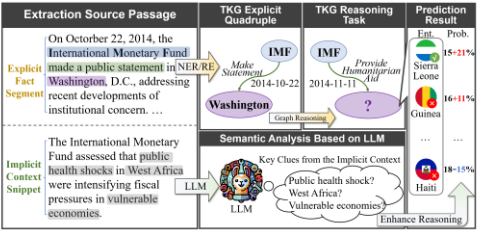
However, this pipeline inherently limits what evidence can be used for reasoning. It retains only text that can be explicitly extracted into a fixed quadruple form (e.g., via Named Entity Recognition or Relation Extraction). We term such extractable textual evidence as explicit context. Many informative cues in the source passage, such as explanations, thematic signals, and regional conditions, cannot be cast into a single quadruple. We term such non-extractable yet informative evidence as implicit contexts. Prior studies on automatic knowledge graph construction have observed that extractionbased pipelines often fail to preserve reasoning-relevant implicit contextual semantics from the original corpus [Zhong et al., 2023], leaving them unused by structure-only TKG reasoning models and limiting predictive performance in complex scenarios. Fig. 1 illustrates how implicit cues can constrain subsequent temporal reasoning queries. Therefore, acquiring and utilizing implicit contexts for TKG reasoning remains an important problem.
To enable effective acquisition and utilization of implicit contexts in TKG reasoning, we need to address the following significant challenges:
CH1. How can implicit contexts be systematically acquired and effectively utilized to enhance query representations for temporal prediction? The first challenge concerns how to reliably identify, acquire and distill useful implicit signals from unstructured text for a given temporal query. Unlike explicit contexts that are directly recorded as graph facts, implicit contexts are scattered, heterogeneous, and often noisy, with relevance that varies across time and queries. Effectively exploiting such information therefore requires temporally aligned context selection as well as compact and noise-robust representation learning, so that the distilled semantics can consistently strengthen temporal link prediction.
CH2. How can semantic representations from implicit contexts be fused with structure-constrained temporal representations? The second challenge concerns coherently fusing semantic representations from implicit contexts with graph-based temporal representations that are constrained by both graph structure and temporal dynamics. Temporal graph models produce structure-aware embeddings by explicitly encoding temporal and relational dependencies, whereas representations derived from implicit text are typically highdimensional and lack explicit structural constraints [Cai et al., 2023b]. Bridging this gap requires a fusion mechanism that respects structural and temporal constraints, ensuring that implicit semantic information complements graph-based reasoning and leads to stable temporal predictions.
Our Approach and Contributions. To address these challenges, we propose the Textual-Temporal Graph Fusion Network (TTGFN), a framework that enhances TKG reasoning by acquiring implicit contexts from text and integrating its LLM-encoded representations with graph-based query representations. Rather than augmenting the graph with additional extracted facts or modifying its structure, TTGFN enhances the original prediction query through context-aware semantic fusion. The main contributions of our work are summarized as follows:
- To address CH1, we propose a context-aware inference module that acquires implicit contexts and encodes it into compact semantic priors using LLMs, thereby enhancing query representations for temporal link prediction.
- To address CH2, we propose a structure-constrained fusion mechanism that aligns LLM-derived semantic representations with temporal graph embeddings, enabling stable and synergistic enhanced reasoning.
- Extensive experiments on three TKG reasoning benchmarks demonstrate that TTGFN achieves state-of-theart performance. We also release three implicit-contextaugmented benchmark datasets 1 to facilitate future research in the community.
2 RelatedWork
2.1 Temporal Knowledge Graph Reasoning
Recent advances in TKG reasoning have been largely driven by neural temporal modeling over observed quadruples. Representative methods capture historical dependencies through autoregressive or recurrent dynamics (e.g., RE-NET [Jin et al., 2019]), incorporate relation-aware temporal message passing and updates (e.g., REGCN [Li et al., 2021a]), and further enhance temporal modeling by combining local and global temporal patterns (e.g., TiRGN [Li et al., 2022]). More recent work explores richer temporal signals, such as trendaware representations for evolving event dynamics (Trend [Huang et al., 2024]), or formulates temporal reasoning as long-horizon decision making to improve dependency modeling (LogiRL [Chen et al., 2025a]). Despite these advances, most existing methods still operate primarily on structured quadruples and do not systematically exploit the rich textual context available during graph construction, limiting their ability to leverage implicit background knowledge for temporal prediction.
1 Our code and three implicit-context-augmented datasets are publicly available at https://github.com/tianzeshu/TTGFN.
2.2 Integration of LLMs with TKGs
Recent studies have explored integrating LLMs with graphbased models for prediction and reasoning [Li et al., 2023b; Jin et al., 2024]. In TKG settings, most approaches use LLMs as auxiliary components, such as generating temporal rules, modeling logical constraints, or reformulating forecasting as language-based inference [Wang et al., 2024a; Bai et al., 2025a; Pan et al., 2025]. However, they often overlook leveraging implicit textual context that is discarded during graph construction to systematically strengthen the prediction query. In contrast, our work reuses such implicit contexts and aligns their semantic representations with structure-constrained temporal representations for more expressive TKG reasoning.
3 ProblemDefinition
A TKG is denoted as G = {E, R, T , Q}, where E is the entity set, R is the relation set, T is the timestamp set, and Q is the set of temporal quadruples. Each quadruple is represented as (es, r, eo, t) ∈ Q, where es, eo ∈ E denote the head and tail entities, r ∈ R denotes the relation, and t ∈ T denotes the timestamp. Given a query (es, r, t), the task of TKG reasoning is formulated as predicting the tail entity eo.
4 Methodology
Fig. 2 illustrates our framework for temporal link prediction as a unified three-stage pipeline. Stage I retrieves implicit context snippets for the query entity using reproducible strategies. Stage II encodes the retrieved context and query information into dense, context-aware representations via a LLM. Stage III integrates these representations with graph-guided reasoning to predict target entities under temporal and structural constraints.
4.1 Stage I: Implicit Context Acquisition
In this work, we define implicit contexts as auxiliary semantic information from unstructured or weakly structured textual sources related to an entity that is not explicitly captured by knowledge graph quadruples, yet remains informative for temporal reasoning. This stage aims to recover such contextual snippets in a concise and reproducible manner.
Implicit Context Repository. We construct an offline Implicit Context Repository (ICR) that stores context snippets associated with each query anchor (es, t) and temporally preceding t (e.g., within [t - w, t), where w denotes a temporal window size), obtained either from available unstructured texts or via entity-anchored retrieval from external corpora.
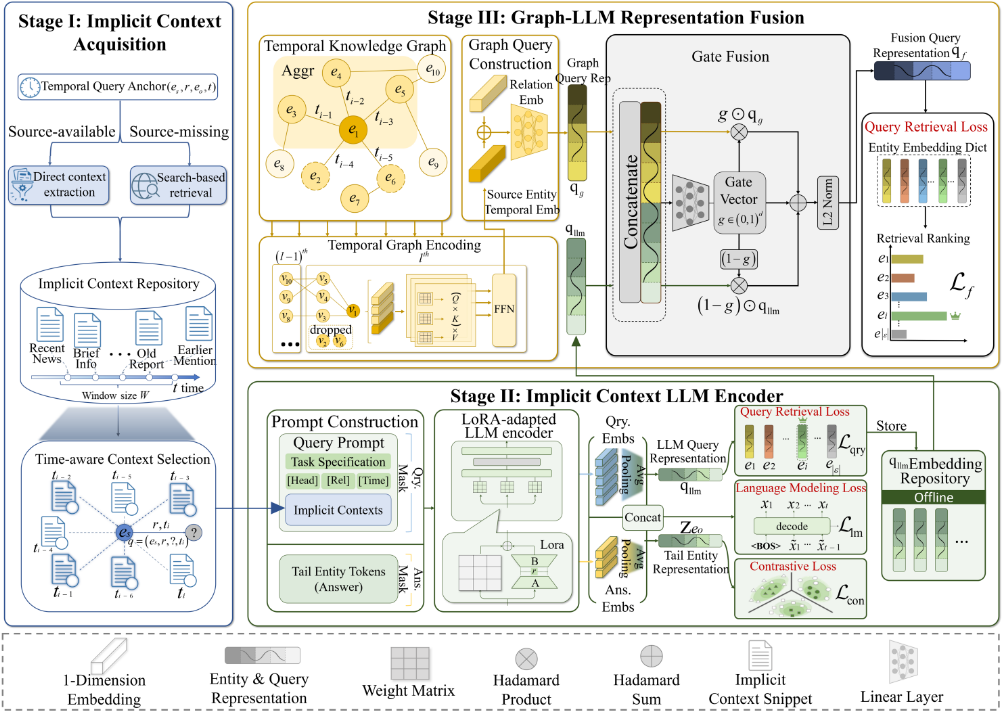
Each snippet is represented as a pair (t′j , xj), where xj is a natural language snippet related to es and t′j ∈ T denotes its timestamp; such snippets do not necessarily mention the target entity or queried relation and may contain noise. For each anchor (es, t), snippets are as follows:
where Nes,t denotes the number of snippets. Each snippet is indexed by (es, t′j ), enabling entity-conditioned and timeaware organization, while the coexistence of informative and irrelevant snippets is handled in Stage II via a two-step training strategy (Section 4.2).
Time-aware Context Selection. At training or inference time, given a temporal query (es, r, t), we retrieve its associated snippet set M[es, t] from the ICR and select only snippets whose timestamps precede the query time:
To emphasize temporal relevance, we retain the K snippets closest to t:
This design prevents temporal leakage and preserves the most relevant implicit contexts for subsequent semantic encoding, where TOPK(·) ranks snippets by their timestamps.
4.2 Stage II: Implicit Context LLMEncoder
Stage II encodes implicit contexts associated with each temporal query into compact, reusable semantic representations using a large language model, providing context-aware information for downstream graph-based temporal reasoning.
Prompt Construction
For each temporal query (es, r, t), we construct a taskoriented prompt by instantiating a fixed template with the query tuple and the retrieved implicit contexts:
where superscripts ictx indicate whether implicit context (ictx) snippets are included in the prompt.
During training, we follow a teacher-forced formulation and append the ground-truth tail entity text to the query prompt, yielding an answer-augmented input P ictx es,r,t,eo , while inference and downstream fusion use P ictx es,r,t alone.
Context-Enhanced Representation Generation
Given the input prompt ˆ P (i.e., Pes,r,t,eo for training and Pes,r,t for inference), the LoRA-adapted encoder fθ produces token-level representations:
Let Iqry, Ians ⊆ {1, . . . , L} denote the token index sets of the query and answer segments, respectively. Segment representations are obtained via masked mean pooling:
Importantly, qllm is computed exclusively from the query segment to prevent label leakage and ensure train-test consistency.
Multi-Objective Optimization
We optimize the prompt encoder using a multi-objective formulation to handle noisy and weakly aligned implicit contexts.
Query Retrieval Loss. Given the context-aware query representation qllm and a fixed entity embedding dictionary E that stores embeddings for all candidate entities e ∈ E, preencoded by the same base language model used for prompt encoding:
we compute retrieval logits s(e) = q⊤llmee/τq for e ∈ E, where τq > 0 is a temperature parameter, and define the retrieval loss as follows:
Language Modeling Loss. Under the teacher-forced formulation adopted during training, let Pes,r,t,eo = (x1, . . . , xL) denote the answer-augmented prompt, where xℓ is the ℓ-th input token. We apply a language modeling loss only on tokens corresponding to the appended ground-truth tail entity, indexed by Ians to regularize hidden representations under retrieval supervision as follows:
where pθ(·) denotes the conditional token probability induced by the language model with parameters θ.
Contrastive Loss. To encourage the query representation to selectively attend to context cues that are discriminative for identifying the correct tail entity, we introduce a contrastive objective between the query representation qllm and the tail entity representation zeo extracted from the same forward computation. For a mini-batch of size B, the contrastive loss is formulated as:
Algorithm 1: Stage II Training Procedure
Input: Temporal training queries Q, implicit contexts index M
Output: Trained encoder fθ
- 1 Step 1: Train with context-free prompts;
- 2 foreach (es, r, t, eo) ∈ Q do
- 3 Construct the answer-augmented prompt Pes,r,t,eo ;
- 4 Compute H= fθ(Pes,r,t,eo ) (Eq. (5));
- 5 Obtain qllm and zeo by masked pooling (Eq. (6));
- 6 Compute Lqry,Llm,Lcon, and optimize Lllm;
- 7 Step 2: Fine-tune with implicit contexts;
- 8 foreach (es, r, t, eo) ∈ Q do
- 9 Retrieve C (K) es,t fromMand construct the answer-augmented ictx-aware prompt P ictx es,r,t,eo ; 10 Compute H= fθ(P ictx es,r,t,eo ) (Eq. (5));
- 11 Obtain qllm and zeo by masked pooling (Eq. (6));
- 12 Compute Lqry,Llm,Lcon, and optimize Lllm;
- 13 return fθ;
where aij denotes the batch-wise similarity between the i-th LLM-based query representation q i llm and the j-th tail entity representation z j eo , and τc > 0 is a temperature parameter.
Overall Objective. The overall training objective of Stage II is defined as follows:
where λlm and λcon control the contributions of semantic regularization and context disambiguation, respectively.
Two-Step Training Strategy
Implicit context snippets are weakly aligned and may contain noise, and directly incorporating them from the beginning of training can cause the model to overfit spurious correlations. To mitigate this issue, Stage II adopts a two-step training strategy based on whether implicit contexts are included. The overall training and inference procedure of Stage II is summarized in Algorithm 1.
Specifically, we first train the model with context-free prompts that exclude implicit contexts, allowing the model to focus on the core temporal prediction task without interference from noisy contextual signals. We then fine-tune the model using context-aware prompts P ictx es,r,t with C (K) es,t to selectively incorporate implicit contextual semantics.
4.3 Stage III: Graph-LLMRepresentation Fusion
We treat the temporal graph encoder as a structure- and timeconstrained semantic module that complements the languagebased query representation with inductive bias. Entities and relations are embedded in the same semantic space as the entity dictionary E, where both entities and relations are initialized by projecting their LLM-induced embeddings, yielding the initial entity embedding v(0) e and the relation embedding vr, respectively.
Temporal Graph Encoding. Given a temporal query (es, r, t), the temporal neighborhood N(es, t) consists of all historical interactions involving es that occurred strictly before t, each represented as (eu, ru→s, tu→s), where eu ∈ E is a neighboring entity, ru→s ∈ R denotes the relation type, and tu→s ∈ T is the interaction timestamp. To capture temporal dynamics, the time gap between each interaction and t is encoded using a continuous time encoding function τ(·). Following TGAT [Xu et al., 2020], relation-aware and timeconditioned messages are aggregated from N(es, t), with each message defined as:
whereWmsg is a learnable weight matrix.
After Lg aggregation layers, the head entity temporal embedding v(Lg) es,t is combined with the query relation embedding vr to form the graph-side semantic query, defined as:
where ϕ(·) denotes a linear projection followed by normalization; qg is subsequently used for gated fusion with the language-based query.
Gated Fusion of Language and Graph Queries. The language-based query qllm and the graph-based query qg are implicitly aligned through shared supervision over the entity embedding dictionary E and consistent semantic initialization, yielding representations in a common semantic space. They are combined via a gated fusion mechanism, where the gate vector g controls the dimension-wise contribution of each query. The fused query representation is obtained as:
where Norm(·) denotes ℓ2 normalization, and ⊙ denotes element-wise multiplication.
Predictions are made by ranking candidate entities according to q⊤f ee, and the model is trained using a softmax-based query loss:
5 Experiments
We conduct extensive experiments to answer the following research questions (RQs):
- RQ1: How does TTGFN perform when compared with state-of-the-art methods on TKG reasoning tasks?
- RQ2: How do individual components of TTGFN contribute to overall performance and robustness against hallucinated contextual signals?
- RQ3: How does the quality of implicit contexts, in terms of relevance and temporal proximity, affect TTGFN and its sensitivity to hallucinated contexts?
- RQ4: How robust is TTGFN under long-tail relations and long-range temporal reasoning?
- RQ5: How sensitive is TTGFN to loss-weighting parameters balancing semantic modeling and structureconstrained alignment?
| Statistic | ICEWS14 | ICEWS05-15 | ICEWS18 |
|---|---|---|---|
| #Entities | 7,128 | 10,488 | 23,033 |
| #Relations | 230 | 251 | 256 |
| #Timestamps | 365 | 4,017 | 365 |
| #Samples | 90,706 | 461,200 | 465,538 |
| #Granularity | 24 hours | 24 hours | 1 hour |
5.1 Experimental Settings
Datasets
We conduct experiments on three widely used ICEWS TKG benchmarks 2 , which record fine-grained socio-political events as temporal quadruples. Specifically, we use ICEWS14, ICEWS05-15, and ICEWS18, following standard 80%/10%/10% train/validation/test splits. All models are evaluated on the link prediction task, with dataset statistics summarized in Table 1. Additional dataset statistics, including temporal coverage, graph scale and three implicitcontext-augmented datasets constructed in this work, are provided in Appendix Section 3.
Evaluation Metrics
We evaluate performance using standard ranking-based metrics, including Mean Reciprocal Rank (MRR) and Hits@k for k ∈ {1, 3}. We focus on temporal link prediction, where the model predicts the tail entity o given (s, r, ?, t). Following common practice [Cai et al., 2023b], we adopt the timeaware filtered evaluation protocol provided by xERTE [Han et al., 2021] to ensure fair and consistent evaluation.
Parameter Settings
Experiments are conducted on a single NVIDIA RTX 5090 GPU, while the codebase also supports multi-GPU training via Distributed Data Parallel (DDP). Unless otherwise stated, all runs are executed with fixed random seeds to ensure reproducibility.
We train TTGFN with AdamW (initial learning rate 1 × 10⁻⁴ ) for up to 50 epochs and apply early stopping (patience = 3) based on time-aware filtered validation MRR. To avoid frequent checkpoint updates caused by marginal fluctuations, we discretize the monitored MRR by flooring to 10-3 precision. We optionally use gradient accumulation and a cosine annealing learning-rate schedule for stable optimization. This discretization stabilizes early stopping without affecting final rankings. All results are averaged over five independent runs to ensure statistical robustness. Detailed parameter settings are provided in Appendix Section 1.
2 https://dataverse.harvard.edu/dataset.xhtml?persistentId=doi: 10.7910/DVN/28075
| Method | ICEWS14 | ICEWS05-15 | ICEWS18 | ||||||
|---|---|---|---|---|---|---|---|---|---|
| MRR | Hits@1 | Hits@3 | MRR | Hits@1 | Hits@3 | MRR | Hits@1 | Hits@3 | |
| Static Graph-based Methods | |||||||||
| Conv-TransE [Shang et al., 2019] | 31.50 | 22.46 | 34.98 | 30.28 | 20.79 | 33.80 | 23.22 | 14.26 | 26.13 |
| ConvE [Liu et al., 2022] | 30.30 | 21.30 | 34.42 | 31.40 | 21.56 | 35.70 | 22.81 | 13.63 | 25.83 |
| Temporal Graph-based Methods | |||||||||
| RGCRN [Seo et al., 2018] | 33.31 | 24.08 | 36.55 | 33.00 | 24.00 | 36.50 | 23.46 | 14.24 | 26.62 |
| ReNet [Jin et al., 2020] | 35.77 | 25.99 | 40.41 | 36.86 | 26.24 | 41.85 | 26.17 | 16.43 | 29.89 |
| RE-GCN [Li et al., 2021b] | 41.50 | 30.86 | 46.60 | 46.41 | 35.17 | 52.76 | 30.55 | 20.00 | 34.73 |
| CYGNET [Zhu et al., 2021] | 35.09 | 25.57 | 39.96 | 36.20 | 26.15 | 41.37 | 25.09 | 15.96 | 28.75 |
| TiRGN [Li et al., 2022] | 43.88 | 33.12 | 49.48 | 48.72 | 37.17 | 55.48 | 32.06 | 21.08 | 36.75 |
| STSP [Li et al., 2023a] | 41.38 | 30.62 | 46.96 | 35.87 | 25.43 | 37.50 | 30.93 | 20.30 | 35.20 |
| CENet [Xu et al., 2023b] | 38.19 | 28.46 | 42.81 | 41.04 | 30.47 | 46.51 | 28.03 | 18.09 | 32.09 |
| Trend [Huang et al., 2024] | 46.33 | 36.01 | 51.76 | 44.21 | 32.78 | 49.86 | 34.67 | 24.02 | 39.30 |
| LogiRL [Chen et al., 2025a] | 44.71 | 35.72 | 51.03 | 51.04 | 40.71 | 57.55 | 34.94 | 24.76 | 39.57 |
| LLM-based Methods | |||||||||
| PPT [Xu et al., 2023a] | 38.42 | 28.94 | 42.50 | 38.85 | 28.57 | 43.35 | 26.63 | 16.94 | 30.64 |
| GenTKG [Liao et al., 2024] | - | 36.85 | 47.95 | - | - | - | - | 24.25 | 37.25 |
| G2S [Bai et al., 2025b] | - | 38.33 | 54.12 | - | - | - | - | 23.04 | 35.32 |
| AnRe [Tang et al., 2025] | 47.40 | 36.90 | 51.10 | 50.90 | 39.10 | 58.00 | 35.50 | 26.00 | 39.20 |
| Graph-LLM Hybrid Methods | |||||||||
| TiRGN + CoH [Xia et al., 2024] | 43.94 | 33.07 | 49.64 | 49.71 | 38.01 | 56.40 | 32.98 | 21.83 | 37.79 |
| LLM-DA [Wang et al., 2024b] | 47.10 | 36.90 | 52.60 | 52.10 | 41.60 | 58.60 | - | - | - |
| DSEP [Deng et al., 2025] | 44.87 | 34.35 | 50.29 | 50.68 | 39.78 | 56.85 | 33.81 | 23.24 | 38.22 |
| CognTKE [Chen et al., 2025b] | 46.06 | 36.49 | 51.11 | 53.13 | 42.62 | 59.42 | 35.24 | 25.21 | 39.93 |
| APE-LLaMA-7B [Yang and Zhu, 2025] | 48.32 | 37.74 | - | 52.86 | 41.94 | - | 36.52 | 26.26 | - |
| Our Method | |||||||||
| TTGFN | 52.58 | 45.61 | 55.94 | 61.28 | 55.89 | 64.00 | 38.58 | 32.62 | 40.90 |
| ∆ Improvement | +8.82% | +20.85% | +6.35% | +15.34% | +31.14% | +7.71% | +5.64% | +24.22% | +2.37% |
Baselines for Comparison
To comprehensively evaluate the effectiveness of TTGFN, we compare it with representative baseline methods summarized in Table 2. All baselines are evaluated using publicly available implementations or by following the experimental settings reported in their original papers. Detailed descriptions of the baseline methods are provided in Appendix Section 2.
5.2 Result 1: Comparison with Baselines
To answer RQ1, we evaluate TTGFN on temporal link prediction over ICEWS14, ICEWS05-15, and ICEWS18, with results reported in Table 2. Overall, TTGFN consistently outperforms all baseline methods across all datasets and all Hits@k metrics, demonstrating robust and comprehensive improvements in ranking performance. In particular, TTGFN achieves gains of 8.82% in MRR and 20.85% in Hits@1 on ICEWS14, and achieves relative gains of up to 15.34% in MRR and 31.14% in Hits@1 on ICEWS05-15, as well as 5.64% in MRR and 24.22% in Hits@1 on ICEWS18, indicating more accurate and reliable tail entity prediction.
These consistent gains suggest that reusing implicit contextual information primarily enhances the discriminative power of query representations, rather than merely reshaping the ranking distribution in isolated cases. By integrating semantic cues recovered by LLMs with structure-constrained temporal representations, TTGFN produces more informative query embeddings, leading to improved top-ranked prediction accuracy across diverse TKGs. We also provide a detailed analysis of training and inference efficiency in Appendix Section 6.
| Variant | ICEWS14 | ICEWS05-15 | ICEWS18 | |||
|---|---|---|---|---|---|---|
| MRR | H@1 | MRR | H@1 | MRR | H@1 | |
| TTGFN | 52.58 | 45.61 | 61.28 | 55.89 | 38.58 | 32.62 |
| LLM-only | 49.13 | 42.54 | 56.44 | 50.53 | 34.91 | 28.65 |
| Graph-only | 47.07 | 40.69 | 58.45 | 53.05 | 33.14 | 27.21 |
| w/o ICR | 48.02 | 41.58 | 59.36 | 53.92 | 34.02 | 27.88 |
| AvgFusion | 50.11 | 43.27 | 60.02 | 54.41 | 35.96 | 30.04 |
| ScalarGate | 51.34 | 44.39 | 60.71 | 55.02 | 37.12 | 31.06 |
5.3 Result 2: Ablation Study
To answer RQ2, we conduct an ablation study under identical hyper-parameter settings, with results summarized in Table 3. This experiment evaluates the contribution of four key designs in TTGFN: language-based semantic reasoning, temporal graph reasoning, implicit context retrieval, and gated representation fusion. We compare the full TTGFN with five ablated variants. Specifically, LLM-only removes the graphbased reasoning path and relies on language-derived representations, while Graph-only disables the language branch and performs reasoning only on temporal graph structure. The w/o ICR variant removes implicit context retrieval and forces the model to operate without external textual context. To examine the fusion design, AvgFusion replaces the gated fusion module with uniform averaging of the two query representations, whereas ScalarGate adopts a simplified fusion mechanism using a learnable scalar gate.
The results show that removing any core component consistently degrades performance across the three datasets. The declines of LLM-only and Graph-only indicate that languagederived semantics and temporal graph structure provide complementary evidence for temporal link prediction. The degradation of w/o ICR further confirms that implicit context retrieval contributes useful external semantic information beyond explicit temporal quadruples. Moreover, although AvgFusion and ScalarGate still combine both representation sources, they remain inferior to the full TTGFN, suggesting that simple averaging or scalar-level weighting cannot fully capture fine-grained interactions between graph-side and language-side signals.
These ablation results demonstrate that TTGFN improves temporal reasoning through coordinated semantic enhancement and structure-constrained fusion, rather than by simply introducing LLM-encoded features. They also address the hallucination concern associated with LLM-based semantics, since TTGFN consistently outperforms both the LLM-only and naive fusion variants. This suggests that semantic cues are injected in a controlled manner, while the gated fusion mechanism helps suppress spurious or hallucinated signals through temporal graph constraints.
5.4 Result 3: Analysis of Implicit Context Quality
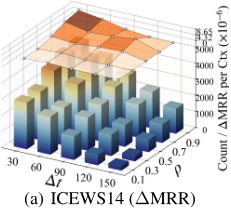
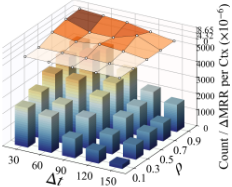
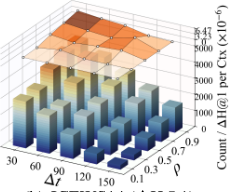
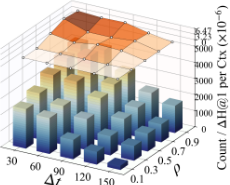
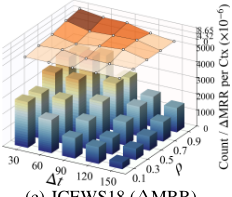
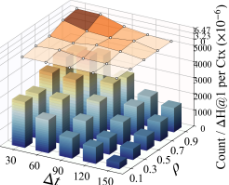
To answer RQ3, we analyze the impact of implicit context quality on temporal link prediction using a binned evaluation (Fig. 3). Implicit context snippets are grouped by their average time gap ∆t and LLM-estimated relevance score ρ, aggregated over the test queries that select each context. This setting allows us to examine how temporal proximity and semantic relevance jointly affect the usefulness of retrieved implicit contexts. Performance gains are measured as ∆MRR and ∆Hits@1 relative to the no-context setting.
Across all datasets, implicit contexts consistently improve performance, with larger gains for contexts that are temporally closer and more semantically relevant. This trend demonstrates that TTGFN can effectively exploit high-quality implicit contexts to enhance temporal query representations. Meanwhile, the performance gains become smaller when contexts are less relevant or temporally distant, indicating that the model remains robust under limited relevance or temporal proximity rather than being overly sensitive to noisy contextual information.
Regarding hallucination, the binned analysis indicates that improvements concentrate in temporally proximate and highrelevance contexts, while low-relevance contexts yield negligible impact. This selectivity suggests that TTGFN does not blindly amplify contextual semantics and is relatively robust to unreliable or hallucinated signals. Overall, the analysis
(c) ICEWS05-15 (∆MRR)
(b) ICEWS14 (∆H@1)
(d) ICEWS05-15 (∆H@1)
(e) ICEWS18 (∆MRR)
(f) ICEWS18 (∆H@1)
Figure 3: Binned analysis of implicit context effectiveness on temporal link prediction. Bins are defined by the time gap ∆t and LLMestimated relevance ρ. 3D columns denote instance counts, and surfaces show performance gains (∆MRR on the left and ∆Hits@1 on the right) on ICEWS14, ICEWS05-15, and ICEWS18.
supports that implicit contexts are beneficial when they provide relevant temporal evidence, while low-quality contexts have limited influence on prediction. Detailed analyses are provided in Appendix Section 5.
5.5 Result 4: Long-Tail and Long-Range Reasoning Analysis
To answer RQ4, we analyze the robustness of TTGFN under long-tail relations and long-range temporal dependencies, with results reported in Table 4. Test queries are analyzed along two dimensions: relation frequency and temporal distance to the most recent historical observation. For relation frequency, relation types are ranked by occurrence frequency and split into three groups with similar numbers of relation types. For temporal distance, queries are grouped into temporal-gap tertiles based on the empirical distribution, with no-history queries considered separately.
Across both analyses, TTGFN maintains relatively stable MRR as relation frequency decreases or temporal gaps increase. In the relation-frequency analysis, the model still achieves reasonable performance on low-frequency relations, indicating its ability to handle long-tail reasoning cases despite limited observations. In the temporal-distance analysis, TTGFN shows moderate degradation from short-gap to longgap settings, and it remains effective in no-history scenarios where recent structural evidence is unavailable.
| Tertile | ICEWS14 | ICEWS05-15 | ICEWS18 | ||||
|---|---|---|---|---|---|---|---|
| #Q | MRR | #Q | MRR | #Q | MRR | ||
| Freq. | Low | 20 | 51.70 | 92 | 53.17 | 89 | 36.24 |
| Mid | 232 | 52.45 | 967 | 57.93 | 1123 | 37.46 | |
| High | 8711 | 57.54 | 45033 | 61.08 | 48333 | 38.61 | |
| Short | 2413 | 54.12 | 13914 | 62.34 | 17779 | 40.06 | |
| ∆t Mid | 2039 | 51.27 | 13278 | 60.58 | 11372 | 38.06 | |
| Long | 2178 | 48.18 | 13456 | 55.82 | 13898 | 37.36 | |
| NH | 2333 | 45.83 | 5444 | 53.18 | 6496 | 37.07 | |
These results demonstrate that TTGFN is robust under sparse structural supervision. Its performance in long-tail, long-range, and no-history settings suggests that the model can still make reliable predictions when explicit graph evidence becomes limited. This observation is consistent with the role of implicit contextual semantics in complementing sparse structural information, while the temporal graph component provides necessary structural constraints for prediction.
5.6 Result 5: Loss Weight Sensitivity Study
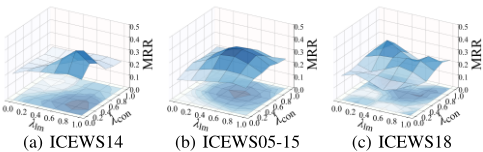
To address RQ5, we investigate the sensitivity of TTGFN to the loss-weight parameters λlm and λcon in the overall Stage II training objective (Eq. (11)). These two parameters control the contributions of the language modeling loss and the contrastive loss, respectively. Fig. 4 shows the MRR performance surfaces on three datasets under different weight combinations.
Across all datasets, TTGFN exhibits a smooth performance landscape with a broad high-performance region, indicating low sensitivity to precise weight tuning. The model maintains strong performance under a range of moderate weight combinations, suggesting that the language modeling loss and contrastive loss can jointly improve the quality of LLM-based query representations. In contrast, extreme imbalance between λlm and λcon causes moderate degradation, showing that overemphasizing either objective may weaken the overall representation quality.
These results demonstrate that TTGFN is robust to lossweight selection and does not require precise dataset-specific parameter tuning. Balanced configurations consistently yield strong performance, supporting the joint use of language modeling supervision and contrastive learning in Stage II training. Accordingly, we adopt a balanced default setting λlm = λcon for all experiments, and fix both to 0.5 in practice unless otherwise specified.
6 Conclusion
In this paper, we propose TTGFN, which integrates LLMs with temporal graph networks for temporal knowledge graph reasoning. By aligning implicit contexts with structureconstrained temporal semantics, TTGFN enhances query representations without altering the graph structure. Experiments on ICEWS benchmarks show consistent gains, especially in long-tail and long-range settings.
@inproceedings{ijcai2026p727,
  title     = {Leveraging Implicit Contexts via LLM–Graph Fusion for Temporal Knowledge Graph Reasoning},
  author    = {Tian, Zeshu and Tao, Junjie and Zhang, Hongli},
  booktitle = {Proceedings of the Thirty-Fifth International Joint Conference on
               Artificial Intelligence, {IJCAI-26}},
  publisher = {International Joint Conferences on Artificial Intelligence Organization},
  editor    = {Diego Calvanese},
  pages     = {6536--6545},
  year      = {2026},
  month     = {8},
  note      = {AI4Tech: AI Enabling Technologies},
  doi       = {10.24963/ijcai.2026/727},
  url       = {https://doi.org/10.24963/ijcai.2026/727},
}
TY - CPAPER TI - Leveraging Implicit Contexts via LLM–Graph Fusion for Temporal Knowledge Graph Reasoning AU - Tian, Zeshu AU - Tao, Junjie AU - Zhang, Hongli T2 - Proceedings of the Thirty-Fifth International Joint Conference on Artificial Intelligence, IJCAI-26 PB - International Joint Conferences on Artificial Intelligence Organization PY - 2026 SP - 6536 EP - 6545 DO - 10.24963/ijcai.2026/727 UR - https://doi.org/10.24963/ijcai.2026/727 ER -Copied
Machine-readable versions of this paper, for tools and AI agents:





