
Learning Kernelized Hypothesis for Hidden Confounder Detection
Proceedings of the Thirty-Fifth International Joint Conference on Artificial Intelligence. Main Track. Pages 4197-4205.
https://doi.org/10.24963/ijcai.2026/467
Keywords
- Machine Learning: Causality
Abstract
Detecting hidden confounding is crucial for reliable causal analysis from observational data, directly determining which downstream causal inference method to be deployed. Inspired by the theory of higher-order regression, recent sample-efficient hypothesis testing strategies overcome the restrictive requirement of multiple heterogeneous data environment. Despite their progress on single-environment confounder detection, such methods suffer from intrinsic flaws that the structural functions of the causal models should be specified in prior (linear or specific kernel functions). By contrast, real-world data acquisition exhibits diverse, unknown forms of structural functions, imposing an important but challenging gap between theories of higher-order regressions to practical confounder detection. In this paper, we contribute a Bi-level Kernel Confounder Detection (BiKCD) framework by learning adaptive kernelized structural space of structural functions. Subsequently, our BiKCD constructs hypothesis testing by comparing coefficients from the higher-order regression and the classical ordinary least squares in learned kernelized space. Finally, the hypothesis is calibrated to ensure valid inference under adaptivity. Theoretically, we establish an oracle-type risk bound for the selected structural space over a candidate kernel family, with the Type-I error control for the downstream test. Extensive experiments on synthetic and real-world datasets demonstrate the effectiveness of the proposed BiKCD.
- [Almond et al., 2005] Douglas Almond, Kenneth Y Chay, and David S Lee. The costs of low birth weight. The Quar- terly Journal of Economics, 120(3):1031-1083, 2005.
- [Angrist et al., 1996] Joshua D Angrist, Guido W Imbens, and Donald B Rubin. Identification of causal effects using instrumental variables. Journal of the American statistical Association, 91(434):444-455, 1996.
- [Aronszajn, 1950] Nachman Aronszajn. Theory of reproduc- ing kernels. Transactions of the American mathematical society, 68(3):337-404, 1950.
- [Buja et al., 2019a] Andreas Buja, Lawrence Brown, Richard Berk, Edward George, Emil Pitkin, Mikhail Traskin, Kai Zhang, and Linda Zhao. Models as ap- proximations i. Statistical Science, 34(4):523-544, 2019.
- [Buja et al., 2019b] Andreas Buja, Lawrence Brown, Arun Kumar Kuchibhotla, Richard Berk, Edward George, and Linda Zhao. Models as approximations ii. Statistical Science, 34(4):545-565, 2019.
- [Cai et al., 2023] Ruichu Cai, Zhiyi Huang, Wei Chen, Zhifeng Hao, and Kun Zhang. Causal discovery with latent confounders based on higher-order cumulants. In Interna- tional conference on machine learning, pages 3380-3407.
- PMLR, 2023.
- [Chen et al., 2024] Wei Chen, Zhiyi Huang, Ruichu Cai, Zhifeng Hao, and Kun Zhang. Identification of causal structure with latent variables based on higher order cumu- lants. In Proceedings of the AAAI Conference on Artificial Intelligence, volume 38, pages 20353-20361, 2024.
- [Chen et al., 2026] Yikai Chen, Yunxin Mao, Chunyuan Zheng, Hao Zou, Shanzhi Gu, Shixuan Liu, Yang Shi, Wenjing Yang, Kun Kuang, and Haotian Wang. Detect- ing unobserved confounders: A kernelized regression ap- proach. arXiv preprint arXiv:2601.00200, 2026.
- [Dahabreh and Bibbins-Domingo, 2024] Issa J Dahabreh and Kirsten Bibbins-Domingo. Causal inference about the effects of interventions from observational studies in medical journals. Jama, 331(21):1845-1853, 2024.
- [Hausman, 1978] Jerry A Hausman. Specification tests in econometrics. Econometrica: Journal of the econometric society, pages 1251-1271, 1978.
- [Hazlett, 2016] Chad Hazlett. Kernel balancing: A flexible non-parametric weighting procedure for estimating causal effects, 2016.
- [Hu et al., 2024] Kun Hu, Wenjing Yang, Wanrong Huang, Xianchen Zhou, Mingyu Cao, Jing Ren, and Huibin Tan. Sequential fusion based multi-granularity consistency for space-time transformer tracking. In Proceedings of the AAAI conference on artificial intelligence, volume 38, pages 12519-12527, 2024.
- [Janzing and Schölkopf, 2018] Dominik Janzing and Bern- hard Schölkopf. Detecting confounding in multivariate linear models via spectral analysis. Journal of Causal In- ference, 6(1):20170013, 2018.
- [Kallus et al., 2018] Nathan Kallus, Aahlad Manas Puli, and Uri Shalit. Removing hidden confounding by experimen- tal grounding. Advances in neural information processing systems, 31, 2018.
- [Karlsson and Krijthe, 2023] Rickard Karlsson and Jesse Krijthe. Detecting hidden confounding in observational data using multiple environments. Advances in Neural In- formation Processing Systems, 36:44280-44309, 2023.
- [Kimeldorf and Wahba, 1971] George Kimeldorf and Grace Wahba. Some results on tchebycheffian spline func- tions. Journal of mathematical analysis and applications, 33(1):82-95, 1971.
- [Kou et al., 2025] Zhiqiang Kou, Si Qin, Hailin Wang, Mingkun Xie, Shuo Chen, Yuheng Jia, Tongliang Liu, Masashi Sugiyama, and Xin Geng. Label distribution learning with biased annotations by learning multi-label representation. arXiv preprint arXiv:2502.01170, 2025.
- [Kühne et al., 2022] Felicitas Kühne, Michael Schomaker, Igor Stojkov, Beate Jahn, Annette Conrads-Frank, Silke Siebert, Gaby Sroczynski, Sibylle Puntscher, Daniela Schmid, Petra Schnell-Inderst, et al. Causal evidence in health decision making: methodological approaches of causal inference and health decision science. GMS Ger- man Medical Science, 20:Doc12, 2022.
- [Lee and Lemieux, 2010] David S Lee and Thomas Lemieux. Regression discontinuity designs in economics. Journal of economic literature, 48(2):281-355, 2010.
- [Listl et al., 2016] Stefan Listl, Hendrik Jürges, and Richard G Watt. Causal inference from observational data. Community dentistry and oral epidemiology, 44(5):409-415, 2016.
- [Liu and Chan, 2018] Furui Liu and Laiwan Chan. Con- founder detection in high-dimensional linear models using first moments of spectral measures. Neural Computation, 30(8):2284-2318, 2018.
- [Mameche et al., 2024] Sarah Mameche, Jilles Vreeken, and David Kaltenpoth. Identifying confounding from causal mechanism shifts. In International Conference on Artifi- cial Intelligence and Statistics, pages 4897-4905. PMLR, 2024.
- [Mastouri et al., 2021] Afsaneh Mastouri, Yuchen Zhu, Limor Gultchin, Anna Korba, Ricardo Silva, Matt Kusner, Arthur Gretton, and Krikamol Muandet. Proximal causal learning with kernels: Two-stage estimation and moment restriction. In International conference on machine learn- ing, pages 7512-7523. PMLR, 2021.
- [Matthay and Glymour, 2022] Ellicott C Matthay and M Maria Glymour. Causal inference challenges and new directions for epidemiologic research on the health effects of social policies. Current Epidemiology Reports, 9(1):22-37, 2022.
- [Mooij et al., 2020] Joris M Mooij, Sara Magliacane, and Tom Claassen. Joint causal inference from multiple con- texts. Journal of machine learning research, 21(99):1- 108, 2020.
- [Muandet et al., 2017] Krikamol Muandet, Kenji Fukumizu, Bharath Sriperumbudur, Bernhard Schölkopf, et al. Ker- nel mean embedding of distributions: A review and be- yond. Foundations and Trends® in Machine Learning, 10(1-2):1-141, 2017.
- [Newey and Powell, 2003] Whitney K Newey and James L Powell. Instrumental variable estimation of nonparametric models. Econometrica, 71(5):1565-1578, 2003.
- [Pearl, 2009] Judea Pearl. Causality. Cambridge university press, 2009.
- [Perry et al., 2022] Ronan Perry, Julius Von Kügelgen, and Bernhard Schölkopf. Causal discovery in heterogeneous environments under the sparse mechanism shift hypothe- sis. Advances in Neural Information Processing Systems, 35:10904-10917, 2022.
- [Pfister et al., 2018] Niklas Pfister, Peter Bühlmann, Bern- hard Schölkopf, and Jonas Peters. Kernel-based tests for joint independence. Journal of the Royal Statistical Soci- ety Series B: Statistical Methodology, 80(1):5-31, 2018.
- [Prosperi et al., 2020] Mattia Prosperi, Yi Guo, Matt Sper- rin, James S Koopman, Jae S Min, Xing He, Shannan Rich, Mo Wang, Iain E Buchan, and Jiang Bian. Causal in- ference and counterfactual prediction in machine learning for actionable healthcare. Nature Machine Intelligence, 2(7):369-375, 2020.
- [Reddy and N Balasubramanian, 2024] Abbavaram Gowtham Reddy and Vineeth N Bala- subramanian. Detecting and measuring confounding using causal mechanism shifts. Advances in Neural Information Processing Systems, 37:61677-61699, 2024.
- [Schultheiss et al., 2024] Christoph Schultheiss, Peter Bühlmann, and Ming Yuan. Higher-order least squares: assessing partial goodness of fit of linear causal mod- els. Journal of the American Statistical Association, 119(546):1019-1031, 2024.
- [Shimizu et al., 2006] Shohei Shimizu, Patrik O Hoyer, Aapo Hyvärinen, Antti Kerminen, and Michael Jordan. A linear non-gaussian acyclic model for causal discovery. Journal of Machine Learning Research, 7(10), 2006.
- [Singh et al., 2019] Rahul Singh, Maneesh Sahani, and Arthur Gretton. Kernel instrumental variable regression. Advances in Neural Information Processing Systems, 32, 2019.
- [Vanderschueren, 2024] Toon Vanderschueren. Operational decision-making with machine learning and causal infer- ence. PhD thesis, University of Antwerp, 2024.
- [Wang et al., 2022] Haotian Wang, Wenjing Yang, Longqi Yang, Anpeng Wu, Liyang Xu, Jing Ren, Fei Wu, and Kun Kuang. Estimating individualized causal effect with confounded instruments. In Proceedings of the 28th ACM SIGKDD Conference on Knowledge Discovery and Data Mining, pages 1857-1867, 2022.
- [Wang et al., 2023a] Haotian Wang, Kun Kuang, Haoang Chi, Longqi Yang, Mingyang Geng, Wanrong Huang, and Wenjing Yang. Treatment effect estimation with adjust- ment feature selection. In Proceedings of the 29th ACM SIGKDD Conference on Knowledge Discovery and Data Mining, pages 2290-2301, 2023.
- [Wang et al., 2023b] Haotian Wang, Kun Kuang, Long Lan, Zige Wang, Wanrong Huang, Fei Wu, and Wenjing Yang. Out-of-distribution generalization with causal feature sep- aration. IEEE Transactions on Knowledge and Data Engi- neering, 36(4):1758-1772, 2023.
- [Wang et al., 2025] Haotian Wang, Haoxuan Li, Hao Zou, Haoang Chi, Long Lan, Wanrong Huang, and Wenjing Yang. Effective and efficient time-varying counterfac- tual prediction with state-space models. In The Thir- teenth International Conference on Learning Representa- tions, 2025.
- [Wang et al., 2026] Haotian Wang, Hao Zou, Haoxuan Li, Haoang Chi, Yang Shi, Yuanxing Zhang, Wenjing Yang, Xinwang Liu, and Zhouchen Lin. Transformers with en- dogenous in-context learning: Bias characterization and mitigation. In The Fourteenth International Conference on Learning Representations, 2026.
- [Wang, 2025] Meng-zhu Wang. Simprof: A simple proba- bilistic framework for unsupervised domain adaptation. In Proceedings of the AAAI Conference on Artificial Intelli- gence, volume 39, pages 21153-21161, 2025.
- [Yan et al., 2025] Yuguang Yan, Zongyu Li, Haolin Yang, Zeqin Yang, Hao Zhou, Ruichu Cai, and Zhifeng Hao. Re- ducing confounding bias without data splitting for causal inference via optimal transport. In Forty-second Interna- tional Conference on Machine Learning, 2025.
- [Yin et al., 2023] Nan Yin, Li Shen, Mengzhu Wang, Long Lan, Zeyu Ma, Chong Chen, Xian-Sheng Hua, and Xiao Luo. Coco: A coupled contrastive framework for unsu- pervised domain adaptive graph classification. In Inter- national Conference on Machine Learning, pages 40040- 40053. PMLR, 2023.
- [Zhang et al., 2015] Kun Zhang, Mingming Gong, and Bern- hard Schölkopf. Multi-source domain adaptation: A causal view. In Proceedings of the AAAI Conference on Artificial Intelligence, volume 29, 2015.
References were extracted automatically from the PDF and may contain errors.
Full text extracted automatically from the PDF; figures, tables and equations may differ. The PDF is the version of record.
1 Introduction
Causal effect estimation plays a central role in many highstakes domains, including healthcare, public policy, and finance [Prosperi et al., 2020; Dahabreh and BibbinsDomingo, 2024; Matthay and Glymour, 2022; K¨uhne et al., 2022; Vanderschueren, 2024]. Although randomized controlled trials provide the most reliable evidence, they are often infeasible due to ethical, operational, or cost constraints.
∗Corresponding Author.
Consequently, observational studies remain a primary source of evidence in practice [Pearl, 2009; Listl et al., 2016]. However, credible causal conclusions from observational data typically hinge on the unconfoundedness assumption, namely that all variables influencing both treatment and outcome are observed and properly adjusted for. When this assumption fails due to hidden confounders, downstream causal estimators can be systematically biased, even when equipped with powerful nonlinear prediction models [Angrist et al., 1996]. This makes confounder detection and falsification procedures a critical diagnostic step that can guide whether, and how, one should proceed with causal effect estimation [Lee and Lemieux, 2010].
To detect hidden confounding, a dominant line of recent progress leverages heterogeneity across multiple environments by observing changes in causal mechanisms to create testable implications [Karlsson and Krijthe, 2023; Mameche et al., 2024; Reddy and N Balasubramanian, 2024]. While powerful in principle, these methods impose stringent data requirements: sufficiently diverse environments must be observed, and the underlying causal structure must satisfy invariance or mechanism-independence conditions across environments. In many real-world applications, however, it is hard to collect multiple observed environments with sufficiently shift-based diagnostics. By contrast, only a single observational dataset is available in most practical cases. Therefore, this gap motivates effective confounder detection methods towards the single-environment setting.
To detect hidden confounders in a single data environment, recent regression-based approaches provide a promising route by following a regression-comparison framework. To be specific, ROCD compares ordinary least squares with a higher-order regression analogue to detect violations of linear causal model assumptions, using their discrepancy as a diagnostic signal [Schultheiss et al., 2024]. Subsequently, KRCD extends the comparison to nonlinear settings by moving from a linear function class to a kernelized space by contrasting a standard kernel least-squares regression with a norm-weighted higher-order kernel regression [Chen et al., 2026]. Consequently, more practical confounder detection under nonlinear mechanisms are facilitated.
In this paper, we aim to investigate practical hidden confounder detection in a single observational environment. Unfortunately, when bridging existing ROCD and KRCD to False Positive Rate practical, single-environment data, they still suffer from the reliance on the specification of structural-function in prior. ROCD assumes linear structural functions, and KRCD must specify the non-linear kernel function. In contrast, structural functions of the true data-generating mechanism are unknown, spanning a diversity of nonlinear forms. As a result, such fixed specifications of structural functions leads to degraded detection performance, as it is difficult to distinguish genuine confounding signals from possible structural mismatch of structural functions. For example, on an exponential synthetic data environment, KRCD yields a strong ROC curve only when the kernel class is well aligned with the mechanism (Figure 1). Thus, a confounder detection framework with adaptive structural space of structural functions for single-environment confounder detection is motivated.
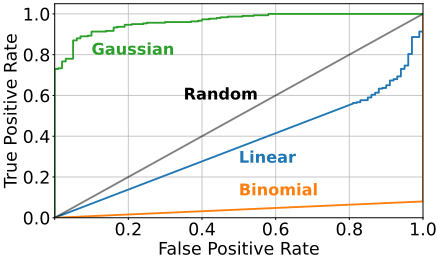
Figure 1: KRCD ROC curves on an exponential synthetic benchmark with different fixed kernel classes.
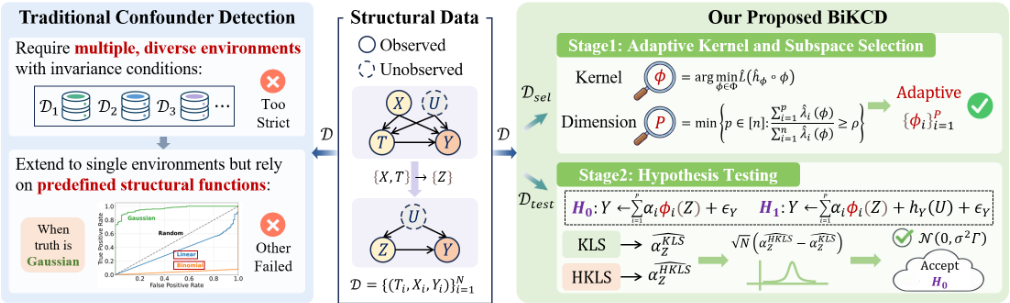
To this end, we propose a learnable and flexible Bi-level Kernel Confounder Detection (BiKCD) approach through a concise three-part pipeline. BiKCD replaces a fixed, userspecified structural function class with a data-driven kernelized structural space learned via a bi-level optimization scheme, where the outer level learns an effective kernel structure and the inner regression admits closed-form solutions. Given this learned structural space, BiKCD performs confounder detection in the induced kernel space by contrasting regression coefficients from a higher-order (norm-weighted) regression with those from the classical least-squares regression, using their discrepancy as the diagnostic signal. The resulting hypothesis test is finally calibrated under adaptivity using selection-test separation (sample splitting or crossfitting), producing valid p-values with controlled Type-I error while improving robustness to structural misspecification in single-environment settings. The main contributions of this paper can be summarized as follows:
- We propose BiKCD, a bi-level kernel confounder detection framework that learns adaptive kernelized structural spaces for practical hidden confounder detection in single-environment observational data with unknown nonlinear mechanisms.
- Theoretically, we establish an oracle-type risk bound for the selected structural space over a candidate kernel family and guarantee Type-I error control for the downstream hypothesis test under adaptivity.
- Empirically, we demonstrate through extensive experiments on synthetic and real-world datasets that BiKCD effectively detects hidden confounders and is robust to structural misspecification.
2 RelatedWork
2.1 Detection of Unobserved Confounders in Single-Environment Settings
Traditional diagnostics for hidden confounding include instrumental variable (IV) regression [Angrist et al., 1996] and specification tests based on estimator disagreement, such as the Durbin-Wu-Hausman test [Hausman, 1978]. These methods typically require external instruments or alternative estimators whose consistency hinges on different assumptions, and they are often studied alongside practical IV constructions and variants in applied settings [Wang et al., 2022; Wang et al., 2026; Kou et al., 2025]. A more recent line replaces instruments with moment-based contrasts and regression-oriented model checks: ROCD [Schultheiss et al., 2024] builds on reweighting views of model checking [Buja et al., 2019a; Buja et al., 2019b] and compares ordinary least squares to a higher-order least-squares analogue in a resampling-free manner [Wang et al., 2023a]. For highdimensional linear models, spectral approaches detect confounding by examining regression-induced associations and covariance perturbations [Liu and Chan, 2018; Janzing and Sch¨olkopf, 2018]. Beyond linearity, latent-variable structure learning based on higher-order information has been explored under identifiable assumptions [Cai et al., 2023; Chen et al., 2024], while other approaches address nonlinear confounding through strong structural requirements (e.g., nonparametric IV [Newey and Powell, 2003]) or specific nonGaussian generative models (e.g., LiNGAM [Shimizu et al., 2006]). Within kernel methods, KRCD [Chen et al., 2026] introduced an RKHS diagnostic that embeds a higher-order contrast into kernel regression with finite-sample calibration.
Our work targets a complementary gap in this singleenvironment landscape: robust confounder detection in general nonlinear settings when the appropriate function class is unknown. While discrepancy-based tests are appealing, their practical performance can hinge on a specified structural form (explicitly in linear models, or implicitly through a fixed RKHS structural space). BiKCD addresses this by learning a kernelized structural space from data via a bi-level procedure and then conducting a calibrated confounder test in the learned kernel space under selection-test separation; to the best of our knowledge, this makes BiKCD the first learnable detection method with rigorous Type-I control under adaptivity in this setting.
2.2 Detection of Unobserved Confounders in Multi-Environment Settings
A complementary strategy leverages environment variation to create testable implications of confounding without causal sufficiency. Early theory identified conditional independence violations that become testable under mechanism shifts [Karlsson and Krijthe, 2023]. Subsequent work developed operational procedures, including information-theoretic scores for detecting confounding from shifts [Mameche et al., 2024] and methods that quantify confounding strength in nonparametric models via causal mechanism changes [Reddy and N Balasubramanian, 2024]. Related threads use heterogeneous data for robustness and generalization, treating shifts as a source of diagnostic signal [Yin et al., 2023; Wang, 2025; Wang et al., 2023b], and connect to joint causal inference across contexts [Mooij et al., 2020] and causal discovery under heterogeneity [Perry et al., 2022]. However, multienvironment approaches typically require explicit distribution shifts, repeated contexts, or auxiliary experimental information [Kallus et al., 2018; Hu et al., 2024], which may be unavailable in standard observational studies. BiKCD complements these methods by targeting the single-environment regime where such mechanism shifts are not observed.
2.3 Kernelized Causal Inference and Structural Space Selection
Reproducing kernel Hilbert spaces (RKHS) were formalized through the reproducing property [Aronszajn, 1950], and the Representer Theorem [Kimeldorf and Wahba, 1971] established finite-sample kernel expansions for regularized learning. Within causal inference, kernels support several recurring motifs. Kernel mean embeddings and related balancing objectives provide flexible nonparametric weighting under causal sufficiency assumptions [Hazlett, 2016; Muandet et al., 2017]. Kernel instrumental-variable regression and proximal variants handle certain forms of confounding but depend on external instruments or proxy structure [Singh et al., 2019; Mastouri et al., 2021]. Other kernel-based methods target latent structure learning or causal structural discovery without directly testing for hidden confounding [Zhang et al., 2015; Pfister et al., 2018]. Structural learning for causal estimation has also been explored via distributional alignment objectives, including optimal-transport-based approaches that aim to reduce confounding bias [Yan et al., 2025; Wang et al., 2025]. Despite their expressive power, these approaches either assume away unobserved confounding, require auxiliary variables, or focus on effect estimation rather than confounder detection.
Discrepancy-based RKHS tests provide a direct route to detecting nonlinear hidden confounding in observational data by embedding higher-order regression contrasts into kernel regression [Chen et al., 2026]. BiKCD follows this diagnostic direction but replaces fixed kernel specification with bilevel structural-space learning and preserves valid inference via selection-test separation, positioning it as a kernelized testing procedure complementary to kernelized causal estimation and structural learning methods.
3 Preliminaries and Problem Setup
We denote the treatment, observed covariates, outcome, and latent confounder by T, X, Y , and U, respectively. We follow the potential outcome notation and write the outcome that would be observed under treatment assignment T = t as Y (t). Random variables are denoted by uppercase letters (e.g., T, Y ) and their realizations by lowercase letters (e.g., t, y). We observe i.i.d. samples {(Ti,Xi, Yi)}Ni=1 from a single observational environment. For convenience, we define Z := (T, X)⊤ and assume E[ϵT ] = E[ϵY ] = 0.
3.1 Background: Regression-Based Confounder Detection
A dominant line of recent progress in single-environment confounder detection builds on regression-comparison principles. We briefly review two representative approaches that motivate our work.
Regression-Oriented Confounder Detection (ROCD). ROCD is a representative single-environment diagnostic in the linear regime [Schultheiss et al., 2024]. It contrasts ordinary least squares with a higher-order least-squares analogue, using their discrepancy as evidence against linear causal model assumptions, with hidden confounding as a primary alternative. Its effectiveness, however, hinges on a specified linear structure in practice and can degrade when the true mechanism is nonlinear.
Kernel Regression for Confounder Detection (KRCD). KRCD extends this discrepancy principle to nonlinear settings by working in an RKHS [Chen et al., 2026]. Within a fixed P-dimensional RKHS subspace, it compares kernelized least squares (KLS) with a norm-weighted higher-order variant (HKLS):
and detects confounding by testing whether the two coefficient vectors agree coordinate-wise:
Limitation. Both ROCD and KRCD share a common, critical premise: the structural function class must be correctly specified in advance-a reliance on known structural specification. For ROCD, this is an explicit linear assumption. For KRCD, it is implicit in the choice of kernel family, its hyperparameters, and the effective subspace dimensionality P. This requirement poses a significant practical hurdle, as the true data-generating mechanisms in real-world observational studies are often complex and unknown.
3.2 Our Problem: Detection Under Unknown Structural Mechanisms
We study hidden confounder detection in the more challenging and practical setting where the underlying structural mechanisms are unknown and potentially nonlinear, and only a single observational dataset is available.
Null-hypothesis. Under the null hypothesis H0, there is no unobserved confounding between T and Y given X, governed by unknown structural functions:
where fT and g are unknown (and possibly nonlinear) functions, and ϵT , ϵY are exogenous noise terms.
Alternative hypothesis. Under the alternative hypothesis H1, there exists a latent confounder U that enters both the treatment and outcome mechanisms through unknown arbitrary functions:
where hT and hY are also unknown and potentially nonlinear. Intuitively, the additional terms hT (U) and hY (U) induce a spurious association between T and Y that cannot be removed by conditioning on X alone.
Challenge. The setting defined by (3)-(4) highlights our core challenge: learning to test without structural knowledge-performing reliable confounder detection when the functional forms of fT , g, hT , hY are not known a priori. This invalidates the key assumption of methods like ROCD and KRCD. The diagnostic procedure must therefore learn an effective structural space of these structural relationships from data itself, before any statistical comparison for confounding can be made. Crucially, this learning process must be accounted for to ensure the validity of the subsequent hypothesis test. BiKCD is designed to meet this challenge by integrating structural-space learning with a calibrated testing procedure in a single framework.
4 Bi-level Kernel Confounder Detection (BiKCD)
We propose Bi-level Kernel Confounder Detection (BiKCD) to address the challenge of detecting hidden confounders when the underlying structural mechanisms are unknown. Given observational samples {(Ti,Xi, Yi)}Ni=1 , BiKCD learns a kernelized structural space of the structural relationships from data and then performs a statistically calibrated hypothesis test based on the coefficient discrepancy between a higher-order regression and ordinary least squares in the learned kernel space.
4.1 Motivation
As highlighted in the previous section, existing regressionbased confounder detection methods like ROCD and KRCD require the structural function class to be correctly specified in advance. In practice, however, the true data-generating mechanisms are often unknown, making this specification requirement a significant practical hurdle. When the chosen structural space mismatches the true mechanism, the discrepancy signal can be attenuated or dominated by variance, leading to a sharp loss of detection power. This limitation motivates us to re-examine a key premise: the structural space used to parameterize the regressions should be learned from data rather than assumed.
Learnable structure. BiKCD addresses this challenge by learning a kernelized structural space via bi-level optimization. Instead of relying on a fixed, user-specified kernel, BiKCD selects an appropriate structural space from a candidate family of kernels based on data-driven criteria. To ensure finite-sample valid inference under this adaptive selection, BiKCD employs selection-test separation (sample splitting or cross-fitting), improving robustness while preserving Type-I error control.
4.2 Theoretical Foundation
We formalize structural-space learning through a bilevel scheme that does not assume prior knowledge of ϕ⋆ , but only assumes it is fixed and unspecified. At a high level, we learn a structural space ˆ ϕ by
where ˆL(·) is the empirical squared loss. The inner optimization fixes a structural space ϕ and finds the best predictor within its associated hypothesis class by minimizing empirical loss, i.e., it returns ˆhϕ such that h◦ϕ fits the data as well as possible under that structural space. The outer optimization then compares structural spaces through their inner-optimal predictors and selects the ˆ ϕ that achieves the best overall objective. In our implementation, the candidate set Φ is instantiated by a kernel family (e.g., a bandwidth grid), where each ϕ ∈ Φ corresponds to one kernel-induced RKHS (or its finite subspace). When the candidate family is universal on a compact domain, it can explicitly approximate broad classes of continuous nonlinear functions, enabling us to handle unknown nonlinear mechanisms.
Energy-threshold selection of ˆ P(ϕ). To choose an effective finite subspace size in a structure-dependent manner, we use eigenvalue thresholding on the (centered) Gram matrix computed on the selection data under structural space ϕ. Let ˆλ1(ϕ) ≥ · · · ≥ ˆλn(ϕ) ≥ 0 be its eigenvalues. Given an energy threshold ρ ∈ (0, 1), we set
This rule retains the leading data-supported directions while discarding components dominated by noise. After learning ˆ ϕ from (5), we set ˆ P = ˆ P ( ˆ ϕ) and work in the corresponding ˆ P-dimensional subspace.
Oracle-type approximation-and-estimation guarantee. A key implication of (5) together with (6) is an oracle-type risk bound for learning an effective structural space from a finite candidate set Φ. For C > 0 and δ ∈ (0, 1), with probability at least 1 - δ, the mean squared error between the learned predictor and the true regression function satisfies
where Afixed(P) is the best approximation error achievable within a P-dimensional subspace, and the second term captures estimation error and the adaptivity cost of searching over Φ. When Φ is instantiated by a universal kernel family and P is selected so that the retained rank grows with N (e.g., (6)), Afixed(P) can be driven to 0.
Algorithm 1 BiKCD (Select-then-Test)
Input: Covariates X ∈ RN×d , treatment T ∈ RN , outcome Y ∈ RN ,
candidate kernels {kγ}γ∈Γ, significance level α, selection ratio s ∈ (0, 1), regularization λ = Nξ.
Output: Detection conclusion
- 1: Z ← [T,X]
- 2: Split indices into selection set Dsel (size ⌊sN⌋) and test set Dtest
- 3: Select structural space: choose (ˆ γ, ˆ P) on Dsel using (5) and eigenvalue thresholding for P (e.g., search over γ ∈ Γ with a held-out criterion)
- 4: Test on Dtest: Ztest, Ytest ← (Z, Y )|Dtest , Ntest ← |Dtest|
- 5: K ← rows1: ˆ P (Kernel Functionˆ γ (Ztest))
- 6: Kψ ← K ⊙ (diag(ZtestZ ⊤ test ))⊤
- 7: αKLS ← (KK⊤ +λI )-1 KYtest
- 8: αHKLS ← (KψK⊤ +λI )-1 (KψYtest)
- 9: V0 ← (KψK⊤ +λI)-1Kψ - (KK⊤ +λI)-1K 10: V ←Ntest · (V0V ⊤ 0 )
- 12: for j = 1 to ˆ P do
- 14: end for
- 15: Apply Bonferroni correction: δj ← 1[pj < α/ ˆ P ]
- 16: if ∑ δj = 0 then
- 17: return "Support null hypothesis"
- 18: else
- 19: return "Reject null hypothesis"
- 20: end if
5 Experiments
Benchmarks
To comprehensively evaluate BiKCD for hidden confounder detection, we conduct simulation studies using synthetic datasets and the Twins semi-synthetic benchmark [Almond
4.3 Hypothesis Testing with Finite Samples
BiKCD uses selection-test separation to ensure valid inference under adaptivity. We split the sample into a selection set Dsel and a test set Dtest, learn (ˆ ϕ, ˆ P) on Dsel, and perform calibration on Dtest only. In our experimental instantiation, each structural space ϕ ∈ Φ is induced by a kernel kγ with γ ∈ Γ (e.g., Gaussian bandwidth), and we write ϕ = ϕγ. Accordingly, we denote by ˆ γ the kernel index corresponding to the selected ˆ ϕ, and use γ to index kernels in the remaining finite-sample analysis.
BiKCDKLS and HKLS estimators. Fix the selected kernel kˆ γ and a ˆ P-dimensional RKHS subspace with basis {ϕi} ˆ Pi=1 . On Dtest = {(Zℓ, Yℓ)}nℓ=1 , let KZZ ∈ R ˆ P ×n with [KZZ]iℓ = ϕi(Zℓ), Y = (Y1, . . . , Yn)⊤, and Ψ = diag(∥Z1∥2 , . . . , ∥Zn∥2 ) computed from standardized Z (using Dsel statistics). With ridge ξ > 0, we compute
and form ˆ δ = ̂ αHKLS Z - ̂ αKLS Z as the test signal.
Testing and calibration. We compute p-values for ˆ δ using a normal approximation with plug-in variance estimation on Dtest, and apply Bonferroni correction, rejecting H0 if minj≤ ˆ P pj < α/ ˆ P. When finite-sample stability is a concern, we optionally use bootstrap calibration on Dtest.
4.4 Complexity Analysis
Let Nsel and Ntest be the sizes of Dsel and Dtest. In our experiments, each ϕ ∈ Φ is induced by kγ with γ ∈ Γ (so |Γ| = |Φ|). On Dsel, forming the Gram matrix costs O(N 2 sel ) per γ, and the eigendecomposition for energy-thresholding costs up to O(N 3 sel ) in the worst case. On Dtest, the rank- ˆ P discrepancy computation costs O( ˆ P 2Ntest + ˆ P 3 ). Nystr¨om or random features can reduce kernel and eigendecomposition costs while preserving the select-then-test procedure.
et al., 2005]. Unless explicitly stated otherwise, all synthetic experiments employ independent non-Gaussian noise components and a default ridge regularization parameter λ = 10-8 . Each parameter configuration is repeated 30 times with a default sample size of N = 1000, and statistical significance is assessed at the conventional α = 0.05 threshold. In addition to the default setting, we vary the sample size N to study the sample-efficiency of BiKCD via a detection-rate heatmap.
Baselines
This paper focuses on representative confounding detection methods for comparative examination, including ROCD [Schultheiss et al., 2024] and ME-ICM [Karlsson and Krijthe, 2023]. We also include KRCD [Chen et al., 2026] as a fixed-structure baseline instantiated with different kernel classes (linear, degree-2 polynomial/binomial, and Gaussian) to highlight the sensitivity of fixed-kernel discrepancy tests to structural specification.
Evaluation Protocols
We report the following metrics to summarize both detection performance and statistical validity:
- ROC Curve & AUC. The ROC curve plots sensitivity against the false positive rate across all thresholds, and the AUC (Area Under the Curve) summarizes the overall discriminative performance.
- Detection Rate. The method's detection rate for unobserved confounders quantifies both sensitivity (when confounders are present) and false positive rate (when confounders are absent).
Questions
The empirical evaluation addresses the following four research questions:
- How sensitive is fixed-structure KRCD to kernel choice across linear, quadratic, and exponential mechanisms, and can BiKCD remain effective without knowing the correct kernel in advance?
- How does BiKCD's detection rate scale with sample size across confounding strengths?
- How does BiKCD compare with representative baseline methods in detection rate across confounding strengths?
- How does BiKCD perform in ROC/AUC across confounding strengths?
5.1 Impact of Kernel Specification on Single-Environment Confounder Detection
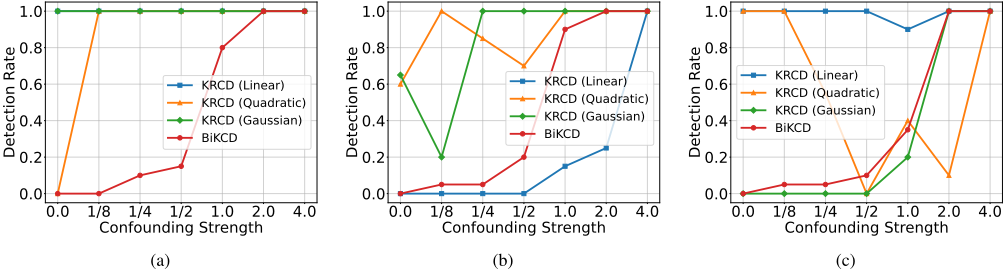
Figure 3 demonstrates a key practical issue of fixed-structure discrepancy tests: KRCD can vary drastically with kernel specification. Across the quadratic, linear, and exponential mechanisms, at least one fixed kernel class yields strong detection over a wide range of confounding strengths, whereas a mismatched kernel can lead to poor or unstable detection, especially in the weak-confounding regime. This illustrates the brittleness induced by structural specification: without knowing the correct structural form (or an aligned kernel space), the discrepancy signal can be smoothed out or dominated by variance in practice.
BiKCD mitigates this sensitivity through adaptive structural-space learning. In Figure 3, BiKCD controls false positives at CS = 0 and improves detection steadily and consistently as confounding strengthens across the three mechanisms in a unified manner, reaching near-certain detection under moderate-to-strong confounding. Compared with the best fixed kernel on a given mechanism, BiKCD can be more conservative under very weak confounding, which is consistent with the select-then-test protocol that reserves data for structural-space learning to ensure valid inference under adaptivity. Overall, these results support our central claim: fixed-kernel KRCD is highly kernel-dependent, while BiKCD reliably provides a more stable performance envelope without requiring prior knowledge of the correct kernel class.
5.2 Sample Efficiency of BiKCDUnder Varying Confounding Strengths
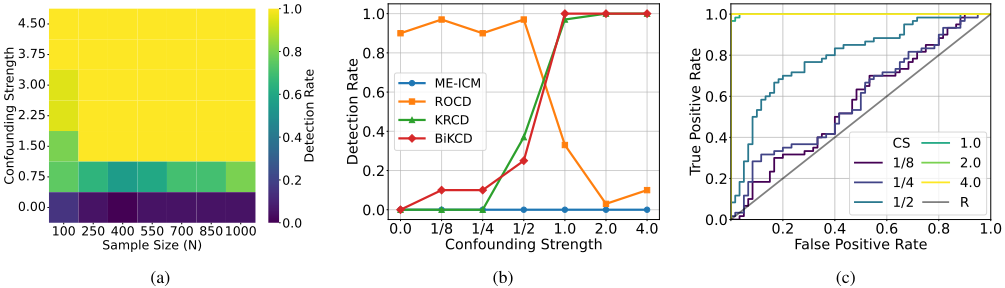
Figure 4a summarizes the sample-efficiency of BiKCD by reporting detection rates over a grid of sample sizes and confounding strengths. Two trends are clear. First, the empirical Type-I error remains low at CS = 0 and stabilizes as N increases, indicating controlled false positives in practice under the select-then-test design. Second, detection power increases with both confounding strength and sample size: weak confounding requires more samples to reach reliable detection, while moderate-to-strong confounding can be detected with substantially fewer samples. Once N is sufficiently large, BiKCD transitions rapidly from partial detection to nearcertain detection as confounding strengthens, consistent with the fact that structural-space learning becomes more reliable with more data.
5.3 Detection Rate Comparison Under Varying Confounding Strengths
Figure 4b reports detection rates on the Twins semi-synthetic benchmark across confounding strengths. ME-ICM, which relies on mechanism shifts across multiple environments, is inapplicable here and yields 0% detection throughout. ROCD, built on linearity assumptions, treats nonlinear structure as spurious dependence, resulting in severe false positives under the null (about 90%-97% detection at CS = 0 to 0.5) and then deteriorating under stronger confounding (dropping to ≈ 33% at CS = 1 and near 0% at CS = 2 as true confounding masks the nonlinear signal). KRCD also effectively controls Type-I error under the null (0% at CS = 0) and achieves near-perfect detection once confounding is strong (about 95% at CS = 1 and 100% for CS ≥ 2), but it remains largely insensitive for CS ≤ 0.5 under a fixed kernel. In contrast, BiKCD controls Type-I error under the null (0% at CS = 0) and reaches 100% detection for CS ≥ 1. This behavior is consistent with BiKCD's select-then-test design, which learns the structural space while preserving valid inference under adaptivity.
5.4 Threshold-Free Performance: ROCCurves and AUC
To complement fixed-threshold detection rates, Figure 4c reports ROC curves across confounding strengths on Twins. Unlike detection rate, which reflects performance at a specific significance level after multiplicity correction, ROC/AUC provides a threshold-free view of discriminative ability by sweeping decision thresholds and tracking the trade-off between true positive rate and false positive rate. Consistent with the detection-rate trends, BiKCD exhibits progressively stronger discrimination as confounding increases: under very weak confounding, the ROC curves stay close to the diagonal and AUC is near the random baseline, indicating limited separability; as confounding strengthens, the curves shift toward the upper-left corner and AUC increases accordingly, reflecting improved separation between confounded and unconfounded cases. Together with Figure 4b, these results support that BiKCD provides stable single-environment confounder detection on Twins, with controlled false positives under the null and consistent gains in threshold-free discrimination under structural uncertainty.
6 Conclusion
BiKCD proposes a bi-level kernel confounder detection framework for nonlinear single-environment observational data, addressing a key practical limitation of recent higherorder regression discrepancy tests, namely their reliance on rigid structural-function specification. The central idea is to replace a fixed, user-chosen function class with a learnable kernelized structural space: BiKCD uses a bi-level procedure to select an effective RKHS structural space together with an energy-thresholded subspace dimension, and then conducts calibrated hypothesis testing by comparing coefficients from a higher-order (norm-weighted) regression and ordinary least squares computed in the learned kernel space. To ensure validity under adaptivity, BiKCD follows a select-then-test protocol (sample splitting or crossfitting), so that structural-space learning and hypothesis testing are decoupled and Type-I error remains controlled. Extensive experiments on synthetic benchmarks spanning linear, quadratic, and exponential structural mechanisms, as well as on the Twins semi-synthetic dataset, demonstrate that BiKCD substantially improves robustness to structural misspecification: BiKCD maintains reliable detection across confounding strengths while preserving controlled false positives.
While BiKCD strengthens practical single-environment confounder detection under unknown nonlinear mechanisms, several directions remain open. One promising extension is to move beyond binary detection and develop principled measures of confounding strength within the learned kernel space. Another direction is to further improve finite-sample calibration under small sample sizes or heavy-tailed noise.
Ethical Statement
There are no ethical issues.
Acknowledgments
This work was supported in part by the NUDT Youth Independent Innovation Science Fund under Grant No. ZK2520, the Tsinghua University-Siemens Joint Research Center (JCIIOT), the National Natural Science Foundation of China under Grant Nos. 62276004 and 62325604, the Beijing Natural Science Foundation under Grant No. L257007, and the Beijing Major Science and Technology Project under Grant No. Z251100008425006.
@inproceedings{ijcai2026p467,
  title     = {Learning Kernelized Hypothesis for Hidden Confounder Detection},
  author    = {Chen, Yikai and Wang, Haotian and Mao, Yunxin and Lv, Xinpeng and Yang, Shaowu and Kuang, Kun and Liu, Xinwang and Yang, Wenjing},
  booktitle = {Proceedings of the Thirty-Fifth International Joint Conference on
               Artificial Intelligence, {IJCAI-26}},
  publisher = {International Joint Conferences on Artificial Intelligence Organization},
  editor    = {Diego Calvanese},
  pages     = {4197--4205},
  year      = {2026},
  month     = {8},
  note      = {Main Track},
  doi       = {10.24963/ijcai.2026/467},
  url       = {https://doi.org/10.24963/ijcai.2026/467},
}
TY - CPAPER TI - Learning Kernelized Hypothesis for Hidden Confounder Detection AU - Chen, Yikai AU - Wang, Haotian AU - Mao, Yunxin AU - Lv, Xinpeng AU - Yang, Shaowu AU - Kuang, Kun AU - Liu, Xinwang AU - Yang, Wenjing T2 - Proceedings of the Thirty-Fifth International Joint Conference on Artificial Intelligence, IJCAI-26 PB - International Joint Conferences on Artificial Intelligence Organization PY - 2026 SP - 4197 EP - 4205 DO - 10.24963/ijcai.2026/467 UR - https://doi.org/10.24963/ijcai.2026/467 ER -Copied
Machine-readable versions of this paper, for tools and AI agents:





