
Adaptive GoGI-Skip: Coupling Goal-Gradient Importance with Dynamic Uncertainty for Efficient Reasoning
Proceedings of the Thirty-Fifth International Joint Conference on Artificial Intelligence. Main Track. Pages 4106-4114.
https://doi.org/10.24963/ijcai.2026/457
Keywords
- Knowledge Representation and Reasoning: Learning and reasoning
- Machine Learning: Optimization
- Natural Language Processing: Language models
- Natural Language Processing: Language generation
Abstract
Chain-of-Thought (CoT) prompting trades inference speed for reasoning accuracy. Existing compressors force a compromise as static gradient techniques treat tokens independently, severing sequential logic, while uncertainty-based pruning ignores the final answer. We introduce Adaptive GoGI-Skip, a framework that resolves this tension by non-linearly coupling Goal-Gradient Importance (GoGI) with Adaptive Dynamic Skipping (ADS). GoGI quantifies each token's functional contribution to answer correctness via gradient sensitivity. ADS leverages runtime entropy to dynamically modulate the GoGI threshold, preserving low-gradient tokens essential for structural coherence at high-uncertainty junctions. Trained on 7,472 MATH traces, our policy transfers zero-shot to AIME, GPQA, and GSM8K, reducing token volume by >45% and accelerating inference up to 2.0x without accuracy loss. These results suggest that thinking-optimal compression demands synergy between teleological goals and epistemic uncertainty.
- [Cobbe et al., 2021] Karl Cobbe, Vineet Kosaraju, Moham- mad Bavarian, Mark Chen, Heewoo Jun, Lukasz Kaiser, Matthias Plappert, Jerry Tworek, Jacob Hilton, Reiichiro Nakano, Christopher Hesse, and John Schulman. Train- ing verifiers to solve math word problems. arXiv preprint arXiv:2110.14168, 2021.
- [Cui et al., 2025] Yingqian Cui, Pengfei He, Jingying Zeng, Hui Liu, Xianfeng Tang, Zhenwei Dai, Yan Han, Chen Luo, Jing Huang, Zhen Li, et al. Stepwise perplexity- guided refinement for efficient chain-of-thought rea- soning in large language models. arXiv preprint arXiv:2502.13260, 2025.
- [Fatemi et al., 2025] Mehdi Fatemi, Banafsheh Rafiee, Mingjie Tang, and Kartik Talamadupula. Concise reasoning via reinforcement learning. arXiv preprint arXiv:2504.05185, 2025.
- [Fu et al., 2025] Qichen Fu, Minsik Cho, Thomas Merth, Sachin Mehta, Mohammad Rastegari, and Mahyar Najibi. Lazyllm: Dynamic token pruning for efficient long context llm inference. In ICLR, 2025.
- [Gao et al., 2024] Jiaxuan Gao, Shusheng Xu, Wenjie Ye, Weilin Liu, Chuyi He, Wei Fu, Zhiyu Mei, Guangju Wang, and Yi Wu. On designing effective rl reward at training time for llm reasoning. arXiv preprint arXiv:2410.15115, 2024.
- [Ge et al., 2024] Suyu Ge, Yunan Zhang, Liyuan Liu, Min- jia Zhang, Jiawei Han, and Jianfeng Gao. Model tells you what to discard: Adaptive KV cache compression for LLMs. In The Twelfth International Conference on Learn- ing Representations, 2024.
- [Graves, 2016] Alex Graves. Adaptive computation time for recurrent neural networks. arXiv preprint arXiv:1603.08983, 2016.
- [Guo et al., 2025] Daya Guo, Dejian Yang, Haowei Zhang, Junxiao Song, Ruoyu Zhang, Runxin Xu, Qihao Zhu, Shi- rong Ma, Peiyi Wang, Xiao Bi, et al. Deepseek-r1: In- centivizing reasoning capability in llms via reinforcement learning. arXiv preprint arXiv:2501.12948, 2025.
- [Hao et al., 2024] Shibo Hao, Sainbayar Sukhbaatar, DiJia Su, Xian Li, Zhiting Hu, Jason Weston, and Yuandong Tian. Training large language models to reason in a contin- uous latent space. arXiv preprint arXiv:2412.06769, 2024.
- [Hendrycks et al., 2021] Dan Hendrycks, Collin Burns, Saurav Kadavath, Akul Arora, Steven Basart, Eric Tang, Dawn Song, and Jacob Steinhardt. Measuring mathemati- cal problem solving with the math dataset. NeurIPS, 2021.
- [Hu et al., 2022] Edward J Hu, yelong shen, Phillip Wallis, Zeyuan Allen-Zhu, Yuanzhi Li, Shean Wang, Lu Wang, and Weizhu Chen. LoRA: Low-rank adaptation of large language models. In International Conference on Learn- ing Representations, 2022.
- [Jain and Wallace, 2019] Sarthak Jain and Byron C. Wal- lace. Attention is not explanation. arXiv preprint arXiv:1902.10186, 2019.
- [Kang et al., 2025] Yu Kang, Xianghui Sun, Liangyu Chen, and Wei Zou. C3ot: Generating shorter chain-of-thought without compromising effectiveness. In Proceedings of the AAAI Conference on Artificial Intelligence, volume 39, pages 24312-24320, 2025.
- [Katharopoulos et al., 2020] Angelos Katharopoulos, Apoorv Vyas, Nikolaos Pappas, and Franc ¸ois Fleuret. Transformers are rnns: Fast autoregressive transformers with linear attention. In International conference on machine learning, pages 5156-5165. PMLR, 2020.
- [Long et al., 2025] Lingkun Long, Rubing Yang, Yushi Huang, Desheng Hui, Ao Zhou, and Jianlei Yang. Slimin- fer: Accelerating long-context llm inference via dynamic token pruning. arXiv preprint arXiv:2508.06447, 2025.
- [Luccioni et al., 2025] Alexandra Sasha Luccioni, Yacine Jernite, and Emma Strubell. How hungry is ai? bench- marking energy, water, and carbon footprint of llm infer- ence. arXiv preprint arXiv:2505.00001, 2025.
- [Luo et al., 2025] Haotian Luo, Li Shen, Haiying He, Yibo Wang, Shiwei Liu, Wei Li, Naiqiang Tan, Xiaochun Cao, and Dacheng Tao. O1-pruner: Length-harmonizing fine- tuning for o1-like reasoning pruning. arXiv preprint arXiv:2501.12570, 2025.
- [Ma et al., 2025] Wenjie Ma, Jingxuan He, Charlie Snell, Tyler Griggs, Sewon Min, and Matei Zaharia. Reasoning models can be effective without thinking. arXiv preprint arXiv:2504.09858, 2025.
- [MAA, 2024] MAA. American invitational mathematics ex- amination -aime. In American Invitational Mathematics Examination -AIME, 2024.
- [MAA, 2025] MAA. American invitational mathematics ex- amination -aime. In American Invitational Mathematics Examination -AIME, 2025.
- [Manvi et al., 2024] Rohin Manvi, Anikait Singh, and Ste- fano Ermon. Adaptive inference-time compute: Llms can predict if they can do better, even mid-generation. arXiv preprint arXiv:2410.02725, 2024.
- [Melo et al., 2026] Luckeciano C. Melo, Alessandro Abate, and Yarin Gal. Stabilizing policy gradients for sample- efficient reinforcement learning in llm reasoning. In Inter- national Conference on Learning Representations, 2026.
- [Pan et al., 2024] Zhuoshi Pan, Qianhui Wu, Huiqiang Jiang, Menglin Xia, Xufang Luo, Jue Zhang, Qingwei Lin, Vic- tor Rühle, Yuqing Yang, Chin-Yew Lin, et al. Llmlingua- 2: Data distillation for efficient and faithful task-agnostic prompt compression. arXiv preprint arXiv:2403.12968, 2024.
- [Patterson et al., 2025] David Patterson, Joseph Gonzalez, Quoc Le, and Chen Liang. The energy impact of llms - where are we in 2025? Journal of Green AI, 3(2), 2025.
- [Qu et al., 2025] Xiaoye Qu, Yafu Li, Zhaochen Su, Weigao Sun, Jianhao Yan, Dongrui Liu, Ganqu Cui, Daizong Liu, Shuxian Liang, Junxian He, et al. A survey of efficient reasoning for large reasoning models: Language, multi- modality, and beyond. arXiv preprint arXiv:2503.21614, 2025.
- [Razzhigaev et al., 2025] Anton Razzhigaev, Matvey Mikhalchuk, Temurbek Rahmatullaev, Elizaveta Gon- charova, Polina Druzhinina, Ivan Oseledets, and Andrey Kuznetsov. Llm-microscope: Uncovering the hidden role of punctuation in context memory of transformers. arXiv preprint arXiv:2502.15007, 2025.
- [Rein et al., 2024] David Rein, Betty Li Hou, Asa Cooper Stickland, Jackson Petty, Richard Yuanzhe Pang, Julien Dirani, Julian Michael, and Samuel R Bowman. Gpqa: A graduate-level google-proof q&a benchmark. In First Conference on Language Modeling, 2024.
- [Saunshi et al., 2025] Nikunj Saunshi, Nishanth Dikkala, Zhiyuan Li, Sanjiv Kumar, and Sashank J Reddi. Rea- soning with latent thoughts: On the power of looped trans- formers. arXiv preprint arXiv:2502.17416, 2025.
- [Schwartz et al., 2020] Roy Schwartz, Jesse Dodge, Noah A. Smith, and Oren Etzioni. Green ai. Communications of the ACM, 63(12), 2020.
- [Shazeer et al., 2017] Noam Shazeer, Azalia Mirhoseini, Krzysztof Maziarz, Andy Davis, Quoc Le, Geoffrey Hin- ton, and Jeff Dean. Outrageously large neural net- works: The sparsely-gated mixture-of-experts layer. arXiv preprint arXiv:1701.06538, 2017.
- [Shen et al., 2025] Yi Shen, Jian Zhang, Jieyun Huang, Shuming Shi, Wenjing Zhang, Jiangze Yan, Ning Wang, Kai Wang, and Shiguo Lian. Dast: Difficulty-adaptive slow-thinking for large reasoning models. arXiv preprint arXiv:2503.04472, 2025.
- [Simonyan et al., 2013] Karen Simonyan, Andrea Vedaldi, and Andrew Zisserman. Deep inside convolutional networks: Visualising image classification models and saliency maps. arXiv preprint arXiv:1312.6034, 2013.
- [Su et al., 2024] DiJia Su, Sainbayar Sukhbaatar, Michael Rabbat, Yuandong Tian, and Qinqing Zheng. Dualformer: Controllable fast and slow thinking by learning with ran- domized reasoning traces. In The Thirteenth International Conference on Learning Representations, 2024.
- [Sui et al., 2025] Yang Sui, Yu-Neng Chuang, Guanchu Wang, Jiamu Zhang, Tianyi Zhang, Jiayi Yuan, Hongyi Liu, Andrew Wen, Hanjie Chen, Xia Hu, et al. Stop over- thinking: A survey on efficient reasoning for large lan- guage models. arXiv preprint arXiv:2503.16419, 2025.
- [Sundararajan et al., 2017] Mukund Sundararajan, Ankur Taly, and Qiqi Yan. Axiomatic attribution for deep net- works. In International conference on machine learning, pages 3319-3328. PMLR, 2017.
- [Team et al., 2025] Gemma Team, Aishwarya Kamath, Jo- han Ferret, Shreya Pathak, Nino Vieillard, Ramona Mer- hej, Sarah Perrin, Tatiana Matejovicova, Alexandre Ramé, Morgane Rivière, et al. Gemma 3 technical report. arXiv preprint arXiv:2503.19786, 2025.
- [Wang et al., 2024a] Xinglin Wang, Shaoxiong Feng, Yi- wei Li, Peiwen Yuan, Yueqi Zhang, Chuyi Tan, Boyuan Pan, Yao Hu, and Kan Li. Make every penny count: Difficulty-adaptive self-consistency for cost-efficient rea- soning. arXiv preprint arXiv:2408.13457, 2024.
- [Wang et al., 2024b] Yongjie Wang, Tong Zhang, Xu Guo, and Zhiqi Shen. Gradient based feature attribution in explainable ai: A technical review. arXiv preprint arXiv:2403.10415, 2024.
- [Wang et al., 2025a] Shenzhi Wang, Le Yu, Chang Gao, Chujie Zheng, Shixuan Liu, Rui Lu, Kai Dang, Xionghui Chen, Jianxin Yang, Zhenru Zhang, et al. Beyond the 80/20 rule: High-entropy minority tokens drive effective reinforcement learning for llm reasoning. arXiv preprint arXiv:2506.01939, 2025.
- [Wang et al., 2025b] Xiangqi Wang, Yue Huang, Yanbo Wang, Xiaonan Luo, Kehan Guo, Yujun Zhou, and Xian- gliang Zhang. Adareasoner: Adaptive reasoning enables more flexible thinking. arXiv preprint arXiv:2505.17312, 2025.
- [Wang et al., 2025c] Yibo Wang, Haotian Luo, Huanjin Yao, Tiansheng Huang, Haiying He, Rui Liu, Naiqiang Tan, Jiaxing Huang, Xiaochun Cao, Dacheng Tao, and Li Shen. R1-compress: Long chain-of-thought compres- sion via chunk compression and search. arXiv preprint arXiv:2505.16838, 2025.
- [Wei et al., 2022] Jason Wei, Xuezhi Wang, Dale Schuur- mans, Maarten Bosma, Fei Xia, Ed Chi, Quoc V Le, Denny Zhou, et al. Chain-of-thought prompting elicits reasoning in large language models. Advances in neural information processing systems, 35:24824-24837, 2022.
- [Xia et al., 2025] Heming Xia, Yongqi Li, Chak Tou Leong, Wenjie Wang, and Wenjie Li. Tokenskip: Controllable chain-of-thought compression in llms. arXiv preprint arXiv:2502.12067, 2025.
- [Yang et al., 2024] An Yang, Baosong Yang, Beichen Zhang, Binyuan Hui, Bo Zheng, Bowen Yu, Chengyuan Li, Dayiheng Liu, Fei Huang, Haoran Wei, et al. Qwen2. 5 technical report. arXiv preprint arXiv:2412.15115, 2024.
- [Yang et al., 2025] Wenkai Yang, Shuming Ma, Yankai Lin, and Furu Wei. Towards thinking-optimal scaling of test-time compute for llm reasoning. arXiv preprint arXiv:2502.18080, 2025.
- [Yao et al., 2025] Zijun Yao, Yantao Liu, Yanxu Chen, Jian- hui Chen, Junfeng Fang, Lei Hou, Juanzi Li, and Tat-Seng Chua. Are reasoning models more prone to hallucination? arXiv preprint arXiv:2505.23646, 2025.
- [Yeo et al., 2025] Edward Yeo, Yuxuan Tong, Morry Niu, Graham Neubig, and Xiang Yue. Demystifying long chain-of-thought reasoning in llms. arXiv preprint arXiv:2502.03373, 2025.
- [Yue et al., 2025] Yang Yue, Zhiqi Chen, Rui Lu, Andrew Zhao, Zhaokai Wang, Yang Yue, Shiji Song, and Gao Huang. Does reinforcement learning really incentivize reasoning capacity in LLMs beyond the base model? In NeurIPS, 2025.
References were extracted automatically from the PDF and may contain errors.
Full text extracted automatically from the PDF; figures, tables and equations may differ. The PDF is the version of record.
1 Introduction
Chain-of-Thought (CoT) prompting unlocks advanced reasoning in Large Language Models [Wei et al., 2022] but incurs prohibitive inference latency and memory costs [Qu et al., 2025; Sui et al., 2025]. Standard efficiency paradigms [Shazeer et al., 2017; Katharopoulos et al., 2020; Su et al., 2024; Wang et al., 2024a] overlook CoT's unique structural redundancy.
CoT traces often contain repetition, circular validation, and excessive elaboration [Fatemi et al., 2025; Sui et al., 2025], sometimes degrading accuracy on simpler tasks [Yang et al., 2025]. A thinking-optimal equilibrium, where models reason only as much as strictly necessary, requires a compression paradigm that is both goal-aware and dynamically adaptive.
Existing Supervised Fine-Tuning (SFT) compression approaches [Xia et al., 2025] rely on generic importance metrics like semantic similarity [Pan et al., 2024] or perplexity [Cui et al., 2025] that often mask structurally critical yet semantically simple tokens. Static compression rates compound the problem by ignoring heterogeneous step difficulty [Ge et al., 2024].
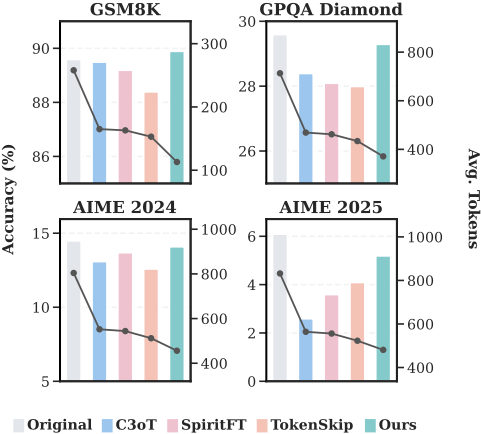
A straightforward combination of gradient-based attribution and adaptive computation can be brittle. In long-context generation, gradient signals are often sparse and noisy [Wang et al., 2024b], and pruning solely by gradient magnitude may disrupt the sequential dependencies required for multi-step deduction. Conversely, uncertainty-based criteria capture local ambiguity but do not necessarily reflect a token's contribution to final answer correctness. These observations motivate coupling the two signals: using epistemic uncertainty to dynamically regulate the teleological goal-alignment threshold.
To bridge this gap, we propose Adaptive GoGI-Skip, a framework for learning efficient, adaptive CoT compression. As Figure 2 illustrates, our approach integrates two synergistic innovations. Goal-Gradient Importance (GoGI) is a metric (G(xi, l) = ||∇hli Lans||1) that quantifies each token's functional utility via its gradient influence on the final answer loss. Adaptive Dynamic Skipping (ADS) employs Entropy-Driven Rate (EDR) Regulation, using predictive entropy Ht to adjust retention rates, and an Adaptive N-Constraint (ANC) that modulates consecutive deletions based on local complexity, preserving coherence.
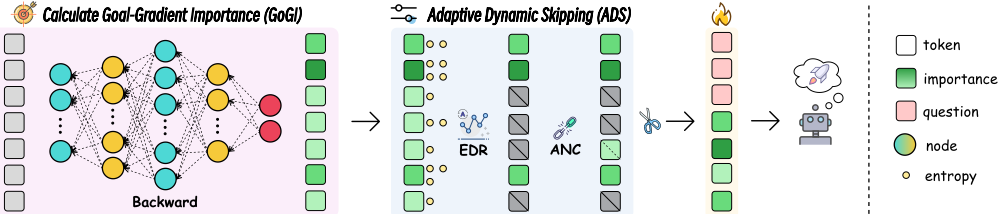
Our key contributions are summarized below:
- We introduce Adaptive GoGI-Skip, a goal-aligned and uncertainty-regulated CoT compression framework that couples Goal-Gradient Importance (GoGI) with Adaptive Dynamic Skipping (ADS) to remove functionally redundant tokens while preserving reasoning-critical structure.
- We establish zero-shot universality by training a single compression policy on 7,472 MATH traces and transferring it across diverse benchmarks (AIME, GPQA, GSM8K) and model families (Gemma, Qwen) without task-specific tuning.
- We push the accuracy-efficiency frontier, achieving >45% token reduction and up to 2.0× speedup while matching or improving original accuracy on rigorous evaluations (Figure 1).
2 RelatedWork
CoT reasoning's efficacy incurs substantial computational cost [Qu et al., 2025; Sui et al., 2025]. Optimization efforts bifurcate into SFT-based compression and alternative reasoning paradigms.
Token Importance Estimation. Existing compression methods rely on proxy metrics for token utility. External distillers such as C3OT [Kang et al., 2025] leverage GPT4. Internal methods instead target semantic redundancy, and TokenSkip [Xia et al., 2025] builds on LLMLingua [Pan et al., 2024]. Other approaches exploit activation sparsity, including LazyLLM [Fu et al., 2025] and SlimInfer [Long et al., 2025]. SPIRIT [Cui et al., 2025] uses perplexity-based signals. These heuristics decouple importance from functional relevance and can remove structurally vital yet semantically simple logical connectors [Razzhigaev et al., 2025]. Gradient-based saliency is well-established in interpretability [Simonyan et al., 2013; Sundararajan et al., 2017], but naive application to pruning fails since attribution does not necessarily reflect generation stability. High-gradient tokens are often high-entropy surprises that, if pruned, cause catastrophic drift; discarding low-gradient tokens can sever reasoning's connective tissue.
GoGI departs from generic attribution by non-linearly coupling gradient magnitude with predictive entropy, creating a dynamic threshold that adapts to the chain's structural fragility.
Adaptive Compression Strategies. Current SFT-based approaches employ static compression rates [Xia et al., 2025] or coarse step-level skipping [Wang et al., 2025c]. These rigid policies struggle to accommodate heterogeneous reasoning complexity. Recent work explores adaptive reasoning steps [Wang et al., 2025b] or compute allocation [Manvi et al., 2024], but often requires complex routers.
Adaptive GoGI-Skip addresses this via ADS. By modulating retention rates based on real-time predictive entropy and regulating consecutive deletions via local context, ADS achieves fine-grained balance between sparsity and coherence unattainable by static baselines.
Alternative Efficiency Paradigms. Parallel tracks explore different trade-offs. Latent-space reasoning [Saunshi et al., 2025; Hao et al., 2024] bypasses linguistic decoding entirely but sacrifices interpretability [Ma et al., 2025]. Reinforcement Learning (RL) approaches [Luo et al., 2025; Shen et al., 2025] integrate length penalties into reward functions, yet RL often fails to incentivize genuine reasoning beyond the base model [Yue et al., 2025], induces training instability [Melo et al., 2026], and is prone to reward hacking [Gao et al., 2024] or increased hallucination [Yao et al., 2025].
Our SFT-based approach offers a distinct advantage through stable, direct optimization that learns precise compression policies without RL's fragility. It also serves as a complementary post-processor that trims verbose traces produced by RL-optimized reasoners.
3 Adaptive GoGI-Skip for Reasoning-Intensive CoT Optimization
Adaptive GoGI-Skip is an SFT framework for dynamic pruning toward Reasoning-Intensive CoT Optimization (RICO). The method combines GoGI, which measures each token's contribution to the answer loss, with ADS, which adapts the retention policy from predictive uncertainty and local stability. This coupling yields finer-grained compression than prior
approaches.
Notation. We denote sequences by (xt)mt=1 and write vectors in bold lowercase. The hidden state of token t at layer l is hlt . Key metrics include the GoGI score Gt, predictive entropy Ht, dynamic retention rate γt, dynamic GoGI threshold τt, and the adaptive N-constraint Nt. The keep decision is Kt ∈ {0, 1}. We denote the answer loss by Lans and model parameters by θ. The operator || · ||1 denotes the L1 norm, ∇ the gradient, and Qp the p-th percentile operator. We use [·]ba for clipping to [a, b], ⌊·⌋ for the floor, and I for the indicator function. We write ∨ for logical OR and ∧ for logical AND.
3.1 Goal-Gradient Importance (GoGI)
Existing importance metrics [Xia et al., 2025; Pan et al., 2024; Cui et al., 2025] ignore the reasoning objective. GoGI directly measures each token's contribution to the target objective via gradient-based sensitivity analysis, grounded in the principle that gradients inherently quantify functional importance.
Given a CoT sequence c = (xt)mt=1 and answer A = (at)kt=1 , the answer prediction loss Lans for model Mθ is:
The GoGI score for token xt at target layer l∗ is the L1 norm of the gradient:
This score measures the local sensitivity of the final answer loss to the intermediate representation hl∗ t .
We select the target layer l∗ by analyzing layer-wise gradient contributions rather than relying on a single isolated maximum. Peak sensitivity occurs in mid-to-late layers, and downstream performance remains empirically stable within this high-contribution region. On Gemma3-4B-Instruct, Layers 23 and 28 exhibit comparable peaks; we select Layer 23 because it balances local sensitivity with globally integrated representations for GoGI computation.
3.2 Adaptive Dynamic Skipping (ADS)
ADS dynamically adjusts the pruning strategy based on runtime context via EDR and ANC components.
Entropy-Driven Rate (EDR) Regulation
EDR regulation leverages predictive entropy Ht (Eq. 3) as an information density signal. Since only a fraction of CoT tokens exhibit high entropy-signaling critical branching points [Wang et al., 2025a]-high Ht warrants conservative pruning. Crucially, Ht and Gt provide complementary signals.
where pt,v = Pθ(Xt+1 = v|x1, . . . , xt). We map Ht to ˆHt ∈ [0, 1] via M(·; θM):
Algorithm 1 Adaptive GoGI-Skip Pruning
Input: CoT sequence c = (xt)mt=1 , answer A, model Mθ Output: Compressed sequence c′comp , keep mask (Kt)mt=1
- 1: Compute Lans(A|c; θ) via forward pass
- 2: Gt ← ∥∇hl∗ t Lans∥1 for all t {GoGI scores}
- 3: Ht ←- ∑v pt,v log pt,v for all t {Entropy}
- 4: Determine Ivalid by excluding non-substantive tokens
- 5: C0 ← 0 {Consecutive prune counter}
- 6: for t = 1 to mdo
- 7: if t /∈ Ivalid then
- 8: Kt ← 1
- 9: Ct ← 0
- 10: continue
- 11: end if
- 12: ˆHt ←M(Ht; θM)
- 13: γt ← [γmin + (γmax -γmin) · ˆHt]γ abs max γ abs min {EDR}
- 15: ¯Ht,W ← 1W ∑min(m,t+⌊W/2⌋) j=max(1,t-⌊W/2⌋) Hj
- 16: ˆ¯Ht,W ←M′ ( ¯Ht,W; θM′)
- 17: ˜Nt ←Nmin + (Nmax -Nmin)(1- ˆ¯Ht,W)
- 19: G ′t ← fweight(Gt, xt) {Optional type-weighting}
- 20: if G ′t ≥ τt or Ct-1 + 1 ≥ Nt then
- 21: Kt ← 1
- 22: Ct ← 0
- 23: else
- 24: Kt ← 0
- 25: Ct ←Ct-1 +1
- 26: end if
- 27: end for
- 28: c′comp ← (xt)Kt=1
- 29: return c′comp , (Kt)mt=1
The local retention rate γt is then:
where γmin, γmax are soft bounds, and [·]max min denotes clipping. γt determines the dynamic GoGI threshold τt:
where Ivalid excludes non-substantive tokens.
Adaptive N-Constraint (ANC) for Coherence
To preserve coherence, ANC limits the number of consecutive pruned tokens (Nt) based on local complexity, estimated via windowed entropy ¯Ht,W:
The adaptive constraint Nt is:
| Method | AIME 2025 [MAA, 2025] | AIME 2024 [MAA, 2024] | ||||||
|---|---|---|---|---|---|---|---|---|
| Acc.↑ | Ratio ↓ | Tokens↓ | Speedup↑ | Acc.↑ | Ratio ↓ | Tokens↓ | Speedup↑ | |
| Original | 6.1(0.0↓) | 1.0 | 832 | 1.0× | 14.5(0.0↓) | 1.0 | 804 | 1.0× |
| Prompting | 1.8(4.3↓) | 0.9 | 764 | 1.0× | 10.2(4.3↓) | 0.9 | 728 | 1.1× |
| C3ot | 2.6(3.5↓) | 0.7 | 564 | 1.4× | 13.1(1.4↓) | 0.7 | 552 | 1.4× |
| Spiritft | 3.6(2.5↓) | 0.6 | 556 | 1.5× | 13.7(0.8↓) | 0.7 | 544 | 1.4× |
| TokenSkip (γ = 0.6) | 4.1(2.0↓) | 0.6 | 523 | 1.6× | 12.6(1.9↓) | 0.6 | 512 | 1.5× |
| TokenSkip (γ = 0.5) | 2.7(3.4↓) | 0.6 | 457 | 1.7× | 11.3(3.2↓) | 0.5 | 448 | 1.6× |
| Adaptive GoGI-Skip (Ours) | 5.2(0.9↓) | 0.6 | 481 | 1.6× | 14.1(0.4↓) | 0.6 | 456 | 1.7× |
| Method | GPQA Diamond [Rein et al., 2024] | GSM8K [Cobbe et al., 2021] | ||||||
| Acc.↑ | Ratio↓ | Tokens↓ | Speedup↑ | Acc.↑ | Ratio↓ | Tokens↓ | Speedup↑ | |
| Original | 29.6(0.0↓) | 1.0 | 713 | 1.0× | 89.6(0.0↓) | 1.0 | 258 | 1.0× |
| Prompting | 21.7(7.9↓) | 0.9 | 651 | 1.0× | 80.2(9.4↓) | 0.9 | 225 | 1.1× |
| C3ot | 28.4(1.2↓) | 0.7 | 469 | 1.5× | 89.5(0.1↓) | 0.6 | 165 | 1.5× |
| Spiritft | 28.1(1.5↓) | 0.6 | 462 | 1.5× | 89.2(0.4↓) | 0.6 | 163 | 1.5× |
| TokenSkip (γ = 0.6) | 28.0(1.6↓) | 0.6 | 434 | 1.6× | 88.4(1.2↓) | 0.6 | 153 | 1.6× |
| TokenSkip (γ = 0.5) | 26.5(3.1↓) | 0.5 | 378 | 1.8× | 84.3(5.0↓) | 0.5 | 133 | 1.9× |
| Adaptive GoGI-Skip (Ours) | 29.3(0.3↓) | 0.5 | 371 | 1.8× | 89.9(0.3↑) | 0.4 | 113 | 1.9× |
High local entropy thus yields a smaller Nt, enforcing conservative pruning.
3.3 Adaptive GoGI-Skip Pruning Algorithm
Algorithm 1 integrates GoGI with EDR and ANC into a unified pruning procedure. Tokens are retained if intrinsically important (G ′t ≥ τt) or if pruning would violate the ANC constraint (Ct-1 + 1 ≥ Nt). This dual-safety mechanism prevents fragmented chains common in pure importance sampling. The resulting compressed sequences c′comp form the SFT training set DSFT .
4 Experiments
We evaluate Adaptive GoGI-Skip to demonstrate its efficiency and accuracy across benchmarks and model architectures. We further analyze the contribution of core components through ablation studies.
4.1 Experimental Setup
Models Our experiments employ two open-source instruction-tuned model families: Gemma3-Instruct [Team et al., 2025] and Qwen2.5-Instruct [Yang et al., 2024]. This selection enables a thorough evaluation of scalability and generalizability.
Training Data We sourced samples from the MATH training dataset [Hendrycks et al., 2021] only, isolating transfer from the effects of broad multi-domain supervision. After standardizing formats and validating parsing, 7,472 valid samples remained. We compress each original CoT trace with Adaptive GoGI-Skip as an SFT set. We then report zero-shot results on AIME, GPQA, and GSM8K across architectures without additional task-specific training.
Baselines We compare against CoT compression baselines compatible with the SFT pipeline, including the standard CoT, denoted Original; zero-shot prompting, referred to as Prompting; C3oT, an external model-based compression method [Kang et al., 2025]; Spiritft, which performs perplexity-guided token pruning [Cui et al., 2025]; and TokenSkip, which applies static token skipping at ratios of 0.5 and 0.6 [Xia et al., 2025].
Implementation Details We computed GoGI scores at model-specific optimal layers. ADS hyperparameters were fixed across experiments. Token type-weighting was disabled. All models were fine-tuned using Low-Rank Adaptation (LoRA) [Hu et al., 2022] on 3 NVIDIA 4090 GPUs.
4.2 Main Results
We evaluated Adaptive GoGI-Skip's efficiency and accuracy balance. All metrics are averaged over 3 independent finetuning runs.
Table 1 shows that Adaptive GoGI-Skip consistently outperforms baselines, achieving ∼1.7× speedups on AIME and 1.9× on GSM8K. This efficiency stems from dynamic retention: the model retains ∼60% of tokens for complex AIME tasks versus ∼45% for GSM8K. Accuracy remains robust, with negligible drops around 0.4% on GPQA/AIME'24 and a 0.3% gain on GSM8K. Even on AIME'25, the 0.9% drop yields a competitive score. In contrast, static baselines like TokenSkip face a rigid trade-off that high speedup costs significant accuracy, while conservative settings limit speedup. Adaptive GoGI-Skip breaks this compromise, matching original accuracy with aggressive efficiency.
| Gemma3-1B-It | Gemma3-12B-It | |||||||||||||||
|---|---|---|---|---|---|---|---|---|---|---|---|---|---|---|---|---|
| Method | AIME'25 | AIME'24 | GPQA | GSM8K | AIME'25 | AIME'24 | GPQA | GSM8K | ||||||||
| Acc. | SU. | Acc. | SU. | Acc. | SU. | Acc. | SU. | Acc. | SU. | Acc. | SU. | Acc. | SU. | Acc. | SU. | |
| Original | 0.7 | 1.0× | 3.1 | 1.0× | 18.7 | 1.0× | 70.2 | 1.0× | 8.1 | 1.0× | 22.7 | 1.0× | 38.4 | 1.0× | 95.2 | 1.0× |
| Prompting | 0.1 | 1.1× | 1.2 | 1.1× | 12.5 | 1.1× | 65.7 | 1.1× | 4.2 | 1.1× | 15.3 | 1.1× | 28.7 | 1.1× | 85.6 | 1.1× |
| C3ot | 0.5 | 1.4× | 2.3 | 1.4× | 16.1 | 1.4× | 68.7 | 1.5× | 7.4 | 1.4× | 21.6 | 1.5× | 37.4 | 1.5× | 94.1 | 1.5× |
| Spiritft | 0.4 | 1.4× | 2.1 | 1.4× | 17.3 | 1.5× | 69.6 | 1.5× | 7.2 | 1.5× | 21.2 | 1.5× | 36.6 | 1.5× | 93.8 | 1.6× |
| TokenSkip (γ=0.6) | 0.5 | 1.5× | 2.2 | 1.5× | 16.5 | 1.5× | 69.9 | 1.6× | 7.5 | 1.5× | 21.9 | 1.6× | 37.1 | 1.6× | 94.3 | 1.6× |
| TokenSkip (γ=0.5) | 0.3 | 1.6× | 1.9 | 1.6× | 15.8 | 1.6× | 64.6 | 1.7× | 6.8 | 1.6× | 21.2 | 1.8× | 36.1 | 1.7× | 92.7 | 1.8× |
| Adaptive GoGI-Skip | 0.6 | 1.5× | 2.9 | 1.5× | 18.4 | 1.6× | 70.2 | 1.8× | 8.0 | 1.6× | 22.9 | 1.7× | 38.4 | 1.7× | 95.5 | 2.0× |
| Qwen2.5-3B-It | Qwen2.5-7B-It | |||||||||||||||
| Method | AIME'25 | AIME'24 | GPQA | GSM8K | AIME'25 | AIME'24 | GPQA | GSM8K | ||||||||
| Acc. | SU. | Acc. | SU. | Acc. | SU. | Acc. | SU. | Acc. | SU. | Acc. | SU. | Acc. | SU. | Acc. | SU. | |
| Original | 2.1 | 1.0× | 7.5 | 1.0× | 25.3 | 1.0× | 78.5 | 1.0× | 6.2 | 1.0× | 18.1 | 1.0× | 35.7 | 1.0× | 84.5 | 1.0× |
| Prompting | 0.8 | 1.1× | 4.1 | 1.1× | 17.2 | 1.1× | 65.3 | 1.1× | 2.8 | 1.1× | 11.2 | 1.1× | 25.8 | 1.1× | 77.1 | 1.1× |
| C3ot | 1.7 | 1.4× | 6.8 | 1.4× | 23.5 | 1.5× | 76.1 | 1.5× | 5.6 | 1.5× | 17.0 | 1.5× | 34.3 | 1.5× | 82.7 | 1.5× |
| Spiritft | 1.6 | 1.5× | 6.5 | 1.5× | 23.0 | 1.5× | 75.2 | 1.5× | 5.3 | 1.5× | 16.6 | 1.5× | 33.6 | 1.5× | 88.2 | 1.6× |
| TokenSkip (γ=0.6) | 1.8 | 1.5× | 6.9 | 1.6× | 23.4 | 1.6× | 76.5 | 1.6× | 5.7 | 1.6× | 17.2 | 1.6× | 34.1 | 1.6× | 83.1 | 1.6× |
| TokenSkip (γ=0.5) | 1.4 | 1.6× | 5.8 | 1.6× | 22.5 | 1.7× | 73.8 | 1.9× | 5.4 | 1.7× | 15.8 | 1.7× | 32.9 | 1.7× | 81.5 | 1.9× |
| Adaptive GoGI-Skip | 2.0 | 1.5× | 7.3 | 1.5× | 24.6 | 1.7× | 78.9 | 1.8× | 6.1 | 1.5× | 18.1 | 1.5× | 35.7 | 1.6× | 85.1 | 1.9× |
| Method Variant | AIME 2025 | AIME 2024 | GPQA Diamond | GSM8K | ||||
|---|---|---|---|---|---|---|---|---|
| Acc. | Speedup | Acc. | Speedup | Acc. | Speedup | Acc. | Speedup | |
| Full Method (GoGI+EDR+ANC) | 5.2 | 1.6× | 14.1 | 1.7× | 29.3 | 1.8× | 89.9 | 1.9× |
| w/o ANC (GoGI+EDR only) EDR (GoGI-Static, γ ≈ | 4.5(0.7↓) | 1.7× 1.6× | 13.6(0.5↓) 13.5(0.6↓) 13.0(1.1↓) 13.8(0.3↓) | 1.8× 1.5× 1.9× 1.7× | 28.5(0.8↓) 28.6(0.7↓) 28.0(1.3↓) 28.8(0.5↓) | 1.9× 1.6× 1.9× | 89.0(0.9↓) 89.5(0.4↓) 88.5(1.4↓) 89.1(0.8↓) | 2.0× 1.6× 1.9× 1.9× |
| w/o 0.5) | 4.3(0.9↓) | |||||||
| w/o ADS (GoGI-Static, γ ≈ 0.5) | 4.0(1.2↓) | 1.9× | ||||||
| w/o GoGI (LLMLingua+ADS) | 4.6(0.6↓) | 1.6× | 1.8× | |||||
Table 2 confirms strong generalization across model scaling and architectures. Efficiency gains scale positively with model size from 1B to 12B. For Gemma3-12B, we achieve a 2.0× speedup on GSM8K while improving accuracy by 0.3% relative to Original as the pruned tokens function mainly as reasoning noise. The method works equally well on Qwen2.5, maintaining exact parity on AIME'24 and GPQA while accelerating GSM8K by 1.9×. This consistency indicates that the learned compression policy captures universal features of logical redundancy.
Table 3 quantifies each module's contribution. Removing ADS causes the sharpest accuracy decline despite achieving highest speedup, confirming that static pruning cannot accommodate variable information density. Without ANC, performance drops on harder tasks by 0.7% on AIME'25, where longer-range dependencies require periodic anchor tokens to maintain logical coherence. The w/o EDR variant underperforms despite matching compression rates since entropydriven modulation prevents cascading failures at high-entropy branching points. Replacing GoGI with LLMLingua degrades accuracy at comparable speedups, indicating that perplexity-based salience does not reliably recover the steps that drive answer correctness. GoGI selects tokens by their sensitivity to the answer loss, and ADS turns this objectivealigned signal into stable, uncertainty-aware pruning. Together, they yield the best accuracy retention at matched speedups in our ablations.
4.3 Analysis
Robustness on Efficiency-Accuracy Frontier. Absolute low scores on AIME reflect base model limitations. Even so, Adaptive GoGI-Skip delivers the strongest accuracy retention at comparable speedups across baselines. While baselines such as C3oT and TokenSkip achieve speedups by sacrificing significant accuracy, Adaptive GoGI-Skip preserves performance even at high compression rates. Results on rigorous benchmarks like AIME are particularly telling that they represent robust evidence that our method identifies functionally critical tokens with greater precision than prior SFT approaches. Superior accuracy preservation under these adversarial conditions demonstrates structural alignment with the model's reasoning topology that static heuristic pruning fails Token Position
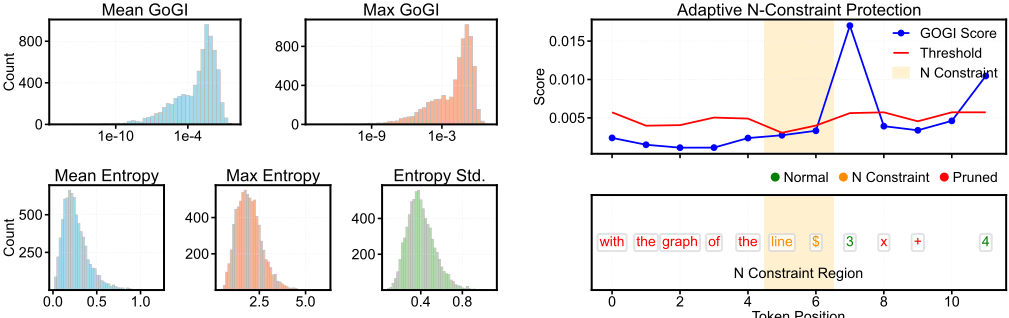
Figure 3: Distributional Dynamics of Information. Left: GoGI scores (top) follow a long-tail distribution, while entropy (bottom) identifies mode switches. Right: ANC dynamically relaxes pruning strictness during entropy spikes, preserving structural coherence at critical junctions.
to capture.
Effectiveness of Adaptive GoGI-Skip. Figure 3 (left) summarizes the signals that make compression reliable. GoGI scores follow a long-tailed distribution, which indicates that most tokens contribute little to the answer loss. The entropy distribution separates stable segments from uncertain transitions, where pruning errors are more likely to cascade. This separation explains why Adaptive GoGI-Skip prunes aggressively in stable regions while remaining conservative around high-uncertainty steps.
Dynamic Behavior of ADS. Figure 3 (right) visualizes the dynamic adaptability of our strategy. EDR dynamically expands the retention window (γt) during high-entropy segments, allocating compute to ambiguous transitions. Simultaneously, ANC acts as a structural stabilizer. ANC intervenes at critical transitions, such as shifting from calculation to conclusion, preventing the model from skipping logically vital but semantically stable connectors like "therefore" and implies. This dual-regulation inversely correlates pruning intensity with local reasoning difficulty, maintaining thinkingoptimal density.
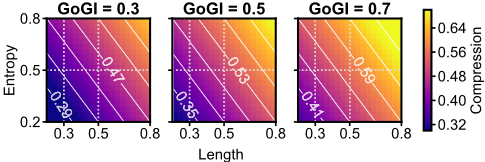
Joint Compression Logic. Figure 4 illustrates the visualization which elucidates the joint regulation of compression. We observe a hierarchical interaction that in highentropy regimes, retention rates remain high regardless of GoGI scores, as EDR enforces safety during uncertainty. Conversely, in low-entropy confident zones, the surface dips significantly, allowing GoGI to aggressively prune tokens with low utility. This pattern confirms that our mechanism effectively prioritizes structural stability over local efficiency when necessary, preventing the blind skipping common in static methods.
Complexity Analysis. Adaptive GoGI-Skip reduces the theoretical attention complexity from O(L2 ) to O((1 - ¯ γ)2L2 ), yielding an approximate 4× reduction in FLOPs for ¯ γ = 0.5. In practice, since LLM inference is memorybandwidth bound, the observed 2.0× speedup stems primarily from reduced memory access frequency for weights and KV-caches. Crucially, because all decision parameters are baked into the SFT weights, this acceleration incurs zero runtime overhead: standard decoding simply outputs a shorter, denser sequence.
5 Discussion
Our experiments validate that Adaptive GoGI-Skip addresses the efficiency-accuracy trade-off in CoT reasoning. Here we synthesize the implications.
5.1 Implications and Insights
Beyond uncertainty-based proxies. The near-zero correlation between GoGI scores and predictive entropy (Figure 5, left) challenges reliance on uncertainty as an importance proxy. Statistical surprise (Ht) signals branching points or ambiguity but cannot distinguish necessary functional steps from linguistic idiosyncrasies. As Jain and Wallace [Jain and Wallace, 2019] note, surface-level attention patterns often diverge from true model reasoning; uncertainty similarly fails to predict valid pruning candidates. By anchoring importance to the answer-loss gradient, GoGI enables aggressive pruning of semantically distinct but functionally redundant tokens, a capability missed by perplexity-based methods that conflate surprising with important.
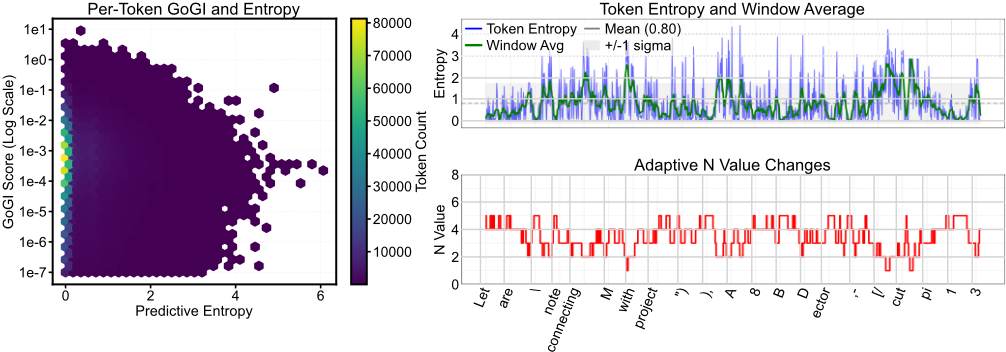
The case for adaptivity. Rigid trade-offs in static baselines underscore the profound heterogeneity of reasoning steps: some require deep computational verification; others are routine syntactic bridges. ADS decouples token count from task difficulty, echoing Adaptive Computation Time principles [Graves, 2016]. As Figure 5 (right) shows, ANC preserves local structural integrity in high-entropy regions even when GoGI signals are low. This synergy enables heavy compression of routine logic while retaining full fidelity for crux moments, approximating thinking-optimal density essential for sustainable Green AI [Schwartz et al., 2020].
Compatibility with RL-based reasoners. RL-based reasoning models such as DeepSeek-R1 [Guo et al., 2025] achieve strong performance but produce increasingly verbose traces [Yeo et al., 2025]. Adaptive GoGI-Skip offers a natural post-processing choice: it compresses RL-generated chains without modifying the base model or reward function. This decoupled design preserves RL's performance benefits while recovering inference efficiency, making our method applicable to any verbose reasoner regardless of its training paradigm.
5.2 Broader Impact
Our work advances practical AI deployment along two axes. Detailed CoT generation multiplies the energy cost per query, and reducing token count by ∼45% lowers kilowatthour consumption proportionally, supporting Green AI initiatives [Luccioni et al., 2025; Patterson et al., 2025]. Speedups reduce end-to-end latency, increase system throughput, and improve resource utilization. This supports higher concurrency and makes it easier to deploy more capable models under fixed infrastructure constraints.
5.3 Limitations
Since GoGI computation requires direct access to model parameters and gradients during data preparation, the method applies to all open models with full parameter access, but it does not extend to models that are only available through closed-source APIs. While inference accelerates, the offline GoGI score calculation incurs a one-time preprocessing cost that scales with the training corpus size, yet this cost amortizes over repeated deployments of the accelerated model.
6 Conclusion
Adaptive GoGI-Skip preserves CoT reasoning while enabling efficient deployment. By unifying goal-gradient importance with dynamic uncertainty regulation, it achieves a principled compression that minimizes redundancy without sacrificing accuracy. Trained on only 7,472 MATH traces, the policy transfers zero-shot across benchmarks and architectures, delivering >45% token reduction and up to 2.0× speedup with negligible accuracy loss. These results show that structural redundancy in reasoning is a learnable, task-agnostic property distinct from semantics. As RL-driven scaling yields ever-longer traces, GoGI-Skip isolates core deductive signals from superfluous content and embeds compact reasoning into model weights via standard SFT, setting a new baseline for resource-efficient inference.
Acknowledgments
I am grateful to Professor Ben Wang and Professor Shuifa Sun from Hangzhou Normal University for their guidance, encouragement, and continued support throughout the course of this work.
@inproceedings{ijcai2026p457,
  title     = {Adaptive GoGI-Skip: Coupling Goal-Gradient Importance with Dynamic Uncertainty for Efficient Reasoning},
  author    = {Zhuang, Ren},
  booktitle = {Proceedings of the Thirty-Fifth International Joint Conference on
               Artificial Intelligence, {IJCAI-26}},
  publisher = {International Joint Conferences on Artificial Intelligence Organization},
  editor    = {Diego Calvanese},
  pages     = {4106--4114},
  year      = {2026},
  month     = {8},
  note      = {Main Track},
  doi       = {10.24963/ijcai.2026/457},
  url       = {https://doi.org/10.24963/ijcai.2026/457},
}
TY - CPAPER TI - Adaptive GoGI-Skip: Coupling Goal-Gradient Importance with Dynamic Uncertainty for Efficient Reasoning AU - Zhuang, Ren T2 - Proceedings of the Thirty-Fifth International Joint Conference on Artificial Intelligence, IJCAI-26 PB - International Joint Conferences on Artificial Intelligence Organization PY - 2026 SP - 4106 EP - 4114 DO - 10.24963/ijcai.2026/457 UR - https://doi.org/10.24963/ijcai.2026/457 ER -Copied
Machine-readable versions of this paper, for tools and AI agents:





