
Keep Experts Diverse: A Task-Aware MoE for Multi-Task Traffic Analysis
Proceedings of the Thirty-Fifth International Joint Conference on Artificial Intelligence. Main Track. Pages 2608-2616.
https://doi.org/10.24963/ijcai.2026/290
Keywords
- Data Mining: Applications
- Data Mining: Networks
- Multidisciplinary Topics and Applications: Security and privacy
Abstract
Network traffic analysis is crucial for maintaining the security of networks. Yet deploying accurate models on edge nodes remains challenging due to protocol diversity, complex traffic behaviors, and stringent resource constraints. Although recent deep learning models achieve strong performance, their dense architectures incur high inference latency, making them unsuitable for edge deployments.
Mixture-of-Experts offers a promising solution through conditional computation, yet existing methods overlook latent inter-task relations and suffer from severe expert load imbalance, leading to expert collapse and suboptimal efficiency.
To address these limitations, we propose TAMoE, a novel Task-Aware Mixture-of-Experts framework for multi-task network traffic analysis.
TAMoE integrates task semantics into both routing and representation learning through a novel Task-Aware Routing, enabling the router to dynamically select experts conditioned on both traffic features and task information.
Besides, to train stably usable and scalable multi-task models, we further design a collaborative multi-task training strategy that encompasses both a dataset mixed construction and a joint training process.
Experiments on six public benchmarks show that TAMoE achieves state-of-the-art results. Deployment on an NVIDIA® Jetson AGX Orin edge node demonstrates that TAMoE reduces inference latency by 60.6% compared to dense models and lowers the Gini Coefficient from 0.391 to 0.275 relative to Multi-Router MoE, achieving more balanced expert utilization.
- [Agarwal et al., 2024] Ishita Agarwal, Aanchal Singh, Aran Agarwal, Shruti Mishra, Sandeep Kumar Satapathy, Sung- Bae Cho, Manas Ranjan Prusty, and Sachi Nandan Mo- hanty. Enhancing road safety and cybersecurity in traf- fic management systems: Leveraging the potential of rein- forcement learning. IEEE Access, 12:9963-9975, 2024.
- [Arp et al., 2022] Daniel Arp, Erwin Quiring, Feargus Pendlebury, Alexander Warnecke, Fabio Pierazzi, Chris- tian Wressnegger, Lorenzo Cavallaro, and Konrad Rieck. Dos and don'ts of machine learning in computer secu- rity. In 31st USENIX Security Symposium (USENIX Se- curity 22), pages 3971-3988, Boston, MA, August 2022. USENIX Association.
- [Cai et al., 2025] Weilin Cai, Juyong Jiang, Fan Wang, Jing Tang, Sunghun Kim, and Jiayi Huang. A survey on mix- ture of experts in large language models. IEEE Transac- tions on Knowledge and Data Engineering, 2025.
- [Chen et al., 2024] Wei Chen, Yuxuan Liu, Zhao Zhang, Fuzhen Zhuang, and Jiang Zhong. Modeling adaptive inter-task feature interactions via sentiment-aware con- trastive learning for joint aspect-sentiment prediction. In Proceedings of the AAAI Conference on Artificial Intelli- gence, volume 38, pages 17781-17789, 2024.
- [Dadkhah et al., 2022] Sajjad Dadkhah, Hassan Mahdikhani, Priscilla Kyei Danso, Alireza Zohourian, Kevin Anh Truong, and Ali A. Ghorbani. Towards the development of a realistic multidimensional iot profiling dataset. In 2022 19th Annual International Conference on Privacy, Security, Trust (PST), pages 1-11, 2022.
- [Dandamudi et al., 2025] Sai Ratna Prasad Dandamudi, Jaideep Sajja, and Amit Khanna. Leveraging artificial intelligence for data networking and cybersecurity in the united states. International Journal of Innovative Research in Computer Science and Technology, 13:34-41, 2025.
- [Devlin et al., 2018] Jacob Devlin, Ming-Wei Chang, Ken- ton Lee, and Kristina Toutanova. Bert: Pre-training of deep bidirectional transformers for language understand- ing. arXiv preprint arXiv:1810.04805, 2018.
- [Dorfman, 1979] Robert Dorfman. A formula for the gini coefficient. The review of economics and statistics, pages 146-149, 1979.
- [Dou et al., 2024] Shihan Dou, Enyu Zhou, Yan Liu, Songyang Gao, Wei Shen, Limao Xiong, Yuhao Zhou, Xiao Wang, Zhiheng Xi, Xiaoran Fan, et al. Loramoe: Alleviating world knowledge forgetting in large language models via moe-style plugin. In Proceedings of the 62nd Annual Meeting of the Association for Computational Linguistics (Volume 1: Long Papers), pages 1932-1945, 2024.
- [Draper-Gil et al., 2016] Gerard Draper-Gil, Arash Habibi Lashkari, Mohammad Saiful Islam Mamun, and Ali A Ghorbani. Characterization of encrypted and vpn traffic using time-related. In Proceedings of the 2nd international conference on information systems security and privacy (ICISSP), pages 407-414, 2016.
- [Fedus et al., 2022] William Fedus, Barret Zoph, and Noam Shazeer. Switch transformers: Scaling to trillion parame- ter models with simple and efficient sparsity, 2022.
- [He et al., 2020] Hong Ye He, Zhi Guo Yang, and Xi- ang Ning Chen. Pert: Payload encoding representation from transformer for encrypted traffic classification. In 2020 ITU Kaleidoscope: Industry-Driven Digital Trans- formation (ITU K), pages 1-8, 2020.
- [Jacobs et al., 2022] Arthur S. Jacobs, Roman Beltiukov, Walter Willinger, Ronaldo A. Ferreira, Arpit Gupta, and Lisandro Z. Granville. Ai/ml for network security: The emperor has no clothes. In Proceedings of the 2022 ACM SIGSAC Conference on Computer and Communications Security, CCS '22, page 1537-1551, New York, NY, USA, 2022. Association for Computing Machinery.
- [Javaheri et al., 2023] Danial Javaheri, Saeid Gorgin, Jeong- A Lee, and Mohammad Masdari. Fuzzy logic-based ddos attacks and network traffic anomaly detection methods: Classification, overview, and future perspectives. Infor- mation Sciences, 626:315-338, 2023.
- [Lashkari et al., 2017] Arash Habibi Lashkari, Ger- ard Draper Gil, Mohammad Saiful Islam Mamun, and Ali A Ghorbani. Characterization of tor traffic using time based features. In International Conference on Information Systems Security and Privacy, volume 2, pages 253-262.
- SciTePress, 2017.
- [Lian et al., 2025a] Xinglin Lian, Chengtai Cao, Yan Liu, Xovee Xu, Yu Zheng, and Fan Zhou. Facing anoma- lies head-on: Network traffic anomaly detection via uncertainty-inspired inter-sample differences. In Proceed- ings of the ACM on Web Conference 2025 (WWW), pages 3908-3917, 2025.
- [Lian et al., 2025b] Xinglin Lian, Yu Zheng, Zhangxuan Dang, Chunlei Peng, and Xinbo Gao. Semi-supervised anomaly traffic detection via multi-frequency reconstruc- tion. Pattern Recognition, 161:111215, 2025.
- [Lian et al., 2026a] Xinglin Lian, Chengtai Cao, Ting Zhong, Yong Wang, Kai Chen, and Fan Zhou. Decom- pose to understand, fuse to detect: Frequency-decoupled anomaly detection for encrypted network traffic. arXiv: 2605.02970, 2026.
- [Lian et al., 2026b] Xinglin Lian, Yu Zheng, Yan Liu, Fan Zhou, Chunlei Peng, and Xinbo Gao. Contextual mask- ing distillation for network traffic anomaly detection. IEEE Transactions on Information Forensics and Security, 21:1273-1286, 2026.
- [Lin et al., 2022] Xinjie Lin, Gang Xiong, Gaopeng Gou, Zhen Li, Junzheng Shi, and Jing Yu. Et-bert: A contextual- ized datagram representation with pre-training transform- ers for encrypted traffic classification. In Proceedings of the ACM Web Conference 2022, pages 633-642, 2022.
- [Liu et al., 2019] Chang Liu, Longtao He, Gang Xiong, Zi- gang Cao, and Zhen Li. Fs-net: A flow sequence net- work for encrypted traffic classification. In IEEE INFO- COM 2019-IEEE Conference On Computer Communica- tions, pages 1171-1179. IEEE, 2019.
- [Liu et al., 2024] Lan Liu, Yongjie Yu, Yafeng Wu, Zhanfa Hui, Jun Lin, and Junhan Hu. Method for multi-task learn- ing fusion network traffic classification to address small sample labels. Scientific Reports, 14(1):2518, 2024.
- [Lotfollahi et al., 2020] Mohammad Lotfollahi, Mahdi Ja- fari Siavoshani, Ramin Shirali Hossein Zade, and Moham- mdsadegh Saberian. Deep packet: A novel approach for encrypted traffic classification using deep learning. Soft Computing, 24(3):1999-2012, 2020.
- [Nascita et al., 2024] Alfredo Nascita, Giuseppe Aceto, Domenico Ciuonzo, Antonio Montieri, Valerio Persico, and Antonio Pescapé. A survey on explainable artificial in- telligence for internet traffic classification and prediction, and intrusion detection. IEEE Communications Surveys & Tutorials, 2024.
- [Ren et al., 2019] Jingjing Ren, DJ Dubois, and D Choffnes. An international view of privacy risks for mobile apps, 2019.
- [Shao et al., 2019] Guolin Shao, Xingshu Chen, Xuemei Zeng, and Lina Wang. Deep learning hierarchical rep- resentation from heterogeneous flow-level communication data. IEEE Transactions on Information Forensics and Se- curity, 15:1525-1540, 2019.
- [Taylor et al., 2016] Vincent F Taylor, Riccardo Spolaor, Mauro Conti, and Ivan Martinovic. Appscanner: Auto- matic fingerprinting of smartphone apps from encrypted network traffic. In 2016 IEEE European Symposium on Security and Privacy (EuroS&P), pages 439-454. IEEE, 2016.
- [Upadhyay et al., 2024] Richa Upadhyay, Ronald Phlypo, Rajkumar Saini, and Marcus Liwicki. Sharing to learn and learning to share; fitting together meta, multi-task, and transfer learning: A meta review. IEEE Access, 2024.
- [van Ede et al., 2020] Thijs van Ede, Riccardo Borto- lameotti, Andrea Continella, Jingjing Ren, Daniel J. Dubois, Martina Lindorfer, David Choffnes, Maarten van Steen, and Andreas Peter. Flowprint: Semi-supervised mobile-app fingerprinting on encrypted network traffic. Network and Distributed System Security Symposium (NDSS), 27, 2020.
- [Wang et al., 2017] Wei Wang, Ming Zhu, Xuewen Zeng, Xiaozhou Ye, and Yiqiang Sheng. Malware traffic classifi- cation using convolutional neural network for representa- tion learning. In 2017 International conference on infor- mation networking (ICOIN), pages 712-717. IEEE, 2017.
- [Wang et al., 2024a] Tongze Wang, Xiaohui Xie, Wen- duo Wang, Chuyi Wang, Youjian Zhao, and Yong Cui. Netmamba: Efficient network traffic classification via pre-training unidirectional mamba. arXiv preprint arXiv:2405.11449, 2024.
- [Wang et al., 2024b] Ziteng Wang, Jun Zhu, and Jianfei Chen. Remoe: Fully differentiable mixture-of-experts with relu routing. arXiv preprint arXiv:2412.14711, 2024.
- [Wei et al., 2024] Xiuying Wei, Skander Moalla, Razvan Pascanu, and Caglar Gulcehre. Building on efficient foun- dations: Effective training of llms with structured feedfor- ward layers. Advances in Neural Information Processing Systems, 37:4689-4717, 2024.
- [Zhang et al., 2021] Zhengyan Zhang, Yankai Lin, Zhiyuan Liu, Peng Li, Maosong Sun, and Jie Zhou. Moefication: Transformer feed-forward layers are mixtures of experts. arXiv preprint arXiv:2110.01786, 2021.
- [Zhang et al., 2023] Haozhen Zhang, Le Yu, Xi Xiao, Qing Li, Francesco Mercaldo, Xiapu Luo, and Qixu Liu. Tfe- gnn: A temporal fusion encoder using graph neural net- works for fine-grained encrypted traffic classification. In Proceedings of the ACM Web Conference 2023, WWW '23, page 2066-2075, New York, NY, USA, 2023. Associ- ation for Computing Machinery.
- [Zhang et al., 2025] Gong-Duo Zhang, Ruiqing Chen, Qian Zhao, Zhengwei Wu, Fengyu Han, Huan-Yi Su, Ziqi Liu, Lihong Gu, and Lin Zhou. Bagging-expert network for multi-task learning: A depolarization solution in multi- gate mixture-of-experts. In Proceedings of the AAAI Conference on Artificial Intelligence, volume 39, pages 22389-22397, 2025.
- [Zhao et al., 2023] Ruijie Zhao, Mingwei Zhan, Xianwen Deng, Yanhao Wang, Yijun Wang, Guan Gui, and Zhi Xue. Yet another traffic classifier: A masked autoencoder based traffic transformer with multi-level flow representation. In Proceedings of the AAAI Conference on Artificial Intelli- gence, volume 37, pages 5420-5427, 2023.
- [Zhou et al., 2022] Yanqi Zhou, Tao Lei, Hanxiao Liu, Nan Du, Yanping Huang, Vincent Zhao, Andrew M Dai, Quoc V Le, James Laudon, et al. Mixture-of-experts with expert choice routing. Advances in Neural Information Processing Systems, 35:7103-7114, 2022.
- [Zhou et al., 2025] Guangmeng Zhou, Xiongwen Guo, Zhuotao Liu, Tong Li, Qi Li, and Ke Xu. Trafficformer: An efficient pre-trained model for traffic data. In 2025 IEEE Symposium on Security and Privacy (SP), pages 1844-1860, 2025.
References were extracted automatically from the PDF and may contain errors.
Full text extracted automatically from the PDF; figures, tables and equations may differ. The PDF is the version of record.
1 Introduction
Network traffic analysis serves as the cornerstone for ensuring the security and reliability of modern edge infrastructures. [Agarwal et al., 2024; Dandamudi et al., 2025]. As edge networks evolve, traffic patterns have become increasingly protocol-diverse and behaviorally complex, driven by heterogeneous edge devices and encrypted communications. [Javaheri et al., 2023]. This complexity presents a fundamental conflict in the edge network. Traffic analysis models require sophisticated, yet real-world network security demands immediate, sub-second responsiveness. Any delay in traffic decision-making can compromise security and reliability.
∗Corresponding authors: Jiyan Sun and Jiang Fang.
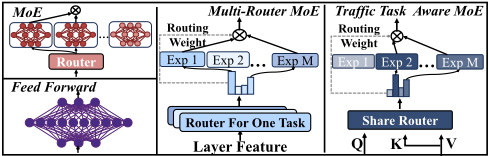
Traditional approaches [Lotfollahi et al., 2020; Liu et al., 2019] typically treat traffic analysis as a set of isolated singletask problems. deploying independent models for application classification, anomaly detection, and related tasks not only incurs substantial computational overhead, but also leads to redundant feature extraction, which collectively increase inference latency and deployment complexity on resourceconstrained edge nodes[Nascita et al., 2024]. These tasks are deeply entangled, i.e., They often share latent semantic features and exhibit strong inter-task correlations [Chen et al., 2024]. This limitation calls for a paradigm shift toward MultiTask Learning, where a unified model concurrently handles diverse analysis tasks [Liu et al., 2024]. However, deploying such unified models on edge nodes faces a critical bottleneck: Inference Latency. State-of-the-art pre-trained models [Lin et al., 2022; Wang et al., 2024a; Zhao et al., 2023; Zhou et al., 2025] typically rely on dense architectures (e.g., Transformers), where the fully connected Feed-Forward Networks (FFNs) force the activation of all parameters for every packet [Zhang et al., 2021]. This dense computation paradigm results in prohibitive inference latency, rendering them unsuitable for real-time edge scenarios where speed is paramount [Wei et al., 2024].
A promising answer lies in Mixture-of-Experts (MoE) [Cai et al., 2025], which introduce a conditional computation paradigm for dense models [Zhang et al., 2021]. By activating only a subset of experts per forward pass, this method effectively addresses the computational bottlenecks of dense models, significantly reducing inference latency. In multitask settings, this paradigm extends to Multi-router MoE (MMoE) [Zhang et al., 2025], employing independent routers to select experts from a shared pool for task-specific processing. However, MMoE remains constrained by two critical limitations. (1) Inadequate task correlation. MMoE assigns an independent router to each task, which operates in isolation without considering inter-task relationships. This design neglects the underlying semantic correlations among tasks, limiting the model's ability to share and transfer knowledge across tasks [Upadhyay et al., 2024]. (2) Unbalanced expert utilization. For multi-task training, MMoE routers rely solely on the current hidden features. Since different tasks may produce highly similar hidden features, the router tends to assign them repeatedly to the same subset of experts [Zhou et al., 2022]. Consequently, many experts are only a few frequently activated, resulting in severe expert load imbalance, namely expert collapse [Wang et al., 2024b]. These limitations reveal a critical gap: existing MoE framework either ignore task semantics or fail to ensure balanced expert utilization in multiple traffic analyses.
To tackle the above challenges and enable the next generation of intelligent network analysis, we propose a Task Aware Mixture-of-Experts framework for multiple traffic analysis task, TAMoE, which redefines how traffic models scale, generalize, and adapt for edge-scale AI. Firstly, unlike prior MoE, we propose a novel Task-Aware Routing mechanism that leverages an attention mechanism to explicitly fuse input features with task embeddings. This enables dynamic, intent-conditioned expert selection while strictly preserving the low-inference-latency advantage. Distinctively, our design facilitates a single, intelligent shared router across all tasks. This strategy allows the model to capture latent intertask correlations, thereby fostering effective expert collaboration and knowledge transfer. More importantly, this design provides semantic guidance, directing the router to activate a broader, more diverse set of experts. This structurally alleviates expert load imbalance and mitigates the risk of expert collapse by reducing over-reliance on a fixed subset of experts. Secondly, to optimize shared architecture, we introduce a collaborative training strategy in which each sample is explicitly paired with its task embedding to direct the routing process. By integrating multiple task-specific objectives into a composite loss, this enables the training of a general traffic feature extraction model that efficiently adapts to new tasks, which is crucial for edge-scale AI. Extensive experiments conducted on publicly available datasets demonstrate the effectiveness of TAMoE. Evaluations on an edge node (NVIDIA® JETSON AGX ORIN) demonstrate that TAMoE reduces inference latency by 60.6% compared with YATC, and reduces the Gini Coefficient from 0.391 to 0.275, compared with MMoE, effectively alleviating the risk of expert collapse. In summary, our work makes the contributions:
- We propose TAMoE, Task-Aware Mixture-of-Experts,
- the MoE model designed for network traffic analysis, which significantly reduces inference latency.
- We design a novel Task-Aware Routing mechanism that utilizes attention mechanism to introduce task semantics into expert selection, which adequately captures the correlations of multi-task and alleviate expert collapse risk.
- We conduct extensive experiments on six traffic analysis tasks. The experimental results demonstrate that our method achieves state-of-the-art (SOTA) performance.
2 RelatedWork
2.1 Network Traffic Analysis Methods
Early studies on network traffic analysis primarily relied on conventional machine learning, where manually crafted statistical features were designed to characterize flow-level behaviors [Shao et al., 2019; Taylor et al., 2016; van Ede et al., 2020]. While these methods provided acceptable performance in static or single-task settings, their heavy reliance on hand-crafted feature engineering hindered adaptability to dynamic network environments. With the advent of deep learning, researchers shifted toward automatically extracting representations directly from raw packet or flow data [Lotfollahi et al., 2020; Liu et al., 2019; Lian et al., 2025a; Lian et al., 2025b]. These models adopted deep neural networks to capture spatial or temporal dependencies within traffic, thereby improving the accuracy of tasks such as intrusion detection and anomaly detection. However, their high parameter counts and reliance on large-scale labeled datasets limited their scalability in edge environments. Pre-trained traffic models have been introduced to enhance transferability by learning generalizable representations from largescale unlabeled traffic [Zhao et al., 2023; Lin et al., 2022; Wang et al., 2024a; He et al., 2020; Zhou et al., 2025; Lian et al., 2026b]. These methods typically rely on strategies such as masked token prediction [Lin et al., 2022], or flow reconstruction [Wang et al., 2024a] to capture latent protocol semantics and communication patterns[Lian et al., 2026a]. After pre-training, the learned representations can be fine-tuned on smaller task-specific datasets.
Despite their success, existing models face two critical limitations. First, these models are predominantly built upon the Transformer architecture, where the fully connected feedforward networks (FFNs) constitute a significant computational bottleneck [Wei et al., 2024; Zhang et al., 2021]. This dense computation results in excessive inference latency, especially when handling the long sequences of network traffic, making such models unsuitable for edge AI. Second, finetuning is typically performed on a task-specific basis, which involves training and deploying a separate, complete model copy for each downstream task. It fails to explore the shared knowledge that often exists in different traffic tasks, leaving an open gap that our proposed framework aims to fill.
2.2 Mixture of Experts (MoE)
The Mixture-of-Experts (MoE) paradigm [Cai et al., 2025] has recently gained attention for its ability to scale model capacity while maintaining efficient inference through conditional computation. This conditional strategy has enabled MoE to achieve remarkable success in large-scale natural language processing and computer vision. However, its potential in the domain of network traffic analysis remains largely unexplored. Given the growing complexity and scale of network traffic, applying MoE to this domain presents a promising opportunity to balance excessive inference latency with practical deployment efficiency. To extend MoE to multi-task scenarios, the Multi-gate Mixture-ofExperts (MMoE) framework was introduced [Cai et al., 2025; Zhang et al., 2025]. MMoE employs a shared pool of experts with independent task-specific routers, allowing each task to learn its own routing strategy. While effective in capturing task-specific variations, MMoE suffers from two critical limitations in the context of network traffic analysis: (1) the isolation of routers hindering cross-task knowledge sharing, and (2) routing mechanisms rely solely on hidden features, which often results in repeatedly selecting the same subset of experts. This causes severe load imbalance, namely expert collapse and results in inefficient knowledge sharing and degraded task performance.
Our work addresses these limitations by introducing a Task-Aware Mixture-of-Experts framework. Unlike conventional methods, TAMoE incorporates task semantic embeddings into the routing process, enabling task-sensitive expert selection that fosters better collaboration across tasks while alleviating expert imbalance. This design enhances both the effectiveness and efficiency of multi-task traffic analysis, making it suitable for deployment in edge-scale AI.
3 TAMoE Design
As illustrated in Figure 2, TAMoE comprises a traffic preprocessing pipeline, a novel Task-Aware MoE layer, and a multi-task collaborative training strategy. Initially, to handle protocol heterogeneity, the preprocessing module transforms raw PCAP traffic into unified token sequences via flow extraction, anonymization, and payload tokenization. Subsequently, to reconcile high parameter capacity with low inference latency, we propose a unified TAMoE framework. Here, a router leverages task embedding to enable the routing network to select a broader range of experts, thereby increasing the likelihood of activating more experts, enabling efficient conditional computation while mitigating expert collapse. Furthermore, by optimizing a composite loss over an interleaved multi-task dataset, the collaborative training strategy anable the TAMoE model to capture latent inter-task correlations, fostering robust knowledge sharing and ensuring superior transferability to unseen tasks.
3.1 Traffic Preprocess
To enable unified representation and efficient modeling of multi-protocol and heterogeneous network traffic, we employ a comprehensive traffic preprocessing pipeline that transforms raw PCAP packets into tokens [Zhao et al., 2023]. The pipeline includes four stages: flow splitting, packet anonymization, packet alignment, and packet tokenization.
Flow Splitting and Packet Anonymization. This preserves the complete sequence order and contextual information necessary for modeling flow-level temporal patterns. We begin by segmenting raw captured traffic into semantically complete session flows using the network five-tuple (SrcIP, DstIP, SrcPort, DstPort, Protocol). Packets sharing the same five-tuple are grouped into a flow Fi = {P1, P2, . . . , Pni }, where Pj denotes the j-th packet in the flow. Besides, to mitigate the risk of sensitive information leakage, IP addresses and port numbers are anonymized, by masking or zeroing, while preserving the overall data distribution [Arp et al., 2022; Jacobs et al., 2022]. This process preserves the temporal structure of session context and reduces the risk of model overfitting, which is essential for analysing patterns of traffic.
Packet Alignment and Tokenization. For compatibility with batched processing, we normalize the length of all traffic sequences, creating uniform input tensors by either padding shorter sequences or truncating longer ones. Let a packet be represented as a tuple P = (s, d), where s denotes the header bytes and d denotes the payload bytes. We align each segment independently to fixed lengths Ls and Ld, respectively. If the actual header is longer than Ls, it is truncated; if it is shorter, it is padded with zero-value bytes. After aligning the traffic packet length, each aligned flow Fi is converted into a 1D token sequence. Every byte is split into 4-bit tokens, yielding a token sequence T = {t1, t2, . . . , tL}, where L = ni 4 × Ls × Ld, L represents the total number of tokens in a flow. Each input sample x therefore corresponds to a fixedsize token representation. This design ensures compatibility across traffic tasks and enable effective learning of temporal and structural patterns.
3.2 Task-Aware MoE Framework
The router function of traditional Mixture-of-Experts relies solely on input features. Such a design not only restricts expert activation to a limited subset of experts but also overlooks the inter-task correlations. In this section, we introduce Task-Aware Mixture of Experts (TAMoE), a novel framework that integrates task-aware routing into expert selection. By conditioning routing decisions on both token representations and task embeddings, TAMoE achieves more balanced expert utilization and effectively leverages inter-task correlations.
Task-Aware MoE Model Design. As shown in Figure 2, the Task-Aware MoE-based Model consists of two parts: Task-Aware Traffic Encoder fθ, and Task-Specific Prediction Head gt. First, since models operate in continuous vector spaces, effective representation requires both token semantics and positional context. To this end, we adopt a learnable token embedding layer that projects each discrete traffic token into a continuous dmodel = 192 dimensional vector. Besides, we use a fixed sinusoidal positional encoding scheme, which adds a unique positional vector to each token embedding. Then, the resulting embedding sequence is processed by a stack of task-aware MoE blocks, with the number of blocks set to N = 4 in this study. Each task-aware MoEBlock is composed of two sub-layers: a multi-head self-attention and a TAMoE layer. RMS normalization and residual connections are applied to each sub-layer to ensure training stability.
To accommodate multiple tasks training, we append a separate, lightweight classification head for each task after the Task-Aware Traffic Encoder fθ. Each head gt is typically a simple Multi-Layer Perceptron (MLP) that takes the final representation from the encoder and maps it to the task-specific output space. This modular design allows the traffic encoder to serve as a powerful, general-purpose feature extractor. This encoder can be fine-tuned using a small set of labeled data and transferred to various tasks.
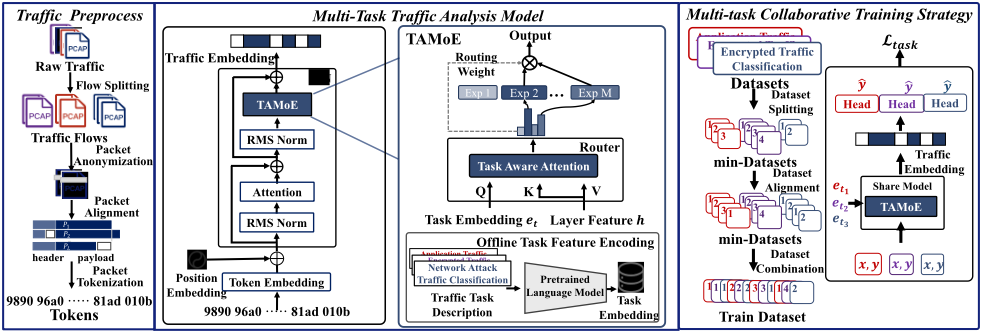
Task Description Embedding. To capture the semantic relationships between traffic analysis tasks, we adopt a pretrained language model embedding that extracts taskdescriptive semantic features as Task Embedding et. This approach enriches the router process with valuable semantic information, enhancing its ability to select experts more effectively for each task. Specifically, we begin by defining a textual description for each traffic task t. This description (e.g., "Darknet Network Attack Traffic Classification") is then treated as a textual prompt and encoded using a Pre-trained Language Model, such as BERT [Devlin et al., 2018], to extract the task embedding, et. represented as: et = LanguageModel(t). Notably, these task embeddings are pre-computed and stored, ensuring zero additional computational cost during the actual training or inference stages.
Task-Aware Routing Mechanism. For enabling expert selection based on task-specific semantic features and adaptation across diverse tasks, we propose a Task-Aware routing mechanism. This module leverages the Task Embedding as the query (Q) and applies it to the input feature representations,h, which serve as both keys (K) and values (V ). The resulting attention weights reflect the semantic relevance between the task intent and input features, thereby measuring which feature positions are most informative.
These W are learnable parameters that project task embeddings and input features into a unified attention space. The attention output represents the alignment of input features with task semantics while simultaneously serving as a routing signal that dynamically guides feature selection and expert allocation based on task intent. Next, the output z is fed into a linear layer to project to expert dimension.
where Wr and br are the parameters of the linear layer. M represents the number of experts. Then, we apply a top-k sparse router strategy by computing the softmax only over the logits of the top-k experts, thereby determining the expert activation distribution.
After obtaining the weighted output of each token from the selected experts, we add a residual connection and apply layer normalization to produce the final feature representation. Each expert Experti receives the same hidden layer input h and produces an output with the same dimensionality. Finally, we aggregate the outputs of the top-k experts by weighting themwith the router scores.
Unlike conventional MoE that rely on auxiliary balancing losses, or routing regularization to prevent collapse, TAMoE is trained without any such artificial constraints. By incorporating task features, this design encourages the routing network to make more diverse expert selections during multitask training. This promotes a more balanced activation across the expert pool, which mitigates the risk of expert collapse. While simultaneously enabling the router to learn and leverage the semantic relationships between tasks.
3.3 Multi-Task Collaborative Training Strategy
Multi-Task Dataset Mixed Construction. Ensuring effective representation across multiple network traffic tasks and avoiding bias due to sample imbalance, we adopt a multi-task collaborative training strategy based on balanced and aligned dataset mixing. Let there be t ∈ T tasks, each associated with a dataset Dt = (xt1 , yt1 ), . . . , (xtNt , ytNt ) , where Nt = |Dt |. Each dataset is first partitioned into equal-sized chunks:
To unify the number of chunks across all tasks, we duplicate and expand smaller datasets until each task has m = maxt⌈Nt/B⌉ segments. This ensures that each task is equally represented during training. During training, we interleave these task-specific segments to form multi-task mixed batches: Bi = [D1 i ,D2 i , . . . ,DT i ] , i = 1, . . . ,m. This alternating mixing strategy ensures that all tasks are fairly represented during each training round, so the model doesn't focus too much on one particular task. By combining data from different tasks evenly, the model can learn both shared patterns across tasks and features unique to each task.
Multi-Task Training Step. For each input batch, the identity of the current task t is encoded into a fixed-length vector et using the Task Description Embedding, which can be precomputed and stored for all tasks. During training or inference, et can be retrieved in real time, avoiding repeated computation. Each input sample xti is passed through the TaskAware Traffic Encoder fθ to produce a sequence of tokenlevel feature representations. Specifically, the task vector et is injected into the TAMoE of the task-aware MoE block as part of the router input. The router computes expert scores using both the token-level features and et. The top-k most relevant experts are selected via sparse routing. The selected experts process the token features, generating transformed feature representations that are adaptive to both the input traffic and task semantics. The global feature vector produced by the MoE block is fed into the task-specific classification head gt to generate predictions ˆ yt i = gt(fθ(xti , et)). For multi-task training, the total loss is computed as the sum of task-specific losses across all tasks:
where Ltask denotes the cross-entropy loss function. This training strategy optimizes multiple tasks simultaneously, enabling TAMoE to learn diverse task-specific semantic features as well as the underlying correlations among tasks.
4 Experiments
4.1 Experiment Setup
Dataset and Baseline
We evaluate TAMoE on six widely adopted datasets covering three distinct traffic analysis domains: Application Classification (CrossPlatform-Android and CrossPlatform-iOS [Ren et al., 2019]), Network Intrusion Detection (CICIoT2022 [Dadkhah et al., 2022], USTCTFC2016 [Wang et al., 2017]), and Encrypted Traffic Classification (ISCXVPN2016 [Draper-Gil et al., 2016], ISCXTor2016 [Lashkari et al., 2017]). For benchmarking, we compare TAMoE against state-of-the-art methods across four major paradigms: (1) Machine Learning (e.g., AppScanner [Taylor et al., 2016], FlowPrint [van Ede et al., 2020]), (2) Deep Learning (e.g., DeepPacket [Lotfollahi et al., 2020], FS-Net [Liu et al., 2019]), (3) Pre-training Frameworks (e.g., ET-BERT [Lin et al., 2022], YaTC [Zhao et al., 2023], NetMamba [Wang et al., 2024a] and TrafficFormer [Zhou et al., 2025]), and (4) MoE-based approaches. This comprehensive setup ensures a rigorous assessment of TAMoE's performance and generalization.
Evaluation Metric and Implementation Details
We used accuracy (ACC) and macro-averaged F1-score (F1) as evaluation metrics. We employed the pre-trained BERT model, BERT-Base-Uncased, to generate task-specific embeddings. We employed a TAMoE Encoder with 4 layers as the traffic encoder model, where we configured the TAMoE component with 6 experts and selected the top 2 most relevant experts for each sample. Training was conducted with a batch size of 128. We used a cosine annealing learning rate scheduler with an initial learning rate of 0.0125 and a weight decay of 1e-05. In the fine-tuning stage, we employed a learning rate of 0.03. Experiments were performed using Pytorch 2.0.0 and on an NVIDIA® 3090 24G GPU.
4.2 Performance against Baselines
As shown in Table 1, TAMoE consistently achieves stateof-the-art performance across all six datasets, outperforming classical machine learning, deep learning, pre-trained, and MoE-based baselines on both accuracy and F1-score.
(1) Comparison to Machine Learning Approaches. On CrossPlatform-Android, TAMoE boosts the F1-score from FlowPrint's 0.7565 to 0.9835, showcasing the limitations of hand-crafted features and the clear advantages of expertdriven traffic modeling. (2) Comparison to Deep Learning Approaches. TAMoE consistently delivers higher accuracy and F1-scores; for example, on CrossPlatform-iOS, it increases the F1-score from DeepPacket's 0.9034 to 0.9787. This gain comes from task-aware routing, which encourages more robust and transferable representations than conventional single-stream architectures. (3) Comparison to Pre-train and Finetune Models. Pretrained models offer strong baselines, yet their unified representations limit cross-task adaptability. TAMoE surpasses them across all benchmarks-for instance, improving the F1-score on CrossPlatform-Android from NetMamba's 0.9260 to 0.9835. The improvement reflects TAMoE's ability to leverage multiple specialized experts to capture more diverse traffic patterns. (4) Comparison to MoE-based Approaches. Compared with the Multi-Router MoE, TAMoE achieves higher scores on every dataset. On CrossPlatform-Android, it improves the F1-score from 0.9731 to 0.9835. These results confirm that task-aware routing and attention enable more effective expert utilization, resulting in more accurate and reliable multi-task traffic analysis.
Overall, the results demonstrate that TAMoE not only improves classification accuracy but also enhances robustness across heterogeneous platforms, varied encryption protocols, and diverse real-world traffic distributions.
| Method | CrossPlatform-Android | CrossPlatform-IOS | CICIoT2022 | USTCTFC2016 | ISCXTor2016 | ISCXVPN2016 | ||||||
|---|---|---|---|---|---|---|---|---|---|---|---|---|
| ACC | F1 | ACC | F1 | ACC | F1 | ACC | F1 | ACC | F1 | ACC | F1 | |
| Machine Learning Based Approach | ||||||||||||
| AppScaner [Taylor et al., 2016] | 0.3868 | 0.3866 | 0.3205 | 0.3130 | 0.7556 | 0.6938 | 0.6998 | 0.6633 | 0.4034 | 0.2113 | 0.7643 | 0.7256 |
| FlowPrint [van Ede et al., 2020] | 0.8739 | 0.8700 | 0.8712 | 0.8603 | 0.5820 | 0.4643 | 0.7992 | 0.7755 | 0.1316 | 0.0306 | 0.9666 | 0.9681 |
| Deep Learning Based approach | ||||||||||||
| Deeppacket [Lotfollahi et al., 2020] | 0.8805 | 0.8138 | 0.9204 | 0.9034 | - | - | 0.9640 | 0.9641 | 0.7449 | 0.7473 | 0.9329 | 0.9321 |
| FS-Net [Liu et al., 2019] | 0.4631 | 0.4628 | 0.3884 | 0.3884 | 0.4391 | 0.4375 | 0.4542 | 0.4542 | 0.7198 | 0.7198 | 0.7322 | 0.7322 |
| TFE-GNN [Zhang et al., 2023] | 0.8141 | 0.8067 | 0.8241 | 0.8130 | 0.9915 | 0.9907 | 0.9747 | 0.9734 | 0.7692 | 0.7618 | 0.8428 | 0.8447 |
| Pre-train and Finetune Based Approach | ||||||||||||
| ET-BERT [Lin et al., 2022] | 0.9166 | 0.9071 | 0.9105 | 0.8850 | 0.9937 | 0.9937 | 0.9915 | 0.9913 | 0.9980 | 0.9980 | 0.9566 | 0.9565 |
| YaTC [Zhao et al., 2023] | 0.9074 | 0.9074 | 0.9562 | 0.9562 | 0.9584 | 0.9583 | 0.9786 | 0.9785 | 0.9890 | 0.9892 | 0.9772 | 0.9769 |
| NetMamba [Wang et al., 2024a] | 0.9257 | 0.9260 | 0.9248 | 0.9242 | 0.9944 | 0.9944 | 0.9982 | 0.9982 | 0.9993 | 0.9991 | 0.9826 | 0.9826 |
| TrafficFormer [Zhou et al., 2025] | 0.9473 | 0.9472 | 0.9468 | 0.9466 | 0.9931 | 0.9931 | 0.9957 | 0.9955 | 0.9953 | 0.9951 | 0.9783 | 0.9883 |
| MoE Based Approach | ||||||||||||
| Multi-Router MoE | 0.9734 | 0.9731 | 0.9618 | 0.9618 | 0.9949 | 0.9949 | 0.9904 | 0.9902 | 0.9917 | 0.9915 | 0.9854 | 0.9852 |
| TAMoE(our) | 0.9836 | 0.9835 | 0.9789 | 0.9787 | 0.9964 | 0.9965 | 0.9988 | 0.9987 | 0.9996 | 0.9996 | 0.9877 | 0.9877 |
4.3 Expert Specialization
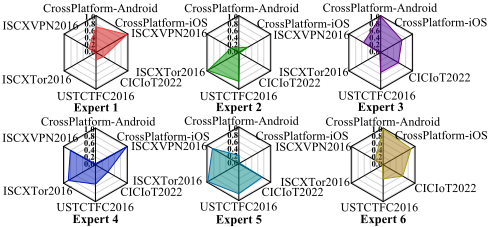
To further understand how TAMoE leverages expert specialization, we analyzed the allocation behavior of each expert by examining the number of tokens they processed for different tasks. As illustrated in Figure 3, we visualize the relative task preferences of six experts using radar charts. The radar plots reveal highly diverse and non-overlapping preference profiles, indicating that no expert dominates across all tasks. Instead, each expert develops its own distinct competency region, shaped by the task-aware routing. This confirms that the router does not collapse to uniform routing but successfully guides tasks toward the most compatible experts.
More concretely, Experts 1, 3, and 6 exhibit strong affinity for application-level classification tasks, consistently showing the highest normalized scores on CrossPlatform-Android and CrossPlatform-iOS. However, these experts perform weakest on encrypted traffic datasets such as ISCXTor2016, suggesting that their learned representations focus on application semantics rather than encrypted flow characteristics. In contrast, other experts (e.g., Experts 4 and 5) show complementary patterns, excelling on encrypted traffic tasks while placing lower emphasis on application-oriented ones.
Overall, these findings indicate pronounced expert heterogeneity and specialization, validating that TAMoE successfully decomposes complex multi-task traffic analysis into a coordinated ensemble of task-aligned experts.
4.4 Expert Load Balancing
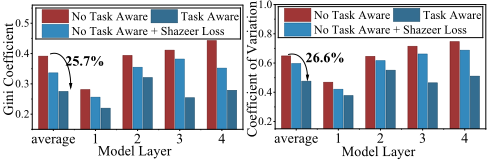
As shown in Figure 4, we report two standard inequality metrics, the Gini Coefficient [Dorfman, 1979] and the Coefficient of Variation (CV) [Dou et al., 2024], where lower values indicate a more balanced workload.
Across all layers, TAMoE achieves the lowest Gini and CV among the three variants (No Task Aware, No Task Aware + Shazeer Loss [Fedus et al., 2022], and our Task-Aware MoE). On average, the Gini score drops from 0.391 (No Task Aware) to 0.275 with TAMoE, while the average CV decreases by 26.6%. Although the Shazeer loss partially alleviates imbalance, it still lags behind TAMoE, indicating that task-aware routing provides additional, complementary gains. Notably, the advantage of TAMoE is more pronounced in deeper layers: while the gap is relatively small in Layer 1, the differences in Layers 3 and 4 are significantly larger. This suggests that task-conditioned routing is particularly beneficial when representations become more task-specific. These findings demonstrate that TAMoE substantially mitigates expert load imbalance and reduces the risk of expert collapse.
4.5 Computational Efficiency
As shown in Table 2, we evaluate computational efficiency on the NVIDIA® JETSON AGX ORIN edge device (batch size = 128). TAMoE achieves an inference latency of
| Method | Parameters | FLOPs | Times (ms) |
|---|---|---|---|
| TFE-GNN | 4.43e+07 | 2.36e+09 | 2.12e+00 |
| ET-BERT | 1.87e+08 | 2.25e+10 | 1.93e+00 |
| YATC | 2.20e+06 | 1.81e+09 | 4.85e-01 |
| NetMamba | 2.30e+06 | 3.66e+09 | 3.42e-01 |
| Multi-Router MoE | 7.70e+06 | 1.37e+09 | 1.73e-01 |
| TAMoE | 7.92e+06 | 1.42e+09 | 1.91e-01 |
1.91e-01 ms, outperforming TFE-GNN (2.12e+00 ms), ETBERT (1.93e+00 ms), and lightweight models such as YATC. This represents a 60.6% reduction in latency compared with YATC. Although TAMoE has more parameters than YATC (7.92e+06 vs. 2.20e+06), its conditional MoE computation ensures that only a small subset of experts is activated per sample, substantially lowering the computational cost. Compared with MultiRouterMoE, TAMoE introduces additional parameters due to task-aware routing, yet it maintains a single shared model for all tasks, eliminating the need for multiple task-specific deployments.
4.6 Few-Shot Evaluation
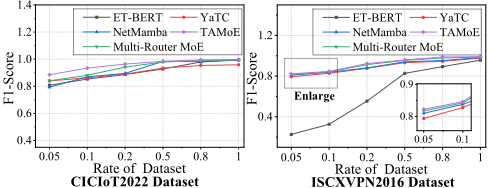
To evaluate the cross-task transfer ability, we first train the feature extractor on five datasets using the Multi-Task Collaborative Training Strategy and then fine-tune it on the remaining dataset. As shown in Figure 5, TAMoE exhibits clear advantages in low-resource settings. On CICIoT2022, with only 5% labeled data, TAMoE achieves an F1-score of 0.8851, surpassing all baselines, including ET-BERT (0.8074), NetMamba (0.7934), YATC (0.8395), and Multi-Router MoE (0.8404). This reflects that TAMoE can reach great performance with only a small set of labels.
TAMoE maintains its performance lead as the dataset size increases. At the 10% proportion, TAMoE reaches 0.9341, significantly outperforming the next-best baseline (0.8810). Although all methods converge with the full dataset, TAMoE's robustness under sparse labels is particularly valuable for edge-scale scenarios.
4.7 Ablation Studies
Robustness of Task Description
To verify robustness, we evaluate TAMoE on CICIoT2022 under four varied task descriptions, including vague and noisy phrasing. As summarized in Table 3, the performance is extremely stable, with ≤ 0.06% variance in F1-score across all descriptions, indicating that the router is not sensitive to the specific wording.
| ID | Description Type | F1 |
| T1 | Standard description | 0.9965 |
| T2 | Synonym-rich paraphrase | 0.9961 |
| T3 | Vague / under-specified | 0.9963 |
| T4 | Noisy (typos / extra words) | 0.9959 |
| Method | ACC | F1 |
|---|---|---|
| TAMoE (default) | 0.9964 | 0.9966 |
| w/o MoE(Transform) | 0.9584 | 0.9583 |
| w/o Position Embedding | 0.9736 | 0.9733 |
| w/o Collaborative Training | 0.9764 | 0.9677 |
| w/o TaskAware | 0.9341 | 0.9338 |
| One-Hot Task Embedding | 0.9764 | 0.9759 |
| Multi-Task Shared-Transformer-Encoder | 0.9518 | 0.9517 |
Other Ablation Settings
As shown in Table 4, we evaluate the contribution of each component on ISCXTor2016.
1. w/o MoE (Transform). Replacing the MoE framework with a standard Transformer causes a clear drop (F1: 0.9966 →0.9583), showing that a single shared representation is insufficient for heterogeneous traffic, while expert specialization is beneficial. 2. w/o Position Embedding. Removing positional information degrades performance (F1: 0.9966 → 0.9733), confirming the importance of temporal order within flows. 3. w/o Collaborative Training. Training on a single dataset instead of jointly across tasks reduces F1 to 0.9677, indicating that inter-task knowledge transfer is crucial for generalization. 4. w/o TaskAware. Replacing the task-aware router with a conventional multi-router MoE leads to a substantial drop (F1: 0.9966 → 0.9338), highlighting the benefit of task-informed routing for effective expert utilization. 5. One-Hot Task Embedding. Using one-hot task vectors instead of learned embeddings lowers F1 to 0.9759, implying that richer task representations better capture inter-task relations. 6. Multi-Task Shared-Transformer-Encoder. All tasks share a single Transformer encoder with task-specific heads achieves only 0.9517 F1, far below TAMoE. This suggests that a fully shared encoder suffers from negative transfer due to conflicting gradients, whereas TAMoE's sparse, conditional computation enables expert specialization and mitigates such interference. Overall, these results demonstrate that each component plays a crucial role in achieving the superior performance of TAMoE.
5 Conclusion
In this work, we introduced TAMoE, a Task-Aware Mixtureof-Experts framework for multi-task network traffic analysis. By incorporating task semantics into the routing process, TAMoE enables dynamic expert selection based on both traffic features and task-level information, thereby mitigating expert collapse, improving cross-task knowledge sharing, and enhancing transferability to unseen tasks.
Acknowledgments
This work was supported by the Science and Technology Programme of STATE GRID Corporation of China (5100202456026A-1-1-ZN).
@inproceedings{ijcai2026p290,
  title     = {Keep Experts Diverse: A Task-Aware MoE for Multi-Task Traffic Analysis},
  author    = {Fu, Jiadong and Fang, Jiang and Sun, Jiyan and Xi, Laile and Zhuang, Shangyuan and Geng, Liru and Liu, Yinlong and Lv, Zhiqiang},
  booktitle = {Proceedings of the Thirty-Fifth International Joint Conference on
               Artificial Intelligence, {IJCAI-26}},
  publisher = {International Joint Conferences on Artificial Intelligence Organization},
  editor    = {Diego Calvanese},
  pages     = {2608--2616},
  year      = {2026},
  month     = {8},
  note      = {Main Track},
  doi       = {10.24963/ijcai.2026/290},
  url       = {https://doi.org/10.24963/ijcai.2026/290},
}
TY - CPAPER TI - Keep Experts Diverse: A Task-Aware MoE for Multi-Task Traffic Analysis AU - Fu, Jiadong AU - Fang, Jiang AU - Sun, Jiyan AU - Xi, Laile AU - Zhuang, Shangyuan AU - Geng, Liru AU - Liu, Yinlong AU - Lv, Zhiqiang T2 - Proceedings of the Thirty-Fifth International Joint Conference on Artificial Intelligence, IJCAI-26 PB - International Joint Conferences on Artificial Intelligence Organization PY - 2026 SP - 2608 EP - 2616 DO - 10.24963/ijcai.2026/290 UR - https://doi.org/10.24963/ijcai.2026/290 ER -Copied
Machine-readable versions of this paper, for tools and AI agents:





