
Looking at Your Photo, What Comes to Mind? Personalized Memory Internalization for Dementia Reminiscence
Proceedings of the Thirty-Fifth International Joint Conference on Artificial Intelligence. Demo Track. Pages 8551-8554.
https://doi.org/10.24963/ijcai.2026/1001
Keywords
- AI: Natural Language Processing
- AI: Humans and AI
Abstract
We present PhoMi, an interactive recall assistant that supports dementia reminiscence by engaging users with personal photographs captured via a live camera interface. Given a photograph, PhoMi delivers spoken questions and receives spoken responses, creating an accessible reminiscence setting with reduced reliance of human therapists. Over repeated sessions, user responses are incorporated into lightweight adapters of a vision–language model, enabling progressively personalized question generation without reprocessing prior interaction logs. PhoMi serves as a prototype toward scalable, lifelong AI companions for dementia reminiscence.
- [Carós et al., 2020] Mariona Carós, Maite Garolera, Petia Radeva, and Xavier Giro-i Nieto. Automatic reminiscence therapy for dementia. In Proceedings of the 2020 Inter- national Conference on Multimedia Retrieval, pages 383- 387, 2020.
- [Duan et al., 2025] Jinhao Duan, Xinyu Zhao, Zhuox- uan Zhang, Eunhye Grace Ko, Lily Boddy, Chenan Wang, Tianhao Li, Alexander Rasgon, Junyuan Hong, Min Kyung Lee, Chenxi Yuan, Qi Long, Ying Ding, Tian- long Chen, and Kaidi Xu. GuideLLM: Exploring LLM- guided conversation with applications in autobiography in- terviewing. In Proceedings of the 2025 Conference of the Nations of the Americas Chapter of the Association for Computational Linguistics: Human Language Technolo- gies (Volume 1: Long Papers), pages 5558-5588. Associ- ation for Computational Linguistics, 2025.
- [Gamborino et al., 2021] Edwinn Gamborino, Alberto Her- rera Ruiz, Jing-Fen Wang, Tsung-Yuan Tseng, Su-Ling Yeh, and Li-Chen Fu. Towards effective robot-assisted photo reminiscence: Personalizing interactions through vi- sual understanding and inferring. In Pei-Luen Patrick Rau, editor, Cross-Cultural Design. Applications in Cultural Heritage, Tourism, Autonomous Vehicles, and Intelligent Agents, pages 335-349. Springer, 2021.
- [Hsu et al., 2025] Long-Jing Hsu, Manasi Swaminathan, Weslie Khoo, Kyrie Jig Amon, Hiroki Sato, Sathvika Dob- bala, Kate Tsui, David Crandall, and Selma Sabanovic. Bittersweet snapshots of life: Designing to address com- plex emotions in a reminiscence interaction between older adults and a robot. In Proceedings of the 2025 CHI Con- ference on Human Factors in Computing Systems, pages 1-18, 2025.
- [Hu et al., 2022] Edward J. Hu, Yelong Shen, Phillip Wallis, Zeyuan Allen-Zhu, Yuanzhi Li, Shean Wang, Lu Wang, and Weizhu Chen. Lora: Low-rank adaptation of large language models. In The Tenth International Conference on Learning Representations, ICLR 2022, 2022.
- [Johnson et al., 2019] Jeff Johnson, Matthijs Douze, and Hervé Jégou. Billion-scale similarity search with GPUs. IEEE Transactions on Big Data, 7(3):535-547, 2019.
- [Liu et al., 2024] Haotian Liu, Chunyuan Li, Yuheng Li, and Yong Jae Lee. Improved baselines with visual instruc- tion tuning. In IEEE/CVF Conference on Computer Vi- sion and Pattern Recognition, CVPR 2024, pages 26286- 26296. IEEE, 2024.
- [Radford et al., 2023] Alec Radford, Jong Wook Kim, Tao Xu, Greg Brockman, Christine McLeavey, and Ilya Sutskever. Robust speech recognition via large-scale weak supervision. In International Conference on Machine Learning, ICML 2023, pages 28492-28518. PMLR, 2023.
- [Woods et al., 2018] Bob Woods, Laura O'Philbin, Emma M Farrell, Aimee E Spector, and Martin Orrell. Reminis- cence therapy for dementia. Cochrane database of sys- tematic reviews, (3), 2018.
- [Zhao et al., 2023] Wenliang Zhao, Xumin Yu, and Zengyi Qin. Melotts: High-quality multi-lingual multi-accent text-to-speech, 2023.
References were extracted automatically from the PDF and may contain errors.
Full text extracted automatically from the PDF; figures, tables and equations may differ. The PDF is the version of record.
1 Introduction
Reminiscence therapy leverages sensory cues to stimulate autobiographical recall in individuals with dementia. In clinical settings, personal photographs often serve as anchors that elicit verbal expression of past experiences [Woods et al., 2018]. Effective reminiscence sessions, however, typically rely on human therapists who guide interactions through questioning and empathetic engagement, making sustained and scalable support difficult to provide in everyday settings.
Early attempts at automated reminiscence therapy [Car´os et al., 2020; Gamborino et al., 2021] introduced memory assistance systems based on deep neural networks. However, these systems generally treat interactions as isolated sessions, without longitudinal personalization across repeated encounters. Furthermore, prior implementations have relied on chatbot-style interfaces, limiting embodied interaction through live visual capture and spoken communication.
Recent advances in multimodal large language models (LLMs) enable more flexible visual-linguistic reasoning. Yet, when applied to dementia reminiscence settings, existing approaches still lack mechanisms for incremental, user-specific adaptation over time. In particular, there remains a gap in internalizing fragmented dialogue into model parameters without relying on ever-growing context windows.
∗Corresponding author.
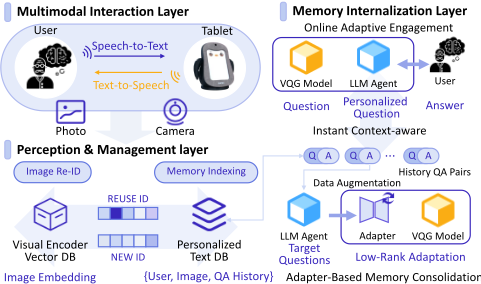
In this paper, we present PhoMi, an interactive recall assistant for sustained and personalized dementia reminiscence. PhoMi integrates live visual capture with spoken question-answer interaction to support multimodal engagement. Given a personal photograph, the system anchors visual stimuli through a real-time camera interface and delivers spoken prompts to elicit autobiographical responses. To maintain continuity across sessions, PhoMi estimates whether the presented photo is familiar to the user and adjusts its prompting strategy to encourage deeper recall over time [Duan et al., 2025; Hsu et al., 2025]. Beyond interaction logging, PhoMi performs memory internalization by distilling accumulated question-answer pairs into parameter-efficient updates of lightweight adapters attached to a vision-language model (VLM). This adapter-based internalization provides a warm-start in future sessions, enabling the system to function as an increasingly personalized recall assistant.
2 The PhoMi Recall Assistant
The schematic overview of PhoMi is shown in Figure 1. The system is organized into three collaborative layers that jointly support personalized reminiscence: (i) a multimodal interaction layer, (ii) a perception and management layer, and (iii) a memory internalization layer. We describe each component in detail below.
2.1 Multimodal Interaction
The multimodal interaction layer enables intuitive visual and spoken communication tailored to individuals with earlystage dementia.
Live Camera Unlike standalone image-upload models, PhoMi incorporates a live camera interface to capture photos in real time. This design makes "looking at a photo" the primary trigger for initiating each reminiscence session.
Speech-Driven Dialogue To support hands-free interaction, the system integrates speech-to-text (STT) and text-tospeech (TTS) modules instead of relying on on-screen text. This allows patients to verbally express memories and receive natural spoken prompts in return.
2.2 Perception andManagement
This layer serves as the bridge between raw visual perception and internal memory indexing.
Re-Identification. When a photo is captured, the system employs a visual encoder to extract feature embeddings, which are stored in a vector database (Vector DB). Using these stored embeddings, PhoMi performs a similarity search to determine whether the captured image matches a previously encountered instance. If the similarity exceeds a predefined threshold, the corresponding ImageID is reused; otherwise, a new identifier is created for the unseen image.
Dual-Database Each ImageID serves as a relational key linking the visual embedding stored in the Vector DB and the associated conversational history maintained in a text database (Text DB). This coordinated design enables consistent referencing of image-specific memory across sessions.
2.3 Memory Internalization
A central design principle of PhoMi is shifting personalization from transient log retrieval to parameter-level adaptation. Instead of repeatedly injecting conversational history into the context window, PhoMi incrementally consolidates accumulated interactions into the model's parameters via Low-Rank Adaptation (LoRA) [Hu et al., 2022]. This internalization is performed as a background process, allowing personalization to evolve without interrupting real-time interaction.
Data Augmentation To transform fragmented dialogue into learnable supervision, we employ an LLM (LLaMA-v3-70B) to filter and structure raw Q&A pairs stored in the Text DB across multiple intent categories (e.g., identity, emotion, routine, relationship, meaning, social memory, temporal context, caregiving, and preference). The LLM synthesizes semantically grounded fine-tuning targets with controlled variations, converting conversational traces into relevant questions.
Memory Consolidation These target questions are used to train image-specific LoRA adapters (rank 4), applied to the WQ,K,V,O projection matrices and attached to a VLM (LLaVA-1.5-7B) [Liu et al., 2024]. Each adapter is also indexed by a unique ImageID, enabling image-level parameter specialization across sessions. Upon re-identification, the agent activates the corresponding adapter, allowing the VLM
to immediately condition on previously internalized personal information without retrieval of historical logs.
3 Demonstration
3.1 Implementation Details
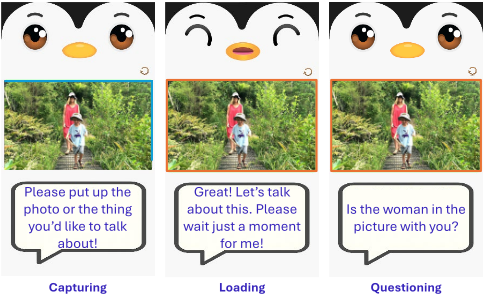
Hardware and Frontend PhoMi is implemented as a native Android application and deployed on an 11-inch tablet device (Galaxy Tab S11). A penguin-shaped enclosure and animated facial expressions, adapted from the MoMo robot 1 , are incorporated in our system to provide a friendly interaction setting. As illustrated in Figure 2, when a photo is positioned under the integrated camera, the UI displays a dynamic loading frame to indicate visual processing. Once identified, the system delivers a spoken prompt, capturing and transcribing user responses in real time via the built-in microphone.
Backend and Software Stack The backend uses an asynchronous microservice architecture. Gunicorn and Flask-SocketIO serve as the API gateway, while task orchestration is managed through Celery with Redis as the message broker. This enables sequential execution across workers dedicated to visual encoding (DINO), visual question generation, dialogue generation, speech recognition (Whisper-Medium) [Radford et al., 2023], and speech synthesis (MeloTTS) [Zhao et al., 2023]. For knowledge management, we utilize a FAISS-based vector DB [Johnson et al., 2019] for visual features and an SQLite-based text DB 2 for conversation logs.
Resources andTraining PhoMi runs on aworkstationwith four NVIDIA A6000 GPUs: two for the LLM and two for the VLM, STT, TTS, and visual encoder modules. During memory internalization, the LLM generates 8 core questions from accumulated Q&A history, which are expanded into 40 variants and used to train the image-specific LoRA adapter for 30 epochs.
3.2 Use Cases
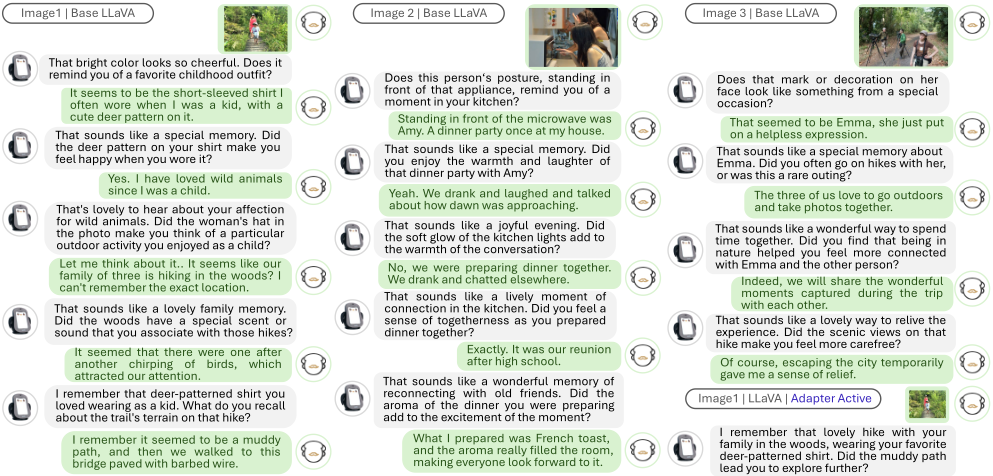
We evaluate the practical effectiveness of PhoMi through several representative use cases, illustrating the interaction flow Figure 3: Conversation flow of PhoMi. The actual interaction was conducted via speech.
1 https://www.whydots.com/en/robot-momo
2 https://sqlite.org/
and the impact of memory internalization on personalized question generation. A full demo video showing the multimodal sensing and real-time interaction process is available at: https://youtu.be/m6AoiS7m5e0.
Interaction Flow Figure 3 illustrates PhoMi interacting with a user across three distinct sessions, each initiated by a novel photograph captured via the live camera. As the perception layer recognizes the photograph as unseen, the VLM starts with generating image-oriented questions without personalized context. For example, it queries noticeable attributes such as a brightly colored outfit, a person in a kitchen, or distinctive facial features. These generic prompts serve as entry points for reminiscence, encouraging the user to share verbal memories, which are transcribed in real time to form the initial dialogue history.
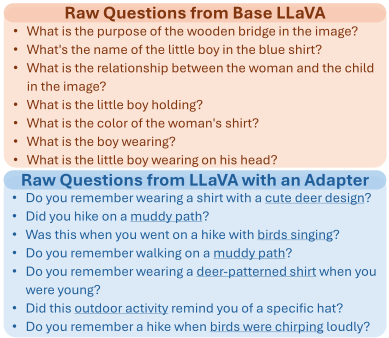
Memory Internalization Memory internalization marks the transition of PhoMi from a generic visual assistant to a persistent personal companion. As underlined in Figure 4, questions generated with the image-specific adapter are enriched with personalized keywords, such as previously mentioned participants or locations. Through this consolidation process, personalized information is embedded into the model's parametric space, enabling personalized warm-starts in subsequent sessions without requiring access to prior textual logs.
PersonalizedWarm-Start When a previously seen photograph is reloaded through the live camera interface (bottomright of Figure 3), PhoMi re-identifies the corresponding ImageID and activates the image-specific adapter within the VLM. As a result, the system resumes the interaction from prior context, incorporating confirmed personal facts (e.g., family hiking or a deer-patterned shirt) into the opening question.
4 Conclusion
In this work, we presented PhoMi, a multimodal reminiscence assistant that internalizes personal memories into parametric space, enabling personalized warm-start interactions without relying on textual logs. By tightly integrating live perception, speech-driven dialogue, and lightweight adapterbased memory consolidation, PhoMi transcends static assistive tools and evolves into a self-growing companion. We envision this paradigm as a foundation for AI systems that do not merely recall the past, but accumulate it, scaling toward lifelong, privacy-preserving personalized memory support.
Acknowledgments
This work was supported by the Institute of Information & Communications Technology Planning & Evaluation (IITP) grants funded by the Korea government (MSIT) (No.20220-00448/RS-2022-II220448, RS-2026-25544527, RS-202625529503).
@inproceedings{ijcai2026p1001,
  title     = {Looking at Your Photo, What Comes to Mind? Personalized Memory Internalization for Dementia Reminiscence},
  author    = {Wen, Shunjie and Lee, Kyung-Hwan and Lee, Gimoon and Heo, Seongsoo and Lee, Jaeyeon and Shin, Sangyeob and Moon, Gyuwon and Kim, Jiwoong and Choi, Dong-Wan},
  booktitle = {Proceedings of the Thirty-Fifth International Joint Conference on
               Artificial Intelligence, {IJCAI-26}},
  publisher = {International Joint Conferences on Artificial Intelligence Organization},
  editor    = {Diego Calvanese},
  pages     = {8551--8554},
  year      = {2026},
  month     = {8},
  note      = {Demo Track},
  doi       = {10.24963/ijcai.2026/1001},
  url       = {https://doi.org/10.24963/ijcai.2026/1001},
}
TY - CPAPER TI - Looking at Your Photo, What Comes to Mind? Personalized Memory Internalization for Dementia Reminiscence AU - Wen, Shunjie AU - Lee, Kyung-Hwan AU - Lee, Gimoon AU - Heo, Seongsoo AU - Lee, Jaeyeon AU - Shin, Sangyeob AU - Moon, Gyuwon AU - Kim, Jiwoong AU - Choi, Dong-Wan T2 - Proceedings of the Thirty-Fifth International Joint Conference on Artificial Intelligence, IJCAI-26 PB - International Joint Conferences on Artificial Intelligence Organization PY - 2026 SP - 8551 EP - 8554 DO - 10.24963/ijcai.2026/1001 UR - https://doi.org/10.24963/ijcai.2026/1001 ER -Copied
Machine-readable versions of this paper, for tools and AI agents:





