
SteelAgent: An LLM-Orchestrated System for Physics-Informed Steel Property Prediction and Generalization Auditing
Proceedings of the Thirty-Fifth International Joint Conference on Artificial Intelligence. Demo Track. Pages 8547-8550.
https://doi.org/10.24963/ijcai.2026/1000
Keywords
- AI: Agent-based and Multi-agent Systems
- AI: Multidisciplinary Topics and Applications
- AI: Natural Language Processing
- AI: Knowledge Representation and Reasoning
Abstract
Machine learning models for steel property prediction routinely report high-quality metrics with R² > 0.85, yet these results rely on random splits that allow similar grades in both train and test sets. We present SteelAgent, an interactive system that exposes a critical generalization gap: the same models drop from R² > 0.85 to R² = 0.11 on unseen steel families, revealing more than 7 times higher quality degradation. Similarly, conformal prediction coverage degrades from 91% to 38% under distribution shift induced by holding out substantial data sources. SteelAgent combines physics-informed features grounded in classical metallurgy and interpretable models with conformal uncertainty quantification, and an LLM orchestrator that coordinates six domain-specific tools. The system supports property prediction with specification compliance checking, competitive steel comparison, and cost-aware inverse alloy design over 3,741 heat treatment records spanning 1,234 grades. All predictions are traceable through explicit tool calls, ensuring that all physical quantities are computed, not generated. We made the code and data freely accessible to the community.
- [Amini et al., 2025] Massih-Reza Amini, Vasilii Feofanov, Loic Pauletto, Lies Hadjadj, Emilie Devijver, and Yury Maximov. Self-training: A survey. Neurocomputing, 616:128904, 2025.
- [Andrews, 1965] Kenneth W. Andrews. Empirical formulae for the calculation of some transformation temperatures. J. Iron Steel Inst., 203:721-727, 1965.
- [Angelopoulos and Bates, 2023] Anastasios N. Angelopou- los and Stephen Bates. Conformal prediction: A gentle introduction. Found. Trends Mach. Learn., 16(4):494-591, 2023.
- [Boiko et al., 2023] Daniil A. Boiko, Robert MacKnight, Ben Kline, and Gabe Gomes. Autonomous chem- ical research with large language models. Nature, 624(7992):570-578, 2023.
- [Bran et al., 2024] Andres M. Bran, Sam Cox, Oliver Schilter, Carlo Baldassari, Andrew D. White, and Philippe Schwaller. Augmenting large language models with chem- istry tools. Nat. Mach. Intell., 6(5):525-535, 2024.
- [Choudhary et al., 2022] Kamal Choudhary, Brian DeCost, Chi Chen, Anubhav Jain, Francesca Tavazza, Ryan Cohn, Cheol Woo Park, Alok Choudhary, Ankit Agrawal, Si- mon J. L. Billinge, Elizabeth Holm, Shyue Ping Ong, and Chris Wolverton. Recent advances and applications of deep learning methods in materials science. npj Comput. Mater., 8:59, 2022.
- [Dunn et al., 2020] Alexander Dunn, Qi Wang, Alex Ganose, Daniel Dopp, and Anubhav Jain. Benchmarking materials property prediction methods: The Matbench test set and Automatminer reference algorithm. npj Comput. Mater., 6:138, 2020.
- [Grossmann and Bain, 1964] Marcus A. Grossmann and Edgar C. Bain. Principles of Heat Treatment. American Soc. for Metals, 5th edition, 1964.
- [Guo et al., 2024] Taicheng Guo, Xiuying Chen, Yaqi Wang, Ruidi Chang, Shichao Pei, Nitesh V. Chawla, Olaf Wiest, and Xiangliang Zhang. Large language model based multi- agents: A survey of progress and challenges. In Proc. IJ- CAI, pages 8048-8057, 2024.
- [Kapoor and Narayanan, 2023] Sayash Kapoor and Arvind Narayanan. Leakage and the reproducibility crisis in machine-learning-based science. Patterns, 4(9):100804, 2023.
- [Lundberg and Lee, 2017] Scott M. Lundberg and Su-In Lee. A unified approach to interpreting model predictions. In Proc. NeurIPS, pages 4766-4777, 2017.
- [Maximov et al., 2018] Yury Maximov, Massih-Reza Amini, and Zaid Harchaoui. Rademacher complexity bounds for a penalized multi-class semi-supervised algorithm. J. Artif. Intell. Res., 61:761-786, 2018.
- [Murdock et al., 2020] Ryan J. Murdock, Steven K. Kauwe, Anthony Yu-Tung Wang, and Taylor D. Sparks. Is domain knowledge necessary for machine learning materials prop- erties? Integr. Mater. Manuf. Innov., 9(3):221-227, 2020.
- [Romano et al., 2019] Yaniv Romano, Evan Patterson, and Emmanuel J. Candes. Conformalized quantile regression. In Proc. NeurIPS, pages 3538-3548, 2019.
- [Schick et al., 2023] Timo Schick, Jane Dwivedi-Yu, Roberto Dessi, Roberta Raileanu, Maria Lomeli, Luke Zettlemoyer, Nicola Cancedda, and Thomas Scialom. Toolformer: Language models can teach themselves to use tools. In Proc. NeurIPS, 2023.
- [Sultimov et al., 2026a] Roman Sultimov, Mikhail Mozikov, Dmitrii Abramov, Mariia Kovalchuk, Maksim Malykh, Ilya Makarov, Andrei Osiptsov, Aleksandr Volkov, and Yury Maximov. RESPOND: Realistic environment simu- lation of population and natural disasters with LLM-driven agents. In Proc. AAAI, pages 41694-41696, 2026.
- [Sultimov et al., 2026b] Roman Sultimov, Aleksandr Volkov, Mile Mitrovic, and Yury Maximov. LLM-guided multi-agent evacuation coordination via episodic memory and cognitive task analysis. In Proc. AAMAS, pages 4164-4166, 2026.
- [Tibshirani et al., 2019] Ryan J. Tibshirani, Rina Foygel Barber, Emmanuel J. Candes, and Aaditya Ramdas. Con- formal prediction under covariate shift. In Proc. NeurIPS, pages 2526-2536, 2019.
- [Vovk et al., 2005] Vladimir Vovk, Alex Gammerman, and Glenn Shafer. Algorithmic Learning in a Random World. Springer, 2005.
- [Ward et al., 2018] Logan Ward, Alexander Dunn, Alireza Faghaninia, Nils E. R. Zimmermann, Saurabh Bajaj, Qi Wang, Joseph Montoya, Jiming Chen, Kyle Bystrom, Maxwell Dylla, Kyle Chard, Mark Asta, Kristin A. Pers- son, G. Jeffrey Snyder, Ian Foster, and Anubhav Jain. Mat- miner: An open source toolkit for materials data mining. Comput. Mater. Sci., 152:60-69, 2018.
- [Wen et al., 2019] Cheng Wen, Yan Zhang, Changxin Wang, Dezhen Xue, Yang Bai, Stoichko Antonov, Lanhong Dai, Turab Lookman, and Yanjing Su. Machine learning as- sisted design of high entropy alloys with desired property. Acta Mater., 170:109-117, 2019.
- [Xiong et al., 2020] Jie Xiong, TongYi Zhang, and San- Qiang Shi. Machine learning of mechanical properties of steels. Sci. China Technol. Sci., 63:1247-1255, 2020.
- [Yao et al., 2023] Shunyu Yao, Jeffrey Zhao, Dian Yu, Nan Du, Izhak Shafran, Karthik Narasimhan, and Yuan Cao. ReAct: Synergizing reasoning and acting in language models. In Proc. ICLR, 2023.
References were extracted automatically from the PDF and may contain errors.
Full text extracted automatically from the PDF; figures, tables and equations may differ. The PDF is the version of record.
1 Introduction
Machine learning models for predicting mechanical properties of steels have achieved impressive accuracy on standard benchmarks [Wen et al., 2019; Xiong et al., 2020; Choudhary et al., 2022]. Gradient-boosted models routinely report R2 > 0.85 for tensile strength prediction, and these numbers are cited to justify deployment in alloy design and qualification pipelines. In practice, however, engineers need models that generalize to new steel grades compositions never seen during training because the primary value of a predictive model lies in reducing the cost and time of designing and qualifying novel alloys.
Unfortunately, high accuracy demonstrated in steel property predictions on random splits often reflects data leakage rather than genuine predictive capability [Kapoor and Narayanan, 2023; Kapoor and Narayanan, 2023]. The root cause is compositional similarity leakage: random train/test splits allow nearly identical steel grades (e.g., AISI 4340 and AISI 4330, which differ by only 0.10% of carbon) belonging to the same family to appear in both sets. The models memorize grade-specific composition bundles instead of learning the underlying metallurgical relationships between chemistry, heat treatment, and mechanical response.
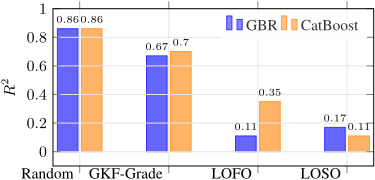
When evaluated on unseen steel families via Leave-OneFamily-Out (LOFO) splitting, where entire categories such as "stainless austenitic" or "CrMo quenched-and-tempered" are held out, the gradient boosting regression quality drops from R2 = 0.86 to R2 = 0.11 representing more than 7.6 times degradation as illustrated in Fig. 1. For safety-critical applications where material qualification decisions depend on predicted properties (aircraft landing gear, nuclear pressure vessels, offshore pipelines) this gap between reported and realworld performance has direct engineering consequences imposing substantial risk for infrastructure and personnel.
We present SteelAgent, an interactive system addressing this gap through three key contributions:
- No-leak evaluation: comparison of four split protocols, exposing that conformal coverage degrades from 91% to 38% under distribution shift [Tibshirani et al., 2019].
- Physics-grounded LLM orchestration: an agent that enforces tool-mediated reasoning [Yao et al., 2023; Schick et al., 2023], computing physical quantities (Ms martensite start temperature, CE carbon equivalent for weldability, DI ideal critical diameter for hardenability) via verified formulas rather than LLM generation.
- End-to-end decision support: from natural-language queries to specification compliance probabilities P(pass) and cost-aware inverse design.
2 SystemArchitecture
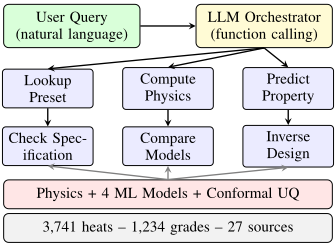
SteelAgent 1 follows a three-layer architecture (see Fig. 2): a physics layer that computes domain-specific features from classical metallurgical formulas, a model layer that runs machine learning algorithms with conformal uncertainty quantification, and an LLM orchestration layer that coordinates these components through structured function calling. The system operates over 3,741 heat treatment records spanning 1,234 grades from 27 independent sources (see Tab. 1), with pre-trained models (XGBoost, LightGBM, CatBoost, Random Forest) for two target properties: ultimate tensile strength (UTS is the maximum stress a material can withstand before fracture) and yield strength (YS is the stress at which the material begins to deform permanently). These two properties are the most commonly specified in industrial standards and drive material selection decisions.
1 Demo video: https://www.youtube.com/watch?v= BwVBJ-SwuQo. Live demo: https://steelagent.vercel.app
| Parameter | Value |
|---|---|
| Total heats (records) | 3,741 |
| Core benchmark heats | 1,636 |
| Unique grades | 1,234 (594 core) |
| Steel families | 15 |
| Independent sources | 27 |
| Composition inputs | 9 elements + 2 HT |
| Physics-derived features | 18 |
| Target properties | UTS, YS |
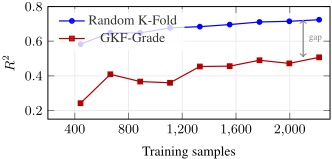
Physics-Informed Features. A key challenge for AI models in metallurgy is that raw composition vectors (e.g., 0.40% C, 0.80% Cr) do not directly encode the physical mechanisms that determine mechanical properties. Two steels with similar compositions can behave very differently depending on how their alloying elements interact during phase transformations. To bridge this gap, SteelAgent computes 18 physics-derived features from 11 raw inputs (C, Mn, Si, Cr, Ni, Mo, V, Cu, Al, Taust, Ttemper). These features can be grouped as: (i) Martensite start temperature Ms = 539 - 423C-30.4Mn-12.1Cr-17.7Ni-7.5Mo+10Si [Andrews, 1965] predicts when martensite, the hard phase responsible for strength, begins to form during quenching; (ii) Carbon equivalent CEIIW =C+ Mn 6 + Cr+Mo+V 5 + Ni+Cu 15 summarizes the combined effect of all alloying elements on weldability and hardenability into a single scalar; (iii) Ideal critical diameter DI [Grossmann and Bain, 1964] the maximum bar diameter that achieves full hardening at center quantifies how deeply a steel can be hardened, a key property for large structural components; (iv) Ac1/Ac3 transformation temperatures, superheat ∆T =Taust-Ac3, tempering resistance index, and maximum martensite hardness. These features serve a dual purpose: they improve Leave-One-Family-Out R2 by +0.25 for gradient boosting regression (see Fig. 3), and they ground the LLM orchestrator in verified physical quantities, preventing hallucination of numerical values.
Uncertainty Quantification. In engineering practice, a point prediction alone (e.g., "UTS=1,746 MPa") is insufficient for decision-making: the engineer needs to know how confident the model is. A prediction interval [ˆ ylo, ˆ yhi] answers this directly. We apply split conformal prediction [Vovk et al., 2005; Romano et al., 2019; Angelopoulos and Bates, 2023] to construct distribution-free prediction intervals with guaranteed ≥90%marginal coverage under exchangeability meaning that at least 90% of true values fall within the predicted interval, with no distributional assumptions on the data.
For specification compliance, we convert conformal intervals to pass probabilities via Gaussian approximation: σ = ˆ q/z0.95, then P(pass) =Φ((ˆ y-ymin)/σ), where ymin is the specification minimum. This gives the engineer a single number e.g., P(pass AMS-6414)=0.93 that directly supports material qualification decisions. Additional unlabeled data may further help with algorithms quality [Amini et al., 2025; Maximov et al., 2018].
LLM Orchestration. A key design decision is to separate reasoning (what to compute and how to interpret results) from computation (the actual physics and ML calculations). The LLM handles the former; the latter is delegated to verified tools. Following the ReAct paradigm [Yao et al., 2023] and tool-augmented LLM agents [Schick et al., 2023; Bran et al., 2024], SteelAgent implements a multi-turn functioncalling loop over six tools: lookup preset (58 reference grades with standard compositions), compute physics (18 derived features), predict property (ML prediction + conformal UQ), check spec (P(pass) for 51 industrial specifications), compare models (4-model consensus with disagreement detection), and inverse design (cost-aware composition search). The system prompt enforces a physics-first pipeline: compute physics must precede predict property, and the LLMmust cite toolcomputed values in its natural-language synthesis. This constraint ensures that physical quantities (e.g., Ms = 305°C) originate from verified formulas rather than LLM generation, while the LLM provides metallurgical context and interpretation that a non-specialist can understand.
| Split | R2 | RMSE | MAE | Cov. |
|---|---|---|---|---|
| Random K-Fold | 0.86 | 114 | 73 | 91% |
| Group K-Fold (Grade) | 0.67 | 175 | 105 | 83% |
| Leave-One-Family-Out | 0.11 | 218 | 154 | 76% |
| Leave-One-Source-Out | 0.17 | 277 | 210 | 38% |
3 Quantitative Results and Demo Scenarios
Table 2 presents two critical findings:
- The gap is structural, not statistical: the drop from Random to LOFO is consistent across models (CatBoost: 0.86 → 0.35; GBR: 0.86 → 0.11) and persists even as training data increases (Fig. 3), indicating that additional data alone cannot cover physics-informed features.
- UQ coverage tracks the gap. Conformal coverage (guaranteed ≥ 90% under exchangeability [Angelopoulos and Bates, 2023]) degrades proportionally to the distribution shift: 91%→83%→76%→38%. This pattern is itself a useful diagnostic: coverage can serve as an automated shift detector, flagging predictions where the exchangeability assumption no longer valid [Tibshirani et al., 2019].
SteelAgent surfaces this information interactively, helping users decide when to trust a prediction.
SteelAgent supports three primary interaction scenarios via a conversational React interface with guided dialogue trees. Users interact in natural language; the system autonomously selects and sequences tool calls, presenting results with physics context and uncertainty.
Scenario 1: Prediction + Specification Compliance. In this scenario, our task is to predict UTS for AISI 4340 (Q&T 845/315°C) and check AMS-6414 compliance. AISI 4340 is a widely used aerospace steel (landing gear, crankshafts, high-strength fasteners). The orchestrator executes a four-tool pipeline: lookup preset → compute physics (Ms = 305°C, CE = 0.85, DI = 10.7 in) → predict property (UTS= 1,746 MPa, 90% CI [1,546, 1,945] MPa) → check spec (P(pass AMS-6414)). The user sees physics context (what transformation behavior to expect), a prediction with calibrated uncertainty (how much to trust it), and a compliance probability (whether the steel will meet the specification).
Scenario 2: Competitive Steel Comparison. In this experiment, we compare AerMet 100 and Ferrium M54 for landing gear redesign. These are premium ultra-high-strength steels
| System | Steel-spec. | Inter. UI | Conf. UQ | Physics | Inv. design | LLM agent | Gen. audit |
|---|---|---|---|---|---|---|---|
| Matbench a | ✗ | ✗ | ✗ | ✗ | ✗ | ✗ | ∼ |
| JARVIS-ML b | ✗ | ✓ | ✗ | ✓ | ✗ | ✗ | ✗ |
| Coscientist c | ✗ | ✗ | ✗ | ✗ | ✗ | ✓ | ✗ |
| ChemCrow d | ✗ | ✓ | ✗ | ∼ | ✗ | ✓ | ✗ |
| SteelAgent | ✓ | ✓ | ✓ | ✓ | ✓ | ✓ | ✓ |
a [Dunn et al., 2020] b [Choudhary et al., 2022] c [Boiko et al., 2023] d [Bran et al., 2024]
Table 3: Feature comparison with materials ML platforms and scientific LLM agents. ✓= supported, ✗= not supported, ∼ = partial.
with different design philosophies. The system predicts properties for both grades (UTSAerMet =1,927 MPa; Ms =192°C, DI = 47 in) and explains trade-offs through physics signatures: AerMet achieves peak strength via M2C secondary hardening enabled by 13.4% cobalt, while Ferrium offers better stress-corrosion cracking resistance. This type of comparative analysis typically requires a senior metallurgist and extensive literature review; the system delivers it in seconds with auditable tool calls.
Scenario 3: Inverse Alloy Design We look for compositions achieving UTS> 1,800 MPa at minimum alloy cost. The system screens 10,000 candidate compositions within physically feasible bounds, evaluating each through the ML pipeline. Results are ranked by estimated alloy cost and include conformal intervals, enabling distinction between alloys that reliably vs. possibly achieve the target a critical distinction for qualification.
Additional capabilities include SHAP-based feature importance [Lundberg and Lee, 2017] with metallurgical interpretation (e.g., identifying which alloying elements drive a specific prediction), multi-model consensus with automatic disagreement detection across 4 models, and interactive dataset exploration across 12 steel families and 27 sources.
4 Positioning
Table 3 positions SteelAgent relative to existing materials informatics platforms and scientific LLM agents.
Materials benchmarks. Matbench [Dunn et al., 2020] and Matminer [Ward et al., 2018] provide standardized benchmarks for materials property prediction, but focus on crystallevel properties rather than alloy-level mechanical properties with heat-treatment dependence. SteelAgent addresses this gap with steel-specific evaluation and an interactive interface.
Evaluation pitfalls. [Murdock et al., 2020] [Murdock et al., 2020] show that domain features provide marginal benefit under random splits, while [Kapoor and Narayanan, 2023] [Kapoor and Narayanan, 2023] document leakage across scientific ML. SteelAgent makes this problem interactive and extends it to uncertainty quantification.
Scientific LLM agents. Coscientist [Boiko et al., 2023] and ChemCrow [Bran et al., 2024] demonstrate domainspecific LLM agents for chemistry, [Sultimov et al., 2026b; Sultimov et al., 2026a] for climate and transportation. LLMbased multi-agent systems [Guo et al., 2024] provide theoretical foundations. SteelAgent contributes a physics-grounded agent architecture where tool calls enforce correctness of numerical claims, combined with calibrated UQ and generalization auditing features absent from prior scientific agents.
Acknowledgments
The work of Roman Sultimov is supported by the Ministry of Economic Development of the Russian Federation in accordance with the subsidy agreement (agreement identifier 000000C313925P4H0002; grant No 139-15-2025-012).
@inproceedings{ijcai2026p1000,
  title     = {SteelAgent: An LLM-Orchestrated System for Physics-Informed Steel Property Prediction and Generalization Auditing},
  author    = {Volkov, Aleksandr and Sultimov, Roman and Kuzin, Mikhail and Maximov, Yury},
  booktitle = {Proceedings of the Thirty-Fifth International Joint Conference on
               Artificial Intelligence, {IJCAI-26}},
  publisher = {International Joint Conferences on Artificial Intelligence Organization},
  editor    = {Diego Calvanese},
  pages     = {8547--8550},
  year      = {2026},
  month     = {8},
  note      = {Demo Track},
  doi       = {10.24963/ijcai.2026/1000},
  url       = {https://doi.org/10.24963/ijcai.2026/1000},
}
TY - CPAPER TI - SteelAgent: An LLM-Orchestrated System for Physics-Informed Steel Property Prediction and Generalization Auditing AU - Volkov, Aleksandr AU - Sultimov, Roman AU - Kuzin, Mikhail AU - Maximov, Yury T2 - Proceedings of the Thirty-Fifth International Joint Conference on Artificial Intelligence, IJCAI-26 PB - International Joint Conferences on Artificial Intelligence Organization PY - 2026 SP - 8547 EP - 8550 DO - 10.24963/ijcai.2026/1000 UR - https://doi.org/10.24963/ijcai.2026/1000 ER -Copied
Machine-readable versions of this paper, for tools and AI agents:





