
The Information Retrieval Experiment Platform (Extended Abstract)
Proceedings of the Thirty-Third International Joint Conference on Artificial Intelligence. Sister Conferences Best Papers. Pages 8405-8410.
https://doi.org/10.24963/ijcai.2024/931
Keywords
- Natural Language Processing: NLP: Information retrieval and text mining
- Natural Language Processing: NLP: Tools
- Natural Language Processing: NLP: Resources and evaluation
Abstract
We have built TIREx, the information retrieval experiment platform, to promote standardized, reproducible, scalable, and blinded retrieval experiments. Standardization is achieved through integration with PyTerrier's interfaces and compatibility with ir_datasets and ir_measures. Reproducibility and scalability are based on the underlying TIRA framework, which runs dockerized software in a cloud-native execution environment. Using Docker images of 50 standard retrieval approaches, we evaluated all of them on 32 tasks (i.e., 1,600 runs) in less than a week on a midsize cluster (1,620 CPU cores and 24 GPUs), demonstrating multi-task scalability. Importantly, TIRA also enables blind evaluation of AI experiments, as the test data can be hidden from public access and the tested approaches run in a sandbox that prevents data leaks. Keeping the test data hidden from public access ensures that it cannot be used by third parties for LLM training, preventing future training-test leaks.
- [Arguello et al., 2015] J. Arguello, F. Diaz, J. Lin, and A. Trotman. SIGIR 2015 workshop on reproducibility, inexplicability, and generalizability of results (RIGOR). In SIGIR 2015, pages 1147-1148, 2015.
- [Armstrong et al., 2009a] T. G. Armstrong, A. Moffat, W. Webber, and J. Zobel. EvaluatIR: An online tool for evaluating and comparing IR systems. In SIGIR 2009, page 833, 2009.
- [Armstrong et al., 2009b] T. G. Armstrong, A. Moffat, W. Webber, and J. Zobel. Improvements that don't add up: Ad-hoc retrieval results since 1998. In CIKM 2009, pages 601-610, 2009.
- [Bevendorff et al., 2018] J. Bevendorff, B. Stein, M. Hagen, and M. Potthast. Elastic ChatNoir: Search engine for the ClueWeb and the Common Crawl. In ECIR 2018, 2018.
- [Bondarenko et al., 2020] A. Bondarenko, M. Fröbe, M. Be- loucif, L. Gienapp, Y. Ajjour, A. Panchenko, C. Biemann, B. Stein, H. Wachsmuth, M. Potthast, and M. Hagen. Overview of Touché 2020: Argument retrieval. In CLEF 2020, pages 384-395, 2020.
- [Bondarenko et al., 2021] A. Bondarenko, L. Gienapp, M. Fröbe, M. Beloucif, Y. Ajjour, A. Panchenko, C. Bie- mann, B. Stein, H. Wachsmuth, M. Potthast, and M. Hagen. Overview of Touché 2021: Argument retrieval. In CLEF 2021, pages 450-467, 2021.
- [Bondarenko et al., 2022] A. Bondarenko, M. Fröbe, J. Kiesel, S. Syed, T. Gurcke, M. Beloucif, A. Panchenko, C. Biemann, B. Stein, H. Wachsmuth, M. Potthast, and M. Hagen. Overview of Touché 2022: Argument retrieval. In CLEF 2022, 2022.
- [Boytsov and Nyberg, 2020] L. Boytsov and E. Nyberg. Flex- ible retrieval with NMSLIB and FlexNeuART. In NLP-OSS 2020, pages 32-43, 2020.
- [Breuer et al., 2019] T. Breuer, P. Schaer, N. Tavakolpour- saleh, J. Schaible, B. Wolff, and B. Müller. STELLA: To- wards a framework for the reproducibility of online search experiments. In OSIRRC at SIGIR 2019, pages 8-11, 2019.
- [Breuer et al., 2020] T. Breuer, N. Ferro, N. Fuhr, M. Maistro, T. Sakai, P. Schaer, and I. Soboroff. How to measure the re- producibility of system-oriented IR experiments. In SIGIR 2020, pages 349-358, 2020.
- [Breuer et al., 2021] T. Breuer, N. Ferro, M. Maistro, and P. Schaer. repro_eval: A python interface to reproducibility measures of system-oriented IR experiments. In ECIR 2021, pages 481-486, 2021.
- [Breuer et al., 2022] T. Breuer, J. Keller, and P. Schaer. ir_metadata: An extensible metadata schema for IR ex- periments. In SIGIR 2022, pages 3078-3089, 2022.
- [Chung et al., 2022] H. W. Chung, L. Hou, S. Longpre, et al. Scaling instruction-finetuned language models. arXiv:2210.11416, 2022.
- [Clancy et al., 2019] R. Clancy, N. Ferro, C. Hauff, J. Lin, T. Sakai, and Z. Z. Wu. Overview of the 2019 open-source IR replicability challenge (OSIRRC 2019). In OSIRRC at SIGIR 2019, pages 1-7, 2019.
- [Cleverdon, 1967] C. Cleverdon. The Cranfield tests on index language devices. In ASLIB Proceedings, pages 173-192, 1967.
- [Costello et al., 2022] C. Costello, E. Yang, D. Lawrie, and J. Mayfield. Patapsco: A python framework for cross- language information retrieval experiments. In ECIR 2022, 2022.
- [Ferro et al., 2016] N. Ferro, N. Fuhr, K. Järvelin, N. Kando, M. Lippold, and J. Zobel. Increasing reproducibility in IR: Findings from the Dagstuhl seminar on "Reproducibility of data-oriented experiments in e-science". SIGIR Forum, 50(1):68-82, 2016.
- [Ferro et al., 2018] N. Ferro, M. Maistro, T. Sakai, and I. Soboroff. Overview of Centre@CLEF 2018: A first tale in the systematic reproducibility realm. In CLEF 2018, 2018.
- [Ferro et al., 2019] N. Ferro, N. Fuhr, M. Maistro, T. Sakai, and I. Soboroff. Overview of Centre@CLEF 2019: Sequel in the systematic reproducibility realm. In CLEF 2019, pages 287-300, 2019.
- [Fröbe et al., 2023a] M. Fröbe, T. Gollub, B. Stein, M. Ha- gen, and M. Potthast. SemEval-2023 Task 5: Clickbait spoiling. In SemEval-2023, pages 2278-2289, 2023.
- [Fröbe et al., 2023b] M. Fröbe, J. H. Reimer, S. MacAvaney, N. Deckers, S. Reich, J. Bevendorff, B. Stein, M. Hagen, and M. Potthast. The information retrieval experiment platform. In SIGIR 2023, pages 2826-2836, 2023.
- [Fröbe et al., 2023c] M. Fröbe, M. Wiegmann, N. Kolyada, B. Grahm, T. Elstner, F. Loebe, M. Hagen, B. Stein, and M. Potthast. Continuous integration for reproducible shared tasks with TIRA.io. In ECIR 2023, 2023.
- [Fuhr, 2017] N. Fuhr. Some common mistakes in IR evalua- tion, and how they can be avoided. SIGIR Forum, 51(3):32- 41, 2017.
- [Fuhr, 2020] N. Fuhr. Proof by experimentation?: Towards better IR research. SIGIR Forum, 54(2):2:1-2:4, 2020.
- [Gollub et al., 2012] T. Gollub, B. Stein, S. Burrows, and D. Hoppe. TIRA: Configuring, executing, and dissemi- nating information retrieval experiments. In TIR 2012 at DEXA, pages 151-155, 2012.
- [Hopfgartner et al., 2015] F. Hopfgartner, T. Brodt, J. Seiler, et al. Benchmarking news recommendations: The CLEF NewsREEL use case. SIGIR Forum, 49(2):129-136, 2015.
- [Hopfgartner et al., 2018] F. Hopfgartner, A. Hanbury, H. Müller, et al. Evaluation-as-a-service for the computa- tional sciences: Overview and outlook. Journal of Data and Information Quality, 10(4):15:1-15:32, 2018.
- [Jagerman et al., 2018] R. Jagerman, K. Balog, and M. de Ri- jke. OpenSearch: Lessons learned from an online evalua- tion campaign. Journal of Data and Information Quality, 10(3):13:1-13:15, 2018.
- [Jose et al., 2021] K. M. Jose, T. Nguyen, S. MacAvaney, J. Dalton, and A. Yates. DiffIR: Exploring differences in ranking models' behavior. In SIGIR 2021, pages 2595- 2599, 2021.
- [Kiesel et al., 2023] J. Kiesel, M. Alshomary, N. Mirzakhme- dova, M. Heinrich, N. Handke, H. Wachsmuth, and B. Stein. SemEval-2023 Task 4: ValueEval: Identification of human values behind arguments. In SemEval 2023, pages 2290- 2306, 2023.
- [Lin and Zhang, 2020] J. Lin and Q. Zhang. Reproducibility is a process, not an achievement: The replicability of IR reproducibility experiments. In ECIR 2020, pages 43-49, 2020.
- [Lin et al., 2021] J. Lin, X. Ma, S. Lin, J. Yang, R. Pradeep, and R. Nogueira. Pyserini: A python toolkit for repro- ducible information retrieval research with sparse and dense representations. In SIGIR 2021, pages 2356-2362, 2021.
- [Lin et al., 2022] J. Lin, D. Campos, N. Craswell, B. Mitra, and E. Yilmaz. Fostering coopetition while plugging leaks: The design and implementation of the MS MARCO leader- boards. In SIGIR 2022, pages 2939-2948, 2022.
- [Lin, 2018] J. Lin. The neural hype and comparisons against weak baselines. SIGIR Forum, 52(2):40-51, 2018.
- [MacAvaney et al., 2020] S. MacAvaney, A. Yates, S. Feld- man, D. Downey, A. Cohan, and N. Goharian. OpenNIR: A complete neural ad-hoc ranking pipeline. In WSDM 2020, pages 845-848, 2020.
- [MacAvaney et al., 2021] S. MacAvaney, A. Yates, S. Feld- man, D. Downey, A. Cohan, and N. Goharian. Simplified data wrangling with ir_datasets. In SIGIR 2021, pages 2429-2436, 2021.
- [MacAvaney et al., 2022] S. MacAvaney, C. Macdonald, and I. Ounis. Streamlining evaluation with ir-measures. In ECIR 2022, pages 305-310, 2022.
- [Macdonald et al., 2021] C. Macdonald, N. Tonellotto, S. MacAvaney, and I. Ounis. Pyterrier: Declarative experimentation in python from BM25 to dense retrieval. In CIKM 2021, pages 4526-4533, 2021.
- [Mallia et al., 2019] A. Mallia, M. Siedlaczek, J. M. Macken- zie, and T. Suel. PISA: Performant indexes and search for academia. In OSIRRC at SIGIR 2019, pages 50-56, 2019.
- [Moffat, 2022] A. Moffat. Batch evaluation metrics in infor- mation retrieval: Measures, scales, and meaning. IEEE Access, 10:105564-105577, 2022.
- [Piwowarski, 2020] B. Piwowarski. Experimaestro and Data- maestro: Experiment and dataset managers (for IR). In SIGIR 2020, pages 2173-2176, 2020.
- [Potthast et al., 2019] M. Potthast, T. Gollub, M. Wiegmann, and B. Stein. TIRA integrated research architecture. In Information Retrieval Evaluation in a Changing World. 2019.
- [Potthast et al., 2021] M. Potthast, S. Günther, J. Bevendorff, J. P. Bittner, A. Bondarenko, M. Fröbe, C. Kahmann, A. Niekler, M. Völske, B. Stein, and M. Hagen. The information retrieval anthology. In SIGIR 2021, pages 2550-2555, 2021.
- [Sainz et al., 2023] O. Sainz, J. A. Campos, I. García-Ferrero, et al. NLP evaluation in trouble: On the need to measure LLM data contamination for each benchmark. In EMNLP 2023, pages 10776-10787, 2023.
- [Sakai et al., 2019] T. Sakai, N. Ferro, I. Soboroff, Z. Zeng, P. Xiao, and M. Maistro. Overview of the NTCIR-14 Centre task. In NTCIR 2019, 2019.
- [Sakai et al., 2020] T. Sakai, S. Tao, Z. Zeng, Y. Zheng, J. Mao, Z. Chu, Y. Liu, M. Maistro, Z. Dou, N. Ferro, et al. Overview of the NTCIR-15 We Want Web with Centre (WWW-3) task. NTCIR 2020, 2020.
- [Sakai, 2020] T. Sakai. On Fuhr's guideline for IR evaluation. SIGIR Forum, 54(1):12:1-12:8, 2020.
- [Thakur et al., 2021] N. Thakur, N. Reimers, A. Rücklé, A. Srivastava, and I. Gurevych. BEIR: A heterogeneous benchmark for zero-shot evaluation of information retrieval models. In NeurIPS Datasets and Benchmarks 2021, 2021.
- [Tsatsaronis et al., 2015] G. Tsatsaronis, G. Balikas, P. Malakasiotis, et al. An overview of the BIOASQ large- scale biomedical semantic indexing and question answering competition. BMC Bioinformatics, 16:138:1-138:28, 2015.
- [Vanschoren et al., 2013] J. Vanschoren, J. N. van Rijn, B. Bischl, and L. Torgo. OpenML: Networked science in machine learning. SIGKDD Explor., 15(2):49-60, 2013.
- [Voorhees et al., 2022] E. M. Voorhees, I. Soboroff, and J. Lin. Can old TREC collections reliably evaluate modern neural retrieval models? arXiv:2201.11086, 2022.
- [Voorhees, 2001] E. M. Voorhees. The philosophy of infor- mation retrieval evaluation. In CLEF 2001, pages 355-370, 2001.
- [Voorhees, 2019] E. M. Voorhees. The evolution of Cranfield. In Information Retrieval Evaluation in a Changing World, pages 45-69. 2019.
- [Yadav et al., 2019] D. Yadav, R. Jain, H. Agrawal, et al. EvalAI: Towards better evaluation systems for AI agents. arXiv:1902.03570, 2019.
- [Yang et al., 2017] P. Yang, H. Fang, and J. Lin. Anserini: En- abling the use of Lucene for information retrieval research. In SIGIR 2017, pages 1253-1256, 2017.
- [Yates et al., 2020] A. Yates, S. Arora, X. Zhang, W. Yang, K. M. Jose, and J. Lin. Capreolus: A toolkit for end-to-end neural ad hoc retrieval. In WSDM 2020, pages 861-864, 2020.
- [Zhang et al., 2022] X. Zhang, N. Thakur, O. Ogundepo, et al. Making a MIRACL: Multilingual information retrieval across a continuum of languages. arXiv:2210.09984, 2022.
- [Zobel, 2023] J. Zobel. When measurement misleads: The limits of batch assessment of retrieval systems. In ACM SIGIR Forum, volume 56, pages 1-20, 2023.
References were extracted automatically from the PDF and may contain errors.
Full text extracted automatically from the PDF; figures, tables and equations may differ. The PDF is the version of record.
1 Introduction
Research and development in information retrieval (IR) is predominantly experimental. Conducting an IR experiment usually consists of using alternative retrieval approaches to produce rankings of a document collection (called "runs") for a set of topics. Then, reusable relevance judgments are collected for documents retrieved on high ranks, and approachspecific effectiveness scores are computed [Voorhees, 2001]. This basic experimental setup is known in IR as the Cranfield paradigm [Cleverdon, 1967]. Since its introduction, it has become the de facto standard for laboratory experiments in IR as well as for the organization of shared tasks at dedicated conferences such as TREC [Voorhees, 2019] and beyond. Shared tasks have helped to scale collaborative experimentation, and they have also been widely adopted in AI.
*Invited extended abstract of Fröbe et al.'s [2023b] SIGIR best paper.
Despite the success of shared tasks, there also are shortcomings: (1) even for tasks with diligently archived code repositories, the results are often not reproducible [Arguello et al., 2015; Lin and Zhang, 2020], (2) run submissions require participants to have access to the test data, which may introduce bias [Fuhr, 2020], and (3) several large language models have been trained, by mistake or deliberately, on publicly available test data [Sainz et al., 2023]. Thus, compared to other disciplines, the current best practices for shared tasks do not enforce "blinded experimentation" 1 with sufficient rigor.
To address these shortcomings, we have developed TIREx, the IR experiment platform. Available open source, 2 TIREx combines tools for working with IR data (ir_datasets [MacAvaney et al., 2021]), for executing retrieval pipelines (PyTerrier [Macdonald et al., 2021]), and for evaluating IR systems (ir_measures [MacAvaney et al., 2022]), with TIRA [Potthast et al., 2019; Fröbe et al., 2023c], a continuous integration service for reproducible shared tasks and experiments. TIREx implements reproducibility by enabling cloud-native experiments with submitted software in shared tasks, where the workload for shared task organizers is kept comparable to that of traditional shared tasks where only submitted software runs are evaluated. As a proof of concept, we conducted an evaluation of 50 "standard" retrieval approaches on 32 shared tasks (15 datasets with a total of 1.9 billion documents); the 1,600 runs finished in less than a week.
2 Background and RelatedWork
We review ad hoc retrieval experiments in evaluation campaigns, common problems and pitfalls in IR experiments, best practices for leaderboards, existing reproducibility initiatives, and tools to support reproducibility. Insights from all these areas have influenced our implementation decisions for TIREx.
Ad hoc retrieval experiments in evaluation campaigns. Today's shared task-style experiments for ad hoc retrieval evolved from the Cranfield experiments and aim to produce re-usable test collections [Voorhees, 2019]. Therefore, the current practice at shared tasks in IR is to assess the relevance of the submitted runs' top-ranked documents, assuming that unjudged documents are non-relevant [Voorhees, 2019], requiring a diverse set of submitted runs pooled at high depth [Voorhees et al., 2022]. Especially for shared tasks that do not attract diverse submissions, TIREx can help to produce a more diverse judgment pool from its dockerized retrieval systems.
1 en.wikipedia.org/wiki/Blinded_experiment
2 github.com/tira-io/ir-experiment-platform
Common problems and pitfalls in IR experiments. Even though there is an ongoing discussion on how to conduct IR experiments [Fuhr, 2017; Sakai, 2020; Zobel, 2023; Moffat, 2022], many important characteristics of IR experiments are undisputed. For instance, retrieval studies should be internally valid (conclusions must be supported by the data) and externally valid (repeating an experiment on different but similar data should yield similar observations), where external validity remains an open problem [Fuhr, 2020]. TIREx helps to improve both: the internal validity by archiving all experiments and results, and the external validity by running a submitted software on different data.
Maintaining ongoing leaderboards. Inspired by the observation that many IR studies do not compare against strong baselines [Armstrong et al., 2009b], Armstrong et al. [2009a] released EvaluateIR, a public leaderboard for run file submissions. Although the concept was highly valuable for the community to select appropriate baselines, "EvaluateIR never gained traction, and a number of similar efforts following it have also floundered" [Lin, 2018]. Still, certain taskspecific leaderboards are quite popular [Zhang et al., 2022; Lin et al., 2022]. Maintaining long-running leaderboards comes with some caveats, as they are conceptually turn-based games where every submission might leak information from the test set [Lin et al., 2022]. With TIREx and its blind evaluation, organizers can choose to blind submissions, supporting the best practices recommended by Lin et al. [2022].
Reproducibility initiatives in IR. The IR communitymakes substantial efforts to foster reproducibility, e.g., with reproducibility tracks at conferences and reproducibility initiatives like OSIRRC [Arguello et al., 2015; Clancy et al.,
2019] or CENTRE [Ferro et al., 2018; Ferro et al., 2019; Sakai et al., 2019; Sakai et al., 2020]. Archiving systems for reproducibility is highly challenging, e.g., because external dependencies or platform dependencies might become unavailable. TIREx improves reproducibility because dockerized software is executed in a sandbox (no internet connection), i.e., all dependencies must be already installed.
Tooling for reproducibility. Many tools have been developed to support shared tasks by reducing the workload of organizers and participants while increasing the reproducibility [Yadav et al., 2019; Breuer et al., 2019; Vanschoren et al., 2013; Jagerman et al., 2018; Tsatsaronis et al., 2015; Hopfgartner et al., 2015; Hopfgartner et al., 2018; Fröbe et al., 2023c]. Documentation plays a key role, e.g., with ir_metadata [Breuer et al., 2022] implementing the PRIMAD model (platform, research goal, implementation, method, actor, data) [Ferro et al., 2016]. Multiple platforms support organizing and running shared tasks, e.g., CodaLab, EvalAI, STELLA, and TIRA. 3 We use TIRA for TIREx as it supports blinded experimentation based on (private) git repositories hosted on GitLab or GitHub to versionize shared tasks and to distribute the workloads via runners connected to the corresponding repositories.
3 TIREx: The IR Experiment Platform
We have constructed TIREx, the IR experiment platform, to facilitate reproducible, shared task-style IR experiments based on software submissions by integrating ir_datasets, ir_measures, and PyTerrier into TIRA. IR experiments typically involve intermediate artifacts (like indexes), and retrieval systems involve multi-stage pipelines. Below, we elaborate on how TIREx addresses these requirements and discuss the interaction between integrated tools, provide examples of using available retrieval approaches in TIREx, and demonstrate how TIREx promotes post-experiment replicability and reproducibility through declarative PyTerrier pipelines.
3 codalab.org, eval.ai, stella-project.org, tira.io
3.1 Experiments in the IR Experiment Platform
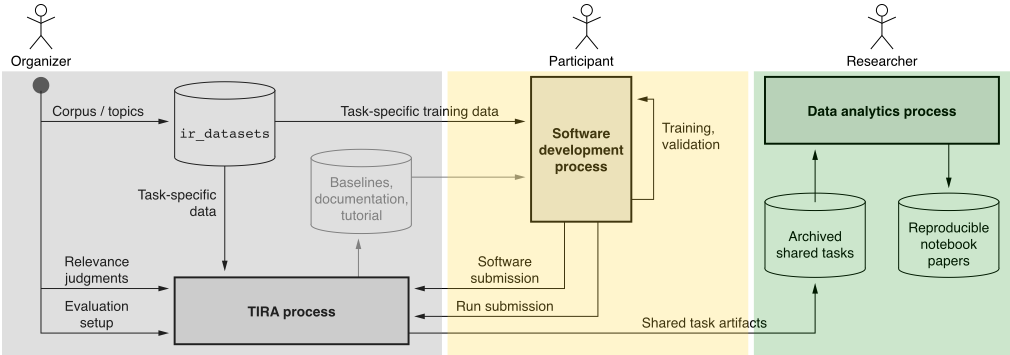
As illustrated in Figure 1, TIREx facilitates the entire process of conducting retrieval experiments. It allows shared task organizers and individual experimenters to import data and utilize any pre-existing retrieval software submitted to TIREx as baselines. Following that, submissions of new retrieval approaches for evaluation can be made as software submissions or, if enabled, also as run submissions. To incorporate a new corpus and topics into TIREx, they can be added to ir_datasets for automatic import to TIRA. Participants submit their software as Docker images. TIRA ensures their reproducibility and prevents test data leaks by executing them in a sandbox. Among other things, the sandbox disables Internet connectivity for the running software, which ensures that the software and its dependencies are fully installed and no data is sent to unauthorized third parties. Participants can provide additional data their software needs by uploading it to TIRA.
TIREx allows for software submissions to be executed on demand within a cloud-based execution environment, utilizing GitLab or GitHub CI/CD pipelines. In order to meet varying demand, experiment organizers can incorporate additional runners as necessary. TIREx maintains a comprehensive record of every artifact of a retrieval experiment in a specific git repository (Figure 1, right), which can be exported and published, enabling the independent re-execution of approaches with identical or differing data. Consequently, TIREx facilitates "always-on" shared tasks for the IR community, along with an extensive variety of ablation studies.
3.2 Reproducible Shared Tasks with TIRA
Since 2012, TIRA has handled software submissions in shared tasks [Gollub et al., 2012; Potthast et al., 2019]; PAN and Touché are long-running examples. 4 A first version of TIRA did let shared task participants access virtual machines to deploy software. Recently, TIRA was completely redeveloped based on the now industry-standard CI/CD pipelines (continuous integration and deployment) using Git, Docker, and Kubernetes [Fröbe et al., 2023c]. Participants now upload their software implemented in Docker images to a private Docker registry dedicated to their team and the new TIRA runs them on a Kubernetes cluster (1,620 CPU cores, 25.4TB RAM, 24 GeForce GTX 1080 GPUs); the first users were 71 teams with 647 software submissions in two NLP tasks hosted at SemEval 2023 [Fröbe et al., 2023a; Kiesel et al., 2023]. As previous IR tasks organized in TIRA [Bondarenko et al., 2020; Bondarenko et al., 2021; Bondarenko et al., 2022] were missing standardized data access, yielding non-reusable software submissions, TIRA was also substantially expanded and redeveloped in major parts to integrate ir_datasets, ir_measures, and PyTerrier.
3.3 Standardized Data Access with ir_datasets
The ir_datasets toolkit [MacAvaney et al., 2021] provides an interface to access over 200 datasets and over 500 topic sets frequently used in IR experiments. The data is kept upto-date and processing documents or topics is possible via a single line of Python code. Thus, ir_datasets already serves as a common data layer in numerous IR frameworks and tools [Yates et al., 2020; Piwowarski, 2020; Boytsov and Nyberg, 2020; MacAvaney et al., 2020; Costello et al., 2022; Macdonald et al., 2021; Yang et al., 2017; Mallia et al., 2019]. We integrate ir_datasets into TIRA via Docker images that can import complete datasets (for full-rank approaches) and that can create re-rankings for any given run file (for reranking approaches). We modify ir_datasets to include a new field 'default_text' for queries and documents so that the same software can process different datasets.
4 pan.webis.de, touche.webis.de
TIREx aims to support experiments in which components for the individual stages of modularized retrieval pipelines can be easily replaced and compared without having to adapt the complete retrieval software each time. Therefore, TIRA distinguishes between two types of retrieval approaches: (1) fullrank approaches with a document corpus and topics as input, and (2) re-rankers with a re-rank file as input (basically, querydocument pairs). From any retrieval software's output, a rerank file can be automatically created and cached in TIREx by the ir_datasets integration. As the structure of these re-rank files always is the same, any re-ranker can easily run on the output of any previous retrieval approach.
3.4 Sanity-checked Evaluation with ir_measures
TIRA can automatically evaluate run files (created by software submissions or uploads) via an ir_measures evaluator. The evaluator performs sanity checks to test if a run file can be parsed and warns of potential errors. Then, if relevance judgments have been provided, the evaluator derives all specified measures averaged over all queries and per query.
3.5 Reproducible IR Pipelines with TIRA
To improve the efficiency of common IR workflows in TIREx, we redeveloped and extended TIRA's ability to define and run modularized software spanning multiple Docker images. All software in TIRA is immutable so that outputs of one software (e.g., an index) can be cached and reused by another software.
Retrieval software in TIRA can have multiple components that form a sequence similar to UNIX pipes or even a directed acyclic graph (DAG). Each component has a Docker image with a command to be executed and can have none, one, or many preceding components, respectively. Since many different components of a software may use a created artifact like an index, we cache all outputs to make pipelines more efficient (as software submissions are immutable).
3.6 Local Pipeline Reproduction with PyTerrier
When an experiment repository is exported and published by the organizers, by default, the test data is kept private but the run files are published via TIRA and software submissions are uploaded as Docker images to Docker Hub. All possible follow-up studies (e.g., a reproducibility study for a shared task) can be conducted independent of TIRA. To simplify such follow-up studies, we created an PyTerrier integration that allows to re-execute Docker images or inject published outputs (e.g., indices) of software executions in declarative PyTerrier pipelines. Especially the re-use of cached outputs in local pipelines reduces the barrier of entry, because posthoc experiments can build upon outputs of complex software without having to re-execute them.
4 Evaluation
To demonstrate the scalability of TIREx, we conducted an experiment with 50 retrieval approaches on 32 retrieval tasks based on 15 datasets (1.9 billion documents). The resulting leaderboards are public and new submissions can be made at any time. 5 We also describe a repro_eval-based [Breuer et al., 2021] case study on system preference reproducibility for different retrieval tasks.
The 15 datasets cover a diverse set of retrieval scenarios, including argument retrieval, general web search, question answering, medical search, news search, etc. (please refer to the original TIREx paper for a full overview of all datasets [Fröbe et al., 2023b]). The 50 retrieval approaches that we imported into TIREx come from 5 retrieval frameworks: BEIR [Thakur et al., 2021], ChatNoir [Bevendorff et al., 2018], Pyserini [Lin et al., 2021], PyGaggle [Lin et al., 2021], PyTerrier [Macdonald et al., 2021]. We ran all retrieval systems on all datasets, see the original TIREx paper for a full evaluation on all datasets [Fröbe et al., 2023b]. Given the reproducibility focus of TIREx, we include a report on a case study on a reproducibility analysis in this extended abstract.
4.1 Case Study: Reproducibility Analysis
As an example of a post-hoc analysis enabled by TIREx, we use repro_eval to analyze to which degree system preferences from the TREC Deep Learning 2019 task can be reproduced on other tasks. For each preference between approaches on TREC Deep Learning 2019 (e.g., monoT5 is more effective on TREC DL 2019 than BM25), we set the approach with the lower effectiveness on TREC Deep Learning 2019 as the "baseline" in repro_eval and the other approach as the "advanced system". We study the reproducibility of the preferences on two dimensions [Breuer et al., 2020]: (1) the effect ratio of the reproduction, and (2) the delta relative improvement of the reproduction. The effect ratio measures to which degree the advanced system is still better than the baseline on the different task (1 indicates a perfect reproducibility, values between 0 and 1 indicate reproducibility with diminished improvements on the different task, and 0 indicates failed reproducibility), while the delta relative improvement measures the relative effectiveness difference of the advanced system to the baseline (0 indicates perfect reproducibility, values between -1 and 0 indicate an increased relative improvement of the advanced system, values between 0 and 1 indicate a smaller relative improvement, and 1 indicates failed reproducibility).
Table 1 shows the results of the preference reproducibility analysis. Not that surprising, the reproducibility on the very similar TREC Deep Learning 2020 is very good (88.1%) but declines fast for other tasks (e.g., only 57.8% for the Web track 2003 on rank 15). Analyzing the quantiles yields similar observations (e.g., 50% of the system preferences have an almost perfect effect ratio of 0.90 or higher for TREC Deep Learning 2020, while the Web track 2003 on rank 15 has a median effect ratio of 0.04).
5 github.com/tira-io/ir-experiment-platform#submission
| Task | Rank | Succ. | Effect Ratio | Delta | Rel. | Impr. | ||
|---|---|---|---|---|---|---|---|---|
| 25% | 50% | 75% | 25% | 50% | 75% | |||
| TREC DL 2020 | 1 | 88.1 | 0.68 | 0.90 | 1.11 | -0.03 | 0.02 | 0.08 |
| Touché 2020 | 2 | 77.1 | 0.12 | 0.38 | 0.73 | -0.09 | 0.04 | 0.17 |
| Web track 2004 | 3 | 75.5 | 0.01 | 0.29 | 0.89 | -0.07 | 0.10 | 0.31 |
| TREC-7 | 4 | 73.9 | -0.03 | 0.31 | 1.11 | -0.02 | 0.12 | 0.34 |
| Core 2018 | 5 | 70.2 | -0.05 | 0.24 | 0.90 | -0.03 | 0.13 | 0.35 |
| NFCorpus | 10 | 66.4 | -0.06 | 0.06 | 0.32 | 0.02 | 0.23 | 0.42 |
| Web track 2003 | 15 | 57.8 | -0.14 | 0.04 | 0.23 | -0.08 | 0.15 | 0.36 |
| Web track 2009 | 20 | 44.1 | -0.40 | -0.04 | 0.26 | 0.00 | 0.30 | 0.52 |
| Web track 2010 | 25 | 36.3 | -0.49 | -0.14 | 0.18 | 0.03 | 0.32 | 0.59 |
| Web track 2013 | 30 | 31.0 | -0.43 | -0.21 | 0.13 | 0.06 | 0.30 | 0.63 |
5 Discussion
We believe that TIREx can have a substantial conceptual impact as we see no alternative to blinded retrieval evaluations in the future (given the practice of training LLMs on basically all available ground truth for IR and NLP tasks [Chung et al., 2022]). Additionally, the platform eases the organization of reproducible IR experiments with software submissions. For shared tasks that run over multiple years on different data, the organizers can automatically re-run approaches submitted to previous editions to track progress. Interesting directions for future development besides including further IR frameworks and libraries are integrations of TIREx with the IR Anthology [Potthast et al., 2021] (e.g., links between entries in the TIREx leaderboards and the corresponding publications) and with DiffIR [Jose et al., 2021] (e.g., rendering runs as search engine result pages to contrast the quantitative evaluations with qualitative evaluations of ranking differences).
6 Conclusion
With TIREx, we aim to substantially ease conducting (blinded) IR experiments and organizing "always-on" reproducible shared tasks on the basis of software submissions. TIREx integrates ir_datasets, ir_measures, and PyTerrier with TIRA. Retrieval workflows can be executed ondemand via cloud-native orchestration, reducing the effort for reproducing IR experiments since software submitted to TIREx can be re-executed in post-hoc experiments. The platform has no lock-in effect, as archived experiments are fully self-contained, work stand-alone, and are easily exported. By keeping test data private, TIREx promotes further standardization and provenance of IR experiments following the example of, e.g., medicine, where blinded experiments are the norm. TIREx is open to the IR community and ready to include more datasets, shared tasks, and retrieval approaches.
Acknowledgments
This work has been partially supported by the OpenWebSearch.eu project (funded by the EU; GA 101070014).
@inproceedings{ijcai2024p931,
  title     = {The Information Retrieval Experiment Platform (Extended Abstract)},
  author    = {Fröbe, Maik and Reimer, Jan Heinrich and MacAvaney, Sean and Deckers, Niklas and Reich, Simon and Bevendorff, Janek and Stein, Benno and Hagen, Matthias and Potthast, Martin},
  booktitle = {Proceedings of the Thirty-Third International Joint Conference on
               Artificial Intelligence, {IJCAI-24}},
  publisher = {International Joint Conferences on Artificial Intelligence Organization},
  editor    = {Kate Larson},
  pages     = {8405--8410},
  year      = {2024},
  month     = {8},
  note      = {Sister Conferences Best Papers},
  doi       = {10.24963/ijcai.2024/931},
  url       = {https://doi.org/10.24963/ijcai.2024/931},
}
TY - CPAPER TI - The Information Retrieval Experiment Platform (Extended Abstract) AU - Fröbe, Maik AU - Reimer, Jan Heinrich AU - MacAvaney, Sean AU - Deckers, Niklas AU - Reich, Simon AU - Bevendorff, Janek AU - Stein, Benno AU - Hagen, Matthias AU - Potthast, Martin T2 - Proceedings of the Thirty-Third International Joint Conference on Artificial Intelligence, IJCAI-24 PB - International Joint Conferences on Artificial Intelligence Organization PY - 2024 SP - 8405 EP - 8410 DO - 10.24963/ijcai.2024/931 UR - https://doi.org/10.24963/ijcai.2024/931 ER -Copied
Machine-readable versions of this paper, for tools and AI agents:





