
Using Causal Inference to Investigate Contraceptive Discontinuation in Sub-Saharan Africa
Proceedings of the Thirty-Third International Joint Conference on Artificial Intelligence. AI for Good. Pages 7161-7169.
https://doi.org/10.24963/ijcai.2024/792
Keywords
- Machine Learning: General
- Multidisciplinary Topics and Applications: General
Abstract
Discontinuation rates vary by family planning method and across socio-economic contexts. Understanding these variations and their causes is paramount for developing and implementing policies aimed at curbing discontinuation rates. Randomized controlled trials (RCTs) are ideal for obtaining this information, but this design can be extremely expensive and logistically complex. The ongoing collection of comprehensive data sets, such as Demographic and Health Surveys (DHS data), when combined with machine learning methods, present an alternative and relatively cost-effective means of evidence gathering for policy development. Here, we use causal inference to estimate the effect of injectable contraceptive use on discontinuation over the 12-month period that follows its adoption. To that aim, we use retrospective observational data from seven sub-Saharan African countries captured by the DHS’ Contraceptive Calendar. We use machine learning methods to characterize data regions that share common covariate support. We find that the use of injectables increased the risk of discontinuation in four of the seven countries analyzed. Consistent with existing literature, we find that concerns with the side-effects of injectables appear to be the most frequent reason for discontinuation. However, these risks decreased after adjusting for socio-economic factors. As risk estimates may not apply uniformly within populations, we characterized the sub-populations for robust estimations by their geographical region, level of unmet needs, marital status, level of education, and age of first sex.
- [Ahmed et al., 2019] Saifuddin Ahmed, Yoonjoung Choi, Jose G Rimon, Souleymane Alzouma, Peter Gichangi, Georges Guiella, Patrick Kayembe, Simon P Kibira, Fredrick Makumbi, Funmilola OlaOlorun, et al. Trends in contraceptive prevalence rates in sub-saharan africa since the 2012 london summit on family planning: results from repeated cross-sectional surveys. The Lancet Global Health, 7(7):e904-e911, 2019.
- [Ali et al., 2012] Mohamed M Ali, John G Cleland, Iqbal H Shah, World Health Organization, et al. Causes and con- sequences of contraceptive discontinuation: evidence from 60 demographic and health surveys. 2012.
- [Alinia et al., 2021] Tahereh Alinia, Soheila Khodakarim, Fahimeh Ramezani Tehrani, and Siamak Sabour. Age at natural menopause; a data mining approach (data from the national health and nutrition examination survey 2013- 2014). International Journal of Preventive Medicine, 12, 2021.
- [Ameyaw et al., 2019] Edward Kwabena Ameyaw, Eugene Budu, Francis Sambah, Linus Baatiema, Francis Appiah, Abdul-Aziz Seidu, and Bright Opoku Ahinkorah. Preva- lence and determinants of unintended pregnancy in sub- saharan africa: A multi-country analysis of demographic and health surveys. PloS one, 14(8):e0220970, 2019.
- [Athey and Imbens, 2016] Susan Athey and Guido Imbens. Recursive partitioning for heterogeneous causal effects. Proceedings of the National Academy of Sciences, 113(27):7353-7360, 2016.
- [Azuike et al., 2017] EC Azuike, LC Ikeako, I Ezeobi, IU Ezebialu, JC Umeobika, KN Obi, JO Anene, and ED Azuike. Predictors of discontinuation of contraceptive use among nigerian women: results of 2013 nigeria demo- graphic and health surveys. J Sci Res Stud, 4(7):171-176, 2017.
- [Barden-O'Fallon et al., 2018] Janine Barden-O'Fallon, Ilene S Speizer, Lisa M Calhoun, and Meghan Corroon. Women's contraceptive discontinuation and switching behavior in urban senegal, 2010-2015. BMC women's health, 18(1):1-9, 2018.
- Saverio Bellizzi, Priya Mannava, Mari Nagai, and Howard L Sobel. Reasons for discontinuation of contraception among women with a current unintended pregnancy in 36 low and middle-income countries. Con- traception, 101(1):26-33, 2020.
- [Breiman, 2017] Leo Breiman. Classification and regression trees. Routledge, 2017.
- [Cahill et al., 2018] Niamh Cahill, Emily Sonneveldt, John Stover, Michelle Weinberger, Jessica Williamson, Chuchu Wei, Win Brown, and Leontine Alkema. Modern con- traceptive use, unmet need, and demand satisfied among women of reproductive age who are married or in a union in the focus countries of the family planning 2020 initia- tive: a systematic analysis using the family planning esti- mation tool. The Lancet, 391(10123):870-882, 2018.
- [Cintas et al., 2021] Celia Cintas, Ramya Raghavendra, Vic- tor Akinwande, Aisha Walcott-Bryant, Charity Wayua, and Komminist Weldemariam. Decision platform for pat- tern discovery and causal effect estimation in contracep- tive discontinuation. In Proceedings of the Twenty-Ninth International Conference on International Joint Confer- ences on Artificial Intelligence, pages 5288-5290, 2021. IJCAI
- [Cothran, 2017] Daniel Cothran. Malawi's community- based health system model: Structure, strategies, and learning. 2017.
- [Darroch et al., 2016] Jacqueline E Darroch, Vanessa Woog, Akinrinola Bankole, and Lori S Ashford. Adding it up: costs and benefits of meeting the contraceptive needs of adolescents. 2016.
- [Dehlendorf et al., 2014] Christine Dehlendorf, Colleen Krajewski, and Sonya Borrero. Contraceptive counseling: best practices to ensure quality communication and enable effective contraceptive use. Clinical obstetrics and gynecology, 57(4):659, 2014.
- [Dey, 2019] Ajit Kumar Dey. Socio-demographic determi- nants and modern family planning usage pattern-an analy- sis of national family health survey-iv data. Int J Commu- nity Med Public Heal, 6(2):738, 2019.
- [Dickerman et al., 2019] Barbra A Dickerman, Xabier García-Albéniz, Roger W Logan, Spiros Denaxas, and Miguel A Hernán. Avoidable flaws in observational analyses: an application to statins and cancer. Nature medicine, 25(10):1601-1606, 2019.
- [Eliason et al., 2013] Sebastian Eliason, Frank Baiden, Glo- ria Quansah-Asare, Yvonne Graham-Hayfron, Derek Bonsu, James Phillips, and Kofi Awusabo-Asare. Fac- tors influencing the intention of women in rural ghana to adopt postpartum family planning. Reproductive health, 10(1):1-8, 2013.
- [Glass et al., 2013] Thomas A Glass, Steven N Goodman, Miguel A Hernán, and Jonathan M Samet. Causal in- ference in public health. Annual review of public health, 34:61-75, 2013.
- [Griggs et al., 2013] David Griggs, Mark Stafford-Smith, Owen Gaffney, Johan Rockström, Marcus C Öhman, Priya Shyamsundar, Will Steffen, Gisbert Glaser, Norichika Kanie, and Ian Noble. Sustainable development goals for people and planet. Nature, 495(7441):305-307, 2013.
- [Hernán and Robins, 2016] Miguel A Hernán and James M Robins. Using big data to emulate a target trial when a randomized trial is not available. American journal of epi- demiology, 183(8):758-764, 2016.
- [Hernán, 2018] Miguel A Hernán. The c-word: scientific euphemisms do not improve causal inference from ob- servational data. American journal of public health, 108(5):616-619, 2018.
- [Hernán, 2021] Miguel A Hernán. Methods of public health research-strengthening causal inference from ob- servational data. New England Journal of Medicine, 385(15):1345-1348, 2021.
- [Hubacher and Trussell, 2015] D. Hubacher and J. Trussell. A definition of modern contraceptive methods. Contra- ception, 92(5):420-421, Nov 2015.
- [Imbens and Rubin, 2015] Guido W Imbens and Donald B Rubin. Causal inference in statistics, social, and biomedi- cal sciences. Cambridge University Press, 2015.
- [Jain and Winfrey, 2017] Anrudh K Jain and William Win- frey. Contribution of contraceptive discontinuation to un- intended births in 36 developing countries. Studies in fam- ily planning, 48(3):269-278, 2017.
- [Johnson, 2017] Ofonime E Johnson. Determinants of mod- ern contraceptive uptake among nigerian women: evi- dence from the national demographic and health survey. African journal of reproductive health, 21(3):89-95, 2017.
- [Larsson and Stanfors, 2014] Cecilia Larsson and Maria Stanfors. Women's education, empowerment, and contra- ceptive use in sub-saharan africa: findings from recent de- mographic and health surveys. African Population Studies, pages 1022-1034, 2014.
- [Michael and Scent, 2017] Turnwait O Michael and Grace AT Scent. Correlates of contraceptive use and the desire for less children in nigeria. The Nigerian Journal of Sociology and Anthropology, 15(2):101-116, 2017.
- [Muhoza et al., 2016] Dieudonne Ndaruhuye Muhoza, Pierre Claver Rutayisire, and Aline Umubyeyi. Measuring the success of family planning initiatives in rwanda: a multivariate decomposition analysis. Journal of Population Research, 33:361-377, 2016.
- [Oberst et al., 2020] Michael Oberst, Fredrik Johansson, Dennis Wei, Tian Gao, Gabriel Brat, David Sontag, and Kush Varshney. Characterization of overlap in observa- tional studies. In International Conference on Artificial Intelligence and Statistics, pages 788-798. PMLR, 2020.
- [Platt and others, 1999] John Platt et al. Probabilistic outputs for support vector machines and comparisons to regular- ized likelihood methods. Advances in large margin classi- fiers, 10(3):61-74, 1999.
- [Radovich et al., 2018] Emma Radovich, Mardieh L Dennis, Kerry LM Wong, Moazzam Ali, Caroline A Lynch, John Cleland, Onikepe Owolabi, Mark Lyons-Amos, and Lenka Benova. Who meets the contraceptive needs of young women in sub-saharan africa? Journal of Adolescent Health, 62(3):273-280, 2018.
- [Rickert et al., 1999] Vaughn I Rickert, Abbey B Berenson, Amy J Williamson, and Constance M Wiemann. Imme- diate recall of oral contraceptive instructions: implications for providers. American journal of obstetrics and gynecol- ogy, 180(6):1399-1406, 1999.
- [Rigollet and Tong, 2011] Philippe Rigollet and Xin Tong. Neyman-pearson classification, convexity and stochastic constraints. Journal of Machine Learning Research, 2011.
- [Rosenbaum and Rubin, 1983] Paul R Rosenbaum and Don- ald B Rubin. The central role of the propensity score in observational studies for causal effects. Biometrika, 70(1):41-55, 1983.
- [Shimoni et al., 2019] Yishai Shimoni, Ehud Karavani, Sivan Ravid, Peter Bak, Tan Hung Ng, Sharon Hensley Alford, Denise Meade, and Yaara Goldschmidt. An evalu- ation toolkit to guide model selection and cohort definition in causal inference. arXiv preprint arXiv:1906.00442, 2019.
- [Sully et al., 2020] Elizabeth A Sully, Ann Biddlecom, Jacqueline E Darroch, Taylor Riley, Lori S Ashford, Naomi Lince-Deroche, Lauren Firestein, and Rachel Murro. Adding it up: investing in sexual and reproduc- tive health 2019. 2020.
- [Thomas et al., 2020] Laine E Thomas, Fan Li, and Michael J Pencina. Overlap weighting: a propensity score method that mimics attributes of a randomized clinical trial. Jama, 323(23):2417-2418, 2020.
- [Tsui et al., 2017] Amy O Tsui, Win Brown, and Qingfeng Li. Contraceptive practice in sub-saharan africa. Pop- ulation and development review, 43(Suppl Suppl 1):166, 2017.
- [United Nations Population Fund (UNFPA), 2021] United Nations Population Fund (UNFPA). Unfpa supplies annual report 2020. https://www.unfpa.org/publications/ unfpa-supplies-annual-report-2020, June 2021. Accessed: 2023-03-29. Link
References were extracted automatically from the PDF and may contain errors.
Full text extracted automatically from the PDF; figures, tables and equations may differ. The PDF is the version of record.
1 Introduction
The World Health Organization (WHO) defines family planning (FP) as a means for women and couples to control the timing of their births and attain their desired number of children. Both the timing of births and the number of children each woman has can affect her health and well-being as well as that of her descendants [Griggs et al., 2013]. One way to achieve FP goals is by using contraceptive methods. The United Nations Population Fund (UNFPA) reports that if modern contraceptive needs were met in developing countries, maternal death would decrease by approximately 23% and childhood death by up to 20% [Darroch et al., 2016; United Nations Population Fund (UNFPA), 2021]. Thus, it is imperative that we improve our understanding of the dynamics of contraceptive uptake and discontinuation. Said information is critical for the development of evidence-based programs that effectively meet FP needs and improve health and well-being for women, and their children, globally. Important advances have been made in the last decade in the study of the determinants of contraceptive use and discontinuation, particularly in developing countries. Some factors that may influence contraceptive uptake and discontinuation include ease of access, contraceptive side effects, women's ages, and partnership and reproductive status [Barden-O'Fallon et al., 2018]. Contraceptive uptake also appears to be linked to education, wealth, residence, and access to information [Radovich et al., 2018]. Beliefs regarding the effect of contraceptives on breast milk and male partner approval have also been shown to be factors in contraceptive use decision-making [Eliason et al., 2013]. Importantly, the rate of progress in uptake and discontinuation varies among countries [Larsson and Stanfors, 2014; Azuike et al., 2017; Johnson, 2017; Michael and Scent, 2017; Cahill et al., 2018; Ahmed et al., 2019; Dey, 2019].
Understanding the causes of said variation in discontinuation is paramount to country, region, and group-specific policies and programs. Studying variation in discontinuation is, however, challenging. Women's reproductive decisions are complex and involve multiple factors. Previous studies attempting to account for these factors have mostly relied on summary statistics and regression analyses, which present limitations due to the interrelationships between relevant variables. For instance, exposure to local media, such as radio and newspapers, can affect attitudes toward sex, reproductive decisions, and contraceptive use, leading to multicollinearity and confounding bias. Additionally, most previous studies aimed at understanding contraceptive use dynamics have been associative. That is, they evaluate statistical relationships between contraceptive use patterns and the socio-ecological and health contexts in which those patterns take place. Yet, associative studies alone are insufficient to inform interventions, as they cannot provide critical information about causal relationships. Randomized control trials (RCTs) are one of the best instruments available for causal inference, but they are not flaw-free, are often expensive, are logistically complex, and have often led to inconsistent conclusions [Dickerman et al., 2019; Hern´an, 2021]. Within that context, causal inference methods such as propensity score matching, instrumental variables, and difference-in-differences, among others, may offer a good alternative, additional support to RCTs, or guidance for future studies and programs [Glass et al., 2013; Hern´an, 2018; Hern´an and Robins, 2016].
Causal methods, when used on observational data, effectively make extrapolations of counterfactual outcomes (hypothetical scenarios) from one group to another, provided that those groups have the same "support" (i.e., overlapping probability regions where the densities of the covariates are positive). This methodology ensures that predictions based on existing data are consistent. Data can be split into, for example, two groups - a group that uses modern contraception and a group that does not. By comparing these two groups in a specific geographical region, causes of discontinuation can be inferred based on observations made in the other geographical region, as long as both geographical regions include individuals from both groups being compared. The overlap between these two groups, thus, enables estimates of each group's counterfactual outcome via data-driven extrapolation. This could be done, for example, by identifying two data points (one in each group) that are statistically similar and using the outcome for one data point as the counterfactual outcome for the other.
Here, we outline the causal inference methods we used to investigate contraceptive use discontinuation to disseminate these protocols for the advancement of reproductive health policies where other forms of data collection, such as RCTs, are economically or logistically not feasible. The contributions of this work are three-folded:
- We examine injectable contraceptive use and explore causes of injectable contraceptive discontinuation using recall data on contraceptive use over the 12-month period following women's uptake of the method. We use retrospective observational study data from seven subSaharan African (SSA) countries captured by the Demographic and Health Surveys (DHS) during 2016-2018, herein referred to as DHS data. We chose this region and time period because 1) women in low- and middleincome countries (LMICs) desire, but often lack access to, contraception, 2) this region has available DHS data, and 3) this time period had a high uptake of injectable contraception [Sully et al., 2020].
- We evaluate the efficacy of causal inference methods, we test the hypothesis that injectable contraceptives are more likely to be discontinued due to health concerns
- compared to other modern methods (such as pills, implants, emergency contraception, or IUDs 1 ), and situate our results in the context of existing knowledge.
- We provide Boolean rule characterizations to interpret results and cross-reference sub-populations, which increases the robustness of the findings. First, we analyze data from a group of individuals who adopted modern contraceptives to estimate the effect of injectable use on discontinuation due to health concerns, adjusting for socioeconomic variables. We refer to this estimate as the "causal effect". Second, we examine the probability density of the data and identify the characteristics of individuals who are likely to use modern contraceptives. By doing so, we can draw conclusions about sub-populations with similar characteristics to those included in the study but may not be captured in the DHS data.
We expect that the analyses we present here will contribute to a growing body of evidence inspiring the application of causal inference methods to other existing reproductive health datasets and that our current results will provide policymakers and FP practitioners with valuable information to develop or improve policies that best match the needs of each social group, allowing for more efficient use of human, infrastructure, and monetary resources.
2 Methods
2.1 Dataset
The DHS Contraceptive Calendar data is a time series that includes retrospective, monthly records of reproductive status (birth, pregnancy, termination), contraceptive use and discontinuation, and reasons for discontinuation [Ali et al., 2012]. In the DHS survey, the pill, IUDs, injection, vaginal methods, condom, female sterilization, male sterilization, and implants are all classified as "modern contraceptive methods". The DHS survey also includes traditional and folk methods. Traditional methods include periodic abstinence (of any kind), withdrawal, and lactational amenorrhea. Folk methods are those referred to by respondents that do not belong to either modern or traditional categories [Cintas et al., 2021; Hubacher and Trussell, 2015]. We conducted our discontinuation data analyses using de-identified DHS Contraceptive Calendars and Surveys, accessed on May 1, 2020, from Burundi in 2016, Ethiopia in 2016, Liberia in 2019, Nigeria in 2018, Sierra Leone in 2019, Uganda in 2016, and Zambia in 2018. We selected SSA countries with DHS Contraceptive Calendar data collected after 2015 because this is the period when modern contraceptive use increased the most in the region [Tsui et al., 2017; Cintas et al., 2021]. We consider each country separately and carefully preprocess the data, removing records that do not meet the eligibility criteria. We considered information not older than five years from when the survey was taken. We also included in our analyses demographic and socioeconomic information recorded for each respondent in the DHS survey.
1 Intrauterine Device
Eligibility Criteria, Outcome, and Preprocessing
We used individual-level potential confounding factors from the Respondent's Basic Data, Reproduction, Contraceptive Table, Fertility Preferences, and Marriage sections of the DHS surveys. Women who did not use modern contraceptives such as injectables, pills, implants, emergency contraception, or intrauterine devices [Hubacher and Trussell, 2015] in the 5-year window evaluated were excluded. We also excluded women who did not undergo a "washout period" (no contraceptive method used) of at least three months between two different contraceptive methods because we would not have been able to differentiate between the effects of said methods accurately. We assigned women who used injectables to a hypothetical treatment group and those who used other forms of contraceptives to the control group. If a woman used both injectables and another form of contraception and, thus, met the eligibility criteria for one group and then another at different times (including a washout period), we assigned her randomly to one of the two groups. This ensures both groups are clearly defined and minimizes any temporal bias as a result of individuals using one method before the other. Importantly, while contraceptive data from the DHS is collected prospectively and retrospectively, allowing us to monitor changes in women's methods' use longitudinally, the socio-economic and demographic data contained in said Contraceptive Data are collected at a single point in time - thus, we must assume that socio-economic and demographic data for each woman is constant during the period we analyzed.
We randomly assigned respondents that meet the eligibility criteria for both the treatment and control at a certain (but different) 12-month window to either the treatment or control group. The outcome was a binary variable indicating whether the woman discontinued within a 12-month window starting from the month in which she adopted a method. We censored the data at 12 months. If a woman only began to use any method later than 12 months before the survey, we excluded her from the analysis. We removed variables with more than 10% missing values. Numerical variables with at most 10% missing were imputed by taking the median across the nonmissing rows. The DHS survey uses the keyword missing for nominal variables with missing records, which we retain as a category. Since the discontinuation data is retrospective, we excluded post-treatment variables that revealed "future" information when treatment was assigned (for example, the number of births in the last five years). After all exclusions, our sample contained 20, 703 individuals across the seven targeted countries, with an average country-specific sample size of 2, 958 (range: 2, 064 - 4, 218) (See Table 1) and 23 imputed and encoded variables 2 .
2.2 OverRule
To identify the sub-population in our analysis for which the causal effect can be generalized from the data, we used the OverRule algorithm [Oberst et al., 2020]. OverRule is used to produce a set of, at most, seven Boolean rules to characterize covariate regions where treatment groups overlap in our dataset. Boolean rules comprise operators that help make logical statements and are useful in decision-making. The "and" operator (also called a conjunction) combines two or more conditions and yields a true statement only if all the conditions are true. The "or" (also called a disjunction) operator combines two or more conditions and yields a true statement if at least one of the conditions are true, and the "not" operator negates a condition and yields the opposite of the corresponding statement. A set of rules expressed as a disjunction of one or more conjunctions of conditions is considered to be in disjunctive normal form (DNF).
2 See more details in the Supplementary Material.
Let X represent the covariates, T ∈ {0, 1} be whether an injectable contraceptive was used or not, and {(xi, ti)}ni=1 be a realization of n points forming a dataset. Assuming the base covariates have been binarized to form literals (e.g., Age > 18, or Region = West), OverRule's first step is to uncover a set of Boolean rules that approximates the marginal density of Pr[X]. This is done by creating a Neyman-Pearson classification task [Rigollet and Tong, 2011] discriminating between the observed samples (the marginal density of X) and a uniform distribution generated over X - the domain of X. This procedure results in Boolean rules S that characterize regions with high density in the covariate space. OverRule's second step is to estimate the overlap region within the highdensity region by filtering out points with extreme probabilities of being treated, for example, by using one-class support vector machines. This approach works by formulating the density estimation problem as a binary classification problem between the observed samples and uniform background samples. The background samples are simply a uniform distribution over an interval defined by the minimum and maximum values of each covariate. This second step also produces a set of rules, which are combined with the first set S to form a characterization of the overlap set ( ˆO). As per OverRule's ruleset estimator requirements, we set a lower bound, α = 0.95, on the probability mass of the subset of the data described by the rules we estimate. We also set the multiplier for the number of reference samples to 0.3. The regularization parameters λ0,λ1 correspond to the fixed cost (penalty) of a clause (set of literals) in a ruleset, and the cost of a literal in a clause, respectively. Smaller λ0, λ1 result respectively in more numerous rules and longer rules in the ruleset. OverRule uses deciles as thresholds for literals involving continuous covariates, providing balanced granularity to the rulesets without making them overly complex. We also do a hyperparameter search using a grid of 100 values evenly spaced on a log scale, and then select the values of λ that yield the least complex ruleset with a balanced accuracy within 1 standard error of the mean from the highest-accuracy ruleset [Breiman, 2017]. The balanced accuracy is computed from the true positive rate (the coverage of observed samples) and the false positive rate (coverage of uniform reference samples) for a given α and reference multiplier. After obtaining the OverRule overlap ruleset, we estimate the causal effect on the overlap set ˆO.
2.3 Effect Estimation
We assume that the association between discontinuation and the health reasons women report for said discontinuation is positive perfect in the DHS data. In other words, when a reason for discontinuation is recorded, the discontinuation should occur. Thus, the effect of injectable use could naively be obtained from its association with discontinuation due to health reasons (say Y ) i.e., ( E[Y |T=1] E[Y |T=0] ) where T = 0 refers to other modern contraceptive use, and T = 1 is the use of injectables. We refer to this as the unadjusted treatment effect. However, it is important to acknowledge that due to confounding factors, this effect estimate is not free from biases - for example, a woman without the necessary financial means may use the pill because it is cheaper than alternatives, even though she may have concerns about its side-effects.
We use Rubin's potential outcomes framework to address this bias and estimate the average treatment effect (ATE) of injectable use on the discontinuation [Imbens and Rubin, 2015]. Let Yi(1), and Yi(0) represent the hypothetical outcomes of units i = 1, · · · ,m under treatment and no treatment, respectively. The ATE can then be defined as E[Yi(1)/Yi(0)] Under the assumptions of overlap, exchangeability, and consistency [Imbens and Rubin, 2015], we can estimate the hypothetical E[Y (t)] from the observed E[Y | T = t,X]. We further aim to validate the overlap assumption and rely on the breadth of data to address exchangeability. We filter out treatment-naive individuals (i.e., those that do not fit the eligibility criteria described in Section 2.1 to ensure proper control.
2.4 Analyses
We selected confounders in the DHS survey according to their expected direct influence on the use of particular modern contraceptive methods and their potential influence on the outcome - i.e., discontinuation due to health concerns [Michael and Scent, 2017; Cahill et al., 2018; Ahmed et al., 2019; Dey, 2019; Dickerman et al., 2019]. A key limitation of our study is that these confounders were assessed at the time of the survey, while the decision to use a particular method was made prior to that moment. Thus, we must assume that the values of those variables are equally reflective had they been measured before the decision to use a method was made. In this regard, as discussed earlier, we exclude variables from the DHS data that reveal future information at the time the treatment was assigned. In sum, we made the following assumptions.
- Within a 5-year period, socio-economic factors like region, residence, education, literacy, and wealth-index did not change drastically across the population.
- Within a 5-year period, access to contraceptive information, knowledge about contraceptive use, and access to media, did not change drastically across the population.
- Within a 5-year period, demographic factors such as age, marital status, and sex of household head did not change drastically across the population.
- Within a 5-year period, variables related to reproductive health choices such as exposure, unmet need, ideal number of children did not change drastically across the population.
- There were no unmeasured confounders, particularly interventions that could invalidate the assumptions made
in 1-4.
With the dataset described in Section 2.1, we estimate the ATE and apply OverRule to identify and characterize regions of covariate overlap for robust estimations. Thus, we can precisely communicate to whom in each country the ATE estimate applies using the rulesets produced by OverRule. The codebase to replicate the analyses is available in a public repository hosted by GitHub 3 .
2.5 Causal Inference for Contraceptive Discontinuation
Inverse probability weighting (IPW) and overlap weighting (OW) are two statistical methods used in causal inference to help account for confounding variables that may bias the estimated effects of a treatment on an outcome. IPW works by computing the probability of each observation to be assigned to their treatment group - referred to as the propensity score - and then assigning them a weight that is the inverse of that probability. Intuitively, IPWupweights observations that are less likely to be assigned to their treatment group, and downweighs those more likely. By doing so, the weighted sample is now more similar to a randomized controlled trial, where the distribution of confounding variables is balanced between the treatment and control groups. OW helps balance the distribution of confounding variables in the overlap region of the treatment and control groups, rather than across the entire sample like IPW. The overlap region is the area of the dataset that, based on the values of the confounding variables, includes observations that could have potentially been in either the treatment or control group. OW downweighs extreme observations that are less likely to have a counterpart in the other treatment group, resulting in more stable (and less variation in) treatment effects. In sum, IPW and OW rely on conditional exchangeability when used for causal inference. That is, conditioning on the covariates included in the propensity score estimation suffices to control for all confounding and are useful methods for causal inference in nonrandomized studies, as they reduce confounding bias in the estimated treatment effects.
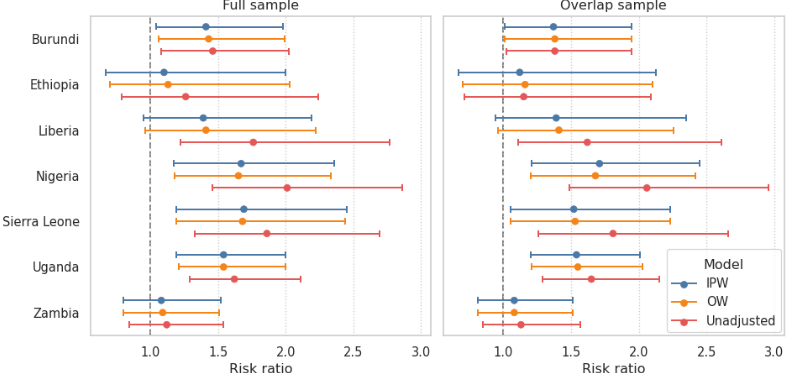
Risk-ratio (ATE) estimates greater than 1 imply discontinuation rates due to health reasons increase with increased use of injectables when compared with the control set, while confounding variables are kept constant. Such risk ratios would provide evidence that injectables may create more health problems or concerns than other modern methods and, thus, be damaging for the users. A risk - ratio < 1 implies that injectables do not create more health problems or concerns than other modern methods and may confer a benefit. We estimate the ATE with IPW [Rosenbaum and Rubin, 1983] and OW [Thomas et al., 2020] using the causallib package 4 . We obtain the ATE on the full dataset and on the overlap set estimated using OverRule. In all of our analyses, we use calibrated logistic regression (CLR) as the propensity model. Calibration is especially important when the model is regularized because the theoretical guarantees of propensity scores assume the true conditional probabilities of treatment assignment, and it is up to us to check if our model captures our probabilistic interpretation (36,37). We split the data into train and test sets - train set (70%) for modeling and test (30%) for evaluation, as is standard practice in machine learning - inferring the causal effect on the test set. Here, we follow Athey and Imbens' "honest effect" construct approach to reduce bias in effect estimation stemming from model overfitting [Athey and Imbens, 2016]. We regularize the CLR models with ridge regression and calibrate with Platt's method [Platt and others, 1999], choosing the hyperparameter value that maximizes AUC (Area under the ROC Curve), minimizes weighted AUC, and is well-calibrated, as detailed in the framework proposed by Shimoni and colleagues [Shimoni et al., 2019]. We then estimate the ATE twice using both IPW and OW and report 95% confidence intervals from 1000 bootstrap samples. We also estimate the placebo effect, which is expected to be close to 1, by replacing the treatment assignment with a random variable drawn from a Bernoulli distribution with the same mean as the treatment prevalence.
3 https://github.com/aknvictor/overlap-fp
4 https://github.com/BiomedSciAI/causallib
| T=1 | T=0 | ||
|---|---|---|---|
| Burundi | N(%) D(%) | 1461(58.7) 342(23.4) | 1029(41.3) 163(15.8) |
| Ethiopia | N(%) D(%) | 1916(68.1) 169(8.8) | 899(31.9) 64(7.1) |
| Liberia | N(%) D(%) | 1382(67.0) 308(22.3) | 682(33.0) 88(13.9) |
| Nigeria | N(%) D(%) | 1133(41.8) 243(21.4) | 1575(58.2) 165(10.5) |
| Sierra Leone | N(%) D(%) | 1281(44.0) 235(18.3) | 1631(56.0) 165(10.1) |
| Uganda | N(%) D(%) | 2889(68.5) 786(27.2) | 1329(31.5) 222(16.7) |
| N(%) D(%) | 359(15.9) | ||
| Zambia | 1235(64.7) | 176(14.3) | |
| 2261(35.3) |
Finally, as discussed, overlap is a requirement for the identification of the treatment effect; the use of IPW and OW on the full dataset may not provide reliable insights. This is because the weights can become extremely large for individuals in non-overlapping regions, resulting in skewed estimates. Nonetheless, we may compare the estimates on both the overlap and full dataset. If the estimates are similar, it suggests that the treatment effect is relatively uniform across the population, and the lack of overlap might not be introducing significant bias. On the other hand, if there is a discrepancy, then the resulting estimates on the overlap set do not generalize to the entire population.
3 Results &Discussion
As previously described, after applying our inclusion and exclusion criteria, our sample contained 20, 703 individuals from seven targeted countries, with an average countryspecific sample size of 2, 958 (range: 2,064 - 4,218) (Table 1). Our analyses of said data show injectables to be the most used modern contraceptive method in all seven countries. In five of those countries, injectables were also the predominant method used after the washout period in the control set (ranging from 58.7% to 68.5%). We report the distribution of the covariates grouped by treatment level in Table 2.
| Marginal | IPW | OW | |
|---|---|---|---|
| Burundi | 1.46(1.08,2.02) | 1.41(1.04,1.98) | 1.43(1.06,1.99) |
| Ethiopia | 1.26(0.79,2.24) | 1.1(0.67,2.0) | 1.13(0.7,2.03) |
| Liberia | 1.76(1.22,2.77) | 1.39(0.95,2.19) | 1.41(0.96,2.22) |
| Nigeria | 2.01(1.46,2.86) | 1.67(1.17,2.36) | 1.65(1.18,2.33) |
| Sierra Leone | 1.86(1.33,2.69) | 1.69(1.19,2.45) | 1.68(1.19,2.44) |
| Uganda | 1.62(1.29,2.11) | 1.54(1.19,2.0) | 1.54(1.21,2.0) |
| Zambia | 1.12(0.84,1.54) | 1.08(0.8,1.52) | 1.09(0.8,1.51) |
| Overlap cohort (% of overall) | |||
| Burundi (92.44%) | 1.38(1.02,1.95) | 1.37(1.01,1.95) | 1.38(1.01,1.95) |
| Ethiopia (91.04%) | 1.15(0.71,2.09) | 1.12(0.67,2.13) | 1.16(0.7,2.1) |
| Liberia (94.18%) | 1.62(1.11,2.61) | 1.39(0.94,2.35) | 1.41(0.96,2.26) |
| Nigeria (95.71%) | 2.06(1.49,2.96) | 1.71(1.21,2.45) | 1.68(1.2,2.42) |
| Sierra Leone (94.5%) | 1.81(1.26,2.66) | 1.52(1.05,2.23) | 1.53(1.05,2.23) |
| Uganda (94.68%) | 1.65(1.29,2.15) | 1.54(1.2,2.01) | 1.55(1.21,2.03) |
| Zambia (93.44%) | 1.13(0.85,1.57) | 1.08(0.81,1.51) | 1.08(0.81,1.51) |
3.1 Causal Effect Estimates
First, we computed the unadjusted effect of injectable use on discontinuation due to health concerns (termed Marginal). We did so by comparing the discontinuation across treatment and control groups (ranging from 1.12 to 2.01). Next, we estimated the treatment effect (adjusting for potential confounding) and observed an overall weak positive effect for discontinuation due to health concerns associated with the use of injectables (95% CI = ranging from 1.08 to 1.69) in four of the seven countries, shown in Figure 1(a). This effect estimate remains stable when either IPW or OW is used. Figure 1(b) shows that the effect estimate does not change drastically when restricted to the overlap cohorts, which comprise most of the women in the overall cohort for all the countries ranging from 91.04% to 95.71%. The placebo effect provides a metric to refute the above ATE estimate. The ATE of the placebo is always close to 1 (See Table 1, Supplementary material). In summary, consistent with the existing literature, individuals using injectable contraceptives are up to two times more likely to stop using them compared to those using other modern contraceptive methods. However, this relative increase in discontinuation lowers after adjusting for socioeconomic factors.
3.2 Overlap
Characterization of overlap was consistent across all seven countries. The variables that characterized women likely to use modern contraceptives were age, age at first sex, cohabitation duration, education, exposure to FP information and public media, their ideal number of children, knowledge of the ovulatory cycle, marital status, region, unmet need, and wealth index. We show detailed rulesets in Figure 2 for Zambia. The remainder of the rulesets for Burundi, Ethiopia, Nigeria, Sierra Leone, Uganda, and Liberia are in the Supplementary Material.
3.3 Discussion
Our results suggest that causal inference methods can, as proposed, be effectively used to advance our understanding of the causes of contraceptive method discontinuation. Said methods, combined with extant DHS survey data from seven sub-Saharan countries between 2016 and 2019, allowed us to identify that, in those countries, discontinuation due to health concerns was more likely given the use of injectable contraception compared to other modern methods. Causal inference methods also allowed us to estimate the size of the effect of health concerns on discontinuation with the sample analyzed. Furthermore, we were able to characterize regions of covariate overlap, which would allow for the generalization of the estimated effects to regions with similar common covariate support, thus allowing us to reliably cross-reference sub-populations. To accurately estimate a treatment's (exposures, intervention, or program) causal effects, treatment group overlap is required. In randomized control trials, carefully designed inclusion and exclusion criteria ensure treatments of interest are applied to every subgroup of the study population. However, in observational studies, where individuals self-assign to treatment based on their covariates such as age, level of education, income, etc., such guarantees do not exist. When overlap does not hold globally, local regions of overlap may still exist, and characterizing such regions, in interpretable ways, can inform the relevance of any causal conclusions for new individuals with these characteristics (e.g., individuals within a specific geographical region or income bracket). Likewise, identifying individuals (in the case of this study, women) that violate the overlap assumption - for example, individuals from a certain geographic region overly represented in the control and not the treatment - enables the identification of individuals for which subsequent causal relationships do not apply, which reduces errors in effects estimation. In this case, our results showed a weak positive risk increase of discontinuation for women using injectable contraceptives across four different countries. Women likely to use modern contraceptives showed overlaps in terms of age, age at first sex, cohabitation duration, education, exposure to FP information and public media, the ideal number of children, knowledge of ovulatory cycle, marital status, region, unmet need, and wealth index. Injectable contraceptives were the most common method used in the seven sub-Saharan countries analyzed and, in five of them, it was also the method most frequently adopted after women re-initiated FP after a washout period. Yet, injectables were also associated with higher health concerns and these concerns were the cause of women's discontinuation of injectables in four of the seven countries. Our findings are consistent with a previous associative analysis of DHS data. Using data from 25 countries, [Ali et al., 2012] reported that method-related dissatisfaction was the most common reason for the discontinuation of modern contraceptive methods and injectable contraceptives presented the highest discontinuation likelihood. In their study, 35% of women discontinued injectables by the end of the first year of their adoption, and by the end of the second year that rate reached 51% [Ali et al., 2012]. The authors suggested that these differences may be partially explained by variations in access to information regarding contraceptive meth-
Support Rules 𝒮
Rule S.1
Respondent's current age > 35
and Region is not "Muchinga"
and Education in single years <= 14
and Cohabitation duration (grouped) is not "5-9"
and Cohabitation duration (grouped) is not "30+"
and Age at first sex <= 28
Rule S.2
Respondent's current age <= 35
and Education in single years <= 14
and Cohabitation duration (grouped) is not "20-24"
and Cohabitation duration (grouped) is not "30+"
and Age at first sex <= 28
"𝒪 = (S.1 𝑜𝑟 S.2) 93.44%
Figure 2: Rulesets that describe individuals in DHS Zambia 2018 likely to use injectables as well as the contraceptive methods in the control set. An individual is in the overlap set if any of the support rules apply. The ruleset covers 93.44% of the data, with balanced accuracy of 90.1.
ods and their side effects, which differed significantly across age groups. Finally, we have also learned from the overlap analysis that reliable causal inference may be drawn from a significant proportion of the sample population (up to 95%).
3.4 Limitations
Our analyses are limited by three factors. First, DHS's Contraceptive Calendar data may be affected by recall bias - women are asked to recall several months of contraceptive use, and their recall can be inaccurate [Rickert et al., 1999; Dehlendorf et al., 2014]. However, as recall bias is expected to be uniform among the sub-groups we compared, its effects on our conclusions should be minimal. Second, we used a washout period of three-months to account for injectables' side effects and the health concerns they can raise. Said washout period is clinically reasonable and increasing it would have resulted in the exclusion of a vulnerable group of women - those that have the highest need to prevent pregnancy. Lastly, we assumed confounding biases and made assumptions in terms of the factors that could be causing them, whereas there may be numerous factors that lead to confounding bias not captured by the DHS Survey.
3.5 Significance
Access to safe, appropriate contraceptive methods is lacking in many LMICs. An estimated 218 million women aged 1549 require, but do not have, access to appropriate contraception methods in LMICs, which contributes to the extremely elevated rate of unplanned pregnancies observed in these countries (approximately 49% of all pregnancies) [Sully et al., 2020]. Importantly, discontinuation of injectable contraceptives is a strong predictor of unplanned pregnancies [Bellizzi et al., 2020; Jain andWinfrey, 2017]. In turn, unplanned pregnancies are linked to higher social and health risks for mothers and their children [Ameyaw et al., 2019]. Our findings, thus, have critical implications for public health, reproduction decision-making, and women's and their children's wellbeing. Strong reproductive health policies have been shown to increase contraceptive uptake in some LMIC contexts such as the sub-Saharan countries of Rwanda and Malawi [Cothran, 2017; Muhoza et al., 2016].
Here, we show how causal inference methods combined with machine learning techniques can be applied to existing, country-specific survey data to learn and extrapolate from successful policies. Multivariate distributions governing high-dimensional data are usually hard to study, thus classical methods for assessing covariate overlap usually reduce problems to one-dimension. Within this context each covariate tends to be marginally examined, comparing summary statistics like their standardized mean difference. Another frequent approach is to summarize multivariate distributions into propensity scores and compare the distribution between treatment and control groups. More modern approaches apply machine learning methods to study covariate overlap in highdimensional spaces. Yet, as data complexity increases, so do the statistical approaches used to account for it, and results become harder to interpret. Conversely, by using Boolean rulesets, our proposed methodology produces characterizations that are simpler to interpret, which requires practitioners to simply cross-reference sub-populations with said rulesets. These rulesets describe groups for whom outcomes related to contraception use are likely to align. Variables that are not found to impact the outcome variable are not described in the ruleset. One example of a group description extracted from our analysis suggests that women in DHS Nigeria (2018) who have an ideal number of children less than or equal to 12 and describe their unmet need for contraception to be any reason except for "spacing failure", are part of a group that is likely to use injectables to the same efficacy (i.e., will discontinue at the same rate) as other modern contraception. In the Nigeria ruleset, no other variables (marital status, region, education, etc.) were found to impact rates of injectable contraceptive discontinuation. The ruleset in our analysis is found to cover 95.71% of the data for DHS Nigeria (2018).
The emergence of new reliable data, such as PMA2020 survey data 5 , paired with digital data collection methods designed specifically for FP, and causal inference methods, should provide useful insights for policy development and implementation for health services providers and women around the world. Furthermore, causal inference methods could also be useful to tackle other critical women's reproductive health issues for which population representative data is, or is becoming, available. Causal inference combined with machine learning can be applied to improve our understanding of social and ecological determinants of women's reproductive transitions, including menarche, age at first sex, age at first birth, and age at menopause [Alinia et al., 2021], which are known to be critical determinants of women's health and wellbeing.
Ethical Statement
This research uses human subject data made available from the DHS portal, the procedures and questionnaires for standard DHS surveys have been reviewed and approved by ICF Institutional Review Board (IRB). Additionally, countryspecific DHS survey protocols are reviewed by the ICF IRB and typically by an IRB in the host country. ICF IRB ensures that the survey complies with the U.S. Department of Health and Human Services regulations for the protection of human subjects (45 CFR 46), while the host country IRB ensures that the survey complies with laws and norms of the nation 6 .
@inproceedings{ijcai2024p792,
  title     = {Using Causal Inference to Investigate Contraceptive Discontinuation in Sub-Saharan Africa},
  author    = {Akinwande, Victor and MacGregor, Megan and Cintas, Celia and Karavani, Ehud and Wei, Dennis and Varshney, Kush R. and Nepomnaschy, Pablo},
  booktitle = {Proceedings of the Thirty-Third International Joint Conference on
               Artificial Intelligence, {IJCAI-24}},
  publisher = {International Joint Conferences on Artificial Intelligence Organization},
  editor    = {Kate Larson},
  pages     = {7161--7169},
  year      = {2024},
  month     = {8},
  note      = {AI for Good},
  doi       = {10.24963/ijcai.2024/792},
  url       = {https://doi.org/10.24963/ijcai.2024/792},
}
TY - CPAPER TI - Using Causal Inference to Investigate Contraceptive Discontinuation in Sub-Saharan Africa AU - Akinwande, Victor AU - MacGregor, Megan AU - Cintas, Celia AU - Karavani, Ehud AU - Wei, Dennis AU - Varshney, Kush R. AU - Nepomnaschy, Pablo T2 - Proceedings of the Thirty-Third International Joint Conference on Artificial Intelligence, IJCAI-24 PB - International Joint Conferences on Artificial Intelligence Organization PY - 2024 SP - 7161 EP - 7169 DO - 10.24963/ijcai.2024/792 UR - https://doi.org/10.24963/ijcai.2024/792 ER -Copied
Machine-readable versions of this paper, for tools and AI agents:





