
Bring Metric Functions into Diffusion Models
Proceedings of the Thirty-Third International Joint Conference on Artificial Intelligence. Main Track. Pages 578-586.
https://doi.org/10.24963/ijcai.2024/64
Keywords
- Computer Vision: CV: Image and video synthesis and generation
Abstract
We introduce a Cascaded Diffusion Model (Cas-DM) that improves a Denoising Diffusion Probabilistic Model (DDPM) by effectively incorporating additional metric functions in training. Metric functions such as the LPIPS loss have been proven highly effective in consistency models derived from the score matching. However, for the diffusion counterparts, the methodology and efficacy of adding extra metric functions remain unclear. One major challenge is the mismatch between the noise predicted by a DDPM at each step and the desired clean image that the metric function works well on. To address this problem, we propose Cas-DM, a network architecture that cascades two network modules to effectively apply metric functions to the diffusion model training. The first module, similar to a standard DDPM, learns to predict the added noise and is unaffected by the metric function. The second cascaded module learns to predict the clean image, thereby facilitating the metric function computation. Experiment results show that the proposed diffusion model backbone enables the effective use of the LPIPS loss, improving the image quality (FID, sFID) of diffusion models on various established benchmarks.
- [An et al., 2023] Jie An, Songyang Zhang, Harry Yang, Sonal Gupta, Jia-Bin Huang, Jiebo Luo, and Xi Yin. Latent-shift: Latent diffusion with temporal shift for efficient text-to-video generation. arXiv preprint arXiv:2304.08477, 2023.
- [Bengio et al., 2014] Yoshua Bengio, Eric Laufer, Guil- laume Alain, and Jason Yosinski. Deep generative stochas- tic networks trainable by backprop. In International Con- ference on Machine Learning, pages 226-234. PMLR, 2014.
- [Benny and Wolf, 2022] Yaniv Benny and Lior Wolf. Dy- namic dual-output diffusion models. In CVPR, 2022.
- [Blattmann et al., 2023] Andreas Blattmann, Robin Rom- bach, Huan Ling, Tim Dockhorn, Seung Wook Kim, Sanja Fidler, and Karsten Kreis. Align your latents: High- resolution video synthesis with latent diffusion models. In CVPR, 2023.
- [Brock et al., 2018] Andrew Brock, Jeff Donahue, and Karen Simonyan. Large scale gan training for high fidelity natural image synthesis. arXiv preprint arXiv:1809.11096, 2018.
- [Che et al., 2020] Tong Che, Ruixiang Zhang, Jascha Sohl- Dickstein, Hugo Larochelle, Liam Paull, Yuan Cao, and Yoshua Bengio. Your gan is secretly an energy-based model and you should use discriminator driven latent sam- pling. NeurIPS, 2020.
- [Chen et al., 2018] Xi Chen, Nikhil Mishra, Mostafa Roha- ninejad, and Pieter Abbeel. Pixelsnail: An improved au- toregressive generative model. In ICML, 2018.
- [Deng et al., 2009] Jia Deng, Wei Dong, Richard Socher, Li- Jia Li, Kai Li, and Li Fei-Fei. Imagenet: a large-scale hierarchical image database. In CVPR, 2009.
- [Dhariwal and Nichol, 2021] Prafulla Dhariwal and Alexan- der Nichol. Diffusion models beat gans on image synthe- sis. In NeurIPS, 2021.
- [Dinh et al., 2014] Laurent Dinh, David Krueger, and Yoshua Bengio. Nice: Non-linear independent compo- nents estimation. arXiv preprint arXiv:1410.8516, 2014.
- [Dinh et al., 2017] Laurent Dinh, Jascha Sohl-Dickstein, and Samy Bengio. Density estimation using real nvp. In ICLR, 2017.
- [Esser et al., 2021] Patrick Esser, Robin Rombach, and Bjorn Ommer. Taming transformers for high-resolution image synthesis. In CVPR, 2021.
- [Fan et al., 2023] Wan-Cyuan Fan, Yen-Chun Chen, Dong- Dong Chen, Yu Cheng, Lu Yuan, and Yu-Chiang Frank Wang. Frido: Feature pyramid diffusion for complex scene image synthesis. In AAAI, 2023.
- [Goodfellow et al., 2014] Ian Goodfellow, Jean Pouget- Abadie, Mehdi Mirza, Bing Xu, David Warde-Farley, Sherjil Ozair, Aaron Courville, and Yoshua Bengio. Gen- erative adversarial nets. In NeurIPS, 2014. [He et al., 2016] Kaiming He, Xiangyu Zhang, Shaoqing Ren, and Jian Sun. Deep residual learning for image recog- nition. In CVPR, 2016.
- [Heusel et al., 2017] Martin Heusel, Hubert Ramsauer, Thomas Unterthiner, Bernhard Nessler, and Sepp Hochre- iter. Gans trained by a two time-scale update rule converge to a local nash equilibrium. In NeurIPS, 2017.
- [Ho et al., 2019] Jonathan Ho, Xi Chen, Aravind Srinivas, Yan Duan, and Pieter Abbeel. Flow++: Improving flow- based generative models with variational dequantization and architecture design. In ICML, 2019.
- [Ho et al., 2020] Jonathan Ho, Ajay Jain, and Pieter Abbeel. Denoising diffusion probabilistic models. NeurIPS, 2020.
- [Ho et al., 2022] Jonathan Ho, William Chan, Chitwan Saharia, Jay Whang, Ruiqi Gao, Alexey Gritsenko, Diederik P Kingma, Ben Poole, Mohammad Norouzi, David J Fleet, et al. Imagen video: High definition video generation with diffusion models. arXiv preprint arXiv:2210.02303, 2022.
- [Johnson et al., 2016] Justin Johnson, Alexandre Alahi, and Li Fei-Fei. Perceptual losses for real-time style transfer and super-resolution. In ECCV, 2016.
- [Jolicoeur-Martineau et al., 2020] Alexia Jolicoeur- Martineau, Rémi Piché-Taillefer, Rémi Tachet des Combes, and Ioannis Mitliagkas. Adversarial score matching and improved sampling for image generation. arXiv preprint arXiv:2009.05475, 2020.
- [Karras et al., 2017] Tero Karras, Timo Aila, Samuli Laine, and Jaakko Lehtinen. Progressive growing of gans for improved quality, stability, and variation. arXiv preprint arXiv:1710.10196, 2017.
- [Karras et al., 2019] Tero Karras, Samuli Laine, and Timo Aila. A style-based generator architecture for generative adversarial networks. In CVPR, 2019.
- [Karras et al., 2020] Tero Karras, Samuli Laine, Miika Ait- tala, Janne Hellsten, Jaakko Lehtinen, and Timo Aila. An- alyzing and improving the image quality of stylegan. In CVPR, 2020.
- [Kingma and Dhariwal, 2018] Durk P Kingma and Prafulla Dhariwal. Glow: Generative flow with invertible 1x1 con- volutions. In NeurIPS, 2018.
- [Kingma and Welling, 2013] Diederik P Kingma and Max Welling. Auto-encoding variational bayes. arXiv preprint arXiv:1312.6114, 2013.
- [Krizhevsky et al., 2009] Alex Krizhevsky, Geoffrey Hinton, et al. Learning multiple layers of features from tiny im- ages. 2009.
- [Liu et al., 2021] Ze Liu, Yutong Lin, Yue Cao, Han Hu, Yixuan Wei, Zheng Zhang, Stephen Lin, and Baining Guo. Swin transformer: Hierarchical vision transformer using shifted windows. In ICCV, 2021.
- [Mao et al., 2017] Xudong Mao, Qing Li, Haoran Xie, Ray- mond YK Lau, Zhen Wang, and Stephen Paul Smolley. Least squares generative adversarial networks. In ICCV, 2017.
- [Nash et al., 2021] Charlie Nash, Jacob Menick, Sander Dieleman, and Peter W Battaglia. Generating images with sparse representations. arXiv preprint arXiv:2103.03841, 2021.
- [Nichol and Dhariwal, 2021] Alexander Quinn Nichol and Prafulla Dhariwal. Improved denoising diffusion proba- bilistic models. In ICML, 2021.
- [Oord et al., 2016] Aaron van den Oord, Sander Diele- man, Heiga Zen, Karen Simonyan, Oriol Vinyals, Alex Graves, Nal Kalchbrenner, Andrew Senior, and Koray Kavukcuoglu. Wavenet: A generative model for raw au- dio. arXiv preprint arXiv:1609.03499, 2016.
- [Ramesh et al., 2022] Aditya Ramesh, Prafulla Dhariwal, Alex Nichol, Casey Chu, and Mark Chen. Hierarchical text-conditional image generation with clip latents. arXiv preprint arXiv:2204.06125, 2022.
- [Razavi et al., 2019] Ali Razavi, Aaron Van den Oord, and Oriol Vinyals. Generating diverse high-fidelity images with vq-vae-2. NeurIPS, 2019.
- [Rombach et al., 2022] Robin Rombach, Andreas Blattmann, Dominik Lorenz, Patrick Esser, and Björn Ommer. High-resolution image synthesis with latent diffusion models. In CVPR, 2022.
- [Saharia et al., 2022a] Chitwan Saharia, William Chan, Hui- wen Chang, Chris Lee, Jonathan Ho, Tim Salimans, David Fleet, and Mohammad Norouzi. Palette: Image-to-image diffusion models. In SIGGRAPH, 2022.
- [Saharia et al., 2022b] Chitwan Saharia, William Chan, Saurabh Saxena, Lala Li, Jay Whang, Emily L Den- ton, Kamyar Ghasemipour, Raphael Gontijo Lopes, Burcu Karagol Ayan, Tim Salimans, et al. Photorealistic text-to- image diffusion models with deep language understand- ing. NeurIPS, 2022.
- [Salimans et al., 2015] Tim Salimans, Diederik Kingma, and Max Welling. Markov chain monte carlo and variational inference: Bridging the gap. In ICML, 2015.
- [Salimans et al., 2017] Tim Salimans, Andrej Karpathy, Xi Chen, and Diederik P Kingma. Pixelcnn++: Improving the pixelcnn with discretized logistic mixture likelihood and other modifications. arXiv preprint arXiv:1701.05517, 2017.
- [Simonyan and Zisserman, 2014] Karen Simonyan and An- drew Zisserman. Very deep convolutional networks for large-scale image recognition. arXiv preprint arXiv:1409.1556, 2014.
- [Singer et al., 2022] Uriel Singer, Adam Polyak, Thomas Hayes, Xi Yin, Jie An, Songyang Zhang, Qiyuan Hu, Harry Yang, Oron Ashual, Oran Gafni, et al. Make-a- video: Text-to-video generation without text-video data. arXiv preprint arXiv:2209.14792, 2022.
- [Song and Ermon, 2019] Yang Song and Stefano Ermon. Generative modeling by estimating gradients of the data distribution. arXiv preprint arXiv:1907.05600, 2019.
- [Song and Ermon, 2020] Yang Song and Stefano Ermon. Improved techniques for training score-based generative models. arXiv preprint arXiv:2006.09011, 2020.
- [Song and Kingma, 2021] Yang Song and Diederik P Kingma. How to train your energy-based models. arXiv preprint arXiv:2101.03288, 2021.
- [Song et al., 2020a] Jiaming Song, Chenlin Meng, and Ste- fano Ermon. Denoising diffusion implicit models. arXiv preprint arXiv:2010.02502, 2020.
- [Song et al., 2020b] Yang Song, Jascha Sohl-Dickstein, Diederik P Kingma, Abhishek Kumar, Stefano Er- mon, and Ben Poole. Score-based generative modeling through stochastic differential equations. arXiv preprint arXiv:2011.13456, 2020.
- [Song et al., 2023] Yang Song, Prafulla Dhariwal, Mark Chen, and Ilya Sutskever. Consistency models. 2023.
- [Szegedy et al., 2016] Christian Szegedy, Vincent Van- houcke, Sergey Ioffe, Jon Shlens, and Zbigniew Wojna. Rethinking the inception architecture for computer vision. In CVPR, 2016.
- [Vahdat and Kautz, 2020] Arash Vahdat and Jan Kautz. Nvae: A deep hierarchical variational autoencoder. NeurIPS, 2020.
- [Van den Oord et al., 2016a] Aaron Van den Oord, Nal Kalchbrenner, Lasse Espeholt, Oriol Vinyals, Alex Graves, et al. Conditional image generation with pixelcnn decoders. NeurIPS, 2016.
- [Van Den Oord et al., 2016b] Aäron Van Den Oord, Nal Kalchbrenner, and Koray Kavukcuoglu. Pixel recurrent neural networks. In ICML, 2016.
- [Van Den Oord et al., 2017] Aaron Van Den Oord, Oriol Vinyals, et al. Neural discrete representation learning. NeurIPS, 2017.
- [Wu et al., 2019] Yan Wu, Jeff Donahue, David Balduzzi, Karen Simonyan, and Timothy Lillicrap. Logan: Latent optimisation for generative adversarial networks. arXiv preprint arXiv:1912.00953, 2019.
- [Yang et al., 2023] Zhengyuan Yang, Jianfeng Wang, Zhe Gan, Linjie Li, Kevin Lin, Chenfei Wu, Nan Duan, Zicheng Liu, Ce Liu, Michael Zeng, et al. Reco: Region- controlled text-to-image generation. In CVPR, 2023.
- [Yu et al., 2015] Fisher Yu, Ari Seff, Yinda Zhang, Shu- ran Song, Thomas Funkhouser, and Jianxiong Xiao. Lsun: Construction of a large-scale image dataset using deep learning with humans in the loop. arXiv preprint arXiv:1506.03365, 2015.
- [Zhang et al., 2018] Richard Zhang, Phillip Isola, Alexei A Efros, Eli Shechtman, and Oliver Wang. The unreasonable effectiveness of deep features as a perceptual metric. In CVPR, 2018.
- [Zhou et al., 2022] Daquan Zhou, Weimin Wang, Hanshu Yan, Weiwei Lv, Yizhe Zhu, and Jiashi Feng. Magicvideo: Efficient video generation with latent diffusion models. arXiv preprint arXiv:2211.11018, 2022.
References were extracted automatically from the PDF and may contain errors.
Full text extracted automatically from the PDF; figures, tables and equations may differ. The PDF is the version of record.
1 Introduction
The Denoising Diffusion Probabilistic Model (DDPM) [Ho et al., 2020] has emerged as a leading method in visual content generation, positioned among other approaches such as Generative Adversarial Networks (GAN) [Goodfellow et al., 2014], Variational Auto-Encoders (VAE) [Kingma and Welling, 2013], auto-regressive models [Esser et al., 2021], and normalization flows [Kingma and Dhariwal, 2018]. DDPM is a score-based model that adopts an iterative Markov chain in generating images, where the transition of the chain is the reverse diffusion process to gradually denoise images.
Recently, [Song et al., 2023] propose a novel score-based generative model called consistency model. One key observation is that using metric functions such as the Learned Perceptual Image Patch Similarity (LPIPS) loss [Zhang et al., 2018] in training can significantly improve the quality of generated images. The LPIPS loss, with its VGG backbone [Simonyan and Zisserman, 2014] trained on the ImageNet dataset for classification, allows the model to capture more accurate and diverse semantic features, which may be hard to learn through generative model training alone. However, it remains unclear whether adding additional metric functions could yield similar improvements in diffusion models. In this study, taking
∗Work done during internship at Microsoft.
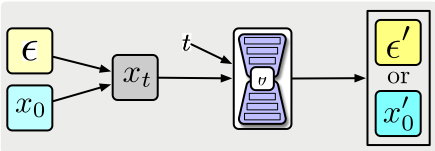
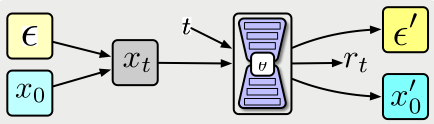
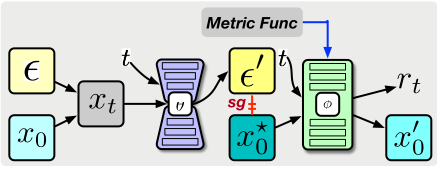
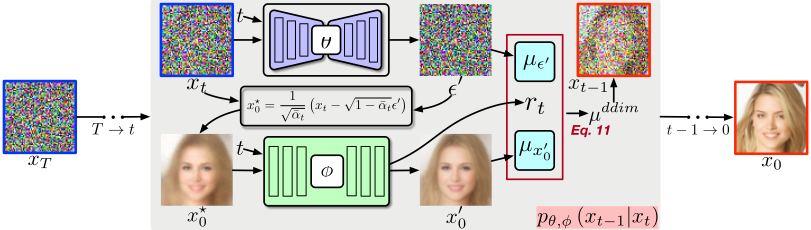
Figure 1: We introduce a cascaded diffusion model that effectively incorporates metric functions in diffusion training. (a) DDPM outputs either ϵ′ or x′0 and uses the corresponding loss in training. (b) Dual Diffusion Model outputs both ϵ′ and x′0 simultaneously with a single network θ, where applying metric functions on x′0 will inevitably disturb the prediction of ϵ′ . (c) Our Cas-DM cascades the main module θ with an extra network ϕ. θ is frozen for the x′0related losses and metric functions. The dashed blue line shows the gradient flow of the metric function. sg denotes stop gradient.
<
l
a
t
e
x
i
s
h
1
_
b
6
4
=
"
J
5
F
2
A
V
W
D
9
B
/
L
o
z
y
Y
Z
I
>
n
c
S
g
N
E
O
r
f
U
P
K
Q
8
H
m
v
d
M
7
w
p
3
k
R
0
T
j
+
q
C
G
X
u
<
l
a
t
e
x
i
s
h
1
_
b
6
4
=
"
J
5
F
2
A
V
W
D
9
B
/
L
o
z
y
Y
Z
I
>
n
c
S
g
N
E
O
r
f
U
P
K
Q
8
H
m
v
d
M
7
w
p
3
k
R
0
T
j
+
q
C
G
X
u
<
l
a
t
e
x
i
s
h
1
_
b
6
4
=
"
J
5
F
2
A
V
W
D
9
B
/
L
o
z
y
Y
Z
I
>
n
c
S
g
N
E
O
r
f
U
P
K
Q
8
H
m
v
d
M
7
w
p
3
k
R
0
T
j
+
q
C
G
X
u
<
l
a
t
e
x
i
s
h
1
_
b
6
4
=
"
T
u
n
f
z
d
N
A
R
B
S
y
Z
2
0
3
H
O
m
I
>
7
c
V
D
L
g
E
r
U
Y
9
o
P
K
Q
8
5
J
v
C
w
F
k
G
j
q
p
X
W
/
+
M
<
l
a
t
e
x
i
s
h
1
_
b
6
4
=
"
T
u
n
f
z
d
N
A
R
B
S
y
Z
2
0
3
H
O
m
I
>
7
c
V
D
L
g
E
r
U
Y
9
o
P
K
Q
8
5
J
v
C
w
F
k
G
j
q
p
X
W
/
+
M
<
l
a
t
e
x
i
s
h
1
_
b
6
4
=
"
T
u
n
f
z
d
N
A
R
B
S
y
Z
2
0
3
H
O
m
I
>
7
c
V
D
L
g
E
r
U
Y
9
o
P
K
Q
8
5
J
v
C
w
F
k
G
j
q
p
X
W
/
+
M
<
l
a
t
e
x
i
s
h
1
_
b
6
4
=
"
o
9
U
N
O
A
g
n
c
W
Y
z
M
v
q
d
8
S
m
f
0
I
>
B
V
D
L
E
y
r
P
K
2
Q
5
H
J
p
7
w
F
3
k
R
C
u
+
/
G
X
Z
j
T
<
l
a
t
e
x
i
s
h
1
_
b
6
4
=
"
o
9
U
N
O
A
g
n
c
W
Y
z
M
v
q
d
8
S
m
f
0
I
>
B
V
D
L
E
y
r
P
K
2
Q
5
H
J
p
7
w
F
3
k
R
C
u
+
/
G
X
Z
j
T
<
l
a
t
e
x
i
s
h
1
_
b
6
4
=
"
o
9
U
N
O
A
g
n
c
W
Y
z
M
v
q
d
8
S
m
f
0
I
>
B
V
D
L
E
y
r
P
K
2
Q
5
H
J
p
7
w
F
3
k
R
C
u
+
/
G
X
Z
j
T
<
l
a
t
e
x
i
s
h
1
_
b
6
4
=
"
2
+
F
9
C
o
E
A
R
p
8
J
g
P
r
n
Z
k
I
c
>
B
7
V
N
S
3
U
q
/
L
0
K
D
w
m
G
v
H
T
u
5
Q
M
f
d
W
j
y
O
X
z
Y
<
l
a
t
e
x
i
s
h
1
_
b
6
4
=
"
3
F
n
j
k
J
y
P
V
G
f
E
0
C
L
R
D
U
>
A
B
8
H
c
S
g
N
K
2
W
O
X
d
M
o
T
z
p
m
Q
w
5
u
q
/
+
7
r
v
I
Z
Y
9
<
l
a
t
e
x
i
s
h
1
_
b
6
4
=
"
F
G
3
P
E
z
n
T
X
A
k
O
W
K
0
u
D
>
B
+
c
V
L
S
N
J
r
U
d
m
v
Y
7
C
Z
o
/
8
f
w
H
M
9
p
q
2
g
I
y
5
Q
j
R
<
l
a
t
e
x
i
s
h
1
_
b
6
4
=
"
2
+
F
9
C
o
E
A
R
p
8
J
g
P
r
n
Z
k
I
c
>
B
7
V
N
S
3
U
q
/
L
0
K
D
w
m
G
v
H
T
u
5
Q
M
f
d
W
j
y
O
X
z
Y
<
l
a
t
e
x
i
s
h
1
_
b
6
4
=
"
2
+
F
9
C
o
E
A
R
p
8
J
g
P
r
n
Z
k
I
c
>
B
7
V
N
S
3
U
q
/
L
0
K
D
w
m
G
v
H
T
u
5
Q
M
f
d
W
j
y
O
X
z
Y
<
l
a
t
e
x
i
s
h
1
_
b
6
4
=
"
C
S
y
X
W
U
z
L
A
d
k
w
M
8
Z
5
m
g
>
B
3
c
V
N
E
J
r
q
/
9
0
n
F
7
o
2
p
Q
+
D
I
G
T
u
j
Y
O
f
v
R
K
P
H
<
l
a
t
e
x
i
s
h
1
_
b
6
4
=
"
T
q
k
w
M
U
m
5
D
Q
p
V
/
A
2
O
I
g
0
X
>
B
n
c
L
S
N
E
y
r
f
Y
9
o
P
K
8
H
J
d
z
7
F
v
3
G
j
W
Z
u
R
C
+
<
l
a
t
e
x
i
s
h
1
_
b
6
4
=
"
I
q
F
O
+
P
j
G
S
J
g
o
Z
E
M
Y
u
>
A
B
8
X
c
V
D
N
K
2
W
w
C
d
R
L
T
k
z
p
7
m
Q
5
3
/
0
U
H
f
y
n
9
v
r
<
l
a
t
e
x
i
s
h
1
_
b
6
4
=
"
F
G
3
P
E
z
n
T
X
A
k
O
W
K
0
u
D
>
B
+
c
V
L
S
N
J
r
U
d
m
v
Y
7
C
Z
o
/
8
f
w
H
M
9
p
q
2
g
I
y
5
Q
j
R
<
l
a
t
e
x
i
s
h
1
_
b
6
4
=
"
F
5
J
L
9
I
o
0
+
q
n
R
B
T
Z
g
f
N
Y
>
A
8
c
V
D
S
M
3
U
2
v
k
w
K
j
P
7
C
X
p
m
y
O
z
H
Q
r
/
u
W
E
G
d
<
l
a
t
e
x
i
s
h
1
_
b
6
4
=
"
I
q
F
O
+
P
j
G
S
J
g
o
Z
E
M
Y
u
>
A
B
8
X
c
V
D
N
K
2
W
w
C
d
R
L
T
k
z
p
7
m
Q
5
3
/
0
U
H
f
y
n
9
v
r
<
l
a
t
e
x
i
s
h
1
_
b
6
4
=
"
I
q
F
O
+
P
j
G
S
J
g
o
Z
E
M
Y
u
>
A
B
8
X
c
V
D
N
K
2
W
w
C
d
R
L
T
k
z
p
7
m
Q
5
3
/
0
U
H
f
y
n
9
v
r
<
l
a
t
e
x
i
s
h
1
_
b
6
4
=
"
F
G
3
P
E
z
n
T
X
A
k
O
W
K
0
u
D
>
B
+
c
V
L
S
N
J
r
U
d
m
v
Y
7
C
Z
o
/
8
f
w
H
M
9
p
q
2
g
I
y
5
Q
j
R
<
l
a
t
e
x
i
s
h
1
_
b
6
4
=
"
T
q
k
w
M
U
m
5
D
Q
p
V
/
A
2
O
I
g
0
X
>
B
n
c
L
S
N
E
y
r
f
Y
9
o
P
K
8
H
J
d
z
7
F
v
3
G
j
W
Z
u
R
C
+
Cas-DM
w/o LPIPS
Cas-DM
w/ LPIPS
LPIPS loss as a prototype, we explore how to effectively incorporate metric functions into diffusion models. The primary challenge lies in the mismatch between the multi-step denoising process that generates noise predictions, and the single-step metric function computation that requires a clean image.
We next zoom in on the DDPM process to better illustrate this mismatch challenge. As shown in Figure 1, DDPM adopts a diffusion process to gradually add noise to a clean image x0, producing a series of noisy images xi, i ∈ 1, ..., T . Then the model is trained to perform a reverse denoising process by predicting a less noisy image xt-1 from xt. Instead of directly predicting xt-1, DDPM gives two ways to obtain xt-1: predicting either the clean image x0 or the added Gaussian noise ϵt. The training objective of the DDPM is the mean squared error (MSE) between the predicted and ground truth x0 or ϵt, where a few papers [Nichol and Dhariwal, 2021; Benny and Wolf, 2022] found the latter (i.e., the ϵ mode) to be empirically better than predicting x0 (i.e., the x0 mode).
The two modes in DDPM provide us with two initial options for bringing metric functions. Applying metric functions directly to predicted noise ϵ is unreasonable because the networks for metric functions are trained on RGB images and produce meaningless signals when applied to noise ϵ. Despite the promising improvements, this x0-mode model with metric functions still suffers from the low performance from the x0-mode baseline, when compared with the ϵ-mode. This naturally motivates the question: can we merge the two modes and further improve the ϵ-mode performance with the metric function? To achieve this, we need a diffusion model that can generate x0 while maintaining the ϵ-mode performance. The goal is made possible with the Dynamic Dual Diffusion Model [Benny and Wolf, 2022], where authors expand the output channel of the DDPM's network θ to let it predict x0, ϵ, and a dynamic mixing weight, simultaneously. The experiments show that Dual Diffusion Model outperforms both the x0- and ϵ-modes of DDPM. However, naively adding the metric function to its x0 head will not work. This is because the additional metric functions on the predicted x0 updates the shared backbone, which disturbs the ϵ prediction and leads to degraded performance.
To this end, we propose a new Cascaded Diffusion Model (Cas-DM), which allows the application of metric functions to DDPM by addressing the above-mentioned issues. We cascade two network modules, where the first model θ takes the noisy image xt and predicts the added noise. We then derive an initial estimation of x0 based on xt and ϵθ following equations of the diffusion process. Next, the second model ϕ takes the initial x0 prediction and the time step t and output the refined prediction of x0 as well as the dynamic weight to mix x0 and ϵ predictions in diffusion model sampling. In training, we apply the metric function to the predicted x0 of ϕ, which is used to update the parameters of ϕ and stop the gradient for θ. This ensures the ϵ branch to be intact while the x0 branch is enhanced by the additional metric function.
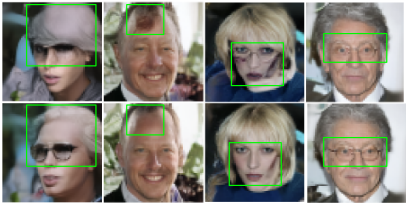
Experimental results on CIFAR10 [Krizhevsky et al., 2009], CelebAHQ [Karras et al., 2017], LSUNChurch/Bedroom [Yu et al., 2015], and ImageNet [Deng et al., 2009] show that applying the LPIPS loss on Cas-DM can effectively improve its performance, leading to the state-ofthe-art image quality (measured by FID [Heusel et al., 2017] and sFID [Nash et al., 2021] on most datasets. Through a side-by-side visual comparison of Cas-DM with/without LPIPS using a fixed seed, we also discover that training diffusion models with the LPIPS loss makes the generated images have fewer artifacts as shown in Fig. 2. This work demonstrates that with a careful architecture design, metric functions such as the LPIPS loss can be used to improve the performance of diffusion models.
Our contributions are three-fold:
- We explore the methodology and efficacy of introducing extra metric functions into DDPM, resulting in a framework that can effectively incorporate metric functions during diffusion training.
- We introduce Cas-DM that addresses the main challenge in adding metric functions to DDPM by jointly predicting the added noise and the original clean image in each diffusion training and denoising step.
- Experiment results show that Cas-DM with the LPIPS loss consistently outperforms the state of the art across various datasets with different sampling steps.
2 RelatedWork
Denoising Diffusion Probabilistic Models. Starting from DDPM introduced by Ho et al., diffusion models [Ho et al., 2020; Dhariwal and Nichol, 2021; Nichol and Dhariwal, 2021; Rombach et al., 2022] have outperformed GANs [Goodfellow et al., 2014; Karras et al., 2017; Mao et al., 2017; Brock et al., 2018; Wu et al., 2019; Karras et al., 2019; Karras et al., 2020], Variational AutoEncoders (VAE) [Kingma and Welling, 2013; Van Den Oord et al., 2017; Vahdat and Kautz, 2020], auto-regressive models [Van Den Oord et al., 2016b; Van den Oord et al., 2016a; Salimans et al., 2017; Chen et al., 2018; Razavi et al., 2019; Esser et al., 2021], and normalization flows [Dinh et al., 2014; Dinh et al., 2017; Kingma and Dhariwal, 2018; Ho et al., 2019] in terms of image quality while having a pretty stable training process. The diffusion model is in line with the score-based [Song and Ermon, 2019; Song and Ermon, 2020] and Markov-chains-based [Bengio et al., 2014;
<
l
a
t
e
x
i
s
h
1
_
b
6
4
=
"
c
v
N
X
H
U
P
C
L
8
p
2
/
5
V
Z
o
9
G
>
A
B
n
D
S
g
E
O
y
r
f
Y
K
Q
I
J
k
7
M
d
m
3
j
0
F
R
q
W
u
z
w
T
+
<
l
a
t
e
x
i
s
h
1
_
b
6
4
=
"
H
P
j
X
K
z
5
v
N
I
0
w
J
3
k
>
A
B
7
c
V
D
L
S
g
M
F
9
Z
W
Y
R
n
y
m
2
U
/
+
O
G
r
u
p
o
E
8
C
q
d
Q
T
f
<
l
a
t
e
x
i
s
h
1
_
b
6
4
=
"
3
f
L
m
V
F
r
Z
Y
C
G
O
U
S
u
k
9
g
P
>
A
B
n
c
D
N
E
y
o
d
X
8
R
z
Q
J
2
I
7
w
v
p
j
q
T
+
K
W
0
/
H
M
5
<
l
a
t
e
x
i
s
h
1
_
b
6
4
=
"
o
9
U
N
O
A
g
n
c
W
Y
z
M
v
q
d
8
S
m
f
0
I
>
B
V
D
L
E
y
r
P
K
2
Q
5
H
J
p
7
w
F
3
k
R
C
u
+
/
G
X
Z
j
T
<
l
a
t
e
x
i
s
h
1
_
b
6
4
=
"
o
w
7
c
f
2
5
y
H
R
K
g
C
m
0
Q
q
P
M
>
A
B
8
X
V
N
S
E
J
3
U
r
/
9
I
v
T
W
F
+
L
p
Y
d
D
j
n
u
O
k
Z
z
G
<
l
a
t
e
x
i
s
h
1
_
b
6
4
=
"
2
T
y
Y
o
9
p
r
P
Z
K
G
8
7
N
C
W
z
v
3
M
>
A
B
H
c
V
D
L
S
g
E
O
d
Q
U
n
J
m
R
X
k
/
w
I
q
u
0
F
j
5
+
f
<
l
a
t
e
x
i
s
h
1
_
b
6
4
=
"
2
T
y
Y
o
9
p
r
P
Z
K
G
8
7
N
C
W
z
v
3
M
>
A
B
H
c
V
D
L
S
g
E
O
d
Q
U
n
J
m
R
X
k
/
w
I
q
u
0
F
j
5
+
f
<
l
a
t
e
x
i
s
h
1
_
b
6
4
=
"
u
o
A
X
J
0
L
j
z
M
k
C
Z
T
c
I
P
O
w
F
>
U
n
V
N
H
R
S
E
D
Y
9
W
7
p
Q
r
B
v
3
2
y
K
m
f
5
/
g
+
G
q
d
8
<
l
a
t
e
x
i
s
h
1
_
b
6
4
=
"
2
+
F
9
C
o
E
A
R
p
8
J
g
P
r
n
Z
k
I
c
>
B
7
V
N
S
3
U
q
/
L
0
K
D
w
m
G
v
H
T
u
5
Q
M
f
d
W
j
y
O
X
z
Y
<
l
a
t
e
x
i
s
h
1
_
b
6
4
=
"
C
S
y
X
W
U
z
L
A
d
k
w
M
8
Z
5
m
g
>
B
3
c
V
N
E
J
r
q
/
9
0
n
F
7
o
2
p
Q
+
D
I
G
T
u
j
Y
O
f
v
R
K
P
H
<
l
a
t
e
x
i
s
h
1
_
b
6
4
=
"
M
7
j
K
E
H
v
r
0
k
c
W
U
P
S
N
w
>
A
B
8
n
V
D
L
F
J
3
d
m
u
+
Y
T
g
y
I
/
R
z
G
5
2
C
9
O
p
X
Z
Q
f
q
o
<
l
a
t
e
x
i
s
h
1
_
b
6
4
=
"
F
G
3
P
E
z
n
T
X
A
k
O
W
K
0
u
D
>
B
+
c
V
L
S
N
J
r
U
d
m
v
Y
7
C
Z
o
/
8
f
w
H
M
9
p
q
2
g
I
y
5
Q
j
R
<
l
a
t
e
x
i
s
h
1
_
b
6
4
=
"
O
k
7
9
Q
Z
V
5
m
S
F
I
u
J
v
w
>
A
B
+
X
c
D
L
N
2
p
r
f
U
d
o
g
q
T
0
K
C
Y
G
y
/
R
3
P
M
H
8
W
j
n
E
z
<
l
a
t
e
x
i
s
h
1
_
b
6
4
=
"
g
7
+
H
C
S
8
M
D
X
Y
q
I
y
o
K
Q
E
>
A
B
/
n
c
V
L
N
F
J
3
U
2
v
5
r
R
j
9
P
p
T
0
Z
m
k
d
w
W
u
G
z
f
O
<
l
a
t
e
x
i
s
h
1
_
b
6
4
=
"
T
q
k
w
M
U
m
5
D
Q
p
V
/
A
2
O
I
g
0
X
>
B
n
c
L
S
N
E
y
r
f
Y
9
o
P
K
8
H
J
d
z
7
F
v
3
G
j
W
Z
u
R
C
+
<
l
a
t
e
x
i
s
h
1
_
b
6
4
=
"
k
P
q
m
B
y
J
2
T
5
j
S
g
f
Z
o
>
A
C
E
H
c
V
D
L
N
F
3
r
0
R
9
G
w
p
W
M
u
n
X
8
Y
+
I
O
z
7
U
v
d
/
Q
K
<
l
a
t
e
x
i
s
h
1
_
b
6
4
=
"
/
5
8
f
J
m
Y
O
A
R
v
G
I
>
B
7
n
c
V
D
L
S
g
N
E
z
M
r
H
C
F
o
W
k
T
2
w
y
0
u
X
Q
P
j
U
9
d
Z
3
q
K
p
+
<
l
a
t
e
x
i
s
h
1
_
b
6
4
=
"
B
U
O
N
n
d
0
S
J
I
m
K
R
z
2
y
k
c
>
A
8
V
D
L
F
p
r
f
Z
u
o
v
g
q
T
7
C
Q
Y
M
+
H
G
/
3
P
X
9
j
W
5
w
E
<
l
a
t
e
x
i
s
h
1
_
b
6
4
=
"
n
T
S
O
Q
A
p
9
u
V
m
8
v
/
r
I
>
B
H
c
D
L
g
M
F
3
j
Z
X
W
Y
G
E
7
o
U
+
5
2
K
J
k
0
N
y
R
C
d
w
q
z
P
f
<
l
a
t
e
x
i
s
h
1
_
b
6
4
=
"
3
f
L
m
V
F
r
Z
Y
C
G
O
U
S
u
k
9
g
P
>
A
B
n
c
D
N
E
y
o
d
X
8
R
z
Q
J
2
I
7
w
v
p
j
q
T
+
K
W
0
/
H
M
5
<
l
a
t
e
x
i
s
h
1
_
b
6
4
=
"
J
5
F
2
A
V
W
D
9
B
/
L
o
z
y
Y
Z
I
>
n
c
S
g
N
E
O
r
f
U
P
K
Q
8
H
m
v
d
M
7
w
p
3
k
R
0
T
j
+
q
C
G
X
u
Salimans et al., 2015] generative models, where the diffusion process can also be theoretically modeled by the discretization of a continuous SDE [Song et al., 2020b]. Diffusion models have been used to generate multimedia content such as audio [Oord et al., 2016], image [Brock et al., 2018; Saharia et al., 2022b; Ramesh et al., 2022], and video [Singer et al., 2022; Zhou et al., 2022; Ho et al., 2022; An et al., 2023; Blattmann et al., 2023]. The open-sourced latent diffusion model [Rombach et al., 2022] sparks numerous image generation models based on conditions such as text [Saharia et al., 2022b; Ramesh et al., 2022; Yang et al., 2023], sketch/segmentation maps [Rombach et al., 2022; Fan et al., 2023], and images in distinct domains [Saharia et al., 2022a].
Improving DiffusionModels. The success of the diffusion model has drawn increasing interest in improving its algorithmic design. [Nichol and Dhariwal, 2021] improve the loglikelihood estimation and the generation quality of the DDPM by introducing a cosine-based noise schedule and letting the model learn variances of the reverse diffusion process in addition to the mean value in training. [Rombach et al., 2022] introduce the latent diffusion model (LDM), which deploys the diffusion model on the latent space of an auto-encoder to reduce the computation cost. [Song et al., 2020a] improve the sampling speed of the diffusion model by proposing an implicit diffusion model called DDIM. In terms of the architecture design, Benny and Wolf propose Dual Diffusion Model, which learns to predict ϵ and x0 simultaneously in training, leading to improved generation quality. For the training approach, [Jolicoeur-Martineau et al., 2020] explore adopting the adversarial loss as an extra loss to improve the prediction of x0. This work studies an orthogonal improvement aspect of diffusion models - How to use additional metric functions to improve the generation performance. We draw the inspiration from [Jolicoeur-Martineau et al., 2020] and [Benny and Wolf, 2022]. While [Jolicoeur-Martineau et al., 2020] found that the adversarial objective based on a learnable discriminator is unnecessary for powerful generative models, we found that metric functions based on a fixed pre-trained network can achieve improved performance with a proper network architecture and training approach. The proposed diffusion model backbone shares the same idea of the dual output as [Benny and Wolf, 2022] but has different architectures and training p✓,φ (xt-1|xt)
strategies.
3 Preliminary
This section introduces the forward/backward diffusion processes and the training losses of DDPM, which will be used to derive the proposed Cas-DM later. The theory of diffusion models consists of a forward and a backward process. Given a clean image x0 and a constant T to denote the maximum steps, the forward process gradually adds randomly sampled noise from a pre-defined distribution to x0, leading to a sequence of images xt for time steps t ∈ [1, ..., T], where xt is derived by adding noise to xt-1. DDPM [Ho et al., 2020] uses the Gaussian noise, resulting in the following transition
q (xt|x0) := N (xt; √ ¯αtx0, (1 - ¯αt) I) , (2) where αt := 1 - βt and ¯αt := ∏ti=1 αi. Via Eq. 2, for any t ∈ [1, T ], one can easily get xt given x0 and a noise sample ϵ ∼ N (0, 1),
where βt ∈ (0, 1] are pre-defined constants. Eq. 1 can derive a direct transition from x0 to xt,
Given a fixed xt, Eq. 3 bridges x0 and ϵ.
The backward process gradually recovers x0 from the noisy image xT ∈ N (xT ; 0, I), where for each t, the transition from xt to xt-1 is p (xt-1|xt), which is the ultimate target to learn of the diffusion model. The backward transition p is then approximated by
The training objective is to maximize the variational lower bound (VLB) of the data likelihood. DDPM simplifies the training process to be first uniformly sample a t from [1, T] and then compute,
which is further simplified to be
where
˜µt (xt, x0, t) and µθ (xt, t) are the mean values of q (xt-1|xt, x0) and pθ (xt-1|xt), respectively. DDPM parameterizes µθ with a neural network θ that either predicts x0 or ϵ, where two types of network outputs are denoted as x′0 and ϵ′ , respectively. We can obtain µθ via Eq. 7 with x′0 . If the network predicts ϵ′ , we first get an indirect x0 prediction from ϵ′ via Eq. 3. Then we can compute µθ via Eq. 7 with the indirect x0 prediction. Ho et al. empirically demonstrate that ϵ′ usually yields better image quality, i.e., lower FID score [Heusel et al., 2017] than x′0 . One may refer to [Benny and Wolf, 2022] and [Ho et al., 2020] for more detailed mathematical derivation.
4 Method
This section introduces the network architecture of our CasDM as well as its training and sampling processes.
4.1 Cascaded DiffusionModel
As shown in Fig. 3, the backbone of Cas-DM consists of two cascaded networks, denoted as θ and ϕ. θ is used to predict the added noise ϵ, and ϕ is to predict the clean image x0. The architectures of both θ follow the improved diffusion [Nichol and Dhariwal, 2021] while ϕ is a network whose input and output tensors have the same shape. We use the model output from both θ and ϕ to obtain an estimation of µθ,ϕ (xt, t), detailed as follows.
In training, θ takes the noisy image xt and the uniformly sampled time step t as the input and predict the added noise ϵ′ , θ is equivalent to a vanilla DDPM predicting ϵ′ . Based on Eq. 3, ϵ′ can lead to an indirect estimation of x0 as follows,
Next, based on ϵ′ , we obtain an estimation of µθ (xt, t), which is denoted as µϵ′ (xt, t),
Eq. 9 is derived by replacing x0 in Eq. 7 with x⋆0 in Eq. 8. ϕ takes x⋆0 and t as the input and output x′0 as well as a dynamic value rt, which is used to balance the strength of θ and ϕ in computing µθ,ϕ (xt, t) later. The application of rt is directly inspired by dual diffusion [Benny and Wolf, 2022], where their experiments show that rt can better balance the effects of two types of predictions and lead to improved performance. We follow this setting and obtain rt by adding an extra channel to the output layer of ϕ. The output of ϕ is the concatenation of x′0 ∈ RH,W,C and rt ∈ RH,W,1 along the channel dimension. We obtain the estimation of µθ (xt, t) based on x′0 as
<
l
a
t
e
x
i
s
h
1
_
b
6
4
=
"
J
5
F
2
A
V
W
D
9
B
/
L
o
z
y
Y
Z
I
>
n
c
S
g
N
E
O
r
f
U
P
K
Q
8
H
m
v
d
M
7
w
p
3
k
R
0
T
j
+
q
C
G
X
u
<
l
a
t
e
x
i
s
h
1
_
b
6
4
=
"
T
u
n
f
z
d
N
A
R
B
S
y
Z
2
0
3
H
O
m
I
>
7
c
V
D
L
g
E
r
U
Y
9
o
P
K
Q
8
5
J
v
C
w
F
k
G
j
q
p
X
W
/
+
M
<
l
a
t
e
x
i
s
h
1
_
b
6
4
=
"
5
Y
A
2
V
w
W
U
R
O
7
G
D
Q
N
X
0
y
>
C
H
c
T
E
F
z
n
Z
K
o
k
I
S
r
p
J
B
+
j
3
L
m
g
u
9
d
q
8
v
/
f
M
P
<
l
a
t
e
x
i
s
h
1
_
b
6
4
=
"
o
9
U
N
O
A
g
n
c
W
Y
z
M
v
q
d
8
S
m
f
0
I
>
B
V
D
L
E
y
r
P
K
2
Q
5
H
J
p
7
w
F
3
k
R
C
u
+
/
G
X
Z
j
T
<
l
a
t
e
x
i
s
h
1
_
b
6
4
=
"
C
J
G
8
7
p
U
D
B
/
w
3
+
T
Z
A
v
c
j
R
O
Y
>
H
M
F
I
d
m
k
K
V
g
r
N
S
E
W
X
Q
u
2
P
y
f
q
0
5
z
L
o
9
n
<
l
a
t
e
x
i
s
h
1
_
b
6
4
=
"
2
+
F
9
C
o
E
A
R
p
8
J
g
P
r
n
Z
k
I
c
>
B
7
V
N
S
3
U
q
/
L
0
K
D
w
m
G
v
H
T
u
5
Q
M
f
d
W
j
y
O
X
z
Y
<
l
a
t
e
x
i
s
h
1
_
b
6
4
=
"
2
T
y
Y
o
9
p
r
P
Z
K
G
8
7
N
C
W
z
v
3
M
>
A
B
H
c
V
D
L
S
g
E
O
d
Q
U
n
J
m
R
X
k
/
w
I
q
u
0
F
j
5
+
f
<
l
a
t
e
x
i
s
h
1
_
b
6
4
=
"
F
G
3
P
E
z
n
T
X
A
k
O
W
K
0
u
D
>
B
+
c
V
L
S
N
J
r
U
d
m
v
Y
7
C
Z
o
/
8
f
w
H
M
9
p
q
2
g
I
y
5
Q
j
R
<
l
a
t
e
x
i
s
h
1
_
b
6
4
=
"
L
F
D
k
B
H
Y
7
f
w
r
W
O
g
N
c
n
0
C
y
5
>
A
+
V
S
J
3
U
2
P
R
G
q
K
I
X
j
Q
m
Z
u
v
M
9
d
8
p
z
E
T
/
o
<
l
a
t
e
x
i
s
h
1
_
b
6
4
=
"
3
F
n
j
k
J
y
P
V
G
f
E
0
C
L
R
D
U
>
A
B
8
H
c
S
g
N
K
2
W
O
X
d
M
o
T
z
p
m
Q
w
5
u
q
/
+
7
r
v
I
Z
Y
9
<
l
a
t
e
x
i
s
h
1
_
b
6
4
=
"
C
S
y
X
W
U
z
L
A
d
k
w
M
8
Z
5
m
g
>
B
3
c
V
N
E
J
r
q
/
9
0
n
F
7
o
2
p
Q
+
D
I
G
T
u
j
Y
O
f
v
R
K
P
H
<
l
a
t
e
x
i
s
h
1
_
b
6
4
=
"
2
T
y
Y
o
9
p
r
P
Z
K
G
8
7
N
C
W
z
v
3
M
>
A
B
H
c
V
D
L
S
g
E
O
d
Q
U
n
J
m
R
X
k
/
w
I
q
u
0
F
j
5
+
f
<
l
a
t
e
x
i
s
h
1
_
b
6
4
=
"
J
9
A
D
B
S
L
H
u
f
E
/
j
O
M
3
8
>
n
c
Z
N
F
I
Y
X
m
R
W
V
C
y
w
r
2
0
k
+
T
q
G
Q
5
v
o
g
z
7
U
d
K
p
P
<
l
a
t
e
x
i
s
h
1
_
b
6
4
=
"
I
q
F
O
+
P
j
G
S
J
g
o
Z
E
M
Y
u
>
A
B
8
X
c
V
D
N
K
2
W
w
C
d
R
L
T
k
z
p
7
m
Q
5
3
/
0
U
H
f
y
n
9
v
r
<
l
a
t
e
x
i
s
h
1
_
b
6
4
=
"
O
k
7
9
Q
Z
V
5
m
S
F
I
u
J
v
w
>
A
B
+
X
c
D
L
N
2
p
r
f
U
d
o
g
q
T
0
K
C
Y
G
y
/
R
3
P
M
H
8
W
j
n
E
z
<
l
a
t
e
x
i
s
h
1
_
b
6
4
=
"
g
7
+
H
C
S
8
M
D
X
Y
q
I
y
o
K
Q
E
>
A
B
/
n
c
V
L
N
F
J
3
U
2
v
5
r
R
j
9
P
p
T
0
Z
m
k
d
w
W
u
G
z
f
O
<
l
a
t
e
x
i
s
h
1
_
b
6
4
=
"
T
q
k
w
M
U
m
5
D
Q
p
V
/
A
2
O
I
g
0
X
>
B
n
c
L
S
N
E
y
r
f
Y
9
o
P
K
8
H
J
d
z
7
F
v
3
G
j
W
Z
u
R
C
+
<
l
a
t
e
x
i
s
h
1
_
b
6
4
=
"
P
J
j
Z
C
u
q
X
K
D
g
v
5
0
2
N
R
>
A
B
+
n
c
V
L
S
F
3
r
W
Y
E
7
o
m
U
M
d
T
8
/
f
9
p
I
k
w
H
O
Q
G
z
y
<
l
a
t
e
x
i
s
h
1
_
b
6
4
=
"
P
7
I
E
M
j
J
N
9
H
y
q
m
A
+
F
Y
u
X
/
>
B
n
c
V
D
L
S
g
O
r
f
U
o
K
2
Q
w
k
T
z
0
v
Z
8
5
W
G
d
3
C
R
p
ϕ is to improve the accuracy of the x0 prediction on top of θ's output. The final estimation of µθ,ϕ (xt, t) is
Compared with dual diffusion [Benny and Wolf, 2022], Cas-DM allows the dedicated metric functions to be applied on the x0 branch without influencing the ϵ branch because we could stop the gradients of metric functions on θ. More details will be in the next part.
4.2 Training and Sampling
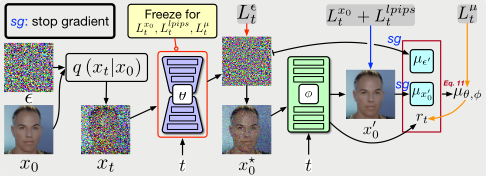
As shown in Fig. 4, we train Cas-DM following the approach of dual diffusion [Benny and Wolf, 2022] with the following loss terms,
The input value of µt, µx′0 , and µϵ′ are omitted for simplicity. [·]sg denotes stop gradients. We use the LPIPS loss [Johnson et al., 2016] from the piq repository* in training to demonstrate that extra metric functions can be applied to CasDM for further improvements,
Here T denotes an image transformation module, which first interpolates an image to the size of 224×224 with the bilinear interpolation, then linearly normalize its value to the range of [0, 1]. In back-propagating, we disconnect θ and ϕ by detaching the whole θ from the computing graph of ϕ, leading to separate loss functions for θ and ϕ:
Since the LPIPS loss only works well on real images, we use Lθt to let θ learn to predict ϵ without the disturbance of the gradient from ϕ and the metric functions, leading to a stable µθ estimation, µϵ′ , as the basis. On top of it, ϕ learns to predict x0, resulting in another estimation µϵ′ . The LPIPS loss can improve the accuracy of µϵ′ , leading to an overall better µθ estimation through Eq. 11.
* https://github.com/photosynthesis-team/piq
| Model | FID↓ | sFID↓ |
|---|---|---|
| CIFAR10 32×32 | ||
| ⋆Gated PixelCNN [Van den Oord et al., 2016a] | 65.93 | - |
| ⋆ EBM [Song and Kingma, 2021] | 38.20 | - |
| ⋆NCSNv2 [Song and Ermon, 2020] | 31.75 | - |
| ⋆ SNGAN-DDLS [Che et al., 2020] | 15.42 | - |
| ⋆ StyleGAN2 + ADA (v1) [Karras et al., 2020] | 3.26 | - |
| ⋆DDPM [Ho et al., 2020] | 32.65 | - |
| ⋆DDIM [Song et al., 2020a] | 5.57 | - |
| ⋆ Improved DDPM [Nichol and Dhariwal, 2021] | 4.58 | - |
| ⋆ Improved DDIM [Nichol and Dhariwal, 2021] | 6.29 | - |
| ⋆Dual Diffusion [Benny and Wolf, 2022] | 5.10 | - |
| ⋆ Consistency Model (CD) [Benny and Wolf, 2022] | 2.93 | - |
| ⋆ Consistency Model (CT) [Benny and Wolf, 2022] | 5.83 | - |
| DDPM (ϵ mode) | 6.79 | 4.97 |
| DDPM (x0 mode) | 17.78 | 6.69 |
| DDPM (x0 + LPIPS) | 9.34 (-8.44) | 6.94 (+0.25) |
| Dual Diffusion | 6.52 | 4.60 |
| Dual Diffusion + LPIPS | 5.65 (-0.87) | 4.89 (+0.29) |
| Cas-DM [ϕUNet] | 6.80 | 5.03 |
| Cas-DM [ϕUNet] + LPIPS | 6.40 (-0.40) | 4.87 (-0.16) |
| Cas-DM [ϕFix-Res] | 6.40 | 4.60 |
| Cas-DM [ϕFix-Res] + LPIPS | 6.28 (-0.12) | 4.57 (-0.03) |
| LSUN Bedroom 64×64 | ||
| DDPM (ϵ mode) | 5.51 | 27.61 |
| DDPM (x0 mode) | 10.28 | 32.13 |
| DDPM (x0 + LPIPS) | 13.14 (+2.86) | 32.93 (+0.80) |
| Dual Diffusion | 5.49 | 27.71 |
| Dual Diffusion + LPIPS | 7.72 (+2.23) | 29.08 (+1.37) |
| Cas-DM [ϕUNet] | 5.29 | 27.80 |
| Cas-DM [ϕUNet] + LPIPS | 5.17 (-0.12) | 27.45 (-0.35) |
| Model | FID↓ | sFID↓ |
|---|---|---|
| CelebAHQ 64×64 | ||
| ⋆DDPM [Ho et al., 2020] | 43.90 | - |
| ⋆DDIM [Song and Ermon, 2020] | 6.15 | - |
| ⋆Dual Diffusion [Benny and Wolf, 2022] | 4.07 | - |
| DDPM (ϵ mode) | 6.34 | 17.16 |
| DDPM (x0 mode) | 8.82 | 19.11 |
| DDPM (x0 + LPIPS) | 10.54 (+1.72) | 21.00 (+1.89) |
| Dual Diffusion | 5.47 | 15.26 |
| Dual Diffusion + LPIPS | 6.86 (+1.39) | 16.06 (+0.80) |
| Cas-DM [ϕUNet] | 5.33 | 14.87 |
| Cas-DM [ϕUNet] + LPIPS | 4.95 (-0.38) | 14.71 (-0.16) |
| Cas-DM [ϕFix-Res] | 5.07 | 14.77 |
| Cas-DM [ϕFix-Res] + LPIPS | 4.64 (-0.43) | 14.32 (-0.45) |
| ImageNet 64×64 | ||
| with guidance | ||
| ⋆ BigGAN-deep [Brock et al., 2018] | 4.06 | 3.96 |
| ⋆ Improved DDPM [Nichol and Dhariwal, 2021] | 2.92 | 3.79 |
| ⋆ADM [Dhariwal and Nichol, 2021] | 2.61 | 3.77 |
| ⋆ADM (dropout) [Dhariwal and Nichol, 2021] | 2.07 | 4.29 |
| without guidance | ||
| ⋆ Consistency Model (CD) [Benny andWolf, 2022] | 4.70 | - |
| ⋆ Consistency Model (CT) [Benny andWolf, 2022] | 11.10 | - |
| DDPM (ϵ mode) | 27.96 | 18.73 |
| DDPM (x0 mode) | 65.09 | 23.86 |
| DDPM (x0 + LPIPS) | 41.41 (-23.68) | 28.20 (+4.34) |
| Dual Diffusion | 38.65 | 18.38 |
| Dual Diffusion + LPIPS | 31.84 (-6.81) | 21.88 (+3.50) |
| Cas-DM [ϕUNet] | 28.34 | 18.46 |
| Cas-DM [ϕUNet] + LPIPS | 27.54 (-0.80) | 18.06 (-0.40) |
We use DDIM [Song et al., 2020a] for sampling. Following dual diffusion [Benny and Wolf, 2022], we obtain the µ estimation via the DDIM's µ computing equation from ϵ′ and x′0 , respectively,
Then the final estimation of the µddim for DDIM sampling is the interpolation of µddim x′0 and µddim ϵ′ based on rt.
5 Experiments
5.1 Implementation Details
DiffusionModel. We implement Cas-DM based on the official code † of improved diffusion [Nichol and Dhariwal,
† https://github.com/openai/improved-diffusion
| Model | CIFAR10 | CelebAHQ | LSUN Bedroom | ImageNet |
|---|---|---|---|---|
| DDPM (x0 mode) + LPIPS | 17.78 -8.44 | 8.82 +1.72 | 10.28 +2.86 | 65.09 -24.68 |
| Dual Diffusion + LPIPS | 6.52 -0.87 | 5.47 +1.39 | 5.49 +2.23 | 38.65 -6.81 |
| Cas-DM [ϕUNet] + LPIPS | 6.80 -0.40 | 5.33 -0.38 | 5.29 -0.12 | 28.34 -0.80 |
2021]. θ is the default U-Net architecture with 128 channels, 3 ResNet blocks per layer, and the learn sigma flag disabled. For hyper-parameters of diffusion models, we use 4000 diffusion steps with the cosine noise scheduler in all experiments, where the KL loss is not used.
Metric Function. We use the LPIPS loss as a prototype metric function following consistency model [Song et al., 2023], where we replace all MaxPooling layers of the LPIPS backbone with AveragePooling operations.

| Model | FID↓ | sFID↓ |
|---|---|---|
| CelebAHQ 64×64 | ||
| Dual Diffusion⋆ Dual Diffusion⋆ + LPIPS | 11.41 8.49 (-2.92) | 19.91 20.10 (+0.19) 15.71 |
| Dual Diffusion† | 5.90 | |
| Dual Diffusion† + LPIPS | 7.62 (+1.71) | 16.55 (+0.84) |
| Cas-DM [ϕUNet] | 5.33 | 14.87 |
| Cas-DM [ϕUNet] + LPIPS | 4.95 (-0.38) | 14.71 (-0.16) |
| LSUN Bedroom 64×64 | ||
| Dual Diffusion⋆ | 9.71 | 31.64 |
| Dual Diffusion⋆ + LPIPS | 13.80 (+4.09) | 34.46 (+2.82) |
| Dual Diffusion† | 6.79 | 28.84 |
| Dual Diffusion† + LPIPS | 9.64 (+2.85) | 30.23 (+1.39) |
| Cas-DM [ϕUNet] | 6.63 | 29.11 |
| Cas-DM [ϕUNet] + LPIPS | 6.34 (-0.29) | 28.71 (-0.40) |
Table 3: Performance Comparison of Cas-DM [ϕUNet] and the variants of Dual Diffusion Models. All the reported scores are based on the best checkpoints of 100k iterations. ⋆ denotes doubling the channel of all UNet layers and † represents cascading two UNets.
Training. Training is conducted on 8 V100 GPUs with 32GB GPU RAM, where the batch size for each GPU is 16, leading to 128 accumulated batch size. We set learning rate to 1e-4 with no learning rate decay. When computing loss functions, λϵ , λx0 , and λµ are set to 1.0 while λlpips is set to 0.1. We train the model for 400k iterations and perform sampling and evaluation with the gap of 20k and 100k when the iteration is less than and higher than 100k, respectively. For each model, we report the best result among all the evaluated checkpoints.
Sampling. When sampling, we use the DDIM sampler and re-space the diffusion step to 100. For each checkpoint, we sample 50k images for CIFAR10 and 10k images for other datasets and compute the evaluation metrics with respect to the training dataset.
5.2 Experiment Settings
Datasets. We conduct experiments on the CIFAR10, CelebAHQ, LSUN Bedroom, and ImageNet datasets. We train the model with image size 32 × 32 on CIFAR10 and 64 × 64 on the others.
Metrics. We compare models with Fr´echet Inception Distance (FID) and sFID. FID and sFID evaluate the distributional similarity between the generated and training images.
FID is based on the pool 3 feature of Inception V3 [Szegedy et al., 2016], while sFID uses mixed 6/conv feature maps. sFID is more sensitive to spatial variability [Nash et al., 2021].
Baselines. We compare Cas-DMwith a few baselines.
- DDPM (ϵ mode). We train DDPM by letting the U-Net predict the added noise ϵ, which is then used to generate images with the DDIM sampler.
- DDPM (x0 mode). It is similar to DDPM (ϵ mode), where the U-Net predicts the clean image x0.
- DDPM (x0) + LPIPS. We add the LPIPS loss in the training of the DDPM (x0 mode). This model is to verify whether adding metric functions can improve the performance of DDPM.
- Dual Diffusion. We re-implement the Dual Diffusion Model based on the official code of the improved diffusion and then train the model with the same setting as other baselines.
- Dual Diffusion + LPIPS. We train the re-implemented Dual Diffusion Model by adding the LPIPS loss to its x0 prediction. This model is to verify whether adding metric functions can improve the performance of the Dual Diffusion Model.
We compare the proposed Cas-DM with the above baselines by conducting two experiments.
- Cas-DM [ϕUNet] & Cas-DM [ϕFix-Res]. We train CasDM with the same settings as other baselines. We consider two variants of Cas-DM, which use UNet and a fixed-resolution CNN as ϕ's backbones, respectively. This experiment is to demonstrate the performance of the vanilla Cas-DM without adding any metric function.
- Cas-DM [ϕUNet] & Cas-DM [ϕFix-Res] + LPIPS. We add the LPIPS loss to the x′0 head of Cas-DM to verify whether the new diffusion model architecture enables the successful application of the LPIPS loss.
5.3 Main Results
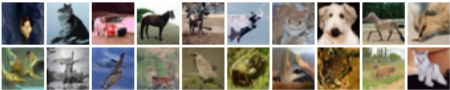
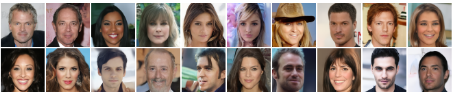
Qualitative Comparison. We conducted a one-by-one visual comparison of Cas-DM with/without LPIPS on CelebAHQ with fixed seed. As shown in Fig. 2, using metric functions (LPIPS) in diffusion model training makes the generated images have fewer artifacts. For example, in the first and fourth columns, using LPIPS corrected the artifacts in generation eye glasses (col 1/4), hair (col 2), and face (col 3). Fig. 5 shows more results generated by Cas-DM [ϕUNet] with LPIPS (the same model in Table 1) using random seed.
| Model | CIFAR10 | CelebAHQ |
|---|---|---|
| Cas-DM [ϕUNet] | 6.80 | 5.33 |
| Cas-DM [ϕUNet] + LPIPS (VGG) | 6.40 | 4.95 |
| Cas-DM [ϕUNet] + ResNet | 6.64 | 5.67 |
| Cas-DM [ϕUNet] + Inception | 6.94 | 5.52 |
| Cas-DM [ϕUNet] + Swin | 6.98 | 5.55 |
| Model | CIFAR10 | CelebAHQ |
|---|---|---|
| Cas-DM [ϕFix-Res] Input: x⋆0 | 6.40 | 5.07 |
| Cas-DM [ϕFix-Res] Input: cancat(x⋆0 , ϵ′) | 7.08 | 5.78 |
Quantitative Comparison. We compare the unconditional image generation performance of Cas-DM [ϕUNet] with baselines in Table 1. We additional list the results in existing papers for reference, which are not comparable since they use different training and sampling settings. For CelebAHQ, LSUN Bedroom, and ImageNet, Cas-DM + LPIPS achieves the best FID and sFID scores among all the compared methods. This indicates that the architecture of Cas-DM is valuable compared with DDPM and Dual Diffusion Model since it produces better results than others on many datasets. More importantly, the improved performance achieves by Cas-DM (both two variants on ϕ backbone) + LPIPS indicates that adding metric functions such as LPIPS is a meaningful strategy to improve the performance of diffusion models, where Cas-DM shows a feasible diffusion model architecture design that can make it work.
Metric Function Effectiveness. Table 2 compares the performance of diffusion models with and without the LPIPS loss. We list the FID increase or drop after the usage of the LPIPS loss on DDPM in x0 mode, Dual Diffusion Model, and Cas-DM [ϕUNet]. DDPM (x0 model) and Dual Diffusion Model achieve improved performance (reduced FID score) after applying the LPIPS loss on CIFAR10 and ImageNet. However, the results are inconsistent on the other two datasets. The proposed Cas-DM [ϕUNet] achieves consistently improved performance among all the compared datasets. This indicates that the architectural design of CasDM enables the effective application of the LPIPS loss on diffusion model training.
Cas-DMv.s. Dual DiffusionVariants. To demonstrate that the better performance of Cas-DM against Dual Diffusion Models [Benny and Wolf, 2022] comes from the novel architecture design rather than more trainable parameters, we conducted experiments by scaling up Dual Diffusion Models to the same parameter size as our Cas-DM and comparing their performance on CelebAHQ and LSUN Bedroom datasets. We consider two scaling-up approaches: 1) Doubling the channel of all UNet layers (marked with ⋆ ) and 2)
| Model | CIFAR10 | CelebAHQ | ||
|---|---|---|---|---|
| Step 10 | Step 100 | Step 10 | Step 100 | |
| DDPM (ϵ mode) | 16.57 | 6.79 | 27.76 | 6.34 |
| Cas-DM [ϕUNet] | 14.91 | 6.80 | 28.67 | 5.32 |
| Cas-DM [ϕUNet] + LPIPS | 13.75 | (-1.16) 6.40 (-0.40) | 27.36 (-1.31) | 4.95 (-0.37) |
cascading two UNets (marked with † ) as Cas-DM does. As shown in Tab. 3, either enlarging channels or using two UNets cannot improve the performance of Dual Diffusion Models. Moreover, the LPIPS metric function does not work on most Dual Diffusion Model variants, demonstrating the Cas-DM's effectiveness in enabling metric functions. More results on other datasets will be added to the revised paper.
5.4 Ablation Study
We conduct an ablation study on metric function's backbones, the input settings of network ϕ in Cas-DM, and the DDIM sampling steps.
Metric Function Backbones. Our experimental results have demonstrated that the LPIPS loss can improve the performance of diffusion models. Table 4 compares the LPIPS loss with other metric function backbones. We use the ResNet [He et al., 2016], Inception v3 [Szegedy et al., 2016], and Swin Transformer [Liu et al., 2021] pre-trained on the ImageNet dataset. Similar to the LPIPS loss, we first extract their features on images at different layers, which is then used to compute the mean square error between corresponding feature maps. We find that ResNet can improve the performance on CIFAR10 while others do not work. We conjecture that the VGG network [Simonyan and Zisserman, 2014] used by the LPIPS loss does not use residual connections, which may make the extracted features contain more semantic information. Similar observations have also been made by [Karras et al., 2020]. We leave the discovery of more powerful metric functions and other strategies for improving the diffusion model training as future work.
Input Types of ϕ. With the motivation that ϵ′ can influence the appearance of x⋆0 according to Eq. 8, we also attempt to take the concatenation of x⋆0 and ϵ′ as the input to train ϕ, which we find does not work well in terms of FID.
Sampling Steps. Table 6 compares the FID of DDPM in the ϵ mode and Cas-DM [ϕUNet] with/without the LPIPS loss on sampling steps 10 and 100. Cas-DM works equally well on small and large sampling steps in terms of enabling the successful application of the LPIPS loss. Note that on different datasets, a comparably larger performance gain may be achieved by either smaller or larger sampling steps.
6 Conclusion
In this paper, we study using metric functions to improve the performance of image diffusion models. To this end, we propose Cas-DM, which uses two cascaded networks to predict the added noise and the clean image, respectively. This architecture design addresses the issue of the dual diffusion model where the LPIPS affects the noise prediction.Experimental results on several datasets show that Cas-DM assisted with the LPIPS loss achieves the state-of-the-art results.
@inproceedings{ijcai2024p64,
  title     = {Bring Metric Functions into Diffusion Models},
  author    = {An, Jie and Yang, Zhengyuan and Wang, Jianfeng and Li, Linjie and Liu, Zicheng and Wang, Lijuan and Luo, Jiebo},
  booktitle = {Proceedings of the Thirty-Third International Joint Conference on
               Artificial Intelligence, {IJCAI-24}},
  publisher = {International Joint Conferences on Artificial Intelligence Organization},
  editor    = {Kate Larson},
  pages     = {578--586},
  year      = {2024},
  month     = {8},
  note      = {Main Track},
  doi       = {10.24963/ijcai.2024/64},
  url       = {https://doi.org/10.24963/ijcai.2024/64},
}
TY - CPAPER TI - Bring Metric Functions into Diffusion Models AU - An, Jie AU - Yang, Zhengyuan AU - Wang, Jianfeng AU - Li, Linjie AU - Liu, Zicheng AU - Wang, Lijuan AU - Luo, Jiebo T2 - Proceedings of the Thirty-Third International Joint Conference on Artificial Intelligence, IJCAI-24 PB - International Joint Conferences on Artificial Intelligence Organization PY - 2024 SP - 578 EP - 586 DO - 10.24963/ijcai.2024/64 UR - https://doi.org/10.24963/ijcai.2024/64 ER -Copied
Machine-readable versions of this paper, for tools and AI agents:





