
SwiftThief: Enhancing Query Efficiency of Model Stealing by Contrastive Learning
Proceedings of the Thirty-Third International Joint Conference on Artificial Intelligence. Main Track. Pages 422-430.
https://doi.org/10.24963/ijcai.2024/47
Keywords
- AI Ethics, Trust, Fairness: ETF: Safety and robustness
- Multidisciplinary Topics and Applications: MTA: Security and privacy
Abstract
Model-stealing attacks are emerging as a severe threat to AI-based services because an adversary can create models that duplicate the functionality of the black-box AI models inside the services with regular query-based access. To avoid detection or query costs, the model-stealing adversary must consider minimizing the number of queries to obtain an accurate clone model. To achieve this goal, we propose SwiftThief, a novel model-stealing framework that utilizes both queried and unqueried data to reduce query complexity. In particular, SwiftThief uses contrastive learning, a recent technique for representation learning. We formulate a new objective function for model stealing consisting of self-supervised (for abundant unqueried inputs from public datasets) and soft-supervised (for queried inputs) contrastive losses, jointly optimized with an output matching loss (for queried inputs). In addition, we suggest a new sampling strategy to prioritize rarely queried classes to improve attack performance. Our experiments proved that SwiftThief could significantly enhance the efficiency of model-stealing attacks compared to the existing methods, achieving similar attack performance using only half of the query budgets of the competing approaches. Also, SwiftThief showed high competence even when a defense was activated for the victims.
- [Aggarwal et al., 2020] Umang Aggarwal, Adrian Popescu, and Céline Hudelot. Active learning for imbalanced datasets. In WACV, 2020.
- [Berthelot et al., 2019] David Berthelot, Nicholas Carlini, Ian Goodfellow, Nicolas Papernot, Avital Oliver, and Colin Raffel. Mixmatch: A holistic approach to semi-supervised learning. In NeurIPS, 2019.
- [Cao et al., 2019] Kaidi Cao, Colin Wei, Adrien Gaidon, Nikos Arechiga, and Tengyu Ma. Learning imbalanced datasets with label-distribution-aware margin loss. In NeurIPS, 2019.
- [Cao et al., 2021] Kaidi Cao, Yining Chen, Junwei Lu, Nikos Arechiga, Adrien Gaidon, and Tengyu Ma. Heteroskedastic and imbalanced deep learning with adaptive regularization. In ICLR, 2021.
- [Chen and He, 2021] Xinlei Chen and Kaiming He. Explor- ing simple siamese representation learning. In CVPR, 2021.
- [Chen et al., 2020] Ting Chen, Simon Kornblith, Mohammad Norouzi, and Geoffrey Hinton. A simple framework for contrastive learning of visual representations. In ICML, 2020.
- [Croce and Hein, 2020] Francesco Croce and Matthias Hein. Reliable evaluation of adversarial robustness with an en- semble of diverse parameter-free attacks. In ICML, 2020.
- [Cui et al., 2019] Yin Cui, Menglin Jia, Tsung-Yi Lin, Yang Song, and Serge Belongie. Class-balanced loss based on effective number of samples. In CVPR, 2019.
- [Fredrikson et al., 2015] Matt Fredrikson, Somesh Jha, and Thomas Ristenpart. Model inversion attacks that exploit confidence information and basic countermeasures. In ACM SIGSAC CCS, 2015.
- [Gong et al., 2021] Xueluan Gong, Yanjiao Chen, Wenbin Yang, Guanghao Mei, and Qian Wang. Inversenet: Aug- menting model extraction attacks with training data inver- sion. In IJCAI, 2021. IJCAI
- [Goodfellow et al., 2014] Ian J. Goodfellow, Jean Pouget- Abadie, Mehdi Mirza, Bing Xu, David Warde-Farley, Sher- jil Ozair, Aaron Courville, and Yoshua Bengio. Generative adversarial networks. In NeurIPS, 2014.
- [Goodfellow et al., 2015] Ian J. Goodfellow, Jonathon Shlens, and Christian Szegedy. Explaining and harnessing adversarial examples. In ICLR, 2015.
- [He et al., 2016] Kaiming He, Xiangyu Zhang, Shaoqing Ren, and Jian Sun. Deep residual learning for image recog- nition. In CVPR, 2016.
- [He et al., 2020] Kaiming He, Haoqi Fan, Yuxin Wu, Saining Xie, and Ross Girshick. Momentum contrast for unsuper- vised visual representation learning. In CVPR, 2020.
- [Helber et al., 2018] Patrick Helber, Benjamin Bischke, An- dreas Dengel, and Damian Borth. Introducing eurosat: A novel dataset and deep learning benchmark for land use and land cover classification. In IGARSS, 2018.
- [Hinton et al., 2014] Geoffrey Hinton, Oriol Vinyals, and Jeff Dean. Distilling the knowledge in a neural network. In NeurIPS workshop, 2014. [Islam et al., 2021]
- Ashraful Islam, Chun-Fu Chen, Rameswar Panda, Leonid Karlinsky, Richard Radke, and Rogerio Feris. A broad study on the transferability of visual representations with contrastive learning. In ICCV, 2021.
- [Jagielski et al., 2020] Matthew Jagielski, Nicholas Carlini, David Berthelot, Alex Kurakin, and Nicolas Papernot. High accuracy and high fidelity extraction of neural networks. In USENIX Security, 2020.
- [Kariyappa et al., 2021] Sanjay Kariyappa, Atul Prakash, and Moinuddin Qureshi. Maze: Data-free model stealing attack using zeroth-order gradient estimation. In CVPR, 2021.
- [Khosla et al., 2020] Prannay Khosla, Piotr Teterwak, Chen Wang, Aaron Sarna, Yonglong Tian, Phillip Isola, Aaron Maschinot, Ce Liu, and Dilip Krishnan. Supervised con- trastive learning. In NeurIPS, 2020.
- [Kim et al., 2020] Minseon Kim, Jihoon Tack, and Sung Ju Hwang. Adversarial self-supervised contrastive learning. In NeurIPS, 2020.
- [Krizhevsky, 2009] Alex Krizhevsky. Learning multiple lay- ers of features from tiny images. Technical report, Univer- sity of Toronto, 2009.
- [Lecun et al., 1998] Yann Lecun, Leon Bottou, Yoshua Ben- gio, and Patrick Haffner. Gradient-based learning ap- plied to document recognition. Proceedings of the IEEE, 86(11):2278-2324, 1998.
- [Lee and Han, 2022] Sangkyun Lee and Sungmin Han. Libra- cam: An activation-based attribution based on the linear approximation of deep neural nets and threshold calibration. In IJCAI, 2022.
- [Lee et al., 2022] Jeonghyun Lee, Sungmin Han, and Sangkyun Lee. Model stealing defense against exploiting information leak through the interpretation of deep neural nets. In IJCAI, 2022. IJCAI
- [Lewis and Gale, 1994] David D. Lewis and William A. Gale. A sequential algorithm for training text classifiers. In ACM SIGIR, 1994.
- [Liu et al., 2022a] Hong Liu, Jeff Z. HaoChen, Adrien Gaidon, and Tengyu Ma. Self-supervised learning is more robust to dataset imbalance. In ICLR, 2022.
- [Liu et al., 2022b] Hong Liu, Jeff Z. HaoChen, Adrien Gaidon, and Tengyu Ma. Self-supervised learning is more robust to dataset imbalance. In ICLR, 2022.
- [Madry et al., 2018] Aleksander Madry, Aleksandar Makelov, Ludwig Schmidt, Dimitris Tsipras, and Adrian Vladu. Towards deep learning models resistant to adversarial attacks. In ICLR, 2018.
- [Mazeika et al., 2022] Mantas Mazeika, Bo Li, and David Forsyth. How to steer your adversary: Targeted and efficient model stealing defenses with gradient redirection. In ICML, 2022.
- [Netzer et al., 2011] Yuval Netzer, Tao Wang, Adam Coates, A. Bissacco, Bo Wu, and A. Ng. Reading digits in natural images with unsupervised feature learning. In NeurIPS workshop, 2011.
- [Orekondy et al., 2019] Tribhuvanesh Orekondy, Bernt Schiele, and Mario Fritz. Knockoff nets: Stealing functionality of black-box models. In CVPR, 2019.
- [Orekondy et al., 2020] Tribhuvanesh Orekondy, Bernt Schiele, and Mario Fritz. Prediction poisoning: Towards defenses against dnn model stealing attacks. In ICLR, 2020.
- [Pal et al., 2020] Soham Pal, Yash Gupta, Aditya Shukla, Aditya Kanade, Shirish K. Shevade, and Vinod Ganapa- thy. Activethief: Model extraction using active learning and unannotated public data. In AAAI, 2020.
- [Papernot et al., 2016] Nicolas Papernot, Patrick McDaniel, Ian Goodfellow, Somesh Jha, Z. Berkay Celik, and Anan- thram Swami. Practical black-box attacks against machine learning. In ACM ASIACCS, 2016.
- [Ribeiro et al., 2015] Mauro Ribeiro, Katarina Grolinger, and Miriam A.M. Capretz. MLaaS: Machine Learning as a Service. In ICMLA, 2015.
- [Russakovsky et al., 2015] Olga Russakovsky, Jia Deng, Hao Su, Jonathan Krause, Sanjeev Satheesh, Sean Ma, Zhiheng Huang, Andrej Karpathy, Aditya Khosla, Michael Bern- stein, Alexander C. Berg, and Li Fei-Fei. ImageNet Large Scale Visual Recognition Challenge. IJCV, 2015.
- [Selvaraju et al., 2019] Ramprasaath R. Selvaraju, Michael Cogswell, Abhishek Das, Ramakrishna Vedantam, Devi Parikh, and Dhruv Batra. Grad-cam: Visual explanations from deep networks via gradient-based localization. IJCV, 2019.
- [Shokri et al., 2017] Reza Shokri, Marco Stronati, Con- gzheng Song, and Vitaly Shmatikov. Membership inference attacks against machine learning models. In IEEE S&P, 2017.
- [Stallkamp et al., 2011] Johannes Stallkamp, Marc Schlips- ing, Jan Salmen, and Christian Igel. The German Traffic Sign Recognition Benchmark: A multi-class classification competition. In IEEE IJCNN, 2011.
- [Tramèr et al., 2016] Florian Tramèr, Fan Zhang, Ari Juels, Michael K. Reiter, and Thomas Ristenpart. Stealing ma- chine learning models via prediction apis. In USENIX Security, 2016.
- [Truong et al., 2021] Jean-Baptiste Truong, Pratyush Maini, Robert J. Walls, and Nicolas Papernot. Data-free model extraction. In CVPR, 2021.
- [Tseng, 2001] Paul Tseng. Convergence of a block coordinate descent method for nondifferentiable minimization. Jour- nal of optimization theory and applications, 109(3):475, 2001.
- [Xiao et al., 2022] Yaxin Xiao, Qingqing Ye, Haibo Hu, Huadi Zheng, Chengfang Fang, and Jie Shi. MExMI: Pool- based active model extraction crossover membership infer- ence. In NeurIPS, 2022.
- [Ye et al., 2019] Shaokai Ye, Kaidi Xu, Sijia Liu, Jan-Henrik Lambrechts, Huan Zhang, Aojun Zhou, Kaisheng Ma, Yanzhi Wang, and Xue Lin. Adversarial robustness vs. model compression, or both? In ICCV, October 2019.
- [Yu et al., 2020] Honggang Yu, Kaichen Yang, Teng Zhang, Yun-Yun Tsai, Tsung-Yi Ho, and Yier Jin. Cloudleak: Large-scale deep learning models stealing through adver- sarial examples. In NDSS, 2020.
- [Zhang et al., 2022] Jie Zhang, Bo Li, Jianghe Xu, Shuang Wu, Shouhong Ding, Lei Zhang, and Chao Wu. Towards efficient data free black-box adversarial attack. In CVPR, pages 15115-15125, June 2022.
- [Zhao et al., 2023] Shiqian Zhao, Kangjie Chen, Meng Hao, Jian Zhang, Guowen Xu, Hongwei Li, and Tianwei Zhang. Extracting cloud-based model with prior knowledge. In arXiv, 2023.
- [Zhou et al., 2020] Mingyi Zhou, Jing Wu, Yipeng Liu, Shuaicheng Liu, and Ce Zhu. Dast: Data-free substitute training for adversarial attacks. In CVPR, 2020.
References were extracted automatically from the PDF and may contain errors.
Full text extracted automatically from the PDF; figures, tables and equations may differ. The PDF is the version of record.
1 Introduction
An increasing number of AI models are commercialized and provided as cloud-based services [Ribeiro et al., 2015], with the remarkable success of deep neural networks. AI models in such services are valuable intellectual properties for developers since training and model optimization typically require significant research and implementation costs. Such AI models may seem well-protected since they are black boxes; their details are inaccessible from the outside world. However, recent studies have revealed that an adversary can create a clone model that mimics the functionality of the black-box AI
∗Corresponding author
model (the victim) by collecting the victim model's responses to adversarial queries.
Such model stealing attacks have been improved in several directions since the early works [Tramèr et al., 2016; Papernot et al., 2016], to use public datasets instead of assuming that the adversary can access the victim's training data [Orekondy et al., 2019], to use active sampling to reduce the number of required queries [Pal et al., 2020] and to use adversarial examples [Yu et al., 2020] or generative models [Gong et al., 2021; Kariyappa et al., 2021; Truong et al., 2021] to synthesize attack queries. Despite the similarity to the knowledge distillation [Hinton et al., 2014], model stealing is more challenging since the adversary cannot access the victim's training data in general. Furthermore, the number of queries must be minimized to avoid detection. Still, existing attack methods require large numbers of queries for successful model extraction.
This paper presents SwiftThief, a novel attack framework that significantly improves query efficiency by taking into account two overlooked subjects in model-stealing attacks:
Utilization of Unqueried Data. Amodel-stealing attacker often has many unqueried data points relative to the number of queried ones when the attack is in its early stages. Unfortunately, most existing attack methods do not effectively use unqueried inputs during an attack, except for a few recent works using semi-supervised learning [Jagielski et al., 2020; Xiao et al., 2022] or self-supervised learning [Zhao et al., 2023]. To address the issue, SwiftThief uses both supervised and self-supervised contrastive learning to learn useful feature representations that are highly transferable [Islam et al., 2021; Liu et al., 2022a], hopefully to victims' tasks, from queried and unqueried attack vectors.
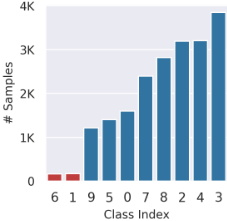
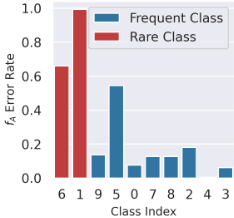
Class Imbalance in Attack Queries. Although class imbalance of training data is often a critical issue in learning problems, not enough attention has been paid to the subject in the context of model stealing. In particular, as shown in Figure 1, we found that even ActiveThief [Pal et al., 2020], one of the recent attacks adopting active learning techniques, faces severe class imbalance in queried inputs, which deteriorates clone models' performance on rarely queried classes. To alleviate the problem, SwiftThief introduces prioritization of rarely queried classes in sampling, selecting inputs preferentially so that query outputs will have a high probability on rare classes based on the density estimation of classes in the clone model's feature space.
Our paper has the following contributions:
- We propose SwiftThief, a novel model-stealing approach utilizing both unqueried and queried data via self-supervised and newly designed soft-supervised contrastive loss, which can fully utilize the probability information from queried data.
- To address the issue of class imbalance in queried data, we introduce a weighted regularizer acting more strongly on rare classes and an enhanced query sampling strategy prioritizing candidates similar to queried rare-class samples in the clone model's representation space.
- SwiftThief achieved the maximum performance of the existing attacks, being ×2.27 more query-efficient in our experiments. Also, ours outperformed other attacks even when the victim's outputs were perturbed by the defense mechanism or constrained to hard labels.
2 RelatedWorks
2.1 Model Stealing Attacks
We summarize recent advances in model stealing attacks.
Sampling fromPublic Datasets. KnockoffNet [Orekondy et al., 2019] showed that public datasets, that may not follow the victim's exact training distribution, can be used effectively for model-stealing queries. ActiveThief [Pal et al., 2020] improved the idea by introducing active sampling mechanisms such as uncertainty-based sampling [Lewis and Gale, 1994]. Recently, MExMI [Xiao et al., 2022] suggested using inputs with high similarity to the victim's training set, identified by the membership inference attack [Shokri et al., 2017].
Data Generation. JBDA [Papernot et al., 2016] introduced a data augmentation technique using a similar mechanism to FGSM [Goodfellow et al., 2015]. Recently, CloudLeak [Yu et al., 2020] suggested an enhanced adversarial sampling using the FeatureFool, an objective function representing the distance between the augmentation target and a guide input on the representation space. InverseNet [Gong et al., 2021] applied the model inversion attack [Fredrikson et al., 2015] to the victim and tried to generate attack queries following a similar distribution to the victim's training data. MAZE [Kariyappa et al., 2021] and DFME [Truong et al., 2021] utilized generative models [Goodfellow et al., 2014] to generate inputs that maximize the disagreement between the victim's query responses and the predictions of the clone model. [Zhou et al., 2020; Zhang et al., 2022] improved the training loss for generative models to ensure the class diversity of synthesized inputs.
Utilization of Unqueried Data. The above methods have not considered using unqueried data for speeding up modelstealing attacks. Although ActiveThief considered unqueried data in its active sampling, it did not use them for actual stealing. [Jagielski et al., 2020; Xiao et al., 2022] showed that semi-supervised learning mechanisms like MixMatch [Berthelot et al., 2019] could improve model stealing; however, our experience indicates that these methods may not be as effective as reported in the original experiments when an attacker has access to no sample from the victim's data distribution, which is the setting we consider in this work. [Zhao et al., 2023] utilizes self-supervised contrastive learning [Chen et al., 2020; He et al., 2020] but only as a pre-training step for model stealing; our work further utilizes the knowledge from queried data for contrastive learning by introducing a new custom-designed soft-supervised contrastive loss for model stealing.
Defenses against Model Stealing. One of the mainstream approaches of model-stealing defense is to disrupt the training of clone models by introducing alterations to the outputs of the victim model. For instance, prediction poisoning [Orekondy et al., 2020] and GRAD2 [Mazeika et al., 2022] introduced controlled perturbations to the victim model's probability outputs. DeepDefense [Lee et al., 2022] suggested a different approach that exposed the probability outputs and the attribution maps [Selvaraju et al., 2019; Lee and Han, 2022] from a misdirection model to deliver maximally distorted gradient information.
2.2 Contrastive Learning
Self-supervised contrastive learning has recently gained massive attention due to its capability to learn highly transferable features [Islam et al., 2021; Liu et al., 2022a]. SimCLR [Chen et al., 2020] provided one of the first frameworks to use positive and negative pairs for representation learning. It requires a large batch size to keep plentiful negative samples and thereby avoid collapsed representation. MOCO [He et al., 2020] provided a more efficient way to keep large negative samples by managing an embedding queue of negative samples across several recent batches. More recently, SimSiam [Chen and He, 2021] suggested the stop-gradient mechanism that detaches the positive samples from the computation graph of back-propagation to prevent collapsed representation.
Another direction of contrastive learning uses supervision [Khosla et al., 2020] for composing positive and negative pairs. However, the existing framework allows only hard labels, whereas, in model-stealing, many victim models provide soft labels, e.g., the softmax probabilities. In this paper, we adapt the self-supervised and supervised contrastive learning frameworks for model stealing so that unqueried and queried data with soft labels can be utilized for maximal attack efficiency.
3 Threat Model
Model stealing assumes that a trained AI model (the victim) f is in service, providing an output for each query input x ∈ Rd from users. We assume that the victim model is a black box; that is, the details about the victim are hidden from attackers, including the model's architecture, parameters, learning algorithms, hyperparameters, the data distribution PV , and training data. We suppose the victims provide softmax probabilities f(x) ∈ ∆K regarding the input x, where ∆K is a K-dimensional simplex.
The goal of a model stealing adversary is to train a clone model fA, which mimics the functionality of the victim model f (we focus on achieving the victim's test accuracy on unseen data from PV ). To extract useful information from the victim, the adversary prepares a surrogate dataset S := {x : x ∼ PA} sampled from the adversary's data distribution PA (in general, PA ̸= PV ), and uses some x ∈ S as queries to the victim to obtain the corresponding outputs y = f(x) ∈ ∆K . We denote the adversary's query budget as B and the set of (query, response) pairs of currently queried inputs as Q := {(x, y) : x ∈ S, y = f(x)} such that |Q| = q. We denote the unqueried remainder as U := S \ {x ∈ S : (x, f(x)) ∈ Q} where |U| = u so that |S| = q + u. In classical model stealing, the attacker trains their clone model fA with Q by minimizing the loss between the query outputs and the prediction results of the clone model, that is, ∑(x,y)∈Q L(fA(x), y). Here, the function L can be the cross-entropy loss [Orekondy et al., 2019] or the ℓp distance [Truong et al., 2021] depending on attack methods.
4 SwiftThief
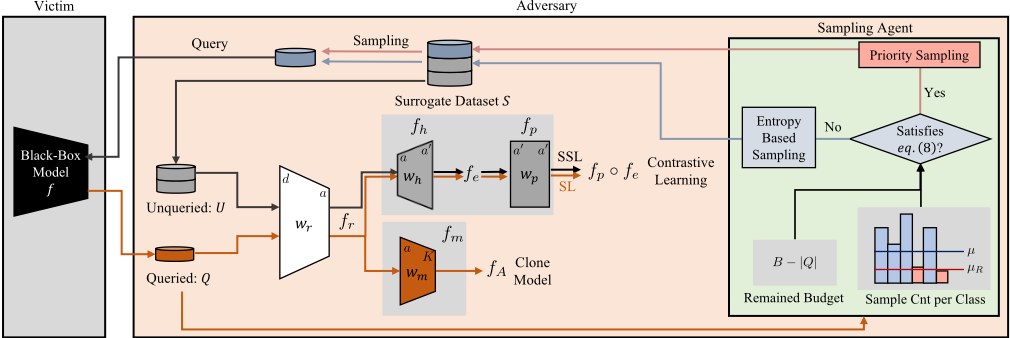
We propose a new model stealing attack called SwiftThief, which utilizes both the queried dataset Q and the unqueried remainder U to maximize cloning efficiency. To achieve the goal, we introduce an objective function consisting of two parts: Lc for contrastive representation learning (which combines soft-supervised and self-supervised losses using Q and U, respectively) and Lm for matching the outcomes of the clone and the victim models based on Q.
Our method uses a representation function fr(·; wr) : Rd → Ra and a classification head fm(·;wm) : Ra → ∆K , so that the clone model is defined as fA(·;wr,wm) := fm ◦ fr(·). For contrastive learning, we use an auxiliary encoder fe(·;wr,wh) := fh ◦ fr(·) defined with a projection head fh(·;wh) : Ra → Ra′ and use a prediction head fp(·;wp) : Ra′ →Ra′ to avoid collapsed representation as in SimSiam. Here, a and a′ are the chosen dimensions of the embedding spaces. Figure 2 illustrates the composition of SwiftThief.
4.1 Learning Objective
Self-Supervised Contrastive Loss for Unqueried Data. To learn representations with the unqueried inputs in U, we use the self-supervised contrastive learning framework of SimSiam [Chen and He, 2021]. (SimSiam outperformed other alternatives such as SimCLR and MOCO in our experience.) We generate positive pairs from U as follows: given 2u transformations π1, · · · , π2u independently sampled from a transformation distribution Π, each input xi ∈ U is augmented as the positive pair ˜x2i-1 := π2i-1(xi) and ˜x2i := π2i(xi), indexed by the set P with elements (2i-1, 2i) for i = 1, . . . , u. Using the encoded versions of the augmentations z = fe(˜x) ∈ Ra′ and z′ = fp(fe(˜x)) ∈ Ra′ , we define the self-supervised contrastive loss for U as:
Here, we treat zi and zj as constants, excluding them from the back-propagation during the optimization process as in the original paper of SimSiam [Chen and He, 2021].
Soft-Supervised Contrastive Loss for Queried Data. We propose a new soft-supervised contrastive loss to use the available soft labels during model stealing, generalizing the hard-label version in [Khosla et al., 2020]. Given transformations ˆπ1, · · · , ˆπ2q ∼ ˆΠ, we create two new augmented inputs (ˆx2i-1, ˆ y2i-1) := (ˆπ2i-1(xi), yi) and (ˆx2i, ˆ y2i) := (ˆπ2i(xi), yi) from each pair (xi, yi) ∈ Q which consists of the queried input xi and the corresponding victim's probability output yi ∈ ∆K . Using the encoded versions of the augmentation ˆ z = fe(ˆx) and ˆ z′ = fp(fe(ˆx)), we propose the new soft-supervised contrastive loss as follows:
Here, ηij ∈ [0, 1] is a variable representing each pair's representation alignment. We designed ηij to adjust the alignment intensity adaptively by focusing not only on pairs with identical class membership in the top-1 sense but also on those pairs whose entire softmax probability distributions show high similarity with great confidence:
We denote by cos∠(a, b) the cosine of the angle between vectors a and b, by H(·) the Shannon entropy H(y) = - ∑Kℓ=1 (y)ℓ log(y)ℓ, where (y)ℓ is the ℓ-th element of the vector y, and by 1[c] an indicator function taking the value of 1 when the condition c is true and 0 otherwise. The expressions in the parentheses of (3) represent reversed normalized entropy where the values become 0 for uniformly distributed victim's softmax outputs and 1 for one-hot outputs. It penalizes the intensity for inputs with high uncertainty in the victim's outputs, considering the risk associated with the potential misclassification of the victim. Note that given hard labels as one-hot vectors, (2) reduces to the existing loss for supervised contrastive learning [Khosla et al., 2020].
Strong Regularization onMinority Classes. As noted in [Cao et al., 2019; Cao et al., 2021; Liu et al., 2022b], minority classes can cause overfitting and need strong regularization. Motivated by this, we introduce a regularizer based on adversarial contrastive learning [Kim et al., 2020]. For the two augmented inputs ˆx2i-1 := ˆπ2i-1(xi) and ˆx2i := ˆπ2i(xi) and their respective encoded versions ˆ z = fe(ˆx) and ˆ z′ =
fp(fe(ˆx)) we have used to construct (2), we consider an additive perturbation δ ∈ Rd and denote ˆ z(δ) = fe(ˆx + δ) and ˆ z′ (δ) = fp(fe(ˆx + δ)) to define our regularizer as:
where ϵ > 0 is a hyperparameter that constrains the magnitude of the perturbation δ. We define the weight cyi := (1 - β)/(1 - βNyi ) following [Cui et al., 2019], where Nyi represents the number of samples in the class yi and β ∈ [0, 1) is a hyperparameter: the rarer yi is, cyi takes larger values. The regularizer is intended to impose a strong penalty to the sharpness of the representation function around minor classes.
Combining the self-supervised (1), soft-supervised losses (2), and the regularizer (4), we construct the loss for our contrastive representation learning as follows (λ1 > 0 and λ2 > 0 are hyperparameters):
Output Matching for Queried Data. For model stealing, we need to match the clone model's output fA(xi; wr, wm) to the victim's response yi on the responded queries (xi, yi) ∈ Q. For this, we define the matching loss based on the crossentropy function,
Finally, we define the total loss for SwiftThief using the contrastive (5) and the matching losses (6):
where λ3 > 0 is a hyperparameter. In Algorithm 1, we outline the overall process of SwiftThief. In the algorithm
(lines 15 and 16), we use an alternating optimization: at the k-th outer iteration, we minimize Lc(wr,wh,wp) to obtain (wk+ 1 2 r , wk+1 h ,wk+1 p ) and then minimize Lm(wr,wm), using wk+ 1 2 r for warm-starting, to obtain (wk+1 r , wk+1 m ). Our approach can be seen as a relaxed form of block coordinate descent [Tseng, 2001] to minimize L, where we avoided, by warm-starting, the explicit duplication of the shared variable wr between Lc and Lm required to form non-overlapping blocks of variables. This reduces the memory footprint and the dependency on the extra hyperparameter λ3.
4.2 Prioritization of Rarely Queried Classes in Sampling
As briefly discussed in Sect. 1 and Figure 1, class imbalance in the queried samples can deteriorate an attacker's performance. However, class-balanced sampling of attack queries is challenging without making extra queries to the victim to obtain prediction results on unqueried samples.
To address the issue, we try to detect class imbalance in queried samples and prioritize rarely queried classes in future sampling. We conjecture that the samples from the same class (according to the victim) will be located nearby in the representation space of the attack model trained by contrastive learning. Based on this, we apply kernel density estimation to the representations of the most rarely sampled class in Q and select samples from U with the highest probability according to the estimated density function.
Specifically, we call a class rarely represented if it has a smaller sample size than the mean sample size of all classes in Q, where the class memberships of the samples in Q are determined by the maximum softmax probability from the victim's outputs. Let Qyn represent the inputs xi in Q belonging to yn, the most rarely represented class in Q. Also let κ(·, σ) = exp (-∥ · ∥22 /(2σ2 )) denote the Gaussian kernel with the bandwidth σ > 0. Using the so-far trained representation function fr(·; wr), we assign the density score of each query candidate xj ∈ U as follows:
We choose the samples xj ∈ U with the largest density scores sj that are most likely to be the class yn if queried in the future, according to our conjecture. In fact, given the total query budget B and the number of outer iterations I of SwiftThief, we sample ⌈B/I⌉ samples from U using this strategy. Also, to avoid the minority class from being too large after accessing the victim, we divide the above process into b steps: in each step, we sample ⌈(B/I)/b⌉ from yn and recompute yn after the assignment of classes in the previous steps. (We used b = 5 and set B as a multiple of I · b in experiments.) However, samples chosen by the above prioritization could be far from the decision boundary, making newly chosen samples less informative for improving an attack model. Therefore, we allow switching our prioritization with entropy-based sampling [Lewis and Gale, 1994]. In particular, inspired by [Aggarwal et al., 2020], we start our attack with entropy-based sampling and use our prioritization strategy when the following condition is satisfied:
Here, B is the total query budget for the attack, |Q| is the number of queried samples so far, and NR is the number of rarely queried classes. Also, µ and µR are the mean sample counts of the entire and rare classes in Q, respectively. The switching of sampling strategies is elaborated in the lines 4-10 of Algorithm 1.
5 Experiments
5.1 Experimental Setup
Victim. We used ResNet-18 [He et al., 2016] as the victim model, which was trained with five task-specific image datasets: MNIST [Lecun et al., 1998], SVHN [Netzer et al., 2011], GTSRB [Stallkamp et al., 2011], CIFAR10 [Krizhevsky, 2009], and EuroSAT [Helber et al., 2018]. Test accuracy rates for each victim model were 98.46% for MNIST, 94.81% for SVHN, 96.68% for GTSRB, 94.46% for CIFAR-10, and 96.67% for EuroSAT.
Adversary. For comparison, we chose six state-of-the-art model-stealing attacks: KnockoffNet [Orekondy et al., 2019], ActiveThief [Pal et al., 2020], MixMatch [Berthelot et al., 2019], InverseNet [Gong et al., 2021], MExMI [Xiao et al., 2022], and EPK (Extraction from Prior Knowledge) [Zhao et al., 2023]. For the surrogate dataset S to choose attack queries from, we used the trainset of ILSVRC-2012 [Russakovsky et al., 2015]. We note that the original MixMatch and MExMI assumed the adversary could access victims' training data. However, since our threat model assumes a more realistic setting where victims' data distributions are hidden, we performed these attacks without using victims' data. We used ResNet-18 as the clone model, which is identical to the victim model's architecture. We set the query budget B to 30, 000 unless otherwise stated. Finally, we used the clone model's accuracy on victims' test sets to measure model stealing performance.
Algorithm 1 The SwiftThief Algorithm
- Require: Query budget B, max. iterations I, a surrogate dataset S, λ1 > 0, λ2 > 0, β ∈ [0, 1) and σ > 0.
- 1: Randomly initialize w0 r ,w0m,w0 h , w0 p ;
- 2: Let k ← 0, Q← ∅ and U ←S;
- 3: while k < I do
- 4: if k = 0 then
- 5: sampling-strategy ← uniform random sampling;
- 7: sampling-strategy ← sampling with rarely-queried class prioritization (using (7));
- 6: else if B - |Q| ≤ NR · (µ-µR) then
- 8: else
- 9: sampling-strategy ← entropy-based sampling;
- 10: end if
- 11: Sample {x1, · · · , xB/I} ⊂ U using sampling-strategy;
- 12: Obtain {f(x1), · · · , f(xB/I)} by querying f;
- 14: U ←U \ {x1, · · · , xB/I};
- 13: Q←Q∪ {(x1, f(x1)), · · · , (xB/I, f(xB/I))};
- 15: Update (wk+ 1 2 r , wk+1 h ,wk+1 p ) by minimizing (5);
- 16: Update (wk+1 r , wk+1 m ) by minimizing (6), warmstarting wr fromwk+ 12 r ;
- 17: k ← k +1;
- 18: end while
- 19: return fA(·;wI r ,wIm);
Setup for SwiftThief. We used the part of the clone model from the input to the penultimate layer as the representation function fr and the remainder to the output layer as the classification head fm. For the contrastive representation learning in SwiftThief (denoted by ST), we set the dimensions a and a′ as 512 and 2, 048 respectively as in the original SimSiam [Chen and He, 2021]. For solving the inner-maximization problem in (4), we adopted FGSM [Goodfellow et al., 2015] with ϵ of 0.01. For the alternating optimization in ST, we set the number of outer iterations I to 10 and the number of epochs for each sub-problem to 40 while increasing the epochs for contrastive representation learning to 100 in the last outer iteration to ensure sufficient convergence. We set λ1 and λ2 in the loss of ST (5) to 1.0 and 0.01, resp. For the entire ILSVRC-2012 trainset S (with 1, 281, 167 samples) and its unqueried portion U, we used randomly sampled 50, 000 inputs from U for the self-supervised contrastive learning of ST.
5.2 Results
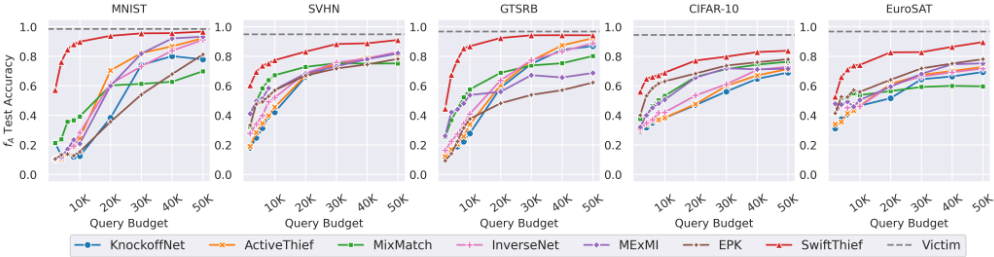
RQ: Howmuch improvement in attack can ST bring? To demonstrate the efficacy of our ST, we compared the test accuracy of the clone models produced by the attack methods mentioned above on nine different query budgets from 2K to 50K. Figure 3 shows the results: ST outperformed the competitors consistently on all query budgets and victim models tried. In particular, ST was considerably more effective at stealing with small query budgets. For example, at relatively small budgets between 2K and 8K, ST achieved ×2.66, ×1.33, ×1.67, ×1.21, and ×1.25 attack performances compared to the second best attacks, on MNIST, SVHN, GTSRB, CIFAR-10, and EuroSAT, respectively; for larger query budgets between 10K and 50K, it achieved ×1.37, ×1.14, ×1.23, ×1.09, and ×1.21 attack performances compared to the second-best, respectively for the victims. Also, at the maximum query budget of 50K in our experiments, ST's clone models reached ×0.95 of the victim's test accuracy on average, while the second-best attack methods achieved only ×0.88 in contrast.
RQ: How effective is ST against defense? To demonstrate how well ST performs when a victim is equipped with a defense mechanism, we compared the performance of attacks against victims with and without one of the popular defense methods called Prediction Poisoning [Orekondy et al., 2020] (denoted by PP). PP adds perturbations to the softmax outputs of the victim so that the attacker's training will use misleading gradient information. In Table 1, we can see that ST outperformed other attacks in terms of the test accuracy of the clone models even when PP was active. In particular, the decrease in attack performance due to PP was much smaller for ST than for other methods relying entirely on the queried dataset, namely KnockoffNet, ActiveThief, and InverseNet. On average, the attack performance of ST decreased to ×0.94, while the performance of KnockoffNet, ActiveThief, and InverseNet decreased significantly to ×0.82, ×0.86 and ×0.84, respectively. On the other hand, for MixMatch, MExMI, and EPK, the approaches using both queried and unqueried datasets, the performance drop was relatively small (×0.92, ×0.93, and ×0.90, resp.). Still, our method ST performed better than them in both defended and undefended cases.
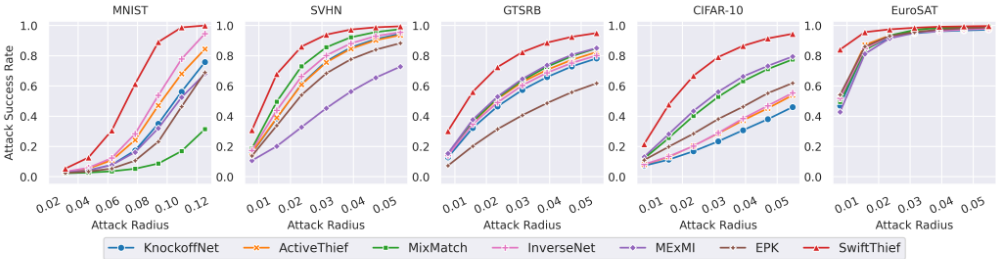
RQ: How effective is ST in black-box adversarial attacks? To investigate the effectiveness of ST against black-box adversarial attacks, we applied adversarial attacks to the clone models generated by each model-stealing method. For the investigation, we adopted the PGD attack [Madry et al., 2018] varying the perturbation radius ϵ in the ℓ∞ norm from 8/255 to 32/255 for MNIST, and from 2/255 to 14/255 for other datasets. (MNIST generally requires stronger perturbations than other datasets for successful attacks [Ye et al., 2019; Croce and Hein, 2020].) Figure 4 shows the attack success rates of the victim models on adversarial examples generated through the corresponding clone models. The result shows that black-box adversarial attacks through model stealing were the most successful with our attack method across all attack radii.
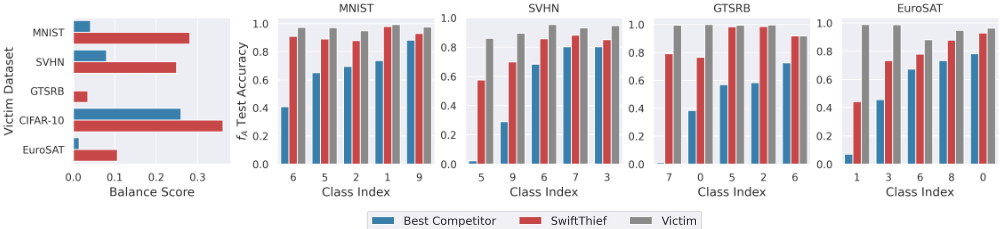
RQ: How effectively does ST deal with the class imbalance in queries? To investigate the RQ, we compared the sample ratios of the rarest classes to the most frequent classes in the queried datasets (denoted by the balance score; higher values mean better balancing) and the class-wise test accuracy of the clone models generated by ST and the best competitor (in terms of the test accuracy) for each victim task in Figure 5. We can see that ST significantly increases the balance score compared to the best competitor. Also, we can see the effect of making more class-balanced queries on attack performance. Regarding class-wise test accuracy rates, the best competitor fails to steal the model in particular classes (e.g., the class 7 of GTSRB) due to rare attack queries made for the class, while ST alleviates the problem significantly.
| Attack | MNIST | SVHN | Victim Dataset GTSRB | CIFAR-10 | EuroSAT | |||||
|---|---|---|---|---|---|---|---|---|---|---|
| Undef | PP | Undef | PP | Undef | PP | Undef | PP | Undef | PP | |
| KnockoffNet | 74.07 | 53.34 | 74.56 | 63.26 | 74.80 | 65.35 | 56.12 | 41.00 | 64.39 | 60.07 |
| ActiveThief | 82.16 | 71.54 | 74.78 | 60.31 | 76.89 | 75.23 | 59.92 | 40.02 | 67.35 | 66.07 |
| MixMatch | 61.30 | 45.65 | 75.27 | 70.99 | 73.76 | 71.14 | 71.26 | 65.90 | 59.20 | 60.52 |
| InverseNet | 73.10 | 66.15 | 75.72 | 64.31 | 77.29 | 58.64 | 61.06 | 46.39 | 66.30 | 60.94 |
| MExMI | 81.75 | 71.53 | 73.21 | 70.75 | 67.20 | 63.05 | 71.83 | 66.77 | 68.07 | 64.00 |
| EPK | 54.01 | 44.38 | 71.68 | 69.41 | 53.82 | 49.96 | 73.68 | 68.21 | 71.74 | 63.06 |
| SwiftThief | 95.51 | 94.76 | 88.26 | 84.24 | 94.20 | 89.55 | 79.73 | 69.12 | 82.78 | 79.26 |
| Victim Dataset | Best Competitor | SwiftThief fA Acc (%) | |
|---|---|---|---|
| Method | fA Acc(%) | ||
| MNIST | InverseNet | 59.33 | 80.87 |
| SVHN | MixMatch | 70.70 | 76.61 |
| GTSRB | MExMI | 67.11 | 77.61 |
| CIFAR-10 | MixMatch | 66.56 | 67.70 |
| EuroSAT | MExMI | 63.33 | 70.37 |
RQ: How does ST perform with different label types? Next, we investigated how effective ST is when only class membership information is provided as the query output. Table 2 displays the test accuracy of clone models created by ST and the best competitor for each victim task in the hard label scenario. We can see that our ST outperforms the best competitors in all victim tasks.
RQ: What are the contributions of the suggested components? Finally, we conducted an ablation study to see the contribution of using the soft-supervised contrastive loss Lsoft c , the self-supervised contrastive loss Lself c , the weighted regularizer Lreg c , and the prioritization of rarely queried classes in sampling. Table 3 shows the test accuracy of ST's fA averaged on five victim tasks. We can see that the entire components increased the clone models' test accuracy compared to previous cases, showing that all components of ST contribute to improved attack performance.
| Components of SwiftThief | fA Test Acc(%) | |||
|---|---|---|---|---|
| Lsoft c | Lself c | Lreg c | Sampling | |
| ✗ | ✗ | ✗ | ✗ | 72.22 (×1.00) |
| ✓ | ✗ | ✗ | ✗ | 79.62 (×1.10) |
| ✓ | ✓ | ✗ | ✗ | 85.46 (×1.18) |
| ✓ | ✓ | ✓ | ✗ | 86.76 (×1.20) |
| ✓ | ✓ | ✓ | ✓ | 88.09 (×1.22) |
6 Conclusion
We proposed SwiftThief, a new query-efficient model-stealing attack framework that uses both queried and unqueried data utilizing soft- and self-supervised contrastive representation learning. We further enhanced our attack by mitigating the class imbalance problem using a new regularizer and an enhanced sampling strategy. Through experiments, we confirmed that SwiftThief outperforms current state-of-the-art attacks even with smaller queries and when a defense is applied. Our future works include extending SwiftThief to other data domains and sophisticating it to exploit new attack surfaces, such as the attribution maps for eXplainable AI (XAI).
Acknowledgments
This research was supported by the MSIT(Ministry of Science and ICT), Korea, under the ITRC(Information Technology Research Center) support program(IITP-2024-2020-0-01749) supervised by the IITP(Institute for Information & Communications Technology Planning & Evaluation).
@inproceedings{ijcai2024p47,
  title     = {SwiftThief: Enhancing Query Efficiency of Model Stealing by Contrastive Learning},
  author    = {Lee, Jeonghyun and Han, Sungmin and Lee, Sangkyun},
  booktitle = {Proceedings of the Thirty-Third International Joint Conference on
               Artificial Intelligence, {IJCAI-24}},
  publisher = {International Joint Conferences on Artificial Intelligence Organization},
  editor    = {Kate Larson},
  pages     = {422--430},
  year      = {2024},
  month     = {8},
  note      = {Main Track},
  doi       = {10.24963/ijcai.2024/47},
  url       = {https://doi.org/10.24963/ijcai.2024/47},
}
TY - CPAPER TI - SwiftThief: Enhancing Query Efficiency of Model Stealing by Contrastive Learning AU - Lee, Jeonghyun AU - Han, Sungmin AU - Lee, Sangkyun T2 - Proceedings of the Thirty-Third International Joint Conference on Artificial Intelligence, IJCAI-24 PB - International Joint Conferences on Artificial Intelligence Organization PY - 2024 SP - 422 EP - 430 DO - 10.24963/ijcai.2024/47 UR - https://doi.org/10.24963/ijcai.2024/47 ER -Copied
Machine-readable versions of this paper, for tools and AI agents:





