
A Streaming End-to-End Framework For Spoken Language Understanding
Proceedings of the Thirtieth International Joint Conference on Artificial Intelligence. Main Track. Pages 3906-3914.
https://doi.org/10.24963/ijcai.2021/538
© 2021 International Joint Conferences on Artificial Intelligence
Keywords
- Natural Language Processing: Speech
- Natural Language Processing: Dialogue
Abstract
End-to-end spoken language understanding (SLU) recently attracted increasing interest. Compared to the conventional tandem-based approach that combines speech recognition and language understanding as separate modules, the new approach extracts users' intentions directly from the speech signals, resulting in joint optimization and low latency. Such an approach, however, is typically designed to process one intent at a time, which leads users to have to take multiple rounds to fulfill their requirements while interacting with a dialogue system. In this paper, we propose a streaming end-to-end framework that can process multiple intentions in an online and incremental way. The backbone of our framework is a unidirectional RNN trained with the connectionist temporal classification (CTC) criterion. By this design, an intention can be identified when sufficient evidence has been accumulated, and multiple intentions will be identified sequentially. We evaluate our solution on the Fluent Speech Commands (FSC) dataset and the detection accuracy is about 97 % on all multi-intent settings. This result is comparable to the performance of the state-of-the-art non-streaming models, but is achieved in an online and incremental way. We also employ our model to an keyword spotting task using the Google Speech Commands dataset, and the results are also highly promising.
- [Andrade et al., 2018] Douglas Coimbra Andrade, Sabato Leo, Martin Loesener Da Silva Viana, and Christoph Bernkopf. A neural attention model for speech command recognition. arXiv preprint arXiv:1808.08929, 2018.
- [Chan et al., 2015] William Chan, Navdeep Jaitly, Quoc V Le, and Oriol Vinyals. Listen, attend and spell. arXiv preprint arXiv:1508.01211, 2015.
- [Chen et al., 2018] Yuan-Ping Chen, Ryan Price, and Srini- vas Bangalore. Spoken language understanding with- out speech recognition. In 2018 IEEE International Conference on Acoustics, Speech and Signal Processing (ICASSP), pages 6189-6193. IEEE, 2018.
- [Choi et al., 2019] Seungwoo Choi, Seokjun Seo, Beomjun Shin, Hyeongmin Byun, Martin Kersner, and Beomsu Kim. Temporal convolution for real-time keyword spot- ting on mobile devices. arXiv preprint:1904.03814, 2019.
- [Graves et al., 2006] Alex Graves, Santiago Fernández, and Faustino Gomez. Connectionist temporal classification: labelling unsegmented sequence data with recurrent neural networks. In Proceedings of the 23rd international confer- ence on Machine learning, pages 369-376, 2006.
- [Haghani et al., 2018] Parisa Haghani, Arun Narayanan, Michiel Bacchiani, Galen Chuang, and Neeraj Gaur. From audio to semantics: Approaches to end-to-end spoken lan- guage understanding. In 2018 IEEE Spoken Language Technology Workshop (SLT), pages 720-726, 2018.
- [Kohrs et al., 2016] Christin Kohrs, Nicole Angenstein, and André Brechmann. Delays in human-computer inter- action and their effects on brain activity. PloS one, 11(1):e0146250, 2016.
- [Kuo et al., 2020] Hong-Kwang J Kuo, Zoltán Tüske, Samuel Thomas, and Yinghui Huang. End-to-end spo- ken language understanding without full transcripts. arXiv preprint:2009.14386, 2020.
- [Li et al., 2020] Ximin Li, Xiaodong Wei, and Xiaowei Qin. Small-footprint keyword spotting with multi-scale tempo- ral convolution, 2020. [Libovickỳ and Helcl, 2018] Jindřich Libovickỳ and Jindřich Helcl. End-to-end non-autoregressive neu- ral machine translation with connectionist temporal classification. arXiv preprint arXiv:1811.04719, 2018.
- [Liu and Lane, 2016] Bing Liu and Ian Lane. Joint on- line spoken language understanding and language mod- eling with recurrent neural networks. arXiv preprint arXiv:1609.01462, 2016.
- [Loshchilov and Hutter, 2017] Ilya Loshchilov and Frank Hutter. Decoupled weight decay regularization. arXiv preprint arXiv:1711.05101, 2017.
- [Lugosch et al., 2019] Loren Lugosch, Mirco Ravanelli, Patrick Ignoto, Vikrant Singh Tomar, and Yoshua Bengio. Speech model pre-training for end-to-end spoken language understanding. arXiv preprint arXiv:1904.03670, 2019.
- [Mhiri et al., 2020] Mohamed Mhiri, Samuel Myer, and Vikrant Singh Tomar. A low latency asr-free end to end spoken language understanding system. arXiv preprint arXiv:2011.04884, 2020.
- [Miao et al., 2016] Yajie Miao, Mohammad Gowayyed, Xingyu Na, Tom Ko, and Florian Metze. An empirical exploration of ctc acoustic models. In 2016 IEEE Inter- national Conference on Acoustics, Speech and Signal Pro- cessing (ICASSP), pages 2623-2627. IEEE, 2016.
- [Mittermaier et al., 2020] S. Mittermaier, L. Kürzinger, B. Waschneck, and G. Rigoll. Small-footprint keyword spotting on raw audio data with sinc-convolutions. In IEEE International Conference on Acoustics, Speech and Signal Processing (ICASSP), pages 7454-7458, 2020.
- [Palogiannidi et al., 2020] Elisavet Palogiannidi, Ioannis Gkinis, George Mastrapas, Petr Mizera, and Themos Stafylakis. End-to-end architectures for asr-free spoken language understanding. In ICASSP 2020-2020 IEEE International Conference on Acoustics, Speech and Signal Processing (ICASSP), pages 7974-7978. IEEE, 2020.
- [Panayotov et al., 2015] Vassil Panayotov, Guoguo Chen, Daniel Povey, and Sanjeev Khudanpur. Librispeech: an asr corpus based on public domain audio books. In 2015 IEEE International Conference on Acoustics, Speech and Signal Processing (ICASSP), pages 5206-5210. IEEE, 2015.
- [Porcheron et al., 2018] Martin Porcheron, Joel E Fischer, Stuart Reeves, and Sarah Sharples. Voice interfaces in ev- eryday life. In proceedings of the 2018 CHI conference on human factors in computing systems, pages 1-12, 2018.
- [Qian et al., 2019] Yao Qian, Rutuja Ubale, Patrick Lange, Keelan Evanini, Vikram Ramanarayanan, and Frank K Soong. Spoken language understanding of human- machine conversations for language learning applications. Journal of Signal Processing Systems, pages 1-13, 2019.
- [Sak et al., 2015] Has ¸im Sak, Andrew Senior, Kanishka Rao, and Franc ¸oise Beaufays. Fast and accurate recur- rent neural network acoustic models for speech recogni- tion. arXiv preprint arXiv:1507.06947, 2015.
- [Schoenenberg et al., 2014] Katrin Schoenenberg, Alexan- der Raake, and Judith Koeppe. Why are you so slow?- misattribution of transmission delay to attributes of the conversation partner at the far-end. International journal of human-computer studies, 72(5):477-487, 2014.
- [Shivakumar et al., 2019] Prashanth Gurunath Shivakumar, Naveen Kumar, Panayiotis Georgiou, and Shrikanth Narayanan. Incremental online spoken language under- standing. arXiv preprint arXiv:1910.10287, 2019.
- [Tian and Gorinski, 2020] Yusheng Tian and Philip John Gorinski. Improving end-to-end speech-to-intent classi- fication with reptile. arXiv preprint:2008.01994, 2020.
- [Warden, 2018] Pete Warden. Speech commands: A dataset for limited-vocabulary speech recognition. arXiv preprint arXiv:1804.03209, 2018.
References were extracted automatically from the PDF and may contain errors.
Full text extracted automatically from the PDF; figures, tables and equations may differ. The PDF is the version of record.
1 Introduction
Spoken language understanding (SLU) aims at extracting structured semantic representations, such as intents and slots, from the speech signal [Mhiri et al., 2020]. For instance, a speech waveform carrying out the sentence "Lights on in the bedroom" can be represented as {intent:'activate lights' , location: 'bedroom'} (see Figure 1). Given the proliferation of voice user interfaces (VUIs) in smartphones and other gadgets, these representations are crucial to provide voice control capabilities to these devices, enabling speech as a primary mode of human-computer interaction (HCI). SLU systems are particularly useful for hands-free conversational interactions, such as while driving a car, cooking or accessing a smart home system.
∗The work was done during a coop internship in Noah's Ark Lab.
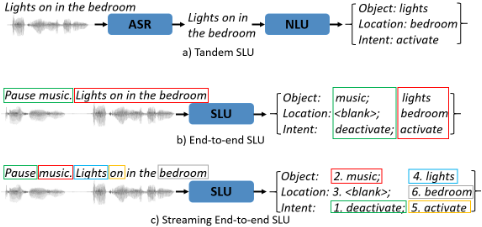
Tandem SLU solutions rely on the text transcription generated by an automatic speech recognition (ASR) module. The ASR output is then processed by a natural language understanding (NLU) system, responsible for interpreting the transcript content [Qian et al., 2019; Shivakumar et al., 2019]. This approach is represented in Figure 1 (a). A notable disadvantage of this approach relates to the fact that the ASR and the NLU systems are optimized separately, therefore not globally optimal for the target SLU task. Moreover, the NLU is often optimized on clean text while the ASR output usually contains errors. This causes severe error accumulation and amplification, aggravating the overall SLU performance [Mhiri et al., 2020]. Although joint training approaches have been proposed, e.g., for the language models [Liu and Lane, 2016], the tandem nature prevents a full joint optimization.
Recently, end-to-end SLU has been proposed to tackle this problem. As shown in Figure 1 (b), the new approach extracts users' intentions directly from the speech signals, resulting in joint optimization [Haghani et al., 2018; Palogiannidi et al., 2020; Lugosch et al., 2019; Chen et al., 2018; Mhiri et al., 2020]. Despite the promising progress, almost all the existing end-to-end SLU methods need to wait at least until all the speech segments are filled or the end of the speech utterance is detected by other models before starting the intent prediction, thus suffering from significant latency [Mhiri et al., 2020; Haghani et al., 2018]. This latency will lead to delayed feedback during human-computer interactions, which often seriously impacts users' experience [Porcheron et al., 2018]. For example, in [Kohrs et al., 2016], the authors conduct a systematic investigation based on functional Magnetic Resonance Imaging (fMRI) showing that delayed feedback (noticeable around 327.2-ms ±89.7) can affect the behaviour, the psychophysiology as well as the neural activity of the user. In [Schoenenberg et al., 2014], it is shown that users in far-end conversation are much less attentive if the delay is more than 400 ms. To reduce the latency, some recent researches are proposed to process the speech signal segment by segment [Mhiri et al., 2020], however the intent prediction is still based on the complete utterance.
Another deficiency of the existing end-to-end SLU methods is that they are short in dealing with multiple intentions. Although users can be asked to speak simply and show one intention, people tend to speak more complex utterances with multiple intents in a single round of interaction. For example, people may say 'I want to book a flight and if possible, please reserve a receiving taxi for me'. For most existing end-to-end approach, the system can only deal with one intent, perhaps the more significant one 'reserve taxi'. This will invoke additional interactions to deal with the missing intent.
In this paper, we propose a fully streaming end-to-end framework for SLU, as shown in Fig. 1 (c). The meaning of 'streaming' is two-fold: (1) the intent is identified 'online', which means one intention is identified whenever sufficient evidence has been accumulated, without the need to wait until the end of the utterance, which significantly reduce the latency; (2) the intent is identified 'incremental', which means multiple intentions can be identified sequentially. To the best of the authors' knowledge, this is the first streaming end-toend architecture for the SLU task.
To achieve that, a unidirectional recurrent neural network (RNN), trained with the connectionist temporal classification (CTC) method, is proposed. The framework is evaluated on three underline tasks. First, our model is assessed on single-intent classification and experiments are conducted on the Fluent Speech Commands corpus (FSC) [Lugosch et al., 2019]. Second, to evaluate the proposed framework on multiintent settings, we generate versions of the FSC dataset containing speech samples with multiple intents. Details about the data generation is given in Section 4. Third, on keyword spotting, where the task refers to detecting short speech commands [Warden, 2018]. For that, we use two versions of the Google Speech Commands (GSC) dataset [Warden, 2018].
The remainder of this paper is organized as follows. In Section 2, we review the related work on end-to-end SLU and approaches to reduce latency. Section 3 presents the proposed framework. Section 4 describes our experimental setup and Section 5 discusses our results. Section 7 gives the conclusion and future works.
2 RelatedWork
Our work is based on the end-to-end SLU approach. Compared to the tandem ASR + SLU architecture, the end-to-end approach identifies users' intent from speech directly, hence avoiding the notorious error propagation through individual modules. A key problem of the end-to-end approach is the limited training data, due to the great variety of the speech signal when expressing an intent. Researchers have made extensive investigation and achieved promising progress. For example, in [Haghani et al., 2018], several end-to-end SLU encoder-decoder solutions are investigated.
In [Palogiannidi et al., 2020], an end-to-end RNN-based SLU solution is proposed. Several architectures for predicting intents conditioned to the slot filling task are introduced. The authors demonstrate that data augmentation is required in order to attain the state-of-the-art performance while training deep architectures for end-to-end SLU. Another recent study introduces the Fluent Speech Command dataset and also presents a pre-training methodology for end-to-end SLU models. Their approach is based on adopting ASR targets, such as words and phonemes, that are used to pre-train initial layers of their final model. These classifiers, once trained, are discarded and the embeddings from the pre-trained layers are used as features for the SLU task. The authors show improved performance on large and small SLU training sets with the proposed pre-training strategy [Lugosch et al., 2019]. A similar approach is found in [Chen et al., 2018]. The authors also propose to fine-tune the front layers of an end-to-end CNN-RNNmodel that learns to predict graphemes. This pretrained acoustic model is optimized with the CTC loss, which allows the model to learn the alignments between input and output sequences. This acoustic model is then combined with a semantic model to predict intents. Note that the CTC loss is calculated for the ASR module, not for the SLU model as in our work.
Treatments of latency have been investigated in the tandem ASR+NLU architecture, in principle based on segment-level ASR output. For example, [Shivakumar et al., 2019] propose a recurrent neural network (RNN) that processes ASR output of arbitrary length and provides intent predictions in real-time. Similarly, [Liu and Lane, 2016] uses an RNN to perform online intent detection and slot filling jointly as ASR output arrives. For the end-to-end system, [Mhiri et al., 2020] propose a speech-to-intent model based on a global maxpooling layer that allows for processing speech sequentially while receiving upcoming segments. Although the authors are able to achieve low latency in their results, the solution is not online, as the intent prediction still requires the entire sentence to be processed completely.
Finally, incremental multiple intention detection has been studied with the ASR+NLU architecture [Shivakumar et al., 2019], based on segmental ASR output and online and incremental NLU. For the end-to-end architecture, no extensive research has been found.
Compared to the aforementioned research, our proposal is a complete streaming end-to-end SLU framework, capable of incrementally predicting multiple intents from incoming chunks of the speech signal. Next, we shall give the reader details on our proposed solution.
3 Proposed Framework
We start this section by presenting the main ideas and challenges behind modeling a streaming end-to-end SLU solution. Next, we introduce the proposed framework. We show how CTC optimization can help our framework to perform multi-intent classification without requiring prior alignment knowledge between the input and output sequences. We finish this section by giving details on how to train our proposed framework with a two-stage pre-training approach.
3.1 Principle
End-to-end SLU. An ASR-free end-to-end SLU model aims at classifying a speech utterance, represented by a sequence of acoustic features X, as a single semantic label L (or intent class), hence bypassing the need of an explicit combination of an ASR and an NLU modules [Qian et al., 2019]. This is achieved by maximizing the following posterior probability,
where θ is the parameters of the end-to-end neural network model. Compared to the tandem ASR + NLU architecture, the end-to-end approach solves the error propagation problem, but usually requires large amounts of data to deal with the high variation in speech signal when expressing the same intent. Methods including data augmentation, pre-training and multi-task learning have been widely used [Palogiannidi et al., 2020; Lugosch et al., 2019; Chen et al., 2018].
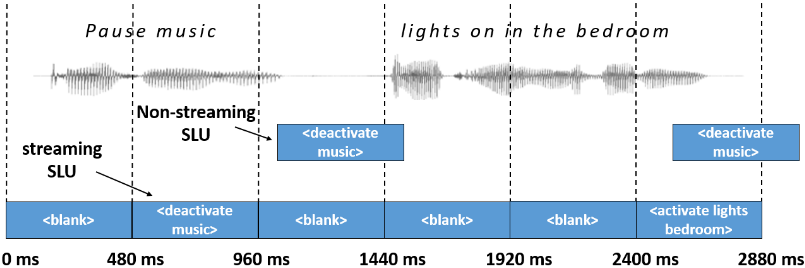
End-to-end streaming SLU. The above end-to-end approach predicts the intent with the entire utterance, and can only predict one intent for a single utterance. This approach is non-streaming. For a streaming approach, however, the model is expected to perform a sequence-to-sequence prediction, which predicts an intent when the evidence is sufficiently accumulated, and multiple intents can be predicted incrementally. The reader can refer to Figure 3 as illustration of the difference between the non-streaming and streaming approaches. Compared to the non-streaming case, the primary difficulty for the streaming model is how to accumulate evidence for each intent so that appropriate intents can be 'fired' when the evidence is sufficient. In the model that will be presented shortly, we employ CTC training as the major tool to solve this problem.
3.2 Proposed Architecture
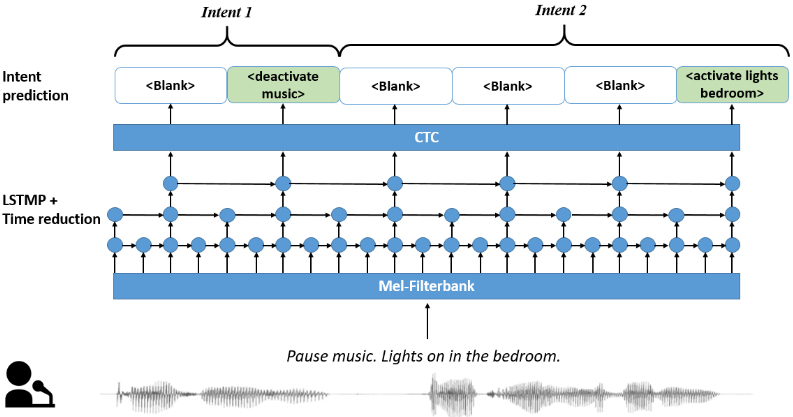
We formulate the streaming end-to-end SLU as a sequenceto-sequence task, where our goal is to predict the sequence of intents L by given an input sequence of acoustic features X. The proposed architecture is shown in Fig. 2. The main structure of the model is a unidirectional RNN network, where the units are long short-term memory with projection (LSTMP). A potential problem for SLU is that the lengths of the speech input and the intent labels are significantly different. The same problem arises in ASR, but for SLU it is more evident as an intention often corresponds to a much longer speech segment than a word. In order to condense the semantic information and reduce the length discrepancy, time reduction [Chan et al., 2015] was employed to reduce the frame rate for each layer.
3.3 CTCCriterion
The key problem of the proposed streaming end-to-end architecture is how to fire intentions automatically when evidence is sufficient. We resort to the Connectionist Temporal Classification (CTC) training. The CTC training was first motivated to train RNNs of unsegmented data [Graves et al., 2006]. Previous to CTC, training RNNs required prior segmentation of the input sequence. With such segmentation, each feature was labelled with an appropriate target and the RNN was trained to predict the target step by step, via the back-propagation through time (BPTT). With CTC, all the potential alignments between the input and output sequences are considered during the training, by inserting blank tokens (<blank>) between any output labels (including the beginning and end of the sequence) to ensure the input and output sequences have the same length. This approach has been successfully employed in various tasks including speech recognition [Miao et al., 2016] and machine translation [Libovick`y and Helcl, 2018].
Formally, the conditional probability of a single alignment, α, is the product of the probabilities of observing αt at time t and can be represented as
where αt represents the given label (including the blank token) at time t, according to the alignment α. Because P(α|X) defines mutually exclusive alignment, the conditional probability for the target sequence Y given the input sequence X amounts to the sum of the probabilities associated with all the alignments:
where BX,L is the set of all valid alignments. The CTC loss is then defined as
This model can be efficiently trained following a forwardback algorithm [Graves et al., 2006]. A favorable feature of a CTCmodel is that during decoding, true target labels are output only the evidence for them are sufficiently accumulated, otherwise the model will output the blank token [Sak et al., 2015]. Once a label has been output, its evidence is reset and a new round of evidence accumulation is started. This feature perfectly fits the request of the streaming SLU, where we expect the model to fire an intent if sufficient evidence from the speech signal has been accumulated, and once it is fired, the evidence should be accumulated again. By this setting, multiple intents can be sequentially identified, no matter how long the speech signal is.
3.4 Two-stage Pre-training
Although CTC can potentially solve the streaming SLU task, some training skills are still required in order to tackle the intrinsic data sparsity problem (as in non-streaming models). For that, we designed a two-stage pre-training scheme as described below. Our experiments show that the pre-training methods are crucial for training a high-quality streaming endto-end model.
ASR pre-training. In the first stage, we initialize the feature extraction layers with a pre-trained ASR model. Only the first layer was used for this purpose. After training, the weights were kept frozen and used to provide embeddings for the next LSTM layers. The upper LSTM layers use these embeddings (or features) to make predictions. This procedure aims at leveraging the large speech corpora and the finegrained word labels in ASR. For that, we utilize the 100 hours of speech signals in the Librispeech dataset [Panayotov et al., 2015]. Our pre-trained model is based on classifying character-level targets, employing the CTC loss. Using characters instead of words as the training target simplifies the training task [Lugosch et al., 2019]. In this study, we only reuse the first layer of the ASR model for the SLU model, which ideally plays the role of robust feature extraction. Different from the approach investigated in [Kuo et al., 2020] and [Lugosch et al., 2019], where the weights of the pretrained ASR model were fine-tuned while training the SLU
model, the layer borrowed from ASR model in our study remains frozen.
Cross-entropy pre-training. In the second stage, we pretrain the SLU model (the first layer fixed) with a crossentropy (CE) loss, before taking the CTC training. For simplicity, we compute the CE loss at the last time step only and back-propagate to the beginning of the sequence. After this pre-training, the model is fine-tuned by using the CTC loss.
4 Experimental Setup
We evaluate the proposed model in three tasks: single-intent classification, multi-intent prediction and spoken keyword spotting. In this section, we firstly present the datasets used and then describe the experimental settings.
4.1 Datasets
Four datasets were involved in our experiments, all audio clips were (re)sampled at 16 kHz.
- All of our pretrained ASR models were trained on the LibriSpeech corpus, which was introduced in [Panayotov et al., 2015]. It was derived from audiobooks and contains roughly 1000 hours of speech. We selected 100 hours of clean speech to train the ASR model. There are couple of reasons for that. First, we are proposing a compact model with relatively reduced number of parameters. Second, the pre-trained ASR is attained by optimizing the weights in the first layer, which means even fewer parameters to be optimized. Therefore, we considered 100 hours (3x more than the in-domain FSC data) enough to train the first layer. Note that this layer is kept frozen while training the rest of the network. Empirically, we found no benefit in unfreezing the first layer while training our model with in-domain data. Similar findings have been found for the same dataset in previous work [Lugosch et al., 2019].
- The Fluent Speech Commands (FSC) dataset [Lugosch et al., 2019] was used to train and evaluate our SLU model for intent classification. It comprised singlechannel audio clips collected using crowd sourcing. Participants were requested to speak random phrases for each intent twice. The dataset contained about 19 hours of speech, providing a total of 30,043 utterances spoken by 97 different speakers. Each utterance contains three slots: action, object, and location. We considered a single intent as the combination of all the slots (action, object and location), resulting 31 intents in total. The whole dataset was split to three subsets: the training set (FSC-Tr) contained 14.7 hours of data, totalling 23,132 utterances from 77 speakers; the validation set (FSC-Val) and test set (FSC-Tst) comprised 1.9 and 2.4 hours of speech, leading to 3,118 utterances from 10 speakers and 3,793 utterances from other 10 speakers, respectively. The validation set was used to select the model, while the test set was used to evaluate the SLU performance.
- To train and test the multi-intent prediction model, we generated three additional multi-intent datasets using the utterances from the FSC dataset. The first dataset, namely FSC-M2, was attained by concatenating two utterances from the same speaker into a single sentence. We have made sure that all the possible intent combinations were evenly distributed in the dataset. The training part of FSC-M2 (FSC-M2-Tr) contained 57,923 utterances (74.27 hours) selected from the FSC training data, and the test part (FSC-M2-Tst) contained 8,538 utterances (11.80 hours) from the FSC test data. Following a similar procedure, we constructed a three-intent dataset (FSC-M3) by augmenting the utterances in FSCM2 with a new utterance from FSC. Finally, we combined roughly 40 % of random samples from FSC, FSCM2, and FSC-M3 to build a large multi-intent set (FSCMM), where the data splitting for training and test was the same as the original datasets. For model selection, we also constructed validation sets for each multi-intent condition.
- We also used the Google Speech Commands (GSC) dataset [Warden, 2018] to verify the capability of our model in spotting short key words. The provider of the dataset published two versions. Version 1 comprised 64,727 utterances from 1,881 speakers, a total of 30 words. We split the dataset into training, validation and test sets, containing 14.08, 1.88, 1.89 hours of speech signals respectively. Version 2 was larger, consisting of 105,829 utterances of 35 words, recorded by 2,618 speakers. The training, validation and test sets contain 23.30, 3.02, 2.74 hours of speech, respectively.
4.2 Experimental Settings
In this work, audio signals are sampled at 16 kHz. The Kaldi toolkit is used to extract 80-dimensional log Mel-Filterbank features with 3-dimensional pitch, totalling 83 dimensions. To extract the Mel features, the audio signal is processed in frames of 320 samples (i.e., 20-ms window length), with a step size of 160 samples (that is, 10-ms hop-size). Global Cepstral Mean and Variance Normalization (CMVN) are applied in order to mitigate the mismatch between training and testing data.
The model was trained using the ADAM optimizer [Loshchilov and Hutter, 2017], with the initial learning rate set to 0.0001. Dropout probability was set to 0.1 and the parameter for weight decay was set to 0.2. For the ASR pretraining, the ASR model was trained 100 epochs; for the CE pre-training, the model was trained for 10 epochs with the CE criterion.
5 Experimental Results
We present the results on three tasks: single-intent classification, multi-intent prediction and spoken keyword spotting. For the ablation study, note that we present the results with and without the two pre-training techniques. Results are all reported on test sets.
| Model | Streaming | Accuracy |
|---|---|---|
| RNN+Pre-training [Lugosch et al., 2019] | no | 98.8 |
| CNN+Segment pooling [Mhiri et al., 2020] | no | 97.8 |
| CNN+GRU(SotA) [Tian and Gorinski, 2020] | no | 99.1 |
| RNN+CTC | yes | 12.66 |
| + ASR Pre-training | yes | 15.83 |
| + CE Pre-training | yes | 98.90 |
5.1 Experiment I: Single-intent Classification
The first experiment is single-intent classification, conducted with the FSC dataset. The model has three LSTMP layers, each with 1024 hidden states followed by a projection layer with 320 dimension. As described in Section 3.4, the first layer is based on a pre-trained ASR model where the current frame is stacked with 7 frames to the left. Frame-skipping is employed, with only 1/3 frames need to be processed, leading to faster computation. The next two LSTMP layers involve a time reduction operation with the reduction factor 4. This results in a 480-ms input context for each output time step. The output of the third LSTMP layer is fed to two fully connected layers and the final output corresponds to the 31 intents.
Table 1 presents the results for this task. For comparison, three recent end-to-end SLU solutions are adopted as benchmarks: the RNN model with pre-training presented by [Lugosch et al., 2019], the CNN model with segment pooling presented by [Mhiri et al., 2020], and the CNN trained with Reptile presented by [Tian and Gorinski, 2020]. The CNN+Reptile approach represents the state-of-the-art (SotA) performance on this task. We emphasize that all of the three models are non-streaming and so cannot perform online and incremental predictions. Nevertheless, their results set good reference for our streaming model.
The results in Table 1 demonstrated that our proposed streaming model is highly effective: it achieves performance as high as 98.90 % with the two-stage pre-training. This result outperforms the first two benchmarks, and is very close to the SotA model [Tian and Gorinski, 2020], while our approach is streaming.
Focusing on the pre-training methods, it can be observed that both the ASR pre-training and the CE pre-training improve the performance, though the contribution of the CE pretraining is much more significant. This is not surprising as the supervision from the target (intent) is very sparse and usually appears at the end of an utterance. The CE pre-training offers a strong bias on the more reasonable alignments for the CTC training.
An interesting observation is that our streaming model usually predicts the intent before the end of the utterance. In most cases, the spotting position is at the 2/3 length of the utterance. This implies that the model has learned to accumulate the evidence and can make the prediction decision if the evidence has been strong enough, rather than waiting for the end of the utterance. This feature is highly desirable. It enables a truly online SLU, and it is a major advantage that the CTC model possesses.
| Trained | |||||
|---|---|---|---|---|---|
| FSC-Tr | FSC-M2-Tr | FSC-M3-Tr | FSC-MM-Tr | ||
| Tested | FSC-Tst | 98.90 | 98.77 | 97.96 | 98.90 |
| FSC-M2-Tst | 56.90 | 97.93 | 96.90 | 97.89 | |
| FSC-M3-Tst | 26.73 | 97.15 | 97.01 | 97.28 | |
| Model | V1 | V2 |
|---|---|---|
| Att-RNN [Andrade et al., 2018] | 95.6 | 96.9 |
| TC-ResNet [Choi et al., 2019] | - | 96.6 |
| SincConv+DSConv [Mittermaier et al., 2020] | 96.6 | 97.4 |
| TENET12+MTConv [Li et al., 2020] | 96.84 | - |
| CTC | 62.64 | 62.98 |
| + Pre-trained ASR | 64.16 | 63.59 |
| + Pre-trained CE | 96.35 | 97.10 |
5.2 Experiment II: Multi-intent Prediction
In the second experiment, we evaluate our model's ability to predict multiple intents. For that, we adopt our architecture based on the two-stage pre-training approach, which provides the best results in the first experiment. We first use the model trained on the single-intent corpus (FSC-Tr) to predict multiple intents, and then retrain multi-intent models using multiintent corpora. Note that the benchmark models in the previous experiment cannot predict multiple intents, so we did not report them here.
The performance is presented in Table 2, where each row represents a test condition and each column represents a training condition. Note that for the multi-intent test, only if all the intents involved in the utterance are identified, the result is recognized as correct. Therefore, the multi-intent prediction is much more challenging than the single-intent classification.
Table 2 shows that, when trained with single-intent data and tested on two-intent and three-intent utterances, the performance of our streaming model is significantly degraded, specially in the three-intent case. This is mainly because there is no prior knowledge about the intent boundaries involved in the training data. Nonetheless, the single-intent model can still predict multiple intents in some cases, especially in the two-intent setting. This is surprising and demonstrated that the CTC streaming model is rather powerful and has learned how to accumulate evidence for intents and reset it when an intent has been detected.
When multi-intent data are employed to train the model, the performance on the two-intent and three-intent conditions is significantly improved. Surprisingly, the accuracy of the multi-intent prediction is almost the same as the singleintent prediction, although the former is much harder. This implies that by learning the multi-intent samples, the model has well learned how to reset the evidence quickly, so that it can prepare for the next intent prediction in time. Remarkably, the model seems to learn this knowledge with two-intent data only and this knowledge can be generalized to conditions with more intentions. For example, on the three-intent test, the accuracy was increased from 26% to 97% when we trained the model with two-intent data.
5.3 Experiment III: Keyword Spotting
In this last experiment, we customize the streaming end-toend architecture and apply it to a keyword spotting task. This model consists of two LSTMP layers. The first LSTMP layer involves 1024 hidden states, followed by a projection layer with 320 units. This layer is initialized by ASR pre-training as in the intention prediction experiment. The second LSTMP layer is similar, but time reduction is applied, so that the time scope is enlarged by 4 times. The output from the second LSTMP layer is fed into two fully connected layers, and the output corresponds to the keywords for detecting.
Two models were trained using the training set of GSC V1 and V2 respectively, and were tested on the test set of GSC V1 and V2 individually. For the test on each dataset, 12 keywords were selected. The performance in terms of detection accuracy is presented in Table 3. For comparison, we reported the results of four benchmarks that represent the stateof-the-art research on this dataset. Results show that on both the two test sets, our model based on two-stage pre-training offers competitive performance when compared to the benchmark results. Meanwhile, our model is streaming and holds the great advantage on spotting multiple keywords online and incrementally.
6 Analysis for Early Spotting
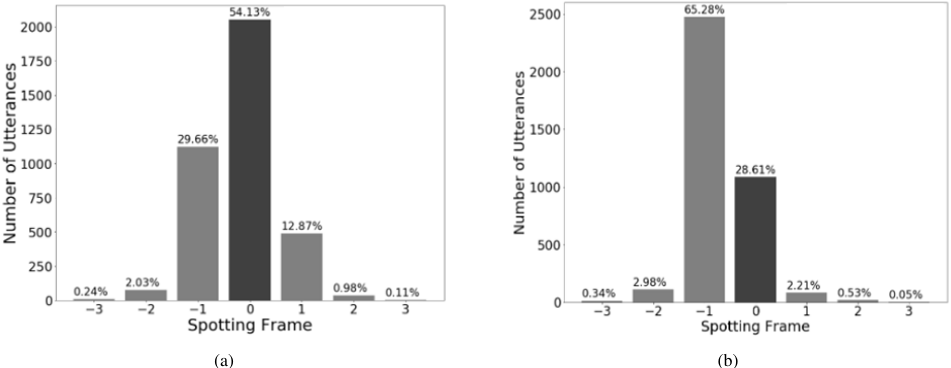
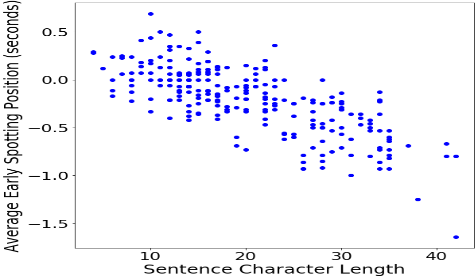
A key advantage of our streaming SLU system is that intents or keywords can be determined whenever evidence is sufficient. In this section, we present some statistical analysis of such early-spotting behavior based on the intent detection. The first analysis investigates the statistics of relative position of the spottings, i.e., the distance between the spotting positions and ground truth positions. Note that we treat the last non-silence frame corresponding to an intention as its ground truth position, which can be determined by Voice Activity Detection (VAD). Figure 4a shows the relative positions of the spottings in the intent detection experiments, where a negative distance denotes an early spotting, and a positive distance denotes a late spotting. It can be found that in the single-intent scenario, more than 30% of the spottings occur earlier than the ground truth positions, and this proportion is 68% in the multi-intent scenario. The second analysis investigates the relation between the early-spotting behavior and the length of the sentence. The results are shown in Figure 5, where the x-axis represents the sentence length in characteres, and the y-axis represents the relative spotting position. It can be found that long sentences are more likely to be early spotted than short sentences.
7 Conclusion
In this paper, we propose an end-to-end streaming SLU framework, which can predict multiple intentions in an online and incremental way. Our model is based on a unidirectional LSTM architecture, optimized with the alignment-free CTC loss and pre-trained with the cross-entropy criterion. We test the model on the intent prediction task. Results show that our model achieves comparable performance to start-of-theart non-streaming models for single-intent classification. For multi-intent prediction, which is more challenging and impossible for the existing non-streaming models, our approach almost maintains the accuracy of single-intent classification. The model was also tested on a keyword spotting task, and the performance is competitive compared to four benchmarks. As future work, we aim to explore streaming intent + slot classification, and integrate local attention mechanism into our streaming solution.
@inproceedings{ijcai2021p538,
  title     = {A Streaming End-to-End Framework For Spoken Language Understanding},
  author    = {Potdar, Nihal and Raymundo Avila, Anderson and Xing, Chao and Wang, Dong and Cao, Yiran and Chen, Xiao},
  booktitle = {Proceedings of the Thirtieth International Joint Conference on
               Artificial Intelligence, {IJCAI-21}},
  publisher = {International Joint Conferences on Artificial Intelligence Organization},
  editor    = {Zhi-Hua Zhou},
  pages     = {3906--3914},
  year      = {2021},
  month     = {8},
  note      = {Main Track},
  doi       = {10.24963/ijcai.2021/538},
  url       = {https://doi.org/10.24963/ijcai.2021/538},
}
TY - CPAPER TI - A Streaming End-to-End Framework For Spoken Language Understanding AU - Potdar, Nihal AU - Raymundo Avila, Anderson AU - Xing, Chao AU - Wang, Dong AU - Cao, Yiran AU - Chen, Xiao T2 - Proceedings of the Thirtieth International Joint Conference on Artificial Intelligence, IJCAI-21 PB - International Joint Conferences on Artificial Intelligence Organization PY - 2021 SP - 3906 EP - 3914 DO - 10.24963/ijcai.2021/538 UR - https://doi.org/10.24963/ijcai.2021/538 ER -Copied
Machine-readable versions of this paper, for tools and AI agents:





