
Faster Smarter Proof by Induction in Isabelle/HOL
Proceedings of the Thirtieth International Joint Conference on Artificial Intelligence. Main Track. Pages 1981-1988.
https://doi.org/10.24963/ijcai.2021/273
© 2021 International Joint Conferences on Artificial Intelligence
Keywords
- Multidisciplinary Topics and Applications: Validation and Verification
- Knowledge Representation and Reasoning: Logics for Knowledge Representation
- Knowledge Representation and Reasoning: Automated Reasoning and Theorem Proving
- Heuristic Search and Game Playing: Meta-Reasoning and Meta-Heuristics
Abstract
We present sem_ind, a recommendation tool for proof by induction in Isabelle/HOL.
Given an inductive problem, sem_ind produces candidate arguments for proof by induction, and selects promising ones using heuristics.
Our evaluation based on 1,095 inductive problems from 22 source files shows that sem_ind improves the accuracy of recommendation from 20.1% to 38.2% for the most promising candidates within 5.0 seconds of timeout compared to its predecessor while decreasing the median value of execution time from 2.79 seconds to 1.06 seconds.
- [Bansal et al., 2019] Kshitij Bansal, Sarah Loos, Markus Rabe, Christian Szegedy, and Stewart Wilcox. HOList: An environment for machine learning of higher order logic theorem proving. In Proceedings of the 36th International Conference on Machine Learning, 2019.
- [Blaauwbroek et al., 2020] Lasse Blaauwbroek, Josef Ur- ban, and Herman Geuvers. Tactic learning and proving for the Coq proof assistant. In LPAR 2020: 23rd Inter- national Conference on Logic for Programming, Artificial Intelligence and Reasoning, Alicante, Spain, 2020.
- [Blanchette and Nipkow, 2010] Jasmin Christian Blanchette and Tobias Nipkow. Nitpick: A counterexample generator for higher-order logic based on a relational model finder. In Interactive Theorem Proving, First International Con- ference, ITP Edinburgh, 2010.
- [Boyer and Moore, 1979] Robert S. Boyer and J. Strother Moore. A computational logic handbook, volume 23 of Perspectives in computing. Academic Press, 1979. [Bulwahn, 2012] Lukas Bulwahn. The new quickcheck for Isabelle -random, exhaustive and symbolic testing under one roof. In Certified Programs and Proofs -Second In- ternational Conference, CPP, 2012.
- [Chvalovský, 2019] Karel Chvalovský. Top-down neural model for formulae. In 7th International Conference on Learning Representations, ICLR 2019, New Orleans, LA, USA. OpenReview.net, 2019.
- [Cruanes, 2017] Simon Cruanes. Superposition with struc- tural induction. In Clare Dixon and Marcelo Finger, edi- tors, Frontiers of Combining Systems -11th International Symposium, FroCoS 2017, Brasília, 2017.
- [Gauthier et al., 2017] Thibault Gauthier, Cezary Kaliszyk, and Josef Urban. TacticToe: Learning to reason with HOL4 tactics. In LPAR-21, 21st International Conference on Logic for Programming, Artificial Intelligence and Rea- soning, Maun, 2017.
- [Gauthier et al., 2021] Thibault Gauthier, Cezary Kaliszyk, Josef Urban, Ramana Kumar, and Michael Norrish. Tac- ticToe: Learning to prove with tactics. J. Autom. Reason., 65(2):257-286, 2021.
- [Gramlich, 2005] Bernhard Gramlich. Strategic issues, prob- lems and challenges in inductive theorem proving. Electr. Notes Theor. Comput. Sci., 125(2):5-43, 2005.
- [Hajdú et al., 2020] Márton Hajdú, Petra Hozzová, Laura Kovács, Johannes Schoisswohl, and Andrei Voronkov. In- duction with generalization in superposition reasoning. In Intelligent Computer Mathematics -13th International Conference, CICM, Bertinoro. Springer, 2020.
- [Harrison, 1996] John Harrison. HOL light: A tutorial intro- duction. In Formal Methods in Computer-Aided Design, First International Conference, FMCAD, Palo Alto, 1996.
- [Jakubuv et al., 2020] Jan Jakubuv, Karel Chvalovský, Miroslav Olsák, Bartosz Piotrowski, Martin Suda, and Josef Urban. ENIGMA anonymous: Symbol-independent inference guiding machine (system description). In Auto- mated Reasoning -10th International Joint Conference, IJCAR Paris, France. Springer, 2020.
- [Johansson et al., 2014] Moa Johansson, Dan Rosén, Nicholas Smallbone, and Koen Claessen. Hipster: Integrating theory exploration in a proof assistant. In Intelligent Computer Mathematics -International Con- ference, CICM Coimbra, Portugal, Lecture Notes in Computer Science. Springer, 2014.
- [Jr., 1982] Guy L. Steele Jr. An overview of common lisp. In Proceedings of the 1982 ACM Symposium on LISP and Functional Programming, LFP Pittsburgh, 1982.
- [Kaliszyk et al., 2017] Cezary Kaliszyk, Franc ¸ois Chollet, and Christian Szegedy. HolStep: A machine learning dataset for higher-order logic theorem proving. In 5th International Conference on Learning Representations, ICLR, Toulon. OpenReview.net, 2017.
- [Klein et al., 2004] Gerwin Klein, Tobias Nipkow, Larry Paulson, and Rene Thiemann. The Archive of Formal Proofs. 2004.
- [Kovács and Voronkov, 2013] Laura Kovács and Andrei Voronkov. First-order theorem proving and vampire. In Computer Aided Verification -25th International Confer- ence, CAV, 2013.
- [Li et al., 2021] Wenda Li, Lei Yu, Yuhuai Wu, and Lawrence C. Paulson. IsarStep: a benchmark for high- level mathematical reasoning. In International Conference on Learning Representations, 2021.
- [Loos et al., 2017] Sarah M. Loos, Geoffrey Irving, Chris- tian Szegedy, and Cezary Kaliszyk. Deep network guided proof search. In LPAR-21, 21st International Confer- ence on Logic for Programming, Artificial Intelligence and Reasoning, Maun, Botswana, EPiC Series in Computing. EasyChair, 2017.
- [Moore and Wirth, 2013] J Strother Moore and Claus-Peter Wirth. Automation of mathematical induction as part of the history of logic. CoRR, abs/1309.6226, 2013.
- [Moore, 1973] J. Strother Moore. Computational logic : structure sharing and proof of program properties. PhD thesis, University of Edinburgh, UK, 1973.
- [Moore, 1998] J. Strother Moore. Symbolic simulation: An ACL2 approach. In Formal Methods in Computer-Aided Design, Second International Conference, FMCAD '98, Palo Alto, 1998.
- [Nagashima and He, 2018] Yutaka Nagashima and Yilun He. PaMpeR: proof method recommendation system for Is- abelle/HOL. In Proceedings of the 33rd ACM/IEEE Inter- national Conference on Automated Software Engineering, ASE, Montpellier, 2018.
- [Nagashima and Kumar, 2017] Yutaka Nagashima and Ra- mana Kumar. A proof strategy language and proof script generation for Isabelle/HOL. In 26th International Con- ference on Automated Deduction, Gothenburg, 2017.
- [Nagashima and Parsert, 2018] Yutaka Nagashima and Ju- lian Parsert. Goal-oriented conjecturing for Isabelle/HOL. In Intelligent Computer Mathematics -11th International Conference, CICM, Hagenberg, 2018.
- [Nagashima, 2019a] Yutaka Nagashima. LiFtEr: Language to encode induction heuristics for Isabelle/HOL. In Pro- gramming Languages and Systems -17th Asian Sympo- sium, APLAS, Nusa Dua, Bali, Indonesia, 2019.
- [Nagashima, 2019b] Yutaka Nagashima. Towards evolution- ary theorem proving for Isabelle/HOL. In Proceedings of the Genetic and Evolutionary Computation Conference Companion, GECCO, Prague, Czech Republic, 2019.
- [Nagashima, 2020a] Yutaka Nagashima. SeLFiE: Modular semantic reasoning for induction in Isabelle/HOL. CoRR, abs/2010.10296, 2020.
- [Nagashima, 2020b] Yutaka Nagashima. Smart induction for Isabelle/HOL (tool paper). In Proceedings of the 20th Conference on Formal Methods in Computer-Aided De- sign -FMCAD, 2020.
- [Nagashima, 2020c] Yutaka Nagashima. Towards united reasoning for automatic induction in Isabelle/HOL. In The Japanese Society for Artificial Intelligence 34th An- nual Conference, JSAI, online, volume https://doi.org/10. 11517/pjsai.JSAI2020.0 3G1ES103, 2020. DOI
- [Nagashima, 2021] Yutaka Nagashima. Appendix to "faster smarter proof by induction in Isabelle/HOL". Zenodo, https:// doi.org/ 10.5281/ zenodo.4743750, 2021. DOI
- [Nipkow et al., 2002] Tobias Nipkow, Lawrence C. Paulson, and Markus Wenzel. Isabelle/HOL -a proof assistant for higher-order logic. Springer, 2002.
- [Paliwal et al., 2020] Aditya Paliwal, Sarah M. Loos, Markus N. Rabe, Kshitij Bansal, and Christian Szegedy. Graph representations for higher-order logic and theorem proving. In The Thirty-Fourth AAAI Conference on Artificial Intelligence, AAAI. AAAI Press, 2020.
- [Piotrowski and Urban, 2020] Bartosz Piotrowski and Josef Urban. Stateful premise selection by recurrent neural net- works. In LPAR 2020: 23rd International Conference on Logic for Programming, Artificial Intelligence and Rea- soning, Alicante, Spain, EPiC Series in Computing, 2020.
- [Reger and Voronkov, 2019] Giles Reger and Andrei Voronkov. Induction in saturation-based proof search. In CADE -27th International Conference on Automated Deduction, Natal, 2019.
- [Sekiyama and Suenaga, 2018] Taro Sekiyama and Kohei Suenaga. Automated proof synthesis for the minimal propositional logic with deep neural networks. In Pro- gramming Languages and Systems -16th Asian Sympo- sium, APLAS, Wellington, New Zealand. Springer, 2018.
- [Slind and Norrish, 2008] Konrad Slind and Michael Nor- rish. A brief overview of HOL4. In Theorem Proving in Higher Order Logics, 21st International Conference, TPHOLs Montreal, 2008.
- [The Coq development team, 2021] The Coq development team. The Coq proof assistant, https://coq.inria.fr. https: //coq.inria.fr, 2021. Accessed: 2021-05-31. Link
- [Wenzel, 2002] Markus Wenzel. Isabelle, Isar -a versatile environment for human readable formal proof documents. PhD thesis, Technical University Munich, Germany, 2002.
- [Wenzel, 2012] Makarius Wenzel. Isabelle/jEdit -A prover IDE within the PIDE framework. In Intelligent Computer Mathematics -11th International Conference, 2012.
- [Yang and Deng, 2019] Kaiyu Yang and Jia Deng. Learning to prove theorems via interacting with proof assistants. In Proceedings of the 36th International Conference on Ma- chine Learning, 2019.
References were extracted automatically from the PDF and may contain errors.
Full text extracted automatically from the PDF; figures, tables and equations may differ. The PDF is the version of record.
1 Introduction
As our society grew reliant on software systems, the trustworthiness of such systems became essential. One approach to develop trustworthy systems is complete formal verification using proof assistants. In a complete formal verification, we specify the desired properties of our systems and prove that our implementations are correct in terms of the specifications using software tools, called proof assistants.
In many verification projects, proof by induction plays a critical role. To facilitate proof by induction, modern proof assistants offer sub-tools, called tactics. For example, Isabelle [Nipkow et al., 2002] comes with the induct tactic. Using the induct tactic, human proof authors can apply proof by induction simply by passing appropriate arguments instead of manually developing induction principles. When choosing such arguments, proof engineers have to answer the following three questions:
- On which terms do they apply induction?
- Which variables do they pass to the arbitrary field to generalise them?
- Which induction rule do they pass to the rule field?
For example, Program 1 defines the append function (@) and two reverse functions (rev1 and rev2) and presents two ways to prove their equivalence by applying the induct tactic. Note that [], #, and [x] represent the empty list, the list constructor, and the syntactic sugar for x # [], respectively.
by considering it as a concrete case of the induction hypothesis. If we remove ys from the arbitrary field, the subsequent application of auto leaves the induction step as follows:
In other words, auto cannot make use of the induction hypothesis since the conclusion of induction step share the same ys. Experienced human researchers can judge that this application of the induct tactic was not appropriate. However, it is also true that this induction step is still provable. For this reason, counter-example finders, such as Nitpick [Blanchette and Nipkow, 2010] and Quickcheck [Bulwahn, 2012], cannot detect that this induct tactic without generalisation is not appropriate for this problem. This is why engineers still have to carefully examine inductive problems to answer the aforementioned three questions when using the induct tactic.
This issue is not specific to Isabelle: other proof assistants, such as Coq [The Coq development team, 2021], HOL4 [Slind and Norrish, 2008], and HOL Light [Harrison, 1996], offer similar tactics for inductive theorem proving, and it is human engineers who have to specify the arguments for such tactics. This issue is not trivial either: in a summary paper from 2005, Gramlich listed generalisation as one of the main problems and challenges of inductive theorem proving while predicting that substantial progress in inductive theorem proving will take time due to the enormous problems and the inherent difficulty of inductive theorem proving [Gramlich, 2005].
Previously, we built smart induct, which suggests arguments of the induct tactic in Isabelle/HOL. Our evaluation showed that smart induct predicts on which variables Isabelle experts apply the induct tactic for some inductive problems. Unfortunately, smart induct has the following limitations:
- L1. It tends to take too long to produce recommendations.
- L2. It cannot recommend induction on compound terms or induction on multiple occurrences of the same variable.
- L3. It is bad at predicting variable generalisations.
- L4. Its evaluation is based on a small dataset with 109 inductive problems.
We overcame these problems with sem ind, a new recommendation tool for the induct tactic. Similarly to smart induct, sem ind suggests what arguments to pass to the the induct tactic for a given inductive problem. Our overall contribution is that
we built a system that predicts how one should apply proof by induction in Isabelle/HOL both quickly and accurately.
Even though we built sem ind for Isabelle/HOL, our approach is transferable to other proof assistants based on tactics: no matter what proof assistants we use, we need an architecture that aggressively removes less promising candidates to address L1 (presented in Section 2), a procedure to construct promising induction candidates without missing out too many good ones to address L2 (presented in Section 3), and domain-agnostic heuristics that analyse not only the syntactic structures of inductive problems but the definitions of relevant constants to address L3 (presented in Section 4). Finally, Section 5 justifies our claims through extensive evaluations based on 1095 inductive problems, addressing L4.
2 The Overall Architecture
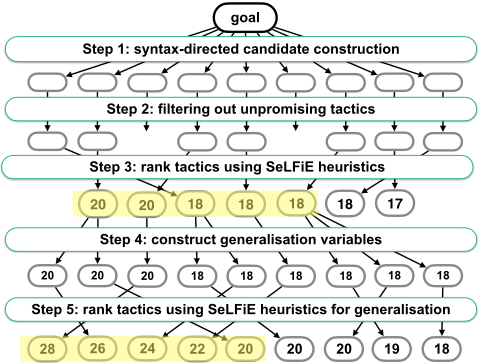
Figure 1 illustrates the overall architecture of sem ind, consisting of 5 steps to produce and select candidate tactics as follows.
Step 1. sem ind produces a set of sequences of induction terms and induction rules for the induct tactic from a given inductive problem. The aim of this step is to produce a small number of candidates intelligently, so that it covers most promising sequences of induction terms and induction rules while avoiding a combinatorial blowup. We expound the algorithm to achieve this goal in Section 3.
Step 2. sem ind applies the induct tactic with the sequences of arguments produced in Step 1 to discard less promising candidates. sem ind decides a sequence of arguments is unpromising if the sequence satisfies any of the following conditions:
- the induct tactic fails with an error message, or
- one of the resulting intermediate goals is identical to the original goal itself.
Step 3. sem ind applies 36 pre-defined heuristics written in SeLFiE [Nagashima, 2020a], which we explain in Section 4 using our running example. These heuristics judge the validity of induction terms and induction rules with respect to the proof goal and the relevant definitions. Each heuristic is implemented as an assertion on inductive problems and arguments of the induct tactic, and each assertion is tagged with a value. If an assertion returns True for a sequence of arguments, sem ind gives the tagged value to the sequence. sem ind sums up such points from the 36 heuristics to compute the score for each sequence. Based on these scores, sem ind sorts sequences of arguments from Step 2 and selects the five most promising sequences for further processing.
Step 4. After deciding induction terms and induction rules for the induct tactic in Step 3, sem ind adds arguments for the arbitrary field to the sequences of arguments passed from Step 3. Firstly, sem ind collects free variables in the proof goal that are not induction terms for each sequence from Step 3. Then, it constructs the powerset of such free variables and uses each set in the powerset as the arguments to the arbitrary field of the induct tactic. For example, if sem ind receives (induct xs) from Step 3 for our running example of list reversal, it produces {{}, {ys}} as the powerset because xs and ys are the only free variables in the goal and xs appears as the induction term. This powerset leads to the following two induct tactics: (induct xs), and (induct xs arbitrary:ys).
Step 5. For each remaining sequence, sem ind applies 8 pre-defined SeLFiE heuristics to judge the validity of generalisation. Again, each heuristic is tagged with a value, which is used to compute the final score for each candidate: for each sequence, sem ind adds the score from the generalisation heuristics to the score from Step 3 to decide the final score for each sequence. Based on these final scores, sem ind sorts sequences of arguments from Step 5 and presents the 10 most promising sequences in the Output panel of Isabelle/jEdit, the default proof editor for Isabelle/HOL [Wenzel, 2012].
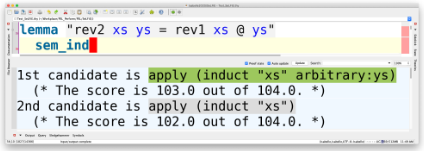
We developed sem ind entirely within the Isabelle ecosystem without any dependency to external tools. This allows for the easy installation process of sem ind: to use sem ind, users only have to download the relevant Isabelle files from our public GitHub repository 1 and install sem ind using the standard Isabelle command. The seamless integration into the Isabelle proof language, Isar [Wenzel, 2002], lets users invoke sem ind within their ongoing proof development and copy a recommended induct tactic to the right location with one click as shown in Figure 2.
3 Syntax-Directed Candidate Construction
In general, the induct tactic may take multiple induction terms and induction rules in one invocation. However, it is rarely necessary to pass multiple induction rules to the rule filed. Therefore, sem ind passes up-to-one induction rule to the induct tactic.
1 https://github.com/data61/PSL
On the other hand, it is often necessary to pass multiple induction terms to the induct tactic, and the order of such induction terms is important to apply the induct tactic effectively. Moreover, it is sometimes indispensable to pass the same induction termmultiple times to the induct tactic, so that each of them corresponds to a distinct occurrence of the same term in the proof goal. What is worse, induction terms do not have to be variables: they can be compound terms such as function applications.
Enumerating all possible sequences of induction terms leads to a combinatorial explosion. To avoid such combinatorial explosion, sem ind produces sequences of induction terms and induction rules taking a syntax-directed approach, which traverses the syntax tree representing the proof goal while collecting plausible sequences of induction terms and rules as follows.
Step 1-A. The collection starts at the root node of the syntax tree with an empty set of sequences of induction arguments.
Step 1-B. If the current node is a function application, sem ind takes arguments to the function, produces a set of lists of such arguments while preserving their order. This set of lists represents candidates for induction terms. If the function in this function application is a constant with a relevant induction rule stored in the proof context, sem ind produces candidate induct tactics with and without this rule for the rule field. For example, if the current node is rev2 xs ys, Step 1-B produces (induct xs) and (induct xs ys rule:rev2.induct), as well as other candidates such as (induct xs ys) and (induct xs rule:rev2.induct).
Step 1-C. If any sub-terms of the current node is a compound term, sem ind moves down to such sub-terms in the syntax tree and repeats S1-b to collect more candidates for induction arguments.
Step 1-D. sem ind finishes Step 1 when it reaches the leaf nodes in all branches of the syntax tree.
This syntax-directed argument construction avoids a combinatorial explosion at the cost of missing out some effective sequences of induction arguments. One notable example is the omission of simultaneous induction, which is essential to tackle inductive problems with mutually recursive functions. Our evaluation results in Section 5 show that despite the omission of such cases sem ind manages to recommend correct induction arguments for most of the cases that appear in dayto-day theorem proving.
In principle, this smart construction of candidate induct tactics ignores handcrafted induction rules: in Step 1-B sem ind collects induction rules derived automatically by Isabelle when defining relevant functions. For example, sem ind picks up rev2.induct when seeing rev2 in our running example since rev2.induct is an induction principle Isabelle automatically derived when defining rev2. This constraint is unavoidable since we cannot predict what induction rules proof engineers will manually develop in the future for problem domains that may not even exist yet.
The notable exceptions to this principle are induction rules manually developed in Isabelle's standard library: in Step 1-B
Program 2 Syntactic analysis for generalisation in SeLFiE
∀ arb term : term ∈ arbitrary_term. ∃ f term : term. ∃ f occ : term_occ ∈ f term. ∃ arb occ ∈ arb term. ∃ generalise nth : number. is_or_below_nth_argument_of (arb occ, generalise nth, f occ) ∧∃def(f term, generalise_nth_argument_of, [generalise nth, f term])the smart construction algorithm collects some manually developed induction rules from the standard library if the rules seem to be relevant to the inductive problem at hand. This optimisation is reasonable: some concepts in the standard library, such as lists and natural numbers, are used in many projects and have useful induction rules handcrafted by Isabelle experts.
4 Induction and Generalisation Heuristics
We now have a closer look at heuristics used in Step 3 and Step 5. To produce accurate recommendations quickly, heuristics for sem ind have to satisfy the following two criteria.
- C1: The heuristics should be applicable to a wide range of problem domains, some of which do not exist yet.
- C2: They should be able to analyse not only the syntactic structures of the inductive problems at hand but also the definitions of relevant constants in terms of how such constants are used within the inductive problems.
To satisfy the above criteria, we choose SeLFiE [Nagashima, 2020a] as our implementation language to encode heuristics. SeLFiE is is a meta-language to encode heuristics for inductive theorem proving as assertions. A SeLFiE
Program 3 Definitional analysis for generalisation in SeLFiE
generalise_nth_argument_of := λ [generalise nth, f term]. ∃ lhs occ : term_occ. is_left_hand_side (lhs occ) ∧∃ nth param on lhs : term_occ. is_nth_argument_of (nth param on lhs, generalise nth, lhs occ) ∧∃ nth param on rhs : term_occ. ¬ are_of_same_term (nth param on rhs, nth param on lhs) ∧∃ f occ on rhs : term_occ ∈ f term. is_nth_argument_of (nth param on rhs, generalise nth, f occ on rhs)assertion takes a pair of arguments to the induct tactic and an inductive problem with relevant definitions. The assertion should return True if the choice of argument of the induct tactic is compatible with the heuristic.
The exact definitions of our 44 heuristics are not informative or possible due to the page limit. Therefore, instead of presenting each heuristic, this section introduces one simple generalisation heuristic written in SeLFiE to demonstrate how we address the above two criteria using SeLFiE.
Program 2 and 3 define the following generalisation heuristic introduced by Nipkow et al.[Nipkow et al., 2002] 2 :
(Variable generalisation) should not be applied blindly. It is not always required, and the additional quantifiers can complicate matters in some cases. The variables that need to be quantified are typically those that change in recursive calls.
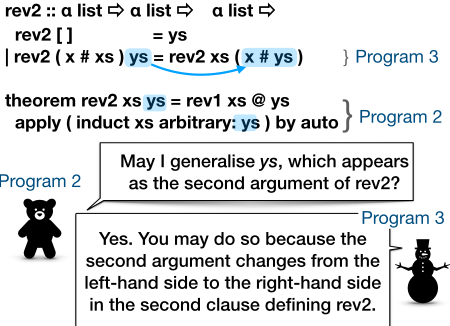
Figure 3 illustrates how this heuristic justifies the generalisation of ys in our running example as an informal dialogue between Program 2 and Program 3. In this dialogue, Program 2 analyses the syntactic structure of the proof goal in terms of the arguments of the induct tactic, whereas Program 3 analyses the definition of rev2 in terms of how rev2 is used in the goal. Note that Program 2 and Program 3 realise this dialogue through a definitional quantifier, ∃def . With this dialogue in mind, we now formally interpret the two programs for our running example.
Program 2 checks for all generalised variable, arb term, if there exists a function, f term, its occurrence, f occ, an occurrence of the generalised variable, arb occ, and a natural number, generalise nth, that satisfy the conjunction. Since our running example has only one generalised variable, ys, if we choose
2 In this explanation we simplified the heuristic to focus on the essence of SeLFiE. The corresponding heuristic we used for sem ind involves optimisations and handling of corner cases.
- rev2 for f term,
- the only occurrence of rev2 in the proof goal for f occ,
- the occurrence of ys on the left-hand side of the equation in the proof goal for arb occ,
- 2 for generalise nth,
we can satisfy the first conjunct for all arb terms because in the proof goal ys appears as the second argument of the only occurrence of rev2.
In the second conjunct, Program 2 uses ∃def to ask Program 3 if there exists a clause defining rev2 that satisfies the condition specified in Program 3. Formally speaking, Program 3 examines if there is a term occurrence, nth param on lhs, such that nth param on lhs is the generalise nth argument on the left-hand side in the equation defining f term, but an occurrence of f term on the right-hand side has a different term for its second argument.
In the second clause defining rev2, the second argument of rev2 is ys on the left-hand side, while the second argument of rev2 is x#ys on the right-hand side. Therefore, Program 3 returns True to ∃def in Program 2, with which Program 2 confirms that the candidate arguments of the induct tactic satisfy Nipkow's heuristic.
Attentive readers may have noticed that Program 2 and Program 3 satisfy the aforementioned two criteria. They satisfy C1 because they refer to problem specific constants and arguments, such as rev2 and ys, abstractly using quantifiers, so that they can be applicable to other inductive problems. They also satisfy C2 because Program 3 analyses the definitions of relevant constants, such as rev2, while Program 2 analyses the syntactic structures of the problem. This is why sem ind achieves higher coincidence rates compared to its predecessor, smart induct [Nagashima, 2020b], reported in Section 5.
In total, we implemented 44 heuristics in SeLFiE. 36 of them are induction heuristics and 8 of them are generalisation heuristics. We adopted some heuristics from smart induct, and we newly implemented others based on literature and our expertise. As discussed above, SeLFiE allows us to encode heuristics that transcend problem domains using quantifiers. At the same time, however, some basic concepts, such as lists, sets and natural numbers, appear in a wide range of verification projects. Therefore, we developed 20 SeLFiE heuristics that explicitly refer to concrete constants or manually derived induction rules from the standard library to improve the accuracy of recommendations for problems involving such commonly used concepts. Unlike other parts of this paper, these 20 heuristics involve expertise specific to Isabelle/HOL.
5 Evaluation
We evaluated sem ind against smart induct. Our focus is to measure the accuracy of recommendations and execution time necessary to produce recommendations. All evaluations are conducted on a MacBook Pro (15-inch, 2019) with 2.6 GHz Intel Core i7 6-core memory 32 GB 2400 MHz DDR4.
Unfortunately, it is, in general, not possible to decide whether a given application of the induct tactic is right for a given problem. In particular, even if we can finish a proof search after applying the induct tactic, this does not guarantee that the arguments passed to the induct tactic are a good choice. For example, it is possible to prove our motivating example by applying (induct ys); however, the necessary proof script following this application of the induct tactic becomes unnecessarily lengthy.
| tool | top 1 | top 3 | top 5 | top 10 |
|---|---|---|---|---|
| sem ind | 38.2% | 59.3% | 64.5% | 72.7% |
| smart induct | 20.1% | 42.8% | 48.5% | 55.3% |
| tool | top 1 | top 3 | top 5 | top 10 |
|---|---|---|---|---|
| sem ind | 54.5% | 63.6% | 72.7% | 72.7% |
| smart induct | 0.0% | 0.0% | 0.0% | 9.1% |
Therefore, we adopt coincidence rates as the surrogate for success rates to approximate the accuracy of sem ind's recommendations: we measure how often recommendations of sem ind coincide with the choice of human engineers. Since there are often multiple equally valid sequences of induction arguments for a given inductive problem, we should regard coincidence rates as conservative estimates of true success rates.
As our evaluation target, we use 22 Isabelle theory files with 1,095 applications of the induct tactic from the Archive of Formal Proofs (AFP) [Klein et al., 2004]. The AFP is an online repository of formal proofs in Isabelle/HOL. Each entry in the AFP is peer-reviewed by Isabelle experts prior to acceptance, which ensures the quality of our target theory files. Therefore, if sem ind achieves higher coincidence rates for our target theory files, we can say that sem ind produces good recommendations for many problems. To the best of our knowledge, this is the most diverse dataset used to measure recommendation tools for proof by induction. For example, when Nagashima evaluated smart induct they used only 109 invocations of the induct tactic from 5 theory files, all of which are included in our dataset.
5.1 Coincidence Rates within 5.0 Seconds
Table 1 shows coincidence rates of both sem ind and smart induct within 5.0 seconds of timeout.
For example, the coincidence rate of sem ind is 38.2% for top 1. This means that the sequences of induction arguments used by human researchers appear as the most promising sequences recommended by sem ind for 38.2% of the uses of the induct tactic. On the other hand, the coincidence rate of smart induct is 20.1% for top 1. This means that sem ind achieved a 90.0% increase of the coincidence rate for the most promising candidates. Overall, Table 1 indicates that sem ind consistently outperforms smart induct when they can suggest multiple sequences.
We leave the coincidence rates for each theory file in the accompanying technical appendix [Nagashima, 2021] but present coincidence rates for a representative theory file in Table 2. This theory file contains 11 proofs by induction, many of which involve generalisation. Previously, we reported low coincidence rates of smart induct for this file and concluded that we could not achieve higher rates because of the domain-specific language we used to encode heuristics [Nagashima, 2020b]: this language, called LiFtEr [Nagashima, 2019a], did not allow us to analyse definitions of relevant constants, even though such definitions often carry the essential information to decide what variables to generalise.
| tool | 0.2s | 0.5s | 1.0s | 2.0s | 5.0s |
|---|---|---|---|---|---|
| sem ind | 8.8% | 24.7% | 47.8% | 69.8% | 86.8% |
| smart | 0.0% | 3.5% | 16.9% | 38.3% | 70.2% |
As shown in Table 2, our evaluation confirmed low coincidence rates of smart induct for this file but showed significantly higher rates of sem ind. That is, sem ind managed to predict experts' use of generalisation accurately since sem ind uses SeLFiE to analyse the definitions of relevant constants as shown in Section 4.
5.2 Return Rates for 5 Timeouts
sem ind achieves the higher accuracy by analysing not only the syntactic structures of inductive problems but also the definitions of constants relevant to the problems. Inevitably, this requires larger computational resources: the SeLFiE interpreter has to examine not only the syntax tree representing proof goals but also the syntax trees representing the definitions of relevant constants. However, thanks to the syntax-directed candidate construction algorithm presented in Section 3 and aggressive pruning strategy presented in Section 2, sem ind provides recommendations faster than smart induct does.
This performance improvement is presented in Table 3, which shows how often sem ind and smart induct return recommendations within certain timeouts. For example, the return rate of sem ind is 8.8% for 0.2 seconds. This means that sem ind returns recommendations for 8.8% of proofs by induction within 0.2 seconds. On the other hand, the return rate of smart induct is 0.0% for 0.2 seconds.
Table 3 shows that for all theory files sem ind produces more recommendations than smart induct does for all timeouts specified in this evaluation, proving the superiority of sem ind over smart induct in terms of the execution time necessary to produce recommendations. In fact, the median values of execution time for these 1,095 problems are 1.06 seconds for sem ind and 2.79 seconds for smart induct. That is to say, sem ind achieved 62% of reduction in the median value of execution time.
6 RelatedWork
Boyer and Moore invented the waterfall model [Moore, 1973] for inductive theorem proving for a first-order logic on Common Lisp [Jr., 1982]. In the original waterfall model, a prover tries to apply any of the following six techniques: simplification, destructor elimination, cross-fertilization, generalisation, elimination of irrelevance, and induction to emerging sub-goals until it solves all sub-goals.
The most well-known prover based on the waterfall model is ACL2 [Moore, 1998]. To decide how to apply induction, ACL2 computes a score, called hitting ratio, based on a fixed formula [Boyer and Moore, 1979; Moore and Wirth, 2013] to estimate how good each induction scheme is. Instead of computing a hitting ratio, we use SeLFiE to encode our induction heuristics as assertions. While ACL2 produces many induction schemes and computes the corresponding hitting ratios, sem ind produces a small number of promising sequences of induction terms and rules.
For Isabelle/HOL, we developed a proof strategy language, PSL [Nagashima and Kumar, 2017]. PSL's interpreter discharges easy induction problems by conducting expensive proof searches, and its extension to abductive reasoning tries to identify auxiliary lemmas useful to prove inductive problems [Nagashima and Parsert, 2018]. While our abductive reasoning mechanism took a top-down approach, Johansson et al. took a bottom-up approach [Johansson et al., 2014] based on the idea of theory exploration.
There are ongoing attempts to extend saturation-based superposition provers with induction: Cruanes presented an extension of typed superposition that can perform structural induction [Cruanes, 2017], while Reger et al. incorporated lightweight automated induction [Reger and Voronkov, 2019] to the Vampire prover [Kov´acs and Voronkov, 2013] and Hajd´u et al. extended it to cover induction with generalisation [Hajd´u et al., 2020]. A straightforward comparison to their approaches is difficult as their provers are based on less expressive logics and different proof calculi. However, we argue that one advantage of sem ind over their approaches is that sem ind never introduces axioms that risk the consistency of Isabelle/HOL. Furthermore, our evaluation consists of a wider range of problem domains written by experienced Isabelle users based on their diverse interests: Hajd´u's evaluation involved a number of inductive problems, but the problem domains were limited to lists, natural numbers, and trees.
Similarly to sem ind, TacticToe [Gauthier et al., 2017; Gauthier et al., 2021] for HOL4, Tactician [Blaauwbroek et al., 2020] for Coq, and PaMpeR [Nagashima and He, 2018] for Isabelle are meta-tactic tools seamlessly integrated in proof assistants' ecosystems; however, none of them logically analyse inductive problems or predict arguments of the induct tactic accurately. Unlike these tools, sem ind presents accurate recommendations without relying on statistical machine learning.
Despite the growing interest in deep learning for theorem proving, [Kaliszyk et al., 2017; Bansal et al., 2019; Yang and Deng, 2019; Jakubuv et al., 2020; Paliwal et al., 2020; Chvalovsk´y, 2019; Sekiyama and Suenaga, 2018; Piotrowski and Urban, 2020; Loos et al., 2017; Li et al., 2021], we mindfully avoided deep learning since we have only a limited number of inductive problems available. Instead of deep learning, we used SeLFiE's quantifiers to encode our heuristics in a domain-agnostic style. To the best of our knowledge, no project based on deep learning has managed to predict arguments to the induct tactic accurately.
7 Conclusion
We presented sem ind, a recommendation tool for proof by induction. sem ind constructs candidate induct tactics for a given inductive problem while avoiding combinatorial explosion, and it selects promising candidates by filtering out unpromising candidates and scoring remaining ones. To give scores to each remaining candidate, we encoded 36 heuristics in SeLFiE to decide on which terms and with which rules we should apply the induct tactic, as well as 8 SeLFiE heuristic to decide which variables to generalise.
Our evaluation based on 1,095 inductive problems from 22 theory files showed that compared to the existing tool, smart induct, sem ind achieves a 90.0% increase of the coincidence rate from 20.1% to 38.2% for the most promising candidate, while achieving a 62.0% decrease of the median value of execution time. In particular, sem ind surpassed the accuracy of the existing tool by a wide margin for inductive problems involving variable generalisation.
Currently, sem ind uses manually specified weights for heuristics. It remains as our future work to optimise such weights using evolutionary computation [Nagashima, 2019b] and to integrate sem ind into a larger AI tool for Isabelle/HOL [Nagashima, 2020c].
Acknowledgements
We thank the anonymous reviewers for useful feedback both at TACAS2020 and IJCAI2021. This work has been supported by the following grants:
- the grant of Singapore NRF National Satellite of Excellence in Trustworthy Software Systems (NSoE-TSS),
- the European Regional Development Fund under the project AI & Reasoning (reg.no.CZ.02.1.01/0.0/0.0/15 003/0000466),
- the ERC starting grant no. 714034, and
- NII under NII-Internship Program 2019-2nd call.
@inproceedings{ijcai2021p273,
  title     = {Faster Smarter Proof by Induction in Isabelle/HOL},
  author    = {Nagashima, Yutaka},
  booktitle = {Proceedings of the Thirtieth International Joint Conference on
               Artificial Intelligence, {IJCAI-21}},
  publisher = {International Joint Conferences on Artificial Intelligence Organization},
  editor    = {Zhi-Hua Zhou},
  pages     = {1981--1988},
  year      = {2021},
  month     = {8},
  note      = {Main Track},
  doi       = {10.24963/ijcai.2021/273},
  url       = {https://doi.org/10.24963/ijcai.2021/273},
}
TY - CPAPER TI - Faster Smarter Proof by Induction in Isabelle/HOL AU - Nagashima, Yutaka T2 - Proceedings of the Thirtieth International Joint Conference on Artificial Intelligence, IJCAI-21 PB - International Joint Conferences on Artificial Intelligence Organization PY - 2021 SP - 1981 EP - 1988 DO - 10.24963/ijcai.2021/273 UR - https://doi.org/10.24963/ijcai.2021/273 ER -Copied
Machine-readable versions of this paper, for tools and AI agents:





