
Exploring Periodicity and Interactivity in Multi-Interest Framework for Sequential Recommendation
Proceedings of the Thirtieth International Joint Conference on Artificial Intelligence. Main Track. Pages 1426-1433.
https://doi.org/10.24963/ijcai.2021/197
Keywords
- Machine Learning: Recommender Systems
- Data Mining: Big Data, Large-Scale Systems
- Data Mining: Recommender Systems
Abstract
Sequential recommendation systems alleviate the problem of information overload, and have attracted increasing attention in the literature. Most prior works usually obtain an overall representation based on the user’s behavior sequence, which can not sufficiently reflect the multiple interests of the user. To this end, we propose a novel method called PIMI to mitigate this issue. PIMI can model the user’s multi-interest representation effectively by considering both the periodicity and interactivity in the item sequence. Specifically, we design a periodicity-aware module to utilize the time interval information between user’s behaviors. Meanwhile, an ingenious graph is proposed to enhance the interactivity between items in user’s behavior sequence, which can capture both global and local item features. Finally, a multi-interest extraction module is applied to describe user’s multiple interests based on the obtained item representation. Extensive experiments on two real-world datasets Amazon and Taobao show that PIMI outperforms state-of-the-art methods consistently.
- [Cen et al., 2019] Yukuo Cen, Xu Zou, Jianwei Zhang, Hongxia Yang, Jingren Zhou, and Jie Tang. Representa- tion learning for attributed multiplex heterogeneous net- work. In Proceedings of the 25th ACM SIGKDD Interna- tional Conference on Knowledge Discovery & Data Min- ing, pages 1358-1368, 2019.
- [Cen et al., 2020] Yukuo Cen, Jianwei Zhang, Xu Zou, Chang Zhou, Hongxia Yang, and Jie Tang. Control- lable multi-interest framework for recommendation. arXiv preprint arXiv:2005.09347, 2020.
- [Covington et al., 2016] Paul Covington, Jay Adams, and Emre Sargin. Deep neural networks for youtube recom- mendations. In Proceedings of the 10th ACM conference on recommender systems, pages 191-198, 2016.
- [Hidasi et al., 2015] Balázs Hidasi, Alexandros Karat- zoglou, Linas Baltrunas, and Domonkos Tikk. Session- based recommendations with recurrent neural networks. arXiv preprint arXiv:1511.06939, 2015.
- [Jiang et al., 2020] Hao Jiang, Wenjie Wang, Yinwei Wei, Zan Gao, Yinglong Wang, and Liqiang Nie. What aspect do you like: Multi-scale time-aware user interest modeling for micro-video recommendation. In Proceedings of the 28th ACM International Conference on Multimedia, pages 3487-3495, 2020.
- [Johnson et al., 2019] Jeff Johnson, Matthijs Douze, and Hervé Jégou. Billion-scale similarity search with gpus. IEEE Transactions on Big Data, 2019.
- [Kang and McAuley, 2018] Wang-Cheng Kang and Julian McAuley. Self-attentive sequential recommendation. In 2018 IEEE International Conference on Data Mining (ICDM), pages 197-206. IEEE, 2018.
- [Li et al., 2019] Chao Li, Zhiyuan Liu, Mengmeng Wu, Yuchi Xu, Huan Zhao, Pipei Huang, Guoliang Kang, Qi- wei Chen, Wei Li, and Dik Lun Lee. Multi-interest net- work with dynamic routing for recommendation at tmall. In Proceedings of the 28th ACM International Conference on Information and Knowledge Management, pages 2615- 2623, 2019.
- [Li et al., 2020] Jiacheng Li, Yujie Wang, and Julian McAuley. Time interval aware self-attention for sequen- tial recommendation. In Proceedings of the 13th Interna- tional Conference on Web Search and Data Mining, pages 322-330, 2020.
- [Luo et al., 2020] A. Luo, P. Zhao, Y. Liu, F. Zhuang, and V. S. Sheng. Collaborative self-attention network for session-based recommendation. In Twenty-Ninth Interna- tional Joint Conference on Artificial Intelligence and Sev- enteenth Pacific Rim International Conference on Artifi- cial Intelligence IJCAI-PRICAI-20, 2020. IJCAI
- [Lv et al., 2019] Fuyu Lv, Taiwei Jin, Changlong Yu, Fei Sun, Quan Lin, Keping Yang, and Wilfred Ng. Sdm: Se- quential deep matching model for online large-scale rec- ommender system. In Proceedings of the 28th ACM Inter- national Conference on Information and Knowledge Man- agement, pages 2635-2643, 2019.
- [Rendle et al., 2010] Steffen Rendle, Christoph Freuden- thaler, and Lars Schmidt-Thieme. Factorizing personal- ized markov chains for next-basket recommendation. In Proceedings of the 19th international conference on World wide web, pages 811-820, 2010.
- [Sabour et al., 2017] Sara Sabour, Nicholas Frosst, and Ge- offrey E Hinton. Dynamic routing between capsules. In Advances in neural information processing systems, pages 3856-3866, 2017.
- [Scarselli et al., 2008] Franco Scarselli, Marco Gori, Ah Chung Tsoi, Markus Hagenbuchner, and Gabriele Monfardini. The graph neural network model. IEEE Transactions on Neural Networks, 20(1):61-80, 2008.
- [Vaswani et al., 2017] Ashish Vaswani, Noam Shazeer, Niki Parmar, Jakob Uszkoreit, Llion Jones, Aidan N Gomez, Łukasz Kaiser, and Illia Polosukhin. Attention is all you need. In Advances in neural information processing sys- tems, pages 5998-6008, 2017.
- [Wang et al., 2020] Chenyang Wang, Min Zhang, Weizhi Ma, Yiqun Liu, and Shaoping Ma. Make it a chorus: knowledge-and time-aware item modeling for sequential recommendation. In Proceedings of the 43rd International ACM SIGIR Conference on Research and Development in Information Retrieval, pages 109-118, 2020.
- [Xu et al., 2015] Kelvin Xu, Jimmy Ba, Ryan Kiros, Kyunghyun Cho, Aaron Courville, Ruslan Salakhudinov, Rich Zemel, and Yoshua Bengio. Show, attend and tell: Neural image caption generation with visual attention. In International conference on machine learning, pages 2048-2057, 2015.
- [Xu et al., 2019] Chengfeng Xu, Pengpeng Zhao, Yanchi Liu, Victor S Sheng, Jiajie Xu, Fuzhen Zhuang, Junhua Fang, and Xiaofang Zhou. Graph contextualized self- attention network for session-based recommendation. In IJCAI, pages 3940-3946, 2019.
- [Ying et al., 2018] Rex Ying, Ruining He, Kaifeng Chen, Pong Eksombatchai, William L Hamilton, and Jure Leskovec. Graph convolutional neural networks for web- scale recommender systems. In Proceedings of the 24th ACM SIGKDD International Conference on Knowledge Discovery & Data Mining, pages 974-983, 2018.
- [Zhang et al., 2017] Yao Zhang, Yun Xiong, Xiangnan Kong, and Yangyong Zhu. Learning node embeddings in interaction graphs. In Proceedings of the 2017 ACM on Conference on Information and Knowledge Management, pages 397-406, 2017.
- [Zhou et al., 2018] Jie Zhou, Ganqu Cui, Zhengyan Zhang, Cheng Yang, Zhiyuan Liu, Lifeng Wang, Changcheng Li, and Maosong Sun. Graph neural networks: A review of methods and applications. arXiv preprint arXiv:1812.08434, 2018.
References were extracted automatically from the PDF and may contain errors.
Full text extracted automatically from the PDF; figures, tables and equations may differ. The PDF is the version of record.
1 Introduction
Sequential recommendation systems play an important role in helping users alleviate the problem of information overload, and in many application domains, e.g., ecommerce, social media and music, it can help optimize the business metrics such as click-through rate (CTR). Sequential recommendation systems sort items by the timestamp of user behavior, and focus on sequential pattern mining to predict the next item that users may be interested in. Most existing methods combine user's preference and item representation to make predictions, researches in sequential recommendation are therefore largely concerned with how to improve the representation quality of users and items.
Due to sequential recommendation systems' highly practical value, many kinds of approaches for sequential recommendation have been proposed and achieved promising performance. For example, GRU4Rec [Hidasi et al., 2015] is the first work to apply RNN to model the sequence information for recommendation. Kang and McAuley [2018] propose attention-based method to capture high-order dynamic information in the sequence. Recently, some works (e.g. PinSage [Ying et al., 2018]) leverage Graph Neural Network (GNN) based methods to obtain the representation of users and items for downstream tasks. However, we observe that most prior studies obtain an overall representation for user's behavior sequence, but a unified user embedding is difficult to reflect the user's multiple interests. In the literature, few studies attempt to model the multi-interest representation of users to alleviate the problem of insufficient represent ability of a single vector.
∗Cong Xue is the corresponding author.
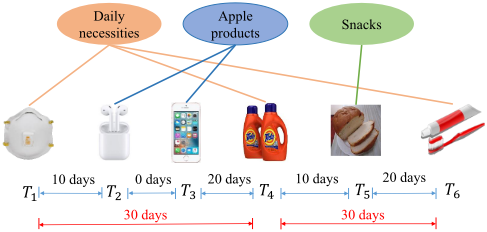
Recently, MIND [Li et al., 2019] utilizes a dynamic routing method based on the capsule network [Sabour et al., 2017] to adaptively aggregate user's historical behavior into user's multiple representation vectors, which can reflect the different interests of the user. ComiRec [Cen et al., 2020] leverages self-attention mechanism and dynamic routing method for multi-interest extraction following MIND. However, these methods have the following limitations: (1) They only use time information to sort items, and ignore that the behaviors of different interests have different time periodicity in user sequence. For example, in Figure 1, given a user's behavior sequence, the user may be interested in daily necessities, Apple's products and snacks. He/she may buy daily necessities every month, but he/she only pays attention to Apple's products during the launch of new Apple products. Therefore, the time interval for the interest in daily necessities is about one month, while the time interval for the interest in Apple's products is longer, about one year. In summary, users' behavior for different types of items have different periodicities. (2) The interactivity between items is not explored effectively. These methods only model the correlation between adjacent items in the sequence, but do not consider the interactivity between items in the multi-interest extraction. In fact, multi-interest extraction can be viewed as the process of soft clustering between items, and the interactivity between items is effective for clustering tasks [Zhang et al., 2017], because items of the same type will learn similar representation through interaction. Thus, we argue that the time interval and interaction information between items in the user's sequence are more powerful to capture multi-interest representation.
To solve these problems, we propose a novel method, called PIMI, to explore Periodicity and Interactivity in MultiInterest framework for sequential recommendation. Firstly, we encode the time interval information between items in the sequence so that the periodicity information can be involved in the user's multi-interest representation, which can reflect the dynamic changes of the user behavior. Secondly, we design an ingenious graph structure. Previous GNN-based methods ignore the sequential information in the user behavior, our graph structure overcomes this shortcoming and captures the correlation between adjacent user behavior. What's more, the proposed graph structure can gather and scatter global and local item interactivity information with the virtual central node to improve the performance of multi-interest extraction. Finally, we obtain multi-interest representation for user based on the attention mechanism, which can be used to select candidate items and make recommendations. The main contributions of this work are summarized as follows:
- We incorporate the time interval information in the user behavior sequence, which can model the periodicity of user's multiple interests and improve the quality of the user's representation.
- We design an innovative graph structure to capture the global and local interactivity among items, and retain the sequential information at the same time, which can improve the quality of the item's representation.
- Our model PIMI achieves the state-of-the-art performance on two real-world challenging datasets Amazon and Taobao for the sequential recommendation.
2 RelatedWork
Sequential recommendation. Sequential recommendation systems are based on the user's behavior sequence to predict the next item that the user might be interested in. Many recent works about sequential recommendation focus on this problem. FPMC [Rendle et al., 2010] contains a common Markov chain and the normal matrix factorization model for sequential data. SDM [Lv et al., 2019] combines user's longand short-term preferences to make recommendations, which models user's preferences based on LSTM and dense fullyconnected networks. Chorus [Wang et al., 2020] utilizes the information of the knowledge graph to model the relations between items, and introduces temporal kernel functions for each item relation to better capture dynamic user demands. These methods give a single vector representation of the user based on behavior sequence, which is hard to reflect the realworld recommendation situation. Recently, MIND [Li et al., 2019] and ComiRec [Cen et al., 2020] attempt to use dynamic routing-based methods and attention-based methods to obtain multiple user's vectors to reflect multiple interests in the sequence. However, they do not explore the periodicity of multiple interests and the interactivity between items sufficiently, which are conducive to the extraction of multi-interest.
Time information learning for recommendation. Time information is very important for recommendation. Most sequential recommendation methods sort items according to the timestamp of user's interactions, which implicitly uses time information. Few works attempt to model the time information in the sequence explicitly. For example, MTIN [Jiang et al., 2020] develops a parallel temporal mask network, which is able to learn multiple temporal information for recommendation. TiSASRec [Li et al., 2020] combines the advantages of absolute position and relative time interval encodings based on self-attention to predict future items.
Graph neural network. Graph embedding is to learn a mapping function which maps the nodes in a graph to lowdimensional latent ] representation [Zhou et al., 2018]. Some recent works utilize graph neural network [Scarselli et al., 2008] methods to obtain the representation of users and items, which can be used for recommendation tasks. For example, GATNE [Cen et al., 2019] supports both transductive and inductive embedding learning for attributed multiplex heterogeneous networks, which can learn the representation of users and items. However, GNNs essentially deal with the interactivity between nodes, they neglect the relationship between adjacent items in the user sequence.
Attention. The originality of attention mechanism can be traced back to decades ago in fields of computer vision [Xu et al., 2015]. It is also adapted to recommendation systems and rather useful on real-world recommendation tasks. For instance, SASRec [Kang and McAuley, 2018] captures highorder dynamics in user behavior sequences based on the selfattention mechanism. GC-SAN [Xu et al., 2019] designs a multi-layer self-attention network to obtain contextualized non-local representation in sequence. CoSAN [Luo et al., 2020] proposes the collaborative self-attention network to learn the session representation by modeling the long-range dependencies between collaborative items.
3 Our Method
The existing sequential recommendation methods usually use a single vector to represent the user, it is hard to reflect user's multiple interests in real-world. Based on the above observation, we explore using multiple vectors to represent the user's multiple interests.
The recent multi-interest frameworks for sequential recommendation ignore two problems: the periodicity of user's interest and the interactivity between items in the sequence. We believe that the user's points of interest have different time periodicity, so adding time information into the multi-interest vectors improves the quality of user representation. Meanwhile, the interactivity between items in the sequence are effective in improving the quality of item representation.
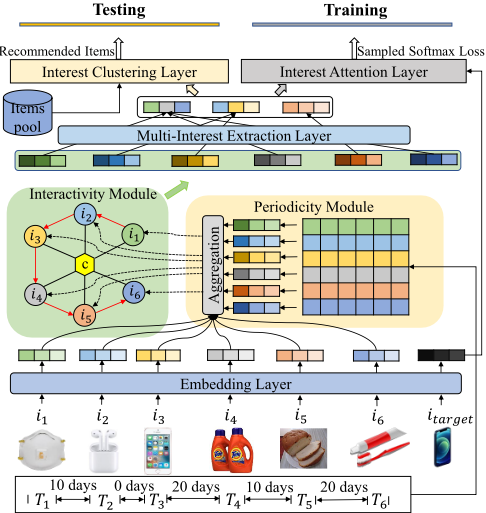
In this section, we first formalize the sequential recommendation problem. Then, we propose a novel method, to explore Periodicity and Interactivity in Multi-Interest framework for recommendation, called PIMI (as shown in Figure 2).
3.1 Problem Statement
Assume U denote a set of users and I denote all items. Each user u ∈ U has a sequence of historical behavior in order. Given the user action history Su = (iu1 , iu2 , ..., iu|Su |-1 ), iur ∈ I represents the r-th item in the sequence. The goal of sequential recommendation is to predict the next item that the user might be interested in.
3.2 Multi-Interest Framework
Embedding Layer
As shown in Figure 2, the input of PIMI is a user behavior sequence, which contains a series of item IDs representing the user's actions with items in time order. We convert the user behavior sequence (iu1 , iu2 , ..., iu|Su |-1 ) into a fixed-length sequence su = (iu1 , iu2 , ..., iun ), where n represents the maximum sequence length we consider. If the sequence length is greater than n, we truncate it and only take the most recent n items, otherwise, we pad the sequence to a fixed length n.
We construct an embedding matrix M I ∈ R|I|×d for all items, where d is the dimension of embedding vector. The embedding look-up operation converts the IDs of items in the sequence into a unified low-dimension latent space. We can obtain its embedding:
where er ∈ R1×d is the embedding of the r-th item.
Periodicity Module
Corresponding to the user's behavior sequence su , we can also obtain a time sequence tu = (tu1 , tu2 , ..., tun ), which contains the timestamp of each item in order. We only focus on the relative length of the time interval in one user behavior sequence and model it as the relationship between any two items. Specifically, given a fixed-length time sequence tu = (tu1 , tu2 , ..., tun ) of user u, the time interval duab between item a and item b is defined as the number of days interacted by user u, where duab ∈ N. duab and duba are equal according to this definition. We also set a threshold p for the time interval to avoid sparse encoding, duab = min(p, duab ). Hence, the time interval matrix M t ∈ Nn×n of a user sequence is:
Similar to the items' embedding, time interval embedding matrix is M T ∈ Rn×n×d . For each item in the sequence, we use the time-aware attention method to obtain the attention score matrix A1 ∈ Rn×n of the time interval matrix:
where W1 ∈ Rd is a trainable parameter. The superscript ⊤ denotes the transpose of the matrix. The attention score matrix A1 with size n × n represents the attention weight of each item for the time interval of other items in the sequence. When we sum up the embedding of time intervals according to the attention score, the broadcast mechanism in Python is used here, we can obtain a matrix representation ET ∈ Rn×d of items, which denotes the position of each item in the timeline of the overall sequence:
Interactivity Module
After the embedding layer and the periodicity module, we aggregate the embedding EI and time interval representation ET of the items and feed them into the interactivity module. In the interactivity module, we design an ingenious graph structure that regards each item in the sequence as a node. Our graph structure not only captures sequential information, but also allows items to interact via the graph neural network. Experimental results prove that the interaction between items can effectively improve multi-interest soft clustering.
Firstly, we construct a meaningful graph from the sequence. As shown in Figure 2, the graph structure contains one virtual central node and n item nodes. The virtual central node is responsible for receiving and distributing feature among all item nodes. For each item node, the black edge represents the undirected connection with the virtual central node. Such a graph structure can make any two non-adjacent item nodes become two-hop neighbors, and can capture nonlocal information. Since the user's behavior is a sequence, we connect the item node in order, as shown by the red connection in the graph. Such graph structure can model the correlation between adjacent items, allow each item node to gather information from neighbors, and capture local information.
Next, we present how to obtain feature vectors of nodes via graph neural network. We use cl ∈ R1×d and Hl ∈ Rn×d to represent the virtual central node and all the item nodes at step l respectively. We initalize H0 and c0 as:
The update of all nodes at step l is divided into two stages: updating all item nodes and updating the virtual central node.
In the first stage, each item node aggregates the following information: its adjacent node hl-1 r-1 in sequence for local information, and the virtual central node cl-1 for global information, in addition, its previous feature hl-1 r , and its corresponding item embedding er. After that, we update the feature of each item node r at step l based on the attention mechanism.
where MultiAtt means Multi-Head Attention network. It was proposed by Vaswani et al. [2017].
In the second stage, the virtual central node aggregates the information of all the item nodes Hl and its previous feature cl-1 . Similar to the item node, it also uses the attention mechanism to update the state.
The overall update algorithm of the interactivity module is shown in the Alg-1.
After L rounds of update, the final feature matrix Hl ∈ Rn×d of item nodes can be used for multi-interest extraction of user interaction sequence.
Algorithm 1 Update Procedure
Input: Items embeddingEI and time interval embeddingET Parameter: Multi-head attention network parameters Output: The feature representation H ∈ Rn×d of all
items
- 1: H0 ←EI +ET
- 2: c0 ← average(H 0 )
- 3: for step ← 1 to L do
- 4: for r ← 1 to n do
- 5: glr = concat[hl-1 r-1 ; cl-1 ; hl-1 r ; er]
- 6: hlr = MultiAtt(Q = hl-1 r ,K = glr , V = glr )
- 7: end for
- 8: ql = concat[cl-1 ;Hl ]
- 9: cl =MultiAtt(Q = cl-1 ,K = ql , V = ql )
- 10: end for
Multi-Interest Extraction Layer
We use the self-attention method to extract multi-interest from the user sequence. Given the hidden embedding representation H ∈ Rn×d of all items from the interactivity module. We can obtain the attention weight A2 ∈ RK×n of multi-interest by the formula:
where W3 and W2 are trainable parameters of size K×4d and 4d × d. K denotes the number of user interests. The matrix A2 with size K × n represents the K perspectives of the user sequence, reflecting the K interest of the user u. Hence, the weighted sum of all item embedding with the attention weight can obtain the K vector representation of the user to reflect the different interests.
3.3 Training Phase
After computing the interest embedding from user behavior through the multi-interest extraction layer, based on a hard attention strategy in the interest attention layer, for the target item, we use the argmax operation to find the most relevant one among the K vector representation:
where Mu is user's multi-interest representation matrix, eo represents the embedding of the target item.
Given a training sample (u, o) with the user embedding mu and the target item embedding eo, we should maximize the probability of user u interacting with item o in the training phase. Due to the expensive computational cost, we utilize the sample softmax method to calculate the likelihood of the user u interacting with the target item o. Finally, we train our model by minimizing the following objective function:
3.4 Testing Phase
After the multi-interest extraction layer, we obtain multiple interests embedding for each user based on his/her past behavior, which can be used for recommendation prediction. In the testing phase, each interest embedding can independently cluster top N items from global items pool based on the inner product similarity by the nearest neighbor library such as Faiss [Johnson et al., 2019] in the interest clustering layer. Hence,we can obtain K × N candidate items, and then get the final recommendation results by maximizing the following value function, that is, a set R containing N items:
| Dataset | users | items | interactions | avg time interval |
|---|---|---|---|---|
| Amazon Books | 459,133 | 313,966 | 8,898,041 | 76 days |
| Taobao | 976,779 | 1,708,530 | 85,383,796 | 1 day |
where ex is the embedding of the candidate item, mku denotes the k-th interest embedding of the user u.
4 Experiments
In this section, we introduce our experimental setup and evaluate the performance of the proposed method, compared with several comparable baselines. In order to maintain the fairness of comparison, we follow the data division and processing method of Cen et al. [2020], which are strong generalization conditions. We split all users into train/validation/test set according to the proportion of 8:1:1, instead of the weak generalization condition, where all users are involved in training and evaluation. When training, we use the entire sequence of the user. Specially, given the behavior sequence (iu1 , iu2 , ..., iuk , ..., iu|S u |-1 ), each training sample (iuk-(n-1) , ..., iuk-1 , iuk ) uses the first n items to predict the (k+1)-th item, where n denotes the maximum sequence length we consider. In the evaluation, we take the first 80% of the user behavior from validation and test users as our model inputs to obtain the user's embedding representation, and compute metrics by predicting the remaining 20% user behavior. Additionally, we conduct a few analysis experiments to prove the effectiveness of PIMI.
4.1 Experiment Settings
Datasets. We conduct experiments on two publicly available datasets Amazon 1 and Taobao 2 . Amazon dataset includes reviews (rating, text, et al.), product metadata (price, brand, et al.), and links from Amazon. We use the Books category of Amazon dataset in our experiment. Taobao dataset contains the interactive behavior of 1 million users, including click, purchase, adding item to shopping cart and item favoring. We use user click behavior in Taobao dataset for experiment. We discard users and items with fewer than 5 interactions, and some illegal timestamp information. We set the maximum length of training samples for Amazon and Taobao to 20 and 50 respectively. After preprocessing, the statistics of the datasets are shown in Table 1.
1 http://jmcauley.ucsd.edu/data/amazon/
2 https://tianchi.aliyun.com/dataset/dataDetail?dataId=649
Baselines. To show the effectiveness of the proposed PIMI, we compare our model with the following baseline methods: (1) YouTube DNN [Covington et al., 2016] is a very successful deep learning model for industrial recommendation systems, which combines the candidate generation model and the ranking model. (2) GRU4Rec [Hidasi et al., 2015], which is the first work that introduces recurrent neural networks for the recommendation. (3) MIND [Li et al., 2019] is a recent model for multi-interest extraction based on dynamic routing algorithm. (4) ComiRec [Cen et al., 2020], which is the state-of-the-art model of multi-interest extraction, there are two different implementations ComiRec-SA and ComiRecDR based on attention mechanism and dynamic routing respectively.
Evaluation Metrics. We adopt three common Top-N metrics, Recall@N, NDCG@N and Hit Rate@N. Recall@N indicates the proportion of the ground truth items are included in the recommendation results. NDCG@N measures the specific ranking quality that assigns high scores to hit at top position ranks. Hit Rate@N represents the percentage that recommended items contain at least one ground truth item in top N position.
Implementation Details. We implement PIMI with TensorFlow 1.13 in Python 3.7. The embedding dimension is 64, batch size for Amazon and Taobao are 128 and 256 respectively, dropout rate is 0.2, learning rate is 0.001. The time interval thresholds for Amazon and Taobao are 64 and 7 respectively. We use three GNN layers to make the items interact sufficiently. We set the number of interest embedding is 4, and use 10 samples for computing sample softmax loss. Finally, we iterate at most 1 million rounds in training phase.
The gap between the Training and Testing. In the training phase, we select the most relevant user's interest embedding for the next target item, while in the testing phase, we extract top N items for each user's interest embedding, and then resort them according to the value function Q. We do this for two reasons: (1) Our experiments are conducted with a strong generalization condition. If the testing phase is consistent with the training phase, the model only predicts the next item based on the most relevant user's interest embedding, which is a weak generalization condition and not fit real-world situation. (2) For a fair comparison, we maintain the same experimental conditions as baselines.
4.2 Comparisons of Performance
To demonstrate the sequential recommendation performance of our model PIMI, we compare it with other state-of-the-art methods. The experimental results of all methods on Amazon and Taobao datasets are illustrated in Table 2, and we have the following observations.
Firstly, YouTube DNN and GRU4Rec use a single vector to represent the user, while MIND, ComiRec and PIMI use the user's multi-interest representation to make recommendations. Experimental results demonstrate that multi-interest representation based on user behavior sequence can reflect the real-world recommendation situation more adequately. Secondly, both MIND and ComiRec-DR use dynamic routing method based on capsule network to extract multiple interests, while ComiRec-SA is a method based on the attention mechanism. We observe that on the sparse dataset Amazon, the self-attention method can better capture the correlation between items in the user behavior sequence, while on the dense dataset Taobao, the dynamic routing method is better. This shows that although self-attention mechanism can capture global feature on sparse datasets, the ability to capture local feature on dense datasets is insufficient.
| Amazon Books | Taobao | |||||||||||
|---|---|---|---|---|---|---|---|---|---|---|---|---|
| Metrics@20 | Metrics@50 | Metrics@20 | Metrics@50 | |||||||||
| Recall | NDCG | Hit Rate | Recall | NDCG | Hit Rate | Recall | NDCG | Hit Rate | Recall | NDCG | Hit Rate | |
| GRU4Rec [Hidasi et al., 2015] | 4.057 | 6.803 | 8.945 | 6.501 | 10.369 | 13.666 | 5.884 | 22.095 | 35.745 | 8.494 | 29.396 | 46.068 |
| YouTube DNN [Covington et al., 2016] | 4.567 | 7.670 | 10.285 | 7.312 | 12.075 | 15.894 | 4.205 | 14.511 | 28.785 | 6.172 | 20.248 | 39.108 |
| MIND [Li et al., 2019] | 4.862 | 7.933 | 10.618 | 7.638 | 12.230 | 16.145 | 6.281 | 20.394 | 38.119 | 8.155 | 25.069 | 45.846 |
| ComiRec-DR [Cen et al., 2020] | 5.311 | 9.185 | 12.005 | 8.106 | 13.520 | 17.583 | 6.890 | 24.007 | 41.746 | 9.818 | 31.365 | 52.418 |
| ComiRec-SA [Cen et al., 2020] | 5.489 | 8.991 | 11.402 | 8.467 | 13.563 | 17.202 | 6.900 | 24.682 | 41.549 | 9.462 | 31.278 | 51.064 |
| PIMI (Ours) | 6.996 | 11.221 | 14.377 | 10.934 | 17.094 | 21.619 | 7.376 | 26.003 | 43.226 | 10.429 | 33.265 | 54.043 |
| Metrics@50 | Amazon Books | Taobao | ||||
|---|---|---|---|---|---|---|
| Recall | NDCG | Hit Rate | Recall | NDCG | Hit Rate | |
| PIMI | 11.062 | 17.228 | 21.858 | 10.476 | 33.502 | 54.001 |
| PIMI-P | 10.758 | 16.823 | 21.155 | 10.076 | 33.025 | 53.076 |
| PIMI-I | 9.251 | 14.479 | 18.125 | 9.725 | 32.219 | 50.976 |
Next, our proposed method PIMI consistently outperforms other competitive methods in terms of three evaluation metrics on both datasets. This indicates that utilizing the timestamp of user behavior and encoding time interval information can perceive periodicity in multi-interest representation, especially the substantial improvement of NDCG metric, that means the ranking quality of recommendation results is improved due to the addition of time interval information, which can also demonstrate the effectiveness of the periodicity module. What's more, experiments show that our interactivity module can overcome the problem of long- and short-range dependence, allowing the effective interaction of the local and non-local features of items, greatly improving the performance of the user's multi-interest extraction. These results verify the availability and effectiveness of PIMI for sequential recommendation.
4.3 Model Analysis and Discussion
Ablation Study. We further investigate that periodicity module and interactivity module are both essential parts of the sequential recommendation task. we conduct the ablation studies to compare PIMI with PIMI-P and PIMI-I. For the model variant PIMI-P, we remove the periodicity module and only make items interact via interactivity module. And for the model variant PIMI-I, we remove the interactivity module and only introduce time interval information in periodicity module. We show the experimental results of PIMI, PIMI-P, and PIMI-I on the Amazon and Taobao valid dataset in Table 3. According to the experimental results, we have the following observations:
| Metric@20 | Metric@50 | |||||
|---|---|---|---|---|---|---|
| Recall | NDCG | Hit Rate | Recall | NDCG | Hit Rate | |
| PIMI | 6.996 | 11.221 | 14.377 | 10.934 | 17.094 | 21.619 |
| PIMI-central node | 6.217 | 10.127 | 13.161 | 9.896 | 15.734 | 20.146 |
- PIMI performs better than both PIMI-P nad PIMI-I in terms of Recall, NDCG and Hit Rate, which demonstrates each component improves the performance effectively.
- PIMI-I performs worse than PIMI-P, which indicates the effectiveness of our graph structure. The reason for this result may be that although items with similar time intervals may belong to the same interest, incorrect clustering will occur during multi-interest extraction without interaction between items.
Impact of the virtual central node. In order to prove that our graph structure is very effective in solving the interactivity between items in sequence recommendation, we conduct an experiment to compare PIMI and PIMI-central node. For the model variant PIMI-central node, we remove the virtual central node in the graph structure, and only model the correlation between adjacent items in the sequence. The experimental results in Table 4 prove that only modeling sequential information cannot sufficiently explore the interactivity between items.
Impact of the time interval threshold. Table 5 shows the Metrics@50 of the impact of different time interval thresholds on Amazon dataset. We choose time interval threshold {32, 64, 128, 256} days to conduct analysis experiments. Experimental results demonstrate that a large time interval threshold will lead to sparse encodings, and a small time interval threshold will cause insufficient learning. The best time interval threshold on the Amazon dataset is set to 64.
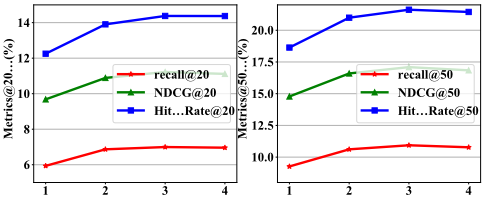
Impact of the number of GNN layers. Figure 4 shows the performance comparison for the number of GNN layers on Amazon dataset. The experimental results demonstrate that as the number of layers in GNN increases, the items will learn higher quality representation due to the interaction between items through L rounds of feature transfer, and the performance of our model will be higher. However, when the number of GNN layers accumulates to a certain extent, the effectiveness of multi-interest extraction is slightly reduced due to overfitting, and the computational cost will also increase.
| Metrics@50 | Amazon Books | ||
|---|---|---|---|
| Recall | NDCG | Hit Rate | |
| PIMI(threshold=32) | 10.368 | 16.276 | 20.453 |
| PIMI(threshold=64) | 10.934 | 17.094 | 21.619 |
| PIMI(threshold=128) | 10.353 | 16.302 | 20.839 |
| PIMI(threshold=256) | 10.048 | 15.904 | 20.367 |
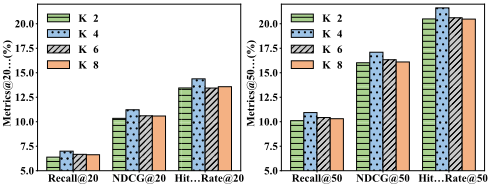
Impact of the number of interests K. Figure 5 shows the Metrics@20 and Metrics@50 of the impact of the number K of interests on Amazon dataset. For the Amazon dataset, PIMI obtains the better performance when K = 4. In the real world, the number of interests for each user is usually not too much or too little. Hence, setting too small and too big numbers of interest cannot reflect the real situation of users.
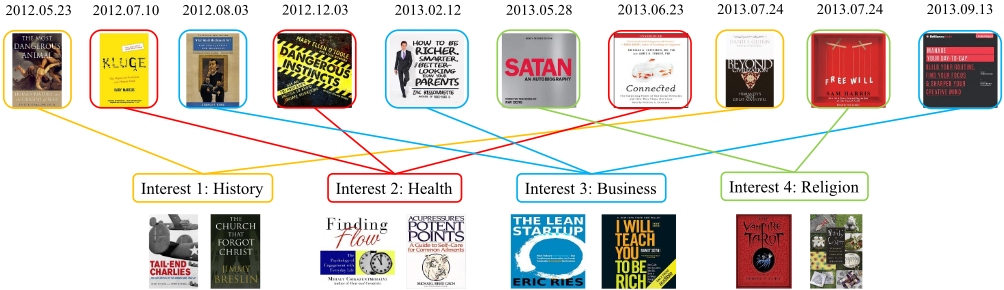
Case study. As shown in Figure 3, we randomly select a user in the Amazon dataset, and generate four interest embedding from the user's behavior sequence. We find that the four interests of the user are about history, health, business, and religion. We have observed that the period for user to review on health books is about five months, while the period for user to review on business books is about half a year. It demonstrates that our proposed PIMI can capture these periodicity information successfully, thus contributing to better representation of interest.
5 Conclusion
In this paper, we proposed a novel method named PIMI for sequential recommendation, which shows the effectiveness of the periodicity and interactivity of recommendations under the multi-interest framework. Specifically, we first introduce the periodicity module, which constructs the time interval matrix in the user behavior sequence, and adds the time information to the user's multi-interest representation. Next, we design the interactivity module, which captures the global and local features of items via a virtual central node, and improves the representation quality of items. Finally, the multiinterest extraction layer captures the user's multiple interests representation, which can be explicitly used to extract candidate items and get recommendations. Extensive experimental analysis verified that our proposed model PIMI consistently outperformed the state-of-the-art methods. In the future, we plan to explore user modeling issues in longer sequence to make better recommendations.
Acknowledgments
This work is supported by National Key Research and Development Program of China.
@inproceedings{ijcai2021p197,
  title     = {Exploring Periodicity and Interactivity in Multi-Interest Framework for Sequential Recommendation},
  author    = {Chen, Gaode and Zhang, Xinghua and Zhao, Yanyan and Xue, Cong and Xiang, Ji},
  booktitle = {Proceedings of the Thirtieth International Joint Conference on
               Artificial Intelligence, {IJCAI-21}},
  publisher = {International Joint Conferences on Artificial Intelligence Organization},
  editor    = {Zhi-Hua Zhou},
  pages     = {1426--1433},
  year      = {2021},
  month     = {8},
  note      = {Main Track},
  doi       = {10.24963/ijcai.2021/197},
  url       = {https://doi.org/10.24963/ijcai.2021/197},
}
TY - CPAPER TI - Exploring Periodicity and Interactivity in Multi-Interest Framework for Sequential Recommendation AU - Chen, Gaode AU - Zhang, Xinghua AU - Zhao, Yanyan AU - Xue, Cong AU - Xiang, Ji T2 - Proceedings of the Thirtieth International Joint Conference on Artificial Intelligence, IJCAI-21 PB - International Joint Conferences on Artificial Intelligence Organization PY - 2021 SP - 1426 EP - 1433 DO - 10.24963/ijcai.2021/197 UR - https://doi.org/10.24963/ijcai.2021/197 ER -Copied
Machine-readable versions of this paper, for tools and AI agents:





