
Context Aware Sequence Modeling
Proceedings of the Twenty-Ninth International Joint Conference on Artificial Intelligence. Doctoral Consortium. Pages 5208-5209.
https://doi.org/10.24963/ijcai.2020/744
Keywords
- Machine Learning: Deep Learning
- Machine Learning: Deep Learning: Sequence Modeling
- Data Mining: Mining Text, Web, Social Media
- Machine Learning: Probabilistic Machine Learning
Abstract
Context modeling helps understand the data, such as sentence or user behavior. Contextual information captures the important underlying feature, and it enhances the relationship between data instances or hidden representations. As the importance of the sequential model grows, so does the importance of the sequential contextual modeling. Under the sequential data, we need to consider the context change over time. In this paper, we present our research works on context modeling and its dynamics modeling over time. Furthermore, we extend our research to handle the multi-granularity of sequential context modeling to consider rich context representations.
- [Blei et al., 2003] David M Blei, Andrew Y Ng, and Michael I Jordan. Latent dirichlet allocation. Journal of machine Learning research, 3(Jan):993-1022, 2003.
- [Gerrish and Blei, 2012] Sean Gerrish and David M Blei. How they vote: Issue-adjusted models of legislative be- havior. In Advances in Neural Information Processing Sys- tems, pages 2753-2761, 2012.
- [Song et al., 2018] Kyungwoo Song, Wonsung Lee, and Il- Chul Moon. Neural ideal point estimation network. In Thirty-Second AAAI Conference on Artificial Intelligence, 2018.
- [Song et al., 2019] Kyungwoo Song, Mingi Ji, Sungrae Park, and Il-Chul Moon. Hierarchical context enabled recurrent neural network for recommendation. In Proceedings of the AAAI Conference on Artificial Intelligence, volume 33, pages 4983-4991, 2019.
- [Song et al., 2020] Kyungwoo Song, JoonHo Jang, Il-Chul Moon, et al. Bivariate beta lstm. In Proceedings of the AAAI Conference on Artificial Intelligence, volume 34, 2020.
- [Williams and Rasmussen, 2006] Christopher KI Williams and Carl Edward Rasmussen. Gaussian processes for ma- chine learning, volume 2. MIT press Cambridge, MA, 2006.
References were extracted automatically from the PDF and may contain errors.
Full text extracted automatically from the PDF; figures, tables and equations may differ. The PDF is the version of record.
1 Introduction
The context denotes the generally related thought of the event, and it can be defined on the sentence user's behavior. The context modeling helps us to discover the clear meaning of the sentence or understand the user's behavior. The recent statistical model has enabled us to capture the diverse context. We can model the context of sentence or user's behavior with the probabilistic graphical model (PGM), and represent the context on the latent space. For example, Latent Dirichlet Allocation (LDA) model the generative process of documents with the context, topic proportion of each document [Blei et al., 2003]. Besides, [Gerrish and Blei, 2012] introduces a generative process of lawmaker's voting with the context of user behavior.
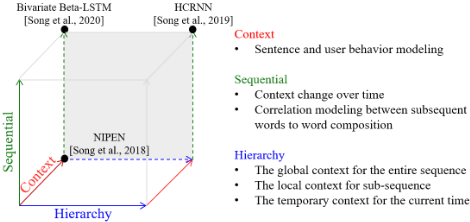
Recently, the importance of sequential modeling has increased, and it is necessary to handle the context of sequential data. For sentence modeling, there are many kinds of research to incorporate the inductive bias of sequential order such as RNN, and Transformer. For sequential user behavior, movie and music streaming services have interested in recommending the next item, which users will click at the right time. Context modeling is helpful to predict the next words or the user's next behavior in the sequence. However, static context modeling is not enough to reflect the context changes in the sentence or user's sequential behavior. We need to handle the dynamics of context to understand the sequential data deeply. Besides, hierarchical sequential context modeling is necessary to capture a more diverse context and represent the relationship between data or hidden representations with sequential information. Figure 1 visualize our propose three models in this thesis, context modeling which consider the relationship between user and sentence (NIPEN) [Song et al., 2018], sequential context modeling which handle the correlations between words (Bivariate Beta-LSTM) [Song et al., 2020], and hierarchical sequential context modeling (HCRNN) [Song et al., 2019].
2 Contributions
We have focused on context modeling and its application to the sequential data to understand the sentence and user's behavior deeply with hierarchical context modeling.
First, we have focused on static context modeling of sentence and user behavior. We investigate the static context on the legislative roll-call data because legislative processes have both contents of bill (sentence) and quantitative record of legislator's voting (user behavior). Under the legislative processes, it is challenging to consider the context of the bill (contents) and the contents of the legislator (ideal point) simultaneously. To solve the issue, we assume that contents and ideal points are composed of several topics and the probability of voting YEA increases proportionally to the conformity of the topic of bill and legislator's ideal point for each topic. Under the assumption, we proposed the Neural Ideal Point Model (NIPEN) [Song et al., 2018], which model each context of sentence and user behavior. With NIPEN, we can understand and interpret the sentence and user behavior itself and the results of legislative voting, which is an interaction between document and user.
Second, we focused on the sequential context of the sentence. The sentence is composed of words, and some words are correlated positively or negatively. We determine the meaning of the sentence by composing appropriate words with proper weight, which represents the level of correlation. It is challenging to handle the correlation on the sequential data and most traditional model lack of explicit correlation modeling. The traditional gate structure handles the correlation implicitly, and their gate value does not represent the value between 0 and 1 flexibly. We improved the traditional model by modeling the correlated input and forget gate based on the bi-variate Beta distribution, which represents the values between 0 and 1 flexibly and correlation [Song et al., 2020]. Under the flexible correlated gate structure, our proposed model, Bivariate Beta-LSTM, determines the level of composition between words, understand the meaning of sentences efficiently.
Third, we focused on the context of user behavior history with hierarchical context modeling. User history is a sequence of user's actions such as clicks or skips. With user history, music, and video streaming services want to recommend appropriate items to the user. To recommend an item that the user wants, we need to reflect the user's context (interest), and the user's long history might have a more diverse context than that of the sentence. We divide these user's context into a global context for the entire sequence of user's action, the local context for sub-sequence, and temporary context for the current time, which are composed hierarchically. In short, we need to model hierarchical user's context modeling, and its dynamics to consider the user's long history well. To address the issue, we proposed the Hierarchical Context enabled Recurrent Neural Network (HCRNN), which handles the sequential hierarchical context [Song et al., 2019], different from LSTM. HCRNN incorporate the topic modeling and memory network for global context and utilize attention mechanism to attend related global context to the current subsequence. Besides, we model the temporary context, current interest, with the local context and the recent user behavior. Additionally, we introduce an interest drift gate, which controls the sequential changes in each context.
3 OngoingWork
Sequential context modeling is still challenging to understand user behavior and sentence deeply. For sequential modeling of user behavior and sentence, Transformer based on selfattention and positional encoding shows the remarkable performance. However, most of the related works do not incorporate the context explicitly into the attention and positional encoding.
First, we extend the self-attention modeling into the PGM to incorporate the context of the sentence. Traditional multihead self-attention handles each multi-head independently.
However, each head needs to attend different parts to handle the diverse context of sentences and similar parts in the opposite case. Under the PGM, we propose generalized attention, which incorporates the relationship and context between multi-heads. Under the flexible attention module, we can understand the given sentence in detail.
Second, we incorporate the property of user behavior into the positional encoding. Traditional positional doesn't consider the context of the user's behavior pattern, and we can improve it by incorporating the stationary pattern for the entire time or locally fixed time. We can understand the user's sequential behavior if we incorporate the user's stationary and locally stationary property. We propose a novel time encoding with the kernel method [Williams and Rasmussen, 2006], which reflects the locally-stationary property of the user's behavior.
4 Conclusions and FutureWork
Context modeling helps us to understand user behavior and sentence deeply. We have proposed context modeling and its application to sequential modeling with a hierarchical structure to capture the diverse context of sentence and user behavior. As our future works, we will propose a multi-granularity attention mechanism that improves the traditional attention, which only compares the pair-wise component to compute the attention. We can generalize the pair-wise based traditional attention with multi-granularity attention, which computes attention with n-wise (n=2,3,...). Multi-granularity attention is the generalized version of traditional attention, and it can reflect a more rich context accurately.
@inproceedings{ijcai2020p744,
  title     = {Context Aware Sequence Modeling},
  author    = {Song, Kyungwoo},
  booktitle = {Proceedings of the Twenty-Ninth International Joint Conference on
               Artificial Intelligence, {IJCAI-20}},
  publisher = {International Joint Conferences on Artificial Intelligence Organization},
  editor    = {Christian Bessiere},
  pages     = {5208--5209},
  year      = {2020},
  month     = {7},
  note      = {Doctoral Consortium},
  doi       = {10.24963/ijcai.2020/744},
  url       = {https://doi.org/10.24963/ijcai.2020/744},
}
TY - CPAPER TI - Context Aware Sequence Modeling AU - Song, Kyungwoo T2 - Proceedings of the Twenty-Ninth International Joint Conference on Artificial Intelligence, IJCAI-20 PB - International Joint Conferences on Artificial Intelligence Organization PY - 2020 SP - 5208 EP - 5209 DO - 10.24963/ijcai.2020/744 UR - https://doi.org/10.24963/ijcai.2020/744 ER -Copied
Machine-readable versions of this paper, for tools and AI agents:





