
Towards an Artificial Argumentation System
Proceedings of the Twenty-Ninth International Joint Conference on Artificial Intelligence. Doctoral Consortium. Pages 5206-5207.
https://doi.org/10.24963/ijcai.2020/743
Keywords
- Knowledge Representation and Reasoning: Computational Models of Argument
- Natural Language Processing: Discourse
- Humans and AI: Computer-Aided Education
Abstract
Computational Argumentation studies the definition of models able to either have a debate, persuade users in decision making or assist humans with argument analysis. In this work, some of our initial contributions and the foundations of this research field are presented.
- [Atkinson et al., 2017] Katie Atkinson, Pietro Baroni, Mas- similiano Giacomin, Anthony Hunter, Henry Prakken, Chris Reed, Guillermo Simari, Matthias Thimm, and Ser- ena Villata. Towards artificial argumentation. AI maga- zine, 38(3):25-36, 2017.
- [Baroni et al., 2011] Pietro Baroni, Martin Caminada, and Massimiliano Giacomin. An introduction to argumen- tation semantics. The knowledge engineering review, 26(4):365-410, 2011.
- [Cocarascu et al., 2019] Oana Cocarascu, Antonio Rago, and Francesca Toni. Extracting dialogical explanations for review aggregations with argumentative dialogical agents. In Proceedings of the 18th International Conference on Autonomous Agents and MultiAgent Systems, pages 1261- 1269. International Foundation for Autonomous Agents and Multiagent Systems, 2019.
- [Dung, 1995] Phan Minh Dung. On the acceptability of ar- guments and its fundamental role in nonmonotonic rea- soning, logic programming and n-person games. Artificial intelligence, 77(2):321-357, 1995.
- [Hunter et al., 2019] Anthony Hunter, Lisa Chalaguine, Tomasz Czernuszenko, Emmanuel Hadoux, and Syl- wia Polberg. Towards computational persuasion via natural language argumentation dialogues. In Joint German/Austrian Conference on Artificial Intelligence (Künstliche Intelligenz), pages 18-33. Springer, 2019.
- [Lawrence and Reed, 2019] John Lawrence and Chris Reed. Argument mining: A survey. Computational Linguistics, 0(0):1-54, 2019.
- [Ruiz-Dolz et al., 2019a] Ramon Ruiz-Dolz, Stella Heras Barberá, José Alemany, and Ana García-Fornes. Auto- matic generation of explanations to prevent privacy viola- tions (in press). In XAILA@JURIX, 2019.
- [Ruiz-Dolz et al., 2019b] Ramon Ruiz-Dolz, Stella Heras Barberá, José Alemany, and Ana García-Fornes. To- wards an argumentation system for assisting users with privacy management in online social networks. In CMNA@PERSUASIVE, 2019.
- [Walton, 2009] Douglas Walton. Argumentation theory: A very short introduction. In Argumentation in artificial in- telligence, pages 1-22. Springer, 2009.
References were extracted automatically from the PDF and may contain errors.
Full text extracted automatically from the PDF; figures, tables and equations may differ. The PDF is the version of record.
1 Motivation
Argumentative discourse has been analysed for a long time, from the Ancient Greece period by philosophers such as Aristotle, to the present by scholars, philosophers and linguists. Recently, Computational Argumentation has gained interest as a way to assist and automatise the analysis of such discourses [Atkinson et al., 2017]. This is related to the latest advances in Artificial Intelligence (AI) research that have shown promising results in areas like Automatic Speech Recognition (e.g., Text to Speech and Speech to Text systems) and Natural Language Processing (e.g., Natural Language Understanding and Automatic Text Generation). Additionally, there has been a significant increase in the interest of the AI research community in explainable AI systems for decision making. From our viewpoint, Computational Argumentation is a very powerful approach to both, exploit the latest advances in AI, and use them to propose explainable systems that are not only able to provide assistance with decision making, but also to provide reasons to the users [Cocarascu et al., 2019]. We identify three main domains, in which we will carry out our research, where the use of Computational Argumentation techniques can be very useful: (i) privacy management assistance in social networks; (ii) argumentative analysis of journalistic texts of opinion, with the objective of detecting misguided arguments (e.g., fallacies, demagogy, etc.); and (iii) educational systems of university debate able to automatically generate discourse graphs, and with it, the expected effect of an argument (or its reasoning pattern) in a specific context. The argumentative process is generally divided into four different tasks: identification, analysis, evaluation and invention [Walton, 2009]. Therefore, Computational Argumentation covers a wide range of different tasks, so it is divided into multiple lines of research as explained in the following section.
2 Background
The first two tasks carried out in an argumentation process are identification and analysis. These tasks are framed into the Argument Mining (AM) line of research. AM not only focuses on the automatic identification of argumentative propositions (i.e., premises, conclusions) in text or speech, but also considers the detection of argument relations (i.e., attacks, supports, schemes) between the argumentative propositions. AM is in fact, considered one of the hardest instances of Natural Language Processing (NLP) problems. This is mainly due to the complexity of automatically detecting relations using current word representations. For its complexity and thanks to the recent improvements in NLP techniques, AM has caught the attention of many NLP researchers as surveyed in [Lawrence and Reed, 2019]. However, we identify two huge limitations when approaching the Argument Mining problem: first, the size of the existing AM corpus may not be big enough to completely take advantage of the most recent advances in NLP; second, cross-domain behaviour of AM models has been scarcely explored, and due to the nature of AM, domain robustness is a very important feature to be considered.
The evaluation of arguments has been typically approached by the Argumentation Solving line of research. In Computational Argumentation, arguments are usually represented with Argumentation Frameworks (AF) [Dung, 1995]. Many variations of the original Abstract AF have been proposed in the literature allowing to extend the argument representation with values (Value-based AF), with support relations (Bipolar AF) or to make the representation suitable for specific domains. The evaluation of arguments can also be seen as the definition of the acceptable set of arguments for a given AF. For that purpose, multiple semantics [Baroni et al., 2011] have also been defined in the literature. The semantics can be seen as the rules that define which argument is acceptable and which not. Argumentation Solving is then, a graph solving problem, and in many situations may imply a computational complexity beyond P and NP. Initiatives like the ICCMA 1 competition are very interesting for the research on efficient algorithms to solve argumentation graphs for multiple semantics.
Finally, the invention of arguments is the task mainly related to the Dialogue Analysis line of research. When defining the structural elements of a new argument (i.e., reasoning patterns, language employed) or the argumentative discourse (i.e., dialogue strategy), it is very important to take into account the target audience. Since one of the most common objectives of argumentation is indeed the persuasion of the audience, any argumentation system should be tailored to each possible target audience in order maximise the persuasion of the system. In [Hunter et al., 2019], it is possible to observe the latest advances in Computational Persuasion with argumentation dialogues. However, the main limitations in this part are the huge variations that there may exist between different audiences in different contexts and the difficulties in gathering persuasion related data.
1 http://argumentationcompetition.org/
3 Research
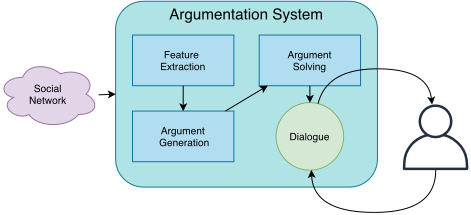
Our research objectives are to make significant advances in the identified limitations and to pave the way towards a robust artificial argumentation system capable of doing a complete analysis of the discourse covering the whole argumentation process. For these purposes, we have done some preliminary research on the privacy management domain. In [Ruiz-Dolz et al., 2019b], we proposed an AF for Online Social Networks (AFOSN) and an architecture for its corresponding argumentative system (Figure 1).
On the other hand, in [Ruiz-Dolz et al., 2019a] we proposed a method with which, using the previously proposed AFOSN as the underlying reasoning engine, it was possible to automatically generate argumentative explanations to persuade users not to share a specific publication when detecting a potential privacy violation. This method was implemented and tested in an educational social network.
Then, our research plan has been designed to tackle the whole Computational Argumentation process. First of all, we plan to define a generic Argument Mining pipeline that allows us to obtain an argument graph (the nodes being the arguments and the edges the relations) from an argumentative input, either text (i.e., opinion pieces or news) or speech (i.e., recordings of debate competitions). For this purpose, we are currently analysing the performance of state of the art NLP approaches (i.e., transformer-based models) when facing the AM task. We are also interested in the evaluation of these models with multiple domain corpus. Second, we plan to explore, for each selected application domain, both efficient algorithms to define the acceptable set of arguments, and the most suitable semantics. This is very important, because the argumentation solving step is very dependant on how the problem has initially been modelled. Finally, we are also interested in analysing the persuasive power of arguments on different audiences. Our ongoing research is about exploring the effect of Big Five personality traits and social network usage statistics on the persuasive power of arguments and argumentation schemes. This way, we intend to define more refined initial strategies depending on each user characterisation.
Acknowledgments
This work is supported by the Valencian Government project PROMETEO/2018/002.
@inproceedings{ijcai2020p743,
  title     = {Towards an Artificial Argumentation System},
  author    = {Ruiz-Dolz, Ramon},
  booktitle = {Proceedings of the Twenty-Ninth International Joint Conference on
               Artificial Intelligence, {IJCAI-20}},
  publisher = {International Joint Conferences on Artificial Intelligence Organization},
  editor    = {Christian Bessiere},
  pages     = {5206--5207},
  year      = {2020},
  month     = {7},
  note      = {Doctoral Consortium},
  doi       = {10.24963/ijcai.2020/743},
  url       = {https://doi.org/10.24963/ijcai.2020/743},
}
TY - CPAPER TI - Towards an Artificial Argumentation System AU - Ruiz-Dolz, Ramon T2 - Proceedings of the Twenty-Ninth International Joint Conference on Artificial Intelligence, IJCAI-20 PB - International Joint Conferences on Artificial Intelligence Organization PY - 2020 SP - 5206 EP - 5207 DO - 10.24963/ijcai.2020/743 UR - https://doi.org/10.24963/ijcai.2020/743 ER -Copied
Machine-readable versions of this paper, for tools and AI agents:





