
Text Style Transfer via Learning Style Instance Supported Latent Space
Proceedings of the Twenty-Ninth International Joint Conference on Artificial Intelligence. Main track. Pages 3801-3807.
https://doi.org/10.24963/ijcai.2020/526
Keywords
- Natural Language Processing: Natural Language Generation
- Natural Language Processing: Natural Language Processing
Abstract
Text style transfer pursues altering the style of a sentence while remaining its main content unchanged. Due to the lack of parallel corpora, most recent work focuses on unsupervised methods and has achieved noticeable progress. Nonetheless, the intractability of completely disentangling content from style for text leads to a contradiction of content preservation and style transfer accuracy. To address this problem, we propose a style instance supported method, StyIns. Instead of representing styles with embeddings or latent variables learned from single sentences, our model leverages the generative flow technique to extract underlying stylistic properties from multiple instances of each style, which form a more discriminative and expressive latent style space. By combining such a space with the attention-based structure, our model can better maintain the content and simultaneously achieve high transfer accuracy. Furthermore, the proposed method can be flexibly extended to semi-supervised learning so as to utilize available limited paired data. Experiments on three transfer tasks, sentiment modification, formality rephrasing, and poeticness generation, show that StyIns obtains a better balance between content and style, outperforming several recent baselines.
- [Atanov et al., 2019] Andrei Atanov, Arsenii Ashukha, Kir- ill Struminsky, Dmitry Vetrov, and Max Welling. The deep weight prior. In ICLR, 2019.
- [Bahdanau et al., 2015] Dzmitry Bahdanau, KyungHyun Cho, and Yoshua Bengio. Neural machine translation by jointly learning to align and translate. In ICLR, 2015.
- [Crystal, 1970] David Crystal. New perspectives for lan- guage study. 1:stylistics. English Language Teaching, 24(2):99-106, 1970.
- [Dai et al., 2019] Ning Dai, Jianze Liang, Xipeng Qiu, and Xuanjing Huang. Style transformer: Unpaired text style transfer without disentangled latent representation. In ACL, pages 5997-6007, 2019.
- [Devlin et al., 2019] Jacob Devlin, Ming-Wei Chang, Ken- ton Lee, and Kristina Toutanova. BERT: Pre-training of deep bidirectional transformers for language understand- ing. In NAACL-HLT, pages 4171-4186, 2019.
- [Embler, 1967] Weller Embler. Style is as style does. ETC: A Review of General Semantics, 24(4):447-454, 1967.
- [Fu et al., 2018] Zhenxin Fu, Xiaoye Tan, Nanyun Peng, Dongyan Zhao, and Rui Yan. Style transfer in text: Ex- ploration and evaluation. In AAAI, pages 663-670, 2018.
- [Germain et al., 2015] Mathieu Germain, Karol Gregor, Iain Murray, and Hugo Larochelle. Made: Masked autoen- coder for distribution estimation. In ICML, 2015.
- [Gong et al., 2019] Hongyu Gong, Suma Bhat, Lingfei Wu, JinJun Xiong, and Wen-mei Hwu. Reinforcement learning based text style transfer without parallel training corpus. In NAACL-HLT, pages 3168-3180, 2019.
- [Goodfellow et al., 2014] Ian Goodfellow, Jean Pouget- Abadie, Mehdi Mirza, Bing Xu, David Warde-Farley, Sherjil Ozair, Aaron Courville, and Yoshua Bengio. Gen- erative adversarial nets. In NeurIPS, 2014.
- [Heafield, 2011] Kenneth Heafield. KenLM: Faster and smaller language model queries. In Proceedings of the Sixth Workshop on Statistical Machine Translation, 2011.
- [Ide, 2004] Nancy Ide. Preparation and analysis of linguistic corpora. A Companion to digital Humanities, 27:278-305, 2004.
- [John et al., 2019] Vineet John, Lili Mou, Hareesh Bahu- leyan, and Olga Vechtomova. Disentangled representation learning for non-parallel text style transfer. In ACL, pages 424-434, 2019.
- [Kingma and Welling, 2014] Diederik P. Kingma and Max Welling. Auto-encoding variational bayes. In ICLR, 2014.
- [Kingma et al., 2016] Durk P. Kingma, Tim Salimans, Rafal Jozefowicz, Xi Chen, Ilya Sutskever, and Max Welling. Improved variational inference with inverse autoregressive flow. In NeurIPS, 2016.
- [Lample et al., 2019] Guillaume Lample, Sandeep Subrama- nian, Eric Michael Smith, Ludovic Denoyer, Marc'Aurelio Ranzato, and Y-Lan Boureau. Multiple-attribute text rewriting. In ICLR, 2019.
- [Li et al., 2018] Juncen Li, Robin Jia, He He, and Percy Liang. Delete, retrieve, generate: a simple approach to sentiment and style transfer. In NAACL-HLT, pages 1865- 1874, 2018.
- [Luo et al., 2019] Fuli Luo, Peng Li, Jie Zhou, Pengcheng Yang, Baobao Chang, Xu Sun, and Zhifang Sui. A dual reinforcement learning framework for unsupervised text style transfer. In IJCAI, pages 5116-5122, 2019. IJCAI
- [Miyato et al., 2018] T. Miyato, T. Kataoka, M. Koyama, and Y. Yoshid. Spectral normalization for generative ad- versarial networks. In ICLR, 2018.
- [Prabhumoye et al., 2018] Shrimai Prabhumoye, Yulia Tsvetkov, Ruslan Salakhutdinov, and Alan W Black. Style transfer through back-translation. In ACL, 2018.
- [Rao and Tetreault, 2018] Sudha Rao and Joel Tetreault. Dear sir or madam, may i introduce the gyafc dataset: Cor- pus, benchmarks and metrics for formality style transfer. In NAACL-HLT, pages 129-140, 2018.
- [Rezende and Mohamed, 2015] Danilo Jimenez Rezende and Shakir Mohamed. Variational inference with normalizing flows. In ICML, pages 1530-1538, 2015.
- [Shang et al., 2019] Mingyue Shang, Piji Li, Zhenxin Fu, Li- dong Bing, Dongyan Zhao, Shuming Shi, and Rui Yan. Semi-supervised text style transfer: Cross projection in la- tent space. In EMNLP-IJCNLP, pages 4936-4945, 2019.
- [Shen et al., 2017] Tianxiao Shen, Tao Lei, Regina Barzilay, and Tommi Jaakkola. Style transfer from non-parallel text by cross-alignment. In NeurIPS, 2017.
- [Vaswani et al., 2017] Ashish Vaswani, Noam Shazeer, Niki Parmar, Jakob Uszkoreit, Llion Jones, Aidan N. Gomez, Lukasz Kaiser, and Illia Polosukhin. Attention is all you need. In NeurIPS, pages 6000-6010, 2017.
- [Wu et al., 2019a] Chen Wu, Xuancheng Ren, Fuli Luo, and Xu Sun. A hierarchical reinforced sequence operation method for unsupervised text style transfer. In ACL, pages 4873-4883, 2019.
- [Wu et al., 2019b] Xing Wu, Tao Zhang, Liangjun Zang, Jizhong Han, and Songlin Hu. Mask and infill: Applying masked language model to sentiment transfer. In IJCAI, pages 5271-5277, 2019.
- [Yang et al., 2018] Zichao Yang, Zhiting Hu, Chris Dyer, Eric P. Xing, and Taylor Berg-Kirkpatrick. Unsupervised text style transfer using language models as discrimina- tors. In NeurIPS, 2018.
- [Yi et al., 2018] Xiaoyuan Yi, Maosong Sun, Ruoyu Li, and Wenhao Li. Automatic poetry generation with mutual re- inforcement learning. In EMNLP, pages 3143-3153, 2018.
- [Zhou et al., 2018] Hao Zhou, Minlie Huang, Tianyang Zhang, Xiaoyan Zhu, and Bing Liu. Emotional chatting machine: Emotional conversation generation with interna- land external memory. In AAAI, pages 730-738, 2018.
- [Zhu et al., 2017] Jun-Yan Zhu, Taesung Park, Phillip Isola, and Alexei A. Efros. Unpaired image-to-image transla- tionusing cycle-consistent adversarial networks. In ICCV, pages 2223-2232, 2017.
References were extracted automatically from the PDF and may contain errors.
Full text extracted automatically from the PDF; figures, tables and equations may differ. The PDF is the version of record.
1 Introduction
Text style transfer aims to endow a sentence with a different style and meanwhile keep its main semantic content unaltered, which could benefit various downstream applications such as text polishing [Rao and Tetreault, 2018], poetic writing [Yi et al., 2018] and dialog generation [Zhou et al., 2018].
Owing to the lack of large parallel corpora, recent work mainly pays attention to unsupervised transfer and generally achieves this goal by fusing content and representations of target styles. However, both literary theory [Embler, 1967] and machine learning study [Lample et al., 2019] manifest that style is coupled with content to some degree, causing a contradiction of content preservation and style accuracy.
∗ Corresponding author
In this work, we mainly study two research paradigms of text style transfer and discuss their influence on performance. One paradigm is a typical disentanglement approach, which explicitly strips style from content, and then incorporates a separated target-style representation [Shen et al., 2017; Fu et al., 2018; John et al., 2019]. Because of the intractability of disentanglement, specifying a target style often brings some unexpected content attached to the source style. As a result, this approach usually obtains high style transfer accuracy but fails to preserve full source content.
To improve content preservation, another paradigm adopts attention-based structures [Bahdanau et al., 2015; Vaswani et al., 2017] to maintain all word-level source information. Instead of disentangling, this method forces the model to focus on style-independent words by cycle reconstruction and uses style embeddings to encourage the fusion of style-related phrases [Lample et al., 2019; Dai et al., 2019]. Nevertheless, for text, style is a highly complex concept involving various linguistic features and individualities [Crystal, 1970]. It is hard to learn expressive and flexible style embeddings to represent such a concept. Consequently, these models tend to overemphasize content preservation and evade the difficult of embedding learning, incurring unsatisfactory style accuracy.
Related linguistic research demonstrates that stylistic syndromes can be better observed in multiple instances by making broader comparisons [Ide, 2004]. Inspired by this idea, we propose a style instance supported method, called StyIns, to alleviate the contradiction mentioned above. When transferring each sentence, StyIns adopts the attention mechanism to preserve complete source information. Then instead of using simple style embeddings, our model incorporates a set of instances sharing the same style, and learns to extract underlying stylistic properties with the powerful generative flow technique [Rezende and Mohamed, 2015] to form a more discriminative latent space. Samples drawn from this space are fed to the decoder to strengthen style signals, yielding a better balance between content preservation and style accuracy. Besides, StyIns can be extended to a semi-supervised version to utilize limited parallel data for further improvement.
In summary, our contributions are as follows:
- We propose a style instance supported method to learn a more discriminative and expressive latent space, which enhances style signals and makes a better balance between style transfer accuracy and content preservation.
- Our model can flexibly switch to a semi-supervision manner to take advantage of limited parallel data, without extra parameters or structures.
- On three text transfer tasks, sentiment, formality and poeticness, both automatic and human evaluations demonstrate that our model achieves better general performance, against several recent baselines 1 .
2 RelatedWork
Style transfer has been widely explored in Computer Vision (CV) filed [Zhu et al., 2017] but remained challenging for text due to the discrete nature and vague style definition of language. Without sufficient parallel text data, recent research interests mainly concentrate on unsupervised transfer methods. According to the way of representing content and style, we can categorize most existing models into four paradigms.
The first paradigm explicitly disentangles text as separated content and style representations, respectively, then combines the content with a target style to achieve transfer. Shen et al. [2017] take a pair of adversarial discriminators to align the source and transferred content distributions. Fu et al. [2018] concatenate the extracted content with a learned target-style embedding. These methods are also improved by utilizing locally-normalized language models as discriminators [Yang et al., 2018]. More recently, John et al. [2019] design multiple losses to pack a sentence into a latent space, which is then split into sub-spaces of content and style. Since complete disentanglement is impracticable, this paradigm usually results in satisfactory style accuracy but poor content preservation.
The second paradigm takes multi-generator structures and generates sentences in each style with a corresponding generator. Namely, each style is implicitly represented as the generator parameters. Fu et al. [2018] make an attempt on this paradigm and adversarially train one encoder to disentangle content. Prabhumoye et al. [2018] utilize a back-translation technique to translate a sentence to another language to corrupt its stylistic properties. Then adversarially trained decoders are used to create transferred sentences in the original language. Based on Reinforcement Learning (RL), Gong et al. [2019] represent each transfer direction between two styles as one encoder-decoder model, and Luo et al. [2019] pair the two transfer directions with a dual learning schema for further improvement. Generally, this paradigm is effective but also resource-consuming since each style or transfer direction needs to be modelled by a separated generator.
The third paradigm is a locate-and-replace schema, which locates style-dependent words and then replaces them with the target-style ones. We can consider the content and style to be represented as corresponding sets of words. Li et al. [2018] design a delete-and-retrieve method to combine content words in a source sentence with stylistic words in a retrieved semantically similar sentence. Wu et al. [2019b] mask all sentimental tokens in a source sentence, then use a pre-trained BERT [Devlin et al., 2019] to infill targetsentiment ones. Wu et al. [2019a] take a hierarchical RL method, which uses two agents to locate style-related words Generator and alter the sentence, respectively. To sum up, this paradigm is more accurate since it maintains all word-level information, but the lack of stylistic vocabularies limits its locating performance. Moreover, it doesn't apply to the scenarios that styles are expressed beyond word level, e.g., poeticness.
1 Our source code is available at github.com/XiaoyuanYi/StyIns.
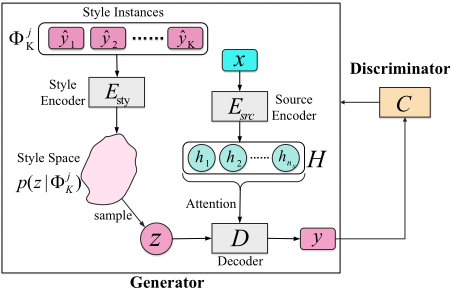
Figure 1: A graphical illustration of the proposed model.
The last paradigm adopts one single attention-based encoder-decoder model [Bahdanau et al., 2015] and feeds a style embedding to the decoder to provide style signals, without explicit disentanglement. Lample et al. [2019] take this paradigm and try to control multiple attributes of text with an attention-based LSTM model. Instead of LSTM, Dai et al. [2019] use the more powerful Transformer [Vaswani et al., 2017]. Such a design helps better preserve source information, avoids structural redundancy of paradigm 2, and could cover broader cases compared to paradigm 3. Nevertheless, since the learned embedding is not expressive enough to model the highly complex concept of style, this paradigm usually causes unsatisfactory style transfer accuracy.
In addition, Shang et al. [2019] devise a semi-supervised method that projects the latent spaces of different styles. Despite achieving further improvement, this model is sensitive to parallel data size and not suitable for unsupervised cases.
Absorbing advantages of paradigm 1 & 4, StyIns learns a more discriminative latent style space to better balance style and content, and it could flexibly switch to a semi-supervised version, compatible with a broader range of scenarios.
3 Methodology
3.1 Formalization and Overview
We first formalize the unsupervised text style transfer task. Suppose there are M datasets {Di}Mi=1 , and sentences in Di share the same style si. Given an arbitrary sentence x with a source style si, our goal is to rephrase x to a new one y with a target style sj(j ̸= i) while preserving its main content.
As discussed before, to produce strong style signals we provide a set of sentences, ΦjK = {ˆ yk}Kk=1 ⊂ Dj , called style instances, to represent an empirical distribution of style sj, which helps the model better learn underlying stylistic properties. For this sake, we incorporate a latent variable z constructed by these instances to represent the complex concept of style. Since sentences of the same style are conditionally
Algorithm 1 Training Process
1: for number of iterations do 2: Sample a source style si and a target style sj; 3: Sample instances ΦiK fromDi and ΦjK fromDj; 4: Sample x fromDi, x /∈ ΦiK ; 5: Accumulate Lrecon, Lcycle, Lstyle; 6: if y∗ exits then 7: Accumulate Lsuper; 8: end if 9: Update the parameters of G; 10: for nC steps do 11: Update the parameters of C with LC; 12: end for 13: end forindependent w.r.t. z, we can derive a new parametric form of text style transfer:
Eq. (1) differs from previous work [Shen et al., 2017; Yang et al., 2018] and suggests the architecture of our StyIns, as presented in Figure 1.
Define Esrc(x) as a bidirectional LSTM encoder, called source encoder, Esty(ΦjK ) as a style encoder to model the distribution p(z|ΦjK ), and D(H, z) as a decoder with the attention mechanism [Bahdanau et al., 2015]. The source encoder maps a given sentence x to a sequence of hidden states H. Then the decoder generates a transferred sentence y with H and z as inputs, where z is sampled from p(z|ΦjK ). These three components together form our generator G(x, ΦjK ).
3.2 Learning Latent Style Space
The style encoder Esty(ΦjK ) takes style instances as inputs, constructs a latent style space, and then outputs a sampled style representation z for the decoder to guide stylistic generation. Previous work [John et al., 2019] usually adopts the Variational Auto-Encoder (VAE) [Kingma and Welling, 2014] to build latent spaces. On the basis of the mean-field approximation, VAE assumes the independence of sentences and allocates each a corresponding isotropic Gaussian latent space. Despite the tractability of computation, this approach is implausible. For one thing, the dimension-independent Gaussian distribution is not expressive enough, which has been explored in various work [Atanov et al., 2019]. For another, sentences with the same style are not dependent but connected by sharing one global style space.
Generative Flow
To avert these problems, we resort to the generative flow (GF) [Rezende and Mohamed, 2015], a potent technique to construct sophisticated distributions. Put simply, GF maps a simple initial latent variable z0 to a complex one zT by applying a chain of parameterized mapping functions ft:
where c is a given condition and T is the length of the chain. GF requires each ft to be invertible and its Jacobian determinant to be computable. Then we can get the probability density of the final distribution by:
Various choices of ft have been proposed these years. We use a simple but effective one here, the Inverse Autoregressive Flow (IAF) [Kingma et al., 2016]. More concretely, we have:
where ⊙ is element-wise multiplication. gt is an autoregressive network, in which the i-th element of output vectors is calculated with the first i-1 elements of zt-1. We use the structure proposed in [Germain et al., 2015] as gt.
Style Instance Supported Latent Space
As mentioned in Sec. 3.1, to construct a more expressive latent space, we discard the mean-filed assumption by utilizing K style instances ΦjK = {ˆ yk}Kk=1 rather than only one single sentence. In detail, we feed each ˆ yk to another bidirectional LSTM, and represent it as vk, the concatenated final hidden state. Then we assume the initial latent variable z0 in Eq. (2) follows the isotropic Gaussian distribution:
where the mean of z0 is approximated by Maximum Likelihood Estimation and we use the unbiased estimator for variance. c is a global representation of ΦjK which is computed by a Multi-Layer Perceptron (MLP) and used in Eq. (4).
With the modules introduced above, we can get an output z of the style encoder Esty(ΦjK ) by sampling z0 with Eq. (6) and mapping it with Eq. (2). Then the sampled z is concatenated with the embedded word and fed to the decoder at each time step. We will show that such a learned latent space is highly discriminative in Sec. 4.
3.3 Unsupervised Training
Given a source sentence x, two sets of style instances, ΦiK (x ̸∈ ΦiK ) and ΦjK , with the source style si and the target style sj , we adopt the following losses to create indirect signals.
Reconstruction Loss. This loss is used by different paradigms of model [Shen et al., 2017; Luo et al., 2019; Wu et al., 2019b], which requires the model to reconstruct the given sentence with source-style signals:
Cycle Consistency Loss. Cycle consistency is first applied to image style transfer [Zhu et al., 2017] to strengthen content preservation and then also adopted for text [Dai et al., 2019; Lample et al., 2019]. We transfer a source sentence in two directions with the support of instances in different styles:
Note that in each iteration, we provide different sampled instances to help StyIns better generalize stylistic properties.
Adversarial Style Loss. Without any parallel corpus, adversarial training [Goodfellow et al., 2014] is utilized to build style supervision. Following [Dai et al., 2019], we use a classifier with M+1 classes as the discriminator C to tell the style of an input sentence (M+1-th class indicates a generated fake). The generator is expected to fool the discriminator by:
and the discriminator is alternately optimized by:
3.4 Semi-Supervised Training
Our method can be regarded as the construction of target-style information with the support of style instances. When the ground truth y∗ ̸∈ ΦjK is available, we can create supervision by maximizing log p(y∗ |x, ΦjK ). We drive a lower bound as:
Based on this lower bound, we get the final supervised loss:
where α and β are hyper parameters to re-scale the loss.
By optimizing Eq. (14), we simultaneously maximize a lower bound of log p(y∗ |x,ΦjK ) and minimize an upper bound of -log p(y∗ |x,ΦjK ) (the second term in Eq. (14)). The KL term, which is approximately estimated with Eq. (3), could benefit alignment of latent style distributions learned with/without ground truth, and thus helps better extract common stylistic properties. We describe the complete training process in Algorithm 1.
4 Experiments
4.1 Datasets
We conduct experiments on three text style transfer tasks.
Sentiment Modification. We use the Yelp dataset processed by [Li et al., 2018], which consists of restaurant reviews with two sentiments, namely negative and positive.
| Dataset | Styles | Paired | Unpaired | |||
|---|---|---|---|---|---|---|
| Train | Valid | Test | Train | Valid | ||
| Yelp | Neg. Pos. | N/A | N/A | 500 500 | 180k 270k | 2,000 2,000 |
| GYAFC | Inf. For. | 52k 52k | 2,788 2,247 | 1,332 1,019 | N/A | N/A |
| CPVT | Ver. Poe. | 4k 4k | 1,000 1,000 | 2,000 2,000 | 200k 200k | 10k 10k |
Formality Rephrasing. The recently released dataset GYAFC [Rao and Tetreault, 2018] contains paired formal and informal sentences in two domains. We use the Family & Relationships domain.
Poeticness Generation. We also consider Chinese poeticness generation, as in [Shang et al., 2019], which seeks to transfer a vernacular sentence to a classical poetic one. As Chinese vernacular text and classical poetry share similar vocabulary, differences between them, e.g., grammar and syntax, lie beyond simple word usage. Hence, this task is more challenging than the above two. We build a corpus called Chinese Poetic and Vernacular Text (CPVT) with vernacular sentences from Chinese prose and poetic sentences from classical poems. Besides, we collect 7,000 pairs of humanauthored sentences for testing and semi-supervised training. We only evaluate the transfer direction from vernacular to poetic. Since the opposite direction is more difficult requiring more sophisticated structures, we leave it for future work.
We use Yelp and GYAFC for unsupervised transfer; CPVT and GYAFC for semi-supervised transfer. English sentences are tokenized with the NLTK tool, and Chinese sentences are segmented as Chinese characters. All digits are replaced with a <NUM> symbol. Table 1 presents detailed data statistics.
4.2 Setups
We set word embedding size, hidden state size, the number of style instances K and the length of generative flow chain T to 256, 512, 10 and 6 respectively. The encoder and decoder share the same word embedding. The prior and posteriori distributions of z in Eq. (13) share parameters to reduce model size. The discriminator is a Convolutional Neural Network (CNN) based classifier with Spectral Normalization [Miyato et al., 2018]. To handle the discrete nature of sentences, as in [Dai et al., 2019], we multiply the softmax distribution by the word embedding matrix, to get a soft generated word and feed this weighted embedding to the discriminator. Adam with mini-batches (batch size=64) is used for optimization.
4.3 Baselines
We conduct comprehensive comparisons with several stateof-the-art style transfer models. For unsupervised transfer, we consider CrossAlign [Shen et al., 2017], MultiDec [Fu et al., 2018], DelRetri [Li et al., 2018], Template [Li et al., 2018], Disentangled [John et al., 2019] and StyleTransformer [Dai et al., 2019]. These models cover the four paradigms described in Sec. 2. We emphasize Disentangled and StyleTransformer (abbreviated as Disent. and StyleTr.) as the representatives Table 3: Human evaluation results. The Krippen-dorff's alpha of human rating is 0.64, indicating acceptable inter-annotator agreement. The diacritic ∗ (p < 0.01) represents that StyIns significantly outperforms baseline models.
| Models | Acc↑ | BLEU↑ | Cos↑ | PPL↓ | GM↑ | Acc↑ | BLEU↑ | Cos↑ | PPL↓ | GM↑ |
|---|---|---|---|---|---|---|---|---|---|---|
| Yelp (Unsupervised) | GYAFC (Unsupervised) | |||||||||
| MultiDec [Fu et al., 2018] | 46.0 | 15.09 | 91 | 175 | 10.52 | 24.9 | 11.53 | 91 | 97 | 8.69 |
| CorssAlign [Shen et al., 2017] | 73.2 | 9.41 | 90 | 76 | 10.94 | 66.8 | 3.18 | 88 | 35 | 8.52 |
| DelRetri [Li et al., 2018] | 88.5 | 16.61 | 93 | 136 | 12.92 | 61.1 | 21.20 | 91 | 110 | 12.58 |
| Template [Li et al., 2018] | 81.6 | 22.62 | 92 | 296 | 13.14 | 49.2 | 34.75 | 94 | 249 | 13.06 |
| Disentangled [John et al., 2019] | 91.7 | 6.71 | 89 | 26 | 11.39 | 67.5 | 8.16 | 90 | 24 | 11.18 |
| StyleTransformer [Dai et al., 2019] | 86.2 | 27.45 | 96 | 231 | 14.29 | 63.1 | 40.91 | 95 | 180 | 14.74 |
| StyIns (Ours) | 90.8 | 26.03 | 96 | 109 | 14.83 | 67.8 | 46.73 | 96 | 92 | 16.11 |
| Models | CPVT (Semi-Supervised 1k) | GYAFC (Semi-Supervised 2.5k) | ||||||||
|---|---|---|---|---|---|---|---|---|---|---|
| CPLS [Shang et al., 2019] StyIns (Ours) | 99.0 | 0.77 3.74 | 89 | 329 443 | 5.85 8.68 | 71.2 68.0 | 36.99 47.30 | 93 | 41 | 16.03 16.16 |
| 97.4 | 95 | 96 | 93 | |||||||
| Models | CPVT (Semi-Supervised 4k) | GYAFC (Semi-Supervised 10k) | ||||||||
| CPLS [Shang et al., 2019] | 98.3 | 3.13 | 90 | 283 | 8.37 | 71.4 | 39.25 | 94 | 44 | 16.24 |
| StyIns (Ours) | 97.5 | 4.00 | 95 | 410 | 8.86 | 70.6 | 47.81 | 96 | 92 | 16.36 |
| Models | Yelp | GYAFC | ||||
|---|---|---|---|---|---|---|
| Sty. | Con. | Flu. | Sty. | Con. | Flu. | |
| DelRetri | 3.26 | 3.24 | 3.46 | 2.31 | 2.37 | 2.39 |
| Template | 3.03 | 3.34 | 3.12 | 2.16 | 3.56 | 2.97 |
| Disent. | 3.95 | 3.20 | 4.46 | 2.84 | 1.85 | 3.79 |
| StyleTr. | 3.51 | 4.35 | 3.78 | 3.03 | 3.27 | 3.14 |
| StyIns | 4.52∗ | 4.41∗ | 4.41 | 3.97∗ | 4.41∗ | 4.48∗ |
| Models | Sty. | Con. | Flu |
| CPLS | 3.13 | 2.18 | 2.41 |
| StyIns | 2.82 | 3.67∗ | 2.91∗ |
of paradigms 1 & 4 respectively. For semi-supervised transfer, we compare CPLS [Shang et al., 2019], which is the only one semi-supervised transfer model to our best knowledge.
4.4 Metrics
We consider three criteria: Style Transfer Accuracy (Sty.), Content Preservation (Con.) and Fluency (Flu.).
Automatic Evaluation. Following previous work [Fu et al., 2018; Luo et al., 2019; John et al., 2019; Dai et al., 2019], we use a classifier's accuracy (Acc) to measure style accuracy. For Yelp and GYAFC, we fine-tuned a pre-trained BERT [Devlin et al., 2019] with each dataset. For CPVT, we train a CNN-based classifier. The three classifiers achieve 98%, 88% and 98% accuracy, respectively. The BLEU score between transferred sentences and human-authored references, and the cosine distance (Cos) between the source and transferred embeddings [Fu et al., 2018], are utilized to measure content preservation. Cos is multiplied by 100 to match the scale of other metrics. We train a 5-gram language model KenLM [Heafield, 2011] with sentences of each style, and measure fluency by perplexity (PPL) of transferred sentences. We also report the geometric mean (GM) of Acc, BLEU, Cos and 1 log PPL as the overall performance.
Human Evaluation. We conduct human rating on our StyIns and four baselines with the highest GM scores under automatic metrics. Due to the limitation of manual labour involved, we access unsupervised results of Yelp and GYAFC, and semi-supervised results of CPVT. For each model with each transfer direction, we sample 50 sentences and get 1,100 generated sentences in total. We invite three annotators to evaluate in a blind review manner. Each of the three criteria is scored on a 5-point scale ranging from 1 (worst) to 5 (best).
4.5 Experimental Results
As shown in Table 2 (upper part), our model achieves the best overall performance (GM). Disentangled gets satisfactory accuracy and PPL on both Yelp and GYAFC datasets, but performs worse for other metrics. These models belonging to paradigm 1 (e.g., Disentangled and CrossAlign) try to separate content and style. However, as discussed in Sec. 1 & 2, due to the intractability of disentanglement, specifying one style may also drag some attached content out from the content space, resulting in fluent transferred sentences with the desired style but irrelevant phrases. On the contrary, StyleTransformer is better at content preservation, benefiting from its powerful attention structures. Nevertheless, the simple style embedding hinders this model from higher transfer accuracy. Moreover, we can found our StyIns also outperforms StyleTransformer on BLEU and Cos for GYAFC. With less data, the complicated Transformer can't be adequately trained, while our model is relatively insensitive to data size.
Table 2 (lower part) gives the results of semi-supervised transfer. Our model gets better overall results and excels at content preservation, while CPLS performs better in style control. CPLS also achieves lower PPL. The reason lies in that CPLS adopts multiple decoders, but our model only contains one decoder. With more paired data, both CPLS and StyIns obtain further improvement. Besides, CPLS is more sensitive to the size of parallel data on BLEU but not on accuracy, opposite to our model. Take poeticness transfer as an example. When the number of paired data increases from
| (d) | negative positive | [Yelp] | positive negative |
|---|---|---|---|
| Input Disent. StyleTr. StyIns | do not go to this practice they are horrible! love this practice. do not go to this practice they are amazing! i always go to this practice they are great! | they were extremely friendly and reasonably priced. they were extremely rude and extremely slow. they were extremely rude and reasonably priced. they were extremely rude and over priced. | |
| informal formal | [GYAFC] | formal informal | |
| Input Disent. StyleTr. StyIns | u 'll find a man who really deserves u one day ). you should take a chance to find a person. perhaps you can find a man who really deserves one day because. you will find a man who really deserves you one day . | that is strange but perhaps. i do not know. i will speak to my friend later next to his locker. this is a friend that i know i like him and i know that. that 's strange but u. : ) strange but maybe . . do n't know . . . get to my friend later next to his locker . . . ! ! | |
| [CVPT] | |||
| Input 敬仰你的高尚品德,别会日夜把你思念。 Due to (my) respect for your noble character, I will miss you day and night after our separation. CPLS 喜君最事,当日夜歌致。 I heard of your well-known fame, and thus, the very night I sang to you to express my ecstasy. StyIns 敬仰君高德,日夜把君念。 Due to (my) respect for your noble character, I will miss you day and night. | |||
1k to 4k, CPLS quintuples its BLEU score, but our model gets limited improvement. Please note that our model is suitable for both unsupervised and semi-supervised cases, while CPLS can be applied to semi-supervised transfer only.
Table 3 presents human evaluation results. Again, StyleTransformer gets worse style accuracy but better content preservation than Disentangled. In addition, StyIns achieves comparable or even better fluency compared to baselines under human rating. This result indicates that overly low PPL may be obtained by ignoring the required content, and a moderate PPL value is enough to reflect acceptable fluency.
4.6 Further Analysis
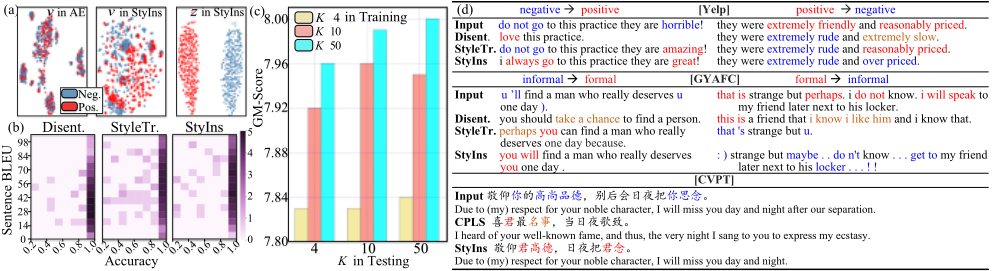
In Figure 2 (a), we vectorize sentences by a pre-trained AutoEncoder and the LSTM in our style encoder (Esty), respectively. We can observe that the former fails to distinguish different sentiments while our style encoder can separate these data points to some extent. We also visualize samples from the latent style space of StyIns. Compared to original sentence representations, this space is much more discriminative, which could produce flexible and strong style signals.
In Figure 2 (b), we plot the accuracy and sentence-BLEU (calculated with NLTK) of sentences transferred by different models. We can see for Disentangled, sentences fall in a lowBLEU and high-Acc area. For StyleTransformer, more sentences spread in the lower-Acc region compared to StyIns. Such results manifest that StyIns makes a better balance between style accuracy and content preservation.
In Figure 2 (c), we investigate the effect of different numbers of style instances K. We found when we use a small K (e.g., 4) in the training phase, setting different K in the testing phase makes a negligible difference. When we use a larger K in training, it's a better choice to take the same one for testing. In general, increasing K could facilitate the learning of latent style space and hence leads to better performance, which could support our claim that the independent assumption of sentences mentioned in Sec. 3.2 is implausible. However, larger K also requires more resources and slows down the training. As a compromise, we set K=10.
Figure 2 (d) shows some transferred samples from different datasets. We can see that Disentangled creates quite fluent sentences in apparent target style, but often loses source information, as discussed before. On Yelp, StyleTransformer can copy most style-independent source phrases but sometimes fails to generate required stylistic words. On the contrary, our StyIns makes a better balance on the two criteria. On CPVT, we can observe more interesting results. As discussed in Sec. 4.1, expressed beyond the use of stylistic words, poeticness is a more complex style than sentiment. CPLS chooses to sidestep this obstacle at times by generating fluent but irrelevant phrases. Our model, by contrast, learns to delete some vernacular words and reorder the remaining ones to better meet the syntactic requirements of classical poetry.
5 Conclusion and FutureWork
In this work, we propose a style instance supported method, StyIns, to alleviate the contradiction of content preservation and style accuracy in text style transfer tasks. StyIns adopts the generative flow technique to construct a more discriminative and expressive latent style space with the support of multiple style instances, which provides strong style signals to an attention-based decoder. Besides, our model can be flexibly extended to the semi-supervised version to utilize limited parallel data for further improvement. Experiments on three transfer tasks show that our model achieves a better balance between content and style, against several state-of-the-arts.
We plan to explore few-instance text style transfer, in which case a new style and a few instances of it are available only in the testing phase. Without explicitly defined style categories, our model possesses the potential to achieve such transfer. We highlight this task and leave it for future work.
Acknowledgments
We would like to thank anonymous reviewers for their insightful comments. This work is supported by the Major Program of the National Social Science Fund of China (Grant No. 18ZDA238), as well as the NSFC project (Grant No. 61661146007) and the NExT++ project, the National Research Foundation, Prime Minister's Office, Singapore under its IRC@Singapore Funding Initiative.
@inproceedings{ijcai2020p526,
  title     = {Text Style Transfer via Learning Style Instance Supported Latent Space},
  author    = {Yi, Xiaoyuan and Liu, Zhenghao and Li, Wenhao and Sun, Maosong},
  booktitle = {Proceedings of the Twenty-Ninth International Joint Conference on
               Artificial Intelligence, {IJCAI-20}},
  publisher = {International Joint Conferences on Artificial Intelligence Organization},
  editor    = {Christian Bessiere},
  pages     = {3801--3807},
  year      = {2020},
  month     = {7},
  note      = {Main track},
  doi       = {10.24963/ijcai.2020/526},
  url       = {https://doi.org/10.24963/ijcai.2020/526},
}
TY - CPAPER TI - Text Style Transfer via Learning Style Instance Supported Latent Space AU - Yi, Xiaoyuan AU - Liu, Zhenghao AU - Li, Wenhao AU - Sun, Maosong T2 - Proceedings of the Twenty-Ninth International Joint Conference on Artificial Intelligence, IJCAI-20 PB - International Joint Conferences on Artificial Intelligence Organization PY - 2020 SP - 3801 EP - 3807 DO - 10.24963/ijcai.2020/526 UR - https://doi.org/10.24963/ijcai.2020/526 ER -Copied
Machine-readable versions of this paper, for tools and AI agents:





