
A Game Theoretic Approach For Core Resilience
Proceedings of the Twenty-Ninth International Joint Conference on Artificial Intelligence. Main track. Pages 3473-3479.
https://doi.org/10.24963/ijcai.2020/480
Keywords
- Data Mining: Mining Graphs, Semi Structured Data, Complex Data
- Multidisciplinary Topics and Applications: Social Sciences
- Data Mining: Theoretical Foundations
Abstract
K-cores are maximal induced subgraphs where all vertices have degree at least k. These dense patterns have applications in community detection, network visualization and protein function prediction. However, k-cores can be quite unstable to network modifications, which motivates the question: How resilient is the k-core structure of a network, such as the Web or Facebook, to edge deletions? We investigate this question from an algorithmic perspective. More specifically, we study the problem of computing a small set of edges for which the removal minimizes the k-core structure of a network. This paper provides a comprehensive characterization of the hardness of the k-core minimization problem (KCM), including innaproximability and parameterized complexity. Motivated by these challenges, we propose a novel algorithm inspired by Shapley value---a cooperative game-theoretic concept--- that is able to leverage the strong interdependencies in the effects of edge removals in the search space. We efficiently approximate Shapley values using a randomized algorithm with probabilistic guarantees. Our experiments, show that the proposed algorithm outperforms competing solutions in terms of k-core minimization while being able to handle large graphs. Moreover, we illustrate how KCM can be applied in the analysis of the k-core resilience of networks.
- [Adiga and Vullikanti, 2013] Abhijin Adiga and Anil Ku- mar S Vullikanti. How robust is the core of a network? In ECML/PKDD, pages 541-556. Springer, 2013.
- [Arulselvan, 2014] Ashwin Arulselvan. A note on the set union knapsack problem. Discrete Applied Mathematics, 169:214-218, 2014.
- [Batagelj and Zaveršnik, 2011] Vladimir Batagelj and Matjaž Zaveršnik. Fast algorithms for determining (generalized) core groups in social networks. Advances in Data Analysis and Classification, 5(2):129-145, 2011.
- [Bhawalkar et al., 2015] Kshipra Bhawalkar, Jon Kleinberg, Kevin Lewi, Tim Roughgarden, and Aneesh Sharma. Pre- venting unraveling in social networks: the anchored k- core problem. SIAM Journal on Discrete Mathematics, 29(3):1452-1475, 2015.
- [Bonnet et al., 2016] Édouard Bonnet, Vangelis Th Paschos, and Florian Sikora. Parameterized exact and approxima- tion algorithms for maximum k-set cover and related sat- isfiability problems. RAIRO-Theoretical Informatics and Applications, 50(3):227-240, 2016.
- [Burke et al., 2009] Moira Burke, Cameron Marlow, and Thomas Lento. Feed me: motivating newcomer contri- bution in social network sites. In SIGCHI, 2009.
- [Carmi et al., 2007] Shai Carmi, Shlomo Havlin, Scott Kirk- patrick, Yuval Shavitt, and Eran Shir. A model of internet topology using k-shell decomposition. PNAS, 2007.
- [Castro et al., 2009] Javier Castro, Daniel Gómez, and Juan Tejada. Polynomial calculation of the shapley value based on sampling. Computers & Operations Research, 36(5):1726-1730, 2009.
- [Chitnis et al., 2013] Rajesh Hemant Chitnis, Fedor V Fomin, and Petr A Golovach. Preventing unraveling in social networks gets harder. In AAAI, 2013.
- [Cohen et al., 2000] Reuven Cohen, Keren Erez, Daniel Ben-Avraham, and Shlomo Havlin. Resilience of the in- ternet to random breakdowns. Physical Review Letters, 85(21):4626, 2000.
- [Cygan et al., 2015] Marek Cygan, Fedor V. Fomin, Lukasz Kowalik, Daniel Lokshtanov, Dániel Marx, Marcin Pilipczuk, Michal Pilipczuk, and Saket Saurabh. Parame- terized Algorithms. 2015.
- [Ellens and Kooij, 2013] Wendy Ellens and Robert E Kooij. Graph measures and network robustness. arXiv preprint arXiv:1311.5064, 2013.
- [Farzan et al., 2011] Rosta Farzan, Laura A Dabbish, Robert E Kraut, and Tom Postmes. Increasing com- mitment to online communities by designing for social presence. In CSCW, 2011.
- [Garcia et al., 2013] David Garcia, Pavlin Mavrodiev, and Frank Schweitzer. Social resilience in online communi- ties: The autopsy of friendster. In COSN, 2013.
- [Goldschmidt et al., 1994] Olivier Goldschmidt, David Nehme, and Gang Yu. Note: On the set-union knapsack problem. Naval Research Logistics (NRL), 1994.
- [Hoeffding, 1963] Wassily Hoeffding. Probability inequali- ties for sums of bounded random variables. Journal of the American statistical association, 58(301):13-30, 1963.
- [Kempe et al., 2003] David Kempe, Jon Kleinberg, and Éva Tardos. Maximizing the spread of influence through a so- cial network. In SIGKDD, pages 137-146, 2003.
- [Laishram et al., 2018] Ricky Laishram, Ahmet Erdem Sariyüce, Tina Eliassi-Rad, Ali Pinar, and Sucheta Soundarajan. Measuring and improving the core resilience of networks. In The Web Conference, 2018.
- [Maleki et al., 2013] Sasan Maleki, Long Tran-Thanh, Greg Hines, Talal Rahwan, and Alex Rogers. Bounding the esti- mation error of sampling-based shapley value approxima- tion. arXiv preprint arXiv:1306.4265, 2013.
- [Malliaros and Vazirgiannis, 2013] Fragkiskos D Malliaros and Michalis Vazirgiannis. To stay or not to stay: mod- eling engagement dynamics in social graphs. In CIKM, pages 469-478, 2013.
- [Medya et al., 2019] Sourav Medya, Tiyani Ma, Arlei Silva, and Ambuj Singh. K-core minimization: A game theoretic approach. arXiv preprint arXiv:1901.02166, 2019.
- [Narayanam and Narahari, 2011] Ramasuri Narayanam and Yadati Narahari. A shapley value-based approach to dis- cover influential nodes in social networks. IEEE TASE, pages 130-147, 2011.
- [Peng et al., 2014] Chengbin Peng, Tamara G Kolda, and Ali Pinar. Accelerating community detection by using k-core subgraphs. arXiv preprint arXiv:1403.2226, 2014.
- [Perliger and Pedahzur, 2011] Arie Perliger and Ami Pedahzur. Social network analysis in the study of ter- rorism and political violence. PS: Political Science & Politics, 44(1), 2011.
- [Seidman, 1983] Stephen B Seidman. Network structure and minimum degree. Social networks, 5(3):269-287, 1983.
- [Shapley, 1953] Lloyd S Shapley. A value for n-person games. Contributions to the Theory of Games, 1953.
- [Shin et al., 2016] Kijung Shin, Tina Eliassi-Rad, and Chris- tos Faloutsos. Corescope: Graph mining using k-core analysis-patterns, anomalies and algorithms. In ICDM, pages 469-478, 2016.
- [Viswanath et al., 2009] Bimal Viswanath, Alan Mislove, Meeyoung Cha, and Krishna P Gummadi. On the evo- lution of user interaction in facebook. In OSN, 2009.
- [Zhang et al., 2017] Fan Zhang, Ying Zhang, Lu Qin, Wenjie Zhang, and Xuemin Lin. Finding critical users for social network engagement: The collapsed k-core problem. In AAAI, pages 245-251, 2017.
- [Zhou et al., 2019] Zhongxin Zhou, Fan Zhang, Xuemin Lin, Wenjie Zhang, and Chen Chen. K-core maximiza- tion: An edge addition approach. In IJCAI, 2019. IJCAI
- [Zhu et al., 2018] Weijie Zhu, Chen Chen, Xiaoyang Wang, and Xuemin Lin. K-core minimization: An edge manipu- lation approach. In CIKM, pages 1667-1670. ACM, 2018.
References were extracted automatically from the PDF and may contain errors.
Full text extracted automatically from the PDF; figures, tables and equations may differ. The PDF is the version of record.
1 Introduction
K-cores play an important role in revealing the higher-order organization of networks. A k-core [Seidman, 1983] is a maximal induced subgraph where all vertices have internal degree of at least k. These cohesive subgraphs have been applied to model users' engagement and viral marketing in social networks [Bhawalkar et al., 2015]. Other applications include anomaly detection [Shin et al., 2016], community discovery [Peng et al., 2014], and visualization [Carmi et al., 2007]. However, the k-core structure can be quite unstable under network modification. For instance, removing only a few edges might lead to the collapse of the core structure of a graph. This motivates the k-core minimization problem:
Given a graph G and constant k, find a small set of b edges for which the removal minimizes the size of the k-core structure [Zhu et al., 2018].
We motivate k-core minimization using the following applications: (1) Monitoring: Given an infrastructure or technological network, which edges should be monitored for attacks [Laishram et al., 2018]? (2) Defense: Which communication channels should be blocked in a terrorist network in order to destabilize its activities [Perliger and Pedahzur, 2011]? and (3) Design: How to prevent unraveling in a social or biological network by strengthening connections between pairs of nodes [Bhawalkar et al., 2015]?
Consider a specific application of k-cores in online social networks (OSNs). OSN users tend to perform activities (e.g., joining a group, playing a game) if enough of their friends do the same [Burke et al., 2009]. Thus, strengthening critical links between users is key to the popularity, and even survival, of the network [Farzan et al., 2011]. This scenario can be modeled using k-cores. Initially, everyone is engaged in the k-core. The removal of a few links (e.g., unfriending, unfollowing) might not only cause a couple of users to leave the network but produce a mass exodus due to cascading effects. This process can help us to understand the decline and death of OSNs such as Friendster [Garcia et al., 2013].
K-core minimization (KCM) can be motivated both from the perspective of a centralized agent who protects the structure of a network or an adversary that aims to disrupt it. Moreover, our problem can also be applied to measure network resilience [Laishram et al., 2018].
There is no polynomial time algorithm that achieves a constant-factor approximation for KCM. This behavior differs from more popular problems in graph combinatorial optimization, such as submodular optimization, where a simple greedy algorithm provides constant-factor approximation guarantees. The algorithm proposed in this paper applies the concept of Shapley values (SVs), which, in the context of cooperative game theory, measure the contribution of players in coalitions [Shapley, 1953]. Our algorithm selects edges with largest Shapley value to account for the joint effect (or cooperation) of multiple edges in the solution set.
Recent papers have introduced the KCM problem [Zhu et al., 2018] and its vertex version [Zhang et al., 2017], where the goal is to delete a few vertices such that the k-core structure is minimized. However, our work provides a stronger theoretical analysis and more effective algorithms that can be applied to both problems. In particular, we show that our algorithm outperforms the greedy approach proposed by a recent work [Zhu et al., 2018].
Our main contributions are summarized as follows:
- We study the k-core minimization (KCM) problem, which consists of finding a small set of edges, removal of which minimizes the size of the k-core structure of a network.
- We show that KCM is NP-hard, even to approximate by a constant for k ≥ 3. We also discuss the parameterized complexity of KCM and show the problem is W[2]-hard and para-NP-hard for different parameters.
- Given the above inapproximability result, we propose a randomized Shapley Value based algorithm that efficiently accounts for the interdependence among the candidate edges for removal.
- We show the accuracy and efficiency of our algorithm using several datasets. Moreover, we illustrate how KCM can be applied to profile the resilience of real networks.
Due to space limitations some details, proofs, and results are in an extended version [Medya et al., 2019].
2 ProblemDefinition
We assume G(V,E) to be an undirected and unweighted graph with sets of vertices V (|V | = n) and edges E (|E| = m). Let d(G, u) denote the degree of vertex u in G. An induced subgraph, H = (VH,EH) ⊂ G is such that if u, v ∈ VH and (u, v) ∈ E then (u, v) ∈ EH. The k-core [Seidman, 1983] of a network is defined below.
Definition 1. k-Core: The k-core of a graph G, denoted by Ck(G) = (Vk(G),Ek(G)), is defined as the maximal induced subgraph that has vertices with degree at least k.
K-core decomposition can be performed in time O(m) by recursively removing vertices with degree lower than k [Batagelj and Zaverˇsnik, 2011].
Let GB = (V, E\B) be the modified graph after deleting a set B of b edges. Deleting an edge reduces the degree of two vertices and possibly removes other vertices from the k-core. For instance, the vertices in a simple cycle are in the 2-core but deleting any edge from the graph moves all the vertices to the 1-core. Let Nk(G) = |Vk(G)| and Mk(G) = |Ek(G)| be the number of nodes and edges respectively in Ck(G).
Definition 2. Reduced k-Core: A reduced k-core, Ck(GB ) is the k-core in GB , where GB = (V, E \ B).
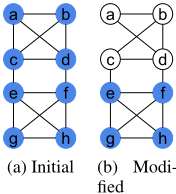
Example 1. Figures 1 shows an initial graph, G, and modified graph GB (where B={(a, c)}). In G, all the nodes are in the 3-core. Deleting (a, c) brings the vertices a and c to the 2-core and thus b and d also go to the 2-core.
Definition 3. K-Core Minimization (KCM): Given a candidate edge set Γ, find the set, B ⊂ Γ of b edges to be removed such that Nk(GB ) is minimized, or, fk(B) = Nk(G) - Nk(GB ) is maximized.
Fig. 1a shows an initial graph, G, where the nodes are in the 3-core. Deleting (a, c) and (e, g) brings all the vertices to the 2-core, whereas deleting (e, c) and (d, f) has no effect on the 3-core structure (assuming b=2). Clearly, the importance of the edges varies in affecting the k-core upon their removal. Next, we discuss strong inapproximability results for the KCM problem along with parameterized complexity.
2.1 Inapproximability
The hardness of the KCM problem stems from the fact that there is a combinatorial number of choices of edges from the candidate set, and there might be strong dependencies in the effects of edge removals. KCM is proved to be NP-hard in [Zhu et al., 2018]. We show a stronger result: KCM is NPhard to approximate within any constant factor.
Theorem 1. The KCM problem is NP-hard to approximate within a constant-factor for all k ≥ 3.
Proof. We sketch the proof for k=3 (similar for k>3).
Let SK(U, S, P,W, q) be an instance of the Set Union Knapsack Problem [Goldschmidt et al., 1994], where U = {u1, . . . un′} is a set of items, S = {S1, . . . Sm′} is a set of subsets (Si ⊆ U), p : S → R+ is a subset profit function, w : U → R+ is an item weight function, and q ∈ R+ is the budget. For a subset A ⊆ S, the weighted union of set A is W(A) = ∑e∈∪t∈ASt we and P(A) = ∑t∈A pt. The problem is to find a subset A∗ ⊆ S such that W(A∗ ) ≤ q and P(A∗ ) is maximized. SK is NP-hard to approximate within a constant factor [Arulselvan, 2014].
We reduce a version of SK with equal profits and weights (also NP-hard to approximate) to the KCM problem. The graph G′ is constructed as follows. For each uj ∈ U, we create a cycle of m′ vertices Yj,1, Yj,2, . . . , Yj,m′ in V and add (Yj,1, Yj,2), (Yj,2, Yj,3), . . . , (Yj,m′-1 , Yj,m′), (Yj,m′ , Yj,1) as edges between them. We also add 5 vertices Zj,1 to Zj,5 with eight edges where the four vertices Zj,2 to Zj,5 form a clique with six edges. The other two edges are (Zj,1,Zj,2) and (Zj,1,Zj,5). Moreover, for each subset Si we create a set of O((m′ )3 ) vertices (sets Xi,∗ are red rectangles in Figure 2), such that each node has exactly degree 3, and add one more node Xi,1 with two edges incident to two vertices in Xi,∗ from Xi,1. In the edge set E, an edge (Xi,1, Yj,i) will be added if uj ∈ Si. Additionally, if uj /∈ Si, the edge (Yj,i,Zj,1) will be added to E. Figure 2 illustrates our construction for a set S1 = {u1, u2}, S2 = {u1, u3}, S3 = {u2}.
In KCM, the number of edges to be removed is the budget, b. The candidate set of edges, Γ is the set of all the edges with form (Yj,1, Yj,2). Initially all the nodes in G′ are in the 3-core. Our claim is that, for any solution A of an instance of SK there is a corresponding solution set of edges, B (where |B| = b) in G′ of the KCM problem, such that f3(B) = P(A) + b(m′ + 1) if the edges in A are removed.
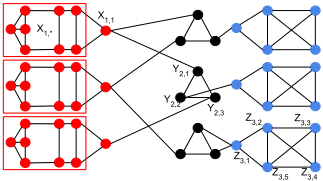
The m′ nodes in any Yj and the node Zj,1 will be in the 2-core if the edge (Yj,1, Yj,2) is removed. So, the removal of any b edges from Γ moves b(m′ +1) nodes to the 2-core. But the node Xi,1 and each node in Xi,∗ (O((m′ )3 ) nodes) will be in the 2-core iff all its neighbours in Yj,is go to the 2-core. Thus, an optimal solution B∗ will be f3(B∗ ) = P(A∗ ) + b(m′ + 1) where A∗ is the optimal solution for SUKP. For any non-optimal solution B, f3(B) = P(A) + b(m′ + 1) where A is also non-optimal solution for SUKP. As P (A∗ ) is at least O((m′ )3 ) by construction (i.e. P(A∗ ) ≫ b(m′ +1)), and P(A∗ ) P(A) cannot be within a constant factor, f3(B∗ ) f3(B) will also not be within any constant factor.
Theorem 1 shows that there is no polynomial-time constant-factor approximation for KCM when k ≥ 3. This contrasts with well-known NP-hard graph combinatorial problems in the literature [Kempe et al., 2003].
2.2 Parameterized Complexity
There are several NP-hard problems (e.g. Vertex Cover) with exact solutions via algorithms that run in time that grows exponentially with the size of the parameter. Thus, if we are only interested in a constant value of the parameter, we can solve the problem in polynomial time. A parameterized problem instance is comprised of an instance X in the usual sense, and a parameter b. The problem is called fixed parameter tractable (FPT) if it is solvable in time g(b)×p(|X|), where g is an arbitrary function of b and p is a polynomial in the input size |X|. We show that KCM is W[2]-hard and para-NP-hard when parameterized by the budget and the core respectively. For details about parameterized complexity classes and reduction techniques, please refer to [Cygan et al., 2015].
Theorem 2. The KCM problem is W[2]-hard parameterized by the budget b.
We show a parameterized reduction from Set Cover, which is known to be W[2]-hard [Bonnet et al., 2016].
Theorem 3. The KCM problem is para-NP-hard parameterized by k.
This can be proven from the fact that our problem KCM is NP-hard even for constant k. These parameterized complexity results ensure that the problem KCM is also hard for either parameter b or k. Motivated by these strong hardness
Algorithm 1: Greedy Cut (GC)
Input: G, k, b Output: B: Set of edges to delete 1 B ← ∅,max ←-∞, G ←Ck(G) 2 while |B| < b do 3 e∗ ← arg maxe∈G (Ek)\B |computeV S(e = (u, v), G , k)| 4 B ←B ∪ {e∗ } 5 LocalUpdate(e, G , k) 6 return Band inapproximability results, we next consider some practical heuristics for the KCM problem.
3 Algorithms
In this section, we propose efficient heuristics for KCM.
3.1 Baseline: Greedy Cut
For KCM, only the current k-core of the graph, G (Vk, Ek) = Ck(G) (|Vk| = Nk,|Ek| = Mk), has to be taken into account. Remaining nodes will already be in a lower-than-k-core and can be removed. We define a vulnerable set V Sk(e, G) as those nodes that would be demoted to a lower-than-k-core if edge e is deleted from the current core graph G . Algorithm 1 (GC) [Zhu et al., 2018] is a greedy approach for selecting an edge set B (|B| = b) that maximizes the kcore reduction, fk(B). In each step, it chooses the edge that maximizes |V Sk(e, G )| (step 3-4) among the candidate edges Γ. The specific procedure for computing V Sk(e, G ) (step 3), LocalUpdate and their running times (O(Mk +Nk)) are described in the extended version of this paper [Medya et al., 2019]. The overall running time of GC is O(b|Γ|(Mk +Nk)).
3.2 Shapley Value Based Algorithm
The greedy algorithm discussed in the last section is unaware of some dependencies between the candidates in the solution set. For instance, in Figure 1a, all the edges have same importance (the value is 0) to destroy the 2-core structure. In this scenario, GC will choose an edge arbitrarily. However, removing an optimal set of seven edges can make the graph a tree (1-core). To capture these dependencies, we adopt a cooperative game theoretic concept named Shapley Value [Shapley, 1953]. Our goal is to take into account a coalition of edges (players) and divide the total gain by this coalition equally among the edges inside it.
Shapley Value
The Shapley Value of an edge e in KCM is defined as follows. Let the value of a coalition P be V (P) = fk(P) = Nk(G)- Nk(GP ). Given an edge e ∈ Γ and a subset P ⊆ Γ such that e /∈ P, the marginal contribution of e to P is:
Let Ω be the set of all |Γ|! permutations of all the edges in Γ and Pe(π) be the set of all the edges that appear before e in a permutation π. The Shapley Value of e is the average of its
Algorithm 2: Shapley Value Based Cut (SV)
Input: G, k, b, Γ
Output: B: Set of edges to delete
- 1 Initialize all Φ′e as 0, ∀e ∈ Γ
- 2 Generate S = O( logΓ ϵ2 ) random permutations of edges
- 3 B ← ∅, G ←Ck(G)
- 4 for π ∈ S do
- 8 Select top b Φ′e edges fromB
- 9 return B
marginal contributions to the edge set that appears before e in all the permutations:
Shapley Values capture the importance of an edge inside a set (or coalition) of edges. However, computing Shapley Value requires considering O(|Γ|!) permutations. Next we show how to efficiently approximate the Shapley Value for each edge via sampling.
Approximate Shapley Value Based Algorithm
Algorithm 2 (Shapley Value Based Cut, SV) selects the best b edges according to their approximate Shapley Values based on a sampled set of permutations, S. For each permutation in S, we compute the marginal gains of all the edges. These marginal gains are normalized by the sample size, s. In terms of time complexity, steps 4-6 are the dominating steps and take O(s|Γ|(Nk + Mk)) time, where Nk and Mk are the number of nodes and edges in Ck(G), respectively. Note that similar sampling based methods have been introduced for different applications [Castro et al., 2009; Maleki et al., 2013] (details are in Section 5).
Analysis
We have introduced a fast sampling algorithm (SV) for kcore minimization using Shapley Values. Here, we study the quality of the approximation provided by SV as a function of the number of samples. We show that our algorithm is nearly optimal with respect to each Shapley Value with high probability. More specifically, given ϵ > 0 and δ < 1, SV takes p( 1ϵ , 1δ ) samples, where p is a polynomial in 1ϵ , 1δ , to approximate the Shapley Values within ϵ error with probability 1-δ.
We sample uniformly with replacement, a set of permutations S (|S| = s) from the set of all permutations, Ω. Each permutation is chosen with probability 1 |Ω| . Let Φ′e be the approximate Shapley Value of e based on S. Xi is a random variable that denotes the marginal gain in the ith sampled permutation. So, the estimated Shapley Value is Φ′e = 1s ∑si=1 Xi. Note that E[Φ′e ] = Φe.
Theorem 4. Given ϵ (0 < ϵ < 1), a positive integer ℓ, and a sample of independent permutations S, |S| = s, where s ≥
| Dataset Name | |V | | |E| | kmax | Type |
|---|---|---|---|---|
| email-Enron (EE) | 36K | 183K | 42 | |
| Facebook (FB) | 60K | 1.5M | 52 | OSN |
| web-Stanford (WS) | 280K | 2.3M | 70 | Webgaph |
| DBLP (DB) | 317K | 1M | 113 | Co-authorship |
| Erdos-Renyi (ER) | 60K | 800K | 19 | Synthetic |
where Nk denotes the number of nodes in Ck(G).
To prove this, we use Hoeffding's inequality [Hoeffding, 1963] and the union bound. The parameter l further enhances the trade-off between number of samples and the corresponding probability. The next result is stronger as it shows a similar bound for a set of edges.
Next, we apply Theorem 4 to analyze the quality of a set B produced by Algorithm 2 (SV), compared with the result of an exact algorithm (without sampling). Let the Shapley Values of the top b edges be ΦoB = {ΦO1,ΦO2,ΦO3, ...,ΦOb} where ΦO1 ≥ ΦO2 ≥ ... ≥ ΦOb. The set produced by Algorithm 2 (SV) has Shapley Values ΦaB = {ΦA1, ΦA2, ΦA3, ..., ΦAb}, where ΦA1 ≥ ΦA2 ≥ ... ≥ ΦAb. We prove the following result regarding the SV algorithm.
Corollary 5. For any i,ΦOi ∈ ΦoB and ΦAi ∈ ΦaB , ϵ (0 < ϵ < 1), positive integer ℓ, and a sample of independent permutations S, |S| = s, where s ≥ (ℓ+1) log |Γ| 2ϵ2 :
where Nk denotes the number of nodes in Ck(G).
Proof. For all edges e ∈ Γ, Theorem 4 shows that Pr(|Φ′e - Φe| < ϵ · Nk) ≥ 1-2|Γ|-ℓ . So, with probability 1-2|Γ|-ℓ , |Φ′Oi -ΦOi| < ϵ · Nk and |Φ′Ai -ΦAi| < ϵ · Nk. As Φ′Ai > Φ′Oi , |ΦOi -ΦAi| < 2ϵ · Nk with the same probability.
At this point, it is relevant to revisit the hardness of approximation result from Theorem 1 in the light of Corollary 5. First, SV does not directly minimize the KCM objective function (Definition 3). Instead, it provides a score for each candidate edge e based on how different permutations of edges including e minimize the KCM objective under the assumption that such scores are divided fairly among the involved edges. Notice that such assumption is not part of KCM, and thus Shapley Values play the role of a heuristic. Corollary 5, which is a polynomial-time randomized approximation scheme (PRAS) type of guarantee instead of a constantfactor approximation, refers to the exact Shapley Value of the top b edges, and not the KCM objective. We evaluate how SV performs regarding the KCM objective in our experiments.
4 Experiments
In this section, we evaluate the proposed Shapley Value Based Cut (SV) algorithm for k-core minimization against baseline solutions. In Sec. 4.3, we show how k-core minimization can be applied in analyzing the structural resilience of networks.
4.1 Experimental Setup
All the experiments were conducted on a 2.59 GHz Intel Core i7-4720HQ machine with 16 GB RAM running Windows 10. Algorithms were implemented in Java.
Datasets: The real datasets are available online and are mostly from SNAP 1 . The Facebook dataset is from [Viswanath et al., 2009]. Table 1 shows dataset statistics, including the largest k-core (a.k.a. degeneracy). We also apply a random graph (ER) generated using the Erdos-Renyi model.
Algorithms: Our algorithm, Shapley Value Based Cut (SV) is described in Section 3.2. Besides the Greedy Cut (GC) algorithm [Zhu et al., 2018] (Section 3.1), we also consider three more baselines in our experiments. Low Jaccard Coefficient (JD) removes the k edges with lowest Jaccard coefficient. Similarly, Low-Degree (LD) deletes k edges for which adjacent vertices have the lowest degree. We also apply Random (RD), which simply deletes k edges from the candidate set Γ uniformly at random. Notice that while LD and JD are quite simple approaches for KCM, they often outperform GC.
Quality evaluation metric: Percentage DN(%) of vertices from the initial graph G that leave the k-core after the deletion of edges in B: DN(%) = Nk(G)-Nk(GB ) Nk(G) ×100.
Default parameters: We set the candidate edge set Γ to those edges (Mk(G)) between vertices in the k-core Ck(G).
Unless stated otherwise, the value of the approximation parameter for SV (ϵ) is 0.05 and the number of samples is log |Γ| ϵ2 .
4.2 Quality Evaluation
KCM algorithms are compared in terms of quality (DN(%)) for varying budget (b), core value k, and the error of the sampling scheme applied by the SV algorithm (ϵ).
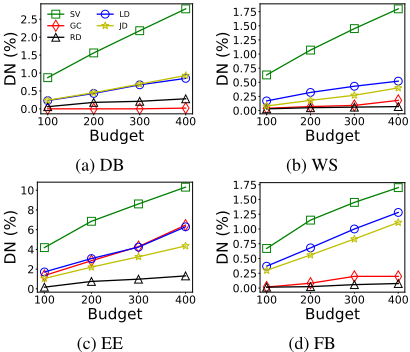
Figure 3 presents the k-core minimization results for k = 5-similar results were found for k=10-using four different datasets. SV outperforms the best baseline by up to six times. This is due to the fact that our algorithm can capture strong dependencies among sets of edges that are effective at breaking the k-core structure. On the other hand, GC, which takes into account only marginal gains for individual edges, achieves worse results than simple baselines such as JD and LD.
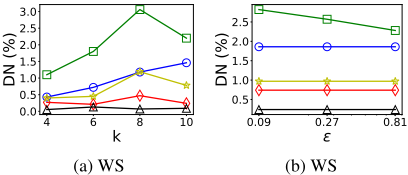
We evaluate the impact of k over quality for the algorithms using WS in Fig. 4a. The budget (b) is set to 400. As in the previous experiments, SV outperforms the competing approaches. However, notice that the gap between LD (the best baseline) and SV decreases as k increases. This is due to the fact that the number of samples decreases for higher k as the number of candidate edge also decreases, but it can be mended by a smaller ϵ. On the other hand, a large value of k leads to a less stable k-core structure that can often be broken by the removal of edges with low-degree endpoints. LD is a good alternative for such extreme scenarios. Similar results were found for other datasets.
The parameter ϵ controls the sampling error of the SV algorithm according to Thm. 4. We show the effect of ϵ over the quality results for WS in Fig. 4b. The values of b and k are set to 400 and 12 respectively. As expected, DN(%) is inversely proportional to the value of ϵ for SV. The trade-off between ϵ and the running time of our algorithm enables both accurate and efficient selection of edges for k-core minimization.
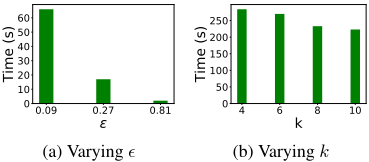
Running Time: Running times for SV varying the sampling error (ϵ) and the core parameter (k) using the FB dataset are given in Figures 5a and 5b, respectively. Even for small error, the algorithm is able to process graphs with tens of thousands of vertices and millions of edges in, roughly, one minute. Running times decay as k increases due to two factors: (1) the size of the k-core structure decreases (2) pruning gets boosted by a less stable core structure.
4.3 Application: k-core Resilience
We show how KCM can be applied to profile the resilience of networks. A profile provides a visualization of the resilience of the k-core structure of a network for different combinations of k and budget. We apply DN(%) as a measure of the percentage of the k-core removed by a certain amount of budget-relative to the immediately smaller budget value.
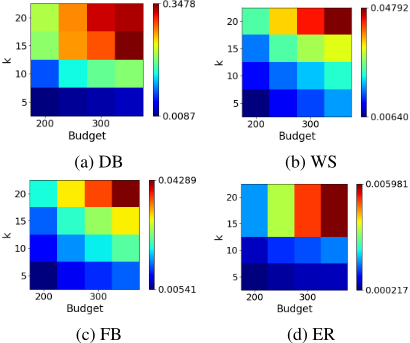
Figure 6 shows the results for co-authorship (DB), Web (WS), social network (FB) and a random (ER) graph. Each cell corresponds to a given k-b combination and the color of cell (X, Y ) shows the difference in DN(%) between b=Y and b = Y -100 for k =X. As colors are relative, we also show the range of values associated to the color scheme. We summarize our main findings as follows:
Stability: ER (Figure 6d) is the most stable graph, as can be noticed by the range of values in the profile. The majority of nodes in ER are in the 19-core. DB (Figure 6a) is the least stable, but only when k > 5, which is due to its large number of small cliques. The high-core structure of DB is quite unstable, with less than 1% of the network in the 20core structure after the removal of 500 edges.
Tipping points: We also look at large effects of edge removals within small variations in budget-for a fixed value of k. Such a behavior is not noticed for FB and WS (Figures 6b and 6c, respectively), for which profiles are quite smooth. This is mostly due to the presence of fringe nodes at different levels of k-core structure. On the other hand, ER produced the most prominent tipping points (k=15 and k=20).
5 Previous Work
The k-core decomposition algorithms were introduced in [Seidman, 1983; Batagelj and Zaverˇsnik, 2011; Bonnet et al., 2016] for different settings. K-cores are applied in community detection [Peng et al., 2014], characterizing the Internet topology [Carmi et al., 2007] and user engagement [Malliaros and Vazirgiannis, 2013]. Bhawalkar et al. [Bhawalkar et al., 2015] and Chitnis et al. [Chitnis et al., 2013] studied the problem of increasing the size of k-core by anchoring a few vertices initially outside of the k-core.
Understanding the behavior of a complex system (e.g. the Internet, a power grid) under different types of attacks and failures has been a popular topic in network science [Cohen et al., 2000]. An overview of different metrics for assessing robustness/resilience is given by [Ellens and Kooij, 2013].
Stability/resilience of k-core: A recent paper [Zhu et al., 2018] proposing the k-core minimization problem is the previous work most related to ours. Compared to the refereed work we: (1) prove stronger inaproximability results for KCM; (2) propose a more effective heuristic based on Shapley Values; and (3) provide a more extensive evaluation of algorithms for KCM using several datasets. Adiga et al. [Adiga and Vullikanti, 2013] studied the stability of high cores in noisy networks. A few studies [Laishram et al., 2018; Zhou et al., 2019] recently introduced a notion of resilience in terms of the stability of k-cores against deletion of random nodes/edges. Another related paper [Zhang et al., 2017] studied the node version of KCM.
Shapley Value (SV) and combinatorial problems: A Shapley Value based algorithm was previously introduced for influence maximization (IM) [Narayanam and Narahari, 2011]. However, notice that IM can be approximated within a constant-factor by a simple greedy algorithm [Kempe et al., 2003]. We apply Shapley Values to solve KCM, which has stronger inapproximability results than IM. Sampling techniques have been for the efficient computation of SV's have also been studied [Castro et al., 2009; Maleki et al., 2013]. Castro et al. [Castro et al., 2009] introduced SV sampling in the context of symmetric and non-symmetric voting games. Maleki et al. [Maleki et al., 2013] provided analyses for stratified sampling specially when the marginal contributions of players are similar. We are able to prove stronger sampling results, bounding the error for the top k edges in terms of Shapley Value (Cor. 5), for KCM.
6 Conclusion
We have studied the k-core minimization (KCM) problem, which consists of finding a set of edges, removal of which minimizes the size of the k-core of a graph. KCMwas shown to be NP-hard, even to approximate within a constant. The problem is also W[2]-hard and para-NP-hard parameterized by budget and k, respectively. Given such hardness and inapproximability results, we have proposed an efficient randomized heuristic based on Shapley Value to account for the interdependence in the impact of candidate edges to be removed. We have evaluated our algorithm against baseline approaches using several real graphs, showing that the proposed solution is scalable and outperforms its competitors in terms of quality. We have also illustrated how KCM can be used for profiling the structural resilience of networks.
Acknowledgements
Research was funded partially by NSF IIS #1817046 and DTRA HDTRA1-19-1-0017.
@inproceedings{ijcai2020p480,
  title     = {A Game Theoretic Approach For Core Resilience},
  author    = {Medya, Sourav and Ma, Tiyani and Silva, Arlei and Singh, Ambuj},
  booktitle = {Proceedings of the Twenty-Ninth International Joint Conference on
               Artificial Intelligence, {IJCAI-20}},
  publisher = {International Joint Conferences on Artificial Intelligence Organization},
  editor    = {Christian Bessiere},
  pages     = {3473--3479},
  year      = {2020},
  month     = {7},
  note      = {Main track},
  doi       = {10.24963/ijcai.2020/480},
  url       = {https://doi.org/10.24963/ijcai.2020/480},
}
TY - CPAPER TI - A Game Theoretic Approach For Core Resilience AU - Medya, Sourav AU - Ma, Tiyani AU - Silva, Arlei AU - Singh, Ambuj T2 - Proceedings of the Twenty-Ninth International Joint Conference on Artificial Intelligence, IJCAI-20 PB - International Joint Conferences on Artificial Intelligence Organization PY - 2020 SP - 3473 EP - 3479 DO - 10.24963/ijcai.2020/480 UR - https://doi.org/10.24963/ijcai.2020/480 ER -Copied
Machine-readable versions of this paper, for tools and AI agents:





