
Discriminative Feature Selection via A Structured Sparse Subspace Learning Module
Proceedings of the Twenty-Ninth International Joint Conference on Artificial Intelligence. Main track. Pages 3009-3015.
https://doi.org/10.24963/ijcai.2020/416
Keywords
- Data Mining: Feature Extraction, Selection and Dimensionality Reduction
- Machine Learning: Feature Selection; Learning Sparse Models
Abstract
In this paper, we first propose a novel Structured Sparse Subspace Learning S^3L module to address the long-standing subspace sparsity issue. Elicited by proposed module, we design a new discriminative feature selection method, named Subspace Sparsity Discriminant Feature Selection S^2DFS which enables the following new functionalities: 1) Proposed S^2DFS method directly joints trace ratio objective and structured sparse subspace constraint via L2,0-norm to learn a row-sparsity subspace, which improves the discriminability of model and overcomes the parameter-tuning trouble with comparison to the methods used L2,1-norm regularization; 2) An alternative iterative optimization algorithm based on the proposed S^3L module is presented to explicitly solve the proposed problem with a closed-form solution and strict convergence proof. To our best knowledge, such objective function and solver are first proposed in this paper, which provides a new though for the development of feature selection methods. Extensive experiments conducted on several high-dimensional datasets demonstrate the discriminability of selected features via S^2DFS with comparison to several related SOTA feature selection methods. Source matlab code: https://github.com/StevenWangNPU/L20-FS.
- [Abid et al., 2019] Abubakar Abid, Muhammad Fatih Balin, and James Zou. Concrete autoencoders for differen- tiable feature selection and reconstruction. arXiv preprint arXiv:1901.09346, 2019.
- [Bishop, 2006] Christopher M Bishop. Pattern recognition and machine learning. springer, 2006.
- [Cai et al., 2013] Xiao Cai, Feiping Nie, and Heng Huang. Exact top-k feature selection via l2, 0-norm constraint. In Proceedings of the Twenty-Third international joint con- ference on Artificial Intelligence, pages 1240-1246, 2013. IJCAI
- [Du et al., 2018] Xingzhong Du, Feiping Nie, Weiqing Wang, Yi Yang, and Xiaofang Zhou. Exploiting combina- tion effect for unsupervised feature selection by ℓ 2,0 -norm. IEEE transactions on neural networks and learning sys- tems, 30(1):201-214, 2018.
- [Gu et al., 2012] Quanquan Gu, Zhenhui Li, and Jiawei Han. Generalized fisher score for feature selection. arXiv preprint arXiv:1202.3725, 2012.
- [Han et al., 2018] Kai Han, Yunhe Wang, Chao Zhang, Chao Li, and Chao Xu. Autoencoder inspired unsupervised fea- ture selection. In 2018 IEEE International Conference on Acoustics, Speech and Signal Processing (ICASSP), pages 2941-2945. IEEE, 2018.
- [He et al., 2012] Ran He, Tieniu Tan, Liang Wang, and Wei- Shi Zheng. ℓ 2,1 regularized correntropy for robust feature selection. In 2012 IEEE Conference on Computer Vision and Pattern Recognition, pages 2504-2511. IEEE, 2012.
- [Horn and Johnson, 2012] Roger A Horn and Charles R Johnson. Matrix analysis. Cambridge university press, 2012.
- [Liao et al., 2015] Shengcai Liao, Yang Hu, Xiangyu Zhu, and Stan Z Li. Person re-identification by local maximal occurrence representation and metric learning. In Proceed- ings of the IEEE conference on computer vision and pat- tern recognition, pages 2197-2206, 2015.
- [Maldonado and Weber, 2009] Sebastián Maldonado and Richard Weber. A wrapper method for feature selection using support vector machines. Information Sciences, 179(13):2208-2217, 2009.
- [Ming and Ding, 2019] Di Ming and Chris Ding. Robust flexible feature selection via exclusive l21 regularization. In Proceedings of the 28th International Joint Conference on Artificial Intelligence, pages 3158-3164. AAAI Press, 2019. IJCAI
- [Nie et al., 2010] Feiping Nie, Heng Huang, Xiao Cai, and Chris H Ding. Efficient and robust feature selection via joint ℓ 2,1 -norms minimization. In Advances in neural in- formation processing systems, pages 1813-1821, 2010.
- [Nie et al., 2017] Feiping Nie, Rui Zhang, and Xuelong Li. A generalized power iteration method for solving quadratic problem on the stiefel manifold. Science China Information Sciences, 60(11):112101, 2017.
- [Nie et al., 2019] Feiping Nie, Zheng Wang, Rong Wang, Zhen Wang, and Xuelong Li. Towards robust discrimi- native projections learning via non-greedy l 2,1 -norm min- max. IEEE Transactions on Pattern Analysis and Machine Intelligence, 2019, DOI: 10.1109/TPAMI.2019.2961877. DOI
- [Pang et al., 2018] Tianji Pang, Feiping Nie, Junwei Han, and Xuelong Li. Efficient feature selection via ℓ 2,0 - norm constrained sparse regression. IEEE Transactions on Knowledge and Data Engineering, 31(5):880-893, 2018.
- [Roffo et al., 2015] Giorgio Roffo, Simone Melzi, and Marco Cristani. Infinite feature selection. In Proceedings of the IEEE International Conference on Computer Vision, pages 4202-4210, 2015.
- [Sun et al., 2016] Ying Sun, Prabhu Babu, and Daniel P Palomar. Majorization-minimization algorithms in signal processing, communications, and machine learning. IEEE Transactions on Signal Processing, 65(3):794-816, 2016.
- [Tian et al., 2019] Lai Tian, Feiping Nie, and Xuelong Li. Learning feature sparse principal components. arXiv preprint arXiv:1904.10155, 2019.
- [Vu et al., 2013] Vincent Q Vu, Jing Lei, et al. Minimax sparse principal subspace estimation in high dimensions. The Annals of Statistics, 41(6):2905-2947, 2013.
- [Wang et al., 2007] Huan Wang, Shuicheng Yan, Dong Xu, Xiaoou Tang, and Thomas Huang. Trace ratio vs. ratio trace for dimensionality reduction. In 2007 IEEE Confer- ence on Computer Vision and Pattern Recognition, pages 1-8. IEEE, 2007.
- [Wang et al., 2014] Zhaoran Wang, Huanran Lu, and Han Liu. Tighten after relax: Minimax-optimal sparse pca in polynomial time. In Advances in neural information pro- cessing systems, pages 3383-3391, 2014.
- [Xiang et al., 2012] Shiming Xiang, Feiping Nie, Gaofeng Meng, Chunhong Pan, and Changshui Zhang. Discrimi- native least squares regression for multiclass classification and feature selection. IEEE transactions on neural net- works and learning systems, 23(11):1738-1754, 2012.
- [Xu et al., 2018] Jie Xu, Lei Luo, Cheng Deng, and Heng Huang. Bilevel distance metric learning for robust image recognition. In Advances in Neural Information Process- ing Systems, pages 4198-4207, 2018.
- [Yan et al., 2016] Hui Yan, Jian Yang, and Jingyu Yang. Robust joint feature weights learning framework. IEEE Transactions on Knowledge and Data Engineering, 28(5):1327-1339, 2016.
- [Yang and Xu, 2015] Wenzhuo Yang and Huan Xu. Stream- ing sparse principal component analysis. In International Conference on Machine Learning, pages 494-503, 2015.
- [Zhang et al., 2020] H. Zhang, J. Wang, Z. Sun, J. M. Zu- rada, and N. R. Pal. Feature selection for neural networks using group lasso regularization. IEEE Transactions on Knowledge and Data Engineering, 32(4):659-673, 2020.
References were extracted automatically from the PDF and may contain errors.
Full text extracted automatically from the PDF; figures, tables and equations may differ. The PDF is the version of record.
1 Introduction
Data in many areas are represented by high-dimensional features, and a natural question emerges out: what are the most discriminative features in the high-dimensional data? Feature selection plays a crucial role in machine learning which endeavors to select a subset of features from the highdimensional data for improving data compactness and reducing noisy features so that the over-fitting, high computational consumption and low performance issues can be alleviated in many real-world applications.
Feature selection approaches can be roughly divided into three categories, i.e., filter methods [Gu et al., 2012], wrapper methods [Maldonado and Weber, 2009] and embedded methods [Xiang et al., 2012; Ming and Ding, 2019; Tian et al., 2019]. Wherein, filter methods focus on evaluating the correlation of features with respect to class label of data, which results in that the correlated features are redundant. Wrapper methods measure the importance of features according to classification performance, so as to the computational cost of wapper model is very high and the representability of learned features may be poor in other tasks. In contrast, embedded methods gain more attentions since it incorporates feature selection and classification model into a unified optimization framework by learning sparse structural projections. Besides, some feature selection approaches based on neural network [Zhang et al., 2020] and autoencoder model [Han et al., 2018; Abid et al., 2019] pay overmuch attentions on minimizing the reconstruct errors, which possible not benefit for classification task and tuning parameters may affect its efficiency of practical applications.
∗Corresponding Author
Most of embedded methods commonly employ ℓ2,1-norm regularization to improve the row-sparsity in learned subspace. Concretely, Nie et al. propose robust feature selection model (RFS) [Nie et al., 2010] which simultaneously incorporates ℓ2,1-norm into loss function and regularization term to overcome outliers issues and make feature selection come true. Similar, [He et al., 2012] proposes to use Correntropy Robust loss function in Feature Selection (CRFS) to enhance model's robustness. Additionally, [Xiang et al., 2012] develops a feature selection effort joints discriminative least square regression (DLSRFS) model and sparse ℓ2,1-norm regularization into an unified framework. Recently, RJFWL [Yan et al., 2016] aims to learn the ranking of all features by imposing ℓ2,1-norm constraint and non-negative constraint on learned feature weights matrix. Regrettably, all aforementioned approaches are always unable to escape the dilemma of tuning the trade-off parameter between loss term and sparse regularization term. Moreover, the compactness of sparse row is sensitive to the trade-off parameter, namely, the uniqueness of optimum is difficult to guarantee.
An illustrative example is depicted in Figure 1, from which we can figure out that ℓ2,1-norm calculates the score of features integrally, then ranks them resorting to the learned scores. By doing so, the feature ranking results may be changed dramatically when the feature score vary subtly. In contrast, ℓ2,0-norm obtains the score matrix only depend upon the k features, and no further ranking operation is required. Based on these, Cai et al. [Cai et al., 2013] questioning that whether the method based on convex problem is always better than that based on non-convex problem. They exploit top-k features selection method (RPMFS) based on least square regression model with ℓ2,0-norm equality constraint. Pang et al. [Pang et al., 2018] develop an Efficient Sparse Feature Selection (ESFS) via ℓ2,0-norm constraint based on least square regression model as well. In [Du et al., 2018], Unsupervised Group Feature Selection (UGFS) algorithm selects a group of features initially then update the selection until a better group appears by using ℓ2,0-norm constraint. Nevertheless, both of above methods optimize the ℓ2,0-norm constraint problem by using Augmented Lagrangian Multiplier (ALM) and gradient descent optimization algorithms, which may result in that the solution is sensitive to the initialization and easy to stuck in local optimum. Ultimately, the subsequent performance of classification is fluctuant.
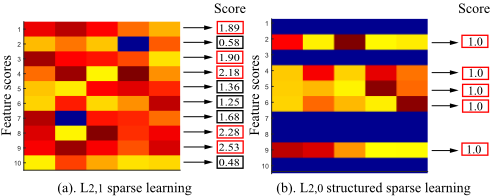
Facing these obstacles that hinder the development of feature selection, we entail solving ℓ2,0-norm constraint problem along with rigorous theoretical guarantee firstly in this paper. Then, we propose a new discriminative feature selection model via orthogonal ℓ2,0-norm constraint. Finally, we analyze the performance of proposed method from two aspects, i.e., discriminability and efficiency. Our contributions can be summarized as follows:
- We propose a Structured Sparse Subspace Learning (S3L) module to solve the subspace sparsity issue with theoretical guarantee, which is first presented in our paper according to our best knowledge.
- We elaborately design a discriminative feature selection model, named Subspace Sparsity Discriminant Feature Selection (S2DFS) that integrates trace ratio formulated objective and structured sparse subspace constraint for acquiring more informative feature subset.
- Optimizing the proposed S2DFS model is a NP-hard problem. We provide an alternative iterative optimization algorithm to solve trace ratio problem, in which the proposed S3L module is employed to acquire a closedformed solution rather than an approximate one, so as to ensure the stability of selection results.
- Experimental results show the effectiveness of proposed optimization algorithm in two perspectives, i.e., performance: our method outperforms other related SOTA
feature selection methods in terms of classification on several real-world datasets; convergent speed: our algorithm reaches convergence within few iterations.
2 RelatedWorks
In this section, we briefly review constrained Linear Discriminative Analysis (LDA) in trace ratio formulation, then the subspace sparsity issue will be introduced.
2.1 Constrained Trace Ratio LDA
Given the training data X = {x1, x2, ..., xn} ∈ Rd×n , where xi ∈ Rd×1 and the label vector is y = {y1, y2, ..., yn}, where yi ∈ {1, 2, ..., c}, and c denotes the total class number. LDA aims to find a transformation matrix W ∈ Rd×m to map original high-dimensional sample x ∈ Rd×1 into lowdimensional subspace with m dimensions where m << d. For improving the discriminative power of model, the samples within the same class are pulled together as well as those points between different classes are pushed far away in learned subspace ideally. There are many kinds of objective function of LDA [Bishop, 2006], one of the most discriminative objectives is the following constrained trace ratio one
where Sb = ∑ci=1 ni (µi -µ) (µi -µ)T and Sw = ∑ci=1 ∑xj∈πi (xj -µi) (xj -µi)T denote between-class and within-class scatter matrix respectively. ni is the number of samples belong to i-th class, µi denotes the mean of samples in i-th class, µ is the mean of total samples and πi denotes the set of i-th class points. Orthogonal constraint is used to avoid trivial solution [Nie et al., 2019]. Note that, optimizing such model in Eq.(1) is a non-convex optimization problem that does not have a closed-form solution, and several attempts [Wang et al., 2007; Nie et al., 2019] have tried to solve it. In what follows, we will provide an alternative iterative optimization algorithm to get the solution.
2.2 Subspace Sparsity Problem
Subspace sparsity issue is originally derived from the sparse principal subspace estimation [Vu et al., 2013] which can be generally formulated as
where m ≤ k ≤ d and A ∈ Rd×d is a positive semidefinite matrix. ‖W‖2,0 = ∑di=1 ∥∥∥∑mj=1 w2 ij ∥∥∥0 denotes the number of non-zero rows in matrix W, and the constraint ‖W‖2,0 = k forces the learned subspace is row sparse, in which the index of non-zero rows equals to the index of selected features. Since both the orthogonal and row sparsity constraints are the non-convex constraint, optimizing problem (2) is challenging. In the following Section 3.1, we will propose the S3L module to solve it with theoretical guarantee.
3 ProposedMethod
3.1 Structured Sparse Subspace LearningModule
In this section, we propose a novel S3L module to solve problem (2) that has been tentatively solved in [Wang et al., 2014; Yang and Xu, 2015], but none of them provides deterministic guarantee on global convergence. We first develop a straightforward strategy for solving the case that rank (A) ≤ m. Then, an iterative optimization Algorithm 1 is derived to solve the general case that rank (A) > m in which a lowrank proxy covariance P is designed to approximate A. For readability, we define two definitions that will be used in following deducing:
Definition 3.1 Given an indices I whose elements span from 1 to d. Then, the row extraction matrix Qkd ∈ Rd×k is defined as:
Define Qd,k(I) = Qkd as an operator that inputs indices I and outputs row extraction matrix Qkd ∈ Rd×k .
Case 1: rank (A) ≤ m
We first consider the simplest problem, i.e., k = m, thus, the problem (2) reduces to
Due to the constraint WT W = Im×m and ‖W‖2,0 = m, W can be rewritten as W = Qmd V, where V ∈ Rm×m and satisfies VT V = Im×m. Additionally, Qmd = Qd,m(I) ∈ Rd×m is the row extraction matrix that has been defined. Then, problem (3) has been reduced to solve
where ˜A = Qmd T AQmd . So far, the row extraction matrix Qmd is still unknown. As a consequence, considering V ∈ Rm×m is a square matrix and VT V = VVT = I, we can infer the fact Tr(VT ˜AV) = Tr(˜AVVT ). Thus, problem (4) can be reduced to
which has a globally optimal solution that m largest diagonal elements of A, and Qmd is generated by operator Qd,m(I) with input I that equals to the indices of m largest diagonal elements of A.
Next, we consider the case that k ̸= m, and problem in Case 1 becomes to
We use similar technique to solve problem (6) as
which can be easily solved globally by selecting k largest diagonal elements of A, and Qkd = Qd,k(I) where I denotes the indices of k largest diagonal elements of A. Throughout above analysis, our S3L module is able to efficiently (non-iteratively) obtain globally optimal solution of NPhard problem (2) when rank(A) ≤ m.
Nevertheless, the Case 1 is not usually occurred in practice, since PCA often used as a data-preprocessing technique to remove null space of data, which cause a general Case 2, i.e., rank(A) = d > m. Next, we develop an iterative S3L module to solve the problem (2) in the following Case 2.
Case 2: rank (A) > m
We solve the problem (2) in case 2 based on the Minimization-Majorization framework (MM) [Sun et al., 2016] whose key insight is to maximize a lowerbound function of target problem. Therefore, how to design a suitable lowerbound function is the key to the success of MM. Fortunately, through a lot of attempts, we elaborately design an ideal lowerbound function of problem (2) as follow:
where K = {W ∈ Rd×m|WT W = I, ‖W‖2,0 = k} is the structured sparse subspace constraint, the surrogate variable Γt = AWt (WT t AWt )† WT t A and (·)† denotes the Moore-Penrose pseudoinverse. As a lowerbound function, a deserved property should be invariably held:
which will be proved in Section 3.2.
According to MM framework, solving problem (2) in Case 2 becomes to solve
which is still a difficult problem that can not be optimized directly. Now, we discuss some properties of designed surrogate variable Γt through the following Theorem 1.
Theorem 1 In the t-th iteration (t ≥ 1), the conditions rank (Γt) ≤ m and Γt ⪰ 0 will always hold.
Proof 1 According to the property of matrix rank rank(AB) ≤ min{rank(A), rank(B)}, we have rank(Γt) ≤ rank(Wt) = m, then the first condition has been proved. Subsequently, we suppose that Ω = AWt (WT t AWt )† WT t A 1 2 , then according to the fact that A ⪰ 0, A is a symmetric matrix and B† = B†BB† , we can obtain
(11)
which completes the proof of Theorem 1.
According to Theorem 1, we wondrously discover an interesting phenomenon that the designed surrogate variable Γt satisfies all conditions of A in case 1, i.e, rank(A) ≤ m and Γt ⪰ 0. Those facts enlighten a thought that problem (10) can be solved by using S3L module iteratively, which is summarized in the following Algorithm 1.
Algorithm 1 Solve problem (2), when rank(A) > m
Input: A, k, m, d andW0;
Initialization: W0 = rand(d, m), t = 0;
Repeat:
- Γt ←AWt (WT t AWt )† WT t A;
- It ←sort ( diag(Γt), 'descend', k );
- Qt kd ←Qd,k(It);
- Wt+1 ← Qt kdVt;
- t = t +1;
Until convergence
Output: W∗ ∈ Rd×m.
3.2 AlgorithmAnalysis
We prove the convergence of the proposed Algorithm 1 through the following Theorem 2.
Theorem 2 Algorithm 1 increases the objective function value of Eq.(2) in each iteration, when rank(A) > m.
Proof 2 Note the fact that B = BB†B, we can infer that
where rank (Γt) ≤ m. Then, we can use the S3L module to maximize the above Eq.(12) as
where ̂WT t+1 is generated according to Eq.(4) with input A = Γt. Thanks to the commutative law in algebraic operation of matrix trace and A is a symmetric matrix, Eq.(13) can be decomposed as
where two symmetric matrices are respectively defined as Φ = A 12Wt (WT t AWt )† WT t A 1 2 ∈ Rd×d , Θ = A 12 ̂Wt+1 ̂WT t+1A 12 ∈ Rd×d . Considering Theorem 4.3.53 in [Horn and Johnson, 2012], we have
which provides an evidence of correctness for Eq.(9). Moreover, note that rank(Θ) ≤ rank(̂Wt+1) = m, then we have ∑mi=1 λi (Θ) = Tr (Θ). Combining Eq.(12), Eq.(13) and Eq.(15), we can conclude that
According to the previous definitions, i.e., ̂Wt+1 = Qt kd ̂Vt and Wt+1 = Qt kdVt, we can finally obtain that
then the proof of Theorem 2 has been completed.
3.3 Subspace Sparsity Discriminant Feature Selection
In this part, we propose to introduce a novel feature selection method named S2DFS, and optimize it by using S3L module.
Model Formulation. In order to improve model's discriminative power, S2DFS leverages trace ratio LDA model in Eq.(1) for pulling samples within same class together and pushing those samples between different classes far away in learned subspace. Besides, we use the structured sparse subspace constraint to directly facilitate the exploration and inference of important features of data. In light of these points, the objective function of S2DFS model can be formulated as
where m ≤ k < d, m is the number of selected features and k means the number of non-zero rows in W. Due to the nonlinear constraints and trace ratio objective, optimizing such a maximization ratio problem in Eq.(18) is challenging.
Optimization Algorithm Before solving problem (18), we first consider to solve a general maximization ratio problem as follow:
where x ∈ C is arbitrary constraint on x and as the denominator, g(x) > 0. In Algorithm 2, we summarize an alternative optimization algorithm to solve the general problem (19), and a series of theorems and proofs are presented to guarantee its convergence.
Algorithm 2 Algorithm to solve the general maximization ratio problem (19).
- Initialization: x ∈ C, t = 1.
While not converge do
- Calculate λt = f(xt) g(xt) .
- Calculate xt+1 = argmax x∈C f(x) -λtg(x).
- t = t +1. end while
Theorem 3 The global solution of the general maximization ratio problem (19) is equivalent to the root of following function:
Proof 3 Supposing x∗ is the global solution of problem (19) and its corresponding maximal objective function value is λ∗ , then the following equation holds: f(x∗ ) g(x∗ ) = λ∗ . As a result,
g(x) > 0, we can infer that f(x)-λ∗ g(x) ≤ 0 which means:
Consequently, the global maximal objective function value λ∗ of problem (19) is the root of function h(λ). Thus, the proof of Theorem 3 is completed.
□
Theorem 4 Algorithm 2 increases the objective function value of problem (19) in each iteration until it reaches convergence.
Proof 4 According to the step 2 in Algorithm 2, we have f(xt) - λtg(xt) = 0, and from step 3, we can infer that f (xt+1) - λtg(xt+1) ≥ f (xt) - λtg(xt). Combining above two inequalities, we can obtain f(xt+1) - λtg(xt+1) ≥ 0 that equals to f(xt+1) g(xt+1) ≥ λt = f(xt) g(xt) . That is, Algorithm 2 increases the objective function value in Eq.(19) in each iteration and the proof of Theorem 4 has been finished.
□
Systematically, it is worth noting that Theorem 3-4 provide a complete framework to optimize the general maximization ratio problem in Eq.(19) with rigorously convergent proof.
According to the Algorithm 2, we can infer that the key of solving proposed maximization ratio problem in Eq.(18) is to solve the following problem:
(22)
max W∈Rd×m T r (WT BW) s.t. WT W= I, ‖W‖2,0 = k, where B = Sb - λSw + ηI is a positive semi-definite matrix if η is large enough. In theory, the relaxation parameter η is easily to be calculated as the largest eigenvalue of Sb -λSw. The first way that can be thought to acquire η is eigenvalue decomposition, which however is time-consuming in dealing with high-dimensional data. Here, we employ a power iteration method [Nie et al., 2017] to solve above issue, which can obtain the relaxation parameter η faster than eigenvalue decomposition and improves the applicability of our method.
Note that problem (22) is a special case of problem (2), which can be directly addressed by using proposed S3L module and obtain a closed-form solution.
4 Experiments
In this section, for verifying the effectiveness of proposed method, we first present an visualization experiment on Mnist dataset. Then, we evaluate its classification performance on nine publicly available high-dimensional datasets. Finally,
we exhibit the convergent speed of our method.
4.1 Preliminary
Datasets. We evaluate the performance of proposedmethod on several high-dimensional real-world datasets, and more details about them are shown in Table ??. For the color image datasets, i.e., Pubfig [Xu et al., 2018], we firstly downsample each image into a suitable scale and extract 100 LOMO features [Liao et al., 2015] for data representation.
1 http://qwone.com/∼jason/20Newsgroups/
| Datasets | Dim. | Class | Num. | Type |
|---|---|---|---|---|
| 20News 1 | 8,014 | 4 | 3,970 | Text |
| WebKB 2 | 4,165 | 7 | 1,166 | Web |
| Binalpha 3 | 320 | 36 | 1,404 | Letter |
| Pixraw10P 3 | 10,000 | 10 | 100 | Face image |
| Text1 3 | 7,511 | 2 | 1,946 | Text |
| Pubfig | 65,536 | 8 | 772 | Face image |
Experimental setting. We compare our method to several SOTA feature selection methods including DLSRFS [Xiang et al., 2012], RFS [Nie et al., 2010], CRFS [He et al., 2012], RJFWL [Yan et al., 2016], infFS [Roffo et al., 2015] and ESFS [Pang et al., 2018] in the classification task. We use the k-nearest neighbor algorithm as the classifier, all experiments are repeatedly conducted 10 times and the average recognition rate and standard deviation are recorded as the measurement of performance for all competitors.
4.2 Visualization Experiment
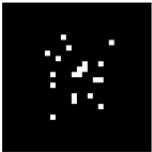
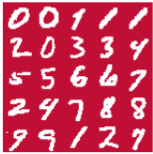
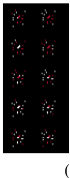
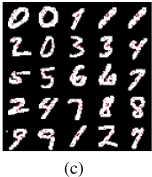
In order to intuitively show the performance of feature selection algorithm, we provide an visualization experiment conducted on Mnist digits dataset. Figure 2b exhibits the two types of selected features, i.e., digital pixels (white dots) and background pixels (red dots) respectively. In the Figure 2c,
we show the selected features lied on the Mnist digits, from
which we can observe that the shape of digits can be dis-
tinctly reconstructed by selected features generated by pro-
posed method. Experimental results verify the discriminabil-
ity of selected features that learned from our method.
(a)
(b)
4.3 Classification Experiment
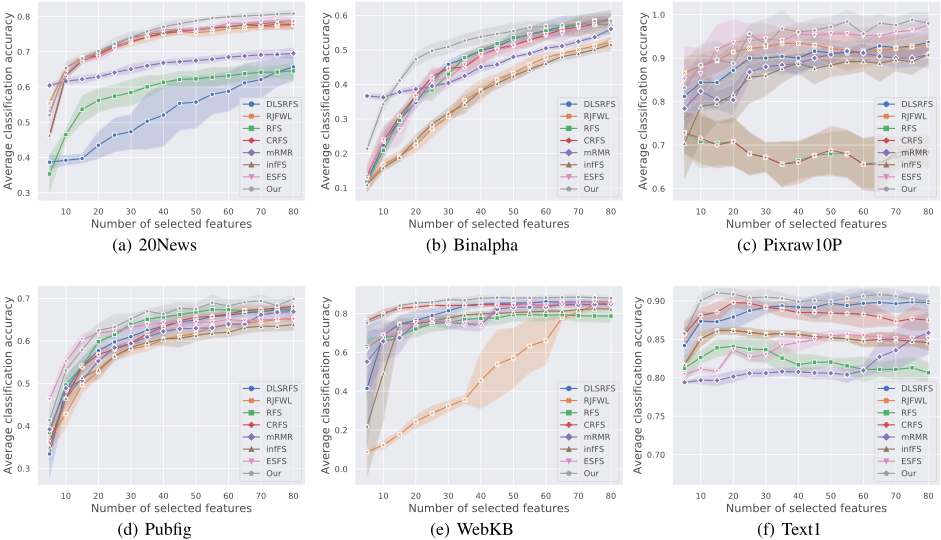
Figure 3 shows the statistical estimation of classification results on six high-dimensional real-world datasets, which demonstrates the discriminability of feature subsets selected by our method. Concretely, in general, comparing to all competitors, our method always achieves comparable or even highest mean accuracies on almost all datasets with different number of selected features. Specifically, due to the nonparameter property of our method, it achieves stable performance on all datasets. Furthermore, our method outperforms ESFS in different degrees on various datasets, which results from that ESFS applies approximate gradient descent algorithm to obtain a suboptimal solution, while our method obtains a closed-form solution, which guarantees stability of our method's performance.
2 http://www.cs.cmu.edu/afs/cs/project/theo-20/www/data/
3 http://www.escience.cn/system/file?fileId=82035
4.4 Convergence Analysis
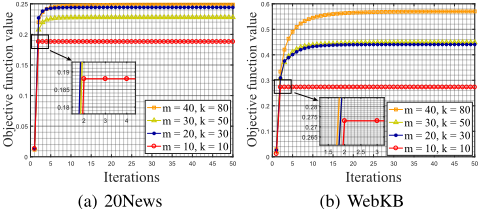
Figure 4 plots the convergence curves of our iterative algorithm with different number of selected features m and model's sparsity k on 20News and WebKB datasets. Overall, our algorithm reaches convergent within 15 iterations in most cases or even less than 5 iterations on 20News dataset. In detail, a subfigure embedded in each figure is used to facilitate observation of the curve convergence when k = m. We discover the fact that the curve reaches convergent with one iteration on all datasets, which verifies the high-efficiency of proposed optimization algorithm.
5 Conclusion
In this paper, we have proposed explicit discriminative feature selection algorithm via employing structured sparse subspace constraint, which is a NP-hard optimization problem. To our best knowledge, there are no techniques able to obtain closed-form solution and proves convergence. As the major contribution of this paper, we provide an ideal iterative optimization algorithm that can directly solve proposed NP-hard problem and reaches convergent very fast in both theory and practice. Experimental results demonstrate the effectiveness of proposed method. In future works, we intend to develop nonlinear feature selection model via proposed S3L module for future improving discriminability of selected features.
Acknowledgements
This work was supported in part by the National Key Research and Development Program of China under Grant 2018AAA0101902, in part by the National Natural Science Foundation of China under Grant 61936014, Grant 61772427 and Grant 61751202, and in part by the Fundamental Research Funds for the Central Universities under Grant G2019KY0501.
@inproceedings{ijcai2020p416,
  title     = {Discriminative Feature Selection via A Structured Sparse Subspace Learning Module},
  author    = {Wang, Zheng and Nie, Feiping and Tian, Lai and Wang, Rong and Li, Xuelong},
  booktitle = {Proceedings of the Twenty-Ninth International Joint Conference on
               Artificial Intelligence, {IJCAI-20}},
  publisher = {International Joint Conferences on Artificial Intelligence Organization},
  editor    = {Christian Bessiere},
  pages     = {3009--3015},
  year      = {2020},
  month     = {7},
  note      = {Main track},
  doi       = {10.24963/ijcai.2020/416},
  url       = {https://doi.org/10.24963/ijcai.2020/416},
}
TY - CPAPER TI - Discriminative Feature Selection via A Structured Sparse Subspace Learning Module AU - Wang, Zheng AU - Nie, Feiping AU - Tian, Lai AU - Wang, Rong AU - Li, Xuelong T2 - Proceedings of the Twenty-Ninth International Joint Conference on Artificial Intelligence, IJCAI-20 PB - International Joint Conferences on Artificial Intelligence Organization PY - 2020 SP - 3009 EP - 3015 DO - 10.24963/ijcai.2020/416 UR - https://doi.org/10.24963/ijcai.2020/416 ER -Copied
Machine-readable versions of this paper, for tools and AI agents:





