
Embodied Multimodal Multitask Learning
Proceedings of the Twenty-Ninth International Joint Conference on Artificial Intelligence. Main track. Pages 2442-2448.
https://doi.org/10.24963/ijcai.2020/338
Keywords
- Machine Learning: Transfer, Adaptation, Multi-task Learning
- Machine Learning: Deep Reinforcement Learning
- Machine Learning Applications: Applications of Reinforcement Learning
Abstract
Visually-grounded embodied language learning models have recently shown to be effective at learning multiple multimodal tasks such as following navigational instructions and answering questions. In this paper, we address two key limitations of these models, (a) the inability to transfer the grounded knowledge across different tasks and (b) the inability to transfer to new words and concepts not seen during training using only a few examples. We propose a multitask model which facilitates knowledge transfer across tasks by disentangling the knowledge of words and visual attributes in the intermediate representations. We create scenarios and datasets to quantify cross-task knowledge transfer and show that the proposed model outperforms a range of baselines in simulated 3D environments. We also show that this disentanglement of representations makes our model modular and interpretable which allows for transfer to instructions containing new concepts.
- [Anderson et al., 2018] Peter Anderson, Qi Wu, Damien Teney, Jake Bruce, Mark Johnson, Niko Sünderhauf, Ian Reid, Stephen Gould, and Anton van den Hengel. Vision-and-language navigation: Interpreting visually-grounded navigation instructions in real en- vironments. In Proceedings of the IEEE Conference on Computer Vision and Pattern Recognition, pages 3674-3683, 2018.
- [Andreas et al., 2016] Jacob Andreas, Marcus Rohrbach, Trevor Darrell, and Dan Klein. Neural module networks. In Proceed- ings of the IEEE Conference on Computer Vision and Pattern Recognition, pages 39-48, 2016.
- [Artzi and Zettlemoyer, 2013] Yoav Artzi and Luke Zettlemoyer. Weakly supervised learning of semantic parsers for mapping in- structions to actions. Transactions of the Association for Compu- tational Linguistics, 1:49-62, 2013.
- [Barsalou, 2008] Lawrence W Barsalou. Grounded cognition. Annu. Rev. Psychol., 59:617-645, 2008.
- [Blukis et al., 2018] Valts Blukis, Dipendra Misra, Ross A Knepper, and Yoav Artzi. Mapping navigation instructions to continuous control actions with position-visitation prediction. Proceedings of The 2nd Conference on Robot Learning, 2018.
- [Chaplot et al., 2018] Devendra Singh Chaplot, Kan- thashree Mysore Sathyendra, Rama Kumar Pasumarthi, Dheeraj Rajagopal, and Ruslan Salakhutdinov. Gated-attention architectures for task-oriented language grounding. In AAAI, 2018.
- [Chen and Mooney, 2011] David L Chen and Raymond J Mooney. Learning to interpret natural language navigation instructions from observations. In Twenty-Fifth AAAI Conference on Artificial Intelligence, 2011.
- [Chen et al., 2019] Howard Chen, Alane Shur, Dipendra Misra, Noah Snavely, and Yoav Artzi. Touchdown: Natural language navigation and spatial reasoning in visual street environments. In CVPR, 2019.
- [Cho et al., 2014] Kyunghyun Cho, Bart Van Merriënboer, Dzmitry Bahdanau, and Yoshua Bengio. On the properties of neural ma- chine translation: Encoder-decoder approaches. arXiv preprint arXiv:1409.1259, 2014.
- [Das et al., 2018] Abhishek Das, Samyak Datta, Georgia Gkioxari, Stefan Lee, Devi Parikh, and Dhruv Batra. Embodied question answering. In CVPR, 2018.
- [de Vries et al., 2018] Harm de Vries, Kurt Shuster, Dhruv Batra, Devi Parikh, Jason Weston, and Douwe Kiela. Talk the walk: Navigating new york city through grounded dialogue. arXiv preprint arXiv:1807.03367, 2018.
- [Glorot et al., 2011] Xavier Glorot, Antoine Bordes, and Yoshua Bengio. Deep sparse rectifier neural networks. In Proceedings of the fourteenth international conference on artificial intelligence and statistics, pages 315-323, 2011.
- [Gordon et al., 2018] Daniel Gordon, Aniruddha Kembhavi, Mo- hammad Rastegari, Joseph Redmon, Dieter Fox, and Ali Farhadi. Iqa: Visual question answering in interactive environments. In Proceedings of the IEEE Conference on Computer Vision and Pattern Recognition, pages 4089-4098, 2018.
- [Hemachandra et al., 2015] Sachithra Hemachandra, Felix Duval- let, Thomas M Howard, Nicholas Roy, Anthony Stentz, and Matthew R Walter. Learning models for following natural lan- guage directions in unknown environments. In 2015 IEEE Inter- national Conference on Robotics and Automation (ICRA), pages 5608-5615. IEEE, 2015.
- [Hermann et al., 2017] Karl Moritz Hermann, Felix Hill, Simon Green, Fumin Wang, Ryan Faulkner, Hubert Soyer, David Szepes- vari, Wojtek Czarnecki, Max Jaderberg, Denis Teplyashin, et al. Grounded language learning in a simulated 3d world. arXiv preprint arXiv:1706.06551, 2017.
- [Kempka et al., 2016] Michał Kempka, Marek Wydmuch, Grzegorz Runc, Jakub Toczek, and Wojciech Jaśkowski. Vizdoom: A doom- based ai research platform for visual reinforcement learning. In 2016 IEEE Conference on Computational Intelligence and Games (CIG), pages 1-8. IEEE, 2016.
- [LeCun et al., 1995] Yann LeCun, Yoshua Bengio, et al. Convolu- tional networks for images, speech, and time series. The handbook of brain theory and neural networks, 3361(10):1995, 1995.
- [MacMahon et al., 2006] Matt MacMahon, Brian Stankiewicz, and Benjamin Kuipers. Walk the talk: Connecting language, knowl- edge, and action in route instructions. Def, 2(6):4, 2006.
- [Matuszek et al., 2012] Cynthia Matuszek, Nicholas FitzGerald, Luke Zettlemoyer, Liefeng Bo, and Dieter Fox. A joint model of language and perception for grounded attribute learning. arXiv preprint arXiv:1206.6423, 2012.
- [Mei et al., 2016] Hongyuan Mei, Mohit Bansal, and Matthew R Walter. Listen, attend, and walk: Neural mapping of navigational instructions to action sequences. In Thirtieth AAAI Conference on Artificial Intelligence, 2016.
- [Misra et al., 2016] Dipendra K Misra, Jaeyong Sung, Kevin Lee, and Ashutosh Saxena. Tell me dave: Context-sensitive grounding of natural language to manipulation instructions. The International Journal of Robotics Research, 35(1-3):281-300, 2016.
- [Misra et al., 2017] Dipendra Misra, John Langford, and Yoav Artzi. Mapping instructions and visual observations to actions with re- inforcement learning. In Proceedings of the 2017 Conference on Empirical Methods in Natural Language Processing, pages 1004-1015, 2017.
- [Misra et al., 2018] Dipendra Misra, Andrew Bennett, Valts Blukis, Eyvind Niklasson, Max Shatkhin, and Yoav Artzi. Mapping instructions to actions in 3d environments with visual goal predic- tion. In Proceedings of the 2018 Conference on Empirical Methods in Natural Language Processing, pages 2667-2678, 2018.
- [Oh et al., 2017] Junhyuk Oh, Satinder Singh, Honglak Lee, and Pushmeet Kohli. Zero-shot task generalization with multi-task deep reinforcement learning. In ICML, 2017.
- [Perez et al., 2018] Ethan Perez, Florian Strub, Harm De Vries, Vin- cent Dumoulin, and Aaron Courville. Film: Visual reasoning with a general conditioning layer. In AAAI, 2018.
- [Schulman et al., 2017] John Schulman, Filip Wolski, Prafulla Dhariwal, Alec Radford, and Oleg Klimov. Proximal policy opti- mization algorithms. arXiv preprint arXiv:1707.06347, 2017.
- [Smith and Gasser, 2005] Linda Smith and Michael Gasser. The development of embodied cognition: Six lessons from babies. Artificial life, 11(1-2):13-29, 2005.
- [Tellex et al., 2011] Stefanie A Tellex, Thomas Fleming Kollar, Steven R Dickerson, Matthew R Walter, Ashis Banerjee, Seth Teller, and Nicholas Roy. Understanding natural language com- mands for robotic navigation and mobile manipulation. In AAAI, 2011.
- [Yu et al., 2018] Haonan Yu, Xiaochen Lian, Haichao Zhang, and Wei Xu. Guided feature transformation (gft): A neural language grounding module for embodied agents. In Conference on Robot Learning, pages 81-98, 2018.
References were extracted automatically from the PDF and may contain errors.
Full text extracted automatically from the PDF; figures, tables and equations may differ. The PDF is the version of record.
1 Introduction
Humans learn language by interacting with a dynamic perceptual environment, grounding words into visual entities and motor actions [Smith and Gasser, 2005; Barsalou, 2008]. In recent years, there has been an increased focus on training embodied agents capable of visually-grounded language learning. These include multimodal tasks involving one-way communication, such as mapping navigational instructions to actions [MacMahon et al., 2006; Chen and Mooney, 2011; Artzi and Zettlemoyer, 2013; Mei et al., 2016; Misra et al., 2018]; and tasks involving two-way communication such as embodied question answering [Gordon et al., 2018; Das et al., 2018] and embodied dialogue [de Vries et al., 2018]. Other studies have shown that grounded semantic goal navigation agents can be effective at exploiting the compositionality of language to generalize to unseen instructions with an unseen composition of semantic attributes [Hermann et al., 2017; Chaplot et al., 2018], or an unseen composition of steps in a multi-step instruction [Oh et al., 2017].
∗Webpage: https://devendrachaplot.github.io/projects/EMML
However, current grounded language learning models have certain limitations. Firstly, these models are typically trained only for a single multimodal task and lack the ability to transfer grounded knowledge of 'concepts'† across tasks. For example, if an agent learns to follow the instruction 'Go to the red torch' and answer the question 'What color is the pillar?', then ideally it should also understand 'Go to the red pillar' and 'What color is the torch?' without additional training. Training multitask grounded-language models can also improve training sample efficiency, as these multimodal tasks share many common learning challenges including perception, grounding, and navigation.
The second limitation is the inability of trained models to quickly transfer to tasks involving unseen concepts. For example, consider a household instruction-following robot trained on an existing set of objects. We would like the robot to follow instructions involving a new object 'lamp' that has been added to the house. Existing models would need to be trained with the new object, which typically requires thousands of samples and can also lead to catastrophic forgetting of known objects. Even if the models were given some labeled samples to detect the new objects, they would require additional training to learn to combine existing grounded knowledge with the new concept (e.g., 'blue lamp' if 'blue' is already known).
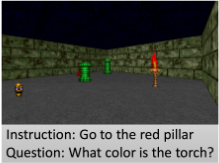
In this paper, we train a multimodal multitask learning model for two tasks: Semantic Goal Navigation, where the agent is given a language instruction to navigate to a goal location, and Embodied Question Answering, where the agent is asked a question and it can navigate in the environment to gather information to answer the question (see Figure 1). We make the following contributions in this paper:
First, we define a cross-task knowledge transfer evaluation criterion to test the ability of multimodal multi-task models to transfer knowledge of concepts across tasks. We show that several prior single-task models, when trained on both tasks, fail to achieve cross-task knowledge transfer. This is because the visual grounding of words is often implicitly learned as a by-product of end-to-end training of the underlying task, which leads to the entanglement of knowledge of concepts in the learnt representations. We propose a novel Dual-Attention
† In this paper, we refer to the knowledge of a word and its grounding in the visual world as the knowledge of a concept (for example, concept 'torch' involves word 'torch' and how torch looks visually).
| Task | Train Set | Test Set |
|---|---|---|
| SGN | Instructions not containing 'red' & 'pillar': 'Go to the blue object' 'Go to the torch' | Instructions containing 'red' or 'pillar': 'Go to the red pillar' 'Go to the tall red object' |
| EQA | Questions not containing 'blue' & 'torch': 'Which object is red in color?' 'What color is the tall pillar?' | Questions containing 'blue' or 'torch': 'Which object is blue in color?' 'What color is the torch?' |
model which learns task-invariant disentangled visual and textual representations and explicitly aligns them with each other. We create datasets and simulation scenarios for testing cross-task knowledge transfer and show an absolute improvement of 43-61% on instructions and 5-26% for questions over baselines (Section 5.1).
Second, the disentanglement and explicit alignment of representations makes our model modular and interpretable. We show that this allows us to transfer the model to handle instructions involving unseen concepts by incorporating the output of object detectors. We also show that our model is able to combine the knowledge of existing concepts with a new concept without any additional policy training (Section 5.4).
Finally, we show that the modularity and interpretability of our model also allow us to use trainable neural modules [Andreas et al., 2016] to handle relational tasks involving negation and spatial relationships and also tackle relational instructions involving new concepts (Section 5.3).
2 RelatedWork
A lot of early work on visual instruction-following in the embodied space such as in robotics applications [Tellex et al., 2011; Matuszek et al., 2012; Hemachandra et al., 2015; Misra et al., 2016] and on mapping natural language instructions to actions [MacMahon et al., 2006; Chen and Mooney, 2011; Artzi and Zettlemoyer, 2013; Mei et al., 2016] required handdesigned symbolic representations. Recently, there have been efforts on learning to follow navigational instructions from raw visual observations [Anderson et al., 2018; Misra et al., 2018; Chen et al., 2019; Blukis et al., 2018]. Some previous works have studied the language learning aspect of instructionfollowing in a more controlled setting, and show that grounded language learning agents are able to learn spatial and logical reasoning and exploit the compositionality of language to generalize to new instructions [Oh et al., 2017; Chaplot et al., 2018; Hermann et al., 2017]
Question Answering in the embodied space has been comparatively less-studied with recent work studying QA which requires exploration, navigation, and interaction with objects in the environment [Gordon et al., 2018; Das et al., 2018]. In contrast to the prior work which tackles a single grounding task, we tackle both instruction-following and question answering in the embodied space and study the ability to transfer the knowledge of concepts across the tasks and tackle instructions with new concepts.
3 ProblemFormulation
Consider an autonomous agent interacting with an episodic environment as shown in Figure 1. At the beginning of each episode, the agent receives a textual input T specifying a task. T could be an instruction to navigate to a target object or a question querying some visual detail of objects in the environment. At each time step t, the agent observes a state st = (It, T) where It is the first-person (egocentric) view of the environment, and takes an action at, which could be a navigational action or an answer action. The agent's objective is to learn a policy π(at|st) which leads to successful completion of the task specified by T .
Environments. We adapt the ViZDoom-based [Kempka et al., 2016] language grounding environment proposed by Chaplot et al. [2018] for embodied multitask learning. It consists of a single room with 5 objects. The objects are randomized in each episode based on the textual input. We use two difficulty settings: Easy: The candidate objects are in the field of view of the agent at the beginning of the episode. Hard: The candidate objects and the agent are dropped at random locations and the objects may or may not be in the agent's field of view in the initial configuration. The agent must explore the map to view all objects. The agent can take 4 actions: 3 navigational actions (forward, left, right) and 1 answer action. When the agent takes the answer action, the answer with the maximum probability in the output answer distribution is used.
Datasets. We use the set of objects and attributes from Chaplot et al. [2018] and create a dataset which includes instructions and questions about object types, colors, relative sizes (tall/short) and superlative sizes (smallest/largest). We create train-test splits for both instructions and questions datasets to explicitly test a multitask model's ability to transfer the knowledge of concepts across different tasks. Each instruction in the test set contains a word that is never seen in any instruction in the training set but is seen in some questions in the training set. Similarly, each question in the test set contains a word never seen in any training set question. Table 1 illustrates the train-test split of instructions and questions.
4 ProposedMethod
In this section, we describe our proposed architecture (illustrated in Figure 2). At the start of each episode, the agent receives a textual input T (an instruction or a question) specifying the task. At each time step t, the agent observes an egocentric image It which is passed through a convolutional neural network [LeCun et al., 1995] with ReLU activations [Glorot et al., 2011] to produce the image representation xI = f(It; θconv) ∈ RV×H×W , where θconv denotes the parameters of the convolutional network, V is the number of feature maps in the convolutional network output which is by design set equal to the vocabulary size (of the union of the instructions and questions training sets), and H and W are the height and width of each feature map. We use two representations for the textual input T: (1) the bag-of-words representation denoted by xBoW ∈ 0, 1V and (2) a sentence representation xsent = f(T ; θsent) ∈ RV , which is computed by passing the words in T through a Gated Recurrent Unit (GRU) [Cho et al., 2014] network followed by a linear layer. Here, θsent denotes the parameters of the GRU network and the linear layer with ReLU activations. Next, the Dual-Attention unit fDA combines the image representation with the text representations to get the complete state representation xS and answer prediction xAns:
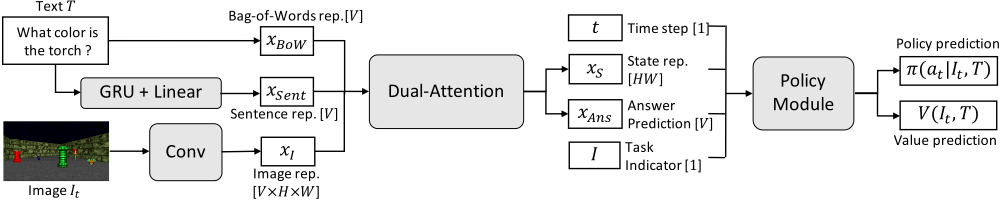
Finally, xS and xAns, along with a time step embedding and a task indicator variable (for whether the task is SGN or EQA), are passed to the policy module to produce an action.
4.1 Dual-Attention Unit
The Dual-Attention unit uses two types of attention mechanisms, Gated-Attention fGA and Spatial-Attention fSA, to align representations in different modalities and tasks.
Gated-Attention (GA). The GA unit [Chaplot et al., 2018] attends to the different channels in the image representation based on the text representation. For example, if the textual input is the instruction 'Go to the red pillar', then the GA unit can learn to attend to channels which detect red things and pillars. Specifically, the GA unit takes as input a 3-dimensional tensor image representation yI ∈ Rd×H×W and a text representation yT ∈ Rd , and outputs a 3-dimensional tensor z ∈ Rd×H×W . Note that the dimension of yT is equal to the number of feature maps and the size of the first dimension of yI. In the GA unit, each element of yT is expanded to a H ×W matrix, resulting in a 3-dimensional tensor MyT ∈ Rd×H×W , whose (i, j, k)th element is given by MyT [i, j, k] = yT [i]. This matrix is multiplied element-wise with the image representation: z = fGA(yI , yT ) = MyT ⊙ yI , where ⊙ denotes the Hadamard product.
Spatial-Attention (SA). We propose an SA unit which is analogous to the Gated-Attention unit except that it attends to different pixels in the image representation rather than the channels. For example, if the textual input is the question 'Which object is blue in color?', then we would like to spatially attend to the parts of the image which contain a blue object in order to recognize the type of the blue object. The Spatial-Attention unit takes as input a 3-dimensional tensor image representation yI ∈ Rd×H×W and a 2-dimensional spatial attention map yS ∈ RH×W , and outputs a tensor z ∈ Rd×H×W . Note that the height and width of the spatial attention map are equal to the height and width of the image representation. In the spatial-attention unit, each element of the spatial attention map is expanded to a d dimensional vector. This again results in a 3-dimensional tensor MyS ∈ Rd×H×W , whose (i, j, k)th element is given by: MyS [i, j, k] = yS[j, k]. Just like in the Gated-Attention unit, this matrix is multiplied element-wise with the image representation: z = fSA(yI , yS) = MyS ⊙ yI . Dual-Attention. We now describe the operations in the DualAttention unit shown in Figure 3, as well as motivate the intuitions behind each operation. Given xI , xBoW, and xsent, the Dual-Attention unit first computes a Gated-Attention over xI using xBoW:
Intuitively, this GA unit grounds each word in the vocabulary with a feature map in the image representation. A particular feature map is activated if and only if the corresponding word occurs in the textual input. Thus, the feature maps in the convolutional output learn to detect different objects and attributes, and words in the textual input specify which objects and attributes are relevant to the current task. The GatedAttention using BoW representation attends to feature maps detecting corresponding objects and attributes, and masks all other feature maps. We use the BoW representation for the first GA unit as it explicitly aligns the words in textual input irrespective of whether it is a question or an instruction.
Next, the output of the GA unit xGA1 is converted to a spatial attention map by summing over all channels followed by a softmax over H × W elements:
where the softmax σ(z)j = exp(zj)/ ∑k exp(zk) ensures that the attention map is spatially normalized. Summation of xGA1 along the depth dimension gives a spatial attention map which has high activations at spatial locations where relevant objects or attributes are detected. ReLU activations in the convolutional feature maps makes all elements positive, ensuring that the summation aggregates the activations of relevant feature maps.
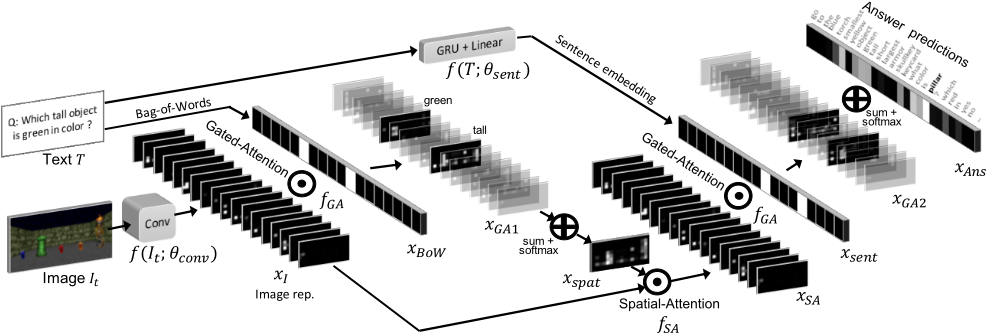
xspat and xI are then passed through a SA unit:
The SA unit outputs all attributes present at the locations where relevant objects and attributes are detected. This is especially helpful for question answering, where a single GatedAttention may not be sufficient. For example, if the textual input is 'Which color is the pillar?', then the model needs to attend not only to feature maps detecting pillars (done by the Gated-Attention), but also to other attributes at the spatial locations where pillars are seen in order to predict their color.
xSA is then passed through another GA unit with the sentence-level text representation:
This second GA unit enables the model to attend to different types of attributes based on the question. For instance, if the question is asking about the color ('Which color is the pillar?'), then the model needs to attend to the feature maps corresponding to colors; or if the question is asking about the object type ('Which object is green in color?'), then the model needs to attend to the feature maps corresponding to object types. The sentence embedding xsent can learn to attend to multiple channels based on the textual input and mask the rest.
Next, the output is transformed to answer prediction by again doing a summation and softmax but this time summing over the height and width instead of the channels:
Summation of xGA2 along each feature map aggregates the activations for relevant attributes spatially. Again, ReLU activations for sentence embedding ensure aggregation of activations for each attribute or word. The answer space is identical to the textual input space RV .
Finally, the Dual-Attention unit fDA outputs the answer prediction xAns and the flattened spatial attention map xS = vec(xspat), where vec(·) denotes the flattening operation.
Policy Module. The policy module takes as input the state representation xS from the Dual-Attention unit, a time step embedding t, and a task indicator variable I (for whether the task is SGN or EQA). The inputs are concatenated then passed through a linear layer, then a recurrent GRU layer, then linear layers to estimate the policy function π(at | It, T) and the value function V (It, T ).
All above operations are differentiable, making the entire architecture trainable end-to-end. Note that all attention mechanisms in the Dual-Attention unit only modulate the input image representation, i.e., mask or amplify specific feature maps or pixels. This ensures that there is an explicit alignment between the words in the textual input, the feature maps in the image representation, and the words in the answer space. This forces the convolutional network to encode all the information required with respect to a certain word in the corresponding output channel. For example, to predict 'red' as the answer, the model must detect red objects in the corresponding feature map. This explicit task-invariant alignment between convolutional feature maps and words in the input and answer space facilitates grounding and allows for cross-task knowledge transfer. As shown in the results later, this also makes our model modular and allows easy addition of objects and attributes to a trained model.
Optimization. The entire model is trained to predict both navigational actions and answers jointly. The policy is trained using Proximal Policy Optimization (PPO) [Schulman et al., 2017]. For training the answer predictions, we use a supervised cross-entropy loss.
Auxiliary Task. As mentioned earlier, the feature maps in the convolutional output are expected to detect different objects and attributes. We add a spatial auxiliary task (trained with cross-entropy loss) to detect the object or attribute in the convolutional output channels corresponding to the word in the bag-of-words representation.
| Easy | Hard | |||||||||||
|---|---|---|---|---|---|---|---|---|---|---|---|---|
| No Aux | Aux | No Aux | Aux | |||||||||
| Train | Test | Train | Test | Train | Test | Train | Test | |||||
| Model | MT | SGN | EQA | MT | SGN | EQA | MT | SGN | EQA | MT | SGN | EQA |
| Text only | 0.33 | 0.20 | 0.33 | 0.31 | 0.20 | 0.33 | 0.36 | 0.20 | 0.33 | 0.36 | 0.20 | 0.33 |
| Image only | 0.41 | 0.20 | 0.09 | 0.40 | 0.21 | 0.08 | 0.36 | 0.16 | 0.08 | 0.36 | 0.15 | 0.08 |
| Concat | 0.97 | 0.33 | 0.21 | 0.99 | 0.31 | 0.19 | 0.57 | 0.20 | 0.26 | 0.71 | 0.39 | 0.22 |
| GA | 0.97 | 0.27 | 0.18 | 0.99 | 0.35 | 0.24 | 0.44 | 0.18 | 0.11 | 0.71 | 0.22 | 0.24 |
| FiLM | 0.97 | 0.24 | 0.11 | 0.99 | 0.34 | 0.12 | 0.52 | 0.12 | 0.03 | 0.55 | 0.25 | 0.15 |
| PACMAN | 0.66 | 0.26 | 0.12 | 0.79 | 0.33 | 0.10 | 0.56 | 0.29 | 0.33 | 0.54 | 0.11 | 0.27 |
| Dual-Attention | 0.99 | 0.86 | 0.53 | 0.99 | 0.96 | 0.58 | 0.85 | 0.86 | 0.38 | 0.90 | 0.82 | 0.59 |
5 Experiments &Results
Jointly learning semantic goal navigation and embodied question answering essentially involves a fusion of textual and visual modalities. While prior methods are designed for a single task, we adapt several baselines for our environment and tasks by using their multimodal fusion techniques. We use two naive baselines, Image only and Text only; two baselines based on prior semantic goal navigation models, Concat (used by [Hermann et al., 2017; Misra et al., 2017]) and GatedAttention (GA) [Chaplot et al., 2018]; and two baselines based on Question Answering models, FiLM [Perez et al., 2018] and PACMAN [Das et al., 2018]. For fair comparison, we replace the proposed Dual-Attention unit with multimodal fusion techniques in the baselines and keep everything else identical to the proposed model. We will open-source the code for the training environment, datasets, and model implementation including all hyper-parameter details to support reproducbility and future work in this direction.
5.1 Results
We train all models for 10 million frames in the Easy setting and 50 million frames in the Hard setting. We use a +1 reward for reaching the correct object in SGN episodes and predicting the correct answer in EQA episodes. We use a small negative reward of -0.001 per time step to encourage shorter paths to the target and answering questions as soon as possible. We also use distance-based reward shaping for SGN episodes, where the agent receives a small reward proportional to the decrease in distance to the target. In the next subsection, we evaluate the performance of the proposed model without the reward shaping. SGN episodes end when the agent reaches any object, and EQA episodes end when the agent predicts any answer. All episodes have a maximum length of 210 time steps. We train all models with and without the auxiliary tasks using identical reward functions.
All models are trained jointly for both the tasks and tested on each task separately. In Table 2, we report the performance of all models for both Easy and Hard settings. The Dual-Attention (DA) model and many baselines achieve 99% accuracy during training in the Easy-Aux setting; however, the test performance of all the baselines is considerably lower than that of the DA model (see Table 2 (left)). Performance of all the baselines is worse than the 'Text only' model on the EQA test set, although the training accuracy is higher. This indicates that baselines tend to overfit on the training set and fail to generalize to questions which contain words never seen in training questions. As expected, using spatial auxiliary tasks improves performance of all models. Even without auxiliary tasks, the DA model achieves a test accuracy 86% (SGN) and 53% (EQA), compared to the best baseline performance of 33% (SGN & EQA).
| No Aux | Aux | |||
|---|---|---|---|---|
| Model | SGN | EQA | SGN | EQA |
| w/o SA | 0.20 | 0.16 | 0.20 | 0.15 |
| w/o GA1 | 0.14 | 0.25 | 0.16 | 0.38 |
| w/o GA2 | 0.80 | 0.33 | 0.97 | 0.15 |
| w/o Task Indicator | 0.79 | 0.47 | 0.96 | 0.56 |
| w/o Reward Shaping | 0.82 | 0.49 | 0.93 | 0.51 |
| DA Single-Task | 0.63 | 0.31 | 0.91 | 0.34 |
| DA Multi-Task | 0.86 | 0.53 | 0.96 | 0.58 |
For the Hard setting, the DA model achieves a higher training (90% vs 71% with Aux) as well as test performance (82% vs. 39% for SGN, 59% vs. 33% for EQA with Aux) than the baselines (see Table 2 (right)). These results confirm the hypothesis that prior models, which are designed for a single task, lack the ability to align the words in both the tasks and transfer knowledge across tasks.
5.2 Ablation tests
We perform several ablation tests to analyze the contribution of each component in the Dual-Attention unit: without SpatialAttention (w/o SA), without the first Gated-Attention with xBoW (w/o GA1), and without the second Gated-Attention with xsent (w/o GA2). We also try removing the task indicator variable (w/o Indicator Variable), removing reward shaping (w/o Reward Shaping), and training the proposed model on a single task, SGN or EQA (DA Single-Task).
In Table 3, we report the test performance of all ablation models. The results indicate that SA and GA1 contribute the most to the performance of the full Dual-Attention model. GA2 is critical for performance on EQA but not SGN (see Table 3). This is expected as GA2 is designed to attend to different objects and attributes based on the question and is used mainly for answer prediction. It is not critical for SGN
as the spatial attention map consists of locations of relevant objects, which is sufficient for navigating to the correct object.
We observe that reward shaping and indicator variable help with learning speed, but have little effect on the final performance (see Table 3). DA models trained only on single tasks work well on SGN, especially with auxiliary tasks, because the auxiliary task for single task models includes object detection labels corresponding to the words in the test set.
5.3 Handling Relational Tasks
The instructions and questions considered so far contained a single target object. We propose a simple extension to our model to handle relational tasks, such as 'Which object is to the left of the torch?', where the agent is required to attend to the region left of the torch, not the torch itself.
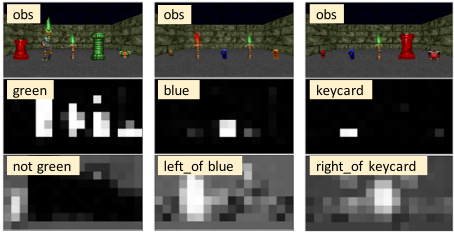
We consider three relational operations: 'left of', 'right of' and 'not'. We add questions and instructions with all objects and attributes using these relational operations to the existing dataset and perform experiments in the Easy-Aux setting. We assume that the knowledge of relational words, and the words they modify, are given. We train a separate module corresponding to each relational operation, and apply it to the convolutional output of the words that are modified. For example, for the above question, we apply the module for relation 'left of' to the convolutional output channel corresponding to the word 'torch'. Each relational module is a trainable convolutional network which preserves the size of the input. The rest of the operations are identical to the Dual-Attention Unit. The relational modules are learned end-to-end without any additional supervision.
In Figure 4, we show convolutional outputs of the relational modules learned by our model. While the original DA model achieves test performance of 0.48 (SGN) and 0.44 (EQA), this simple extension achieves 0.97 (SGN) and 0.64 (EQA).
5.4 Transfer To NewConcepts
Suppose that the user wants the agent to follow instructions about a new object such as 'pillar' or a new attribute such as 'red' which the agent has never seen during training. Prior SGN models [Chaplot et al., 2018; Hermann et al., 2017; Yu et al., 2018] cannot handle instructions containing a new concept. In contrast, our model can be used for handling such instructions by using an object detector for each new concept. In order to test this, we train the DA model in the Easy setting on the training set for only instructions. We use auxiliary tasks but only for words in the vocabulary of the instructions training set. After training the policy, we test the agents on instructions containing test concept words 'red' and 'pillar', which the agent has never seen in textual input during training and never received any supervision about how this attribute or object looks visually.
| Instruction | Acc |
|---|---|
| Go to the red object | 0.99 |
| Go to the <color name> pillar. | 1.00 |
| Go to the red <object name> | 1.00 |
| Go to the largest/smallest red object | 0.95 |
| Go to the tall/short red pillar | 0.99 |
| Go to the red pillar | 0.99 |
| Go to the <color name> object that is not a pillar | 0.91 |
| Go to the <object name> that is left of the red object | 0.96 |
| Go to the red object that is right of the pillar | 0.95 |
For transferring the policy, we assume access to two object detectors for 'red' and 'pillar' separately. We append the object detections for the new concepts to the image representation xI. We also append the words 'red' and 'pillar' to the bagof-words representation in the same order such that they are aligned with the appended feature maps.
The results in Table 4 show that this policy generalizes well to different types of instructions with unseen concepts, including: combining knowledge of existing attributes with a new object, or knowledge of existing objects with a new attribute; and composing a new attribute with a new object. The results shown in the lower part of Table 4 indicate that the model also generalizes well to relational instructions containing new concepts. This means that given an object detector for a new object 'pillar', the model can (without any additional training) detect and differentiate between green and blue pillars, or between tall and short pillars; and understand left of/right of pillar. The model can also combine 'pillar' with another new attribute 'red' to detect red pillars and understand relational instructions involving both red objects and pillars. This suggests that a trained policy can be scaled to more objects provided the complexity of navigation remains consistent.
6 Conclusion
We proposed a Dual-Attention model for visually-grounded multitask learning which uses Gated- and Spatial-Attention to disentangle attributes in feature representations and align them with the answer space. We show that the proposed model is able to transfer the knowledge of concepts across tasks and outperforms the baselines on both Semantic Goal Navigation and Embodied Question Answering by a considerable margin. We showed that disentangled and interpretablew representations make our model modular and allow for easy addition of new objects or attributes to a trained model. For future work, the model can potentially be extended to transferring knowledge across different domains by using modular interpretable representations of objects which are domain-invariant.
@inproceedings{ijcai2020p338,
  title     = {Embodied Multimodal Multitask Learning},
  author    = {Chaplot, Devendra Singh and Lee, Lisa and Salakhutdinov, Ruslan and Parikh, Devi and Batra, Dhruv},
  booktitle = {Proceedings of the Twenty-Ninth International Joint Conference on
               Artificial Intelligence, {IJCAI-20}},
  publisher = {International Joint Conferences on Artificial Intelligence Organization},
  editor    = {Christian Bessiere},
  pages     = {2442--2448},
  year      = {2020},
  month     = {7},
  note      = {Main track},
  doi       = {10.24963/ijcai.2020/338},
  url       = {https://doi.org/10.24963/ijcai.2020/338},
}
TY - CPAPER TI - Embodied Multimodal Multitask Learning AU - Chaplot, Devendra Singh AU - Lee, Lisa AU - Salakhutdinov, Ruslan AU - Parikh, Devi AU - Batra, Dhruv T2 - Proceedings of the Twenty-Ninth International Joint Conference on Artificial Intelligence, IJCAI-20 PB - International Joint Conferences on Artificial Intelligence Organization PY - 2020 SP - 2442 EP - 2448 DO - 10.24963/ijcai.2020/338 UR - https://doi.org/10.24963/ijcai.2020/338 ER -Copied
Machine-readable versions of this paper, for tools and AI agents:





