
CounterFactual Regression with Importance Sampling Weights
Proceedings of the Twenty-Eighth International Joint Conference on Artificial Intelligence. AI for Improving Human Well-being. Pages 5880-5887.
https://doi.org/10.24963/ijcai.2019/815
Keywords
- Special Track on AI for Improving Human-Well Being: Health applications (Special Track on AI and Human Wellbeing)
Abstract
Perhaps the most pressing concern of a patient diagnosed with cancer is her life expectancy under various treatment options. For a binary-treatment case, this translates into estimating the difference between the outcomes (e.g., survival time) of the two available treatment options – i.e., her Individual Treatment Effect (ITE). This is especially challenging to estimate from observational data, as that data has selection bias: the treatment assigned to a patient depends on that patient's attributes. In this work, we borrow ideas from domain adaptation to address the distributional shift between the source (outcome of the administered treatment, appearing in the observed training data) and target (outcome of the alternative treatment) that exists due to selection bias. We propose a context-aware importance sampling re-weighing scheme, built on top of a representation learning module, for estimating ITEs. Empirical results on two publicly available benchmarks demonstrate that the proposed method significantly outperforms state-of-the-art.
- [Atan et al., 2018] Onur Atan, James Jordon, and Mihaela van der Schaar. Deep-treat: Learning optimal personalized treatments from observational data using neural networks. In AAAI, pages 2071-2078, 2018.
- [Austin, 2011] Peter C Austin. An introduction to propensity score methods for reducing the effects of confounding in observational studies. Multivariate behavioral research, 46(3):399-424, 2011.
- [Bengio et al., 2013] Yoshua Bengio, Aaron Courville, and Pascal Vincent. Representation learning: A review and new perspectives. IEEE TPAMI, 35(8):1798-1828, 2013.
- [Beygelzimer and Langford, 2009] Alina Beygelzimer and John Langford. The offset tree for learning with partial labels. In 15th ACM SIGKDD. ACM, 2009.
- [Bottou et al., 2013] Léon Bottou, Jonas Peters, Joaquin Quinonero Candela, Denis Xavier Charles, Max Chickering, Elon Portugaly, Dipankar Ray, Patrice Y Simard, and Ed Snelson. Counterfactual reasoning and learning systems: the example of computational advertising. JMLR, 14(1), 2013.
- [Breiman, 2001] Leo Breiman. Random forests. Machine learning, 45(1):5-32, 2001.
- [Chipman et al., 2010] Hugh A Chipman, Edward I George, and Robert E McCulloch. Bart: Bayesian additive regres- sion trees. The Annals of Applied Statistics, 2010.
- [Dorie, 2016] Vincent Dorie. NPCI: Non-parametrics for causal inference, 2016. https://github.com/vdorie/npci. Link
- [Gretton et al., 2012] Arthur Gretton, Karsten M Borgwardt, Malte J Rasch, Bernhard Schölkopf, and Alexander Smola. A kernel two-sample test. JMLR, 13(Mar):723-773, 2012.
- [Gruber and van der Laan, 2011] Susan Gruber and Mark J van der Laan. tmle: An R package for targeted maximum likelihood estimation. 2011.
- [Hassanpour and Greiner, 2018] Negar Hassanpour and Rus- sell Greiner. A novel evaluation methodology for assessing off-policy learning methods in contextual bandits. In Cana- dian AI, pages 31-44, 2018.
- [Hill, 2011] Jennifer L Hill. Bayesian nonparametric mod- eling for causal inference. Journal of Computational and Graphical Statistics, 20(1):217-240, 2011.
- [Imbens and Rubin, 2015] Guido W. Imbens and Donald B. Rubin. Causal Inference for Statistics, Social, and Biomedi- cal Sciences: An Introduction. Cambridge University Press, 2015.
- [Imbens and Wooldridge, 2009] Guido W Imbens and Jef- frey M Wooldridge. Recent developments in the economet- rics of program evaluation. Journal of economic literature, 47(1):5-86, 2009.
- [Johansson et al., 2016] Fredrik Johansson, Uri Shalit, and David Sontag. Learning representations for counterfactual inference. In ICML, pages 3020-3029, 2016.
- [Johansson et al., 2018] Fredrik D Johansson, Nathan Kallus, Uri Shalit, and David Sontag. Learning weighted represen- tations for generalization across designs. arXiv preprint arXiv:1802.08598, 2018.
- [Karavani et al., 2018] Ehud Karavani, Yishai Shimoni, and Chen Yanover. IBM causal inference benchmarking frame- work, 2018. https://github.com/IBM-HRL-MLHLS/. Link
- [Kingma and Ba, 2015] Diederik P Kingma and Jimmy Ba. Adam: A method for stochastic optimization. In ICLR, 2015.
- [Li et al., 2010] Lihong Li, Wei Chu, John Langford, and Robert E Schapire. A contextual-bandit approach to person- alized news article recommendation. In 19th International Conference on World Wide Web. ACM, 2010.
- [Li et al., 2015] Lihong Li, Shunbao Chen, Jim Kleban, and Ankur Gupta. Counterfactual estimation and optimization of click metrics in search engines: A case study. In 24th International Conference on World Wide Web. ACM, 2015.
- [MacDorman and Atkinson, 1998] Marian F MacDorman and Jonnae O Atkinson. Infant mortality statistics from the 1996 period linked birth/infant death data set. Monthly vital statistics report, 46(12):1980-92, 1998.
- [Pearl, 2009] Judea Pearl. Causality. Cambridge University Press, 2009.
- [Rollinson and Brunskill, 2015] Joseph Rollinson and Emma Brunskill. From predictive models to instructional policies. International Educational Data Mining Society, 2015.
- [Rosenbaum and Rubin, 1983] Paul R Rosenbaum and Don- ald B Rubin. The central role of the propensity score in observational studies for causal effects. Biometrika, 1983.
- [Rubin, 1974] Donald B Rubin. Estimating causal effects of treatments in randomized and nonrandomized studies. Journal of educational Psychology, 66(5):688, 1974.
- [Shalit et al., 2017] Uri Shalit, Fredrik D. Johansson, and David Sontag. Estimating individual treatment effect: gen- eralization bounds and algorithms. In ICML, 2017.
- [Shimodaira, 2000] Hidetoshi Shimodaira. Improving pre- dictive inference under covariate shift by weighting the log-likelihood function. Journal of statistical planning and inference, 90(2), 2000.
- [Shimoni et al., 2018] Yishai Shimoni, Chen Yanover, Ehud Karavani, and Yaara Goldschmnidt. Benchmarking frame- work for performance-evaluation of causal inference analy- sis. arXiv preprint arXiv:1802.05046, 2018.
- [Strehl et al., 2010] Alex Strehl, John Langford, Lihong Li, and Sham M Kakade. Learning from logged implicit explo- ration data. In NeurIPS, pages 2217-2225. 2010.
- [Sutton and Barto, 1998] Richard S Sutton and Andrew G Barto. Reinforcement learning: An introduction, volume 1. MIT Press Cambridge, 1998.
- [Swaminathan and Joachims, 2015a] Adith Swaminathan and Thorsten Joachims. Batch learning from logged bandit feedback through counterfactual risk minimization. JMLR, 16, 2015.
- [Swaminathan and Joachims, 2015b] Adith Swaminathan and Thorsten Joachims. The self-normalized estimator for counterfactual learning. In NeurIPS, 2015.
- [Wager and Athey, 2018] Stefan Wager and Susan Athey. Es- timation and inference of heterogeneous treatment effects using random forests. Journal of the American Statistical Association, 113(523):1228-1242, 2018.
References were extracted automatically from the PDF and may contain errors.
Full text extracted automatically from the PDF; figures, tables and equations may differ. The PDF is the version of record.
1 Introduction
To identify the appropriate action to take, an intelligent agent must infer the causal effects of its every possible action choice. A prominent example is precision medicine - i.e., the customization of health-care tailored to each individual patient - that attempts to identify which medical procedure t ∈ T will benefit each specific patient x the most. Learning such models requires answering counterfactual questions [Rubin, 1974; Pearl, 2009] such as: "Would this patient have lived longer, had she received an alternative treatment?". This type of counterfactual analysis is not limited to health-care; it can be used in any field where personalized action selection is of value, including intelligent tutoring systems [Rollinson and Brunskill, 2015], news article recommender systems [Li et al., 2010], ad-placement systems [Bottou et al., 2013], and webpage recommendation by search engines [Li et al., 2015].
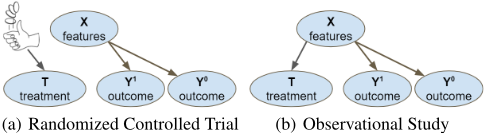
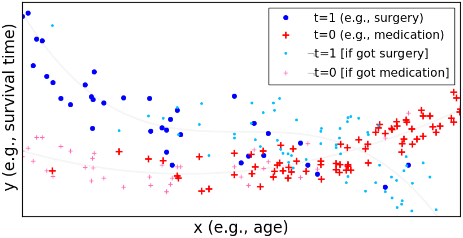
Pearl [2009] demonstrates that, in general, causal relationships can only be learned by experimentation (on-line exploration), or running a Randomized Controlled Trial (RCT). In RCTs, the treatment assignment does not depend on the individual X - see Fig. 1(a). In many cases, however, this is expensive, unethical, or even infeasible [Pearl, 2009]. As a result, we are forced to approximate causal effects from off-line datasets collected through observational studies. Such datasets, however, often exhibit selection bias [Imbens and Rubin, 2015], - i.e., where Pr( T | X ) ̸= Pr( T ). In other words, the administered treatment T depends on some attribute values of the individual X - see Fig. 1(b). Fig. 2 illustrates selection bias in an example of a synthetic observational dataset.
∗Contact Author
For notation: a dataset D = { [xi, ti, yi] }Ni=1 used for causal effect estimation has the following format: for the ith instance (e.g., patient), we have some context information xi ∈ X ⊆ RK (e.g., age, BMI, blood work, etc.), the administered treatment ti chosen from a set of treatment options T (e.g., {0: medication, 1: surgery}), and the respective observed outcome yi ∈ Y (e.g., survival time; Y ⊆ R) as a result of receiving treatment ti. Note that D only contains the outcome of the administered treatment (observed outcome: yi), but not the outcome(s) of the alternative treatment(s) (counterfactual outcome(s): yt i for t ∈ T \ {ti}), which is(are) inherently unobservable. For a binary-treatment case, we denote the alternative treatment as ¬ti = 1 - ti.
In this paper, we are interested in finding the Individual Treatment Effect (ITE) for each instance i - i.e., we want to estimate ei = y1 i - y0 i . To do so, we frame the solution as learning the function f : X × T → Y that can accurately predict the outcomes (both observed ˆ yi ti = f(xi, ti) as well as counterfactuals ˆ yi¬ti = f(xi, ¬ti)) given the context information xi for each individual.
There are two challenges associated with estimating ITEs:
- (i) Training data never includes the counterfactual outcomes y¬t for any training instances; which makes estimating causal effects a significantly different (and more complicated) problem than the common tasks in standard supervised machine learning.
- (ii) Selection bias in observational datasets implies having fewer instances within each treatment arm at specific regions of the domain. This sparsity, in turn, would decrease the accuracy and confidence of estimating the counterfactual outcomes at those regions.
The first challenge is an inherent characteristic of this task. We focus on the following ways to mitigate the second challenge:
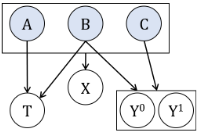
- Representation learning [Bengio et al., 2013] - The idea here is to learn a representation space Φ( · ) in which the selection bias is reduced as much as possible but not at the expense of a decrease in accuracy of predicting the observed outcomes. In other words, assuming X is generated from three underlying (unobserved) factors as shown in Fig. 3 1 , this would ideally be conducted by identifying {A, B, C} factors and then removing A.
- Re-weighting - This is a common statistical method for addressing covariate shift [Shimodaira, 2000] and domain adaptation in general. It is easy to show that selection bias in observational studies translates into a domain adaptation scenario (see Appendix for details) where we want to learn a model from the "source" (observed) data distribution that will perform well in the "target" (counterfactual) one.
1 Examples for (A) wealth: rich patients receiving the expensive treatment while poor patients receiving the cheap one, although outcomes of the possible treatments are not particularly dependent on patients' wealth status; (B) age: younger patients receiving surgery while older patients receiving medication; and (C) genetic information that determines the efficacy of various medications, however, such relationships are unknown to the attending physician.
2 In other words, all confounders B in Fig. 3 are either directly observed in X or discoverable by proxy from X (e.g., Body Mass Index (BMI) can be considered a proxy for true body fat percentage).
Main contribution: In this work, we propose a new contextaware weighting scheme based on importance sampling technique, on top of a representation learning module, to alleviate the problem of selection bias in ITE estimation.
Our analysis relies on the following assumptions:
Assumption 1: Unconfoundedness - There are no unobserved confounders (i.e., covariates that contribute to both treatment selection procedure as well as determination of outcomes). Formally, {Y t }t∈T ⊥⊥ T | X. 2
Assumption 2: Overlap - Every individual x has a nonzero chance of being assigned to any treatment arm. That is, Pr( t | x) ̸= 0 ∀t ∈ T , ∀x ∈ X.
These two assumptions together are called strong ignorability [Rosenbaum and Rubin, 1983], which is sufficient for ITE to be identifiable [Imbens and Wooldridge, 2009].
2 RelatedWorks
Learning treatment effects from observational studies is closely related to "off-policy learning in contextual bandits" - cf., [Strehl et al., 2010; Swaminathan and Joachims, 2015a], where the goal is to learn an optimal policy π( t | x) that picks the best treatment for each individual. One strategy to address this task is "outcome prediction" - i.e., estimating y(x, t) ∀t ∈ T for each x, then select the one that promises the best outcome π( t | x ) = argmax y(x, t). This is equiv-
t
alent to what is done for ITE estimation. 3 Another strategy bypasses the outcome prediction step and directly obtains the optimal policy by maximizing a utility function (similar to "expected return" in Reinforcement Learning [Sutton and Barto, 1998]). The majority of approaches under this second strategy belong to the Inverse Propensity Weighting (IPS) family of methods, which attempt to balance the source and target distributions by re-weighting certain data instances - cf., [Austin, 2011; Swaminathan and Joachims, 2015b].
Atan et al. [2018] use an auto-encoder network to learn a representation space Φ( · ) that reduces the selection bias by minimizing the cross entropy loss between Pr( t ) and Pr( t |Φ(x) ). However, by training an auto-encoder, they force their network to be able to reproduce all the covariates in x from Φ. This could effectively neutralize the merit of representation learning when there are features (in x) that had contributed to selecting the assigned treatment, but which had no effect on determining the outcomes - see Footnote 1(A).
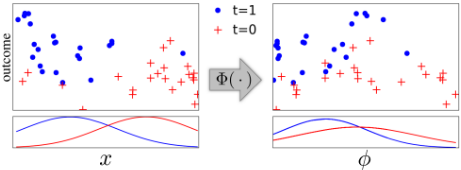
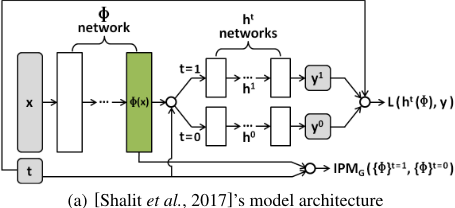
Shalit et al. [2017] - called "SJS" below - attempt to reduce selection bias by learning a common representation space Φ( · ) that tries to make Pr( x | t =0 ) and Pr( x | t =1 ) as close to each other as possible (see Fig. 4), provided that Φ( x ) retains enough information that all | T | learned regressors ht (Φ) can generalize well on the observed outcomes. Φ and ht are implemented as neural networks and learned by minimizing:
where L[ yi, hti (Φ(xi)) ] is the loss of predicting the observed outcome for sample i, weighted by ωi, derived via:
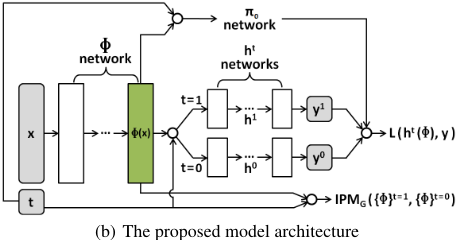
where u = 1N ∑Ni=1 ti = Pr( t=1 ). Also, R(h) in Eq. (1) is the regularization term for penalizing model complexity, and the final term disc = IPM({Φ(xi)}i:ti=0, {Φ(xi)}i:ti=1 ) is the discrepancy - calculated by an Integral Probability Metric (IPM) - that measures the distance between the two distributions Pr(Φ( x) | t = 0 ) and Pr(Φ( x) | t = 1 ). See Fig. 5(a) for SJS's model architecture.
The SJS model is closely related to its predecessor [Johansson et al., 2016], which defined disc between the joint distributions of Φ and t (factual) versus Φ and ¬t (counterfactual) - i.e., disc = IPM({[Φ(xi), ti ]}Ni=1 , {[Φ(xi), ¬ti ]}Ni=1). This makes sense in theory: if the factual and counterfactual joint distributions are hard to distinguish, it means that the data is close to RCT. However, since the two joint distributions only differ in their treatment bit (i.e., t versus ¬t, while Φ( x ) is the same for both), the numerical value of disc would naturally be small. Therefore, its contribution to the objective would be negligible. Moreover, a high dimensional Φ( · ) can overshadow the information in the treatment bit, which results in an even smaller disc.
3 While this approach is overkill - as computing an optimal policy only requires ranking the potential treatments - we focus on this approach as predicting these exact outcomes is valuable to both patients as well as insurance companies: knowing the margin of effect would hopefully increase compliance in the former and persuade the latter to accommodate the more expensive treatment.
Perhaps the work most related to ours is [Johansson et al., 2018], which also applies sample re-weighting on top of representation learning to balance their source and target domains by minimizing disc between the factual joint distribution pµ(φ, t) and a weighted ( ω ) counterfactual one ω · pπ(φ, ¬t), where φ is set as the numerical value of Φ(x). Hence, this method is also susceptible to and suffers from the same issue with small disc as discussed above.
3 Context-aware ImportanceWeighting
Observe that J(h, Φ)'s first term in Eq. (1) tries to minimize a weighted sum of the factual losses - i.e., a standard supervised machine learning objective. We can re-write this term as:
where Nt is the number of instances assigned to the treatment arm t ∈ {0, 1}.
Using Eq. (2), SJS is basically setting ωi = 1 2 Pr( ti ) , where Pr( ti ) is simply the observed probability of using the treatment ti ∈ {0, 1} over the entire population. This effectively reduces the loss term in Eq. (3) to the macro-average 12 ∑t∈T 1 Nt ∑Nt j=1 L[ yj, htj (Φ(xj)) ]. In other words, different treatment arms contribute equally to the objective, irrespective of their sample size. This somewhat makes sense since, at test time, we want to estimate the outcomes of all possible treatments.
Such weights, however, do not account for the remainder selection bias in Φ(x) due to the presence of confounding factors B (see Fig. 3). 4 In our work, inspired by the importance sampling technique, we propose context-aware weights that incorporate the valuable context information of each instance Φ( x ), thus further mitigating the impact of selection bias on estimating ITEs.
Importance sampling is used to compute Ex∼p(x) [f(x)] when in fact we observe samples that are drawn from an alternative distribution q(x), where p and q are called the "nominal" and "importance" distributions respectively. It is easy to show that Ex∼p(x) [f(x)] = Ex∼q(x) [f(x) p(x) q(x) ] (see Appendix for proof). In the task of ITE estimation, we have a similar problem. Therefore, we need to first identify the importance distribution that generated the data, then design a nominal distribution that helps improve the performance.
4 The disc term tries to balance the two distributions by pushing to eliminate factors A and B from Φ, while the factual loss term fights to keep B in Φ. Due to this trade-off, we anticipate that Φ will learn to eliminate A and keep B and C. Note it is critical that Φ includes B as it contributes to accurately predicting the outcome (y) and is critical to correctly modeling the un-removable selection bias.
Re-visiting Eq. (3), our solution strategy is to learn an independent regression function ht ( Φ( x ) ) for each treatment arm t ∈ {0, 1} that predicts the outcome of the respective treatment t for subject x. By decoupling the weights from J(h, Φ)'s parameters via setting φ = Φ( x ), we arrive at the following belief net: t ← x → φ → {y1 , y0 }. The importance distribution of L[ y, ht ( φ ) ] is then:
We choose Pr( y, φ | ¬t ) as our nominal distribution in order to emphasize those instances that are important for predicting accurate counterfactual outcomes. This yields the likelihood ratio of Pr( y, φ | ¬t ) Pr( y, φ | t ) = Pr( y | φ) · Pr(φ | ¬t ) Pr( y | φ) · Pr(φ | t ) = Pr(φ | ¬t ) Pr(φ | t ) . Moreover, to ensure that our model also performs well on the observed instances (associated with ti), we add Pr( φi | ti ) Pr( φi | ti ) = 1 to the derived likelihood ratio so that our objective accounts for the factual loss as well. Our weights would then be:
Note these ωi weights depend on φi whose numerical values are derived from Φ(xi ). This means that estimating these weights adds a nested optimization loop (for learning the ω( · ) parameters) within the main optimization loop (for learning the Φ( · ) and ht ( · ) parameters). This motivates us to devise an efficient method for learning the weights. In this sense, learning the weights directly is not desirable because:
- It requires fitting two density functions: Pr(φ | t ) and Pr( φ | ¬t ) that doubles the necessary computations.
- Efficient solutions, such as fitting simple multi-variate Gaussians, are anticipated to yield inaccurate densities.
- More flexible solutions, such as fitting Gaussian mixture models, are of high computational complexity.
To circumvent these issues, we use the Bayes theorem to learn Pr( φ | t ) indirectly from π0( t | φ ) - i.e., probability of selecting the assigned treatment t given the context φ - which can be efficiently obtained by fitting a Logistic Regression (LR) model. As a result, the counterfactual part of our proposed weight function can be simplified as follows:
where π0( t | φ ) is parametrized by LR with [ W, b ] as:
and parameters [W, b ] are learned by minimizing:
Since π0 depends on Φ, we update [W, b ] with every update of the parameters of Φ and h. Hence, this is a multiobjective optimization problem with two objectives - i.e., Eqs. (1) and (6) - that we try to solve alternatingly. That is, each training iteration consists of two steps:
- (i) Minimizing Eq. (1) using stochastic gradient descent to update the parameters of the representation and hypothesis networks - i.e., U and V . Note that ωis in the factual loss term are calculated based on Eqs. (4) and (5), with parameters W and b held fixed during optimization.
- (ii) Minimizing Eq. (6) to update parameters of the propensity score function π0( t | φ ) - i.e., W and b - with parameters U and V held fixed.
Algorithm 1 describes this procedure in more details. Note that both objective functions are computed for one mini-batch at a time. Fig. 5(b) illustrates our network architecture.
4 Experiments
As mentioned earlier, an inherent characteristic of causal inference datasets is that counterfactual outcomes are unobservable, which makes it difficult to evaluate any proposed algorithm. The common solution in the literature is to synthesize datasets where the outcomes of all possible treatments are available.
Algorithm 1 CFR-ISW: CounterFactual Regression with Importance Sampling Weights
- 1: Input: Factual samples {[x1, t1, y1], ..., [xN, tN, yN]}, batch size m, scaling parameter α > 0, regularization parameter λ > 0, loss function L(·, ·), representation network ΦU with initial weights [U], outcome network hV with initial weights [V ], function family for IPM, propensity network π with initial weights [W, b ], and limit on the total number of iterations I.
- 2: Estimate probabilities Pr( t ) for t ∈ {0, 1}
- 3: for iter = 1 to I do
- 4: Sample mini-batch {i1, i2, ..., im} ⊂ {1, 2, ...,N}
- 5: Calculate the gradient of the discrepancy term: gd = ∇U IPM({ΦU (xij )}tij =0, {ΦU (xij )}tij =1)
- 6: Calculate the proposed importance sampling weights ωij fromW and Pr( t ) following Eq. (5)
- 7: Calculate the gradients of the empirical loss:
- 8: Obtain step size scalar or matrix η1 with standard neural net methods (e.g., Adam [Kingma and Ba, 2015])
- 9: Update weights of the representation and hypothesis networks:
- 10: Calculate gradients of the propensity network's cost function:
- 11: Obtain η2 ∈ R+ % distance to move
- 12: Update the propensity network's weights:
- 13: end for
- 14: Output: [U, V ]
Some entries are then discarded in order to create a proper observational dataset with characteristics (such as selection bias) similar to a real-world one - see for example [Hassanpour and Greiner, 2018] and [Beygelzimer and Langford, 2009]. To make performance comparison easier, however, we do not synthesize our own datasets here. Instead, we use two publicly available benchmarks - see Sec. 4.3.
4.1 Evaluation Criteria
There are two categories of performance measures for evaluating causal effect estimation algorithms: individual-based and population-based. Our main focus here is producing models with high individual-based performance, as measured by "Precision in Estimation of Heterogeneous Effect" (PEHE) [Hill, 2011] and "Effect-Normalized Root Mean Squared Error" (ENoRMSE) [Shimoni et al., 2018; Karavani et al., 2018]:
where ˆei = ˆ y1 i - ˆ y0 i is the predicted effect and ei = y1 i - y0 i is the true effect. We also consider a population-based performance measure, namely, bias of the "Average Treatment Effect (ATE)": ϵATE = ∣∣ATE - ̂ ATE∣∣ where ATE = 1N ∑Ni=1 y1 i - 1N ∑Nj=1 y0 j in which y1 i and y0 j are the true outcomes for the treatment and control arms respectively 5 and ̂ ATE is calculated based on the estimated outcomes.
4.2 Hyperparameter Selection
As counterfactuals are unobserved, it is impossible for our learning algorithm to perform standard internal crossvalidation, to set the hyperparameters. Therefore, our learner needs to obtain some estimate ˜ei of the true effect ei = y1 i -y0 i , so that it can calculate a surrogate for its desired performance measure. SJS estimated the outcome of y(xi, ¬ti) as the observed outcome y¬ti j(i) , where j(i) is the nearest neighbor of xi who received treatment ¬ti (i.e., 1-NN based on a distance metric defined on the original x space). The surrogate effect would then be ˜e1-NN = (2ti - 1)(yti i - y¬ti j(i) ).
However, as our empirical results also confirm, this method is quite unlikely to select good hyperparameters. This is expected since, due to selection bias, the nearest neighbor j(i) in the alternative treatment arm might not be a good enough representative of the counterfactual outcome. Hence, its estimated surrogate effect might not be reliable for finding the best set of hyperparameters.
A better solution is to employ a stronger counterfactual regression method - such as Bayesian Additive Regression Trees (BART) [Chipman et al., 2010]. This is interesting because, even though our empirical results (see Sec. 4.3) show that BART's performance is not as good as either CFR or CFR-ISW, ˜eBART identifies much better set of hyperparameters (via PEHEBART or ENoRMSEBART) compared to ˜e1-NN.
4.3 Results and Discussion
In this paper, we empirically compare the proposed CFR-ISW with the following ITE estimation methods 6 :
- 1-NN: One Nearest Neighbor method (as described in Sec. 4.2) - the baseline.
- BART: Bayesian Additive Regression Trees method [Chipman et al., 2010].
- CFR: CounterFactual Regression method (i.e., SJS).
- RCFR: Re-weighted CFR [Johansson et al., 2018]. 7
5 We can calculate ATE here since we work with a synthetic dataset and so have access to both observed and counterfactual outcomes. In RCTs, the Sample Average Treatment Effect (SATE) = 1 N1 ∑N1 i=1 y1 i - 1 N0 ∑N0 j=1 y0 j is used as a proxy for the true ATE, where N1 (N0) is the number of treated (controlled) subjects and y1 i (y0 j ) is the outcome of subject i (j) upon receiving treatment (control).
6 While these are only a subset of the many methods in the literature, Table 1 of [Shalit et al., 2017] establishes that CFR significantly outperforms several notable ones such as Random Forest [Breiman, 2001], Causal Forest [Wager and Athey, 2018], and Targeted Maximum Likelihood Estimation [Gruber and van der Laan, 2011].
7 As RCFR's code is unavailable, we are limited in comparing its performance against contenders to what is reported in their paper.
| METHODS | ENORMSE | PEHE | ϵATE ϵATE ϵATE |
|---|---|---|---|
| 1-NN BART | 24.6 (189) 2.13 (11.3) | 4.85 (6.29) 1.57 (2.41) | 0.67 (1.27) 0.22 (0.30) |
| CFR† RCFR‡ | 0.78 (0.0?) 0.65 (0.04) | 0.31 (0.01) | |
| P1 CFR CFR-ISW | 2.65 (1.67) 3.82 (3.17) | 0.88 (0.10) 0.77 (0.10) | 0.20 (0.03) 0.19 (0.03) |
| PB CFR CFR-ISW | 1.87 (1.29) 2.50 (2.05) | 0.65 (0.05) 0.55 (0.05) | 0.21 (0.03) 0.20 (0.03) |
| EB CFR CFR-ISW | 1.18 (0.29) 0.88 (0.29) | 0.84 (0.07) 0.66 (0.05) | 0.23 (0.03) 0.16 (0.02) |
Below, we explain the characteristics of the two benchmarks used for evaluation. We also discuss the performance of the proposed method and compare it with its contenders.
Infant Health and Development Program (IHDP)
IHDP is a synthetic binary-treatment dataset, designed to evaluate the effect of specialist home visits on future cognitive test scores of premature infants. Hill [2011] induced selection bias by removing a non-random subset of the treated population from the original RCT data in order to create a realistic observational dataset. The resulting dataset contains 747 instances (608 control, 139 treated) with 25 covariates that measure different attributes of infants and their mothers.
We worked with the same dataset provided by and used in [Shalit et al., 2017; Johansson et al., 2016; Johansson et al., 2018], in which outcomes are simulated as setting "A" of the Non-Parametric Causal Inference (NPCI) package [Dorie, 2016]. The noiseless outcomes are used to compute the true individual effects (available for evaluation purpose only). We report the methods' performances by averaging over 100 realizations of outcomes with 63/27/10 train/validation/test splits.
Table 1 reports ENoRMSE, PEHE, and ϵATE performances of the considered methods on the IHDP dataset. Our results show that CFR-ISW significantly outperforms CFR and RCFR in all three evaluation measures. Note that ˜eBART selects better hyperparameters than ˜e1-NN - compare P1 and PB rows. Also note that we should use a proper surrogate measure for hyperparameter selection depending on the performance measure that we would like to optimize - compare PB and EB rows. This is expected, since, there is no way to encode such a criterion in the objective function that is being optimized.
Atlantic Causal Inference Conference 2018 (ACIC'18)
ACIC'18 is a collection of 24 synthetic binary-treatment datasets released for a data challenge; with number of instances nm ∈ {1, 2.5, 5, 10, 25, 50}×103 (four datasets in each category) for m ∈ {1, ..., 24}, each comprised of 177 features. The covariates matrix for each of these datasets are sub-sampled from a covariates table of real-world medical measurements taken from the Linked Birth and Infant Death Data (LBIDD) [MacDorman and Atkinson, 1998], that contains information corresponding to 100,000 subjects.
| DATASETS | 1-NN | BART | CFR | CFR-ISW | |
|---|---|---|---|---|---|
| ALL | 54.56 | 9.35 | 5.43 | 0(5.78) | 1.03 (0.27) |
| 1 k | 66.70 | 73.66 | 7.08 | 0(8.97) | 1.54 (0.87) |
| 2.5 k | 33.31 | 15.12 | 8.33 | (14.78) | 0.68 (0.31) |
| INSTANCES 5 k | 31.89 | 8.15 | 2.00 | 0(2.28) | 0.88 (0.35) |
| 10 k | 31.46 | 2.60 | 0.86 | 0(1.00) | 0.74 (0.39) |
| 25 k | 19.47 | 1.27 | 0.85 | 0(0.30) | 1.00 (0.28) |
| # 50 k | 75.43 | 12.27 | 8.23 | 0(8.63) | 1.13 (0.23) |
For each of the 24 datasets, we have access to both factual and counterfactual tables. For each subject, factual tables contain the treatment bit and the respective observed outcome. Counterfactual tables (only to be used for evaluation purpose) contain the true outcomes {y0 , y1 } for treatments 0 and 1 respectively. For each synthetic dataset, a Data Generating Process (DGP) determines t, y0 , and y1 for each sampled x instance. The challenge organizers have not revealed the used DGPs. Here, we look at two evaluation measures: (i) the aggregated ENoRMSE for datasets with the same number of instances (i.e., An for n ∈ S = {1, 2.5, 5, 10, 25, 50}×103 ), where S is the set of different dataset sizes; and (ii) the aggregated ENoRMSE of all the 24 datasets (i.e., A). An and A respectively are calculated as follows:
where Dn is set of all datasets that have n instances.
Table 2 summarizes the macro-average performances of the four methods on the ACIC'18 datasets in terms of aggregated ENoRMSE. Our empirical results indicate that incorporating the proposed context-aware importance sampling weights into the network's objective function improves the aggregated ENoRMSE on all datasets significantly and by a large margin. We also computed the micro-average performances (not shown) which confirms that, as expected, CFR-ISW significantly outperforms CFR in all categories as well.
5 FutureWorks and Conclusion
Currently, this approach can only be applied to binary-treatment datasets. We plan to explore ways to facilitate counterfactual regression when multiple (categorical) treatments are available; or even real-valued treatment options - such as predicting the right dosage of insulin for diabetic patients.
In this work, we proposed a context-aware importance sampling weighting scheme that helps mitigate the negative effect of selection bias on the accuracy of models that estimate Individual Treatment Effects (ITEs). Additionally, we proposed a hyperparameter selection procedure, which plays an important role in determining the model performance. The proposed improvements were applied to the CounterFactual Regression (CFR) framework [Shalit et al., 2017], leading to our method: CFR with Importance Sampling Weights (CFR-ISW).
We evaluated CFR-ISW against 1-NN (baseline), Bayesian Additive Regression Trees (BART), and the state-of-the-art methods CFR and Re-weighted CFR on two publicly available synthetic benchmarks: (i) Infant Health and Development Program (IHDP) and (ii) Atlantic Causal Inference Conference 2018 (ACIC'18) data challenge. The empirical results demonstrated that CFR-ISW significantly ( p < α = 0.05 ) outperforms all the contender methods in terms of three common measures of performance for estimating causal effects, namely: Precision in Estimation of Heterogeneous Effect (PEHE), Effect-Normalized Root Mean Squared Error (ENoRMSE), and bias of the Average Treatment Effect (ϵATE).
Appendix
A Selection Bias Entails Covariate Shift
Here, we want to prove that existence of selection bias in data Pr(T |X ) ̸= Pr(T ) entails covariate shift: Pr(X, T ) ̸= Pr(X, ¬T ).
Proof by contraposition:
Assume Pr(X, T ) = Pr(X, ¬T ), then:
Having proved the contrapositive Pr( T |X ) = Pr( T ) , we infer the original statement Pr(T |X ) ̸= Pr(T ) =⇒ Pr(X, T ) ̸= Pr(X, ¬T ) to hold. □
B Importance Sampling
Here, we want to show Ex∼p(x) [f (x)] = Ex∼q(x) [f (x) p(x) q(x) ], where p and q are probability density functions defined on Rd , with p(x) ̸= 0 ∀ x ∈ D and p(x) = 0 otherwise, and q(x) > 0 for x ∈ Q where f(x)p(x) ̸= 0 , then:
since p(x)=0 for x ∈ Dc ∩ Q and f(x)=0 for x ∈ D ∩ Qc . □
| Parameter name | Range |
|---|---|
| Imbalance parameter α Num. of representation layers Num. of hypothesis layers Dim. of representation layers Dim. of hypothesis layers Batch size | 1E{-2, -1, 0, 1} {3, 5} {3, 5} {50, 100, 200} {50, 100, 200} {100, 300} |
C ProposedWeighting Scheme: Intuition
To illustrate the idea (in a trivialized fashion), imagine subject S received treatment T0, but his 10 clones {S1, . . . , S10} were each observed to receive treatment T1. How much should we weight our estimate of hT0 (S)? One component is based on the fact that we observed [S, T0], which should contribute Pr(Φ(S) | T0 ). But later, to estimate the ITE for each clone Si, our algorithm will want to know what-would-havehappened had Si received T0. In this situation, that would also be hT0 (S). Hence, the weight should also include the density of instances that look like S, but received the other treatment - i.e., Pr( Φ(S) | T 1 ) - which here would be based on the 10 clones Si. Of course, the real situation is much more complicated, as we will not typically have exact clones. In general, this suggests that the weight associated with observing [φi, ti] should be Pr(φi | ti ) +Pr(φi | ¬ti ), normalized in the expectation by dividing by Pr( φi | ti ).
D Hyperparameters
We trained CFR-ISW's π0 logistic regression function with gradient descent optimizer and a learning rate of 1E-3.
For both CFR and CFR-ISW, we trained the Φ and ht networks with regularization coefficient λ=1E-3, elu as the non-linear activation function, Adam optimizer [Kingma and Ba, 2015], learning rate of 1E-3, and maximum number of iterations of 3000. We used the Maximum Mean Discrepancy (MMD) [Gretton et al., 2012] as our IPM to calculate disc between the Pr( Φ | t=1 ) and Pr( Φ | t=0 ) distributions. See Table 3 for details on our hyperparameter search space.
Acknowledgements
The authors gratefully acknowledge financial support from Natural Sciences and Engineering Research Council of Canada (NSERC) and Alberta Machine Intelligence Institute (Amii). We wish to thank Dr. Martha White and Junfeng Wen for fruitful conversations, and Dr. Fredrik Johansson for publishing/maintaining the code-base for the CFR method online.
@inproceedings{ijcai2019p815,
  title     = {CounterFactual Regression with Importance Sampling Weights},
  author    = {Hassanpour, Negar and Greiner, Russell},
  booktitle = {Proceedings of the Twenty-Eighth International Joint Conference on
               Artificial Intelligence, {IJCAI-19}},
  publisher = {International Joint Conferences on Artificial Intelligence Organization},
  editor    = {Sarit Kraus},
  pages     = {5880--5887},
  year      = {2019},
  month     = {8},
  note      = {AI for Improving Human Well-being},
  doi       = {10.24963/ijcai.2019/815},
  url       = {https://doi.org/10.24963/ijcai.2019/815},
}
TY - CPAPER TI - CounterFactual Regression with Importance Sampling Weights AU - Hassanpour, Negar AU - Greiner, Russell T2 - Proceedings of the Twenty-Eighth International Joint Conference on Artificial Intelligence, IJCAI-19 PB - International Joint Conferences on Artificial Intelligence Organization PY - 2019 SP - 5880 EP - 5887 DO - 10.24963/ijcai.2019/815 UR - https://doi.org/10.24963/ijcai.2019/815 ER -Copied
Machine-readable versions of this paper, for tools and AI agents:





