
Representation Learning-Assisted Click-Through Rate Prediction
Proceedings of the Twenty-Eighth International Joint Conference on Artificial Intelligence. Main track. Pages 4561-4567.
https://doi.org/10.24963/ijcai.2019/634
Keywords
- Machine Learning Applications: Other Applications
- Machine Learning Applications: Applications of Supervised Learning
Abstract
Click-through rate (CTR) prediction is a critical task in online advertising systems. Most existing methods mainly model the feature-CTR relationship and suffer from the data sparsity issue. In this paper, we propose DeepMCP, which models other types of relationships in order to learn more informative and statistically reliable feature representations, and in consequence to improve the performance of CTR prediction. In particular, DeepMCP contains three parts: a matching subnet, a correlation subnet and a prediction subnet. These subnets model the user-ad, ad-ad and feature-CTR relationship respectively. When these subnets are jointly optimized under the supervision of the target labels, the learned feature representations have both good prediction powers and good representation abilities. Experiments on two large-scale datasets demonstrate that DeepMCP outperforms several state-of-the-art models for CTR prediction.
- [Chapelle et al., 2015] Olivier Chapelle, Eren Manavoglu, and Romer Rosales. Simple and scalable response pre- diction for display advertising. ACM Transactions on In- telligent Systems and Technology, 5(4):61, 2015.
- [Cheng et al., 2016] Heng-Tze Cheng, Levent Koc, Jeremiah Harmsen, Tal Shaked, Tushar Chandra, Hrishi Aradhye, Glen Anderson, Greg Corrado, Wei Chai, Mustafa Ispir, et al. Wide & deep learning for recommender systems. In DLRS, pages 7-10. ACM, 2016.
- [Covington et al., 2016] Paul Covington, Jay Adams, and Emre Sargin. Deep neural networks for youtube recom- mendations. In RecSys, pages 191-198. ACM, 2016.
- [Duchi et al., 2011] John Duchi, Elad Hazan, and Yoram Singer. Adaptive subgradient methods for online learning and stochastic optimization. Journal of Machine Learning Research, 12(Jul):2121-2159, 2011.
- [Gao et al., 2018] Li Gao, Hong Yang, Jia Wu, Chuan Zhou, Weixue Lu, and Yue Hu. Recommendation with multi- source heterogeneous information. In IJCAI, 2018.
- [Gong et al., 2019] Yu Gong, Xusheng Luo, Yu Zhu, Wenwu Ou, Zhao Li, Muhua Zhu, Kenny Q Zhu, Lu Duan, and Xi Chen. Deep cascade multi-task learning for slot filling in online shopping assistant. In AAAI, 2019.
- [Guo et al., 2017] Huifeng Guo, Ruiming Tang, Yunming Ye, Zhenguo Li, and Xiuqiang He. Deepfm: a factorization-machine based neural network for ctr predic- tion. In IJCAI, pages 1725-1731, 2017. IJCAI
- [He and Chua, 2017] Xiangnan He and Tat-Seng Chua. Neu- ral factorization machines for sparse predictive analytics. In SIGIR, pages 355-364. ACM, 2017.
- [He et al., 2014] Xinran He, Junfeng Pan, Ou Jin, Tianbing Xu, Bo Liu, Tao Xu, Yanxin Shi, Antoine Atallah, Ralf Herbrich, Stuart Bowers, et al. Practical lessons from pre- dicting clicks on ads at facebook. In ADKDD, pages 1-9. ACM, 2014.
- [Huang et al., 2013] Po-Sen Huang, Xiaodong He, Jianfeng Gao, Li Deng, Alex Acero, and Larry Heck. Learning deep structured semantic models for web search using click- through data. In CIKM, pages 2333-2338. ACM, 2013.
- [Huang et al., 2018] Jizhou Huang, Wei Zhang, Yaming Sun, Haifeng Wang, and Ting Liu. Improving entity rec- ommendation with search log and multi-task learning. In IJCAI, pages 4107-4114, 2018. IJCAI
- [Juan et al., 2016] Yuchin Juan, Yong Zhuang, Wei-Sheng Chin, and Chih-Jen Lin. Field-aware factorization ma- chines for ctr prediction. In RecSys, pages 43-50. ACM, 2016.
- [Koren et al., 2009] Yehuda Koren, Robert Bell, and Chris Volinsky. Matrix factorization techniques for recom- mender systems. Computer, (8):30-37, 2009.
- [LeCun et al., 2015] Yann LeCun, Yoshua Bengio, and Ge- offrey Hinton. Deep learning. nature, 521(7553):436, 2015.
- [Liu and others, 2009] Tie-Yan Liu et al. Learning to rank for information retrieval. Foundations and Trends R in In- formation Retrieval, 3(3):225-331, 2009.
- [McMahan et al., 2013] H Brendan McMahan, Gary Holt, David Sculley, Michael Young, Dietmar Ebner, Julian Grady, Lan Nie, Todd Phillips, Eugene Davydov, Daniel Golovin, et al. Ad click prediction: a view from the trenches. In KDD, pages 1222-1230. ACM, 2013.
- [Mikolov et al., 2013] Tomas Mikolov, Ilya Sutskever, Kai Chen, Greg S Corrado, and Jeff Dean. Distributed rep- resentations of words and phrases and their composition- ality. In NIPS, pages 3111-3119, 2013.
- [Nair and Hinton, 2010] Vinod Nair and Geoffrey E Hinton. Rectified linear units improve restricted boltzmann ma- chines. In ICML, pages 807-814, 2010.
- [Pan et al., 2018] Junwei Pan, Jian Xu, Alfonso Lobos Ruiz, Wenliang Zhao, Shengjun Pan, Yu Sun, and Quan Lu. Field-weighted factorization machines for click-through rate prediction in display advertising. In WWW, pages 1349-1357. International World Wide Web Conferences Steering Committee, 2018.
- [Qu et al., 2016] Yanru Qu, Han Cai, Kan Ren, Weinan Zhang, Yong Yu, Ying Wen, and Jun Wang. Product-based neural networks for user response prediction. In ICDM, pages 1149-1154. IEEE, 2016.
- [Rendle, 2010] Steffen Rendle. Factorization machines. In ICDM, pages 995-1000. IEEE, 2010.
- [Rendle, 2012] Steffen Rendle. Factorization machines with libfm. ACM Transactions on Intelligent Systems and Tech- nology, 3(3):57, 2012.
- [Richardson et al., 2007] Matthew Richardson, Ewa Domi- nowska, and Robert Ragno. Predicting clicks: estimating the click-through rate for new ads. In WWW, pages 521- 530. ACM, 2007.
- [Shan et al., 2016] Ying Shan, T Ryan Hoens, Jian Jiao, Hai- jing Wang, Dong Yu, and JC Mao. Deep crossing: Web- scale modeling without manually crafted combinatorial features. In KDD, pages 255-262. ACM, 2016.
- [Srivastava et al., 2014] Nitish Srivastava, Geoffrey Hinton, Alex Krizhevsky, Ilya Sutskever, and Ruslan Salakhutdi- nov. Dropout: a simple way to prevent neural networks from overfitting. The Journal of Machine Learning Re- search, 15(1):1929-1958, 2014.
- [Van den Oord et al., 2013] Aaron Van den Oord, Sander Dieleman, and Benjamin Schrauwen. Deep content-based music recommendation. In NIPS, pages 2643-2651, 2013.
- [Wang et al., 2017] Ruoxi Wang, Bin Fu, Gang Fu, and Min- gliang Wang. Deep & cross network for ad click predic- tions. In ADKDD, page 12. ACM, 2017.
- [Zhang et al., 2016a] Fuzheng Zhang, Nicholas Jing Yuan, Defu Lian, Xing Xie, and Wei-Ying Ma. Collaborative knowledge base embedding for recommender systems. In KDD, pages 353-362. ACM, 2016.
- [Zhang et al., 2016b] Weinan Zhang, Tianming Du, and Jun Wang. Deep learning over multi-field categorical data. In ECIR, pages 45-57. Springer, 2016.
- [Zhao et al., 2018] Kui Zhao, Yuechuan Li, Zhaoqian Shuai, and Cheng Yang. Learning and transferring ids represen- tation in e-commerce. In KDD, pages 1031-1039. ACM, 2018.
- [Zhou et al., 2018] Guorui Zhou, Xiaoqiang Zhu, Chenru Song, Ying Fan, Han Zhu, Xiao Ma, Yanghui Yan, Junqi Jin, Han Li, and Kun Gai. Deep interest network for click- through rate prediction. In KDD, pages 1059-1068. ACM, 2018.
References were extracted automatically from the PDF and may contain errors.
Full text extracted automatically from the PDF; figures, tables and equations may differ. The PDF is the version of record.
1 Introduction
Click-through rate (CTR) prediction is to predict the probability that a user will click on an item. It plays an important role in online advertising systems. For example, the ad ranking strategy generally depends on CTR × bid, where bid is the benefit the system receives if an ad is clicked by a user. Moreover, according to the common cost-per-click charging model, advertisers are only charged once their ads are clicked by users. Therefore, in order to maximize the revenue and to maintain a desirable user experience, it is crucial to estimate the CTR of ads accurately.
CTR prediction has attracted lots of attention from both academia and industry [He et al., 2014; Shan et al., 2016; Guo et al., 2017]. For example, the Logistic Regression (LR) model [Richardson et al., 2007] considers linear feature importance and models the predicted CTR as ˆ y = σ(w0 + ∑i wixi), where σ(·) is the sigmoid function, xi is the ith feature and w0,wi are model weights. The Factorization Machine (FM) [Rendle, 2010] is proposed to further model pairwise feature interactions. It models the predicted CTR as ˆ y = σ(w0 + ∑i wixi + ∑i ∑j vT i vjxixj), where vi is the latent embedding vector of the ith feature. In recent years, Deep Neural Networks (DNNs) [LeCun et al., 2015] are exploited for CTR prediction and item recommendation in order to automatically learn feature representations and high-order feature interactions [Van den Oord et al., 2013; Zhang et al., 2016b; Qu et al., 2016; Covington et al., 2016]. To take advantage of both shallow and deep models, hybrid models are also proposed. For example, Wide&Deep [Cheng et al., 2016] combines LR and DNN, in order to improve both the memorization and generalization abilities of the model. DeepFM [Guo et al., 2017] combines FM and DNN, which further improves the model ability of learning feature interactions. Neural Factorization Machine [He and Chua, 2017] combines the linearity of FM and the non-linearity of DNN.
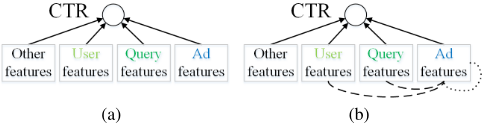
Nevertheless, these models only consider the feature-CTR relationship. In contrast, the DeepMCP model proposed in this paper additionally considers feature-feature relationships, such as the user-ad relationship and the ad-ad relationship. We illustrate their difference in Figure 1. Note that the feature interaction in FM still models the feature-CTR relationship. It can be considered as two features-CTR, because it models how the feature interaction vT i vjxixj relates to the CTR ˆ y, but does not model whether the two feature representations vi and vj should be similar to each other.
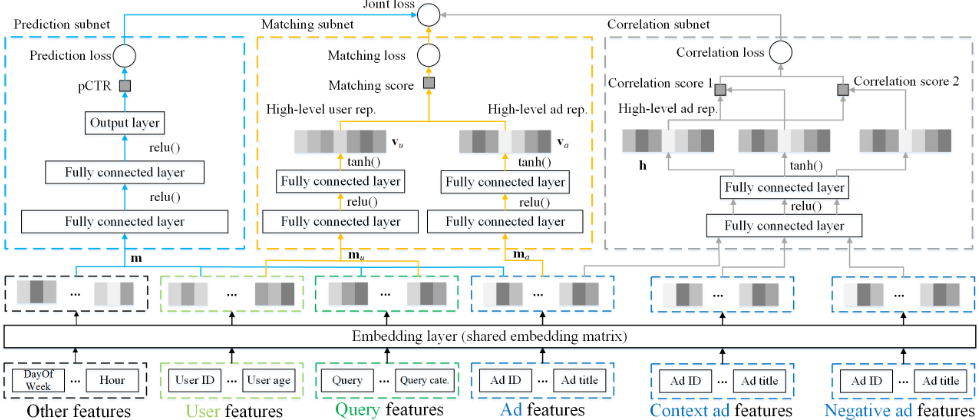
In particular, our proposed DeepMCP model contains three parts: a matching subnet, a correlation subnet and a prediction subnet. They share the same embedding matrix. The matching subnet models the user-ad relationship (i.e., whether an ad matches a user's interest) and aims to learn useful user and ad representations. The correlation subnet models the ad-ad relationship (i.e., which ads are within a time window in a user's click sequence) and aims to learn useful ad representations. The prediction subnet models the feature-CTR relationship and aims to predict the CTR given all the features. When these subnets are jointly optimized under the supervision of the target labels, the feature representations are learned in such a way that they have both good prediction powers and good representation abilities. Moreover, as the same feature appears in different subnets in different ways, the learned representations are more statistically reliable.
| Label | User ID | User Age | Ad Title |
|---|---|---|---|
| 1 | 2135147 | 24 | Beijing flower delivery |
| 0 | 3467291 | 31 | Nike shoes, sporting shoes |
| 0 | 1739086 | 45 | Female clothing and jeans |
In summary, the main contributions of this paper are
- We propose a new model DeepMCP for CTR prediction. Unlike classical CTR prediction models that mainly consider the feature-CTR relationship, DeepMCP further considers user-ad and ad-ad relationships.
- We conduct extensive experiments on two large-scale datasets to compare the performance of DeepMCP with several state-of-the-art models. We make the implementation code of DeepMCP publicly available 1 .
2 DeepMatching, Correlation and Prediction (DeepMCP) Model
In this section, we present the DeepMCP model in detail.
2.1 Model Overview
The task of CTR prediction in online advertising is to estimate the probability of a user clicking on a specific ad. Table 1 shows some example instances. Each instance can be described by multiple fields such as user information (user ID, city, etc.) and ad information (creative ID, title, etc.). The instantiation of a field is a feature.
Unlike most existing CTR prediction models that mainly consider the feature-CTR relationship, our proposed DeepMCP model additionally considers the user-ad and adad relationships. DeepMCP contains three parts: a matching subnet, a correlation subnet and a prediction subnet (cf. Figure 2(a)). When these subnets are jointly optimized under the supervision of the target labels, the learned feature representations have both good prediction powers and good representation abilities. Another property of DeepMCP is that although all the subnets are active during training, only the prediction subnet is active during testing (cf. Figure 2(b)). This makes the testing phase rather simple and efficient.
We segregate the features into four groups: user (e.g., user ID, age), query (e.g., query, query category), ad (e.g., creative ID, ad title) and other features (e.g., hour of day, day of week). Each subnet uses a different set of features. In particular, the prediction subnet uses all the four groups of features, the matching subnet uses the user, query and ad features, and the correlation subnet uses only the ad features. All the subnets share the same embedding matrix.
1 https://github.com/oywtece/deepmcp
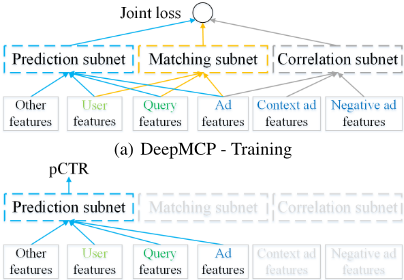
Figure 2: Sketch view of the DeepMCP model: (a) Training, (b) Testing. All the subnets are active during training, but only the prediction subnet is active during testing. pCTR is predicted CTR.
2.2 Prediction Subnet
The prediction subnet presented here is a typical DNN model. It models the feature-CTR relationship (where explicit or implicit feature interactions are modeled). It aims to predict the CTR given all the features, supervised by the target labels. Nevertheless, the DeepMCP model is flexible that the prediction subnet can be replaced by any other CTR prediction model, such as Wide&Deep [Cheng et al., 2016] and DeepFM [Guo et al., 2017].
First, a feature xi ∈ R (e.g., a user ID) goes through an embedding layer and is mapped to its embedding vector ei ∈ RK , where K is the vector dimension and ei is to be learned. The collection of all the feature embeddings is an embedding matrix E ∈ RN×K , where N is the number of unique features. For multivalent categorical features such as the bi-grams in the ad title, we first map each bi-gram to an embedding vector and then perform sum pooling to generate the aggregated embedding vector of the ad title.
We then concatenate the embedding vectors from all the features as a long vector m. The vector m then goes through several fully connected (FC) layers with the ReLU activation function (ReLU(x) = max(0, x)), in order to exploit highorder nonlinear feature interactions [He and Chua, 2017]. Nair and Hinton [2010] show that ReLU has significant benefits over sigmoid and tanh activation functions in terms of the convergence rate and the quality of obtained results.
Finally, the output z of the last FC layer goes through a sigmoid function to generate the predicted CTR as
where w and b are model parameters to be learned. To avoid model overfitting, we apply dropout [Srivastava et al., 2014] after each FC layer. Dropout prevents feature co-adaptation by setting to zero a portion of hidden units during training.
All the model parameters are learned by minimizing the average logistic loss on a training set as
where y ∈ {0, 1} is the true label of the target ad corresponding to ˆ y and Y is the collection of labels.
2.3 Matching Subnet
The matching subnet models the user-ad relationship (i.e., whether an ad matches a user's interest) and aims to learn useful user and ad representations. It is inspired by semantic matching models for web search [Huang et al., 2013].
In classical matrix factorization for recommendation [Koren et al., 2009], the rating score is approximated as the inner product of the latent vectors of the user ID and the item ID. In our problem, instead of directly matching the user ID and the ad ID, we perform matching at a higher level, incorporating all the features related to the user and the ad. When a user clicks an ad, we assume that the clicked ad is relevant, at least partially, to the user's need (given the query submitted by the user, if any). In consequence, we would like the representation of the user features (and the query features) and the representation of the ad features to match well.
In particular, the matching subnet contains two parts: "user part" and "ad part". The input to the "user part" is the user features (e.g., user ID, age) and query features (e.g., query, query category). As in the prediction subnet, a feature xi ∈ R first goes through an embedding layer and is mapped to its embedding vector ei ∈ RK . We then concatenate all the feature embeddings as a long vector mu ∈ RNu (Nu is the vector dimension). The vector mu then goes through several FC layers in order to learn more abstractive, high-level representations. We use tanh (rather than ReLU) as the activation function of the last FC layer, which is defined as tanh(x) = 1-exp(-2x) 1+exp(-2x) . We will explain the reason later. The output of the "user part" is a high-level user representation vector vu ∈ RM (M is the vector dimension).
The input to the "ad part" is the ad features (e.g., creative ID, ad title). Similarly, we first map each ad feature to its embedding vector and then concatenate them as a long embedding vector ma ∈ RNa (Na is the vector dimension). The vector ma then goes through several FC layers and results in a high-level ad representation vector va ∈ RM . Note that, the inputs to the "user" and "ad" parts usually have different sizes, i.e., Nu ̸= Na (because the number of user features and the number of ad features may not necessarily be the same). However, after the matching subnet, vu and va have the same size M. In other words, we project two different sets of features into a common low-dimensional space.
We then compute the matching score s as
We do not use ReLU as the activation function of the last FC layer because the output after ReLU will contain lots of zeros, which makes vT u va → 0. There are at least two choices to model the matching score: point-wise and pairwise [Liu and others, 2009]. In a point-wise model, we could model s(vu, va) → 1 if user u clicks ad a and model s(vu, va) → 0 otherwise. In a pair-wise model, we could model s(vu, vai ) > s(vu, vaj ) + δ where δ > 0 is a margin, if user u clicks ad ai but not ad aj .
We choose the point-wise model because it can directly reuse the training dataset for the prediction subnet. Formally, we minimize the following loss for the matching subnet
where y(u, a) = 1 if user u clicks ad a and it is 0 otherwise.
2.4 Correlation Subnet
The correlation subnet models the ad-ad relationship (i.e., which ads are within a time window in a user's click sequence) and aims to learn useful ad representations. The skipgram model is proposed in [Mikolov et al., 2013] to learn useful representations of words in a sequence, where words within a context window have certain correlation. It has been widely applied in many tasks to learn useful low-dimensional representations [Zhao et al., 2018; Zhou et al., 2018].
In our problem, we apply the skip-gram model to learn useful ad representations, because the clicked ads of a user also form a sequence with certain correlation over time. Formally, given a sequence of ads {a1, a2, · · · , aL} clicked by a user, we would like to maximize the average log likelihood as
where L is the number of ads in the sequence and C is a context window size.
The probability p(ai+j |ai) can be defined in different ways such as softmax, hierarchical softmax and negative sampling [Mikolov et al., 2013]. We choose the negative sampling technique due to its efficiency. p(ai+j|ai) is then defined as
where Q is the number of sampled negative ads and σ(hTai+j hai ) = 1 1+exp(-hTai+j hai ) . hai is a high-level representation vector that involves all the features related to ad ai and that goes through several FC layers (cf. Figure 3).
The loss function of the correlation subnet is then given by minimizing the negative average log likelihood as
2.5 Offline Training Procedure
The final joint loss function of DeepMCP is given by
where lossp is the prediction loss in Eq. (1), lossm is the matching loss in Eq. (2), lossc is the correlation loss in Eq. (3), and α and β are tunable hyperparameters for balancing the importance of different subnets.
The DeepMCP model is trained by minimizing the joint loss function on a training dataset. Since our aim is to maximize the CTR prediction performance, we evaluate the model on a separate validation dataset and record the validation AUC (an evaluation metric, which will be explained in §3.4) during the training procedure. The optimal model parameters are obtained at the highest validation AUC.
2.6 Online Procedure
As we have illustrated in Figure 2(b), in the online testing phase, the DeepMCP model only needs to compute the predicted CTR (pCTR). Therefore, only the features from the target ad are needed and only the prediction subnet is active. This makes the online phase of DeepMCP rather simple and efficient.
3 Experiments
In this section, we conduct experiments on two large-scale datasets to evaluate the performance of DeepMCP and several state-of-the-art methods for CTR prediction.
| Dataset | # Instances | # Fields | # Features |
|---|---|---|---|
| Avito | 11,211,794 | 27 | 42,301,586 |
| Company | 60,724,276 | 28 | 29,997,247 |
3.1 Datasets
Table 2 lists the statistics of two large-scale datasets.
- Avito advertising dataset 2 . This dataset contains a random sample of ad logs from avito.ru, the largest general classified website in Russia. We use the ad logs from 2015-04-28 to 2015-05-18 for training, those on 2015-05-19 for validation, and those on 2015-05-20 for testing. In CTR prediction, testing is usually the next-day prediction. The test set contains 2.3 × 10⁶ instances. The features used include 1) user features such as user ID, IP ID, user agent and user device, 2) query features such as search query, search category and search parameters, 3) ad features such as ad ID, ad title and ad category, and 4) other features such as hour of day and day of week.
2) Company advertising dataset. This dataset contains a random sample of ad impression and click logs from a commercial advertising system in Alibaba. We use ad logs of 30 consecutive days during Aug.-Sep. 2018 for training, logs of the next day for validation, and logs of the day after the next day for testing. The test set contains 1.9×10⁶ instances. The features used also include user, query, ad and other features.
3.2 Methods Compared
We compare the following methods for CTR prediction.
- LR. Logistic Regression [Richardson et al., 2007]. It models linear feature importance.
- FM. Factorization Machine [Rendle, 2010]. It models both first-order feature importance and second-order feature interactions.
- DNN. Deep Neural Network. It contains an embedding layer, several fully connected layers and an output layer.
- Wide&Deep. The Wide&Deep model in [Cheng et al., 2016]. It combines LR (wide part) and DNN (deep part).
- PNN. The Product-based Neural Network in [Qu et al., 2016]. It introduces a production layer between the embedding layer and fully connected layers of DNN.
- DeepFM. The DeepFM model in [Guo et al., 2017]. It combines FM (wide part) and DNN (deep part).
- DeepCP. A variant of the DeepMCP model, which contains only the correlation and the prediction subnets. It is equivalent to setting α = 0 in Eq. (4).
- DeepMP. A variant of the DeepMCP model, which contains only the matching and the prediction subnets. It is equivalent to setting β = 0 in Eq. (4).
- DeepMCP. The DeepMCP model (§2) which contains the matching, correlation and prediction subnets.
3.3 Parameter Settings
We set the embedding dimension of each feature as K = 10, because the number of distinct features is huge. We set the number of fully connected layers in neural network-based models as 2, with dimensions 512 and 256. We set the batch size as 128, the context window size as C = 2 and the number of negative ads as Q = 4. The dropout ratio is set to 0.5. All the methods are implemented in Tensorflow and optimized by the Adagrad algorithm [Duchi et al., 2011].
2 https://www.kaggle.com/c/avito-context-ad-clicks/data
| Avito | Company | |||
|---|---|---|---|---|
| Algorithm | AUC | Logloss | AUC | Logloss |
| LR | 0.7556 | 0.05918 | 0.7404 | 0.2404 |
| FM | 0.7802 | 0.06094 | 0.7557 | 0.2365 |
| DNN | 0.7816 | 0.05655 | 0.7579 | 0.2360 |
| PNN | 0.7817 | 0.05634 | 0.7593 | 0.2357 |
| Wide&Deep | 0.7817 | 0.05595 | 0.7594 | 0.2355 |
| DeepFM | 0.7819 | 0.05611 | 0.7592 | 0.2358 |
| DeepCP | 0.7844 | 0.05546 | 0.7610 | 0.2354 |
| DeepMP | 0.7917 | 0.05526 | 0.7663 | 0.2345 |
| DeepMCP | 0.7927 | 0.05518 | 0.7674 | 0.2341 |
3.4 EvaluationMetrics
We use the following evaluation metrics.
- AUC: the Area Under the ROC Curve over the test set. The larger the better. It reflects the probability that a model ranks a randomly chosen positive instance higher than a randomly chosen negative instance. A small improvement in AUC is likely to lead to a significant increase in online CTR [Cheng et al., 2016].
- Logloss: the value of Eq. (1) over the test set. The smaller the better.
3.5 Effectiveness
Table 3 lists the AUC and Logloss values of different methods. It is observed that FM performs much better than LR, because FM models second-order feature interactions while LR models linear feature importance. DNN further outperforms FM, because it can learn high-order nonlinear feature interactions [He and Chua, 2017]. PNN outperforms DNN because it further introduces a production layer. Wide&Deep further outperforms PNN, because it combines LR and DNN, which improves both the memorization and generalization abilities of the model. DeepFM combines FM and DNN. It performs slightly better than Wide&Deep on the Avito dataset, but slightly worse on the Company dataset.
It is observed that both DeepCP and DeepMP outperform the best-performing baseline on the two datasets. As the baseline methods only consider the prediction task, these observations show that additionally consider representation learning tasks can aid the performance of CTR prediction. It is also observed that DeepMP performs much better than DeepCP. It indicates that the matching subnet brings more benefits than the correlation subnet. This makes sense because the matching subnet considers both the users and the ads, while the correlation subnet considers only the ads. It is observed that DeepMCP that contains the matching, correlation and prediction subnets performs best on both datasets. These observations demonstrate the effectiveness of DeepMCP.
3.6 Effect of the Balancing Parameters
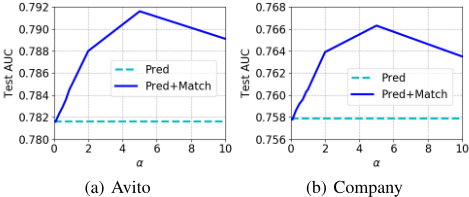
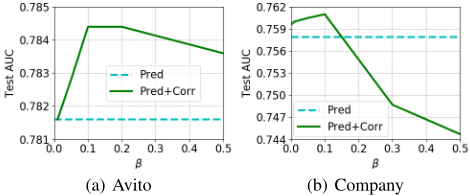
In this section, we examine the effect of tuning balancing hyperparameters of DeepMCP. Figure 4 and Figure 5 examine α (matching subnet) and β (correlation subnet) respectively. It is observed that the AUCs increase when one hyperparameter enlarges at the beginning, but then decrease when it further enlarges. On the Company dataset, large β can lead to very bad performance that is even worse than the prediction subnet only. Overall, the matching subnet leads to larger AUC improvement than the correlation subnet.
3.7 Effect of the Hidden Layer Size
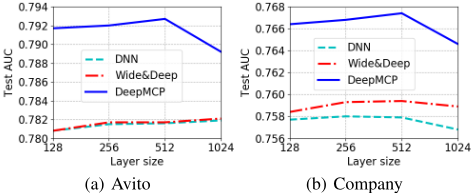
In order not to make the figure cluttered, we only show the results of DNN, Wide&Deep and DeepMCP. Figure 6 plots the AUCs vs. the hidden layer sizes when the number of hidden layers is 2. We use a shrinking structure, where the second layer dimension is only half of the first. It is observed that when the first layer dimension increases from 128 to 512, AUCs generally increase. But when the dimension further enlarges, the performance may degrade. This is possibly because it is more difficult to train a more complex model.
3.8 Effect of the Number of Hidden Layers
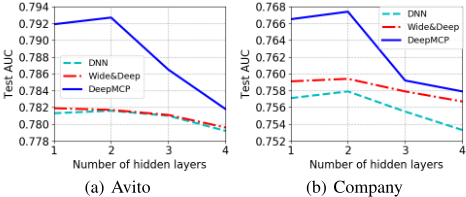
The dimension settings are: 1 layer - [256], 2 layers - [512, 256], 3 layers - [1024, 512, 256], and 4 layers - [2048, 1024, 512, 256]. It is observed in Figure 7 that when the number of hidden layers increases from 1 to 2, the performance generally increases. This is because more hidden layers have better expressive abilities [He and Chua, 2017]. But when the number of hidden layers further increases, the performance then decreases. This is because it is more difficult to train deeper neural networks.
4 RelatedWork
CTR Prediction
CTR prediction has attracted lots of attention from both academia and industry [He et al., 2014; Cheng et al., 2016; He and Chua, 2017; Zhou et al., 2018]. Generalized linear models, such as Logistic Regression (LR) [Richardson et al., 2007] and Follow-The-Regularized-Leader (FTRL) [McMahan et al., 2013], have shown decent performance in practice. However, a linear model lacks the ability to learn sophisticated feature interactions [Chapelle et al., 2015]. Factorization Machines (FMs) [Rendle, 2010; Rendle, 2012] are proposed to model pairwise feature interactions in terms of the latent vectors corresponding to the involved features. Fieldaware FM [Juan et al., 2016] and Field-weighted FM [Pan et al., 2018] further consider the impact of the field that a feature belongs to in order to improve the performance of FM.
In recent years, Deep Neural Networks (DNNs) are exploited for CTR prediction and item recommendation in order to automatically learn feature representations and high-order feature interactions [Van den Oord et al., 2013; Covington et al., 2016; Wang et al., 2017; He and Chua, 2017]. Zhang et al. [2016b] propose Factorization-machine supported Neural Network (FNN), which pre-trains an FM before applying a DNN. Qu et al. [2016] propose the Product-based Neural Network (PNN) where a product layer is introduced between the embedding layer and the fully connected layer. Cheng et al. [2016] propose Wide&Deep, which combines LR and DNN in order to improve both the memorization and generalization abilities of the model. Guo et al. [2017] propose DeepFM, which models low-order feature interactions like FM and models high-order feature interactions like DNN. He et al. [2017] propose the Neural Factorization Machine which combines the linearity of FM and the non-linearity of neural networks. Nevertheless, these methods mainly model the feature-CTR relationship. Our proposed DeepMCP model further considers user-ad and ad-ad relationships.
Multi-modal / Multi-task Learning
Our work is also closely related to multi-modal / multi-task learning, where multiple kinds of information or auxiliary tasks are introduced to help improve the performance of the main task. For example, Zhang et al. [2016a] leverage heterogeneous information (i.e., structural content, textual content and visual content) in a knowledge base to improve the quality of recommender systems. Gao et al. [2018] utilize textual content and social tag information, in addition to classical item structure information, for improved recommendation. Huang et al. [2018] introduce context-aware ranking as an auxiliary task in order to better model the semantics of queries in entity recommendation. Gong et al. [2019] propose a multi-task model which additionally learns segment tagging and named entity tagging for slot filling in online shopping assistant. In our work, we address a different problem and we introduce two auxiliary but related tasks (i.e., matching and correlation with shared embeddings) to improve the performance of CTR prediction.
5 Conclusion
In this paper, we propose DeepMCP, which contains a matching subnet, a correlation subnet and a prediction subnet for CTR prediction. These subnets model the user-ad, ad-ad and feature-CTR relationship respectively. Compared with classical CTR prediction models that mainly consider the featureCTR relationship, DeepMCP has better prediction power and representation ability. Experimental results on two largescale datasets demonstrate the effectiveness of DeepMCP in CTR prediction. It is observed that the matching subnet leads to higher performance improvement than the correlation subnet. This is possibly because the former considers both users and ads, while the latter considers ads only.
@inproceedings{ijcai2019p634,
  title     = {Representation Learning-Assisted Click-Through Rate Prediction},
  author    = {Ouyang, Wentao and Zhang, Xiuwu and Ren, Shukui and Qi, Chao and Liu, Zhaojie and Du, Yanlong},
  booktitle = {Proceedings of the Twenty-Eighth International Joint Conference on
               Artificial Intelligence, {IJCAI-19}},
  publisher = {International Joint Conferences on Artificial Intelligence Organization},
  editor    = {Sarit Kraus},
  pages     = {4561--4567},
  year      = {2019},
  month     = {8},
  note      = {Main track},
  doi       = {10.24963/ijcai.2019/634},
  url       = {https://doi.org/10.24963/ijcai.2019/634},
}
TY - CPAPER TI - Representation Learning-Assisted Click-Through Rate Prediction AU - Ouyang, Wentao AU - Zhang, Xiuwu AU - Ren, Shukui AU - Qi, Chao AU - Liu, Zhaojie AU - Du, Yanlong T2 - Proceedings of the Twenty-Eighth International Joint Conference on Artificial Intelligence, IJCAI-19 PB - International Joint Conferences on Artificial Intelligence Organization PY - 2019 SP - 4561 EP - 4567 DO - 10.24963/ijcai.2019/634 UR - https://doi.org/10.24963/ijcai.2019/634 ER -Copied
Machine-readable versions of this paper, for tools and AI agents:





