
Lightweight Random Indexing for Polylingual Text Classification (Extended Abstract)
Proceedings of the Twenty-Seventh International Joint Conference on Artificial Intelligence. Journal track. Pages 5642-5646.
https://doi.org/10.24963/ijcai.2018/801
Keywords
- Machine Learning: Multi-instance;Multi-label;Multi-view learning
- Natural Language Processing: Text Classification
Abstract
Polylingual Text Classification (PLC) is a supervised learning task that consists of assigning class labels to documents written in different languages, assuming that a representative set of training documents is available for each language. This scenario is more and more frequent, given the large quantity of multilingual platforms and communities emerging on the Internet. In this work we analyse some important methods proposed in the literature that are machine-translation-free and dictionary-free, and we propose a particular configuration of the Random Indexing method (that we dub Lightweight Random Indexing). We show that it outperforms all compared algorithms and also displays a significantly reduced computational cost.
- [Achlioptas, 2001] Dimitris Achlioptas. Database-friendly random projections. In Proceedings of the 20th ACM Sym- posium on Principles of Database Systems (PODS 2001), pages 274-281, Santa Barbara, US, 2001.
- [Amini et al., 2009] Massih-Reza Amini, Nicolas Usunier, and Cyril Goutte. Learning from multiple partially ob- served views; An application to multilingual text catego- rization. In Proceedings of the 23rd Annual Conference on Neural Information Processing Systems (NIPS 2009), pages 28-36, Vancouver, CA, 2009.
- [Bel et al., 2003] Nuria Bel, Cornelis H. Koster, and Marta Villegas. Cross-lingual text categorization. In Proceed- ings of the 7th European Conference on Research and Advanced Technology for Digital Libraries (ECDL 2003), pages 126-139, Trondheim, NO, 2003.
- [Deerwester et al., 1990] Scott C. Deerwester, Susan T Du- mais, Thomas K. Landauer, George W. Furnas, and Richard A. Harshman. Indexing by latent semantic analy- sis. Journal of the American Society for Information Sci- ence, 41(6):391-407, 1990.
- [Dumais et al., 1997] Susan T. Dumais, Todd A. Letsche, Michael L. Littman, and Thomas K. Landauer. Automatic cross-language retrieval using latent semantic indexing. In Working Notes of the AAAI Spring Symposium on Cross- language Text and Speech Retrieval, pages 18-24, Stan- ford, US, 1997.
- [Esuli et al., 2017] Andrea Esuli, Tiziano Fagni, and Alejan- dro Moreo Fernández. Jatecs an open-source java text categorization system. arXiv preprint arXiv:1706.06802, 2017.
- [Fradkin and Madigan, 2003] Dmitriy Fradkin and David Madigan. Experiments with random projections for ma- chine learning. In Proceedings of the 9th ACM Interna- tional Conference on Knowledge Discovery and Data Min- ing (KDD 2003), pages 517-522, Washington, US, 2003.
- [García Adeva et al., 2005] Juan José García Adeva, Rafael A. Calvo, and Diego López de Ipińa. Multilingual approaches to text categorisation. European Journal for the Informatics Professional, 5(3):43-51, 2005.
- [Gliozzo and Strapparava, 2005] Alfio Gliozzo and Carlo Strapparava. Cross-language text categorization by acquir- ing multilingual domain models from comparable corpora. In Proceedings of the ACL Workshop on Building and Us- ing Parallel Texts, pages 9-16, Ann Arbor, US, 2005.
- [Johnson et al., 1986] William B. Johnson, Joram Linden- strauss, and Gideon Schechtman. Extensions of Lipschitz maps into Banach spaces. Israel Journal of Mathematics, 54(2):129-138, 1986.
- [Kanerva et al., 2000] Pentti Kanerva, Jan Kristofersson, and Anders Holst. Random indexing of text samples for latent semantic analysis. In Proceedings of the 22nd An- nual Conference of the Cognitive Science Society, pages 1036-1037, Philadelphia, US, 2000.
- [Moreo Fernández et al., 2016] Alejandro Moreo Fernández, Andrea Esuli, and Fabrizio Se- bastiani. Lightweight random indexing for polylingual text classification. Journal of Artificial Intelligence Research, 57:151-185, 2016.
- [Nastase and Strapparava, 2013] Vivi Nastase and Carlo Strapparava. Bridging languages through etymology: The case of cross-language text categorization. In Proceedings of the 51st Annual Meeting of the Association for Com- putational Linguistics (ACL 2013), pages 651-659, Sofia, BL, 2013.
- [Papadimitriou et al., 1998] Christos H. Papadimitriou, Hisao Tamaki, Prabhakar Raghavan, and Santosh Vem- pala. Latent semantic indexing: A probabilistic analysis. In Proceedings of the 17th ACM Symposium on Principles of Database Systems (PODS 1998), pages 159-168, Seattle, US, 1998.
- [Sahlgren and Cöster, 2004] Magnus Sahlgren and Rickard Cöster. Using bag-of-concepts to improve the performance of support vector machines in text categorization. In Pro- ceedings of the 20th International Conference on Compu- tational Linguistics (COLING 2004), Geneva, CH, 2004.
- [Sahlgren and Karlgren, 2005] Magnus Sahlgren and Jussi Karlgren. Automatic bilingual lexicon acquisition using random indexing of parallel corpora. Natural Language Engineering, 11(3):327-341, 2005.
- [Sahlgren, 2001] Magnus Sahlgren. Vector-based semantic analysis: Representing word meanings based on random labels. In Proceedings of the ESSLLI Workshop on Seman- tic Knowledge Acquistion and Categorization, Helsinki, FI, 2001.
- [Sahlgren, 2005] Magnus Sahlgren. An introduction to ran- dom indexing. In Proceedings of the Workshop on Meth- ods and Applications of Semantic Indexing, Copenhagen, DK, 2005.
- [Vinokourov et al., 2002] Alexei Vinokourov, John Shawe- Taylor, and Nello Cristianini. Inferring a semantic repre- sentation of text via cross-language correlation analysis. In Proceedings of the 16th Annual Conference on Neural In- formation Processing Systems (NIPS 2002), pages 1473- 1480, Vancouver, CA, 2002.
- [Wei et al., 2011] Chih-Ping Wei, Yen-Ting Lin, and Christopher C. Yang. Cross-lingual text categorization: Conquering language boundaries in globalized envi- ronments. Information Processing and Management, 47(5):786-804, 2011.
- [Wei et al., 2014] Chih-Ping Wei, Chin-Sheng Yang, Ching- Hsien Lee, Huihua Shi, and Christopher C. Yang. Exploit- ing poly-lingual documents for improving text categoriza- tion effectiveness. Decision Support Systems, 57:64-76, 2014.
- [Xiao and Guo, 2013] Min Xiao and Yuhong Guo. A novel two-step method for cross-language representation learn- ing. In Proceedings of the 27th Annual Conference on Neural Information Processing Systems (NIPS 2013), pages 1259-1267, Lake Tahoe, US, 2013.
References were extracted automatically from the PDF and may contain errors.
Full text extracted automatically from the PDF; figures, tables and equations may differ. The PDF is the version of record.
1 Introduction
With the rapid increase in the amount of multi-cultural and multilingual information on the Internet, how to properly classify texts potentially belonging to many different languages has become a problem of relevant practical interest. How to effectively leverage multilingual information constitutes a sub-task of Multilingual Text classification (MLC) typically known as Polylingual Text Classification (PLC). In PLC, and differently from Cross-Lingual Text Classification (CLTC) [Bel et al., 2003], a representative set of training documents for each language is assumed available. Therefore, a straightforward solution may consist of training a separate monolingual classifier for each language (the so-called na¨ıve polylingual classifier [Garc´ıa Adeva et al., 2005]) and merging the outcomes of each classifier [Amini et al., 2009]. However, such a solution is suboptimal, since each classifier does not take advantage of the training documents available for the other languages. The challenge in PLC consists thus of improving the final classification performance with respect to a set of independent monolingual classifiers.
In addition to traditional difficulties encountered in TC, there are specific obstacles that arise in the polylingual scenario, which are mainly related to the high dimensionality problem (which is due to the presence of multiple languages) and the feature disjointness problem (which is due to their lack of lexical overlap).
∗This paper is an extended abstract of an article appeared as [Moreo Fern´andez et al., 2016].
To overcome these difficulties some authors propose the use of automatic machine translation (MT) tools [Bel et al., 2003; Wei et al., 2011], multilingual ontologies [Nastase and Strapparava, 2013], or bilingual corpora [Vinokourov et al., 2002] as a means to fill the gaps among the different languages. These approaches are however limited by the need of external resources, which might not be available for all languages of interest or not be public / free to use. As a response to these drawbacks, methods for the automatic acquisition of bilingual dictionaries [Wei et al., 2014] have been proposed. However, these methods are affected by high computational costs, due to the use of sophisticated statistical analysis. With the goal of reducing the restrictions imposed to the final classifier, we will restrict our investigation to methods that are both MT-free and dictionary-free.
One of the main challenges in PLC concerns the relevant increase in the number of features that represent the documents. An important dimensionality reduction technique is Latent Semantic Analysis (LSA) [Deerwester et al., 1990], which has been later applied to cross-lingual problems [Dumais et al., 1997] and multilingual classification [Xiao and Guo, 2013]. Random Indexing (RI) [Kanerva et al., 2000; Sahlgren, 2005], a method belonging to the family of Random Projections methods [Papadimitriou et al., 1998], arises as a computationally cheaper alternative to LSA [Sahlgren, 2001], while at the same time preserving some important characteristics of LSA [Fradkin and Madigan, 2003].
In this work we investigate the suitability of RI as a representation scheme for PLC. Besides the fact that the original relative distances are approximately preserved in the new space [Johnson et al., 1986], it turns out that, in a multilingual scenario, each latent axis is defined as a random linear combination of the original terms regardless of the language these terms belong to. As a result the entire new space becomes informative for all languages at once. While RI has already been tested in multilingual scenarios [Sahlgren and Karlgren, 2005] and monolingual TC [Sahlgren and C¨oster, 2004], to the best of our knowledge it has not been tested in the PLC case so far. We identify a particular configuration of RI, dubbed Lightweight Random Indexing (LRI) [Moreo Fern´andez et al., 2016], that presents a significantly reduced computational cost, and we conduct an analytical study that can be useful to better understand the nature of random mapping methods.
2 Lightweight Random Indexing
RI is a distributional semantic model that builds distributional vectors for words based on the observation of the terms they co-occur with. To do so, RI maintains a dictionary of random index vectors for each feature in the original space. Each random index vector consists of an n-dimensional sparse vector with k non-zero values, randomly distributed across +1 and -1. The distributional vector of a word is iteratively updated by cumulating the random index vectors of the words in its context, in an online fashion.
When applied to text classification [Sahlgren and C¨oster, 2004], RI is reformulated to build distributional vectors for documents (and not for words), considering the entire document as the context. That is, documents end up being represented by the aggregation of the random index vectors of the terms they contain (weighted by their tfidf score). RI has been tested in (monolingual) text classification using SVMs as the classifier [Sahlgren and C¨oster, 2004] but, to the best of our knowledge, has never been applied to poly-lingual contexts.
RI depends on two parameters: k, the percentage of nonzero values in the random index vectors, and n, the predefined dimensionality of the mapping. Setting k = 1%n is a common practice in the related literature (denoted RI1% in our experiments), since it is known to help in preserving matrix sparsity.
Beside sparsity, the choice of k in RI has an effect on the probability that two random index vectors are orthogonal. We observed that the probability or orthogonality, i.e., 〈⃗u, ⃗v〉 = 0, for any two randomly generated vectors ⃗u, ⃗v tends to increase as k decreases (it also increases when n increases, but by a fairly slower ratio - a broader discussion is later offered). Additionally, it could be shown that even for small values of k it is possible to encode a large number of distinct features in a reduced space (provided n is sufficiently high). As an example, by setting k = 2 and n = 5, 000 it is possible to encode 2n(n - 1) = 49, 990, 000 distinct features. Note that this capacity already exceeds the demands of big datasets, while it still allows for a drastic reduction in the original feature space (typically, of the order of hundreds of thousands of dimensions).
Accordingly, and contrarily to the common RI1% setting, we propose to set k = 2, i.e., to the smallest possible value for which a RI projection is still feasible 1 . We dub this configuration Lightweight Random Indexing (LRI). LRI presents the following advantages with respect to standard RI1% and, in general, with respect to any RI with k > 2:
- Each index vector has only two non-zero values. The mapping can be allocated in memory for any number of original features, and the projection is performed very quickly.
1 Note that choosing k = 1 is equivalent to performing a random permutation of feature indexes in a bag-of-words (BoW) representation when n = |F|, and is insufficient to distinctly encode all features if n < |F |.
- Given a fixed value of n, LRI has a higher probability of generating nearly-orthogonal projections.
- Parameter k becomes a constant that needs no tuning.
3 Experiments
We have compared LRI against (1) the polylingual BoW representation (PolyBoW - a language-agnostic BoW representation which simply represents all documents in the same feature space where each distinct term, irrespective of its language, is given a dedicated dimension), (2) the na¨ıve monolingual (MonoBoW) classifiers 2 [Garc´ıa Adeva et al., 2005], (3) Random Indexing with k = n/100 (RI1%) [Sahlgren and C¨oster, 2004], (4) the Achlioptas mapping [Achlioptas, 2001], (5) Cross-Lingual Latent Semantic Analysis (CLLSA) [Dumais et al., 1997], (6) Multilingual Domain Models (MDM) [Gliozzo and Strapparava, 2005], and (7) feature selection on PolyBoW (FS) 3 .
We have run experiments on different polylingual tasks, including classification of polylingual comparable documents, dimensionality reduction of the polylingual feature space, and the improvement of different monolingual classifiers by leveraging poly-lingual information 4 . The classifier was, in all cases, generated via SVMs with a linear kernel and with the rest of the parameters left to their default values.
As the effectiveness measures we use the macro- and micro-averaged versions of F1, the harmonic mean of precision (π) and recall (ρ).
As the datasets on which to test our model we have considered two publicly available multilingual corpora, the Reuters RCV1/RCV2 and the JRC-Acquis collections. For the sake of brevity, in this extended abstract we will restrict our attention to the RCV1/RCV2 experiments, and refer the interested reader to [Moreo Fern´andez et al., 2016] for more details.
RCV1/RCV2 5 consists of 804,414 English news stories (RCV1) plus 487,000 news stories written in other thirteen languages (RCV2) and produced by Reuters from 20 Aug 1996 to 19 Aug 1997. The collection is comparable at topic level, i.e., news stories are not direct translations of each other but are instead news referring to similar or related events written by local reporters in different languages. We randomly selected 8,000 news stories for 5 languages (English, Italian, Spanish, French, German) pertaining to the last 4 months (from 1997-04-19 to 1997-08-19), and we performed a 70%/30% train/test split, thus obtaining a training set of 28,000 documents (5,600 for each language) and a test set of 12,000 documents (2,400 for each language). In our experiments we have restricted our attention to the 67 classes (out of 103) with at least one positive training example for each of the five languages. After preprocessing (stopword removal and stemming) the number of distinct features amounted to 123,258.
2 PolyBoW and MonoBoW correspond to the NP1C and NPNC setups in [Garc´ıa Adeva et al., 2005].
3 Information Gain was used as the term space reduction function and round robin as the selection policy.
4 The code all experiments is publicly available at http://hlt.isti.cnr.it/jatecs/ as part of the JaTeCs project [Esuli et al., 2017]
5 http://trec.nist.gov/data/reuters/reuters.html
3.1 Results
Polylingual Information
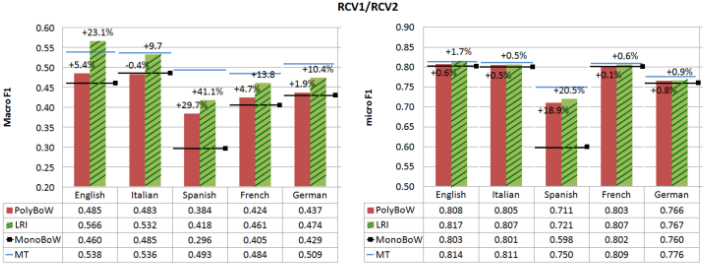
As a first case of study, we investigate how much the addition of polylingual information affects the performance of a monolingual classifier. In this scenario we compare MonoBoW, where training is performed only on documents of the same language of the test documents; PolyBoW, which trains on documents from all the five languages; and LRI, for which we set n = |F | (i.e., no dimensionality reduction).
The results shown in Figure 1 show that the simple addition of examples in different languages (PolyBoW) helps to improve the performance for the monolingual task, probably because of the shared words across languages; however, LRI clearly outperforms both MonoBoW and PolyBoW. The improvements are more marked for F M 1 than for F µ 1 , indicating that the improvements especially take place in the more infrequent classes, which impact susbstantially on F M 1 but not on F µ 1 .
Note that in this experiment the matrices that PolyBoW and LRI feed to the learning algorithm are of the same size. However, in LRI all dimensions become potentially useful for all languages due to random projection.
Dimensionality Reduction
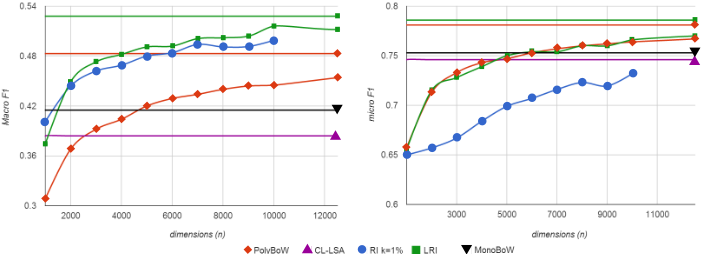
The following experiments explore the dimensionality reduction aspect of the problem, and concern a realistic polylingual scenario, where both training and test data are of a multilingual nature. To test the scalability of LRI when several languages are involved we conducted an experiment varying the feature space dimension from 500 to 10,000. Due to its high computational costs, we varied the dimensionality of CL-LSA from 500 to 1000 (Figure 2); for MDM the dimensionality was set to 400, according to indications reported in [Gliozzo and Strapparava, 2005]. Note that not all algorithms were able to complete their execution due to memory constraints.
LRI obtained good results on both macro- and microaveraged F1, while the other methods exhibited alternating performance on the two measures. RI1% obtained comparable results in terms of F M 1 but performed poorly on F µ 1 ; in contrast, PolyBoW performed comparably in terms of F µ 1 but worse in terms of F M 1 . Surprisingly CL-LSA and MDM performed worse than the na¨ıve classifier (MonoBoW) with all features. However, it should be remarked that they outperformed all other baselines in F µ 1 with only 400 (MDM) and 1000 (CL-LSA) dimensions.
4 Analysis: Space and Time Efficiency
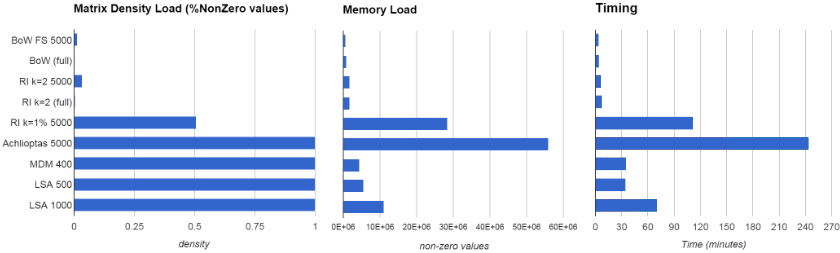
The random projection has a direct impact on sparsity. Each time a document contains a feature, k non-zero values are placed in the projected matrix. It is usually the case that sparsity benefits not only space occupation but also execution time. To explore this phenomenon we run experiments considering only English and Italian documents, which generate a 11,200-by-51,828 co-occurrence matrix, and examine their matrix density load (percentage of non-zero values over the total matrix size), memory load (absolute number of non-zero values), and execution time 6 (Figure 3). LRI requires double the space of standard BoW, but succeeds to preserve sparsity, while RI1% drastically increases the matrix density and produces a large memory load. MDM, LSA, and Achlioptas' method operate on dense matrices, which has a clear impact in execution times. The total time needed by LRI is roughly higher by a factor of 2 with respect to the full BoW representation, which is still negligible if compared with the rest of baselines, especially RI1% and the Achlioptas mapping.
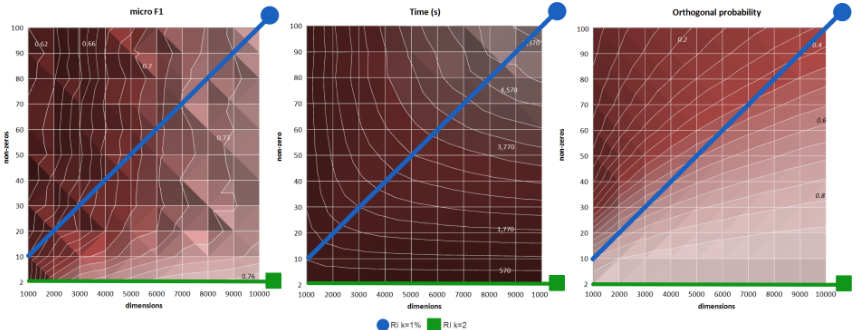
We empirically studied the probability function of this event as a function of the number of non-zero values (k) for RI, ranging from 2 to 100, and of the reduced dimensionality (n), ranging from 1,000 to 10,000 (Figure 4).
The following trends can be directly observed from the results. The performance in RI1% improves at the cost of space and time efficiency, and by gradually disrupting the orthogonality of the base. On the contrary, LRI behaves differently: when dimensionality increases, (i) accuracy improves (ii) without penalizing execution times due to the preservation of sparsity, and (iii) the orthogonality of the base is improved.
6 All the experiments were run on a dedicated Intel i7 64bit processor with 12 cores, running at 1,600MHz, and 24GBs RAM memory.
5 Conclusions
Lightweight Random Indexing is a machine-translation-free, dictionary-free variant of RI that better preserves matrix sparsity (i.e., both memory load and training times are not penalized) and increases the chance of orthogonality among random vectors. This configuration yielded the best results in classification accuracy in two popular multilingual benchmarks.
In the polylingual BoW representation most of the features (dimensions) are only informative for one of the languages. RI instead maps the feature space into a space that is shared among all languages at once. The effect is that any dimension of the space becomes informative regardless of language. In a particular configuration in which the projection space is larger than the actual number of different features for a single language, the "kernel-trick" effect appears: the informative space for each language is enlarged and it thus becomes more easily separable.
@inproceedings{ijcai2018p801,
  title     = {Lightweight Random Indexing for Polylingual Text Classification (Extended Abstract)},
  author    = {Fernández, Alejandro Moreo and Esuli, Andrea and Sebastiani, Fabrizio},
  booktitle = {Proceedings of the Twenty-Seventh International Joint Conference on
               Artificial Intelligence, {IJCAI-18}},
  publisher = {International Joint Conferences on Artificial Intelligence Organization},
  editor    = {Jérôme Lang},
  pages     = {5642--5646},
  year      = {2018},
  month     = {7},
  note      = {Journal track},
  doi       = {10.24963/ijcai.2018/801},
  url       = {https://doi.org/10.24963/ijcai.2018/801},
}
TY - CPAPER TI - Lightweight Random Indexing for Polylingual Text Classification (Extended Abstract) AU - Fernández, Alejandro Moreo AU - Esuli, Andrea AU - Sebastiani, Fabrizio T2 - Proceedings of the Twenty-Seventh International Joint Conference on Artificial Intelligence, IJCAI-18 PB - International Joint Conferences on Artificial Intelligence Organization PY - 2018 SP - 5642 EP - 5646 DO - 10.24963/ijcai.2018/801 UR - https://doi.org/10.24963/ijcai.2018/801 ER -Copied
Machine-readable versions of this paper, for tools and AI agents:





