
From the Periphery to the Core: Information Brokerage in an Evolving Network
Proceedings of the Twenty-Seventh International Joint Conference on Artificial Intelligence. Main track. Pages 3912-3918.
https://doi.org/10.24963/ijcai.2018/544
Keywords
- Agent-based and Multi-agent Systems: Agent-Based Simulation and Emergence
- Multidisciplinary Topics and Applications: AI and the Web
- Agent-based and Multi-agent Systems: Coordination and Cooperation
- Multidisciplinary Topics and Applications: Social Sciences
- Knowledge Representation and Reasoning: Action, Change and Causality
Abstract
Interpersonal ties are pivotal to individual efficacy, status and performance in an agent society.This paper explores three important and interrelated themes in social network theory: the center/periphery partition of the network; network dynamics; and social integration of newcomers. We tackle the question: How would a newcomer harness information brokerage to integrate into a dynamic network going from periphery to center? We model integration as the interplay between the newcomer and the dynamics network and capture information brokerage using a process of relationship building. We analyze theoretical guarantees for the newcomer to reach the center through tactics; proving that a winning tactic always exists for certain types of network dynamics. We then propose three tactics and show their superior performance over alternative methods on four real-world datasets and four network models. In general, our tactics place the newcomer to the center by adding very few new edges on dynamic networks with ~14000 nodes.
- [Barabási and Albert, 1999] Albert-László Barabási and Réka Albert. Emergence of scaling in random networks. science, 286(5439):509-512, 1999.
- [Borgatti and Everett, 2000] Stephen Borgatti and Martin Everett. Models of core/periphery structures. social net- works, 21(4):375-395, 2000.
- [Borgatti and Everett, 2006] Stephen Borgatti and Martin G Everett. A graph-theoretic perspective on centrality. social networks, 28(4):466-484, 2006.
- [Borgatti and Halgin, 2011] Stephen Borgatti and Daniel Halgin. On network theory. Organization science, 22(5):1168-1181, 2011.
- [Bornholdt and Ebel, 2001] Stefan Bornholdt and Holger Ebel. World wide web scaling exponent from simon's 1955 model. Phys Rev E, 64(3):035104, 2001.
- [Brânzei and Larson, 2011] Simina Brânzei and Kate Lar- son. Social distance games. In AAMAS-2011, pages 1281- 1282. International Foundation for Autonomous Agents and Multiagent Systems, 2011.
- [Christley et al., 2005] Robert Christley, Pinchbeck, Bow- ers, Clancy, French, Bennett, and Turner. Infection in so- cial networks: using network analysis to identify high-risk individuals. AJE, 162(10):1024-1031, 2005.
- [Csermely et al., 2013] Peter Csermely, András London, Ling-Yun Wu, and Brian Uzzi. Structure and dynamics of core/periphery networks. Journal of Complex Networks, 1(2):93-123, 2013.
- [Fricke and Lux, 2015] Daniel Fricke and Thomas Lux. Core-periphery structure in the overnight money market: evidence from the e-mid trading platform. COMPUT ECON, 45(3):359-395, 2015.
- [Galov et al., 2015] Ivan Galov, Aleksandr Lomov, and Dmitry Korzun. Design of semantic information broker for localized computing environments in the internet of things. In FRUCT-2015, pages 36-43. IEEE, 2015.
- [Harris et al., 2008] John Michael Harris, Jeffry Hirst, and Michael Mossinghoff. Combinatorics and graph theory, volume 2. Springer, 2008.
- [Holme, 2005] Petter Holme. Core-periphery organization of complex networks. Phys Rev E, 72(4):046111, 2005.
- [Honkola et al., 2010] Jukka Honkola, Hannu Laine, Ronald Brown, and Olli Tyrkkö. Smart-m3 information sharing platform. In ISCC-2010, pages 1041-1046. IEEE, 2010.
- [Jackson and Nei, 2015] Matthew. Jackson and Stephen Nei. Networks of military alliances, wars, and international trade. PNAS, 112(50):15277-15284, 2015.
- [Jackson and Rogers, 2007] Matthew Jackson and Brian Rogers. Meeting strangers and friends of friends: How random are social networks? AER, 97(3):890-915, 2007.
- [Jackson, 2010] Matthew Jackson. Social and economic net- works. Princeton university press, 2010.
- [Krugman and Venables, 1995] Paul Krugman and Anthony Venables. Globalization and the inequality of nations. QJE, 110(4):857-880, 1995.
- [Kumar et al., 2016] Srijan Kumar, Francesca Spezzano, Subrahmanian, and Christos Faloutsos. Edge weight pre- diction in weighted signed networks. In ICDM-2016, pages 221-230. IEEE, 2016.
- [Leskovec et al., 2007] Jure Leskovec, Jon Kleinberg, and Christos Faloutsos. Graph evolution: Densification and shrinking diameters. TKDD, 1(1):2, 2007.
- [Liu and Moskvina, 2016] Jiamou Liu and Anastasia Moskvina. Hierarchies, ties and power in organizational networks: model and analysis. Social Network Analysis and Mining, 6(1):106, 2016.
- [Moskvina and Liu, 2016] Anastasia Moskvina and Jiamou Liu. How to build your network? a structural analysis. In IJCAI-2016, pages 2597-2603. AAAI Press, 2016. IJCAI
- [Padgett and Ansell, 1993] John Padgett and Christopher Ansell. Robust action and the rise of the medici, 1400- 1434. AJS, 98(6):1259-1319, 1993.
- [Panzarasa et al., 2009] Pietro Panzarasa, Tore Opsahl, and Kathleen Carley. Patterns and dynamics of users' behavior and interaction: Network analysis of an online community. JAIST, 60(5):911-932, 2009.
- [Rombach et al., 2017] Puck Rombach, Mason Porter, James Fowler, and Peter Mucha. Core-periphery structure in networks (revisited). SIAM Review, 59(3):619-646, 2017.
- [Uzzi and Dunlap, 2005] Brian Uzzi and Shannon Dunlap. How to build your network. Harvard business review, 83(12):53, 2005.
- [Wasserman and Faust, 1994] Stanley Wasserman and Katherine Faust. Social network analysis: Methods and applications, volume 8. Cambridge university press, 1994.
- [Wu and Holme, 2011] Zhi-Xi Wu and Petter Holme. Onion structure and network robustness. Phys Rev E, 84(2):026106, 2011.
- [Yan et al., 2017] Bo Yan, Yang Chen, and Jiamou Liu. Dy- namic relationship building: Exploitation versus explo- ration on a social network. In WISE-2017, pages 75-90. Springer, 2017.
References were extracted automatically from the PDF and may contain errors.
Full text extracted automatically from the PDF; figures, tables and equations may differ. The PDF is the version of record.
1 Introduction
An agent society (or system) is defined by patterns of dyadic links between individuals. Research on social networks has greatly advanced our understanding of how traits such as ties, modules, and flow, impact agents' positions [Borgatti and Halgin, 2011]. Gaining a central position is seen as beneficial thanks to the relative easiness it brings to receive diverse information and exercise influence over other agents, i.e., a central position defines an information broker who accesses and integrates information through social links. This notion has wide implications on roles, status and leadership in organizations [Liu and Moskvina, 2016] and has recently facilitated applications such as IoT [Galov et al., 2015] and semantic web [Honkola et al., 2010].
A predominant meso-scale feature of many complex networks is the emergence of tiers: Sitting at the center is a densely-connected cohesive core, and on the outskirts a loosely-knit periphery. This paper asks the question: How would a newcomer harness information brokerage to integrate into a dynamic network going from the periphery to the center? Two assumptions are made: (a) We focus on networks that have a distinguished center, e.g., a core/periphery structure; and (b) We examine the decisions and processes of relationships building. The aim is to approach the question through a formal, algorithmic lens. This demands settling two issues: (1) The first concerns representations of center and brokerage. We stay consistent with the framework defined in [Moskvina and Liu, 2016] and treats information brokers as agents that give the newcomer low eccentricity, hence getting into the (Jordan) center of the network [Wasserman and Faust, 1994]. (2) The second is about network dynamics. As the network evolves with time, the model must make sense for dynamic networks. This sets this work apart from previous works on information brokerage where only static networks are of concern and brings extra complications to the problem. Even though we phrase the problem assuming additive changes to the network (as, e.g., a citation network), our notions and techniques also apply to fully dynamic networks.
Contribution. (1) We formulate integration as repeated, parallel interplays between a newcomer and the ensemble of other agents in the network it aims to join. The network evolves in the form of a sequence of snapshots in discrete time, which is determined by the initial network, the network's own evolution trace, and the newcomer's strategy for adding ties. The goal of the newcomer is to adopt a tactic that moves it from periphery to center within a finite number of steps regardless of dynamic changes of the network. (2) We study the existence of such strategies under certain reasonable conditions. In particular, when the center is bounded - as in many networks with a center/periphery structure - the newcomer has a winning tactic. (3) We propose three simple tactics and compare them with two methods from [Moskvina and Liu, 2016] which are designed for the same problem on static networks. Our tactics outperform the alternatives over four real-world dynamic networks.We also propose four dynamic network models with varying core/periphery-ness: dynamic preferential attachment, Jackson-Rogers, rich-club and onion models, and analyze the performance of tactics over them. Our tactics bring the newcomer to the center by creating less than 10 new edges in all of the experiments performed.
Related work. Game-theoretical research on network formation focuses on equilibria among rational agents [Jackson, 2010; Brˆanzei and Larson, 2011]; in contrast, our paper complements this body of work by investigating optimal tactics for a single agent in a dynamic setting. Motivated from [Uzzi and Dunlap, 2005], [Moskvina and Liu, 2016] initiates the static version of the problem under investigation, namely, building the least amount of edges to bring a newcomer to the network center. We build on their work and study dynamic networks. As opposed to the static case, a desired tactic may not exist under certain forms of network dynamics.
The definition of a graph center goes back to the work of Jordan in the 19th century and eccentricity belongs to a family of distance-based centrality indices [Borgatti and Everett, 2006]. Despite its simplicity, eccentricity has been useful in many places, e.g. from analyzing the rise of the Medici family in marriage alliance network [Padgett and Ansell, 1993] to mapping Hollywood actors/actresses [Harris et al., 2008]. Although the center can be identified for any network, we specifically target at core/periphery structures [Borgatti and Everett, 2000]. Observations of such tiered structures root in economics where the world is divided between industrial, "core" nations and agricultural, "peripheral" nations [Krugman and Venables, 1995]. Similar structures are subsequently witnessed in, e.g., social networks [Christley et al., 2005] and trading networks [Fricke and Lux, 2015]. Agents in the core, being hubs, enjoy many benefits such as control over information and domination of resources. A crucial feature of the core, apart from its central position and density, is the stability over time [Csermely et al., 2013; Rombach et al., 2017].
2 Network Building in a Dynamic Network
A social network is an undirected graph G = (V,E); V is a set of vertices (or agents), an edge {u, v} ∈ E, denoted by uv, represents links between agents u, v. The distance distG(v, u) is the shortest length of any path between v and u; for S ⊆ V , set distG(v, S) =minu∈S(distG(v, u)). The eccentricity of v ∈ V is eccG(v)=maxu∈V distG(u, v). The radius and diameter of G are, resp., rad(G)=mini∈V ecc(i) and diam(G)=maxi∈V ecc(i) [Harris et al., 2008]. The center of G is the set C(G) = {v ∈ V | ecc(v) = rad(G)}.
A dynamic network evolves in discrete-time, i.e., it consists of a (potentially infinite) list of networks G=G0, G1, G2, . . . where Gi = (Vi,Ei) is the network instance at timestamp i≥0. We define the set of vertices of a dynamic network G as the set VG = ∪i∈NVi. As G may contain infinitely many timestamps, VG may be infinite. For any v ∈ VG, the set of neighbors EG(v) is {u ∈ VG | vu ∈ Ei, i ∈ N}. As individuals usually have an only bounded capacity to manage social links, we require that EG(v) being finite for all v. Thus the graph (VG, ∪i∈NEi) stays a locally-finite graph.
Two caveats exist: Firstly, we should clarify what forms of structural changes may happen. In principle, any addition/removal of vertices/edges may occur. For the majority of this paper, however, we focus on a simpler form of dynamics where the network only makes additive changes,i.e., the only allowable updates are the addition of vertices/edges. Secondly, we need a policy regarding the frequency of timestamps. One natural method is to separate consecutive instances with a fixed period. Another common approach is to add a timestamp only when an update occurs. The exact meaning should be up to the actual application scenario.
Imagine an outside agent who aims to integrate into the network and explore information within. Information brokers refer to a set of appropriately located vertices who collectively give the newcomer good access to the network. More formally, for G = (V,E), H = (U, F) (V,U may or may not overlap), G ⊕ H denotes the network (V ∪ U, E ∪ F). Throughout, we use u to denote a newcomer. For any subset S ⊆ V , define S ⊗ u as (S ∪ u, {vu | v ∈ S}). Thus G ⊕ (S ⊗ u) is the resulting network obtained after integrating u into G via building links between u and every vertex in S. A broker set for G is B ⊆ V such that eccG⊕(B⊗u)(u) = rad(G ⊕ (B ⊗ u)) [Moskvina and Liu, 2016]. The intuition behind the definition is that by making contacts with members of a broker set, u can gain maximum access to the network. As a broker set always exists for a graph G, the minimum broker set problem asks for a broker set B ⊆ V with the smallest cardinality and is shown to be NP-complete [Moskvina and Liu, 2016].
Note that connecting to brokers embodies a dynamic process: As building relations requires effort and time, a broker set B is built iteratively where edges are added for u one by one, until its eccentricity becomes rad(G⊕(B⊗u)). Over a dynamic network G, u would act while the network evolves [Yan et al., 2017]. From u's perspective, its position relies not only on its own actions but also on the ensemble of all other agents in the network. At any timestamp, both parties make moves simultaneously, affecting the next network instance. Agent u's move consists of building new edges to the current graph; the others party's move consists of updates of the form "adding a new edge (either between two existing nodes, or a new vertex and an existing node)". Formally, for any network G, an expansion of G is a network F whose every connected component contains at least one node in G, i.e., G⊕ F is a network achieved by the two types of updates.
Definition 1. Fix an initial network G0 = (V0,E0) and a newcomer u /∈ V0. For k, ℓ ∈ N, an integration process (IP) is a dynamic network I = G0, G1, G2, . . . where ∀i ≥ 0
where Si is a set of vertices in Gi that are not adjacent to u, and Fi is an expansion of Gi that does not contain u.
Conceptually, one can view an IP as an iterative interplay between u and the network who acts as a sort of "opponent". Progressing from iteration i ≥ 0 to i+1 the network changes by (i) "attaching" a subgraph Fi; this may bring more vertices and edges to Gi; and (ii) adding an edge between u and all vertices in Si. The sequence of edges F1, F2, . . . is called the evolution trace and the sequence of sets S1, S2, . . . is called the newcomer strategy of I. The IP is uniquely determined by the initial network G0, actions of the network (in the form of an evolution trace) and the actions of u (in the form of a newcomer strategy). The definition of a dynamic network means that an IP must satisfy a locally-finiteness (LF) condition:
(LF) Any agent (including u) eventually stops adding new edges, i.e., ∀v ∈ VI ∃rv ∈N∀r′ ≥ rv : v does not appear in the network Fr′ ⊕ (Sr′ ⊗ u).
3 Information Broker in a Dynamic Network
A question arises as to how the newcomer may choose its strategy during an IP to get into the network center.
Definition 2. An IP I = G0,G1, . . . is a broker scheme of u if u ∈ C(Gr) for some r ∈ N.
We are interested in tactics that construct a broker scheme regardless of the evolution trace. Here, our attention is on a type of strategies where u makes decisions about Si at each timestamp given only the current network instance Gi.
Definition 3. A tactic of u is a function τ defined on the set of all networks such that τ(G) ⊆ V for any G = (V,E) and ∀v ∈ V : uv ∈ E ⇒ v /∈ τ(G). An IP I = G0,G1, . . . is said to be consistent with τ if its newcomer strategy S1, S2, . . . satisfies that ∀i > 0: Si = τ(Gi-1); we use IP(τ) to denote the class of all IPs consistent with τ .
We generalize information brokerage to the dynamic context.
Definition 4. Let P be a collection of IPs. A broker tactic for P is a tactic β such that P ∩ IP(β) ̸= ∅ and any I ∈ P ∩ IP(β) is a broker scheme.
The rest of the section studies the existence of broker tactics.
Definition 5. Fix numbers k > 0 and ℓ ≥ 0. An IP I is (k, ℓ)-confined if Fi of the evolution trace F1, . . . contains at most ℓ and any |Si| ≤ k for all i ≥ 1.
(k, 0)-confined IP is static where broker tactics always exist.
Theorem 1. For any k > 1, there exists a broker tactic of u for the class of (k, 1)-confined IPs.
Proof. Define the tactic τ of u as follows: Let τ(G) be an arbitrary set of k vertices in G not adjacent to u (or the set of all vertices not adjacent to u if more than k such vertices exist). We claim that any IP I = G0, G1, . . . consistent with τ is a broker scheme of u. Since k > 1, for any timestamp s > t = (k - 1)|V0|, the network instance Gs contains at most one vertex not-linked to u. Moreover, if u is linked to all other vertices in Gs, eccGs (u) = 1 < rad(Gs) and then I is a broker scheme.
Now suppose that for all s > t, the evolution process adds a new vertex, say xs and an edge xsys where ys ∈ Vs-1. Then there must be a timestamp s > t, such that ys = xs′ for some t < s′ < s, as otherwise some vertex in Gt will have an infinite degree. In the instance Gs, the furthest vertex from u is xs with distGs (u, xs) = 2 and hence eccGs (u) = 2. Clearly, ys is not connected to all vertices in Vs and thus rad(Gs) = 2. Therefore at this timestamp, u ∈ C(Gs), and the IP is a broker scheme.
Theorem 2. No broker tactic exists for the set of (k, ℓ)- confined IPs when ℓ≥2.
Proof. Take a tactic τ of u. Inductively construct (k, ℓ)- confined IP G0,G1, . . . in IP(τ) where u /∈ C(Gi) for any i ≥ 0: Suppose u /∈C(Gi) at instance Gi = (Vi,Ei). Consider the graph H =Gi ⊕ (τ(Gi) ⊗ u). If u is not adjacent to any vertex in H, then clearly u will not reach the center of Gi+1 regardless of Fi+1. Otherwise, take v ∈ Vi that is the furthest from u. Let r=distH(u, v). Let P =v, x1, . . . , xℓ be a simple path attaches to v at one end, x1, . . . , xℓ do not belong to Vi, and the edges are {vx1, x1x2, . . . , xℓ-1xℓ}. Now set Gi+1 = Gi ⊕ (P ⊕ (τ (Gi) ⊗ u)) = H ⊕ P .
Clearly, eccGi+1 (u) = r + ℓ as the furthest vertex from u is xℓ. Now pick a path between u and v, and let w be the vertex along this path that is adjacent to u; distGi+1 (w, xℓ) = r + ℓ - 1, and for all other vertices y, distGi+1 (w, y) ≤ distGi+1 (u, y)+1 ≤ r+1. As ℓ ≥ 2, eccGi+1 (w) ≤ r+1 < eccGi+1 (u). This means that u /∈ C(Gi+1).
One can view (k, ℓ) as specification of an IP protocol: When k>1=ℓ, the newcomer u gains an upper hand to reach the center; If, on the other hand, ℓ > 2, u may never "catch up" with the rest of the network. The only case left is when k=ℓ=1, and we will focus on this case in our experiments.
To further investigate the existence of a broker tactic, we look closely at the proof of Thm. 1. The non-existence of a broker tactic is due to the fact that the center "shifts" as new vertices are added. This may not be the case in real-life, e.g., a core/periphery structure contains a highly stable network core meaning that the network center would be relatively stable [Csermely et al., 2013; Rombach et al., 2017].
Definition 6. Let G=G0,G1, . . . be a dynamic network. We say that G has a bounded center if there exists a vertex c∈VG, and d∈N such that ∀i ≥ 0∀v ∈ C(Gi) : distGi (v, c) ≤ d.
Bounded center property means that the center of the dynamic network would not expand or shift indefinitely. The following fact easily follows from (LF).
Lemma 1. G is a dynamic network with a bounded center if and only if the set C = ⋃i∈N C(Gi) is a finite set.
Proof. Suppose C is finite. Pick any c ∈ C and set d as lim supi∈N maxv∈C(Gi) distGi (c, v); d must be in N as C is finite. Therefore ∀i≥0: C(Gi)⊆{v ∈ VG | distGi (v, c)≤d}.
Conversely, suppose G has a bounded center. Then C is a subset of the union D0 ∪ D1 ∪ · · · ∪ Dd where each Di = {v ∈ VG | ∃j ∈ N: distGj (v, c) = i}, 0 ≤ i ≤ d. Clearly, D0 = {c}. Suppose Di is a finite set, by (LF), ⋃v∈Di {w | vw ∈ Ej , j ∈ N} is also finite. Therefore, Di+1 is also finite, and hence ⋃i∈N C(Gi) is finite.
Theorem 3. There exists a broker tactic for the class of all (1, ℓ)-confined IPs with a bounded center.
Proof. Define tactic τ by τ(G) = {v} where ∃w ∈ C(G): distG(v,w) ≤ 1 and uv /∈ E if such a vertex exists; τ(G) = ∅ otherwise. To show that there is some I ∈ IP(τ) that has a bounded center, simply take G0 =({x0, v, y0}, {x0v, vy0}) and evolution trace F1, F2, . . . where the edges in each Fi are yiyi-1, xi-1xi, i > 0. The corresponding IP I ∈ IP(τ) will set Gi = Gi-1 ⊕ (Fi ⊕ τ (Gi-1). Clearly C(Gi) = {u, v} after timestamp 3 when all edges uv, ux0, uy0 are added, and τ(Gi) = ∅ for all i > 3.
Take an IP I ∈ IP(τ) with a bounded center. By Lem. 1, C = ⋃i∈N C(Gi) is finite. By (LF), the set C ′ = ⋃i∈N{w ∈ VI | distGi (w, v) ≤ 1, v ∈ C} is also finite. Thus for some timestamp t, all edges uv where v ∈ C ′ would have been added to Gt. At this timestamp, u belongs to C(G) and the IP is a broker scheme.
4 Cost-Effective Tactics and Evaluations
As shown empirically below, real networks usually have bounded centers, but the tactic in the proof of Thm. 3 is unpractical as it may create arbitrarily many edges. To fix a framework where tactics are comparable, from now on, we focus on tactics τ that add a single edge in a timestamp (i.e., |τ(G)| = 1) until u enters C(G). By the cost of an IP, we mean the number of timestamps elapsed before u enters the center (infinite if u never enters the center). We are interested in cost-effective tactics that result in the least expected cost.
Uset-based tactics. Over static networks, our problem reduces to finding a minimum broker set. The problem is shown to be NP-complete by [Moskvina and Liu, 2016] who also gave several cost-effective tactics. At any timestamp i of I = G0,G1, . . ., the uncovered set (Uset) Ui is {v∈Vi | distGi (u, v)>rad(Gi)}. Two tactics, named SMax and SBtw resp., add an edge from u to a vertex v ∈ Uu,i that has maximum degree (as in SMax) or betweenness (as in SBtw) centrality. Over static networks, their tactics build a sub-radius dominating set which corresponds to a broker set and is normally small, e.g., SMax finds a broker set of size 4 on a (static) collaboration network with > 8600 vertices.
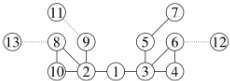
Rset-based tactics. A downside, however, lies with the Usetbased tactics over core/periphery structures: Once a link is created from u to someone in the core, these tactics would forbid further links with those that are also in the core (as they are "covered"). As a result, they result in suboptimal solutions. We thus modify the method by allowing u to link with some vertices in the Uset, as long as they are close to uncovered vertices. More formally, we define a remote-center set (Rset) at timestamp i of I=G0,G1, . . . as Ri ={v∈V | distGi (x, v)>rad(Gi)}, where x is a furthest vertex from u. We introduce RMax and RBtw as tactics that, instead of choosing vertices from Ui at timestamp i, links u with a v in the Rset Ri that has the largest degree (in RMax) or maximum betweenness (in RBtw) centrality. To contrast these tactics, Fig. 1 shows an example where SMax gave suboptimal solutions for both static/dynamic case; SBtw gave an optimal solution for static but not for the dynamic case; and RMax/RBtw gave optimal solutions for both cases.
MUF. Another tactic for u is to link with neighbors of a center vertex c, thus getting into the center. To minimize cost, c is chosen to have the least degree in C(G). A heuristic then selects from the most useful friends (MUF) of c, which are defined as neighbors of c that are at distance rad(G)-1 from the furthest vertex from u. Alg.1 implements this tactic for one timestamp (when u /∈ C(G)). This tactic will work in dynamic networks whose center does not change much.
| Trade | Msg | Bitcoin | Cit | |
|---|---|---|---|---|
| |V | | 176 | 1899 | 5875 | 14083 |
| |E| | 1229 | 20296 | 21489 | 104211 |
| clust-coef | 0.54 | 0.10 | 0.17 | 0.26 |
| max.deg | 113 | 255 | 795 | 266 |
| diam | 4 | 8 | 9 | 15 |
| center size | 118 | 1 | 16 | 61 |
| timestamps | 50 | 59835 | 35592 | 2000 |
| goodness of fit | 0.74 | 0.89 | 0.86 | 0.91 |
| cp-coef | 0.11 | 0.08 | 0.11 | 0.14 |
Algorithm 1 Most-Useful-Friends (MUF) tactic INPUT A graph G = (V, E), newcomer u c ← arg minv∈C(G) deg(v). ▷ center with min degree If u is isolated, return v adjacent to c with max degree. x ← argmaxi∈V distG(i, u) F ← {v ∈ V | vc ∈ E, distG(v, x) = rad(G) -1} Return v∈F not adjacent to u with max degree.
We run and evaluate the tactics on 4 real-world datasets.
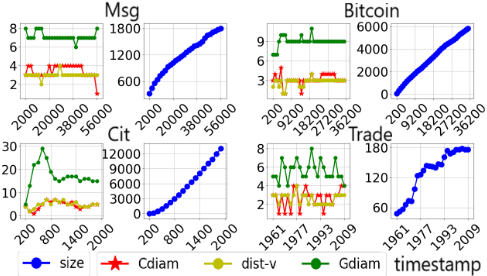
Datasets. The number of timestamps in these networks ranges from 50 to ∼ 60000. CollegeMsg network (Msg) is a timestamped online social network at the University of California, Irvine [Panzarasa et al., 2009]; An edge jk denotes a message sent between j and k. Bitcoin OTC trust network (Bitcoin) record anonymous Bitcoin trading on Bitcoin OTC with temporal information [Kumar et al., 2016]. An edge jk denotes a trade between j and k. Cit-HepPh network (Cit) is a high-energy physics citation network [Leskovec et al., 2007], which collects all papers from 1992 to 1998 on arXiv; An (undirected) edge jk denotes that paper j cites paper k. Trade network (Trade) denotes yearly world trade partnership, 1951 - 2009 [Jackson and Nei, 2015]; Edges represent trade partnership which is defined based on import/export between two countries. All networks above, apart from Trade, has only additive changes to the network. Table 1 shows multiple statistics of the last networks instance. The goodness of fit shows how well nodal degrees align with a power-law distribution, indicating a clear scale-free property. clus-coef and diam show that the networks have high clustering coefficient and low diameter, indicating small-world property. Cp-coef is a metrics for core-periphery structure; a positive value indicates a clear core/periphery structure [Holme, 2005]. Fig. 2 analyzes temporal properties of the networks. It is clearly seen that, despite the continuous expansion of the network (in size), the graph center gains little in terms of diameter. Moreover, the location of the center does not shift as the maximum distance between a fixed vertex v and vertices in the center stay bounded by a small distance during all timestamps.
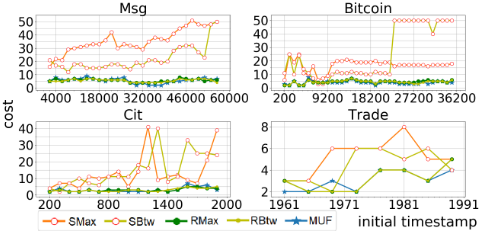
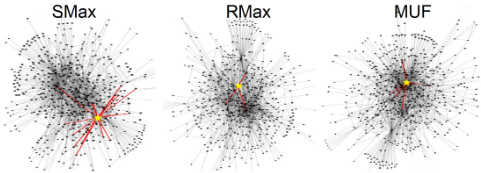
Experiment 1 (Cost). The goal is to compare the tactics treating SMax/SBtw as benchmarks. For each dataset, we choose 28(Msg), 36(Bitcoin), 18(Cit), and 8(Trade) timestamps as an initial network from which IP are simulated. We also tune the interval between two consecutive timestamps where the newcomer u adds an edge; See Fig. 3 for results of tactics: RMax, RBtw, MUF significantly outperform the benchmarks in all cases, obtaining costs generally below 10. They are robust in the sense that the costs vary little when starting from different initial network, while costs of SMax/SBtw dramatically increase as initial timestamp changes. To visually compare the tactics, Fig. 4 illustrates the result of SMax/RMax/MUF after running on an instance of Bitcoin with 2200 initial vertices, stopping when u enters the center. SMax apparently incurs higher cost building more edges than the other two tactics. It is also apparent that SMax connects largely to peripheral vertices, while MUF positions u well into the center.
5 Dynamic Center/PeripheryModels
To analyze factors attributing to tactic performance, we run dynamic network models of center/periphery structures.
Dynamic BA model. This well-established dynamic model takes a parameter d ∈ N and adds a new vertex at each timestamp who randomly links with d vertices by a preferential attachment mechanism. Over multiple iterations, the graph develops a scale-free property, however, it fails to achieve a highly-clustered core.
Dynamic JR model. The model proposed by [Jackson and Rogers, 2007] simulates stochastic friendship making among an agent population. An agent may link with a friend-offriends or a random individual. At each timestamp, the model randomly samples for every vertex v a set S1(v) of m nonadjacent vertices from the entire network, and another set S2(v) of m vertices who are at distance 2 from v (S1(v) and S2(v) may not be disjoint). It then builds edges between v and every vertex in S1(v) ∪ S2(v) with probability p. As argued in [Jackson and Rogers, 2007], the model meets most of the desired properties such as scale-free and small-world properties. The value m ≈ d/4p relies on p and an expected average degree d ∈ N which are parameters of the model. We pick p = {0.25, 0.5, 1} to resemble the fitted values on the real-world networks in [Jackson and Rogers, 2007].
Dynamic rich-club. Rich-club has been a "go-to" model of a core/periphery structure which develops a dense, central core with a sparse periphery [Bornholdt and Ebel, 2001; Csermely et al., 2013]. At each timestamp, the process adds a new vertex with probability α ∈ [0, 1] (and links it with a random vertex) or a link between two existing vertices with probability 1 - α. If the latter case, it chooses a random source w ∈ V and links it with a target z as follows: For every k ∈ N, set [k] = {v ∈ V | deg(v) = k}; The probability that z ∈ [k] is ∝k[k]. The probability α, computed by α=2(N+1)/(Nd+2), depends on the targeted average degree d and graph size N, which are parameters in the model.
Dynamic onion. An onion is a core/periphery structure, but unlike in a rich-club, peripheral vertices here are connected to form one or several layers surrounding the core, resembling highly resilient networks, e.g., criminal rings [Csermely et al., 2013]. The original static onion model generates a network with a fixed a power-law degree distribution q(k) ∼ k-γ (where γ ∈ R depends on the average degree d). We dynamize this model so that vertices are iteratively added, loosely speaking: At each timestamp, we (1) add a new vertex v whose degree deg(v)=k with probability q(k); (2) To add v to G while preserving the degree distribution, create a pool of "studs" (i.e., half-edges) initially containing k studs attached to v; (3) randomly severe k existing edges into 2k studs which are added to L; (4) repeatedly "join" random pairs of studs v, w in L to form edge vw with probability pvw=(1+3|sv-sw|)-1 , taking care to avoid self-loops and duplicates, until L = ∅ [Wu and Holme, 2011].
| BA | JR0.25 | JR0.5 | JR1 | rich-club | onion | |
|---|---|---|---|---|---|---|
| clustering | 0.04 | 0.29 | 0.34 | 0.24 | 0.04 | 0.21 |
| max deg | 53.4 | 31.6 | 32.9 | 27.18 | 46.44 | 118 |
| center size | 120.5 | 33.0 | 47.1 | 19.18 | 27.16 | 3 |
| diameter | 5.6 | 8.3 | 7.84 | 6.54 | 9.46 | 7.4 |
| radius | 4 | 5 | 4.7 | 4.08 | 5.2 | 4.18 |
| cp-coef | -0.09 | 0.04 | 0.02 | -0.05 | 0.13 | 0.26 |
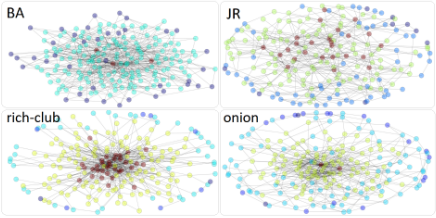
Table 2 summarizes key statistics of the models minding that they share the same parameter - average degree d ∈ N. Here we set d = 6 to resemble values in empirical data sets 1 , the network size 500 and the initial network being a cycle graph with length 10, as for BA model in [Barab´asi and Albert, 1999]. For the JR model, a column is created for each value of p ∈ {0.25, 0.5, 1}. The rich-club and onion models have exceptionally high CP coefficient showing a clear core/periphery structure. Fig. 5 visually contrasts the four models clearly displaying the core in rich-club and onion, while for BA and JR the center is not clear.
Experiment 2. We run all tactics treating SMax & SBtw as benchmarks over synthetic dynamic networks. IPs are simulated using the models above; the initial network is generated by the corresponding model and has size 500. There are several parameters which we may adjust. The first is the average degree d which corresponds to the speed of adding edges to the network at each timestamp. The second is the growth rate ℓ of the network, which is the number of vertices that can be added in each timestamp. Firstly, we take d = 2, . . . , 10 and fix ℓ = 1; the costs of all tactics are plotted in Fig. 6. Then, we fix d = 6 and adjust ℓ from 10 to 500; the costs are plotted in Fig. 7 (so that the resulting IP is (1, ℓ)-confined). All values in Fig. 6 and Fig. 7 are averaged among 100 trials.
We make several discussions: · Apparent from the plots, RMax, RBtw and MUF places u into the center with much less costs compared to the benchmarks; The cost of these tactics is also very stable where the cost remains below 10
1 80 datasets on KONECT and SNAP have average degree between 2 and 10 http://konect.uni-koblenz.de/, http://snap.stanford. edu/
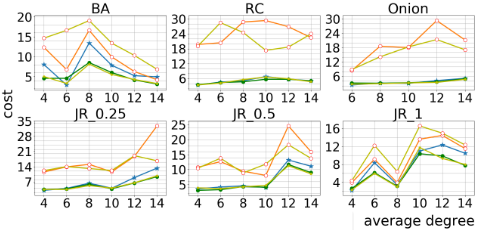
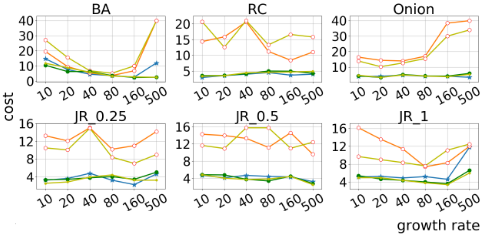
for every model even when d = 14 or ℓ = 500. Recall from Thm. 2 that when the network expands more rapidly, potentially no broker tactic would exist leading to an infinite cost; our experiment show that this would not happen for the four models of dynamic networks. · The gap in cost between RMax/RBtw/MUF and SMax/SBtw gets very wide (5 - 8 times) for models with a high CP-coefficient (rich-club, onion). This may be due to dense ties among core members resulting in them being excluded by SMax/SBtw. · Tactics have relatively similar performance over BA and JR-1 networks; This may be due to the lack of a tight-knit core in these two models. · A faster growth rate ℓ (with a fixed d) would not affect the costs of tactics as the tactics exploit the central vertices which are relatively stable regardless of ℓ. · The vertices with high betweenness tend to locate around the center, so tactics with maximum betweenness have better performance on high CP-coefficient networks.
6 Conclusion and FutureWork
We develop a structural investigation into the process where a newcomer integrates into a dynamic network through building ties. Our conclusions concern with conditions that warrant the existence of a broker tactic and simple cost-effective tactics over center/periphery networks. Five tactics are extensively compared on four real world datasets and four dynamic network models.
Modeling network dynamics has posed many challenges and we hope this work addresses some of them by providing a new angle and further insights. Many future work remain:
- It is a natural question to explore dynamic models where ties are added as well as severed. (2) A distinction exists between the notions of network core and center [Borgatti and Everett, 2000]; A future question would be to investigate tactics that place the newcomer into the core, rather than just the network center. (3) Community structure is another prevalent meso-scale property and the same question could be targeted at dynamic community structure models. (4) Moving from the tactics of a single agent to a population of agents, one may formulate and investigate game-theoretical models of network formation based on the notions of social capital.
@inproceedings{ijcai2018p544,
  title     = {From the Periphery to the Core: Information Brokerage in an Evolving Network},
  author    = {Yan, Bo and Liu, Yiping and Liu, Jiamou and Cai, Yijin and Su, Hongyi and Zheng, Hong},
  booktitle = {Proceedings of the Twenty-Seventh International Joint Conference on
               Artificial Intelligence, {IJCAI-18}},
  publisher = {International Joint Conferences on Artificial Intelligence Organization},
  editor    = {Jérôme Lang},
  pages     = {3912--3918},
  year      = {2018},
  month     = {7},
  note      = {Main track},
  doi       = {10.24963/ijcai.2018/544},
  url       = {https://doi.org/10.24963/ijcai.2018/544},
}
TY - CPAPER TI - From the Periphery to the Core: Information Brokerage in an Evolving Network AU - Yan, Bo AU - Liu, Yiping AU - Liu, Jiamou AU - Cai, Yijin AU - Su, Hongyi AU - Zheng, Hong T2 - Proceedings of the Twenty-Seventh International Joint Conference on Artificial Intelligence, IJCAI-18 PB - International Joint Conferences on Artificial Intelligence Organization PY - 2018 SP - 3912 EP - 3918 DO - 10.24963/ijcai.2018/544 UR - https://doi.org/10.24963/ijcai.2018/544 ER -Copied
Machine-readable versions of this paper, for tools and AI agents:





