
Robust Multi-view Learning via Half-quadratic Minimization
Proceedings of the Twenty-Seventh International Joint Conference on Artificial Intelligence. Main track. Pages 3278-3284.
https://doi.org/10.24963/ijcai.2018/455
Keywords
- Machine Learning: Clustering
- Machine Learning: Multi-instance;Multi-label;Multi-view learning
- Machine Learning: Unsupervised Learning
Abstract
Although multi-view clustering is capable to usemore information than single view clustering, existing multi-view clustering methods still have issues to be addressed, such as initialization sensitivity, the specification of the number of clusters,and the influence of outliers. In this paper, we propose a robust multi-view clustering method to address these issues. Specifically, we first propose amulti-view based sum-of-square error estimation tomake the initialization easy and simple as well asuse a sum-of-norm regularization to automaticallylearn the number of clusters according to data distribution. We further employ robust estimators constructed by the half-quadratic theory to avoid theinfluence of outliers for conducting robust estimations of both sum-of-square error and the numberof clusters. Experimental results on both syntheticand real datasets demonstrate that our method outperforms the state-of-the-art methods.
- [Black and Rangarajan, 1996] Michael J. Black and Anand Rangarajan. On the unification of line processes, outlier rejection, and robust statistics with applications in early vi- sion. International Journal of Computer Vision, 19(1):57- 91, 1996.
- [Brito et al., 1997] MR Brito, EL Chavez, AJ Quiroz, and JE Yukich. Connectivity of the mutual k-nearest-neighbor graph in clustering and outlier detection. Statistics & Prob- ability Letters, 35(1):33-42, 1997.
- [Cao et al., 2015] Xiaochun Cao, Changqing Zhang, Huazhu Fu, Si Liu, and Hua Zhang. Diversity-induced multi-view subspace clustering. In CVPR, pages 586-594, 2015.
- [Charbonnier et al., 1997] Pierre Charbonnier, Laure Blanc- Féraud, Gilles Aubert, and Michel Barlaud. Determinis- tic edge-preserving regularization in computed imaging. IEEE Trans. Image Processing, 6(2):298-311, 1997.
- [Chi and Lange, 2015] Eric C Chi and Kenneth Lange. Split- ting methods for convex clustering. Journal of Computa- tional and Graphical Statistics, 24(4):994-1013, 2015.
- [Ding et al., 2005] Chris Ding, Xiaofeng He, and Horst D Simon. On the equivalence of nonnegative matrix factor- ization and spectral clustering. In SDMs, pages 606-610, 2005.
- [Elhamifar and Vidal, 2013] Ehsan Elhamifar and Rene Vi- dal. Sparse subspace clustering: Algorithm, theory, and applications. IEEE transactions on pattern analysis and machine intelligence, 35(11):2765-2781, 2013.
- [Fang and Wang, 2012] Yixin Fang and Junhui Wang. Se- lection of the number of clusters via the bootstrap method. Computational Statistics & Data Analysis, 56(3):468-477, 2012.
- [Frey and Dueck, 2007] Brendan J Frey and Delbert Dueck. Clustering by passing messages between data points. sci- ence, 315(5814):972-976, 2007.
- [He et al., 2014] Ran He, Wei-Shi Zheng, Tieniu Tan, and Zhenan Sun. Half-quadratic-based iterative minimization for robust sparse representation. IEEE transactions on pattern analysis and machine intelligence, 36(2):261-275, 2014.
- [Hocking et al., 2011] Toby Dylan Hocking, Armand Joulin, Francis Bach, and Jean-Philippe Vert. Clusterpath an al- gorithm for clustering using convex fusion penalties. In ICML, page 1, 2011.
- [Hu et al., 2017] Rongyao Hu, Xiaofeng Zhu, Debo Cheng, Wei He, Yan Yan, Jingkuan Song, and Shichao Zhang. Graph self-representation method for unsupervised feature selection. Neurocomputing, 220:130-137, 2017.
- [Jiang et al., 2015] Yizhang Jiang, Fu-Lai Chung, Shitong Wang, Zhaohong Deng, Jun Wang, and Pengjiang Qian. Collaborative fuzzy clustering from multiple weighted views. IEEE Trans. Cybernetics, 45(4):688-701, 2015.
- [Kriegel et al., 2009] Hans-Peter Kriegel, Peer Kröger, and Arthur Zimek. Clustering high-dimensional data: A sur- vey on subspace clustering, pattern-based clustering, and correlation clustering. TKDD, 3(1):1:1-1:58, 2009.
- [Li et al., 2017] Jundong Li, Kewei Cheng, Suhang Wang, Fred Morstatter, Robert P. Trevino, Jiliang Tang, and Huan Liu. Feature selection: A data perspective. ACM Comput. Surv., 50(6):94:1-94:45, 2017.
- [Nie et al., 2017] Feiping Nie, Guohao Cai, and Xuelong Li. Multi-view clustering and semi-supervised classification with adaptive neighbours. In AAAI, pages 2408-2414, 2017.
- [Nikolova and Chan, 2007] Mila Nikolova and Raymond H. Chan. The equivalence of half-quadratic minimization and the gradient linearization iteration. IEEE Trans. Image Processing, 16(6):1623-1627, 2007.
- [Nikolova and Ng, 2005] Mila Nikolova and Michael K. Ng. Analysis of half-quadratic minimization methods for sig- nal and image recovery. SIAM J. Scientific Computing, 27(3):937-966, 2005.
- [Rodriguez and Laio, 2014] Alex Rodriguez and Alessandro Laio. Clustering by fast search and find of density peaks. Science, 344(6191):1492-1496, 2014.
- [Shah and Koltun, 2017] Sohil Atul Shah and Vladlen Koltun. Robust continuous clustering. Proceedings of the National Academy of Sciences of the United States of America, 114(37):9814, 2017.
- [Sun, 2013] Shiliang Sun. A survey of multi-view ma- chine learning. Neural Computing and Applications, 23(7- 8):2031-2038, 2013.
- [Xu et al., 2015] Chang Xu, Dacheng Tao, and Chao Xu. Multi-view self-paced learning for clustering. In IJCAI, pages 3974-3980, 2015. IJCAI
- [Xu et al., 2016] Jinglin Xu, Junwei Han, Kai Xiong, and Feiping Nie. Robust and sparse fuzzy k-means clustering. In IJCAI, pages 2224-2230, 2016. IJCAI
- [Yin et al., 2015] Qiyue Yin, Shu Wu, Ran He, and Liang Wang. Multi-view clustering via pairwise sparse subspace representation. Neurocomputing, 156:12-21, 2015.
- [Zhang et al., 2006] Shichao Zhang, Yongsong Qin, Xi- aofeng Zhu, Jilian Zhang, and Chengqi Zhang. Optimized parameters for missing data imputation. In PRICAI, pages 1010-1016, 2006.
- [Zhang et al., 2017] Shichao Zhang, Xuelong Li, Ming Zong, Xiaofeng Zhu, and Ruili Wang. Efficient knn classification with different numbers of nearest neighbors. IEEE transactions on neural networks and learning sys- tems,DOI: 10.1109/TNNLS.2017.2673241, 2017. DOI
- [Zhu and Martinez, 2006] Manli Zhu and Aleix M Martinez. Subclass discriminant analysis. IEEE Transactions on Pat- tern Analysis and Machine Intelligence, 28(8):1274-1286, 2006.
- [Zhu et al., 2014a] Xiaofeng Zhu, Heung-Il Suk, and Ding- gang Shen. Multi-modality canonical feature selection for alzheimer's disease diagnosis. In MICCAI, pages 162- 169, 2014.
- [Zhu et al., 2014b] Yingying Zhu, Dong Huang, Fernando De La Torre, and Simon Lucey. Complex non-rigid mo- tion 3d reconstruction by union of subspaces. In CVPR, pages 1542-1549, 2014.
- [Zhu et al., 2016] Yingying Zhu, Xiaofeng Zhu, Minjeong Kim, Dinggang Shen, and Guorong Wu. Early diagnosis of alzheimer's disease by joint feature selection and classi- fication on temporally structured support vector machine. In MICCAI, pages 264-272, 2016.
- [Zhu et al., 2017a] Pengfei Zhu, Wencheng Zhu, Qinghua Hu, Changqing Zhang, and Wangmeng Zuo. Subspace clustering guided unsupervised feature selection. Pattern Recognition, 66:364-374, 2017.
- [Zhu et al., 2017b] Yingying Zhu, Xiaofeng Zhu, Minjeong Kim, Daniel Kaufer, and Guorong Wu. A novel dynamic hyper-graph inference framework for computer assisted diagnosis of neuro-diseases. In IPMI, pages 158-169. Springer, 2017.
- [Zhu et al., 2018] Pengfei Zhu, Qian Xu, Qinghua Hu, Changqing Zhang, and Hong Zhao. Multi-label feature se- lection with missing labels. Pattern Recognition, 74:488- 502, 2018.
References were extracted automatically from the PDF and may contain errors.
Full text extracted automatically from the PDF; figures, tables and equations may differ. The PDF is the version of record.
1 Introduction
Compared to single-view clustering, multi-view clustering is capable to generate more robust clustering models as every view of multi-view data has particular information different from other views so that multi-view data provide more useful information for clustering [Chi and Lange, 2015; Zhang et al., 2017; Nie et al., 2017; Zhu et al., 2014a]. Recently, reasonably taking full use of the information (e.g., common information and particular information) among different views has been demonstrated to be a key strategy for multi-view clustering beyond single view clustering [Kriegel et al., 2009; Hu et al., 2017; Rodriguez and Laio, 2014].
By considering the way of using the information in multiple views, existing multi-view clustering methods can be categorized into three categories, such as concatenation approach, distributed approach, and centralized approach. Concatenation approach firstly concatenates the feature vectors of every view to form a set of long vectors and then conducts single view clustering on the resulting long-vector representations. Existing concatenation approach is easy to perform, but difficultly yields satisfied clustering performance. For example, high-dimensional representation of long vectors in concatenation approach easily leads to the issue of curse of dimensionality [Li et al., 2017; Zhu et al., 2016]. Distributed approach firstly generates clustering results from every view independently, and then proposes strategies to combine these results. Similar to the concatenation approach, distributed approach does not take full use of information of multi-view data yet and thus is unavailable to yield reasonable clustering performance [Sun, 2013]. Centralized approach takes advantage of distinguishing information or common information among multi-view data to more easily achieve better performance, compared to the former two approaches [Yin et al., 2015]. However, centralized approach has well-known drawbacks such as initialization sensitivity [Shah and Koltun, 2017; Zhu et al., 2018].
∗Corresponding author: Xiaofeng Zhu (seanzhuxf@gmail.com).
Increasingly complex datasets and real-world requirements are creating new demands for multi-view clustering [Xu et al., 2016; Jiang et al., 2015]. Real-world data are often corrupted by outliers [Zhu et al., 2017b; Zhang et al., 2006], but most existing multi-view clustering methods were designed to equivalently regard every sample without addressing the issue of the influence of outliers. Another challenging task of multi-view clustering is the specification of the number of clusters, which is required as an input. Usually, predefined input needs prior knowledge. Otherwise, the obtained solution is prone to error, especially for conducting multi-view clustering on the datasets with complex distribution or structure [Frey and Dueck, 2007; Fang and Wang, 2012].
In this paper, we propose a novel Robust Multi-View Clustering (RMVC) method to conduct simple initialization sensitivity, taking sample importance into account to avoid the influence of outliers, and automatically specifying the number of the clusters. To do this, firstly, a sum-of-square error estimation is used to minimize the difference between original samples and their corresponding new representations, aim for resulting in easy initialization, i.e., initializing every new representation as its corresponding original feature to yield fast convergence. Moreover, we extend such a framework from single view data to multi-view data to further improve the clustering robustness by making the full use of the information in multi-view data. Meanwhile, we select robust estimators (based on the half-quadratic theory [Nikolova and Chan, 2007; He et al., 2014]) to push a constraint on every sample of every view so that the outliers are removed out the model construction, unimportant samples are assigned small weights, and the important samples are assigned large weights. Secondly, a sum-of-norm regularization is used to control the tradeoff between the model fit (i.e., the sum-of-square error estimation) and the number of clusters, so that the number of clusters can be automatically learnt according to the data distribution, and not need to be specified in advance.
Compared to previous multi-view clustering methods, our proposed RMVC method has the following advantages.
- Its initialization is easy as well as fixed, i.e., initializing every sample with its original feature to achieve very simple and efficient initialization. It is noteworthy that existing multi-view clustering methods (e.g., [Xu et al., 2015; Nie et al., 2017; Jiang et al., 2015; Cao et al., 2015]) are very sensitive to the initialization, and the initialization is complex such as a small set of random centroid is firstly initialized and then iteratively refined [Chi and Lange, 2015; Zhu et al., 2014b]. Furthermore, different initializations lead to different clustering results. As a result, heuristic initialization methods should be used. Otherwise, clustering results may lead to a local minima and or even drastically suboptimal results.
- It does not require the input of the number of clusters, i.e., automatically learning the number of clusters according to data distribution by a sum-of-norm regularization. By contrast, most of existing multi-view methods need to specify the number of clusters, which is time consuming as well as needs prior knowledge. Although some methods (e.g., affinity propagation [Frey and Dueck, 2007; Zhu et al., 2017a]) do not need to assign the number of clusters by users, these methods need to face the initialization issue [Shah and Koltun, 2017; Hocking et al., 2011].
- It is capable of simultaneously separating outliers from important samples and learning the number of clusters. Most of existing multi-view methods ignored these two constraints and only a few of previous clustering methods considered one of them. Moreover, our method is a general methodology that can be applied to other clustering problems such as single view clustering and semisupervised clustering.
2 Approach
We summarize all notations used in this paper in table 1.
2.1 Robust Clustering
K-means clustering partitions all the samples into K clusters so that every sample belongs to a specific cluster whose centroid is closest to this sample. Specifically, the objective function of k-means clustering [Ding et al., 2005] can be formulated as:
| X | a matrix |
|---|---|
| x | a vector of X |
| xi,j | the element in the i-th row and the j-th column of X |
| xi,· | the i-th row of X |
| x·,j | the j-th column of X |
| ||X||F | the Frobenius norm of X, i.e., ||X||F = √∑i,j x2i,j |
| ||X||2,1 | the ℓ2,1-norm of X, i.e., ||X||2,1 = ∑i √∑j x2ij |
| XT | the transpose of X |
| tr(X) | the trace of X |
| X-1 | the inverse of X |
where G ∈ Rn×k is a binary matrix to indicate the samples belonging to a specific cluster out of K clusters, and F ∈ Rk×d is the centroid matrix, and ‖ · ‖F is a Frobenius norm.
Firstly, k-means clustering is sensitive to initialization since it is a non-convex optimization problem, whose optimization easily leads to a local minima or even sometimes drastically suboptimal. Moreover, heuristic initialization methods should be used for k-means clustering since different initializations may lead to considerably different clustering results [Hocking et al., 2011]. Secondly, k-means clustering needs to set the number of clusters by users. It is usually time consuming for selecting an appropriate value for the number of clusters and there is a demand of prior knowledge. Thirdly, most existing clustering methods ignore the influence of outliers so that constructed clustering models deviate to the real ones.
Intuitively, closed samples in some similarity/distance measures should be assigned to the same cluster, and vice versa. As a result, a centroid can be obtained for each cluster. In real applications, we have no idea on the number of clusters, so we denote ui,· (the i-th row of U ∈ Rn×d , i = 1, ..., n) as the new representation of the sample xi,· as well as the centroid containing the sample xi,·. We expect to firstly initialize ui,· as xi,·, and then recursively join the closed samples together to form a cluster/group until all the samples are jointed their closest clusters. This results in a sum-of-square error as follows:
where ‖ · ‖2 is an ℓ2-norm. The minimization optimization of Eq. (2) easily results in trivial solutions, i.e., xi,· = ui,·(i = 1, ..., n). To address this issue, an appropriate constraint (e.g., an ℓp-norm regularization) can be added to have the following formulation:
where ‖ · ‖p is an ℓp-norm regularization, (p, q) ∈ ε indicate that the p-th sample xp,· is one of the nearest neighbors of the q-th sample xq,·, i.e., their distance is less then ε, and λ is a tuning parameter balancing two terms of Eq. (3).
In Eq. (3), the first term (i.e., the sum-of-square error estimation) learns the new representation U of X so that recursively updating U which is gradually close to X as well as satisfies the constraint in the second term, i.e., the sumof-norm regularization. The second term requires that U preserves the similarity of X and the new representations of samples from the same cluster are very approximate. Specifically, the similarity of X is preserved by an adjacency matrix W = [wp,q]p,q=1,...,n ∈ Rn×n , which can be constructed by the k Nearest Neighbor (kNN) method, or the mutual kNN method [Brito et al., 1997], or the sparse representation method [Elhamifar and Vidal, 2013]. On the other hand, if the p-th sample and the q-th sample come the same clustering, i.e., wp,q ≤ ε, then their centroid should be same, i.e., up,· = uq,·. By inducing the ℓp-norm regularization and tuning the parameter λ, some same-cluster-pairs (i.e., the pair i ↔ j if ui,· = uj,·, i, j = 1, ...n) are generated. Moreover, the larger the value of λ, the more the number of samecluster-pairs is. After the optimization process, all the samples are gathered into clusters, and thus the number of the cluster is decided.
Eq. (3) solves the issue of initialization sensitivity, but does not solve the issue of the specification of the number of clusters well as the ℓp-norm regularization has still limitations on robustly dealing with the outlier edges of W, high-order outliers for short. That is, the outlier edges will still appear instead of diminishing during the process of optimizing U. Moreover, Eq. (3) does not touch the issue of outlier samples (low-order outliers for short) in its first term. In this paper, we have two considerations. Firstly, the outlier edges inWwill be suppressed via assigning a small or even zero weight on the difference estimation of ‖up,· -uq,·‖. Secondly, the outliers in X will also be assigned small weights. To do this, we employ robust estimators constructed by the half-quadratic theory to have:
where ρ1(·) and ρ2(·) are robust estimators constructed by the half-quadratic theory [Nikolova and Ng, 2005; Charbonnier et al., 1997; Black and Rangarajan, 1996]. Robust estimators were designed to produce robust estimation that are not unduly affected by outliers and output good performance when there are small departures from parametric distributions [Nikolova and Ng, 2005]. The popular robust estimators include ℓ1 - ℓ2 estimator, Cauchy estimator, Geman-McClure estimator, and so on.
2.2 Robust Multi-viewClustering
We denote Xv ∈ Rn×dv of multi-view data as the feature matrix of the v-th view data, where n and dv , respectively, are the number of samples and the features of the v-th view data. We also denote xvi,j , xvi,· and xv·,j , respectively, as the element of the i-th row and the j-th column, the vector of the i-th row, and the vector of the j-th column, of the v-th feature matrix. It is noteworthy that the dimensions of different views are usually different. In this paper, we first map the feature matrix Xv of each view into a kernel space ˆXv ∈ Rn×n via a linear kernel. Thus, we extend Eq. (4) into the following Robust Multi-View Clustering (RMVC):
In Eq. (5), we expect to learn a common representation ˆU ∈ Rn×n from all m views and save the similarity of every view in ˆWv (v = 1, ..., n) which are constructed by the mutual kNN method in this paper. After optimizing Eq. (5), we use the obtained ˆU (i.e., the common representation of multi-view data) to conduct multi-view clustering.
For simplicity, in this paper, we use the ℓ1 - ℓ2 estimator to replace both ρ1(·) and ρ2(·), i.e.,
where z is a vector or matrix variable, γ1 and γ2 are used to control the number of samples involving into the process of optimization in each iteration. Hence, we obtain the final objective function as follows:
where γ v 1 is the tuning parameter of the v-th view data ˆXv .
For efficient optimization and the control of the number of samples involving into the process of optimization in each iteration, the half-quadratic theory usually transfers the robust estimator into its equivalent formulation via adding an extra variable c, i.e., min z ρ(z) ⇐⇒min c,z cz2 +ψ(c), where cz2 is a quadratic function, ψ(·) is the dual function of the robust estimator [He et al., 2014]. Usually, different robust estimators have different dual functions and every dual function has its minimization function which decides the weight vector c. After such a transformation, each element ci in the weight vector c is the weight of the corresponding zi. Specifically, if zi is an outlier, then the value of ci is small or even 0, and vice versa. Hence, the influence of outliers is suppressed or even diminished while tuning the parameters of robust estimators, such as γ v 1 and γ2 in Eq. (8). Moreover, we do not need to know the explicit function of the dual function as c is decided by the minimization function of the dual function.
Based on above analysis, we transfer our objective function in Eq. (7) to the following problem:
where αv ∈ Rn×1 and β ∈ Rn×n . The vector αv is used to control outlier samples in Xv and β is used to control the outlier edges in ˆWv .
Eq. (8) is not convex for all the variables (i.e., U, αv (v = 1, ...,m), β) but is convex for each of them while fixing the others. In this paper, we employ the alternative optimization strategy to optimize Eq. (8), i.e., (i) optimizing αv and β while fixing U and (ii) optimizing U while fixing αv and β. We literately repeat the step (i) and (ii) until the objective value achieves stable or satisfies the predefined demand of stop criteria.
2.3 Convergence
To prove the convergence of optimization algorithm (i.e., the alternative strategy), we first denote ˆU(t+1) as the value of (t +1)-th iteration of ˆU. Thus Eq. (8) is changed into:
As the variables αv and β are decided by the half-quadratic theory, whose convergence has been proved in [Nikolova and Ng, 2005]. Thus we have
The variable ˆU has a closed form solution, so
By plugging Eq. (11) into Eq. (10), we have:
Hence, optimization algorithm converges to a local minima.
3 Experiments
We evaluated our proposed method by comparing with three state-of-the-art multi-view clustering and a single view clustering method on one synthetic multi-view dataset and four real multi-view datasets in term of four clustering metrics, such as ACCuracy of clustering (ACC), Normalized Mutual Information (NMI), Purity, and Adjusted Rand Index (ARI).
3.1 Experimental Settings
In our experiments, we evaluated our method by comparing with five comparison methods, which details were summarized as follows:
- We conducted k-means clustering on every view of multi-view data and denoted the worst result and best result, respectively, as Worst and Best.
- As a concatenation approach, Concatenation k-means clustering (ConKM) concatenates the features cross all the views to form a long vector and then conducts kmeans clustering on a single dataset.
- As a distributed approach, Weighted view Collaborative Fuzzy C-means (WvCoFCM) [Jiang et al., 2015] first conducts clustering on each view based on the fuzzy k-means clustering and then combines all the resulting result to output the final clustering result. WvCoFCM takes the importance of each view into account.
- As a centralized approach, Multi-View Self-Paced Learning for Clustering (MSPLC) [Xu et al., 2015] uses self-paced learning to simultaneously consider both the sample-diversity and the view-diversity.
| Data Sets | #(Views) | #(Samples) | #(Classes) | #(Type) |
|---|---|---|---|---|
| Cornell | 4 | 195 | 5 | Web |
| Texas | 4 | 187 | 5 | Web |
| Washingdon | 4 | 230 | 5 | Web |
| Wisconsin | 4 | 265 | 5 | Web |
In our experiments, we repeated k-means clustering 20 times and reported their average value for single view clustering and ConKM, and set the value of k as [10, 15, ..., 40] in k-nearest neighbor for the methods such as our proposed method. We also set the number of clusters as the number of real classes for all comparison methods, while our method automatically generates the number of clusters. The ranges of parameters of every method were set by strictly following the corresponding literature. We set the range of parameter λ in our method as λ ∈ [10-3 , 10-2 , ..., 103 ] and set the stop criteria of the iterative optimization as ‖obj(t+1)-obj(t)‖22 obj(t) ≤ 10-6 , where obj(t) stands for the objective value in the t-th iteration.
3.2 Synthetic Datasets
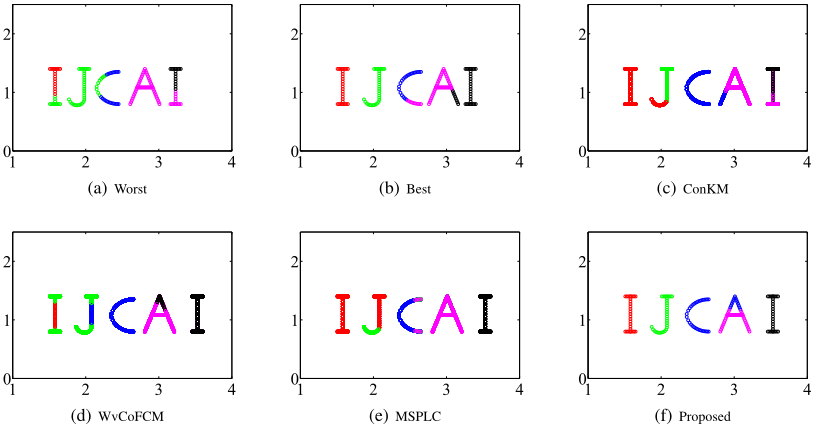
The synthetic dataset consisted of five letters (such as "I", "J", "C", "A", and "I"), which were represented by five views. The samples in each letter formed a cluster and were visualized with a color different from others. The first letter and the last letter were far away other letters in first two views, the former two letters and the last two letters were far away from other letters in other two views, and the middle letter was far away from other letters in 5th view. Figure 1 visualized the clustering results of all the methods, where all the clustering methods did not correctly output exact clustering results since the shapes of clusters are different and irregular. However, our method achieved the best clustering performance, compared to all the comparison methods. Actually, it is difficult for the comparison methods to have effective initializations on complex multi-view datasets. For example, random sampling for the initialization was unavailable to obtain initial centroid cross all the clusters, so the final clustering results easily achieved local minima or even sub-optimality. By contrast, our proposed method exactly selected all centroid since the initialization with original samples preserved the structures of the data better than random sampling methods. Thus, our method could easily achieve good clustering performance with simple initialization.
In a word, our method outperformed all the comparison methods for multi-view clustering on the synthetic dataset, which was with predefined number of clusters. The experimental results verified the advantages of our method in term of initialization sensitivity via the synthetic dataset.
3.3 Real Datasets
We used four real multi-view datasets to evaluate the practical clustering performance of our proposed method. The details of the used datasets are reported in Table 2 and the clustering results of all the methods on these datasets were reported in Table 3.
Obviously, our method achieved the best clustering performance, followed by WvCoFCM, MSPLC and ConKM. For example, the accuracy of our method improved on average by 8.71% and 12.88%, respectively, compared to the best comparison method (i.e., WvCoFCM) and the worst comparison method (i.e., ConKM) on all four datasets. The possible reason is that our method simultaneously takes three constraints into account, i.e., initialization sensitivity, the influences of outliers, and the specification of the number of clusters. By contrast, all the comparison methods only consider a part of these constraints, so that were unavailable to output robust clustering models. In particular, both our proposed method and MSPLC considered the influence of outliers, but MSPLC does not touch other constraints and only took the influence of the low-order outliers into account.
3.4 Parameters' Tuning
In this section, we investigated the variations of our method with different parameters' setting.
Firstly, we conducted experiments on our method with different parameters (k and λ) and listed the ACC results in Figure 2. The results showed that our method is sensitive a little to parameters' setting. For example, our method easily achieved the best clustering performance while setting k ∈ [10, 20] and λ ∈ [101 , 103 ] on dataset Wisconsin. This indicates that the parameters ranges of our method can be easily adjusted to achieve reasonable clustering performance.
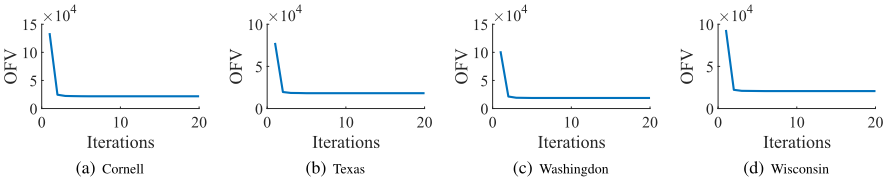
Secondly, we experimentally demonstrated the convergence of our proposed optimization algorithm to solve our objective function Eq. (7) via listing the variations of objective function values in Eq. (7) with different numbers of iterations in Figure 3. As a result, our proposed optimization algorithm fast converged within 20 iterations.
Thirdly, we conducted experiments to show the feasibility of automatically generating the number of clusters. To do this, we generated different binary matrices via tuning the parameters in our method so that our method outputted different numbers of clusters. We reported the results in Figure 4, where yellow color is the results while the number of clusters is the real classes. From Figure 4, the datasets partitioned into different numbers of clusters may yield different clustering results. Moreover, the yellow results may be worse than other results. This indicates that the real class may not be the best number of clusters. This is true in real applications because one cluster may be partitioned into multiple sub-clusters and some clusters may also be categorized into one cluster [Zhu and Martinez, 2006]. Moreover, the results in Figure 4 verified the advantages of our proposed method in terms of the specification of the number of clusters, i.e., flexibly outputting the number of clusters according to data distribution and not needing to preset the number of clusters for clustering.
4 Conclusion
In this paper, we have proposed a novel robust multi-view clustering method to deal with the issues of existing multiview clustering, such as initialization sensitivity, the influence of outliers, and the specification of the number of clusters. Experimental results on both synthetic and real datasets verified that these constraints affect clustering results as our method considering all of them outperformed the comparison methods only considering a part of these constraints.
Acknowledgements
This work was supported in part by the Nation Natural Science Foundation of China (Grants No: 61573270 and 61672177), the China Key Research Program (Grant No: 2016YFB1000905), the Guangxi Natural Science Foundation
| Datasets | Cornell | Texas | Washingdon | Wisconsin | ||||||||||||
|---|---|---|---|---|---|---|---|---|---|---|---|---|---|---|---|---|
| ACC | NMI | Purity | ARI | ACC | NMI | Purity | ARI | ACC | NMI | Purity | ARI | ACC | NMI | Purity | ARI | |
| Worst | 0.3641 | 0.0578 | 0.4308 | 0.0394 | 0.4439 | 0.2086 | 0.6043 | 0.0768 | 0.4478 | 0.0278 | 0.4652 | 0.0084 | 0.4113 | 0.0328 | 0.4679 | 0.0230 |
| Best | 0.4256 | 0.0274 | 0.4359 | 0.0081 | 0.5561 | 0.1506 | 0.5829 | 0.1673 | 0.4739 | 0.0259 | 0.4826 | 0.0076 | 0.5208 | 0.1614 | 0.5396 | 0.1808 |
| ConKM | 0.4359 | 0.2709 | 0.5744 | 0.1336 | 0.4492 | 0.2048 | 0.6086 | 0.1297 | 0.4565 | 0.0148 | 0.5696 | 0.0057 | 0.4906 | 0.0496 | 0.4981 | 0.0181 |
| WVCoFCM | 0.4513 | 0.3032 | 0.5897 | 0.1499 | 0.5027 | 0.3382 | 0.6952 | 0.2287 | 0.4913 | 0.2925 | 0.6565 | 0.2016 | 0.5509 | 0.1827 | 0.5547 | 0.1889 |
| MSPLC | 0.3995 | 0.2288 | 0.4462 | 0.0167 | 0.4385 | 0.2568 | 0.5615 | 0.0271 | 0.4774 | 0.3216 | 0.6470 | 0.2508 | 0.5102 | 0.3445 | 0.5509 | 0.0779 |
| Proposed | 0.4945 | 0.3125 | 0.6006 | 0.1482 | 0.6087 | 0.3215 | 0.7067 | 0.2378 | 0.6478 | 0.3642 | 0.7054 | 0.3379 | 0.5964 | 0.3538 | 0.6304 | 0.1791 |


(Grant No: 2015GXNSFCB139011), the Guangxi High Institutions Program of Introducing 100 High-Level Overseas Talents, the Guangxi Collaborative Innovation Center of MultiSource Information Integration and Intelligent Processing, and the Research Fund of Guangxi Key Lab of Multi-source Information Mining & Security (18-A-01-01).
@inproceedings{ijcai2018p455,
  title     = {Robust Multi-view Learning via Half-quadratic Minimization},
  author    = {Zhu, Yonghua and Zhu, Xiaofeng and Zheng, Wei},
  booktitle = {Proceedings of the Twenty-Seventh International Joint Conference on
               Artificial Intelligence, {IJCAI-18}},
  publisher = {International Joint Conferences on Artificial Intelligence Organization},
  editor    = {Jérôme Lang},
  pages     = {3278--3284},
  year      = {2018},
  month     = {7},
  note      = {Main track},
  doi       = {10.24963/ijcai.2018/455},
  url       = {https://doi.org/10.24963/ijcai.2018/455},
}
TY - CPAPER TI - Robust Multi-view Learning via Half-quadratic Minimization AU - Zhu, Yonghua AU - Zhu, Xiaofeng AU - Zheng, Wei T2 - Proceedings of the Twenty-Seventh International Joint Conference on Artificial Intelligence, IJCAI-18 PB - International Joint Conferences on Artificial Intelligence Organization PY - 2018 SP - 3278 EP - 3284 DO - 10.24963/ijcai.2018/455 UR - https://doi.org/10.24963/ijcai.2018/455 ER -Copied
Machine-readable versions of this paper, for tools and AI agents:





