
Efficiently Characterizing Non-Redundant Constraints in Large Real World Qualitative Spatial Networks
Proceedings of the Twenty-Fourth International Joint Conference on Artificial Intelligence. Special Track on Knowledge Representation and Reasoning. Pages 3229-3234.
© 2015 International Joint Conferences on Artificial Intelligence
Abstract
RCC8 is a constraint language that serves for qualitative spatial representation and reasoning by encoding the topological relations between spatial entities. We focus on efficiently characterizing non-redundant constraints in large real world RCC8 networks and obtaining their prime networks. For a RCC8 network N a constraint is redundant, if removing that constraint from N does not change the solution set of N. A prime network of N is a network which contains no redundant constraints, but has the same solution set as N. We make use of a particular partial consistency, namely, G-path consistency, and obtain new complexity results for various cases of RCC8 networks, while we also show that given a maximal distributive subclass for RCC8 and a network N defined on that subclass, the prunning capacity of G-path consistency and path consistency is identical on the common edges of G and the complete graph of N, when G is a triangulation of the constraint graph of N. Finally, we devise an algorithm based on G-path consistency to compute the unique prime network of a RCC8 network, and show that it significantly progresses the state-of-the-art for practical reasoning with real RCC8 networks scaling up to millions of nodes.
- [Allen, 1983] James F. Allen. Maintaining Knowledge about Tem- poral Intervals. Commun. ACM, 26:832-843, 1983.
- [Amaneddine et al., 2013] Nouhad Amaneddine, Jean-Franc ¸ois Condotta, and Michael Sioutis. Efficient Approach to Solve the Minimal Labeling Problem of Temporal and Spatial Qualitative Constraints. In IJCAI, 2013.
- [Bliek and Sam-Haroud, 1999] Christian Bliek and Djamila Sam- Haroud. Path consistency on triangulated constraint graphs. In IJCAI, 1999.
- [Bodirsky and Wölfl, 2011] Manuel Bodirsky and Stefan Wölfl. RCC8 is polynomial on networks of bounded treewidth. In IJCAI, 2011. IJCAI
- [Chmeiss and Condotta, 2011] Assef Chmeiss and Jean-Franc ¸ois Condotta. Consistency of Triangulated Temporal Qualitative Con- straint Networks. In ICTAI, 2011.
- [Condotta et al., 2009] Jean-Franc ¸ois Condotta, Souhila Kaci, Pierre Marquis, and Nicolas Schwind. Merging Qualitative Con- straint Networks in a Piecewise Fashion. In ICTAI, 2009.
- [Diestel, 2012] Reinhard Diestel. Graph Theory, volume 173 of Graduate Texts in Mathematics. Springer, 4th edition, 2012.
- [Duckham et al., 2014] Matt Duckham, Sanjiang Li, Weiming Liu, and Zhiguo Long. On Redundant Topological Constraints. In KR, 2014.
- [Frank, 1991] Andrew U. Frank. Qualitative Spatial Reasoning with Cardinal Directions. In ÖGAI, 1991.
- [Goodwin et al., 2008] John Goodwin, Catherine Dolbear, and Glen Hart. Geographical Linked Data: The Administrative Geography of Great Britain on the Semantic Web. TGIS, 12:19-30, 2008.
- [Guesgen, 1989] Hans Werner Guesgen. Spatial Reasoning Based on Allen's Temporal Logic. Technical report, International Com- puter Science Institute, 1989.
- [Huang et al., 2013] Jinbo Huang, Jason Jingshi Li, and Jochen Renz. Decomposition and tractability in qualitative spatial and temporal reasoning. AIJ, 195:140-164, 2013.
- [Huang, 2012] Jinbo Huang. Compactness and its implications for qualitative spatial and temporal reasoning. In KR, 2012.
- [Li et al., 2015] Sanjiang Li, Zhiguo Long, Weiming Liu, Matt Duckham, and Alan Both. On redundant topological constraints. AIJ, 225:51-76, 2015. In press.
- [Ligozat, 1998] Gerard Ligozat. Reasoning about cardinal direc- tions. J. Vis. Lang. Comput., 9(1):23-44, 1998.
- [Liu and Li, 2012] Weiming Liu and Sanjiang Li. Solving Minimal Constraint Networks in Qualitative Spatial and Temporal Reason- ing. In CP, 2012.
- [Nikolaou and Koubarakis, 2013] Charalampos Nikolaou and Manolis Koubarakis. Querying Incomplete Geospatial Informa- tion in RDF. In SSTD, 2013.
- [Nikolaou and Koubarakis, 2014] Charalampos Nikolaou and Manolis Koubarakis. Fast Consistency Checking of Very Large Real-World RCC-8 Constraint Networks Using Graph Partitioning. In AAAI, 2014.
- [OGC, 2012] OGC. GeoSPARQL -A geographic query language for RDF data. OGC R Standard, 2012.
- [Parter, 1961] Seymour Parter. The use of linear graphs in Gauss elimination. SIAM Review, 3:119-130, 1961.
- [Randell et al., 1992] David A. Randell, Zhan Cui, and Anthony Cohn. A Spatial Logic Based on Regions and Connection. In KR, 1992.
- [Renz and Ligozat, 2005] Jochen Renz and Gérard Ligozat. Weak Composition for Qualitative Spatial and Temporal Reasoning. In CP, 2005.
- [Renz and Nebel, 1999] Jochen Renz and Bernhard Nebel. On the Complexity of Qualitative Spatial Reasoning: A Maximal Tractable Fragment of the Region Connection Calculus. AIJ, 108:69-123, 1999. IJCAI
- [Renz and Nebel, 2001] Jochen Renz and Bernhard Nebel. Efficient Methods for Qualitative Spatial Reasoning. JAIR, 15:289-318, 2001.
- [Sioutis and Koubarakis, 2012] Michael Sioutis and Manolis Koubarakis. Consistency of Chordal RCC-8 Networks. In ICTAI, 2012.
- [Sioutis et al., 2015a] Michael Sioutis, Sanjiang Li, and Jean- Franc ¸ois Condotta. On Redundancy in Linked Geospatial Data. In LDQ@ESWC, 2015. To appear.
- [Sioutis et al., 2015b] Michael Sioutis, Yakoub Salhi, and Jean- Franc ¸ois Condotta. A Simple Decomposition Scheme For Large Real World Qualitative Constraint Networks. In FLAIRS, 2015. To appear.
- [Wallgrün, 2012] Jan Oliver Wallgrün. Exploiting qualitative spatial reasoning for topological adjustment of spatial data. In SIGSPA- TIAL, 2012.
References were extracted automatically from the PDF and may contain errors.
Full text extracted automatically from the PDF; figures, tables and equations may differ. The PDF is the version of record.
1 Introduction
The Region Connection Calculus (RCC) is the dominant approach in Artificial Intelligence, and Knowledge Representation in particular, for representing and reasoning about topological relations [Randell et al., 1992]. RCC can be used to describe regions that are non-empty regular subsets of some topological space by stating their topological relations to each other. RCC8 is the constraint language formed by the following 8 binary topological base relations of RCC: disconnected (DC), externally connected (EC), equal (EQ), partially overlapping (PO), tangential proper part (TPP), tangential proper part inverse (TPPi), non-tangential proper part (NTPP), and non-tangential proper part inverse (NTPPi). These 8 relations are depicted in [Randell et al., 1992, Fig. 4].
The literature has mainly focused on the satisfiability problem [Renz and Nebel, 2001] and the minimal labeling problem Jean-Franc¸ois Condotta CRIL CNRS UMR 8188
Universit´e d'Artois France condotta@cril.fr
{NT P P i}
{NT P P i}
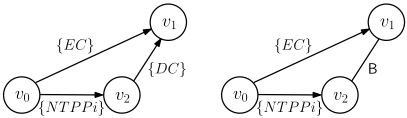
Figure 1: A RCC8 network (left) and its prime network (right)
(MLP) [Amaneddine et al., 2013; Liu and Li, 2012] of a RCC8 network. The satisfiability problem is deciding if there exists a solution, i.e., a spatial configuration satisfying the constraints of a given network, whilst the MLP is determining all the base relations participating in at least one solution for each of the constraints of that network. Recently, the important problem of deriving redundancy in a RCC8 network was considered and already well established in [Duckham et al., 2014; Li et al., 2015]. For a RCC8 network N a constraint is redundant, if removing that constraint from N does not change the solution set of N. A prime network of N is a network which contains no redundant constraints, but has the same solution set as N. Finding a prime network can be useful in many applications such as computing, storing, and compressing the relationships between spatial objects and hence saving space for storage and communication, facilitating comparison between different networks, merging networks [Condotta et al., 2009], aiding quering in spatially-enhanced databases [Nikolaou and Koubarakis, 2013; OGC, 2012], unveiling the essential network structure of a network (e.g., being a tree or of bounded treewidth [Bodirsky and W¨olfl, 2011]), and adjusting geometrical objects to meet topological constraints [Wallgr¨un, 2012]. Due to space constraints, we refer the reader to [Li et al., 2015] for a well depicted real motivational example and further application possibilities.
In [Li et al., 2015], the complexity results and algorithms obtained rely on the use of ⋄-consistency [Renz and Ligozat, 2005], which enforces consistency on all paths of length 2 in the complete graph of a given network. Hence, the approach offered becomes impractical for networks scaling up to a few tens of thousands of nodes as it is time consuming and most often hits the memory limit (preview Table 1). To solve this practical problem, we are concerned with efficiently characterizing non-redundant constraints in large real world RCC8 networks using partial reasoning. In particular, we make the following contributions: (i) we provide new complexity results for various cases of RCC8 networks with respect to deriving their non-redundant constraints and obtaining their prime networks, using a particular partial consistency that enforces consistency on all paths of length 2 in a graph G, viz., ⋄G-consistency [Chmeiss and Condotta, 2011], while we also show that given a maximal distributive subclass for RCC8 and a network N defined on that subclass, the prunning capacity of ⋄G-consistency and ⋄-consistency is identical on the common edges of G and the complete graph of N, when G is a triangulation of the constraint graph of N; (ii) as a byproduct, we show that ⋄G-consistency on a network defined on a maximal distributive subclass of relations equals to ◆G-consistency [Amaneddine et al., 2013], which can have a positive impact on the algorithm for solving the MLP of a network that was devised in [Amaneddine et al., 2013]; (iii) given a maximal distributive subclass for RCC8 and a triangulation of its constraint graph, we implement an algorithm to compute the unique prime network of very large real world RCC8 networks scaling up to millions of nodes, and show that it goes well beyond the state-of-the-art.
2 Preliminaries
A (binary) qualitative temporal or spatial constraint language [Renz and Ligozat, 2005] is based on a finite set B of jointly exhaustive and pairwise disjoint (JEPD) relations defined on a domain D, called the set of base relations. The base relations of set B of a particular qualitative constraint language can be used to represent definite knowledge between any two entities with respect to the given level of granularity. B contains the identity relation Id, and is closed under the converse operation (-1 ). Indefinite knowledge can be specified by unions of possible base relations, and is represented by the set containing them. Hence, 2B represents the total set of relations. 2B is equipped with the usual set-theoretic operations union and intersection, the converse operation, and the weak composition operation denoted by symbol ⋄ [Renz and Ligozat, 2005]. In the case of RCC8 [Randell et al., 1992], as noted in Section 1, the set of base relations B is the set {DC,EC,PO,TPP,NTPP,TPPi,NTPPi,EQ}, with EQ being relation Id. RCC8 networks can be viewed as qualitative constraint networks (QCNs), defined as follows.
Definition 1 A QCN is a pair N = (V, C) where: V is a nonempty finite set of variables; C is a mapping that associates a relation C(v, v′ ) ∈ 2B to each pair (v, v′ ) of V × V . C is such that C(v, v) = {Id} and C(v, v′ ) = (C(v′ , v))-1 .
In what follows, given a QCN N = (V,C) and v, v′ ∈ V , N[v, v′ ] will denote the relation C(v, v′ ). N[v,v′ ]/r with r ∈ 2B is the QCN N ′ defined by N ′ [v, v′ ] = r, N ′ [v′ , v] = r-1 , and N ′ [v, v′ ] = N[v, v′ ] ∀(v, v′ ) ∈ (V × V ) \ {(v, v′ ), (v′ , v)}. Given a set of variables V , ⊥VG , with G = (V, E) a graph, will denote the particular QCN where each constraint between each pair of variables (v, v′ ) ∈ E is defined by the empty relation ∅. Given a QCN N = (V, C) we have the following definitions: N is said to be trivially inconsistent iff ∃v, v′ ∈ V with N[v, v′ ] = ∅. A solution of N is a mapping σ defined from V to the domain D, yielding a spatial configuration, such that for every pair (v, v′ ) of variables in V , (σ(v), σ(v′ )) can be described by N[v, v′ ], i.e., there exists a base relation b ∈ N[v, v′ ] such that the relation defined by (σ(v), σ(v′ )) is b. Two QCNs are equivalent iff they admit the same set of solutions.
Definition 2 A QCNN is satisfiable iff it admits a solution.
A sub-QCN N ′ of N, is a QCN (V,C ′ ) such that N ′ [v, v′ ] ⊆ N[v, v′ ] ∀v, v′ ∈ V where N ′ [v, v′ ] ̸= B. If b is a base relation, then {b} is a singleton relation. An atomic QCN is a QCN where each constraint is a singleton relation. A scenario S of N is an atomic satisfiable sub-QCN of N . A partial scenario of N on V ′ ⊆ V is a scenario restricted to constraints involving only variables of V ′ .
Definition 3 ([Li et al., 2015]) A QCN N = (V, C) is weak globally consistent iff, for any V ′ ⊂ V , every partial scenario of N on V ′ can be extended to a partial scenario of N on V ′ ∪ {v} ⊆ V , for any v ∈ V \ V ′ .
Definition 4 A QCN N = (V, C) is minimal iff ∀v, v′ ∈ V and ∀b ∈ N[v, v′ ], b is a feasible base relation of N. The unique equivalent minimal sub-QCN of N , called the minimal QCN of N, is denoted by Nmin.
A base relation b ∈ N[v, v′ ] with v, v′ ∈ V is feasible (resp. unfeasible) iff there exists (resp. there does not exist) a scenario S of N such that S[v, v′ ] = {b}.
A subclass of relations is a set A ⊆ 2B closed under converse, intersection, and weak composition. In what follows, all the considered subclasses will contain the singleton relations of 2B .
Definition 5 A subclass A ⊆ 2B is a tractable subclass if a QCN N comprising only relations from A is tractable. A subclass A ⊆ 2B is a maximal tractable subclass if there is no other tractable subclass that properly contains A.
Given three relations r, r′ , and r′′ , we say that weak composition distributes over intersection if we have that r⋄(r′∩r′′ ) = (r ∩ r′ ) ⋄ (r ∩ r′′ ) and (r′ ∩ r′′ ) ⋄ r = (r′ ∩ r) ⋄ (r′′ ∩ r).
Definition 6 ([Li et al., 2015]) A subclass A ⊆ 2B is a distributive subclass if weak composition distributes over nonempty intersections for all relations r, r′ , r′′ ∈ A. A subclass A ⊆ 2B is a maximal distributive subclass if there is no other distributive subclass that properly contains A.
A QCN N is ⋄-consistent or closed under weak composition iff ∀v, v′ , v′′ ∈ V we have that N[v, v′ ] ⊆ N[v, v′′ ] ⋄ N[v′′ , v′ ]. Given a QCN N = (V, C), ⋄-consistency can be determined in O(|V |3 ) time. The ⋄-consistent QCN of N is denoted by ⋄(N), and it is equivalent to N. In what follows, all considered graphs are undirected. Given two graphs G = (V, E) and G′ = (V ′ , E′ ), G is a subgraph of G′ , denoted by G ⊆ G′ , iff V ⊆ V ′ and E ⊆ E′ . Given a QCN N = (V, C) and a graph G = (V, E), N is ⋄G-consistent [Chmeiss and Condotta, 2011] iff for ∀(v, v′ ), (v, v′′ ), (v′′ , v′ ) ∈ E we have that N[v, v′ ] ⊆ N[v, v′′ ] ⋄ N[v′′ , v′ ]. Given a QCN N = (V, C) and a graph G = (V,E), ⋄G-consistency can be determined in O(δ · |E|) time, where δ is the maximum vertex degree of G. The ⋄G-consistent QCN of N is denoted by ⋄G(N). A graph G = (V, E) is a chordal graph (or triangulated graph)
[Diestel, 2012] iff each of its cycles of length strictly greater than 3 has a chord, i.e., an edge joining two vertices that are not adjacent in the cycle. The complete graph, denoted by KV with V a set of variables, is graph G = (V,E) where E = {(v, v′ ) | v, v′ ∈ V }. The constraint graph of a QCN N = (V, C) is the graph (V, E), denoted by G(N), for which we have that (v, v′ ) ∈ E iff N[v, v′ ] ̸= B.
Checking the satisfiability of a QCN of RCC8 is NP-hard in general [Renz and Nebel, 1999]. However, there exist the maximal tractable subclasses ˆH8, C8, and Q8 for RCC8 for which the satisfiability problem becomes tractable [Renz and Nebel, 2001], as noted earlier. RCC8 also has two maximal distributive subclasses, namely, D41 8 andD64 8 , that are properly contained in ˆH8 [Li et al., 2015]. From this fact, and due to the implication of chordal graphs in the satisfiability problem in RCC8 [Sioutis and Koubarakis, 2012], we have the following result:
Proposition 1 ([Sioutis and Koubarakis, 2012]) Let N = (V,C) be a not trivially inconsistent QCN of RCC8 defined on one of the subclasses ˆH8, C8, Q8, D41 8 , or D64 8 , and G = (V,E) a graph such that G(N) ⊆ G. If G is chordal and N is ⋄G-consistent, then N is satisfiable.
Solving the minimal labelling problem for a QCN of RCC8, i.e., obtaining the minimal QCN Nmin of a QCN N of RCC8, is NP-hard in general (cf. [Liu and Li, 2012]). However, for the two maximal distributive subclasses D41 8 and D64 8 for RCC8, the minimal labelling problem becomes tractable [Li et al., 2015]. In particular we have the following result:
Proposition 2 ([Li et al., 2015]) Let N = (V,C) be a not trivially inconsistent QCN of RCC8 defined on one of the maximal distributive subclasses D41 8 , or D64 8 . If N is ⋄-consistent, then N is weak globally consistent and minimal.
Finally, let N = (V,C) and N ′ = (V ′ ,C′ ) be two QCNs such that N[v, v′ ] = N ′ [v, v′ ] for all v, v′ ∈ V ∩ V ′ . We denote by N ′ ∪ N the QCN N ′′ = (V ′′ ,C′′ ), where V ′′ = V ∪ V ′ , N ′′ [v, v′ ] = N[v, v′ ] for all v, v′ ∈ V \ V ′ , N ′′ [v, v′ ] = N ′ [v, v′ ] for all v, v′ ∈ V ′ \ V , and N ′′ [v, v′ ] = N ′′ [v′ , v] = B for all v ∈ V ′ \ V , v′ ∈ V \ V ′ .
3 Prime Network in RCC8
In this section we give the definitions of a redundant relation in a QCN N of RCC8 and a prime QCN of N, and provide new complexity results and algorithms for finding a prime QCN of N when N is defined on a non-tractable, a maximal tractable, or a maximal distributive subclass for RCC8.
Given a QCN N = (V, C), we say that N entails a relation r(v, v′ ) ∈ 2B , with v, v′ ∈ V , if for every solution σ of N, the relation defined by (σ(v), σ(v′ )) is a base relation b such that b ∈ r(v, v′ ). A relation N[v, v′ ] in N is redundant if network N[v,v′ ]/B entails N[v, v′ ]. Note that by definition every universal relation B in a QCN is redundant. Recalling the fact that the constraint graph of a QCN involves all the non-universal relations, we can obtain the following lemma:
Lemma 1 Given a QCN N = (V,C) and its constraint graph G(N) = (V,E), a relation N[v, v′ ] with v, v′ ∈ V is redundant if (v, v′ ) ̸∈ E.
We recall the definition of a reducible and a prime QCN.
Definition 7 ([Li et al., 2015]) A QCN N = (V,C) is reducible if it comprises a redundant relation other than relation B, and irreducible otherwise. An equivalent irreducible subQCN of N, is called a prime QCN of N. If a prime QCN of N is also unique, it is denoted by Nprime.
In Figure 1 a QCN N of RCC8 and its prime QCN are depicted. Relation {DC} is redundant as it can be entailed by N[v1,v2]/B and, thus, can be replaced with relation B (that denotes the lack of a constraint between two entities in a QCN).
3.1 RCC8 networks in the general case
Given an arbitrary QCN N of RCC8, finding a prime QCN of N is clearly at least as hard as determining if N is reducible. We then have the following result, which relies on the fact that retrieving a solution for a QCN of RCC8 is NP-hard in general [Renz and Nebel, 1999]:
Proposition 3 ([Li et al., 2015]) Let N = (V, C) be a QCN of RCC8. It is co-NP-complete to decide if N[v, v′ ], with v, v′ ∈ V , is redundant in N.
However, we can have a stronger theoretical result than that for QCNs of RCC8 of bounded treewidth. The width of a tree decomposition (T, {X1, . . . ,Xn}) [Diestel, 2012] is max 1≤i≤n|Xi| - 1. The treewidth of a graph G is the minimum width possible for arbitrary tree decompositions of G.
Theorem 1 ([Bodirsky and W¨olfl, 2011]) For any k, the satisfiability problem for a QCN of RCC8 of treewidth at most k can be solved in polynomial time.
A detailed algorithm for Theorem 1 that builds on the proof sketch of [Bodirsky and W¨olfl, 2011] is provided in [Huang et al., 2013]. In particular, the satisfiability check can be made in O(w3 ·|V |·cw2 · log |V | ) time for a QCN N = (V, C) of RCC8, where w is the treewidth of G(N) and c a constant such that |B||V |·|V -1|/2 ≤ c|V |2 , with the algorithm provided in [Huang et al., 2013]. We then have the following result:
Proposition 4 Let N = (V,C) be a QCN of RCC8 of bounded treewidth. It takes polynomial time to decide if N[v, v′ ], with v, v′ ∈ V , is non-redundant in N.
Proof. Let r = B \ N[v, v′ ], viz., the set of base relations not included in N[v, v′ ]. To check if N[v, v′ ] is non-redundant in N, we must check if N[v,v′ ]/r is satisfiable. This satisfiability check can be made in polynomial time due to Theorem 1. ⊣
The obtained bound for the algorithm for Theorem 1 does not allow for practical applicability of Proposition 4, for which we are interested in this paper, but, nevertheless, is of theoretical merit. To check if a QCN N of RCC8 is reducible, we need to check O(E(G(N))) relations as suggested by Lemma 1. Thus, due to Proposition 4 we can obtain a prime network in polynomial time with a simple procedure similar to the one provided in [Li et al., 2015, p. 60].
3.2 RCC8 networks defined on a maximal tractable subclass
Given a QCN N of RCC8 that is defined on a maximal tractable subclass for RCC8, finding a prime QCN of N takes polynomial time. In particular, we have the following result:
Proposition 5 Let N = (V, C) be a QCN of RCC8 defined on one of the maximal tractable subclasses ˆH8, C8, or Q8, G(N) = (V,E′ ) its constraint graph, and G = (V,E) a chordal graph such that G(N) ⊆ G. We can determine if a relation is non-redundant in N in O(δ · |E|) time, where δ denotes the maximum vertex degree of G, and in O(δ·|E|·|E′ |) time find all non-redundant relations in N. In addition, a prime QCN of N can be found in O(δ · |E| · |E′ |) time.
Proof. Let r = B \ N[v, v′ ], where N[v, v′ ] with (v, v′ ) ∈ E′ is a non-universal relation in N. To check if relation N[v, v′ ] is non-redundant in N, we must check if there ∃b ∈ r such that N[v,v′ ]/{b} is satisfiable. If such b exists, N[v, v′ ] is non-redundant in N. Due to Proposition 1, satisfiability checking can be done in O(δ·|E|) time with the ⋄G-consistency operation, and as we can have a check for at most a constant number of |B| base relations, the complexity remains O(δ·|E|). By Lemma 1, we need only perform the non-redundancy check for a total of O(E′ ) relations. Thus, finding all non-redundant relations takes O(δ · |E| · |E′ |) time, and, as a consequence, we can obtain a prime network in O(δ · |E| · |E′ |) time using a simple procedure like the one provided in [Li et al., 2015, p. 60]. ⊣
As noted in [Li et al., 2015], calculating Nprime for a QCN N of RCC8 defined on a maximal tractable subclass is not always possible, as N may have more than one prime network. To obtain Nprime we need N to be defined on a maximal distributive subclass, which we will study in the sequence.
3.3 RCC8 networks defined on a maximal distributive subclass
Given a QCN N of RCC8 that is defined on a maximal distributive subclass for RCC8, we will show that we can find Nprime with an algorithm that goes well beyond the state-ofthe-art algorithm presented in [Li et al., 2015]. To be able to do so, we will first present a result that is similar to a main result of [Bliek and Sam-Haroud, 1999], namely, we will show that for a maximal distributive subclass for RCC8 and a QCN N defined on that subclass, the prunning capacity of ⋄G-consistency and ⋄-consistency is identical on the common edges of a chordal graph G with G(N ) ⊆ G and the complete graph of N. As a consequence, we will also briefly explain the implication of this result in the minimal labelling problem (MLP) of a QCN of RCC8 [Amaneddine et al., 2013].
First, we recall the following lemma that will allow us to make a chordal graph complete by adding a single edge at a time and keeping all intermediate graphs chordal:
Lemma 2 ([Bliek and Sam-Haroud, 1999]) If G = (V,E) is a non-complete chordal graph, then one can add a missing edge (u, v) with u, v ∈ V such that the graph G′ = (V, E ∪ {(u, v)}) is chordal and the graph induced by X = {x | (u, x), (x, v) ∈ E} is complete.
We now proceed with proving the following result:
Proposition 6 Let N = (V, C) be a not trivially inconsistent QCN of RCC8 defined on one of the maximal distributive subclasses D41 8 , or D64 8 , and G = (V,E) a chordal graph such that G(N) ⊆ G. Then, ∀(v, v′ ) ∈ E we have that ⋄(N)[v, v′ ] = ⋄G(N)[v, v′ ].
Proof. Suppose that N is ⋄G-consistent. We consider only the case where ⋄G-consistency did not result in the assignment of the empty relation ∅ for some edge in G, i.e., the case where N is satisfiable, as otherwise we would have that ⋄(N) = ⊥VKV , ⋄G(N) = ⊥VG , and as a consequence ∀(v, v′ ) ∈ E trivially have that ⋄(N)[v, v′ ] = ⋄G(N)[v, v′ ] = ∅, as desired. We will add to graph G the missing edges one by one until it becomes complete. We will show that the relations that correspond to the new edges can be computed from existing relations, so that for each intermediate chordal graph G′ network N is ⋄G′ -consistent, and for the final complete graph KV network N is therefore ⋄KV -consistent, that is, ⋄-consistent. Every edge is added according to Lemma 2 to retain a chordal graph at all times. Consider graph G as shown below.
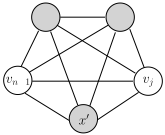
After adding edge e = (vn-1, vj) to G we obtain graph G′ = (V,E ∪ {e}). (As e ̸∈ E, initially N[vn-1, vj] = B.) Let X = {x | (vn-1, x), (x, vj) ∈ E} be the set of variables that induce a complete graph and are denoted in grey colour in our figure. We will show that the relation corresponding to edge e can be computed as follows:
Note that by construction graphs A induced by {vn-1} ∪ X and B induced by X∪{vj} are complete. Let us denote by NA and NB the QCNs of RCC8 that correspond to graphs A and B respectively. We need to show that network N is ⋄G′ -consistent. In particular, we need to show that every path π of length 2 that goes through vn-1 and vj is consistent, as every other path of length 2 is by assumption consistent. We need to consider two cases (reasoning is the same for symmetrical cases). With x′ ∈ X, either π = 〈vn-1, vj, x′ 〉, or π = 〈vn-1, x′ , vj〉. If π = 〈vn-1, vj, x′ 〉, we prove that for every base relation of N[vn-1, x′ ], there exist base relations for both N[vn-1, vj] as defined in (1) and N[vj, x′ ], so that the path is consistent (i.e., N[vn-1, x′ ] ⊆ N[vn-1, vj] ⋄ N[vj, x′ ]). As graph A is complete, NA is ⋄-consistent, and therefore due to Proposition 2, NA is weak globally consistent and minimal. Thus, for every base relation of N[vn-1, x′ ] there exist compatible base relations for all other constraints in NA, i.e., there exists a scenario for NA, denoted by N S A . As V (A)∩V (B) = X induces a complete graph, the assignment of base relations for every constraint in NA will define a partial scenario for NB on X. Again, as graph B is complete, NB is ⋄-consistent, and therefore due to Proposition 2, NB is weak globally consistent and minimal, thus, this partial scenario can be extented to a scenario for NB, denoted by N S B . As such, N [vj , x′ ] will be also characterized by a base relation. Finally, relations N[vn-1, x] and N[x, vj] for all x ∈ X participating in (1) will be characterized by base relations, thus, there exists a base relation for N[vn-1, vj] too as clearly N S A ∪N S B is ⋄G-consistent and, thus, satisfiable due to Proposition 1. If π = 〈vn-1, x′ , vj〉, by equation (1) we know that for every base relation of N[vn-1, vj] we can find base relations for N[vn-1, x′ ] and N[x′ , vj], so that N[vn-1, vj] ⊆ N [vn-1, x′ ] ⋄ N [x′ , vj ] can hold. ⊣
Given a not trivially inconsistent QCN N = (V,C) of RCC8 defined on one of the maximal distributive subclasses D41 8 , or D64 8 , and G = (V,E) a chordal graph such that G(N) ⊆ G, due to Proposition 2 and Proposition 6 we have that ∀(v, v′ ) ∈ E every base relation b ∈ ⋄G(N)[v, v′ ] is feasible. As a consequence we have the following result:
Proposition 7 Let N = (V, C) be a not trivially inconsistent QCN of RCC8 defined on one of the maximal distributive subclasses D41 8 , or D64 8 , and G = (V,E) a chordal graph such that G(N) ⊆ G. Then, N is ◆G-consistent [Amaneddine et al., 2013] iff it is ⋄G-consistent.
In [Amaneddine et al., 2013], given a QCN N of RCC8 and a chordal graph G = (V,E) such that G(N) ⊆ G, ◆G-consistency is a partial consistency that is applied to characterize the feasible base relations ∀N[u, v] with (u, v) ∈ E. It is shown that if N is defined on a maximal tractable subclass ˆH8, C8, or Q8, computing ◆G-consistency takes O(δ·|E|2 ) time, where δ is the maximum vertex degree of G. Proposition 7 suggests that if we restrict N to a maximal distributive subclass D41 8 , or D64 8 , ◆G-consistency can be computed in O(δ·|E|) time. As ◆G-consistency is used in an algorithm for solving the MLP in [Amaneddine et al., 2013], this result can have a positive impact on its performance, which is out of the scope of this paper to explore.
Let us now introduce a property that will hold for all the considered QCNs in what follows.
Property 1 ([Li et al., 2015]) Let N = (V,C) be a satisfiable QCN of RCC8. Then, N will be said to satisfy the uniqueness property iff ∀u, v ∈ V , with u ̸= v, we have that N does not entail a relation r ⊆ N[u, v] where r = {EQ}.
The uniqueness property specifies that every region in a QCN of RCC8 should be unique and not identical to any other region. This property establishes a very weak condition in the sense that we can eliminate all entailed singleton {EQ} relations from a given QCN of RCC8 and retain its knowledge by reducing the spatial variables that are identical to each other into a single variable, maintaining all involved relations. This is a necessary condition to be able to obtain the unique prime network of a QCN [Li et al., 2015]. Before obtaining another result in this section, we recall the following lemma:
Lemma 3 ([Li et al., 2015]) Let N = (V,C) be a not trivially inconsistent QCN of RCC8 defined on one of the maximal distributive subclasses D41 8 , or D64 8 , and having the uniqueness property. If N is ⋄-consistent, then a relation N[v, v′ ], with v, v′ ∈ V , is non-redundant in N iff we have that N[v, v′ ] ̸= ⋂{N[v, v′′ ] ⋄ N[v′′ , v′ ] | v′′ ∈ V \ {v, v′}}.
We will now prove a result that allows us to obtain the same set of non-redundant relations as the one provided by Lemma 3, more efficiently, through the use of chordal graphs.
Proposition 8 Let N = (V, C) be a not trivially inconsistent QCN of RCC8 defined on one of the maximal distributive subclasses D41 8 , or D64 8 , and having the uniqueness property, and G = (V,E) a graph such that G(N) ⊆ G. If G is chordal and N is ⋄G-consistent, then a relation ⋄(N)[v, v′ ] is non-redundant in ⋄(N) (i.e., the ⋄-consistent network N as in Lemma 3), iff we have that (v, v′ ) ∈ E(G(N)) and N[v, v′ ] ̸= ⋂{N[v, v′′ ] ⋄ N[v′′ , v′ ] | (v, v′′ ), (v′′ , v′ ) ∈ E}.
Proof. By Lemma 1 and the fact that for a QCN M of RCC8, ⋄(M) andMare equivalent, it trivially follows that if (v, v′ ) ̸∈ E(G(N)) then ⋄(N)[v, v′ ] is redundant in ⋄(N). We will show that we can have the same set of non-redundant relations as the one suggested in Lemma 3. Let ⋄(N)[v, v′ ] with (v, v′ ) ∈ E(G(N)) be a relation in ⋄(N), then by Proposition 6 we have that ⋄(N)[v, v′ ] = ⋄G(N)[v, v′ ] (= N[v, v′ ]). Let G′ = (V, E′ = E ∪ {e}) be the chordal graph that results by adding edge e = (u, v′ ) to G according to Lemma 2. It suffices to show that the next equation holds:
Equation (2) states that N[v, v′ ] is strictly contained in the intersection of all paths of length 2 that start with v and end with v′ in G iff N[v, v′ ] is strictly contained in the intersection of all paths of length 2 that start with v and end with v′ in G′ . If (2) holds, it follows that we can add all edges necessary to obtain the paths of length 2 that start with v, end with v′ , and go through every v′′ ∈ V \ {v, v′}, and have that ⋂{⋄G(N)[v, v′′ ] ⋄ ⋄G(N)[v′′ , v′ ] | (v, v′′ ), (v′′ , v′ ) ∈ E} = ⋂{⋄(N)[v, v′′ ] ⋄ ⋄(N)[v′′ , v′ ] | v′′ ∈ V \ {v, v′}}, so that the necessary and sufficient conditions specified in Lemma 3 and Proposition 8 are equivalent with respect to deciding the redundancy of ⋄(N)[v, v′ ]. We will assume that (2) does not hold and result in a contradiction. In particular, we will assume that b is a base relation that is in the intersection of all paths of length 2 that start with v and end with v′ in G, but not in the intersection of all paths of length 2 that start with v and end with v′ in G′ . Clearly, this is only possible when b ̸∈ N[v, u] ⋄ N[u, v′ ], where new relation N[u, v′ ] is computed according to (1) in the proof of Proposition 6, i.e., N[u, v′ ] is the intersection of all paths of length 2 that start with u and end with v′ in G. Thus, a path π = 〈u, x, v′ 〉 exists in G such that b ̸∈ N [v, u]⋄N [u, x]⋄N [x, v′ ]. Then, we have that b ̸∈ N[v, x] ⋄ N[x, v′ ]. However, both (v, x) and (x, v′ ) are in G and we already know that b ∈ N[v, v′′ ] ⋄ N[v′′ , v′ ] for all v′′ ∈ V such that (v, v′′ ), (v′′ , v′ ) ∈ E, thus, b ∈ N[v, x] ⋄N[x, v′ ]. This is a contradiction, thus, (2) holds. ⊣
The set of non-redundant relations as provided by Lemma 3 and Proposition 8 is related to the unique prime network of a QCN N of RCC8, viz., Nprime, as follows:
Theorem 2 ([Li et al., 2015]) Let N = (V,C) be a satisfiable QCN of RCC8 defined on one of the maximal distributive
Algorithm 1: Delphys▽(N )
| network | Delphys | Delphys▽ | speedup (%) |
|---|---|---|---|
| nuts | 0.26s | 0.19s | 26.9% |
| adm1 | 25 536.93s | 222.33s | 99.1% |
| gadm1 | 140 685.26s | 329.43s | 99.8% |
| gadm2 | 9.18s | 2.34s | 74.5% |
| adm2 | ∞ | 1 069.51s | ∼ 100% |
subclasses D41 8 , or D64 8 , and having the uniqueness property. Further, let χ be the set of non-redundant relations in ⋄(N). Then, ∀u, v ∈ V we have that Nprime[u, v] = N[u, v] if ⋄(N)[u, v] ∈ χ and Nprime[u, v] = B otherwise.
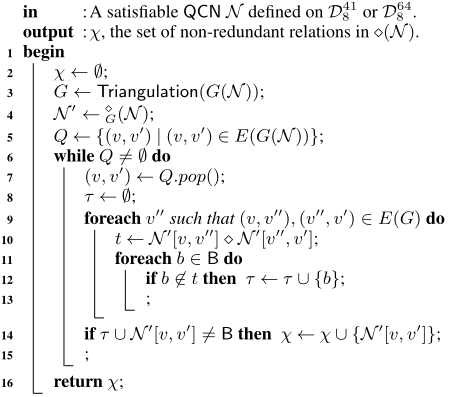
An algorithm based on Lemma 3 to obtain the set of nonredundant relations was provided in [Li et al., 2015] with a time complexity of O(|V |3 ) for a given QCN N = (V, C) of RCC8, which we here call Delphys. Due to Proposition 8, we can have a new algorithm with a time complexity of O(δ · |E|) for a chordal graph G = (V, E) such that G(N) ⊆ G, where δ denotes its maximum vertex degree, as the triangulation procedure in line 3 is linear in the size of G [Parter, 1961; Diestel, 2012] and ⋄G-consistency in line 4 dominates the overall complexity. Our new algorithm is presented in Algorithm 1, under the name Delphys▽.
4 Experimental Evaluation
In this section, we compare the performance of Delphys▽ with that of Delphys [Li et al., 2015] using a real dataset. The experiments were carried out on a computer with an Intel Core 2 Quad Q9400 processor with a CPU frequency of 2.66 GHz per core, 8 GB RAM, and the Precise Pangolin x86 64 OS. Both Delphys▽ and Delphys were written in pure Python and run with with PyPy 2.4.0 (http://pypy.org/). Only one of the CPU cores was used.
We consider the dataset of real network instances that was originally introduced in [Nikolaou and Koubarakis, 2014]:
· nuts: a nomenclature of territorial units using RCC8
| network | initial # of relations | non-redundant # of relations | decrease (%) |
|---|---|---|---|
| nuts | 3 176 | 2 249 | 29.19% |
| adm1 | 44 832 | 44 601 | 0.52% |
| gadm1 | 159 600 | 158 440 | 0.73% |
| gadm2 | 589 573 | 292 331 | 50.42% |
| adm2 | 5 236 270 | 1 798 132 | 65.66% |
relations that contains 2 235/3 176 nodes/edges. 1
- adm1: a network that describes the administrative geography of Great Britain using RCC8 relations [Goodwin et al., 2008] and contains 11 761/44 832 nodes/edges.
- gadm1: a network that describes the German administrative units using RCC8 relations and contains 42 749/159 600 nodes/edges.
- gadm2: a network that describes the world's administrative areas using RCC8 relations and contains 276727/589573 nodes/edges (http://gadm.geovocab. org/).
- adm2: a network that describes the Greek administrative geography using RCC8 relations and contains 1 732 999/5 236 270 nodes/edges. 1
The aforementioned network instances are satisfiable. They comprise relations that are properly contained in any of the two maximal distributive subclasses D41 8 and D64 8 for RCC8. (Also, some identical regions were properly amalgamated to satisfy the uniqueness property.)
The results on the performance of Delphys▽ and Delphys are shown in Table 1. 2 Note that symbol ∞ signifies that a reasoner hits the memory limit. The speedup for Delphys▽ reaches as high as nearly 100% for the cases where Delphys was actually able to reason with the networks (e.g., gadm1). Table 2 shows the decrease that we can achieve with respect to the total number of non-redundant relations that we can obtain from an initial network, which allows one to construct sparse constraint graphs that boost various graph related tasks such as storing, querying, representing, and reasoning. Note that the constraint graphs of the initial networks are sparse, thus, a lot of redundancy is already avoided. Still, for the biggest network of the dataset, namely, adm2, the decrease is around 66%, which is almost linear to the number of its vertices, confirming a similar observation in [Li et al., 2015].
5 Conclusion
We made use of ⋄G-consistency [Chmeiss and Condotta, 2011] to obtain new complexity results for various cases of RCC8 networks with respect to deriving their non-redundant constraints and obtaining their prime networks, while we also showed that given a maximal distributive subclass for RCC8 and a network N defined on that subclass, the prunning capacity of ⋄G-consistency and ⋄-consistency is identical on the common edges of G and the complete graph of N, when G is a triangulation of G(N). As a byproduct, we showed that ⋄G-consistency on a network defined on a maximal distributive subclass of relations equals to ◆G-consistency [Amaneddine et al., 2013]. Given a maximal distributive subclass for RCC8, we devised an algorithm based on ⋄G-consistency to compute the unique prime network of a RCC8 network, and showed that it significantly progresses the state-of-the-art for practical reasoning with very large real RCC8 networks.
1 Retrieved from: http://www.linkedopendata.gr/
2 As Delphys relies on ⋄-consistency and consequently uses an adjacency matrix to store the complete graph of a given network that forbids it from being able to consider networks of more than a few tens of thousands of nodes, its operation was appropriately aided with the simple decomposition scheme of [Sioutis et al., 2015b], as described in [Sioutis et al., 2015a]. The same decomposition scheme was applied to Delphys▽ too, to maintain a fair comparison. However, Delphys▽ did not really benefit from that scheme, as it uses an adjacency list to store a chordal graph of a given network and it was already very time/memory efficient for the involved instances.
A Generalization to other Calculi
As RCC5 is a sublanguage of RCC8 where no significance is attached to boundaries of regions [Randell et al., 1992], all results in this paper immediately carry over to RCC5 with respect to its own particularities, such as its maximal tractable and maximal distributive subclasses.
All results, except that of Theorem 2 which uses some particular algebraic properties of RCC5/8, can be applied to several other qualitative spatial constraint calculi, such as the Cardinal Direction Calculus [Frank, 1991; Ligozat, 1998], the Block Algebra [Guesgen, 1989], and even the Interval Algebra [Allen, 1983] when viewed as a spatial calculus, again, with respect to their own particularities. In fact, it can be shown that the aforementioned results can be applied to any qualitative spatial constraint calculus that is a relation algebra and has patchwork for networks defined on one of its maximal tractable subclasses of relations [Huang, 2012]. This is due to the fact that the sound use of ⋄G-consistency, when G is a triangulation of the constraint graph of a given network, implicitly considers patchwork for the involved qualitative spatial constraint calculus [Amaneddine et al., 2013, Property 1].
@inproceedings{ijcai2015p455,
  title     = {Efficiently Characterizing Non-Redundant Constraints in Large Real World Qualitative Spatial Networks},
  author    = {Sioutis, Michael and Li, Sanjiang and Condotta, Jean-François},
  booktitle = {Proceedings of the Twenty-Fourth International Joint Conference on
               Artificial Intelligence, {IJCAI-15}},
  publisher = {International Joint Conferences on Artificial Intelligence},
  editor    = {Qiang Yang and Michael Wooldridge},
  pages     = {3229--3234},
  year      = {2015},
  month     = {7},
  note      = {Special Track on Knowledge Representation and Reasoning},
  url       = {https://ijcai.org/proceedings/2015/455},
}
TY - CPAPER TI - Efficiently Characterizing Non-Redundant Constraints in Large Real World Qualitative Spatial Networks AU - Sioutis, Michael AU - Li, Sanjiang AU - Condotta, Jean-François T2 - Proceedings of the Twenty-Fourth International Joint Conference on Artificial Intelligence, IJCAI-15 PB - International Joint Conferences on Artificial Intelligence PY - 2015 SP - 3229 EP - 3234 UR - https://ijcai.org/proceedings/2015/455 ER -Copied
Machine-readable versions of this paper, for tools and AI agents:





