
Tracking Political Elections on Social Media: Applications and Experience
Proceedings of the Twenty-Fourth International Joint Conference on Artificial Intelligence. Main Track. Pages 2320-2325.
© 2015 International Joint Conferences on Artificial Intelligence
Abstract
In recent times, social media has become a popular medium for many election campaigns. It not only allows candidates to reach out to a large section of the electorate, it is also a potent medium for people to express their opinion on the proposed policies and promises of candidates. Analyzing social media data is challenging as the text can be noisy, sparse and even multilingual. In addition, the information may not be completely trustworthy, particularly in the presence of propaganda, promotions and rumors. In this paper we describe our work for analyzing election campaigns using social media data. Using data from the 2012 US presidential elections and the 2013 Philippines General elections, we provide detailed experiments on our methods that use granger causality to identify topics that were most “causal” for public opinion and which in turn, give an interpretable insight into “elections topics” that were most important. Our system was deployed by the largest media organization in the Philippines during the 2013 General elections and using our work, the media house able to identify and report news stories much faster than competitors and reported higher TRP ratings during the election.
- [Agrawal et al., 1993] Rakesh Agrawal, Tomasz Imieliński, and Arun Swami. Mining association rules between sets of items in large databases. In Proceedings of the 1993 ACM SIGMOD International Conference on Management of Data, SIGMOD '93, pages 207-216, New York, NY, USA, 1993. ACM.
- [Bhatt et al., 2010] Rushi Bhatt, Vineet Chaoji, and Rajesh Parekh. Predicting product adoption in large-scale social networks. In Proceedings of ACM international confer- ence on Information and knowledge management, pages 1039-1048, 2010.
- [Bollen et al., 2011] Johan Bollen, Huina Mao, and Xiao- Jun Zeng. Twitter mood predicts the stock market. Journal of Computational Science, 2(1):1-8, 2011.
- [Bothos et al., 2010] Efthimios Bothos, Dimitris Apostolou, and Gregoris Mentzas. Using social media to predict fu- ture events with agent-based markets. IEEE Intelligent Systems, 25(6):50-58, 2010.
- [Chung and Mustafaraj, 2011] Jessica Elan Chung and Eni Mustafaraj. Can collective sentiment expressed on twit- ter predict political elections? In Proceedings of the AAAI Conference on Artificial Intelligence, 2011.
- [Contractor and Faruquie, 2013] Danish Contractor and Tan- veer Afzal Faruquie. Understanding election candidate approval ratings using social media data. In Proceedings of the 22nd international conference on World Wide Web companion, pages 189-190. International World Wide Web Conferences Steering Committee, 2013.
- [Finn et al., 2014] S Finn, PT Metaxas, E Mustafaraj, M OKeefe, L Tang, S Tang, and L Zeng. Trails: A sys- tem for monitoring the propagation of rumors on twitter. Computation and Journalism Symposium, NYC, NY, 2014.
- [Gayo-Avello et al., 2011] Daniel Gayo-Avello, Panagio- tis T. Metaxas, and Eni Mustafaraj. Limits of Electoral Predictions Using Twitter. In International AAAI Confer- ence on Weblogs and Social Media (posters), July 2011.
- [Gayo-Avello, 2012] Daniel Gayo-Avello. I wanted to pre- dict elections with twitter and all i got was this lousy pa- per -a balanced survey on election prediction using twitter data. 2012.
- [Granger, 1969] C. W. J. Granger. Investigating Causal Rela- tions by Econometric Models and Cross-spectral Methods. Econometrica, 37(3):424-438, August 1969.
- [Jungherr et al., 2012] A. Jungherr, P. Jürgens, and H. Schoen. Why the pirate party won the german election of 2009 or the trouble with predictions: A re- sponse to tumasjan, a., sprenger, to, sander, pg, & welpe, im predicting elections with twitter: What 140 characters reveal about political sentiment. Social Science Computer Review, 30(2):229-234, 2012.
- [Krishnamurthy et al., 2009] Rajasekar Krishnamurthy, Yunyao Li, Sriram Raghavan, Frederick Reiss, Shivaku- mar Vaithyanathan, and Huaiyu Zhu. Systemt: A system for declarative information extraction. SIGMOD Rec., 37(4):7-13, March 2009.
- [O'Connor et al., 2010] Brendan O'Connor, Ramnath Bala- subramanyan, Bryan R. Routledge, and Noah A. Smith. From tweets to polls: Linking text sentiment to public opinion time series. In Proceedings of the International Conference on Weblogs and Social Media (ICWSM), 2010.
- [Osborne and Dredze, 2014] Miles Osborne and Mark Dredze. Facebook, twitter and google plus for breaking news: Is there a winner? In Eighth International AAAI Conference on Weblogs and Social Media, 2014.
- [Petrovic et al., 2013] Sasa Petrovic, Miles Osborne, Richard McCreadie, Craig Macdonald, and Iadh Ounis. Can twitter replace newswire for breaking news? 2013.
- [Rill et al., 2014] Sven Rill, Dirk Reinel, Jörg Scheidt, and Roberto V. Zicari. Politwi: Early detection of emerging political topics on twitter and the impact on concept-level sentiment analysis. Knowl.-Based Syst., 69:24-33, 2014.
- [Sadilek et al., 2012] A. Sadilek, H. Kautz, and V. Silenzio. Predicting disease transmission from geo-tagged micro- blog data. In Twenty-Sixth AAAI Conference on Artificial Intelligence, 2012.
- [Sang and Bos, 2012] Erik Tjong Kim Sang and Johan Bos. Predicting the 2011 dutch senate election results with twit- ter. In Proceedings of the Workshop on Semantic Analysis in Social Media, 2012.
- [Tumasjan et al., 2010] A. Tumasjan, T. O. Sprenger, P. G. Sandner, and I. M. Welpe. Predicting elections with twit- ter: What 140 characters reveal about political sentiment. In Proceedings of the Fourth International AAAI Confer- ence on Weblogs and Social Media, pages 178-185, 2010.
- [William and Gulati, 2008] C William and G Gulati. What is a social network with facebook and vote share in the 2008 presidential primaries. In Annual Meeting of American Po- litical Science Association, 2008.
- [Wolf et al., 2009] Timo Wolf, Adrian Schroter, Daniela Damian, and Thanh Nguyen. Predicting build failures us- ing social network analysis on developer communication. In Proceedings of International Conference on Software Engineering, 2009.
- [Xie et al., 2014] Runquan Xie, Feida Zhu, Hui Ma, Wei Xie, and Chen Lin. Clear: A real-time online observa- tory for bursty and viral events. Proc. VLDB Endow., 7(13):1637-1640, August 2014.
References were extracted automatically from the PDF and may contain errors.
Full text extracted automatically from the PDF; figures, tables and equations may differ. The PDF is the version of record.
1 Introduction
Social Media often complements or supercedes existing sources of information because of the variety of interactions, speed of availability and the collective expression of people. This is particularly true for applications which require analyzing information from a large number of people. Social media is thus becoming an increasingly popular medium for many election campaigns. On one hand it allows a candidate to mass communicate and reach out to a large section of the electorate, on the other hand it provides a medium for people to express their opinion on the proposed policies and Sameep Mehta IBM Research New Delhi sameepmehta@in.ibm.com
Tanveer A. Faruquie
IBM T.J. Watson Research Center Yorktown Heights, New York tafaruqu@us.ibm.com
promises of candidates. The resulting interaction that builds up to the day of the election provides a goldmine of information which can be used to analyze the political campaign, gauge public sentiment and establish causality between policies and peoples perception. Indeed, the successful application of online campaigns such as the 2008 Presidential Elections in the US, 2012 London Mayoral elections and the recent 2014 Indian Prime Ministerial Elections have shown the importance of online political opinions. However, analyzing social media comes with its own set of challenges. Much of the data is encoded in text, which is noisy, sparse and unstructured and sometimes even multilingual. Further, the information itself may not be completely trustworthy, particularly in the presence of propaganda, promotions and rumours. Moreover, the views of the people often swing because of external events.
Given the national prominence of elections and the influence of social media, the area has attracted the attention of several researchers. Their work ranges from using simple statistics to sophisticated linguistic analysis to predict the outcomes of elections[Gayo-Avello, 2012; Jungherr et al., 2012; O'Connor et al., 2010; Chung and Mustafaraj, 2011; William and Gulati, 2008; Sang and Bos, 2012]. Social media has also been used to better design election campaigns 1 , reach out to supporters, raise money and analyze social expression as a feedback mechanism to improve the election campaigns. Work such as [Osborne and Dredze, 2014; Petrovic et al., 2013] study whether information available on Twitter and other social media is indeed different from information available from other news sources.
In this paper we describe our work for analyzing election campaigns using social media data. Using data collected from the 2012 US Presidential Election and 2013 Filipino Election we describe our methods and experiments for detecting topics and sentiments that are important in an election. Our system identifies short term trending topics (emerging topics) as well as long-term topics, topics that are significant in a larger course of time. Our work was deployed live by ABS-CBN Corporation 2 , which is the largest media house in Phillipines, during its coverage of the 2013 Filipino general elections. Reporters using our system were able to identify breaking news stories and run them much ahead of their competitors (Details in section 3).
1 For eg: http://www.salesforce.com/uk/socialsuccess/socialmedia/london-mayoral-election-2012.jsp
In summary, our paper makes the following contributions :
- To the best of our knowledge, we are the first to actively deploy a system live in an election and demonstrate how social media data can be used to detect potential news stories that can be used by other main stream media.
- We describe our language independent methods for identifying topics that are most influential in elections and present experiments using two election data sets.
- Lastly, since there exists a large body of literature that uses social media data for prediction, we present our experiments on predicting election candidate approval ratings using causal topics identified by our system. While we do not claim our system can be used as a replacement of offline opinion polls and electoral surveys, our system can possibly be used as one more source to gauge the mood of the crowd during an election campaign.
The rest of our paper is organized as follows - the next section describes details of our system. In Section 3 we describe some experiments and results, in section 4 we review some related work and in section 5 we conclude the paper.
2 System
This section describes the implementation details and the methods employed for topic trend identification and candidate approval rating prediction.
2.1 Architecture
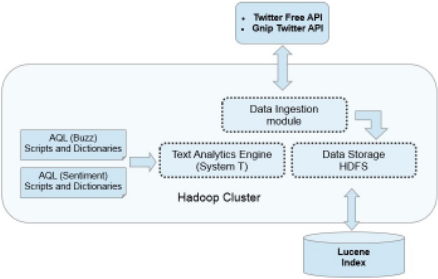
Our system was designed to analyze large amounts data from the social media 3 . We used a multi-node Hadoop cluster for building our system. Hadoop supports the processing of large amounts of data in a distributed fashion on a cluster of commodity machines. The ingestion components, composed of Java modules, were run on the master-server which connected to the Twitter APIs and fetched data directly to the HDFS storage on Hadoop. Data was stored in files of size approximately equal to the HDFS block size.
2 http://www.abs-cbnnews.com/
3 Twitter, for example reports nearly 10,000 tweets per second.
The data was analyzed using rules created in the SystemT [Krishnamurthy et al., 2009] implementation. SystemT provides a rule based language called AQL (Annotation Query Language) for text analytics which is capable of executing in a Hadoop based environment. The rule language is convenient for identifying patterns from text, running the text through dictionaries, combining rules, filtering them etc.
In order to detect sentiment, we made use of a rule based sentiment analyzer built using SystemT. The sentiment rules defined in AQL make use of dictionaries containing negative and positive polarity words and the neighboring context captured in terms of part of speech tags. The sentiment module was coupled with another module called Buzz, which tagged any similar occurrences of top bigrams that occurred in the text. This allowed us to arrive at a sentiment polarity for a particular term (or bi-gram) as opposed to the sentiment for a sentence in general. In effect, the same tweet could be positive for some bigram while being negative for another bigram. The top-bigrams were updated periodically based on the volume of incoming tweets. The sentiment labeling module was found to have an F1 accuracy of 0.70 on tagged sentiment data set of 1000 english pre-labeled english language tweets. Figure 1 is a schematic representation of the architecture described.
Tagalog language: In order to customize the sentiment analyzer for the Tagalog language, language experts were requested to translate the rulesets used by the sentiment analyzer.
2.2 Topic trends in tweets
This section describes our modules for topic detection. We discover two types of topics - "short term or emerging" topics and "long-term" topics. As the names suggests, short-term topics are topics that are likely to appear and remain for short durations while long-term topics are broader themes or topics that remain active in social media discussions for larger periods of time.
Short-term (emerging) Topic detection
Emerging topics are the topics or keywords which appear in the "recent buzz" in social media. These topics are not very well known and are often short lived. They occur in bursts and disappear very quickly depending upon their significance or the entity they are linked with.
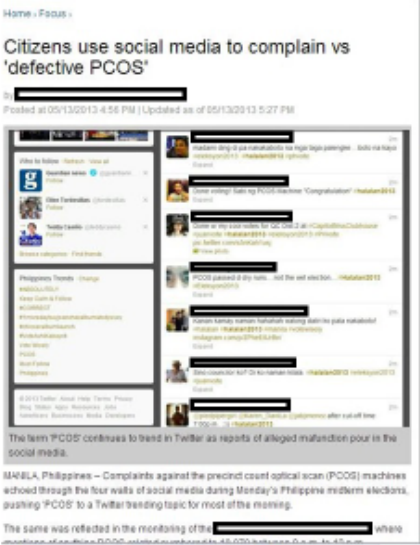
Since we were working with a news broadcaster, one of the key requirements was to detect "breaking" news off Social Media which can be delivered (after further development) on main stream news media. We used the Apriori algorithm [Agrawal et al., 1993] for finding frequent item sets on tweets to find potential new topics. The requirement here was to not only identify the topics, but also link them to possible election entities (candidates and political parties). Due to the very nature of the data set we were dealing with, the names of candidates, political parties and common election keywords were bound to be frequent. Hence, an item set like ["election","philippines"] is not interesting enough. However, in a set with more than one element, if we have a known entity relating one or more unrelated entities, then it becomes interesting enough and a subject for further investigation or reporting. Hence we filtered the sets which had all known entities, so as to link a known entity to an unknown entity. A very fitting example of such a set is ["nancybinay","viceganda"] which identified the event involving comedian Vice Ganda making a comment on political experience of Nancy Binay. Another such example is the set ["pcos, "malfunction"] which related to the alleged malfunction of PCOS machines. In fact "PCOS" became the Twitter trending topic 4 for most of the morning of the day this event occurred.
The discovered topics along with set of tweets were presented to reporters for manual verification, validation and further story development. While this module is fairly simple, it was found to be very effective in determining emerging topics in near real time. We now describe our work detecting longterm topics - topics that were important for a larger duration of time.
Long-term Topic detection
We define long-term topics to be those topics that are active in social discussions for a longer duration (a week or longer). In order to identify these topics, we use mentions of the most frequent bigrams, along with candidate names to build a regression model using the approval ratings of candidates (available from external sources - details in section 3). Using a regression model we then identify the most causal topics for the prediction made by the regression [Contractor and Faruquie, 2013].
Algorithm 1 Build prediction model using n-grams occurring in the data
Let Ad be the approval rating for a candidate on date d and m be the set of most frequent bigrams in the data
for each date d in the collection do
for each of the political candidates do
Let the set of users who mention candidate c, be Uc
for each ngram ng ∈ N do
Value of predictor feature fc for candidate = number of occurrences of bigram ng in posts made by user uc on date d
end for end for end for end for
Build linear regression model using the set of fc's as predictors and approval ratings Ad as predictions.
Linear Regression
Let the dependent variable in the linear regression be y and let there be N independent variables x. Let the total number of data points be P , then the relationship can be expressed as
4 http://www.abs-cbnnews.com/insights/05/13/13/citizens-usesocial-media-complain-vs-defective-pcos
where (p = 1, 2 . . . P) and ϵp is the error term for the p-th observation. The residual term ep defined as
gives the error between the prediction and the actual value of the dependent variable. Using the ordinary least squares method that minimizes the sum of the squared residuals, the parameters set β can be estimated. For our work the dependent variable y are the candidate approval ratings (A), while the independent variables are frequent bigrams.
Causality between topics (bigrams) and ratings
A commonly used technique to infer causal effects using time series observations is Granger causality [Granger, 1969]. A time series x is said to be be granger causal for another time series y if building a regression model combining the two series gives better predictions than a model built using only the time series y.
If on applying a t-test or an F-test on the predicted outcomes from the two regression models above, shows a significant improvement in prediction when both time series, then the causality x is said to granger cause y.
Since we use multiple features in our models, performing a pair-wise granger test using each feature would be computationally expensive and therefore we use the Lasso Granger method for causality determination.
Lasso Granger method
The Lasso algorithm for linear regression performs variable selection using the L1 penalty term to obtain a sparse estimate of the coefficient vectors β. The variable selection can be obtained by solving the following optimization problem:
where λ is the penalty parameter that determines the sparseness of β. The series x is said to cause y iff β is a non-zero vector. The next section describes the data used and our experiments and results. We made use of Lasso Granger regression implementation provided by Matlab 5 for our experiments.
3 Experiments and Results
This section describes our experiments and results of our trial deployment during the 2012 US Presidential Elections and a live deployment used by the ABS-CBN News Corporation during the 2013 Filipino General Elections.
5 http://www.mathworks.in/help/stats/lasso.html
3.1 Data set - US Elections
We used the US elections data set for development purposes and estimating how well our system would do when deployed live in a real election.
US poll data
We used the presidential candidate opinion poll released by Gallup 6 . Gallup conducts opinion polls concerning political, social, economic issues and regularly publishes poll outcomes. For the 2012 US Presidential elections, Gallup collected data 7 from approximately 3,050 registered voters by asking whom they would vote for if the elections were held at that time and reported seven day rolling averages for the opinion poll ratings. The models we described in this paper predict these ratings using tweets collected from Twitter.
Twitter data
Using the freely available twitter4j 8 Java API library we collected over 37 million tweets between Sept 7, 2012 and Nov 7, 2012. These APIs are restricted by the rate limits 9 imposed by Twitter and collect a small fraction of the total data available at any given time. The following meta-data was collected along with the content of the tweets:
- Screen name and Twitter ID of author of tweet
- Screen name and Twitter ID of original author of tweet, in case the tweet is a retweet
- Screen name and Twitter ID of author of parent tweet, if a tweet is a response.
- Twitter ID of tweet
- Date and time of posting of the tweet.
3.2 Data preprocessing
From each post in the collection, bigrams were extracted after stop word removal and stored along with the text. These were indexed along with the raw data from Twitter and stored in Apache Lucene 10 , a popular text search engine library for Java.
3.3 Training - Long term topic detection
Using the poll ratings collected from Gallup as the predicted variable, and using each of the features defined in the model as predictors we trained regression models in a seven day window. Thus, data from the last seven days was used to train a regression model and predict the poll rating for both presidential candidates on the eighth day.
3.4 Causal analysis of bigrams - US Elections
By running the lasso granger regression model using the predicted variables and the bigram features, we identified bigrams (long-term topics) that were causal for the predictions. We found 227 bigrams that were causal for Barack Obama during the elections and 183 bigrams for Mitt Romney. Some examples of bigrams found to be causal for the two US presidential candidates are shown in Table 1. As can be seen from Table 1, bigrams related to "taxes", "job growth", "osama bin laden", " automobile bailout", "benghazi attack', etc were found to be contributing to the approval ratings. Causal bigrams for Mitt Romney include some with negative sentiments such as,"obama lied", "failed policies" etc (Note: These were causal bigrams and no sentiment analysis was done to identify these).
6 http://www.gallup.com
7 http://www.gallup.com/poll/150743/Obama-Romney.aspx
8 http://twitter4j.org/
9 https://dev.twitter.com/docs/rate-limiting
10 http:/lucene.apache.org/
| Barack Obama | Mitt Romney |
|---|---|
| american soil auto bailout bin laden business owners climate change fiscal cliff fix economy foreign policy job growth hillary clinton trillion debt obama hillary taxes obama | acceptance letter al qaeda arab spring birth certificate bush americans cut deficit dnc obama democratic national dnc speech equal pay failed policies fiscal cliff health insurance |
3.5 Election day approval rating prediction - US elections
Gallup did not make available the poll ratings in the final week running up to the election. Therefore, we trained the model using the last seven days of available data and used it to predict the outcome on election day using the tweets. Our model predicted 47.8 % of the vote to Barack Obama and Mitt Romney receiving 47.2 %. These prediction values are very close to the poll predictions made by different polling agencies 11 .
We also used candidate mentions in tweets as an estimate of popularity (commonly used in previous work), and were able to detect a clear win for Barack Obama but the vote shares predicted for the candidates were off from actual vote shares by a very large margin. We found no correlation between the number of tweet mentions of the candidates and the daily approval ratings. Barack Obama won the 2012 US Presidential election with 50.8% of the overall vote.
3.6 Philippines Elections
This section describes details about the live deployment and use of our system during the 2013 Filipino General elections. The elections in Philippines were held on the 13th May 2013 to elect 12 of the 24 seats in the senate. Together with the senators elected in 2010, the candidates elected in this election formed the 16th Congress of the Philippines. A total of
11 http://www.realclearpolitics.com/epolls/2012/president/us/ general\ election\ romney\ vs\ obama-1171.html
33 candidates contested for the election with two main coalitions - Team PNoy and United Nationalist Alliance (UNA).
Twitter data for the Philippines election was collected using the Gnip Powertrack stream which provides all the tweets which contains the user specified keywords. We collected only election related tweets using specific keywords formulated using the names of candidates, political parties, election campaigns etc. The structure of the data was similar to the Twitter data for US Elections and the pre-processing as described earlier was performed. A total of 7.5 million tweets were collected from March 20, 2013 up to the elections on May 13, 2013.
In order to train the long-term topics module during the Filipino election, we used the electoral surveys generated by Pulse Asia 12 that contained opinion polls for all candidates in the 2013 General Elections.
3.7 SystemDeployment and Results - Filipino Election
Deployment : Around 4 million Tagalog and 3.5 million English Tweets were analyzed over a 50 day period using our system. Data was analysed on a daily basis to identify the buzz and sentiment around candidates and political parties. In addition, trending topics were identified each day. However, during debates (held twice during the pre election period) and 2 days leading up to the election, the reports were delivered at a 4 hour interval. Each batch of tweets was run through the buzz and sentiment detection module before being consolidated for candidates and political parties. After this, the data was passed through the topic detection module which identified the trending topics in that batch. The topics delivered in each batch along with the sentiments for candidates helped the reporters to arrive at a news story which could be published immediately or investigated further. This story would contain the insights that were derived from our analysis in addition to the actual event that occurred, thus making the story interesting and unique for the news media.
12 http://www.pulseasia.ph/EP2013.html
Experiences and Results : During May 1 to May 13 (day of polling), all the insights were hosted on the media house's election page garnering about 1.5 million hits. More importantly, our system (specifically the local event detection algorithm) was able to discover breaking news off social media. For example, during election day, our tool discovered defective voting machines as emerging topics. The reporters at media house followed this story and were the first to report in through their news channel (much ahead of their competitors). Figure 2 shows a print version of the story as it appeared on the website of the media house. As an additional validation, we tracked the TRP of programs showing social insights from our work and found it to be 25% more than election programming by other channels. The hashtag (#Halalan2013) on which the social media insights generated by our system were disseminated was found to be top trending hashtag in Philippines 13 .
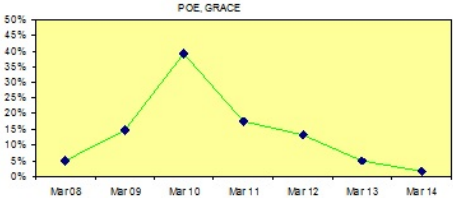
Senatorial Candidate Nancy Binays tiff with comedian Vice Ganda generated a lot of debate on the social media. When reporters saw the keywords "Vice Ganda", "Comedy", "Binay" and "Risa" among the trending keywords, they immediately could relate to the actual story (Vice Ganda making a comment on Nancy Binay about not knowing enough about being a public servant). We also had instances when social media gauged public mood very strongly, for example, Figure 3 shows how negative sentiment around Grace Poe increased when a TV ad was aired.
As another example, Nancy Binay lead the share of tweets by 78% when compared to 22% share of another candidate, Grace Poe. However, Grace Poe actually lead by 16 million votes as against 13 million for Nancy Binay in the final results. Further analysis showed that most of the tweets for Nancy Binay, talked about her birthday near the election day. Most others talked about her tiff with Vice Ganda. Furthermore the sentiment results showed that Grace Poe has more positive sentiments (31% vs 21%) and less negative (6% vs 14%) as compared to Nancy Binay, which seemed to agree with the actual electoral outcomes. In yet another example, emerging keywords unearthed Senator Miriam Santiago's tweet supporting candidate Sonny Angara because he has "sex appeal", also created a news story.
13 http://www.medianewser.com/2013/05/abs-cbns-halalan-2013is-most-watched.html
| Grace Poe | Francis "Chiz" Escudero |
|---|---|
| maaga ito si heart ate grace sa pilipinas poe sila sinimulan ni evangelista believes tutuloy nya escudero para sino nga humor painfulthings escudero saychiz | scudero para rt pingmedina gmanews ang escudero saychiz isda nsug alanpcayetano sonnyangara waterfall restaurant rt iamaljangeles ipagmamalaking karanasan magalang grace senator saychiz chiz mahal |
Table 2 shows some of the important long-term topics found in the elections. As can be seen, candidate Escudero Chiz's controversial fight between his girlfriend Heart Evangelista and her parents was identified as a long-term topic ("si heart ", "chiz mahal ") and this event indeed featured prominently during the elections.
The supplementary notes 14 contain further details on the deployment as well other models we developed during the course of this work.
4 Related work
Researchers have tried to measure the impact of social media on many different applications including prediction of product sales [Bhatt et al., 2010], movie award winners [Bothos et al., 2010], stocks [Bollen et al., 2011], project risks [Wolf et al., 2009], disease transmission [Sadilek et al., 2012], rumour detection [Finn et al., 2014] and elections [Tumasjan et al., 2010]. Most work involving social media data and elections has focused on tasks such as election forecasting.
[Tumasjan et al., 2010] used Twitter for predicting German elections. They used mentions of political party names and concluded that the relative number of tweets mentioning the names is a good indicator to predict elections. Similar conclusion was reached by [William and Gulati, 2008] where Facebook supports were indicative of the 2008 US election results. But, this method was found to be sensitive to the period from which Tweets were chosen for counting and to omission of smaller parties from the counting process. The work in [Sang and Bos, 2012] found that just counting the number of tweets is not enough and it is important to filter high quality tweets for counting entity mentions along with using sentiment for prediction. They applied their system for predicting the 2011 Dutch elections. The work in [Chung and Mustafaraj, 2011] also contended that merely counting mention of party or candidate is not enough and recommended to discount spam tweets and incorporate the tweet sentiment in the prediction system. In [O'Connor et al., 2010] the authors found that the sentiments in Twitter showed correlation to approval polls. The work in [Gayo-Avello et al., 2011] experimented with previously proposed election prediction models including that of [O'Connor et al., 2010] and [Tumasjan et al., 2010] and in contrast, found that the accuracy of prediction was very low. All of the above work have concentrated on predicting the final outcome of the elections. Our experience in both the 2012 US General Elections and 2013 Filipino elections also demonstrates that hashtags or entity mentions and tweet volumes etc do not necessarily indicate election outcomes and we adopt a different approach. Instead we focus on using Twitter to track the issue based support of people and use granger causality, to identify long-term causal topics in an election.
14 http://www.researchgate.net/publication/275539820 Tracking political elections on social media Applications and Experience (Supplementary Material)
[Xie et al., 2014] present a system which identifies bursty topics and viral events by comparing the distribution of words in a time slice with an archival snapshot. One of the drawbacks of this method is that the number of unique words to keep track of can become very large. In contrast, our method for emerging topics detection uses frequent item set mining which is further constrained using seed words. Other related work by [Rill et al., 2014] describes methods to detect emerging political topics on Twitter but relies heavily on the presence of topical hashtags which may not always be present.
5 Discussion and Conclusion
In this paper we described our work for monitoring social media during elections and demonstrate in a live election, how they can be useful in gauging public sentiment, detecting breaking news etc. We demonstrated our work on two different elections from two vastly different geographies, languages and electoral systems. We show that for some of the large scale events, social platforms may provide information ahead of traditional news sources. While many discussions on social media were more reactive, during our deployment, we found instances where new events were reported first on Twitter (traditional media lagged by few hours !). In the future we would like to develop richer online topic detection models as the methods developed for offline large scale text processing cannot directly be applied to live streaming data. We also plan to deploy and study our work in the context of other events such as sports competitions and movie releases.
@inproceedings{ijcai2015p328,
  title     = {Tracking Political Elections on Social Media: Applications and Experience},
  author    = {Contractor, Danish and Chawda, Bhupesh and Mehta, Sameep and Subramaniam, L. Venkata and Faruquie, Tanveer A.},
  booktitle = {Proceedings of the Twenty-Fourth International Joint Conference on
               Artificial Intelligence, {IJCAI-15}},
  publisher = {International Joint Conferences on Artificial Intelligence},
  editor    = {Qiang Yang and Michael Wooldridge},
  pages     = {2320--2325},
  year      = {2015},
  month     = {7},
  note      = {Main Track},
  url       = {https://ijcai.org/proceedings/2015/328},
}
TY - CPAPER TI - Tracking Political Elections on Social Media: Applications and Experience AU - Contractor, Danish AU - Chawda, Bhupesh AU - Mehta, Sameep AU - Subramaniam, L. Venkata AU - Faruquie, Tanveer A. T2 - Proceedings of the Twenty-Fourth International Joint Conference on Artificial Intelligence, IJCAI-15 PB - International Joint Conferences on Artificial Intelligence PY - 2015 SP - 2320 EP - 2325 UR - https://ijcai.org/proceedings/2015/328 ER -Copied
Machine-readable versions of this paper, for tools and AI agents:





