
Environment-Driven Social Force Model: Lévy Walk Pattern in Collective Behavior
Proceedings of the Twenty-Fourth International Joint Conference on Artificial Intelligence. Main Track. Pages 75-80.
© 2015 International Joint Conferences on Artificial Intelligence
Abstract
Animals in social foraging not only present the ordered and aggregated group movement but also the individual movement patterns of Lévy walks that are characterized as the power-law frequency distribution of flight lengths. The environment and the conspecific effects between group members are two fundamental inducements to the collective behavior. However, most previous models emphasize one of the two inducements probably because of the great difficulty to solve the behavior conflict caused by two inducements. Here, we propose an environment-driven social force model to simulate overall foraging process of an agent group. The social force concept is adopted to quantify the conspecific effects and the interactions between individuals and the environment. The cohesion-first rule is implemented to solve the conflict, which means that individuals preferentially guarantee the collective cohesion under the environmental effect. The obtained results efficiently comply with the empirical reports that mean the Lévy walk pattern of individual movement paths and the high consistency and cohesion of the entity group. By extensive simulations, we also validate the impact of two inducements for individual behaviors in comparison with several classic models.
- [Ballerini et al., 2008] M. Ballerini, N. Cabibbo, R. Candelier, A. Cavagna, E. Cisbani, I. Giardina, and V. Zdravkovic. Interaction ruling animal collective behavior depends on topological rather than metric distance: Evidence from a field study. Proceedings of the National Academy of Sciences, 105(4): 1232-1237, 2008.
- [Benhamou, 2007] S. Benhamou. How many animals really do the Levy walk? Ecology, 88(8): 1962-1969, 2007.
- [Buhl et. al., 2006] J. Buhl, D. J.Sumpter, I. D. Couzin et al.. From disorder to order in marching locusts. Science, 312(5778): 1402-1406, 2006.
- [Couzin et al., 2002] I. D. Couzin, J. Krause, R. James, G. D. Ruxton, and N. R. Franks. Collective memory and spatial sorting in animal groups. Journal of Theoretical Biology, 218(1): 1-11, 2002.
- [Couzin and Krause, 2003] I. D. Couzin and J. Krause. Self-organization and collective behavior in vertebrates. Advances in the Study of Behav-ior, 32(1), 2003.
- [Davidson and Morris, 2001] D. L. Davidson and D. W. Morris. Density-dependent foraging effort of Deer Mice (Peromyscus maniculatus). Functional Ecology, 15(5): 575-583, 2001.
- [de Jager et al., 2011] M. de Jager, F. J. Weissing, P. M. Herman, B. A. Nolet, and J. van de Koppel. Lévy walks evolve through interaction between movement and envi- ronmental complexity. Science, 332(6037): 1551-1553, 2011.
- [de Knegt et al., 2007] H. J. De Knegt, G. M. Hengeveld, F. Van Langevelde, W. F. De Boer, and K. P. Kirkman. Patch density determines movement patterns and foraging efficiency of large herbivores. Behavioral Ecology, 18(6): 1065-1072, 2007.
- [Dumont and Boissy, 2000] B. Dumont and A. Boissy. Grazing behaviour of sheep in a situation of conflict be- tween feeding and social motivations, Behavioural Pro- cesses, 49(3): 131-138, 2000.
- [Fauchald and Tveraa, 2006] P. Fauchald and T. Tveraa. Hierarchical patch dynamics and animal movement pat- tern. Oecologia, 149(3): 383-395, 2006.
- [Han et al., 2011] X. P. Han, T. Zhou, and B. H. Wang. Scaling mobility patterns and collective movements: Deterministic walks in lattices. Physical Review E, 83(5): 056108, 2011.
- [Helbing and Molnar, 1995] D. Helbing and P. Molnar. So- cial force model for pedestrian dynamics. Physical Re- view E, 51(5):4282, 1995.
- [Jiang, 2009] Jiang, Y. Concurrent collective strategy diffu- sion of multiagents: the spatial model and case study. Systems, Man, and Cybernetics, Part C: Applications and Reviews, IEEE Transactions on, 39(4), 448-458, 2009.
- [Li and Jiang, 2014] Z. Li and Y. Jiang. Friction based social force model for social foraging of sheep flock. Ecological Modelling, 273: 55-62, 2014.
- [Moussaïd et al., 2011] M. Moussaïd, D. Helbing, and G. Theraulaz. How simple rules determine pedestrian be- havior and crowd disasters. Proceedings of the National Academy of Sciences, 108(17): 6884-6888, 2011.
- [Nabe-Nielsen, 2013] J. Nabe-Nielsen, J. Tougaard, J. Teilmann, K. Lucke, and M. C. Forchhammer. How a simple adaptive foraging strategy can lead to emergent home ranges and increased food intake. Oikos, 122(9): 1307-1316, 2013.
- [Nonaka and Holme, 2007] E. Nonaka and P. Holme. Agent-based model approach to optimal foraging in het- erogeneous landscapes: effects of patch clumpiness. Ecography, 30(6): 777-788, 2007.
- [Pillot et al., 2010] M. H. Pillot, J. Gautrais, J. Gouello, P. Michelena, and R. Bon. Moving together: Incidental leaders and naïve followers. Behavioural Processes, 83(3): 235-241, 2010.
- [Pillot et al., 2011] M. H. Pillot, J. Gautrais, P. Arrufat, I. D. Couzin, R. Bon, and J. L. Deneubourg. Scalable rules for coherent group motion in a gregarious vertebrate. PloS one, 6(1): e14487, 2011.
- [Reynolds, 1987] C. W. Reynolds. Flocks, herds and schools: A distributed behavioral model. ACM SIGGRAPH Computer Graphics, 21(4): 25-34, 1987.
- Romanczuk and Schimansky-Geier 2012]
- P. Romanczuk and L. Schimansky-Geier. Swarming and pattern formation due to selective attraction and repulsion. Interface focus, 2(6): 746-756, 2012.
- [Sibbald and Hooper, 2004] A. M. Sibbald and R. J. Hooper. Sociability and the willingness of individual sheep to move away from their companions in order to graze. Ap- plied Animal Behaviour Science, 86(1): 51-62, 2004.
- [Turchin, 1998] P. Turchin. Quantitative analysis of move- ment: measuring and modelling population redistribution in animals and plants. Sunderland (MA): Sinauer Asso- ciates, 1998.
- [Vicsek, 1995] T. Vicsek, A. Czirók, E. Ben-Jacob, I. Cohen, and O. Shochet. Novel type of phase transition in a sys- tem of self-driven particles. Physical review letters, 75(6): 1226, 1995.
- [Viswanathan et al., 1996] G. M. Viswanathan, V. Afanasyev, S. V. Buldyrev, E. J. Murphy, P. A. Prince, and H. E. Stanley. Lévy flight search patterns of wan- dering albatrosses. Nature, 381(6581): 413-415, 1996.
- [Viswanathan et al., 1999] G. M. Viswanathan, S. V. Buldyrev, S. Havlin, M. G. E. Da Luz, E. P. Raposo, and H. E. Stanley. Optimizing the success of random searches. Nature, 401(6756): 911-914, 1999.
References were extracted automatically from the PDF and may contain errors.
Full text extracted automatically from the PDF; figures, tables and equations may differ. The PDF is the version of record.
1 Introduction
The environment and the conspecific effects simultaneously induce the complex behaviors of an animal group [Pillot et al., 2011]. Facing to the heterogeneous and uncertain environment in social foraging, animals adjust the movement speeds and the tortuosity of the movement paths [Benhamou, 2007] to maximize the foraging efficiency. This tortuous paths generally show the Lévy walk pattern which is characterized as the power-law frequency distribution P(l) ~ l -ȝ of flight lengths (l) with 1 < ȝ 3 [Turchin, 1998; Viswanathan et al., 1996]. Meanwhile, the animal group can still keep the collective cohesion and alternately present the order state or the disorder state with moving out of or into the food patches [Viswanathan et al., 1996]. The modeling method to reproduce the collective behavior has been widely investigated
[Couzin and Krause, 2003; Han et al., 2011; Li and Jiang, 2014]. However, in most studies, each agent behaves depending on one of the two inducements and cannot simultaneously perform the group-level and individual-level behaviors. For instance, some models focus on how the conspecific effects lead to the consistent behavior of an agent group and individual moves according to the average moving directions and speeds of neighbors [Reynolds, 1987; Vicsek, 1995]. Consequently, agents move in the less tortuous line. In some other studies, the environment effects determine the destination or moving direction of each agent while the group consistency in collective movement are generally be ignored [Han et al., 2011; Viswanathan et al., 1999].
However, there is a conflict between the effects of food and conspecifics [Dumont and Boissy, 2000; Sibbald and Hooper, 2004]. On one hand, the heterogeneous food distribution in the system drives individuals to access more and better food resources. On the other hand, the interactions between conspecifics constrain individual behaviors to stay in the group [Ballerini et al., 2008; Reynolds, 1987]. Therefore, the solution to the conflict may be the core to form the mechanism of individual Lévy walk pattern in collective behavior. According some real field experiments on sheep that a single individual never leave the group to pursue better food [Dumont and Boissy, 2000; Sibbald and Hooper, 2004], a cohesion-first rule is suggested: individuals will guarantee the collective cohesion preferentially.
Thus, this paper mainly aims at simulating the individual-level Lévy walk pattern and the group-level consistency and cohesion in an agent-based model. We propose an environment-driven social force model to describe individual behavior strategies. The social force concept is used to quantify the physics and psychology motivations to guide individual behaviors [Helbing and Molnar, 1995]. The friction, pull force, and repulsion-attraction force are generally applied to characterize individual interactions with the environmental food and the conspecifics [Li and Jiang, 2014]. Individuals make own behavior decision by estimating the values and the directions of the three forces autonomously and evaluating which effect is firstly considered based on the cohesion-first rule. Individuals are the forager on a two dimensional square and the food resources are patchily distributed. For the patchy environment, our model involves a switching strategy between the searching paradigm and the feeding paradigm to address environmental mutation, which means the transition from food area to waste land or vice versa [Fauchald and Tveraa, 2006; Nabe-Nielsen, 2013].
By extensive simulations, our model can achieve two objectives: 1) individual movement pattern present the characteristics of Lévy walks and 2) the group still keeps collective characteristics under the influence of environment. Meanwhile, by the test on the population density, we find that the patchily distributed food causes the conspecific competition resulting in disorder and dispersion while the conspecific cooperation can emerge with the order movement of all the agents if the group moves between patches.
2 Model Design
2.1 Individual and Foraging Environment
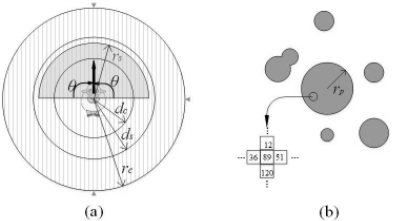
The individuals in our model have some general capabilities like the seeing, perceiving, moving and feeding. Individuals are regarded as the agents that are autonomous and individual entities. In Figure 1(a), an agent is shown as an arrow that points to moving direction or facing direction and the origin represents the location of agent. Agent a is characterized by the current location xa and velocity va. The agent has a sight distance rs and a two-dimensional view range [-ș, ș] [Moussaïd et al., 2011] which are represented by the shadow area in Figure 1(a). The food resources can be only perceived by eyes. However, agents can locate the companions within the perception domain, which are the circular regions with the radius rc. The perception domain is divided into the repulsion zone, the comfortable zone and the attraction zone [Couzin et al., 2002]. The repulsion zone is a circle area with radius dc. The comfortable zone and attraction zone are both annular areas with the width ds-dc and rc-ds, respectively
The environment is represented by two-dimensional N×N grids with nonperiodic boundary conditions. The patchiness is proposed to describe the heterogeneous distribution of resources in the real world [Fauchald and Tveraa, 2006]. The pixels (grids) with food are nested in patches. The patches denoted as circles of radius rp are distributed discretely and randomly. The pixels are indivisible food units that fill patches continuously. An arbitrary pixel can be located by a unique coordinate pi. An integer value Ai denotes the amount of food at the Pixel i (Figure 1(b)). The maximum amount Am of food in a pixel is constant. As the agents consume the food, Ai will decrease to zero. Here, the food cannot be replenished.
2.2 Force Representation
In our model, we consider that the agents hope to keep a comfortable distance with companions and are also attracted by the preferred food. These motivations are regarded as the interactions of agents with the companions and the food, which are distinguished into three types of forces based on social force model. The interactions among these three forces determine the moving directions and speeds of agents.
Friction
Li and Jiang in [2014] consider that the food at the location where the agent stands presently will obstruct it to leave. This effect is similar to "Friction" in Newtonian Mechanics. The friction force emerges only if the agent tends to move away from current location with food. The value of friction is linearly correlated with the amount of food at current pixel. The direction of friction is opposite to the direction of velocity. Thus, the friction is given by
Here, Ff(a,i) is the vector of friction on Agent a at Pixel i. The factor ȝ is the "Friction Coefficient" considered as the magnitude of friction and is identical for each agent.
Pull Force
In social foraging, the foundational objective of agents is to access more food. Thus, the agent tends to move to the pixels with abundant food instinctively. The pull force quantifies this tendency and drives the agent to the objective pixel. The location of objective pixel and the amount of food determine the direction and the value of pull force. Pull force is computed by a function with natural exponent [Turchin, 1998].
The factors pi and xa are the location coordinates of Pixel i and Agent a. The factor Į determine the magnitude of Fp(a,i).
Repulsion-attraction Force
Each agent in the group should follow two rules: (1) avoiding collision with the near neighbors, (2) approaching the group center to avoid being alone [Couzin et al., 2002; Reynolds, 1987]. The repulsion-attraction force is applied to explain the conspecific effects mathematically. Repulsion-attraction force means that the repulsion force and the attraction force are distinguished by the distance between the focal agent and other agents [Jiang, 2009; Li and Jiang, 2014]. The attraction force makes agents approach each other. The repulsion force makes agents away from each other.
Here, Fe(a,b) indicates the repulsion force or the attractive force between Agent a and Agent b that is one of neighbors in the perception domain of Agent a. Moreover, ȕ is used to adjust the magnitude of Fe(a,b).
The repulsion-attraction force of Agent a at pi, Fe(a|i), is the vector sum of Fe(a,b). Meanwhile, Fe(a|i) also presents either the repulsion force or the attraction force. Fe(a|i) is determined by perceiving the number of neighbors in the three zones. If the sum of neighbors in the repulsion zone and the comfortable zone is greater than k, Fe(a|i) can be computed by the vector sum of repulsion forces from agents in the repulsion zone of Agent a. Otherwise, Fe(a|i) will be equal to the vector sum of attraction forces from agents in the attraction zone. Here, k is the threshold to judge that Agent a locates at close to group center or the border of the group.
ȅa is the set of neighbors of Agent a deriving from either the repulsion zone or the attraction zone. The smaller the value of Fe(a|i) is, the more comfortable the Pixel i is for Agent a.
2.3 The Model
Agents perform composite movement pattern to enhance search efficiency that includes extensive search between patches and intensive search within patches [Benhamou, 2007; Nonaka and Holme, 2007]. The extensive search means that individuals travel fast and straight with large displacements between patches, but the intensive search indicates the low velocities and large turn angles moving within patches. Therefore, individuals present two different movement paradigms. The continuous foraging process in this paper is considered as a switching strategy between two movement paradigms: searching paradigm and feeding paradigm [Benhamou, 2007; Fauchald and Tveraa, 2006; Nabe-Nielsen, 2013; Nonaka and Holme, 2007].
Two decision processes are determined corresponding to the two motion paradigms. In the searching paradigm, agents make decision through computing resultant force, namely, the force analysis. If each agent reaches the force balance, all agents will have identical velocity value and direction. In the feeding paradigm, agents are hard to reach a force balance because of the heterogeneously distributed food. However, agents can feed only if they are motionless. The method of force analysis is unsuitable for agents' decision-making in the feeding paradigms. Therefore, we consider that agents
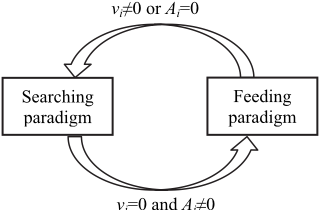
vi=0 and Ai0
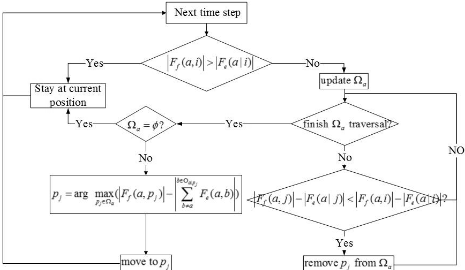
Figure 3: Flow diagram of selecting the destination pixel.
move to the target pixels directly within a time step, and the forces here are used to select target pixels by comparing the directions and values. Figure 2 shows the critical conditions to switch between the two paradigms.
In the feeding paradigm, with the consumption of the food at located pixel, the friction of Agent a at the present position cannot resist the repulsion-attractive force. According to the cohesion-first rule, agents try to meet own needs of food under the premise of staying in the group. Figure 3 shows the selecting flow of destination. If agents decide to leave the current pixels, two rules must be followed: (1) the value of friction acting on focal agent is less than the repulsion-attraction force; (2) pixels within sight can provide enough friction for the focal agent to resist the repulsion-attraction force. Each elements of the set ȍa that consist of all the pixels within sight of Agent a is tested by comparing the difference value that the value of friction minuses the value of repulsion-attraction force. The Pixel j is selected because of the maximum difference value in ȍa. It means that Agent a can enjoy either relatively abundant food or comparatively comfortable position. This selection method avoids that too much preference for food leads to the departure of agents in the group and prevents the fear of social isolation and the decrease of the foraging efficiency. After the selection, agents move to the target pixels directly. Otherwise, Agent a still remains at the current pixel.
In the searching paradigm, the destinations of agents at next time step may be still codetermined by food distribution and conspecific effects. However, when agents know less about the destinations of the movement because of the uncertain environment, the moving directions and velocities depend on the interaction between conspecifics. Agents balance the stimuli from food and the conspecific effects according to Newtonian Mechanics. Based on the force analysis, the resultant force F t (a,i) is used to determine the moving direction and velocity of Agent a.
If ȍa is empty, Fp(a,i) is a null vector. Otherwise, Fp(a,i) is determined by the optimal pixel which is selected according to the flow diagram in Figure 3. Fw(a,dw) is the force to avoid the boundary of simulation space. If dw < D, Fw(a,dw) = Ȗ × (D - dw) where dw is the vertical distance between Agent a and the boundary and D is safe distance. If dw D, Fw(a,dw) = 0.
In this paper, we assume that these forces are stable in one time interval. Thus, agents can be considered to perform uniformly accelerated motion within one time step. The velocity at next time step is calculated by
Then, the position of Agent a at Time t + 1 is
Here, ¨t stands for the unit time interval. At time t + 1, Agent a locates at the position of xa t + 1 .
4 Simulation and Analysis
4.1 Simulation Settings
To improve the reliability of our model, the environment configuration accords with the real field data in the study of de Knegt et.al [2007] who have analyzed the relation between the food density and the movement pattern. The simulation space is presented by square field with 600 × 600 pixels and includes mp randomly distributed patches. Food density is represented by the percentage of the total areas of patches distributed in the square field. To exclude other factors that affect the food density, the area of each patch obeys the uniform distribution. The amount of food at a pixel is stochastic within the region of [0, Am]. If Agent a is at a pixel with food, it will consume a portion of the rest food every time step [Li and Jiang, 2014].
We consider that all the agents have same capabilities without regard to the personalities, such as mass, sight distance, visual angle and perception distance [Moussaïd et al., 2011]. The scale of agent group is ten, and is similar to the settings in some relevant literature [Pillot et al., 2010]. The velocity has an upper limit to prevent the endlessly increasing value because of the non-zero acceleration.
4.2 Model Validation
Lévy walk
The main objective of the section is to prove that our model can present the relationship between the flight distribution and the food density. The frequency distribution of flight lengths can be analyzed by tracking the path of an arbitrary agent. The definition of the flight is based on the real field studies, and the flight consists of multiple continuous steps in the almost same direction [Turchin, 1998; de Knegt et al., 2007]. Assuming N steps are combined into a flight, there are N + 1 positions in this flight. If these N steps are in one flight, the N - 1 positions in the middle should be located no more than x (set as 3 pixels) away from the line connecting the two ends of this flight. There are two reasons that we analyze the distribution of flight lengths rather than step lengths (motion distance in one time step): first, the step length is constrained by the velocity with an upper limit and the sight distance; second, the distribution of long steps and short steps cannot reflect the changes of moving direction.
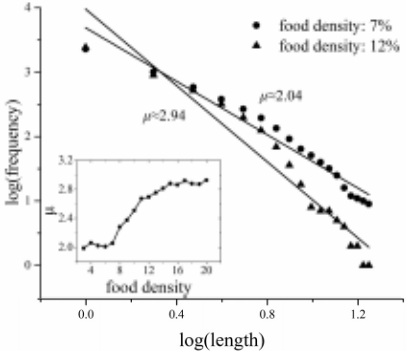
In Figure 4, the frequency distributions of flight lengths is taken the logarithm and it can be found that the flight lengths comply with the power-law distributions, P(l) ~ l -ȝ , compared with the linear fitting lines. Simultaneously, an index R 2 (coefficient of determination) is tested to estimate how well the simulation data fits the lines of the power-law distributions. We get ȝ = 2.04 with R 2 = 0.95 when food density is 7% and ȝ = 2.94 with R 2 = 0.92 at the food density of 12%. This result approaches the result of real field data (R 2 = 0.90 in [de Knegt et al., 2007]). Moreover, this simulation data also reveals the relation between power-law exponent (ȝ) and food density in the inset of Figure 4. It can be seen that with increasing food density the power-law exponent fluctuates slightly around 2 at first, then increases to 3, and finally tends to keep at about 3. This result agrees with the hypothesis from Lévy walks: animals move with ȝ § 2 at low food density but with ȝ § 3 at high food density [de Knegt et al., 2007]. This range of ȝ covers almost all the known real-world observations of flight distributions of animals [Han et al., 2011].
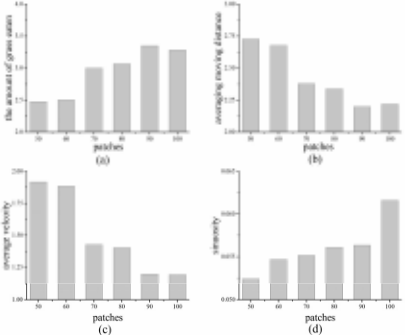
Then, we test other correlative indexes to explain how the food density influences the behaviors. We conclude the trends of the mean amount of food consumed at one time step, the step length, average velocity, and sinuosity of path with the increase of food density. In Figure 5(a), the food consumed by the agent increases if the food density increases. In Figure 5(b), (c) and (d), the mean step length and average velocity in one time step present an apparent descending trend; on the contrary, the sinuosity of movement path increases. Combining these three graphs, we can see that agents adjust the behavior strategies to accommodate the environment of different food densities. As food density gradually increases, agents present shorter step lengths and larger turn angles, which make the movement path more tortuous, reduce the net displacement and avoid moving out of the current patch. Agents also reduce the velocities to prevent from missing abundant food sites and capture more food as shown in Figure 5a. Therefore, the food distribution is the main factor to drive agents to perform different behaviors according to the environment-driven social force model.
Collective Consistency and Cohesion
In this section, we prove that our model can also present the collective consistency and cohesion of the entire group. The collective consistency is measured by the group polarization [Vicsek, 1995], and the number of neighbors of agents is used to describe the collective cohesion [Davidson and Morris, 2001]. Group polarization means the order degree of alignment and can be obtained by equation (8).
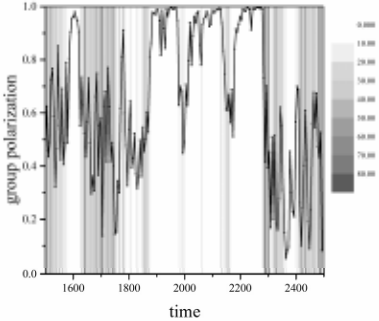
Here, n is the scale of the group. If the Ȍgroup is close to 1, the group shows the high order state. Inversely, the group aligns disorderly if Ȍgroup tends to 0. Here, the high value of group polarization denotes that agents reach an agreement on the moving direction. As shown in Figure 6, the group polarization fluctuates with the amount of food. The change in the lightness of the grey background indicates the different average amounts of food at the current pixels of all agents. Figure 6 shows that the group polarization varies steeply and cannot reach a high value when the background is dark grey (low lightness and more food). However, it is easy to reach a high value of group polarization with relatively smaller fluctuation if the background becomes white (high lightness and less food). Therefore, the group consistency is sensitive to the amount of food. Furthermore, our model confirms the perspective [Buhl et. al., 2006] that food shortage facilitates the formation of collective consensus. Due to the uncertainty on food locations, cooperation (order) will provide more competitiveness than the search of the single agent. However, agents begin to seek personal benefit and the competition (disorder) emerges when agents travel into a patch.
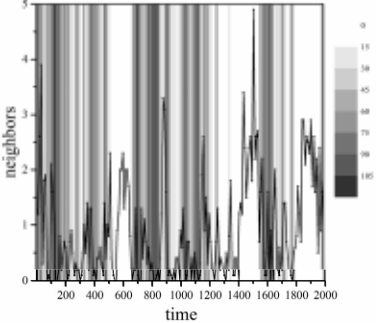
The cooperation keeps the agents in an aggregate group, and individuals can split temporally because of the competition [de Jager et al., 2011]. The increased population density will reduce the cost of finding the new patches, but population density will decrease if food is abundant because the communication time between conspecifics in a large group can greatly improve the cost of foraging [Davidson and Morris, 2001]. The food density is the inherent reason. This feature of social foraging can also be presented by our model. As shown in Figure 7, the number of neighbors around an agent changes over time. The severe fluctuation of the broken line means that the value of the number of neighbors hardly becomes stable. It is because agents keep on adjusting the locations for fitness no matter within or between patches. The high value is always along with the low amount of food, and the number of neighbors in the continuous area of less food is higher than the one in the continuous area of abundant food.
Comparison with the Existing Models
In this section, we compare our model with several typical models in the patchy foraging environment. The following is a list of models in simulations.
- Vicsek model (VM) is the self-propelled particles model [Vicsek, 1995]. Agent with unlimited perception domain determines the moving direction depending on average directions of all the members in the system. VM can present high consistency (Table 1).
| Capabilities of individuals | GP within patch | GP out of patch | PD within patch | PD out of | |||
|---|---|---|---|---|---|---|---|
| Sight dis- tance | Velocity | Perception domain | patch | ||||
| ESF | limited | diverse | limited | 0.382 | 0.768 | 8.182 | 8.103 |
| SF | / | diverse | limited | / | 0.935 | / | 6.668 |
| VM | / | constant | unlimited | / | 0.983 | / | 8.757 |
| LF | limited | / | / | 0.277 | 0.284 | 0.053 | 0.054 |
| DW | unlimited | / | / | 0.297 | / | 0.542 | / |
However, because of the absence of the environmental effect, agents hardly change moving direction. Therefore, the flight distribution fails to follow a power-law distribution (Figure 8).
- Social force model without environment (SF) simplifies the collective dynamics based on selective attraction and repulsion proposed by Romanczuk and Schimansky-Geier [2012]. Individuals with limited perception domain determine the moving direction and velocity based on the force analysis. This model can get high value of group polarization and population density (Table 1). However, agents move with the long flights much more than the short flights because agents cannot perform diverse velocities and are generally influenced by balanced forces without the environmental effect (Figure 8).
- Purely statistical Lévy flight model (LF) is applied for the search for randomly distributed target in a large space [Viswanathan et al., 1999]. Individuals determine the moving distance in a random direction according to the probability density function of power-law distribution (Figure 8). Therefore, this model can simulate Lévy Walk patterns of individual (Figure
- but present low consistency and cohesion (Table 1) without the conspecific effects.
- Deterministic walk model (DW) is proposed by Han et al. [2011], in which individuals directly jump to the location of targets (the nearest position with the maximum food). Because of the unlimited sight distance, the flight length depends on the food distribution (Figure 8). In the patchy environment, DW can present the power-law distribution of flight length perfectly (Figure 8). However, this model cannot simulate the consistency and agents are dispersive because of the absence of conspecific effects (Table 1).
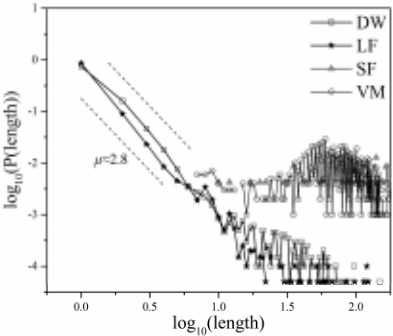
Therefore, the environment is the core to induce the diverse flights and tortuous movement paths. The conspecific effects lead to the aggregated and consistent group movement.
5 Conclusion
The main contribution of this paper is to implement the cohesion-first rule in the environment-driven social force model to simulate the collective behavior of a group of agents. The environmental effects drive the agent to perform complex patterns of individual movement and the cohesion-first rule solves the conflict between the conspecific constraint and the food preference. The simulation results accord with the empirical results, which mean the Lévy walks of individuals and the collective characteristics of the entire group.
Furthermore, our model can help to understand the overall movement process of animal groups in social foraging under the influence of the conspecifics and the environment. Moreover, it is hoped that our model can provide a novel perspective in the design of decision-making mechanism.
Acknowledgments
This work was supported by the National Natural Science Foundation of China (No.61170164, and No. 61472079), the Funds for Distinguished Young Scholars of the Natural Science Foundation of Jiangsu Province (No.BK2012020), the Program for Distinguished Talents of Six Domains in Jiangsu Province (No.2011-DZ023), and the Scientific Research Foundation of Graduate School of Southeast University (No.YBJJ1449).
@inproceedings{ijcai2015p18,
  title     = {Environment-Driven Social Force Model: Lévy Walk Pattern in Collective Behavior},
  author    = {Lv, Danyan and Li, Zhaofeng and Jiang, Yichuan},
  booktitle = {Proceedings of the Twenty-Fourth International Joint Conference on
               Artificial Intelligence, {IJCAI-15}},
  publisher = {International Joint Conferences on Artificial Intelligence},
  editor    = {Qiang Yang and Michael Wooldridge},
  pages     = {75--80},
  year      = {2015},
  month     = {7},
  note      = {Main Track},
  url       = {https://ijcai.org/proceedings/2015/18},
}
TY - CPAPER TI - Environment-Driven Social Force Model: Lévy Walk Pattern in Collective Behavior AU - Lv, Danyan AU - Li, Zhaofeng AU - Jiang, Yichuan T2 - Proceedings of the Twenty-Fourth International Joint Conference on Artificial Intelligence, IJCAI-15 PB - International Joint Conferences on Artificial Intelligence PY - 2015 SP - 75 EP - 80 UR - https://ijcai.org/proceedings/2015/18 ER -Copied
Machine-readable versions of this paper, for tools and AI agents:





