
Planning under Partial Observability by Classical Replanning: Theory and Experiments
Proceedings of the Twenty-Second International Joint Conference on Artificial Intelligence. Pages 1936-1940.
https://doi.org/10.5591/978-1-57735-516-8/IJCAI11-324
© 2011 International Joint Conferences on Artificial Intelligence
Abstract
Planning with partial observability can be formulated as a non-deterministic search problem in belief space. The problem is harder than classical planning as keeping track of beliefs is harder than keeping track of states, and searching for action policies is harder than searching for action sequences. In this work, we develop a framework for partial observability that avoids these limitations and leads to a planner that scales up to larger problems. For this, the class of problems is restricted to those in which 1) the non-unary clauses representing the uncertainty about the initial situation are nvariant, and 2) variables that are hidden in the initial situation do not appear in the body of conditional effects, which are all assumed to be deterministic. We show that such problems can be translated in linear time into equivalent fully observable non-deterministic planning problems, and that an slight extension of this translation renders the problem solvable by means of classical planners. The whole approach is sound and complete provided that in addition, the state-space is connected. Experiments are also reported.
- [Albore and Bertoli, 2006] A. Albore and P. Bertoli. Safe LTL assumption-based planning. In Proc. ICAPS, pages 192-202, 2006.
- [Albore et al., 2009] A. Albore, H. Palacios, and H. Geffner. A translation-based approach to contingent planning. In Proc. IJ- CAI, pages 1623-1628, 2009. IJCAI
- [Bäckström and Nebel, 1995] C. Bäckström and B. Nebel. Com- plexity results for SAS+ planning. Comp. Intell., 11(4):625-655, 1995. IJCAI
- [Bonet and Geffner, 2000] B. Bonet and H. Geffner. Planning with incomplete information as heuristic search in belief space. In Proc. ICAPS, pages 52-61, 2000.
- [Brenner and Nebel, 2009] M. Brenner and B. Nebel. Continual planning and acting in dynamic multiagent environments. Aut. Agents and Multi. Sys., 19(3):297-331, 2009.
- [Bryce et al., 2006] D. Bryce, S. Kambhampati, and D. E. Smith. Planning graph heuristics for belief space search. JAIR, 26:35- 99, 2006.
- [Cimatti et al., 2004] A. Cimatti, M. Roveri, and P. Bertoli. Confor- mant planning via symbolic model checking and heuristic search. Art. Int., 159:127-206, 2004.
- [Ferguson et al., 2005] D. Ferguson, A. Stentz, and S. Thrun. PAO* for planning with hidden state. In Proc. ICRA, pages 2840-2847, 2005.
- [Fox and Long, 1998] M. Fox and D. Long. The automatic infer- ence of state invariants in TIM. JAIR, 9:367-421, 1998.
- [Helmert, 2009] M. Helmert. Concise finite-domain representa- tions for pddl planning tasks. Art. Int., 173(5-6):503-535, 2009.
- [Hoffmann and Brafman, 2005] J. Hoffmann and R. Brafman. Con- tingent planning via heuristic forward search with implicit belief states. In Proc. ICAPS, pages 71-80, 2005.
- [Hoffmann and Nebel, 2001] J. Hoffmann and B. Nebel. The FF planning system: Fast plan generation through heuristic search. JAIR, 14:253-302, 2001.
- [Kaelbling et al., 1999] L. P. Kaelbling, M. Littman, and A. R. Cas- sandra. Planning and acting in partially observable stochastic do- mains. Art. Int., 101:99-134, 1999.
- [Kearns and Singh, 2002] M. Kearns and S. Singh. Near-optimal reinforcement learning in polynomial time. Machine Learning, 49(2):209-232, 2002.
- [Koenig et al., 2003] S. Koenig, C. Tovey, and Y. Smirnov. Perfor- mance bounds for planning in unknown terrain. Art. Int., 147(1- 2):253-279, 2003.
- [Likhachev and Stentz, 2009] M. Likhachev and A. Stentz. Proba- bilistic planning with clear preferences on missing information. Art. Int., 173(5-6):696-721, 2009.
- [Palacios and Geffner, 2009] H. Palacios and H. Geffner. Com- piling uncertainty away in conformant planning problems with bounded width. JAIR, 35:623-675, 2009.
- [Petrick and Bacchus, 2002] R. Petrick and F. Bacchus. A knowledge-based approach to planning with incomplete informa- tion and sensing. In Proc. ICAPS, pages 212-222, 2002.
References were extracted automatically from the PDF and may contain errors.
Full text extracted automatically from the PDF; figures, tables and equations may differ. The PDF is the version of record.
1 Introduction
Planning problems with partial observability can be formulated as non-deterministic search problems in belief space [Bonet and Geffner, 2000]. This is the mainstream approach in both contingent [Hoffmann and Brafman, 2005; Bryce et al., 2006; Cimatti et al., 2004] and POMDP planning [Kaelbling et al., 1999]. The difficulties for scaling up, in comparison to classical planners, arise from two reasons: keeping track of beliefs is harder than keeping track of states, and searching for action policies or trees, is harder than searching for action sequences. In general, there is no escape from these difficulties, and the challenge is to improve the belief representation and the heuristic or value functions over beliefs. Yet, another approach is to introduce restrictions on the problems to allow for more efficient solution methods.
In this work, we develop a framework for planning under partial observability that avoids the difficulties mentioned above. For this, the range of problems is restricted to those in
Hector Geffner
ICREA & Universitat Pompeu Fabra 08003 Barcelona, SPAIN
hector.geffner@upf.edu
which R1) the non-unary clauses representing the uncertainty about the initial situation are invariant (i.e. respected by all the actions), and R2) the fluents that are hidden in the initial situation do not appear in the body of conditional effects, all of which are assumed to be deterministic.
An special class of problems that fit these restrictions is the class of deterministic planning problems where the uncertainty is about the initial values of a set of multi-valued variables that are used in goals or action preconditions but not in the body of conditional effects. It follows from recent results by Albore et al. [2009] that contingent problems P of this form are simple in the following sense: they all have bounded contingent width (width 1 indeed), which means that they can be efficiently translated into equivalent fully-observable nondeterministic planning problems that require no beliefs.
In this work, we go beyond the general results of Albore et al., and introduce a translation that is tailored to contingent problems that comply with R1 and R2 above, that is both more compact and convenient. The translation is more compact because it is linear rather than quadratic, and it is more convenient because a small modification of it renders the problem solvable by a classical planner. The whole approach is shown to be both sound and complete, provided that in addition to R1 and R2, the state space is connected.
The work is related to a number of proposals for planning with sensing aimed at scalability that do not address the contingent planning problem in its full generality. One thread of such work can be understood as assuming that action preconditions are made of two parts: hidden preconditions and known preconditions. For example, the action of going through a door may have two preconditions: that the agent is at the door and that the door is open. If the agent always knows its location; the first precondition would involve no uncertainty, while the second precondition may be hidden. The assumption in these proposals is that the hidden preconditions become observable, and hence known to be either true or false, in states where the non-hidden preconditions hold. Under this assumption, an effective greedy method for on-line planning is to: A) make the most convenient assumption about the values of the hidden variables, B) execute the plan that is obtained from the resulting classical planning problem, and C) revise the assumptions and replan, if during the execution, the observations refute the assumptions made. An instance of this general idea, used in robot navigation tasks, goes under the name of 'freespace assumption planning' [Koenig et al., 2003], where the hidden variables refer to the traversable status of cells in a grid. Variations on this basic idea appear in off-line planners that are aimed at solving the fully-observable non-deterministic problem [Ferguson et al., 2005], in certain cases assuming that one value of the hidden (binary) variables is 'preferred' to the other possible value(s) [Likhachev and Stentz, 2009], and in the use of 'safe-assumptions' for simplifying the planning process that can be formally verified at run time [Albore and Bertoli, 2006]. The use of LRTA* for path-finding in partially-observable settings can also be seen from this perspective, as the algorithm requires the action cost c(a, s) only when the agent is at s where the cost value is assumed to be observable. Last, the recent framework of continual planning [Brenner and Nebel, 2009] accommodates a language for expressing explicit assumptions of this form in partiallyobservable settings that involve more than one agent.
In our work, we exploit similar intuitions but adopt a more general formulation that generalizes and makes precise the idea and scope of 'planning under optimism' in partially observable settings. In particular, we cast our work in the general setting of domain-independent contingent planning, and establish conditions for a sound and complete approach.
The paper is organized as follows. We start with a general definition of partially observable planning and then consider the properties and methods for the class of problems that comply with the restrictions R1 and R2. We then define a planner based on these results and report experiments that illustrate the scope and effectiveness of the formulation.
2 Partially Observable Planning
We start with the general problem of planning with partial observability and deterministic actions.
2.1 Language
The language is a simple extension of STRIPS with conditional effects, negation, an uncertain initial situation, and sensing. More precisely, a partially observable problem is a tuple P = 〈F,O, I,G,M〉 where F stands for the fluent symbols, O for the actions, I is a set of clauses over F defining the initial situation, G is a set of F-literals defining the goal situation, and M represents the sensor model. An action a has preconditions given by a set of literals, and a set of conditional effects a : C → L where C is a set of literals and L is a literal. The sensor model M is a set of pairs (C, L) where C is a set of literals and L is a positive literal. The pair indicates that the truth value of L is observable when C is true. Each pair (C, L) can be understood as a sensor that is active when C is true, or as an information-gathering action with precondition C that reveals the boolean value of L. Unlike the other actions, however, these sensing actions trigger when their preconditions hold. We use ¬L to denote the complement of L.
2.2 Policies
The general solution to a partially observable planning problem can be expressed in many forms, the most common of which are trees of possible executions, and functions mapping belief states into actions. Here, for convenience, we mix these two forms and let policies Π denote partial functions from belief states b into action sequences, under the restriction that the action sequence Π(b) must be applicable in b.
Recall that a state s is a truth valuation over the fluents, a belief state b is a non-empty collection of states, and a formula A holds or is true in b if A is known to be true in b, meaning that A holds in every state s ∈ b. Likewise, an action a is applicable in b if the preconditions of a hold in b, and a maps b into the belief b′ if a is applicable in b, and b′ is the set of states that result from applying the action a to each state s in b. Similarly, an action sequence π = a0, . . . , am is applicable in b = b0 and results in the belief b′ = bm+1 if the action ai maps bi into bi+1 for i = 0, . . . ,m.
Finally, a policy Π solves the problem P iff all the executions that are possible according to Π given the initial belief state of P, reach a goal belief. The initial belief is the set of states that satisfy I, and the goal beliefs are the sets of states where G is true. An execution b0, b1, . . . , bn is possible according to Π if b0 is the initial belief state of P, bi+1 is the result of applying the action sequence Π(bi) to bi, and bi+2 is a possible successor belief of bi+1, i = 0, 2, 4, . . .. The belief b′ is a successor of b, written b′ ∈ Succ(b), if b′ represents a maximal set of states in b that agree on the literals that are sensed in b. These literals are those appearing in sensors (C, L) in M such that C is true in b, and neither L nor ¬L are true in b; we call these sensors the active sensors in b. As an illustration, if b consists of two states s = {p, q} and s′ = {p, ¬q}, then the sensor (C, L) with C = p and L = q is active in b, and its successors are b1 = {s} and b′1 = {s′ }, as C is true in b, and b1 and b′1 are the maximal sets of states in b that agree on the value of the sensed literal q.
3 Simple Partially Observable Planning
The definitions above are general and standard. Next, we focus on the restrictions and transformations that allow us to replace belief states by plain states. Let us recall that an invariant in a planning problem is a formula that is true in each possible initial state, and remains true in any state that can be reached from them with the available actions. For example, for an object o that can be picked up and dropped into a number of different positions li, i = 1, . . . , n, formulas like at(o, l1)∨· · ·∨at(o, ln)∨hold(o), ¬at(o, li)∨¬hold(o), and ¬at(o, li) ∨ ¬at(o, lk), i ̸= k, are all invariant. The first expresses that a set of literals is exhaustive, meaning that at least one of them must be true in every reachable state, while the other two, capture mutual exclusivity, meaning that at most one of them can be true in a reachable state. There are several algorithms for detecting such invariants [Fox and Long, 1998], and some of them [Helmert, 2009], focus exactly on the detection of sets of literals that are mutually exhaustive and exclusive, and which can be assumed to represent the different values of a multi-valued variable [B¨ackstr¨om and Nebel, 1995]. Such invariants are usually denoted as expressions oneof(x1, . . . , xn) where the xi's are atoms.
Interestingly, it turns out that when the non-unary clauses in I are all invariant (i.e., those expressing uncertainty) and the effects of the actions do not depend on fluents that are hidden in I (these are the fluents p such that neither p nor ¬p are known to be true in I), then the beliefs that need to be maintained in the planning process can be characterized in a simple form. We say that such problems are simple:
Definition 1. A (deterministic) partially observable problem P = 〈F,O, I,G,M〉 is simple if the non-unary clauses in I are all invariant, and no hidden fluent appears in the body of a conditional effect.
For example, if I is made up of the expression oneof(x1, x2, x3) and the literal ¬x1, and first, the xi literals do not appear in the body of a conditional effect, and second, the 'one-of' expression is an invariant, then the problem is simple. On the other hand, if I is encoded with the expressions oneof(x2, x3) and ¬x1, the problem would not be simple, even if the new formulas are logically equivalent to the old ones. The reason is that the information about the original one-of invariant is lost in the new encoding.
Notice that hidden fluents can appear in action preconditions and heads of conditional effects in simple problems, and hence, there is no requirement for hidden fluents to be invariant or static themselves: they can change. Similarly, the literals that are known to hold in I can change as well. What cannot change are the problem constraints captured by the non-unary clauses in I.
One-of expressions are normally used to encode multivalued variables, and in the absence of other non-unary clauses in the initial situation, problems featuring such constructs express uncertainty only about the initial value of such variables. The simplicity of the belief representation often required for such problems follows from recent results in [Albore et al., 2009], where partially observable problems P are mapped into equivalent non-deterministic planning problems X(P) that are fully-observable and hence require no beliefs at all. Albore et al. show that the size of the translation X(P) is O(|P|w(P)+1 ), where w(P) in the contingent width of P. The contingent width, like the notion of conformant width that it generalizes [Palacios and Geffner, 2009], represents the maximum number of hidden multi-valued variables that interact in the problem such that all of them are relevant to a goal, an action precondition, or an observable literal. Variables interact one with the other through action conditional effects, but do not interact at all through action preconditions, as in the latter case, the value of the variables must be known with certainty. Thus, our simple problems P have width w(P) = 1, and hence, they can be translated into equivalent fully-observable problems X(P) of size O(|P|2 ). This thus means, among other things, that the complexity of the belief representation required for such problems is no more than quadratic in the size of P, rather than exponential as in the most general case.
By focusing on simple problems P , with multi-valued variables or not, we obtain a more efficient translation that is linear in P rather than quadratic, and which provides the basis for solving P using classical planners. The linear belief representation and update is granted by the following:
Theorem 2 (Simple Beliefs). Let P be a simple partially observable problem, and let Iu stand for the set of non-unary clauses (invariants) in the initial situation I of P. Then if b is a reachable belief state from I that makes a set R of literals true, then b is the set of states that satisfies R and Iu, and hence, it is fully characterized by the formula R∪ Iu.
In other words, in simple problems, we just need to keep track of the set of literals that are true; the additional information needed is captured by the invariants that are given in I, which as invariants, do not change and hence do not have to be tracked. A relevant result is the following. We say that a literal L is known in a belief state b if L is known to be true in b or known to be false in b:
Proposition 3 (Monotonicity). If the literal L is known in a reachable belief state b over a simple problem P, and b′ is a belief reachable from b, then L is known in b′ .
These results provide conditions under which (reachable) beliefs can be given a very simple representation with no information loss, in terms of literals that need to be maintained, and invariants that need to be detected in the initial situation.
3.1 Compiling beliefs away: K′ (P) Translation
The translationK′ (P) below, like the translation X(P), captures partially observable problems P at the 'knowledgelevel' [Petrick and Bacchus, 2002] by applying an extension of the K0 translation for conformant problems [Palacios and Geffner, 2009]. The K0 translation replaces each literal L by two fluents KL and ¬KL that stand for whether L is known to be true or not, and is complete for problems with 0 conformant width.
Definition 4. For a partially observable problem P = 〈F,O, I,G,M〉, K′ (P) = 〈F ′ ,O′ , I ′ ,G′ ,M ′ ,D′ 〉 is the fully observable non-deterministic problem where
- F ′ = {KL,K¬L : L ∈ F},
- I ′ = {KL : L ∈ I},
- G′ = {KL : L ∈ G},
- M ′ = {KC, ¬KL, ¬K¬L → KL|K¬L : (C, L) ∈ M},
- D′ = {KC ⊃KL : if ¬C ∨L invariant in I}
- O′ = O but with each precondition L for a ∈ O replaced by KL, and each conditional effect C → L replaced by KC → KL and ¬K¬C → ¬K¬L.
The expressions KC and ¬K¬C for C = L1 ∧ L2 . . . are abbreviations of the formulas KL1 ∧KL2 . . . and ¬K¬L1 ∧ ¬K¬L2 . . . respectively.
In K′ (P), the M ′ component stands for a set nondeterministic rules KC, ¬KL, ¬K¬L → KL|K¬L, that capture the effects of the sensors (C, L) in P at the knowledge-level. Namely, such rules make L known (either true or false), when C is known to be true, and L is not known. Likewise, the D′ component captures the invariants in I with the literals L replaced by KL.
The solution to the fully-observable non-deterministic problem K′ (P) can be expressed in a way analogous to the solutions to the partially observable problem P , but as a policy Π mapping states s over K′ (P) into action sequences Π(s) that must be applicable in the state s. The criterion of applicability is the same as in classical planning, as the state s is fully known, and all the actions in K′ (P) have deterministic effects. The non-determinism in K′ (P) is the result of the non-deterministic rules that represent the effect of sensors, and enters into the conditions that make the policy Π a solution to the problemK′ (P).
A policy Π solves K′ (P ) iff all the executions that are possible according to Π in K′ (P ) reach a goal state. A goal state is a state where the literals KL ∈ G′ are true. An execution s0, . . . , sn is possible according to Π if s0 = I ′ and si+1 is the result of applying the action sequence Π(si) to si, and si+2 is a possible successor state of si+1, for i = 0, 2, 4, . . ..
The set Succ(s) of successor states of s is defined in terms of the non-deterministic rules in M ′ encoding sensing, and the clauses in D′ encoding invariants. Let ri = Ai → Bi|Ci for i = 1, . . . , n, be the set of non-deterministic rules in M ′ such that Ai is true in s, and let Succ0(s) be the set of states s′ that can be produced from s by applying action sequences a1, . . . , an, where ai is an action with the single (deterministic) conditional effect Ai → Bi, or the single conditional effect Ai → Ci. Then Succ(s) is defined as the set of states in Succ0(s), each one closed under the formulas in D′ ; i.e, s′′ ∈ Succ(s) iff s′ ∈ Succ0(s) and s′′ is s′ extended with the literals KL entailed by the literals in s′ and D′ .
Provided with these definitions, the relationship between partially observable problems P and their fully-observable translations K′ (P) is captured by the following results. The expression sb is used to denote the set of literals KL such that L is true in b, and bs is used to denote the single reachable belief state b that makes a literal L true iff KL is in s (this belief state is unique in simple problems as a result of Thm. 2).
Theorem 5 (Soundness). Let Π be a policy that solves the fully-observable problem K′ (P) for a partially observable problem P . Then if Π maps s into the action sequence π, the function Π′ that maps bs into π is a policy that solves P.
Theorem 6 (Completeness). Let Π be a policy that solves the partially observable problem P . Then if Π maps a reachable belief state b into the action sequence π, the function Π′ that maps sb into π is a policy that solves K′ (P).
In other words, the partially observable problem P can be solved by solving the fully-observable translation K′ (P ), and moreover, this is always possible if P is simple and solvable. We turn next to the problem of solving the translation K′ (P) using classical planners.
3.2 Classical K(P) Translation
The action sequence π associated with the response Π(b) = π for a belief b maps b into a new belief b′ . Yet, if b′ is not a goal belief, nor a belief where a sensor (C, L) becomes active, then Succ(b′ ) = {b′ } and an equivalent policy Π′ can be obtained by changing Π(b) to the concatenation of π and π′ where Π(b′ ) = π′ . This reduction just removes an 'idle pivot' belief in some executions, leaving the other executions untouched. If we apply this argument iteratively, we see that for completeness it suffices to focus on policies Π that map beliefs reachable from I and Π into goal beliefs or beliefs that activate a sensor (C, L). We call such policies reduced.
In the case of simple problems P and in light of the completeness theorem, reduced policies Π over P, translate into reduced policies Π over K′ (P) where Π(s) is an action sequence that maps s into a state s′ where the goal G′ is true, or KC is true for a sensor (C, L) such that KL and K¬L are both false in s. This means that the action sequence Π(s) can be conceived as a plan for the classical planning problem that results fromK′ (P) = 〈F ′ ,O′ , I ′ ,G′ ,M ′ ,D′ 〉 when the initial situation is s, the new goal is the disjunction of the old goal G′ and the various such KC's, and the components M ′ and D′ are ignored. Any sequence Π(s) = π obtained from a classical planner for that problem will achieve the goal or make a hidden fluent known. Since the number of fluents is finite, and known fluents remain known, any Π constructed in this manner, is guaranteed to solve K′ (P) and hence P, if in addition, the space is connected, a condition that ensures that all such classical planning problems have solutions. 1
The shortcoming of policies derived in this manner is that they may drive the agent to look for information that is not necessary for achieving the goal. In order to compute policies Π that are always goal oriented, we make two refinements in the definition of the classical planning problemK(P). First, the goal of K(P) is set to the goal of K′ (P). Second, in order to make the goal achievable from any state even when information from sensors is needed, we translate the invariants and sensors in P into actions in K(P). A sensor (C, L) is translated into two deterministic actions, one with preconditions KC, ¬KL and ¬K¬L, and effect KL, and the other with same preconditions but effect K¬L. We denote these actions as A(C, L) and A(C, ¬L), and call them assumptions, as each makes an assumption about the truth value of the literal L whose value is observed when C is true.
Definition 7. The classical problemK(P)[s] is defined from P and the translation K′ (P) = 〈F ′ ,O′ , I ′ ,G′ ,M ′ ,D′ 〉 as K(P)[s] = 〈F ′′ ,O′′ , I ′′ ,G′′ 〉 where F ′′ = F ′ , G′′ = G′ , I ′′ = s, and O′′ is O′ union the actions KC → KL for the invariants ¬C ∨ L in P, and the actions A(C, L) and A(C, ¬L) for the sensors (C, L) in P .
Since this classical problem is key in the computational account, let us illustrate it through an example. Let the invariant oneof(y1, . . . , yn, h) represent the possible locations yi of an object, with h standing for the object being held, and let x1, . . . , xn denote the possible agent locations. The agent location is known but the object location is not, except for h that is initially false. There are actions that allow the agent to move from one location to the next, and actions to pick up the object from a location if the object is known to be there. From a given location, the agent can sense whether the object is in that location or not, and the goal is to hold the object. The encoding P of this problem is direct with the one-of invariant in I, and the sensors (xi, yi) in M, i = 1, . . . , n. The translation K′ (P) is direct as well with fluents Kxi, K¬xi, Kyi, and K¬yi, and pick-up actions with precondition Kxi and Kyi, and effects Kh and K¬yi. The translation K(P)[s] extends K′ (P) with actions standing for the invariants, and actions standing for the sensors. The former feature actions with preconditions K¬h and K¬yi for i ̸= k, and effect Kyk, while the latter feature actions (assumptions) A(xi, yi) and A(xi, ¬yi) for 1 ≤ i ≤ n, both with preconditions Kxi, ¬Kyi, and ¬K¬yi, and effects Kyi and K¬yi respectively.
1 The space is connected when for every pair of states reachable from a possible initial state, one is reachable from the other.
The classical planning problemK(P)[s] for s = I ′ is solvable if P is solvable and simple. Yet, the plan π obtained for K(P)[s] cannot always be applied in one shot over K′ (P). This is because the plan may include actions that are not in K′ (P); i.e., those expressing invariants or assumptions. A suitable non-empty prefix of the plan, however, can always be applied. Let us say that a prefix π′ of the action sequence Π(s) = π reveals an assumption in π if π′ achieves KC from s for an assumption A(C, L) in π. Then:
Definition 8. The executable prefix of a plan π for the problem K(P)[s] is the shortest prefix of π that reveals an assumption in π, with the invariant actions removed. If π has no assumptions, it is π without the invariant actions.
Notice that any plan π for the state s that includes an assumption A(C, L) must include a prefix that achieves KC, as KC is a precondition of A(C, L). Thus, some action before the assumption produces an observation (in P) that either confirms or refutes the assumption. The invariant actions are needed in K(P ) only after gathering the first observation, and hence can be dropped from the prefix. The following exploration and exploitation principle [Kearns and Singh, 2002] holds for executable prefixes that either must reach the goal or activate a sensor:
Proposition 9 (Exploration or Exploitation). Let P be a partially observable problem, b a reachable belief in P, and π a plan for K(P)[sb]. Then, either b′ is a goal belief or |Succ(b′ )| > 1 where b′ is the result of applying the executable prefix π′ of π in b.
The main result of the paper, about the conditions under which partially observable problems P can be solved using classical planners, can be expressed by means of the following theorems, which require that the non-unary clauses in I, that express invariants, to be in prime implicate form: 2
Theorem 10. Let P be a p.o. problem with a connected space and the set of non-unary clauses in prime implicate form. Then Π is a (reduced) policy that solves K′ (P) iff for every state s reachable by Π in K′ (P ), Π(s) = π is the executable prefix of a classical plan for K(P)[s].
Theorem 11. Let P be a simple p.o. problem with a connected space and the set of non-unary clauses in prime implicate form. Then Π is a (reduced) policy that solves P iff for every belief state b reachable by Π in P , Π(b) = π is the executable prefix of a classical plan for K(P)[sb].
The first result follows from the fact that any executable prefix achieves the goal of K′ (P) or makes a hidden literal known. Then, frommonotonicity in K′ (P) (every know literal remains known) and connectedness that ensures that all relevant classical problems K(P)[s] remain solvable, any policy defined from such plans will eventually reach the goal. The second result is a consequence of the soundness and completeness properties of K′ (P ) for problems P that are simple.
3.3 K-Planner
The K-translation is the basis for an on-line K-planner for partially observable problems. Following Theorem 11, the K-planner constructs a policy Π that solves P in on-line fashion, setting the response Π(b) for the current belief as the prefix π of the plan obtained with an off-the-shelf classical planner for the classical problem K(P)[sb]. The K-planner is always sound, and it is complete if P is simple and connected. The K-planner solves an instance with a given hidden initial state if the single execution that results from the policy Π(b) computed in this fashion reaches the goal. In the K-planner, the beliefs b over P are represented by the states over the translation K′ (P).
2 A set of clauses C is in prime implicate form if any clause C entailed by C is a tautology or is subsumed by a clause C′ in C.
| domain | N | solved | len. | calls | search |
|---|---|---|---|---|---|
| freespace | 140 | 134 | 26.49 | 8.31 | 8.02 |
| doors | 90 | 69 | 132.96 | 85.17 | 11.98 |
| wumpus | 70 | 70 | 34.60 | 2.39 | 1.11 |
| kill-wumpus | 30 | 30 | 49.20 | 31.10 | 1.92 |
| colored-balls | 75 | 26 | 115.81 | 27.54 | 26.51 |
| trail | 140 | 133 | 22.77 | 8.18 | 7.54 |
4 Experimental Results
We tested the K-planner on instances from several domains, all of which can be naturally encoded as simple partially observable problems. Several of these domains are beyond the reach of simple replanners as non-trivial beliefs that integrate the observations gathered need to be maintained. In the Kplanner, this is achieved by keeping track of literals while maintaining the invariants. The domains are:
- freespace: the agent needs to reach a final position by moving through unknown terrain. Each cell of the grid is either blocked or clear. As the agent moves, it senses the status of adjacent cells.
- doors: the agent moves in a grid to reach a final position, yet is has to cross doors whose positions are only partially known.
- wumpus: the agent moves in a grid to reach a final position that contains a number of deadly wumpuses that must be avoided. As the agent moves, it smells the stench of nearby wumpuses.
- kill-wumpus: a variation of the above in which the agent must locate and kill the single wumpus in the grid.
- colored-balls: the agent navigates a grid to pick up and deliver balls of different colors to destinations that depend on the color of the ball. The positions and colors of the balls are unknown, but when the agent is at a position, he observes if there are balls in there, and if so, their colors.
- trail: the agent must follow a trail of stones til the end. The shape and length of the trail are not known. The agent cannot get off trail but can observe the presence of stones in the nearby cells.
Experiments on a total of 545 instances were performed using FF [Hoffmann and Nebel, 2001], on Linux machines with Xeon X5355 CPUs and limits of 1,800 seconds and 2Gb of RAM. Table 1 summarizes the results. For each domain, the table shows the total number of solved instances and the average length of the on-line plan, and the average number of calls and search time over the solved instances. 3 We do not include comparisons with contingent planners because the size of the contingent plans for these domains is just too large. For instance, a 9×9 instance of colored balls solved by the K-planner features 18 balls of 4 possible colors, resulting in more than (81 · 4)18 = 1.54 × 1045 possible initial states.
3 Search time is not the same as total time as the current implementation solves every problemK(P)[s] that arises in an execution
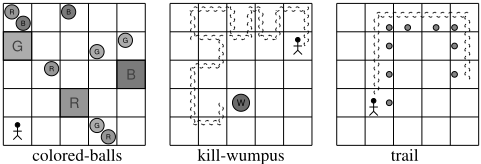
Some of the domains are well beyond the ability of simple replanners. For example, in kill-wumpus the agent must perform complex inferences to locate the wumpus. The invariants are 1) ¬stench(p) ⊃ ¬wumpus(p′ ) for adj(p, p′ ), 2) ¬wumpus(p) ∨ ¬wumpus(p′ ) for p ̸= p′ , and 3) stench(p) ⊃ ∨4i=1wumpus(pi) where {pi}4i=1 are the cells adjacent to p. Fig. 1 shows a 5×5 instance with the path traversed by the agent. Observe that when the agent reaches (2, 2), it infers that the wumpus is at (3, 2). This is obtained because at (2, 2) there is a stench which, by invariant 3, implies that there is a wumpus at either (1, 2), (2, 3), (2, 1) or (3, 2). The inference follows then because the agent visited all such cells except (3, 2).
5 Summary
We have laid out a logical and computational framework for planning with partial observability that exploits the use of classical planners. The formulation generalizes and makes precise the idea and the scope of 'planning under optimism' in partially observable settings. In particular, building on the general setting of domain-independent contingent planning, we established conditions under which the approach is sound and complete. A number of experiments have also been reported that illustrate the efficiency and expressive power of the proposed framework. The basic framework can be extended in a number of ways, including the use of actions with non-deterministic but observable effects. A limitation of the framework is that the idea of 'planning under optimism' is not always good; in particular, when backing up is impossible or not feasible. In the future, we would like to explore extensions that take such considerations into account. The planner and the examples will be made available through the web.
from scratch. This means that the PDDL of every such problem is parsed and preprocessed in each call. This is a considerable overhead that explains why FF fails on some of the instances, as 1,800 seconds is the bound on total time. Most of this overhead can be eliminated by implementing the K-planner inside the planner. This would make the K-planner more efficient but planner dependent.
Acknowledgmens
H. Geffner is partially supported by grants TIN2009-10232, MICINN, Spain, and EC-7PM-SpaceBook.
@inproceedings{ijcai2011p324,
  title     = {Planning under Partial Observability by Classical Replanning: Theory and Experiments},
  author    = {Bonet, Blai and Geffner, Hector},
  booktitle = {Proceedings of the Twenty-Second International Joint Conference on
               Artificial Intelligence, {IJCAI-11}},
  publisher = {AAAI Press/International Joint Conferences on Artificial Intelligence},
  editor    = {Toby Walsh},
  pages     = {1936--1940},
  year      = {2011},
  month     = {7},
  doi       = {10.5591/978-1-57735-516-8/IJCAI11-324},
  url       = {https://doi.org/10.5591/978-1-57735-516-8/IJCAI11-324},
}
TY - CPAPER TI - Planning under Partial Observability by Classical Replanning: Theory and Experiments AU - Bonet, Blai AU - Geffner, Hector T2 - Proceedings of the Twenty-Second International Joint Conference on Artificial Intelligence, IJCAI-11 PB - AAAI Press/International Joint Conferences on Artificial Intelligence PY - 2011 SP - 1936 EP - 1940 DO - 10.5591/978-1-57735-516-8/IJCAI11-324 UR - https://doi.org/10.5591/978-1-57735-516-8/IJCAI11-324 ER -Copied
Machine-readable versions of this paper, for tools and AI agents:





