
Modular Community Detection in Networks
Proceedings of the Twenty-Second International Joint Conference on Artificial Intelligence. Pages 1366-1370.
https://doi.org/10.5591/978-1-57735-516-8/IJCAI11-231
© 2011 International Joint Conferences on Artificial Intelligence
Abstract
Network community detection — the problem of dividing a network of interest into clusters for intelligent analysis — has recently attracted significant attention in diverse fields of research. To discover intrinsic community structure a quantitative measure called modularity has been widely adopted as an optimization objective. Unfortunately, modularity is inherently NP-hard to optimize and approximate solutions must be sought if tractability is to be ensured. In practice, a spectral relaxation method is most often adopted, after which a community partition is recovered from relaxed fractional values by a rounding process. In this paper, we propose an iterative rounding strategy for identifying the partition decisions that is coupled with a fast constrained power method that sequentially achieves tighter spectral relaxations. Extensive evaluation with this coupled relaxation-rounding method demonstrates consistent and sometimes dramatic improvements in the modularity of the communities discovered.
- [Adamic and Glance, 2005] L.A. Adamic and N. Glance. The political blogosphere and the 2004 U.S. election: di- vided they blog. In Proceedings of the 3rd international workshop on Link discovery, pages 36-43. ACM, 2005.
- [Agarwal and Kempe, 2008] G. Agarwal and D. Kempe. Modularity-maxmizing graph communities via mathemat- ical programming. European Physical Journal B, 66, 2008.
- [Brandes et al., 2006] U. Brandes, D. Delling, M. Gaertler, R. Görke, M. Hoefer, Z. Nikoloski, and D. Wagner. On modularity -NP-completeness and beyond, 2006.
- [Easley and Kleinberg, 2010] D. Easley and J. Kleinberg. Networks, Crowds, and Markets: Reasoning About a Highly Connected World. Cambridge University Press, 2010.
- [Fleischer et al., 2006] L. Fleischer, K. Jain, and D.P. Williamson. Iterative rounding 2-approximation algo- rithms for minimum-cost vertex connectivity problems. J. Comput. Syst. Sci., 72(5):838-867, 2006.
- [Girvan and Newman, 2002] M. Girvan and M. Newman. Community structure in social and biological networks. Proceedings of National Academy of Sciences, 99:7821- 7826, 2002.
- [Jain et al., 1999] A.K. Jain, M.N. Murty, and P.J. Flynn. Data clustering: A review. ACM Computing Surveys, 31(3):264-323, September 1999.
- [Knuth, 1993] D. Knuth. The Stanford graphbase: a plat- form for combinatorial algorithms. ACM Press, 1993.
- [Leskovec et al., 2010] J. Leskovec, K.J. Lang, and M.W. Mahoney. Empirical comparison of algorithms for net- work community detection. In Proceedings of the 19th In- ternational Conference on World Wide Web. ACM, 2010.
- [Lin and Kernighan, 1973] S. Lin and B.W. Kernighan. An effective heuristic algorithm for the traveling salesman problem. Operations Research, 21:498-516, 1973.
- [Lusseau et al., 2003] D. Lusseau, K. Schneider, O.J. Bois- seau, P. Haase, E. Slooten, and S.M. Dawson. The bot- tlenose dolphin community of doubtful sound features a large proportion of long-lasting associations: Can geo- graphic isolation explain this unique trait? Behavioral Ecology and Sociobiology, 54(4):396-405, 2003.
- [Newman, 2001] M. Newman. The structure of scientific collaboration networks. Proceedings of National Academy of Sciences, 98:404-409, 2001.
- [Newman, 2006] M. Newman. Modularity and commu- nity structure in networks. Proceedings of the National Academy of Sciences, 103(23):8577-8582, 2006.
- [Ng et al., 2002] A. Ng, M. Jordan, and Y. Weiss. On spec- tral clustering: Analysis and an algorithm. In Advances in Neural Information Processing Systems 14, Cambridge, MA, 2002. MIT Press.
- [Shi and Malik, 2000] J.B. Shi and J. Malik. Normalized cuts and image segmentation. IEEE Trans. Pattern Anal- ysis and Machine Intelligence, 22(8):888-905, August 2000.
- [Watts and Strogatz, 1998] D.J. Watts and S.H. Strogatz. Collective dynamics of 'small-world' networks. Nature, 393(6684):397-498, June 1998.
- [Xu et al., 2009] L. Xu, W. Li, and D. Schuurmans. Fast nor- malized cut with linear constraints. In 2009 IEEE Com- puter Society Conference on Computer Vision and Pattern Recognition, pages 2866-2873, 2009.
- [Zachary, 1977] W. Zachary. An information flow model for conflict and fission in small groups. Journal of Anthropo- logical Research, 33:452-473, 1977.
References were extracted automatically from the PDF and may contain errors.
Full text extracted automatically from the PDF; figures, tables and equations may differ. The PDF is the version of record.
1 Introduction
Many important systems can be represented as networks, with entities represented by vertices and relationships represented by edges. Prominent examples include the world wide web, social networks, biological networks, communication networks, etc. [Easley and Kleinberg, 2010]. Research on networks has attracted significant recent interest, particularly in computing sciences and artificial intelligence, in response to the rapid increase in size and availability of real world networks and the practical needs to analyze them.
When analyzing such networks, an important question has often been "How many communities are there and what are the memberships?". Community (i.e. cluster) structure seems to be inherent in real-world networks: vertices tend to cluster in groups where vertex connections within the same group are dense, while the connections are sparser between vertices from different groups. The ability to find and analyze such groups has proved invaluable in understanding network structure.
Computationally, the quality of a partition obtained depends on the quality of the objective function being used Dale Schuurmans University of Alberta Edmonton, Canada dale@cs.ualberta.ca
[Leskovec et al., 2010]. Recently, the modularity function, Q, which measures the quality of a particular grouping of vertices in a network, has been widely accepted. Girvan and Newman [2002] have shown across a variety of simulated and real-world networks that larger Q values are correlated with better graph vertex groupings.
Unfortunately, maximizing Q is fundamentally difficult, hence heuristic approximation methods have been proposed for locally optimizing it. Among them, a spectral method proposed [Newman, 2006] has attracted broad attention. After relaxation, the method computes a decision vector where each element corresponds to the partition assignment of a vertex. To recover a hard partition from such a relaxed solution it has been standard practice to round each element individually based simply on their sign. Although simple, this conventional rounding strategy has achieved good empirical results and has been deployed extensively in the analysis of real-world networks and other graph partition applications.
In this paper we propose an iterative rounding strategy for recovering the final decisions. Unlike conventional rounding, which purely operates on the individual signs, we take the magnitude of each element into consideration in a sequential manner. That is, in successive rounds only a portion of elements with large magnitudes are rounded to hard decisions. The remaining elements are then re-optimized in the next iteration by solving a residual problem. The solution to the residual problem is again partially rounded into decisions, and so on. At the core of our proposal is a new constrained power method that achieves fast computation of the residual problem. This sequential approach more tightly approximates the global modularity objective by interleaving partial rounding with tighter spectral relaxation of the successive residual problems. Through extensive evaluations, the iterative rounding method reports significant and consistent improvement over the conventional approach.
2 Preliminaries
Modularity is the standard objective function used in network cluster analysis. It quantifies the quality of a given division of a network into communities. Good divisions, which have high modularity values, are those with dense edge connections between the vertices within a community but sparse connections between vertices in different communities.
Consider an undirected graph G = (V,E) where V = {v1, v2, · · · , vn} is a set of vertices and E is a set of edges between vertex pairs. Let wij be an element of the adjacency matrix W of the network, which gives the number of edges between vertices vi and vj . We further denote di = ∑j wij as the degree of vi and m = 1 2 ∑i di as the total edge number.
For a candidate partition of the vertices into clusters, the modularity is defined to be the portion of the edge connections within the same cluster minus the expected portion if the connections were distributed randomly. Assuming the degree di associated with each vertex vi is preserved, under uniform random selection the expected number of edges between two vertices vi and vj is didj 2m . Thus the observed number minus the expected number is wij - didj 2m . Summing over all pairs of vertices within the same group, the modularity, denoted by Q, is given by
where ci is the group to which vertex vi belongs, and δ is the Kronecker delta function.
The value of Q lies in the range [-1, 1]. It is positive when the observed connections within the same group exceed the expected number under random connections. Given a larger than expected portion of connections, one can reasonably infer the presence of an underlying cluster structure. Thus, the cluster structure can be searched precisely by checking the network divisions that have large modularity values.
An equivalent formulation is often used. Define sir to be 1 if vertex vi belongs to group r and 0 otherwise. Then δ (ci, cj) = ∑r sirsjr and hence
where tr denotes the trace of a matrix, S is the matrix having elements sir , and B is the modularity matrix having elements
All rows and columns of the modularity matrix sum to zero, which means that the modularity of an undivided graph is always zero.
Unlike most statistical clustering models or graph partition techniques, which require a prior setting of partition numbers or group sizes [Jain et al., 1999; Shi and Malik, 2000; Ng et al., 2002], the modularity score determines the partition number and the group size automatically without manual intervention. This measure also allows the possibility that no good division of a network exists, corresponding to the case that the modularity value is zero (and cannot be increased by further division of vertices).
3 Spectral ModularityMaximization
Maximizing Q is NP-hard [Brandes et al., 2006], therefore researchers have sought approximate solutions. In practice, a spectral relaxation method is widely used, that obtains reasonable empirical results in both optimization accuracy and computation time [Newman, 2006].
3.1 Two-Way Partitions
To first understand the spectral method, consider a simple case where the graph is divided into two groups. One defines si = ±1 to indicate the group membership of vi, yielding
where s is the column vector with elements si.
The vector s can be expressed as a linear combination of the normalized eigenvectors ui of the modularity matrix B, so that s = ∑ni=1 aiui with ai = uTi s. Then one obtains
where λi is the eigenvalue of B corresponding to the eigenvector ui.
Assume that the eigenvalues are labeled non-increasingly, λ1 ≥ λ2 ≥ · · · ≥ λn. To maximize Q, the assignment vector s needs to concentrate as much weight as possible in the terms involving the leading (largest algebraic) eigenvalues, which, if s were unconstrained, could be achieved by setting s proportional to the leading eigenvector u1. But with "±1" constraints, s cannot be chosen freely, which makes the optimization difficult.
Fortunately there is a convenient approximation available. Ignoring the inconvenient fact that it is not possible to make s perfectly parallel to u1, one simply divides the vertices into two groups according to the signs of each element of u1. Although this approximation is straightforward, it has often been found to give reasonable results in practice.
3.2 Multi-Way Partitions
The simple two-way partition method can be extended to multi-way partition method recursively. That is, using successive two-way partitions that divide the graph into subgraphs, the process can be continued on each subgraph until no further increases in Q can be found.
Formally, for each subgraphG′ = (V ′ , E′ ) with n′ vertices we define an n′ × n′ subgraph modularity matrix B′ with elements
where d′i = ∑j:vj∈V ′ wij and m′ = 12 ∑i:vi∈V ′ di. The subgraph modularity is given by Q′ = 1 4m s′T B′s′ , where s′ is a column vector with n′ elements. Maximizing Q′ with respect to s′ gives the further contribution to the modularity Q obtained by subdividing the subgraph. When G′ = G, B′ reduces to B since d′i → di and m′ → m in that case.
The division process on each subgraph is halted when there exists no division that further increases the graph modularity; that is, no division that yields a positive value for Q′ . This happens when the modularity matrix B′ has no positive eigenvalues, hence the leading eigenvalue provides a simple check for terminating the division process.
3.3 Combination with Exchange Heuristics
In practice, the spectral method is often used in conjunction with exchange heuristics. In this approach, one uses spectral partitioning to obtain an initial broad division of the graph into subgraphs, then refines this division by moving vertices between groups using the Kernighan-Lin algorithm [Lin and Kernighan, 1973].
Given two groups of vertices, the refinement proceeds as follows. Successively find the vertex that, when moved to the other group, obtains the largest increase in Q, or the smallest decrease if no increase exists. Repeatedly make such moves, but ensuring that each vertex is moved only once. When all vertices have been moved, search all intermediate states to find the division that obtained the greatest Q. Starting again from this state, repeat the exchange process, until no further improvement is possible for Q.
As reported in [Newman, 2006], this combination gives excellent results on many open networks and has become a standard baseline when comparing community detection algorithms.
3.4 Computational Issues
The modularity matrix B has special structure that can be exploited to efficiently compute the leading eigenvector via the power method. The power method approximates the dominant eigenvalue (the eigenvalue with the largest magnitude) and its eigenvector by iteratively multiplying a given matrix with an initial vector. For example, starting from a random vector v0 , the power method iteratively refines v by matrixvector multiplication and renormalization vi+1 = Bvi ‖Bvi ‖ , and approximates the dominant eigenvector of B efficiently.
For modularity matrices, although the leading eigenvector might not be dominant, one can still apply the power method by using a simple trick. Without loss of generality assume the eigenvalues of B satisfy λ1 > λ2 ≥ · · · ≥ 0 ≥ · · · ≥ λn-1 > λn. Using the power method, first compute B's dominant eigenvalue. If the eigenvalue is positive, it is λ1, and its eigenvector is precisely the leading eigenvector u1 we seek. If the eigenvalue is negative, it is λn, the most negative eigenvalue. In this case, shift the matrix B+ |λn| 2 I, where I is an n × n identity matrix. The shifted matrix has eigenvalues λ1 + |λn| 2 , λ2 + |λn| 2 , · · · , λn 2 but the same eigenvectors as B. Applying the power method to this new matrix returns λ1 + |λn| 2 , with the desired eigenvector u1.
With trivial modifications, the power method can also be used to calculate the leading eigenvector for the subgraph modularity matrix B′ . We omit the details here.
4 Iterative Rounding for Community Detection
We now present our main proposal for improving the modularity of the communities discovered in a network.
4.1 Conventional Rounding vs Iterative Rounding
In the spectral approach, given the computed eigenvector, a vertex partition is usually recovered by simple rounding
where u1i denotes the i-th element of the leading eigenvector u1. We refer to this strategy as conventional rounding.
Note that the conventional rounding strategy is based on the signs of the eigenvector elements, regardless of their magnitudes (absolute values). However, the elements with different magnitudes contribute differently to Q, and therefore affect the confidence in the rounding decisions. For example, if u1i has a large magnitude, then si will have a significant influence on uT1 s in the objective, and we would be more confident in inferring its rounded value. However, if the magnitude is small, si's contribution to the objective is less evident, and one would be less confident to make the rounding decision. In this latter case, we would like to postpone the rounding decision to a later phase.
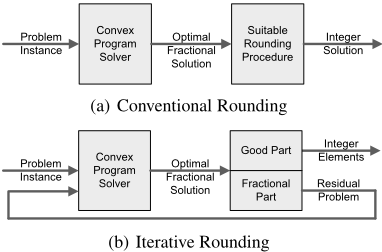
Based on the idea, we propose a successive rounding method that only rounds variables with top magnitudes. That is, unlike conventional rounding that makes the entire partition decision in a single batch, we propose to recover more accurate community structure incrementally, using a strategy we will refer to as iterative rounding.
The two rounding schemes are illustrated in Figure 1. In iterative rounding, we first find an approximate solution to the original problem. Then, given a relaxed result, we do not turn all the elements into decisions like conventional rounding, but instead only round those with large magnitudes. Then we proceed to the next iteration by studying the residual problem, which often has a structure similar to the original but with fewer elements. This process is repeated until no variables are left un-rounded.
4.2 Constrained Power Method
To explain how the residual problems are efficiently solved in the context of iterative rounding, consider an illustration of the approach. In the first iteration, we have the same problem, maxsT Bs, as the conventional spectral method. We simply use the power method and get the leading eigenvector. Then, rather than deploy conventional rounding, we only round the elements with largest magnitudes into decisions.
After the first iteration, we are left a residual problem to solve. Now suppose s = ( s1 s2 ) where s1 denotes the rounded elements that are held fixed, and s2 contains the unrounded elements yet to be set. We can re-write the objective as the maximization of
where B11,B12,B21 and B22 are four sub-matrices of B. Equivalently we have a residual problem to maximize
with respect to s2, subject to the unit length constraint.
We can apply the gradient-based method for the maximization by iteratively updating s2 along the gradient direction and renormalizing it, with which the convergence is guaranteed.
We also find a procedure we call constrained power method that gives excellent results. In gradient-based update s2 converges when the gradient ∇L is parallel to the current estimate of s2, or ∇L = 2λs2 where λ is a scalar number. Then we have
We can force λ to be positive. Since s2 is of unit length, it must hold that ‖B22s2 +B21s1‖ = λ. Thus we reach a simple update rule for s2:
The update occurs in a similar manner as in the power method. When B21s1 = 0, the constrained power method reduces exactly to the power method.
Starting with the previous fractional result as s02, the constrained power method often converges quickly in practice. Given the updated relaxed solution produced by the constrained power method, we again only round those elements in s2 that have large magnitude. After this partial rounding, we are left another residual problem sharing the same structure. The constrained power method and iterative rounding are applied successively for each residual problem. The process is terminated once s2 has no elements, hence all vertex grouping decisions have been made.
It is also possible to apply the projected power method developed in [Xu et al., 2009] for the optimization problem in each iteration, which exhibits similar performance as the constrained power method on community detections. We omit the details here.
4.3 Complexity Analysis
To analyze the time complexity for iterative rounding in spectral partitions, we first borrow some results on the power method from [Newman, 2006]. For a sparse network with n vertices and m ≤ kn edges where k is a constant, the power method effectively requires O (n) matrix-vector multiplications to converge, where each multiplication requires O (n) floating point operations. In total, the power method requires O (n2 ) time to calculate the leading eigenvector of the modularity matrix.
Similarly to the power method, the constrained power method has a complexity of O (n2 ) for a problem with n variables. Furthermore, suppose after each iteration an ϵ (0 < ϵ ≤ 1) fraction of the variables are rounded into integer decisions. Then in the subsequent round the residual problem becomes one with n(1- ϵ) variables, and the constrained power method would therefore require O (n2 (1 - ϵ)2) operations to converge. Repeating this argument, the complexity of iterative rounding becomes:
and we come to the following observation.
For a network with n vertices, the complexity of iterative rounding is O ( 1ϵ n2 ) where ϵ is the fraction of variables to round in each iteration.
Comparing with the complexity of O (n2 ) for conventional rounding in network community detection, we can see the difference is up to a factor 1ϵ , which is usually a constant value in practice. Suppose in each iteration 14 of the variables are rounded, then the run time of iterative rounding would be around 4 times the run time of the conventional rounding method. Although the estimate is not theoretically strict, as we will see in our evaluations, it fits practice well.
5 Evaluation
We compared the proposed iterative rounding strategy to the conventional spectral method. In a series of experiments we observed consistent and sometimes very large improvements. In particular,
- for two-way partitions (cf. Section 3.1), iterative rounding demonstrates significantly improved Q values;
- for multi-way partitions (cf. Section 3.2), iterative rounding demonstrates significantly improved Q values;
- for partitions refined by exchange heuristics (cf. Section 3.3), iterative rounding demonstrates significantly improved Q values;
- iterative rounding has reasonable computation overhead comparing with conventional rounding.
These evaluations were conducted on all fourteen networks contained in a standard benchmark collection. 1 These benchmark networks cover a variety of application areas and are briefly described in Table 1.
1 http://www-personal.umich.edu/∼mejn/netdata/
| Network | Source | |
|---|---|---|
| karate (34) | friendships of 34 members in a karate club [Zachary, 1977] | |
| dolphins (62) | frequent associations of 62 dolphins [Lusseau et al., 2003] | |
| lesmis | character interactions from Les Mis´erables [Knuth, 1993] | |
| (77) polbooks | ||
| (105) adjnoun | co-purchase of politics books at Amazon.com (www.orgnet.com) | |
| adjacency of adjs and nouns in David Copperfield [Newman, 2006] | ||
| (112) | ||
| football | US college football games during Fall 2000 | |
| (115) | ||
| [Girvan and Newman, 2002] | ||
| celegans (297) | neural network of C. Elegans [Watts 1998] | |
| polblogs | and Strogatz, hyperlinks of US politics web logs | |
| (1224) | [Adamic and Glance, 2005] | |
| co-authorship on network theory and experiment | ||
| netsci | [Newman, 2006] | |
| (1461) power | topology of US Western States Power Grid | |
| (4941) | [Watts and Strogatz, 1998] | |
| hepth | co-authorship on preprints of High-Energy Theory | |
| astroph | [Newman, 2001] | |
| (7610) | co-authorship on preprints of Astrophysics | |
| [Newman, 2001] | ||
| (16046) | ||
| (16264) | [Newman, 2001] | |
| internet | snapshot of Internet in level of autonomous | |
| systems | ||
| (www.routeviews.org) | ||
| (22963) | ||
| co-authorship on preprints of Condensed Matter | ||
| condmat |
5.1 Two-Way Partitions
In this case, we divided each network into two partitions and checked the Q value obtained by two rounding methods respectively. The results are listed in Table 2. On all fourteen networks, iterative rounding demonstrates improved Q values over conventional rounding.
For small networks, two rounding methods reported comparable Q values and the improvement from iterative rounding is not large. On the smallest "karate" network with 34 vertices, the improvement is only slight, from 0.371 to 0.372. However, on larger networks the improvements are much more significant. One example is on "hepth" network with 7, 610 vertices, where the conventional rounding result is 0.034 while the iterative rounding achieves a modularity score of 0.455.
5.2 Multi-Way Partitions
Next, we investigated multi-way partitioning, wherein twoway partitions are repeated until no further increase of Q is possible. These results are listed in Table 2, where it can be seen that improvements achieved by iterative rounding remain consistent. On all networks, iterative rounding obtained better Q values than conventional rounding.
Similarly to the two-way case, the improvement is particularly significant on large networks. On "karate" network, the increase is only from 0.393 to 0.417; while on the larger "hepth" network, it becomes 0.739 to 0.829; and on the largest "internet" network the improvement is from 0.419 to 0.620.
| Networks | CR | IR |
|---|---|---|
| karate dolphins lesmis polbooks adjnoun football celegan polblogs netsci power hepth astroph condmat internet | .371/.393/.420 .390/.491/.519 .361/.532/.550 .445/.467/.521 .191/.243/.308 .376/.493/.599 .261/.332/.400 .424/.424/.425 .131/.671/.908 .062/.898/.924 .034/.739/.812 .195/.586/ .210/.677/ .301/.419/ | .372/.417/.420 .403/.526/.526 .381/.551/.560 .457/.523/.527 .214/.298/.308 .400/.601/.605 .313/.381/.401 .426/.426/.426 .496/.953/.954 .491/.933/.934 .455/.829/.839 .417/.725/ .453/.823/ .370/.620/ |
5.3 With Exchange Heuristics
As discussed in Section 3.3, the spectral partition method is often used in conjunction with exchange heuristics, which provides further refinement for the community partitions discovered. In our experiments, we also compared the Q values achieved by the two rounding methods after this fine-tuning.
The refined Q values are listed in Table 2. On "karate" network, both methods successfully detected the partition structure with Q = 0.420 which is known to be optimal via mathematical programming [Agarwal and Kempe, 2008]. On "adjnoun" network, the two methods obtained the same result after refinement. On all the other nine networks where the exchange heuristic was applicable on a conventional computer, iterative rounding achieved improved Q values to conventional rounding.
An interesting observation is that iterative rounding benefits less from the exchange heuristic. For conventional rounding, the exchange heuristic helps to increase Q significantly on most networks. However for iterative rounding, the increase is not as evident. On the other hand, on eight out of eleven networks, the iterative rounding multi-way results alone (without refinement) are better than the conventional rounding results with refinement, further exhibiting the effectiveness of iterative rounding.
5.4 Run Time Comparison
We recorded the run time of conventional rounding and iterative rounding on networks with more than 1, 000 vertices. Both rounding methods were implemented in Matlab and run on an Intel Xeon workstation with 32G RAM. For iterative rounding, we set ϵ = 14 , meaning that 14 of the variables were rounded in each iteration.
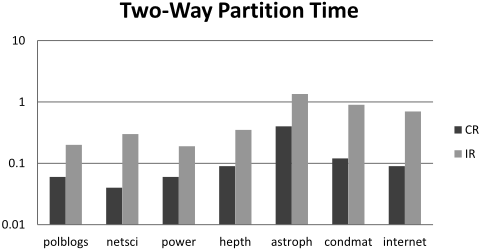
The two-way partition time is listed in Figure 2. The multiway partition time is not listed because the two rounding methods typically produce partitions with different numbers and sizes which makes the results not directly comparable. From these results, we can see that iterative rounding brings reasonable computation overhead, given the additional time required to solve the residual problems. It is approximately 3 to 7 times slower than conventional rounding in the experiment, consistent with our complexity analysis in Section 4.3.
6 Conclusion
This paper studies the community detection problem in networks. For this problem, a spectral relaxation algorithm is widely used in combination with a standard rounding strategy. Our work focuses on improving the results of these methods by a sequential rounding approach. This rounding strategy has achieved significantly improved results in empirical studies.
The study of rounding strategies is difficult. Not much work has been investigated [Fleischer et al., 2006]. In practice, however, the strategy can be extremely important, especially for relaxation-based methods. As we have seen in Section 5, it sometimes governs the success of an algorithm. Thus more investigations along this line deserve our further attention. We expect such results to be applicable to a variety of related spectral partition problems, such as normalized cut.
@inproceedings{ijcai2011p231,
  title     = {Modular Community Detection in Networks},
  author    = {Li, Wenye and Schuurmans, Dale},
  booktitle = {Proceedings of the Twenty-Second International Joint Conference on
               Artificial Intelligence, {IJCAI-11}},
  publisher = {AAAI Press/International Joint Conferences on Artificial Intelligence},
  editor    = {Toby Walsh},
  pages     = {1366--1370},
  year      = {2011},
  month     = {7},
  doi       = {10.5591/978-1-57735-516-8/IJCAI11-231},
  url       = {https://doi.org/10.5591/978-1-57735-516-8/IJCAI11-231},
}
TY - CPAPER TI - Modular Community Detection in Networks AU - Li, Wenye AU - Schuurmans, Dale T2 - Proceedings of the Twenty-Second International Joint Conference on Artificial Intelligence, IJCAI-11 PB - AAAI Press/International Joint Conferences on Artificial Intelligence PY - 2011 SP - 1366 EP - 1370 DO - 10.5591/978-1-57735-516-8/IJCAI11-231 UR - https://doi.org/10.5591/978-1-57735-516-8/IJCAI11-231 ER -Copied
Machine-readable versions of this paper, for tools and AI agents:





