
Optimal Partitions in Additively Separable Hedonic Games
Proceedings of the Twenty-Second International Joint Conference on Artificial Intelligence. Pages 43-47.
https://doi.org/10.5591/978-1-57735-516-8/IJCAI11-019
© 2011 International Joint Conferences on Artificial Intelligence
Abstract
We conduct a computational analysis of fair and optimal partitions in additively separable hedonic games. We show that, for strict preferences, a Pareto optimal partition can be found in polynomial time while verifying whether a given partition is Pareto optimal is coNP-complete, even when preferences are symmetric and strict. Moreover, computing a partition with maximum egalitarian or utilitarian social welfare or one which is both Pareto optimal and individually rational is NP-hard. We also prove that checking whether there exists a partition which is both Pareto optimal and envy-free is Σ2p-complete. Even though an envy-free partition and a Nash stable partition are both guaranteed to exist for symmetric preferences, checking whether there exists a partition which is both envy-free and Nash stable is NP-complete.
- A. Abdulkadiroglu and T. Sönmez. Random serial dictator- ship and the core from random endowments in house allo- cation problems. Econometrica, 66(3):689-702, 1998.
- D. J. Abraham, K. Cechlárová, D. Manlove, and K. Mehlhorn. Pareto optimality in house allocation problems. In Proc. of 16th International Symposium on Algorithms and Computation, pages 1163-1175, 2005.
- C. Ballester. NP-completeness in hedonic games. Games and Economic Behavior, 49(1):1-30, 2004.
- S. Banerjee, H. Konishi, and T. Sönmez. Core in a sim- ple coalition formation game. Social Choice and Welfare, 18:135-153, 2001.
- N. Bansal, A. Blum, and S. Chawla. Correlation clustering. Machine Learning, 56:89-113, 2004.
- S. Barberà, W. Bossert, and P. K. Pattanaik. Ranking sets of objects. In S. Barberà, P. J. Hammond, and C. Seidl, editors, Handbook of Utility Theory, volume II, chapter 17, pages 893-977. Kluwer Academic Publishers, 2004.
- A. Bogomolnaia and M. O. Jackson. The stability of hedo- nic coalition structures. Games and Economic Behavior, 38(2):201-230, 2002.
- S. Bouveret and J. Lang. Efficiency and envy-freeness in fair division of indivisible goods: logical representation and complexity. Journal of Artificial Intelligence Research, 32(1):525-564, 2008. IJCAI
- S. Branzei and K. Larson. Coalitional affinity games and the stability gap. In Proc. of 21st IJCAI, pages 1319-1320, 2009. IJCAI
- K. Cechlárová. Stable partition problem. In Encyclopedia of Algorithms. 2008.
- B. de Keijzer, S. Bouveret, T. Klos, and Y. Zhang. On the complexity of efficiency and envy-freeness in fair division of indivisible goods with additive preferences. In Proc. of 1st International Conference on Algorithmic Decision The- ory, pages 98-110, 2009.
- X. Deng and C. H. Papadimitriou. On the complexity of co- operative solution concepts. Mathematics of Operations Research, 12(2):257-266, 1994.
- D. Dimitrov, P. Borm, R. Hendrickx, and S. C. Sung. Sim- ple priorities and core stability in hedonic games. Social Choice and Welfare, 26(2):421-433, 2006.
- J. H. Drèze and J. Greenberg. Hedonic coalitions: Optimality and stability. Econometrica, 48(4):987-1003, 1980.
- M. R. Garey and D. S. Johnson. Computers and Intractabil- ity: A Guide to the Theory of NP-Completeness. W. H. Freeman, 1979.
- J. Hajduková. Coalition formation games: A survey. Interna- tional Game Theory Review, 8(4):613-641, 2006.
- R. J. Lipton, E. Markakis, E. Mossel, and A. Saberi. On approximately fair allocations of indivisible goods. In Proc. of 5th ACM-EC Conference, pages 125-131, 2004.
- H. Moulin. Axioms of Cooperative Decision Making. Cam- bridge University Press, 1988.
- A. Roth and M. A. O. Sotomayor. Two-Sided Matching: A Study in Game Theoretic Modelling and Analysis. Cam- bridge University Press, 1990.
- T. Sandholm, K. Larson, M. Andersson, O. Shehory, and F. Tohmé. Coalition structure generation with worst case guarantees. Artificial Intelligence, 111(1-2):209-238, 1999.
- S. C. Sung and D. Dimitrov. Computational complexity in additive hedonic games. European Journal of Operational Research, 203(3):635-639, 2010.
- J. von Neumann and O. Morgenstern. Theory of Games and Economic Behavior. Princeton University Press, 2nd edi- tion, 1947.
- G. J. Woeginger. A polynomial time approximation scheme for maximizing the minimum machine completion time. Operations Research Letters, 20(4):149-154, 1997.
References were extracted automatically from the PDF and may contain errors.
Full text extracted automatically from the PDF; figures, tables and equations may differ. The PDF is the version of record.
1 Introduction
Ever since the publication of von Neumann and Morgenstern's Theory of Games and Economic Behavior in 1944, coalitions have played a central role within game theory. The crucial questions in coalitional game theory are which coalitions can be expected to form and how the members of coalitions should divide the proceeds of their cooperation. Traditionally the focus has been on the latter issue, which led to the formulation and analysis of concepts such as Gillie's core, the Shapley value, or the bargaining set. Which coalitions are likely to form is commonly assumed to be settled exogenously, either by explicitly specifying the coalition structure, a partition of the players in disjoint coalitions, or, implicitly, by assuming that larger coalitions can invariably guarantee better outcomes to its members than smaller ones and that, as a consequence, the grand coalition of all players will eventually form.
The two questions, however, are clearly interdependent: the individual players' payoffs depend on the coalitions that form just as much as the formation of coalitions depends on how the payoffs are distributed.
∗ This material is based on work supported by the Deutsche Forschungsgemeinschaft under grants BR-2312/6-1 (within the European Science Foundation's EUROCORES program LogICCC) and BR 2312/7-1.
Coalition formation games, as introduced by Dr`eze and Greenberg [1980], provide a simple but versatile formal model that allows one to focus on coalition formation as such. In many situations it is natural to assume that a player's appreciation of a coalition structure only depends on the coalition he is a member of and not on how the remaining players are grouped. Initiated by Banerjee et al. [2001] and Bogomolnaia and Jackson [2002], much of the work on coalition formation now concentrates on these so-called hedonic games.
The main focus in hedonic games has been on notions of stability for coalition structures such as Nash stability, individual stability, contractual individual stability, or core stability and characterizing conditions under which they are guaranteed to be non-empty [see, e.g., Bogomolnaia and Jackson, 2002]. The most prominent examples of hedonic games are two-sided matching games in which only coalitions of size two are admissible [Roth and Sotomayor, 1990].
General coalition formation games have also received attention from the artificial intelligence community, where the focus has generally been on computing partitions that give rise to the greatest social welfare [see, e.g., Sandholm et al., 1999]. The computational complexity of hedonic games has been investigated with a focus on the complexity of computing stable partitions for different models of hedonic games [Ballester, 2004; Dimitrov et al., 2006; Cechl´arov´a, 2008]. We refer to Hajdukov´a [2006] for a critical overview.
Among hedonic games, additively separable hedonic games (ASHGs) are a particularly natural and succinct representation in which each player has a value for every other player and the value of a coalition to a particular player is computed by simply adding his values of the players in his coalition.
Additive separability satisfies a number of desirable axiomatic properties [Barber`a , 2004]. ASHGs are the non-transferable utility generalization of graph games studied by Deng and Papadimitriou [1994]. Sung and Dimitrov [2010] showed that for ASHGs, checking whether a core stable, strict-core stable, Nash stable, or individually stable partition exists is NP-hard. Dimitrov et al. [2006] obtained positive algorithmic results for subclasses of additively separable hedonic games in which each player divides other players into friends and enemies. Branzei and Larson [2009] examined the tradeoff between stability and social welfare in ASHGs.
Contribution In this paper, we analyze concepts from fair division in the context of coalition formation games. We present the first systematic examination of the complexity of computing and verifying optimal partitions of hedonic games, specifically ASHGs. We examine various standard criteria from the social sciences: Pareto optimality, utilitarian social welfare, egalitarian social welfare, and envy-freeness [see, e.g., Moulin, 1988].
In Section 3, we show that computing a partition with maximum egalitarian social welfare is NP-hard. Similarly, computing a partition with maximum utilitarian social welfare is NP-hard in the strong sense even when preferences are symmetric and strict.
In Section 4, the complexity of Pareto optimality is studied. We prove that checking whether a given partition is Pareto optimal is coNP-complete in the strong sense, even when preferences are strict and symmetric. By contrast, we present a polynomial-time algorithm for computing a Pareto optimal partition when preferences are strict. 1 Interestingly, computing an individually rational and Pareto optimal partition is NP-hard in general.
In Section 5, we consider complexity questions regarding envy-free partitions. Checking whether there exists a partition which is both Pareto optimal and envy-free is shown to be Σ p 2 -complete. We present an example which exemplifies the tradeoff between satisfying stability (such as Nash stability) and envy-freeness and use the example to prove that checking whether there exists a partition which is both envyfree and Nash stable is NP-complete even when preferences are symmetric.
2 Preliminaries
In this section, we provide the terminology and notation required for our results.
2.1 Hedonic games
A hedonic coalition formation game is a pair (N, P) where N is a set of players and P is a preference profile which specifies for each player i ∈ N the preference relation ≿i, a reflexive, complete and transitive binary relation on set Ni = {S ⊆ N | i ∈ S }.
S ≻i T denotes that i strictly prefers S over T and S ∼i T that i is indifferent between coalitions S and T. A partition π is a partition of players N into disjoint coalitions. By π(i), we denote the coalition in π which includes player i.
A game (N, P) is separable if for any player i ∈ N and any coalition S ∈ Ni and for any player j not in S we have the following: S ∪{ j} ≻i S if and only if {i, j} ≻i {i}; S ∪{ j} ≺i S if and only if {i, j} ≺i {i}; and S ∪ { j} ∼i S if and only if {i, j} ∼i {i}.
In an additively separable hedonic game (N,P), each player i ∈ N has value vi( j) for player j being in the same coalition as i and if i is in coalition S ∈ Ni, then i gets utility ∑ j∈S\{i} vi( j). For coalitions S, T ∈ Ni, S ≿i T if and only if ∑ j∈S \{i} vi( j) ≥ ∑ j∈T\{i} vi( j).
1 Thus, we identify a natural problem in coalitional game theory where verifying a possible solution is presumably harder than actually finding one.
A preference profile is symmetric if vi( j) = vj(i) for any two players i, j ∈ N and is strict if vi( j) nequal 0 for all i, j ∈ N such that i nequal j. We consider ASHGs (additively separable hedonic games) in this paper. Unless mentioned otherwise, all our results are for ASHGs.
2.2 Fair and optimal partitions
In this section, we formulate concepts from the social sciences, especially the literature on fair division, for the context of hedonic games. A partition π satisfies individual rationality if each player does as well as by being alone, i.e., for all i ∈ N, π(i) ≿i {i}. For a utility-based hedonic game (N, P) and partition π, we will denote the utility of player i ∈ N by uπ(i). The different notions of fair or optimal partitions are defined as follows. 2
- The utilitarian social welfare of a partition is defined as the sum of individual utilities of the players: uut(π) = ∑i∈N uπ(i). A maximum utilitarian partition maximizes the utilitarian social welfare.
- The elitist social welfare is given by the utility of the player that is best off: uel(π) = max{uπ(i) | i ∈ N}. A maximum elitist partition maximizes the utilitarian social welfare.
- The egalitarian social welfare is given by the utility of the agent that is worst off: ueg(π) = min{uπ(i) | i ∈ N}. A maximum egalitarian partition maximizes the egalitarian social welfare.
- A partition π of N is Pareto optimal if there exists no partition π ′ of N which Pareto dominates π, that is for all i ∈ N, π ′ (i) ≿i π(i) and there exists at least one player j ∈ N such that j ∈ N, π ′ ( j) ≻j π( j).
- Envy-freeness is a notion of fairness. In an envy-free partition, no player has an incentive to replace another player.
For the sake of brevity, we will call all the notions described above "optimality criteria" although envy-freeness is rather concerned with fairness than optimality. We consider the following computational problems with respect to the optimality criteria defined above.
Optimality: Given (N, P) and a partition π of N, is π optimal? Existence: Does an optimal partition for a given (N, P) exist? Search: If an optimal partition for a given (N,P) exists, find one.
Existence is trivially true for all criteria of optimality concepts. By the definitions, it follows that there exist partitions which satisfy maximum utilitarian social welfare, elitist social welfare, and egalitarian social welfare respectively.
2 All welfare notions considered in this paper (utilitarian, elitist, and egalitarian) are based on the interpersonal comparison of utilities. Whether this assumption can reasonably be made is debatable.
3 Complexity of maximizing social welfare
In this section, we examine the complexity of maximizing social welfare in ASHGs. We first observe that computing a maximum utilitarian partition for strict and symmetric preferences is NP-hard because it is equivalent to the NP-hard problem of maximizing agreements in the context of correlation clustering [Bansal et al., 2004].
Theorem 1 Computing a maximum utilitarian partition is NP-hard in the strong sense even with symmetric and strict preferences.
Computing a maximum elitist partition is much easier. For any player i, let F(i) = { j | vi( j) > 0} be the set of players which i strictly likes and f (i) = ∑ j∈F(i) vi( j). Both F(i) and f (i) can be computed in linear time. Let k ∈ N be the player such that f (k) ≥ f (i) for all i ∈ N. Then π = {{{k} ∪ F(k)}, N \ {{k} ∪ F(k)}} is a partition which maximizes the elitist social welfare. As a corollary, we can verify whether a partition π has maximum elitist social welfare by computing a partition π ∗ with maximum elitist social welfare and comparing uel(π) with uel(π ∗ ). Just like maximizing the utilitarian social welfare, maximizing the egalitarian social welfare is hard.
Theorem 2 Computing a maximum egalitarian partition is NP-hard in the strong sense.
Proof: We provide a polynomial-time reduction from the NP-hard problem MaxMinMachineCompletionTime [Woeginger, 1997] in which an instance consists of a set of m identical machines M = {M1, . . . , Mm}, a set of n independent jobs J = {J1, . . . , Jn} where job Ji has processing time pi. The problem is to allot jobs to the machines such that the minimum processing time (without machine idle times) of all machines is maximized. Let I be an instance of MaxMinMachineCompletionTime and let P = ∑n i=1 pi. From I we construct an instance I ′ of EgalSearch. The ASHG for instance I ′ consists of N = {i | Mi ∈ M} ∪ {si | Ji ∈ J} and the preferences of the players are as follows: for all i = 1, . . .m and all j = 1, . . . , n let vi(s j) = pj and vs j (i) = P. Also, for 1 ≤ i, i ′ ≤ m, i nequal i ′ let vi(i ′ ) = -(P + 1) and for 1 ≤ j, j ′ ≤ n, j nequal j ′ let vs j (vs j′ ) = 0. Each player i corresponds to machine Mi and each player s j corresponds to job J j.
Let π be the partition which maximizes ueg(π). We show that players 1, . . . , m are in separate coalitions and each player s j is in π(i) for some 1 ≤ i ≤ m. We can do so by proving two claims. The first claim is that for i, j ∈ {1, . . . m} such that i nequal j, we have that i nelement π( j). The second claim is that each player s j is in a coalition with a player i. The proofs of the claims are omitted due to space limitations.
A job allocation Alloc(π) corresponds to a partition π where s j is in π(i) if job Jj is assigned to Mi for all j and i. Note that the utility uπ(i) = ∑s j∈π(i) vi(s j) = ∑s j∈π(i) pj of a player corresponds to the total completion time of all jobs assigned to Mi according to Alloc(π). Let π ∗ be a maximum egalitarian partition. Assume that there is another partition π ′ and Alloc(π ′ ) induces a strictly greater minimum completion time. We know that uπ ∗ (s j) = uπ ′′ (s j) = P for all 1 ≤ j ≤ n and uπ ∗ (i) ≤ P for all 1 ≤ i ≤ m. But then from the assumption we have ueg(π ′ ) > ueg(π ∗ ) which is a contradiction. □
4 Complexity of Pareto optimality
We now consider the complexity of computing a Pareto optimal partition. The complexity of Pareto optimality has already been considered in several settings such as house allocation [Abraham et al., 2005]. Bouveret and Lang [2008] examined the complexity of Pareto optimal allocations in resource allocation problems. We show that checking whether a partition is Pareto optimal is hard even under severely restricted settings.
Theorem 3 The problem of checking whether a partition is Pareto optimal is coNP-complete in the strong sense, even when preferences are symmetric and strict.
Proof: The problem is clearly in coNP as another partition which Pareto dominates the given partition π is a witness that π is not Pareto optimal. The reduction is from the NP-complete problem E3C (EXACT-3-COVER) to deciding whether a given partition is Pareto dominated by another partition or not. Recall that in E3C, an instance is a pair (R, S ), where R = {1, . . . , r} is a set and S is a collection of subsets of R such that |R| = 3m for some positive integer m and |s| = 3 for each s ∈ S . The question is whether there is a sub-collection S ′ ⊆ S which is a partition of R.
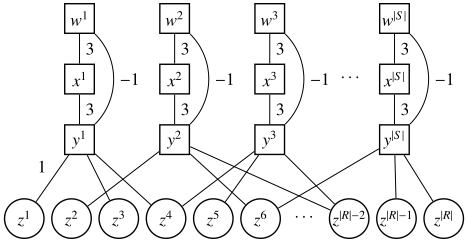
It is known that E3C remains NP-complete even if each r ∈ R occurs in at most three members of S [Garey and Johnson, 1979]. Let (R, S ) be an instance of E3C. (R, S ) can be reduced to an instance ((N,P), π), where (N,P) is an ASHG defined in the following way. Let N = {w s , x s , y s | s ∈ S } ∪ {z r | r ∈ R}. The players preferences are symmetric and strict and are defined as follows (as also depicted in Figure 1): vw s (x s ) = vx s (y s ) = 3 for all s ∈ S ; vy s (w s ) = vy s (w s ′ ) = -1 for all s, s ′ ∈ S ; vy s (z r ) = 1 if r ∈ s and vy s (z r ) = -7 if r nelement s; vz r (z r ′ ) = 1/(|R| - 1) for any r, r ′ ∈ R; and va(b) = -7 for any a, b ∈ N and a nequal b for which va(b) is not already defined.
The partition π in the instance ((N,P), π) is {{x s , y s }, {w s } | s ∈ S }} ∪ {{z r | r ∈ R}}. We see that the utilities of the players are as follows: uπ(w s ) = 0 for all s ∈ S ; uπ(x s ) = uπ(y s ) = 3 for all s ∈ S ; and uπ(z r ) = 1 for all r ∈ R.
Assume that there exists S ′ ⊆ S such that S ′ is a partition of R. Then we prove that π is not Pareto optimal and there exists another partition π ′ of N which Pareto dominates π. We form another partition π ′ = {{x s , w s } | s ∈ S ′ }∪{{y s , zi, z j, zk} | s ∈ S ′ ∧ i, j, k ∈ s} ∪ {{x s , y s }, {w s } | s ∈ (S \ S ′ )}}. In that case, uπ ′ (w s ) = 3 for all s ∈ S ′ ; uπ ′ (w s ) = 0 for all s ∈ S \ S ′ ; uπ(x s ) = uπ(y s ) = 3 for all s ∈ S ; and uπ(z r ) = 1 + 2/(|R| - 1) for all r ∈ R. Whereas the utilities of no player in π ′ decreases, the utility of some players in π ′ is more than in π. Since π ′ Pareto dominates π, π is not Pareto optimal.
We now show that if there exists no S ′ ⊆ S such that S ′ is a partition of R, then π is Pareto optimal. We note that -7 is a sufficiently large negative valuation to ensure that if va(b) = vb(a) = -7, then a, b ∈ N cannot be in the same coalition in a Pareto optimal partition. For the sake of contradiction, assume that π is not Pareto optimal and there exists a partition π ′ which Pareto dominates π. We will see that if there exists a player i ∈ N such that uπ ′ > uπ, then there exists at least one j ∈ N such that uπ ′ < uπ. The only players whose utility can increase (without causing some other player to be less happy) are {x s | s ∈ S }, {w s | s ∈ S } or {z r | r ∈ R}. We consider these player classes separately. If the utility of player x s increases, it can only increase from 3 to 6 so that x s is in the same coalition as y s and w s . However, this means that y s gets a decreased utility. The utility of y s can increase or stay the same only if it forms a coalition with some z r s. However in that case, to satisfy all z r s, there needs to exist an S ′ ⊆ S such that S ′ is a partition of R.
Assume the utility of a player w s for s ∈ S increases. This is only possible if w s is in the same coalition as x s . Clearly, the coalition formed is {w s , x s } because coalition {w s , x s , y s } brings a utility of 2 to y s . In that case y s needs to form a coalition {y s , zi, z j, zk} where s = {i, j, k}. If y s forms a coalition {y s , zi, z j, zk}, then all players y s ′ for s ′ ∈ (S \{s}) need to form coalitions of the form {y s ′ , zi ′ , z j ′ , zk ′ } such that s ′ = {i ′ , j ′ , k ′ }. Otherwise, their utility of 3 decreases. This is only possible if there exists a set S ′ ⊆ S of R such that S ′ is a partition of R.
Assume that there exists a partition π ′ that Pareto dominates π and the utility of a player uπ ′ (z r ) > uπ(z r ) for some r ∈ R. This is only possible if each z r forms the coalition of the form {z r , z r ′ , z r ′′ , y s } where s = {r, r ′ , r ′′ }. This can only happen if there exists a set S ′ ⊆ S of R such that S ′ is a partition of R. Thus we have proved that π is not Pareto optimal if and only if (R, S ) is a 'yes' instance. □
The fact that checking whether a partition is Pareto optimal is coNP-complete has no obvious implications on the complexity of computing a Pareto optimal partition. In fact there is a simple polynomial-time algorithm to compute a partition which is Pareto optimal for strict preferences.
Theorem 4 For strict preferences, a Pareto optimal partition can be computed in polynomial time.
Proof: The statement follows from an application of serial dictatorship. Serial dictatorship [Abdulkadiro˘glu and S¨onmez, 1998] is a well-known mechanism in resource allocation in which an arbitrary player is chosen as the 'dictator' who is then given his most favored allocation and the process is repeated until all players or resources have been dealt with. In the context of coalition formation, serial dictatorship is well-defined if preferences of players over coalitions are strict. Serial dictatorship is also well-defined for ASHGs with strict preferences as the dictator forms a coalition with all the players he strictly likes who have been not considered as dictators or are not already in some dictator's coalition. The resulting partition π is such that for any other partition π ′ , at least one dictator will strictly prefer π to π ′ . Therefore π is Pareto optimal. □
A standard criticism of Pareto optimality is that it can lead to inherently unfair allocations. To address this criticism, the algorithm can be modified to obtain less lopsided partitions. Whenever an arbitrary player is selected to become the dictator among the remaining players, choose a player that does not get extremely high elitist social welfare among the remaining players. Nevertheless, even this modified algorithm may output an partition that fails to be individually rational.
We know that the set of partitions which are both Pareto optimal and individually rational is non-empty. Repeated Pareto improvements on individually rational partition consisting of singletons leads to a Pareto optimal and individually rational partition. We show that computing a Pareto optimal and individually rational partition for ASHGs is weakly NP-hard.
Theorem 5 Computing a Pareto optimal and individually rational partition is weakly NP-hard.
Proof: Consider the decision problem SubsetSumZero in which an instance consists of a set of k integer weights A = {a1, . . . , ak} and the question is whether there exists a non-empty S ⊆ A such that ∑s∈S s = 0? Since SubsetSum for positive integers is NP-complete, it follows that SubsetSumZero is also NP-complete. 3 Therefore, MaximalSubsetSumZero, the problem of finding a maximal cardinality subset S ⊆ A such that ∑s∈S s = 0 is NP-hard.
We prove the theorem by a reduction from MaximalSubsetSumZero. Reduce an instance of I of MaximalSubsetSumZero to an instance I ′ = (N, P) where (N, P) is an ASHG defined in the following way: N = {x, y1, y2} ∪ Z where Z = {zi | i ∈ {1, . . . , k}; vx(y1) = vx(y2) = k + 1; vx(zi) = 1 for all i ∈ {1, . . . , k}; vy1 (zi) = -vzi (y1) = -vy2 (zi) = vzi (y2) = ai for all i ∈ {1, . . . , k}; and va(b) = 0 for any a, b ∈ N for which va(b) is not already defined.
First, we show that in an individually rational partition π, no player except x gets positive utility, i.e., uπ(b) = 0 for all b ∈ N \ {x}. Assume that w.l.o.g y1 gets positive utility in π. This implies there exist a subset Z ′ = Z ∩ π(y1) such that ∑z∈Z ′ vy1 (z) > 0. Then there exists z ∈ Z ′ such that vy1 (z) > 0 which means that vz(y1) < 0. Due to individual rationality, y2 ∈ π(z) = π(y1). But if y1 ∈ π(y2), then uπ(y2) = ∑z∈Z ′ -vy1 (z) < 0 and π is not individually rational.
3 We note that in any instance of SubsetSum all zeros in the set A can be omitted to obtain an equivalent problem. Reduce SubsetSum to SubsetSumZero by adding ak+1 = -W to A.
Assume that there exists a zi ∈ Z such that uπ(zi) > 0. Then without loss of generality vzi (y1) > 0 and due to individual rationality y1 ∈ π(zi). Again due to individual rationality, y1 needs to be with another z j such that vy1 (z j) > 0. And again due to individual rationality, z j needs to be with y2. This means, that for each zl ∈ π(zi) ∩ Z, uπ(zl) = al - al = 0.
We show that in every Pareto optimal and individually rational partition π, we have y1, y2 ∈ π(x). For any other partition π ′ , in which this does not hold, uπ ′ (x) ≤ 2k+1 < 2k+2 = uπ(x).
Consider an S ⊆ A and let π S z be any partition of {zi | ai ∈ A \ S }. The claim is that π is a Pareto optimal and individually rational partition if and only if π is of the form {{x, y1, y2} ∪ {zi | ai ∈ S }} ∪ π S z where S ⊆ A is the maximal subset such that ∑s∈S s = 0. Assume that S ⊆ A is not a maximal subset such that ∑s∈S s = 0. If ∑s∈S s nequal 0, there exists a y ∈ {y1, y2} such that uπ(y) < 0. If S is not maximal then there is a larger set S ′ and a corresponding partition π ′ = {{x, y1, y2}∪{zi | ai ∈ S ′ }}∪π S ′ z with uπ(x) = |S | < |S ′ | = uπ ′ (x) and uπ(b) = uπ ′ (b) for all b ∈ N \ {x}. For any other S ′ ⊆ A such that |S ′ | > |S |, we know that ∑s ′ ∈S ′ ≤ 0 which implies that there is a y ∈ {y1, y2} which gets negative utility. □
5 Complexity of envy-freeness
Envy-freeness is a desirable property in resource allocation, especially in cake cutting settings. Lipton et al. [2004] proposed envy-minimization in different ways and examined the complexity of minimizing envy in resource allocation settings. Bogomolnaia and Jackson [2002] mentioned envyfreeness in hedonic games but focused on stability. We already know that envy-freeness can be easily achieved by the partition of singletons. 4 Therefore, in conjunction with envyfreeness, we seek to satisfy other properties such as stability or Pareto optimality. A partition is Nash stable if there is no incentive for a player to be deviate to another (possibly empty) coalition. For symmetric ASHGs, it is known that Nash stable partitions always exist and they correspond to partitions for which the utilitarian social welfare is a local optimum [see, e.g., Bogomolnaia and Jackson, 2002]. We now show that for symmetric ASHGs, there may not exist any partition which is both envy-free and Nash stable.
Example 6 Consider an ASHG (N,P) where N = {1, 2, 3} and P is defined as follows: v1(2) = v2(1) = 3, v1(3) = v3(1) = 3 and v2(3) = v3(2) = -7. Then there exists no partition which is both envy-free and Nash stable.
We use the game in Example 6 as a gadget to prove the following. 5
Theorem 7 For symmetric preferences, checking whether there exists a partition which is both envy-free and Nash stable is NP-complete in the strong sense.
4 The partition of singletons also satisfies individual rationality.
5 Example 6 and the proof of Theorem 7 also apply to the combination of envy-freeness and individual stability where individual stability is a variant of Nash stability [Bogomolnaia and Jackson, 2002].
Proof: The problem is clearly in NP since envy-freeness and Nash stability can be verified in polynomial time. We reduce the problem from E3C. Let (R, S ) be an instance of E3C where R is a set and S is a collection of subsets of R such that |R| = 3m for some positive integer m and |s| = 3 for each s ∈ S . We will use the fact that E3C remains NP-complete even if each r ∈ R occurs in at most three members of S . (R, S ) can be reduced to an instance (N,P) where (N,P) is an ASHG defined in the following way. Let N = {y s | s ∈ S } ∪ {z r 1 , z r 2 , z r 3 | r ∈ R}. We set all preferences as symmetric. The players preferences are as follows: for all r ∈ R, vz r 1 (z r 2 ) = vz r 2 (z r 1 ) = 3, vz r 1 (z r 3 ) = 3 and vz r 2 (z r 3 ) = vz r 3 (z r 2 ) = -7; for all s = {i, j, k} ∈ S , vz i 1 (z j 1 ) = vz i 1 (z k 1 ) = v z j 1 (z k 1 ) = 1/10 and vy s (z i 1 ) = vy s (z j 1 ) = vy s (z k 1 ) = 28/10; and for all a, b ∈ N for which valuations have not been defined, va(b) = vb(a) = -7
We note that -7 is a sufficiently large negative valuation to ensure that if va(b) = vb(a) = -7, then a and b will get negative utility if they are in the same coalition. We show that there exists an envy-free and Nash stable partition for (N, P) if and only if (R, S ) is a 'yes' instance of E3C.
Assume that there exists S ′ ⊆ S such that S ′ is a partition of R. Then there exists a partition π = {{y s , z i 1 , z j 1 , z k 1 } | s = {i, j, k} ∈ S ′ } ∪ {{z r 2 }, {z r 3 } | r ∈ R} ∪ {{s} | s ∈ S \ S ′ }. It is easy to see that partition π is Nash stable and envy-free. Players z r 1 and z r 3 both had an incentive to be with each other when they are singletons. However, each z r 1 now gets utility 3 by being in a coalition with z r ′ 1 , z r ′′ 1 and y s where s = {r, r ′ , r ′′ } ∈ S . Therefore z r 1 has no incentive to be with z r 3 and z r 3 has no incentive to join {z r ′ 1 , z r ′ 1 , z r ′′ 1 , y s } because vz r 3 (z r ′ 1 ) = vz r 3 (z r ′′ 1 ) = vz r 3 (y s ) = -7. Similarly, no player is envious of another player.
Assume that there exists no partition S ′ ⊆ S of R such that S ′ is a partition of R. Then, there exists at least one r ∈ R such that z i 1 is not in the coalition of the form {z r 1 , z r ′ 1 , z r ′′ 1 , y s } where s = {r, r ′ , r ′′ } ∈ S . Then the only individually rational coalitions which z r 1 can form and get utility at least 3 are the following {z r 1 , z r 3 }, {z r 1 , z r 2 }. In the first case, z r 1 wants to deviate to {z r 3 }. In the second case, z r 2 is envious and wants to replace z r 3 . Therefore, there exists no partition which is both Nash stable and envy-free. □
While the existence of a Pareto optimal partition and an envy-free partition is guaranteed, we show that checking whether there exists a partition which is both envy-free and Pareto optimal is hard.
Theorem 8 Checking whether there exists a partition which is both Pareto optimal and envy-free is Σ p 2 -complete.
Proof: The problem has a 'yes' instance if there exists an envy-free partition that Pareto dominates every other partition. Therefore the problem is in the complexity class NP coNP = Σ p 2 .
We prove hardness by a reduction from a problem concerning resource allocation (with additive utilities) [de Keijzer et al., 2009]. A resource allocation problem is a tuple (I, X, w) where I is a set of agents, X is a set of indivisible objects and w : I × X → R is a weight function. An a : I → 2 X is an allocation if for all i, j ∈ I such that i nequal j, we have a(i) ∩ a( j) = ∅. The resultant utility of each agent i ∈ I is then ∑x∈a(i) w(i, x). It was shown by de Keijzer et al. [2009] that the problem ∃-EEF-ADD of checking the existence of an envy-free and Pareto optimal allocation is Σ p 2 -complete.
Now, consider an instance (I, X, w) of ∃-EEF-ADD and reduce it to an instance (N,P) of an ASHG where N = I ∪ X and P is specified by the following values: vi(xj) = w(i, xj) and vxj (i) = 0 for all i ∈ I, xj ∈ X; vxk (xj) = vxj (xk) = 0 for all xj, xk; and vi( j) = vj(i) = -W · |I ∪X| for all i, j ∈ I where W = ∑i∈I,xj∈X |w(i, xj)|. It can then be shown that there exists a Pareto optimal and envy-free partition in (N, P) if and only if (I, X, w) is a 'yes' instance of ∃-EEF-ADD. The proof is omitted due to space limitations. □
The results of this section show that, even though envyfreeness can be trivially satisfied on its own, it becomes much more delicate when considered in conjunction with other desirable properties.
6 Conclusions
We studied the complexity of partitions that satisfy standard criteria of fairness and optimality in additively separable hedonic games. We showed that computing a partition with maximum egalitarian or utilitarian social welfare is NP-hard in the strong sense and computing an individually rational and Pareto optimal partition is weakly NP-hard. A Pareto optimal partition can be computed in polynomial time when preferences are strict. Interestingly, checking whether a given partition is Pareto optimal is coNP-complete even in the restricted setting of strict and symmetric preferences.
We also showed that checking the existence of partition which satisfies not only envy-freeness but an additional property like Nash stability or Pareto optimality is computationally hard. The complexity of computing a Pareto optimal partition for ASHGs with general preferences is still open. Other directions for future research include approximation algorithms to compute maximum utilitarian or egalitarian social welfare for different representations of hedonic games.
@inproceedings{ijcai2011p19,
  title     = {Optimal Partitions in Additively Separable Hedonic Games},
  author    = {Aziz, Haris and Brandt, Felix and Seedig, Hans Georg},
  booktitle = {Proceedings of the Twenty-Second International Joint Conference on
               Artificial Intelligence, {IJCAI-11}},
  publisher = {AAAI Press/International Joint Conferences on Artificial Intelligence},
  editor    = {Toby Walsh},
  pages     = {43--47},
  year      = {2011},
  month     = {7},
  doi       = {10.5591/978-1-57735-516-8/IJCAI11-019},
  url       = {https://doi.org/10.5591/978-1-57735-516-8/IJCAI11-019},
}
TY - CPAPER TI - Optimal Partitions in Additively Separable Hedonic Games AU - Aziz, Haris AU - Brandt, Felix AU - Seedig, Hans Georg T2 - Proceedings of the Twenty-Second International Joint Conference on Artificial Intelligence, IJCAI-11 PB - AAAI Press/International Joint Conferences on Artificial Intelligence PY - 2011 SP - 43 EP - 47 DO - 10.5591/978-1-57735-516-8/IJCAI11-019 UR - https://doi.org/10.5591/978-1-57735-516-8/IJCAI11-019 ER -Copied
Machine-readable versions of this paper, for tools and AI agents:





