
SATenstein: Automatically Building Local Search SAT Solvers from Components
Proceedings of the Twenty-First International Joint Conference on Artificial Intelligence. Pages 517-523.
© 2009 International Joint Conferences on Artificial Intelligence
Abstract
Designing high-performance algorithms for computationally hard problems is a difficult and often time-consuming task. In this work, we demonstrate that this task can be automated in the context of stochastic local search (SLS) solvers for the propositional satisfiability problem (SAT). We first introduce a generalised, highly parameterised solver framework, dubbed SATenstein, that includes components gleaned from or inspired by existing high-performance SLS algorithms for SAT. The parameters of SATenstein control the selection of components used in any specific instantiation and the behaviour of these components. SATenstein can be configured to instantiate a broad range of existing high-performance SLSbased SAT solvers, and also billions of novel algorithms. We used an automated algorithm configuration procedure to find instantiations of SATenstein that perform well on several well-known, challenging distributions of SAT instances. Overall, we consistently obtained significant improvements over the previously best-performing SLS algorithms, despite expending minimal manual effort.Ashiqur R. KhudaBukhsh, Lin Xu, Holger H. Hoos, Kevin Leyton-Brown
- [Carchrae and Beck, 2005] T. Carchrae and J.C. Beck. Applying machine learning to low knowledge control of optimization algo- rithms. Computational Intelligence, 21(4):373-387, 2005.
- [Chiarandini et al., 2008] M. Chiarandini, C. Fawcett, and H.H. Hoos. A modular multiphase heuristic solver for post enroll- ment course timetabling (extended abstract). In Proc. PATAT, 2008.
- [Clarke et al., 2004] E. Clarke, D. Kroening, and F. Lerda. A tool for checking ANSI-C programs. In Proc. TACAS, pages 168-176, 2004.
- [Eén and Biere, 2005] N. Eén and A. Biere. Effective preprocessing in SAT through variable and clause elimination. In Proc. SAT, pages 61-75, 2005.
- [Fukunaga, 2002] A.S. Fukunaga. Automated discovery of com- posite SAT variable-selection heuristics. In Proc. AAAI, pages 641-648, 2002.
- [Fukunaga, 2004] A.S. Fukunaga. Evolving local search heuristics for SAT using genetic programming. In Proc. GECCO, pages 483-494, 2004.
- [Gagliolo and Schmidhuber, 2006] M. Gagliolo and J. Schmidhuber. Learning dynamic algorithm portfolios. Annals of Mathematics and Artificial Intelligence, 47(3-4):295-328, 2006.
- [Gaspero and Schaerf, 2007] L.D. Gaspero and A. Schaerf. Easysyn++: A tool for automatic synthesis of stochastic local search algorithms. In Proc. SLS, pages 177-181, 2007.
- [Gent et al., 1999] I. P. Gent, H. H. Hoos, P. Prosser, and T. Walsh. Morphing: Combining structure and randomness. In Proc. AAAI, pages 654-660, 1999.
- [Gomes and Selman, 1997] C. P. Gomes and B. Selman. Problem structure in the presence of perturbations. In Proc. AAAI, pages 221-226, 1997.
- [Gomes and Selman, 2001] C. P. Gomes and B. Selman. Algorithm portfolios. Artificial Intelligence, 126(1-2):43-62, 2001.
- [Gratch and Dejong, 1992] Jonathan Gratch and Gerald Dejong. COMPOSER: A probabilistic solution to the utility problem in speed-up learning. In Proc. AAAI, pages 235-240, 1992.
- [Guerri and Milano, 2004] A. Guerri and M. Milano. Learning tech- niques for automatic algorithm portfolio selection. In Proc. ECAI, pages 475-479, 2004.
- [Hirsch, 2002] E. A. Hirsch. Random generator hgen2 of satisfi- able formulas in 3-CNF. http://logic.pdmi.ras.ru/ ˜hirsch/benchmarks/hgen2-1.01.t%ar.gz, 2002. Link
- [Hoos, 2002] H.H. Hoos. An adaptive noise mechanism for Walk- SAT. In Proc. AAAI, pages 655-660, 2002.
- [Hoos, 2008] Holger H. Hoos. Computer-aided design of high- performance algorithms. Technical Report TR-2008-16, Uni- versity of British Columbia, Department of Computer Science, 2008.
- [Hutter et al., 2002] F. Hutter, D. A. D. Tompkins, and H. H. Hoos. Scaling and probabilistic smoothing: Efficient dynamic local search for SAT. In Proc. CP, pages 233-248, 2002.
- [Hutter et al., 2007a] F. Hutter, D. Babić, H.H. Hoos, and A.J. Hu. Boosting verification by automatic tuning of decision procedures. In Proc. FMCAD, pages 27-34, 2007.
- [Hutter et al., 2007b] F. Hutter, H. H. Hoos, and T. Stützle. Au- tomatic algorithm configuration based on local search. In Proc. AAAI, pages 1152-1157, 2007.
- [Hutter et al., 2008] F. Hutter, H. H. Hoos, T. Stützle, and K. Leyton- Brown. ParamILS version 2.2. http://www.cs.ubc.ca/ labs/beta/Projects/ParamILS, 2008. Link
- [KhudaBukhsh, 2009] A.R. KhudaBukhsh. SATenstein: Auto- matically building local search SAT solvers from components. http://www.cs.ubc.ca/labs/beta/Projects/ SATenstein/ashiq%ue_masters_thesis.pdf, 2009. Link
- [Li and Huang, 2005] C.M. Li and W. Huang. Diversification and determinism in local search for satisfiability. In Proc. SAT, pages 158-172, 2005.
- [Li et al., 2007a] C. M. Li, W. X. Wei, and H. Zhang. Combin- ing adaptive noise and look-ahead in local search for SAT. In Proc. SAT, pages 121-133, 2007.
- [Li et al., 2007b] C.M. Li, W. Wei, and H. Zhang. Combining adap- tive noise and promising decreasing variables in local search for SAT. Solver description, SAT competition 2007, 2007.
- [McAllester et al., 1997] D. McAllester, B. Selman, and H. Kautz. Evidence for invariants in local search. In Proc. AAAI, pages 321-326, 1997.
- [Minton, 1993] S. Minton. An analytic learning system for special- izing heuristics. In Proc. IJCAI, pages 922-929, 1993. IJCAI
- [Monette et al., 2009] J. Monette, Y. Deville, and P.V. Hentenryck. Aeon: Synthesizing scheduling algorithms from high-level models. In Proc. INFORMS (to appear), 2009.
- [Oltean, 2005] M. Oltean. Evolving evolutionary algorithms us- ing linear genetic programming. Evolutionary Computation, 13(3):387-410, 2005.
- [Pham and Anbulagan, 2007] D.N. Pham and Anbulagan. Resolu- tion enhanced SLS solver: R+AdaptNovelty+. Solver description, SAT competition 2007, 2007.
- [Pham and Gretton, 2007] D. N. Pham and C. Gretton. gNovelty+. Solver description, SAT competition 2007, 2007.
- [Prestwich, 2005] S. Prestwich. Random walk with continuously smoothed variable weights. In Proc. SAT, pages 203-215, 2005.
- [SAT Competition, 2009] SAT Competition. http://www. satcompetition.org, 2009. Link
- [Selman et al., 1994] B. Selman, H. Kautz, , and B. Cohen. Noise strategies for improving local search. In Proc. AAAI, pages 337- 343, 1994.
- [Simon, 2002] L. Simon. SAT competition random 3CNF generator. http://www.satcompetition.org/2003/ TOOLBOX/genAlea.c, 2002. Link
- [Thornton et al., 2004] J. Thornton, D. N. Pham, S. Bain, and V. Fer- reira. Additive versus multiplicative clause weighting for SAT. In Proc. AAAI, pages 191-196, 2004.
- [Tompkins and Hoos, 2004] D.A.D. Tompkins and H.H. Hoos. UBCSAT: An implementation and experimentation environment for SLS algorithms for SAT & MAX-SAT. In Proc. SAT, pages 37-46, 2004.
- [Uchida and Watanabe, 1999] T. Uchida and O. Watanabe. Hard SAT instance generation based on the factorization prob- lem. http://www.is.titech.ac.jp/˜watanabe/ gensat/a2/GenAll.ta%r.gz, 1999. Link
- [Westfold and Smith, 2001] S.J. Westfold and D.R. Smith. Synthe- sis of efficient constraint-satisfaction programs. The Knowledge Engineering Review, 16(1), 2001.
- [Xu et al., 2008] L. Xu, F. Hutter, H.H. Hoos, and K. Leyton-Brown. SATzilla: portfolio-based algorithm selection for SAT. Journal of Artificial Intelligence Research, 32:565-606, 2008.
- [Xu et al., 2009] L. Xu, F. Hutter, H.H. Hoos, and K. Leyton-Brown. SATzilla2009: An automatic algorithm portfolio for SAT. Solver description, 2009 SAT Competition, 2009.
References were extracted automatically from the PDF and may contain errors.
Full text extracted automatically from the PDF; figures, tables and equations may differ. The PDF is the version of record.
1 Introduction
In Mary Shelley's classic novel Frankenstein; or, The Modern Prometheus, a brilliant and obsessed scientist, Victor Frankenstein, sets out to create a 'perfect' human being from scavenged body parts. The approach we follow in this work is based on the same general idea: we build new algorithms using components scavenged from existing high-performance solvers for a given problem. Unlike Frankenstein, we use an automated construction process, which enables us to build algorithms whose performance is optimised for specific types of tasks (i.e., problem instances) with minimal human effort.
In the traditional approach to building heuristic algorithms, most design choices are fixed at development time, with a small number of parameters exposed to the user. In contrast, we advocate an approach in which the designer fixes as few choices as possible, instead exposing a vast number of design elements as parameters that can be configured at runtime. This spares the designer the burden of making early decisions without knowing how they will interact with other algorithm components on instance distributions of interest. Instead, the designer can include as many alternate approaches to solving the same subproblem as seem promising, drawing on elements of known algorithms as well as novel mechanisms. Of course, to solve actual problems, such a framework must be made to instantiate a particular algorithm by setting its parameters. We use a black-box algorithm configuration procedure to make this choice for an instance distribution of interest.
1 We thank Frank Hutter for valuable suggestions regarding automatic configuration, experimental setup, and algorithm design, and Dave Tompkins for his help with extending the UBCSAT framework.
Of course, we are not the first to propose building algorithms by using automated methods to search a large design space. To the contrary, our work can be seen as part of a general and growing trend, fueled by an increasing demand for high-performance solvers for difficult combinatorial problems in practical applications, by the desire to reduce the human effort required for building such algorithms, and by an ever-increasing availability of cheap computing power that can be harnessed for automating parts of the algorithm design process (see also [Hoos, 2008]). There are many examples of work along these lines [Gratch and Dejong, 1992; Minton, 1993; Carchrae and Beck, 2005; Xu et al., 2008; Gagliolo and Schmidhuber, 2006; Fukunaga, 2002; Oltean, 2005; Westfold and Smith, 2001; Monette et al., 2009; Gaspero and Schaerf, 2007]. We discuss the most closelyrelated work in detail in Section 2.
In broad strokes, our approach is distinguished in three key ways. First, it explicitly separates the specification of a vast combinatorial design space from the search for highperformance algorithms in that space. Second, it uses a completely automated procedure for the latter stage, which makes it possible to obtain specialised solvers for various types of input instances using essentially exclusively computational power rather than human effort. Finally, it is validated by the fact that we obtain new state-of-the art solvers for one of the most challenging and widely-studied problems in computer science: the propositional satisfiability problem (SAT). We also note that our approach differs from automated algorithm selection methods such as SATzilla [Xu et al., 2008], which select one of several solvers to be run on a given problem instance based on characteristics of that instance. Indeed, the two approaches are complementary: methods like SATzilla can take advantage of solvers obtained using the automated design approach pursued in this work.
Although the approach we have outlined is not limited to a particular domain, this paper focuses on the automated construction of stochastic local search (SLS) algorithms for SAT. This domain is a challenging one for automated algorithm design, since a broad and sustained research effort has gone into the (manual) design of high-performance SLS algorithms for SAT since the late 1980s. SLS-based solvers continue to represent the state of the art for solving various types of SAT instances; they also play an important role in state-of-the-art portfolio-based automated algorithm selection methods for SAT [Xu et al., 2008].
This paper introduces SATenstein, a flexible new framework for designing SLS SAT solvers. SATenstein incorporates components from over two dozen existing SLS algorithms for SAT, as well as on a variety of novel strategies. In total, this design space comprises more than 2 × 10¹¹ distinct SAT solvers, including most state-of-the-art SLS-based SAT solvers known from the literature as well as a vast number of completely novel designs. It therefore spans a much wider range of distinct algorithms than previous SAT solver frameworks such as our own UBCSAT [Tompkins and Hoos, 2004], which we used as a starting point for this work.
We rely on a black-box algorithm procedure to choose an actual SAT solver from the rich design space defined by our framework. In principle, any sufficiently-powerful configuration procedure could be used to identify SATenstein configurations that perform well on given distributions of SAT instances. We used ParamILS [Hutter et al., 2007b; 2008], a tool developed in our own group, for this purpose.
We demonstrate experimentally that our new, automaticallyconstructed solvers outperform the best SLS-based SAT solvers currently available by a significant margin on six wellknown SAT instance distributions, ranging from hard random 3-SAT instances to SAT-encoded factoring and software verification problems. Because SLS-based SAT solvers are the best known methods for solving four of these six benchmark distributions, our new solvers represent a substantial advance in the state of the art for solving the respective sub-classes of SAT. On the remaining two types of instances, in particular on SAT-encoded software verification problems, our new solvers narrow the gap between the performance of the best SLS algorithms and the best DPLL-based solvers.
The remainder of this paper is organised as follows. After a discussion of related work (Section 2), we describe the design of SATenstein (Section 3). This is followed by a description of the setup we used for empirically evaluating SATenstein (Section 4) and a presentation and discussion of the results from these experiments (Section 5). We end with some general conclusions and an outlook on future work (Section 6).
2 RelatedWork
There is a large body of literature in AI and related areas that deals with automated methods for building effective algorithms. This includes work on automatic algorithm configuration (see, e.g., [Gratch and Dejong, 1992; Minton, 1993; Hutter et al., 2007b]), algorithm selection (see, e.g., [Guerri and Milano, 2004; Carchrae and Beck, 2005; Xu et al., 2008]), algorithm portfolios (see, e.g., [Gomes and Selman, 2001; Gagliolo and Schmidhuber, 2006]), and, to some extent, genetic programming (see, e.g., [Fukunaga, 2002; 2004;
Oltean, 2005]) and algorithm synthesis (see, e.g., [Westfold and Smith, 2001; Monette et al., 2009; Gaspero and Schaerf, 2007]). In what follows, we restrict our discussion to research efforts that are related particularly closely to our approach.
Notably, Fukunaga automatically constructed variable selection mechanisms for a generic SLS algorithm for SAT by means of genetic programming [Fukunaga, 2002; 2004]. The design space considered in his approach is potentially unbounded, and his genetic programming procedure is customtailored to searching this space. Only GSAT-based and WalkSAT-based SLS algorithms up to the year 2000 were considered, and candidate variable selection mechanisms were evaluated solely on Random-3-SAT instances with at most 100 variables. In contrast, we consider a huge but bounded combinatorial space of algorithms based on components taken from 25 of the best SLS algorithms for SAT currently available, and we use an off-the-shelf, general-purpose algorithm configuration procedure to search this space. During this metaalgorithmic search process, candidate solvers are evaluated on SAT instances with up to 4 878 variables and 56 238 clauses. The best automatically-constructed solvers obtained by Fukunaga achieved a performance level similar to the best WalkSAT variants available in 2000 on moderately-sized SAT instances, but did not consistently improve on the performance of the best SLS-based SAT algorithms at the time. In contrast, our new SATenstein solvers perform substantially better than current state-of-the-art SLS-based SAT solvers on a broad range of challenging SAT instances. Finally, while Fukunaga's approach in principle could be used to obtain high-performance solvers for specific types of SAT instances, to our knowledge this potential was never realised. Our approach, on the other hand, is specifically designed for automatically building highperformance solvers for given instance distributions, and our empirical results clearly show that it works well in practice.
Two other pieces of work from our own group are conceptually related to the work presented here. Hutter et al. [2007a] used an automated algorithm configuration procedure to refine a highly-parametric DPLL-type SAT solver, SPEAR, which was subsequently tuned, using the same configuration procedure, for solving SAT-encoded hardware and software verification problems, respectively. These automatically-tuned versions of SPEAR were demonstrated to improve the state of the art in solving these types of SAT instances at the time. Similarly, Chiarandini et al. [2008] recently used the same automated algorithm configuration procedure to design a modular SLS algorithm for timetabling problems, which subsequently placed third in one of the categories of the 2007 International Timetabling Competition. In both cases, the automated configuration procedure was used as a tool within the human design process, while in the work presented here it provides the basis for a distinct and fully-automated phase after this process.
Another conceptual relationship exists with our own work on SATzilla [Xu et al., 2008]: Both approaches use automatic methods to achieve improved performance on given distributions of SAT instances by selecting from a set of algorithms. (And, of course, both have similar names!) However, the similarity ends there. SATzilla performs per-instance selection from a fixed set of black-box SAT solvers, relying on characteristics of a given instance and substantial amounts of runtime data for each solver. In contrast, SATenstein is an approach for automatically building novel solvers from components. Together, these components define a vast space of candidate algorithms, most of which have never been studied before. We advocate instantiating solvers from this space only on a per-distribution basis and without considering characteristics of individual problem instances. Furthermore, algorithm configuration tools that search this space are limited to gathering a very limited amount of runtime data for most configurations considered. In fact, our two approaches are highly complementary: SATenstein can be used to obtain new SAT algorithms to be used within SATzilla. Indeed, the latest version of SATzilla (recently submitted to the 2009 SAT Competition) makes use of several solvers constructed using SATenstein [Xu et al., 2009].
Existing work on algorithm synthesis is mostly focused on automatically generating algorithms that satisfy a given formal specification or that solve a specific problem from a large and diverse domain (see, e.g., [Westfold and Smith, 2001; Monette et al., 2009; Gaspero and Schaerf, 2007]), while our work is focused on performance optimisation in a large space of candidate solvers that are all guaranteed to be correct by construction. Clearly, there is complementarity between both approaches; at the same time, because of the significant difference in focus, the methods considered in algorithm synthesis and performance-oriented automated algorithm design, as considered here, are quite different.
Finally, our work builds fundamentally on the large body of research that gave rise to the high-performance SAT solvers from which we took the components for our SATenstein solvers (see Section 3), and on the UBCSAT solver framework for SLS-based SAT algorithms [Tompkins and Hoos, 2004], on top of which we implemented SATenstein.
3 SATenstein-LS
Nearly all existing SLS-based SAT solvers can be grouped into one of four broad categories: GSAT-based, WalkSATbased, dynamic local search and G2WSAT-variant algorithms. While GSAT-based algorithms are of considerable historical importance, no present state-of-the-art SAT algorithm belongs to this category. We thus constructed our solver framework to span high-performance local search algorithms from the remaining three families.
This framework is described as Procedure SATenstein-LS. The pseudocode is roughly divided into five building blocks, denoted B1-B5. A SATenstein-LS instantiation has the following general structure:
- Optionally execute B1 to perform search diversification [Pham and Gretton, 2007; Hoos, 2002];
- Obtain a variable to flip by executing one of B2, B3, and B4-thus determining whether a G2WSAT-derived (B2), WalkSAT-based (B3), or dynamic local search algorithm (B4) is instantiated-and then flip this variable;
- Optionally execute B5 to perform updates to the promising variable list, tabu attributes, clause penalties or dynamically adapted algorithm parameters.
Each of our blocks is built from one or more components, some of which are shared across multiple blocks. These com-
Procedure SATenstein-LS(. . .)
Input: CNF formula φ; real number cutoff ; booleans performDiversification, singleClauseAsNeighbor, usePromisingList Output: Satisfying variable assignment Start with random Assignment A; Initialise parameters; while runtime < cutoff do if A satisfies φ then return A; VarFlipped ← FALSE; if performDiversification then B1 if within probability diversificationProbability() then B1 c ← selectClause(); B1 y←diversificationStrategy(c) ; B1 VarFlipped ← TRUE; if Not VarFlipped then if usePromisingList then B2 if promisingList is nonempty then B2 y← selectFromPromisingList() ; else B2 c ← selectClause(); B2 y← selectHeuristic(c) ; else if singleClauseAsNeighbor then B3 c ← selectClause(); B3 y← selectHeuristic(c) ; else B4 sety ← selectSet(); B4 y ← tieBreaking(sety); flip y ; B5 update();ponents are summarised in Table 1. Each component is in turn configurable by one or more parameters (41 in total; not all of which are reflected in the high-level pseudocode), to select among different core heuristics from high-performance SLS algorithms. 2 These are the parameters that we expose on the command line and tune using our automatic configurator. Because some of these parameters conditionally depend on others, it is difficult to determine the exact number of valid SATenstein-LS instantiations; a conservative lower bound is 2 × 10¹¹ .
We now give a high-level description of each building block. B1 depends on the selectClause(), diversificationStrategy(), and diversificationProbability() components. Component selectClause() takes a categorical parameter as input and, depending on its value, selects a false clause uniformly at random or with probability proportional to its clause penalty [Tompkins and Hoos, 2004]. Component diversificationStrategy() can be configured by a categorical parameter to do any of the following with probability diversificationProbability(): flip the least recently flipped variable [Li and Huang, 2005], flip the least frequently flipped variable [Prestwich, 2005], flip the variable with minimum variable weight [Prestwich, 2005], or flip a randomly selected variable [Hoos, 2002].
2 For detailed information, please refer to [KhudaBukhsh, 2009].
| Component | Block | # param | # poss. values | Based on |
|---|---|---|---|---|
| diversificationProbability() | 1 | 1 | 4 | [Pham and Gretton, 2007; Hoos, 2002; Prestwich, 2005; Li and Huang, 2005] |
| SelectClause() | 1, 2, 3 | 1 | 2 | [Tompkins and Hoos, 2004] |
| diversificationStrategy() | 1 | 4 | 24 | [Pham and Gretton, 2007; Hoos, 2002; Prestwich, 2005; Li and Huang, 2005] |
| selectFromPromisingList() | 2 | 4 | ≥ 4341 | [Li and Huang, 2005; Li et al., 2007a; 2007b; Pham and Gretton, 2007] |
| selectHeuristic() | 2, 3 | 9 | ≥ 1220800 | [Hoos, 2002; Li and Huang, 2005; Li et al., 2007a; 2007b; Prestwich, 2005; Selman et al., 1994; McAllester et al., 1997] |
| selectSet() | 4 | 9 | ≥ 111408 | [Hutter et al., 2002; Thornton et al., 2004] |
| tiebreaking() | 4 | 1 | 4 | [Hoos, 2002; Li and Huang, 2005; Prestwich, 2005] |
| update() | 5 | 12 | ≥ 73728 | [Hoos, 2002; Li et al., 2007a; Hutter et al., 2002; Thornton et al., 2004; Pham and Gretton, 2007; Li and Huang, 2005] |
| Design choice | Based on |
|---|---|
| If freebie exists, use tieBreaking(); else, select uniformly at random Variable selection from Novelty Variable selection from Novelty+ Variable selected uniformly at random Variable with best VW1 score Variable with best VW2 score Variable with best score Variable selection from Novelty++ Variable selection from Novelty++′ Least recently flipped variable Variable selection from Novelty+p | [Selman et al., 1994] [McAllester et al., 1997] [Hoos, 2002] [Hoos, 2002] [Prestwich, 2005] [Prestwich, 2005] [Pham and Gretton, 2007; Li and Huang, 2005] [Li and Huang, 2005] [Li et al., 2007b] [Li et al., 2007a] [Li et al., 2007b] |
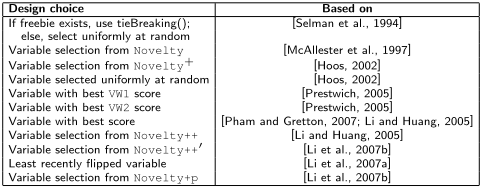
Block B2 instantiates solvers from the G2WSAT architecture, which use a "promising list" to keep track of a set variables considered for being flipped. Two strategies for selecting the variable ultimately to be flipped from the promising list have been proposed in the literature: choosing the variable with the highest score [Li and Huang, 2005] and choosing the least recently flipped variable [Li et al., 2007a]. We added nine novel options based on heuristics from other solvers that, to our knowledge, have never before been applied to G2WSATvariant algorithms. (For example, we believe that variable selection mechanisms from Novelty variants have only been applied to unsatisfied clauses, not to promising lists.) The 11 possible values for selectFromPromisingList() and a reference for each heuristic are given in Table 2.
If the promising list is empty, block B2 behaves exactly like block B3, which instantiates WalkSAT-based algorithms. First a clause c is selected using the selectClause() component already described in B1. Then a variable to be flipped is selected from c using the selectHeuristic() component. This component can be configured to implement 13 different variable selection strategies, including those from WalkSAT/SKC [Selman et al., 1994], VW1 and VW2 [Prestwich, 2005], and various Novelty variants. The selection strategy in gNovelty+ also includes an optional "flat move" mechanism; we extended this optional mechanism to the selection strategies for all the other Novelty variants.
Block B4 instantiates dynamic local search algorithms. The selectSet() component considers the set of variables that occur in any unsatisfied clause. It associates with each such variable v a score, which depends on the clause weights of each clause that changes satisfiability status when v is flipped. These clause weights reflect the perceived importance of satisfying each clause; for example, weights might increase the longer a clause has been unsatisfied, and decrease afterwards [Hutter et al., 2002; Thornton et al., 2004]. After scoring the variables, selectSet() returns all variables with maximal score. Our implementation of this component incorporates three different scoring functions, including those due to McAllester et al. [1997], Selman et al. [1994], and a novel, greedier variant that only considers the number of previously unsatisfied clauses that are satisfied by a variable flip. The tieBreaking() component selects a variable from the maximum-scoring set according to the same strategies used by the diversificationStrategy() component.
Block B5 updates underlying data structures after a variable has been flipped. Performing these updates in an efficient manner is a core issue in optimising the performance of SLS algorithms; in combination with the fact that the SATenstein-LS framework supports the combination of mechanisms from many different SLS algorithms, each depending on different data structures, this rendered the implementation of the update() technically quite challenging.
We validated the correctness of SATenstein-LS by carefully examining its behavior when configured to instantiate ten prominent algorithms (see [KhudaBukhsh, 2009] for details), comparing to independent reference implementations. We also compared the different implementations in terms of empirical performance, finding that in some cases they were virtually identical (for SAPS, RSAPS, and adaptNovelty+) while in others SATenstein-LS was slower (the worst was 2.17 times slower, for gNovelty+). The primary reason for observed performance differences between SATenstein-LS and the reference implementations was the lack of special-purpose data structure optimisations in the update() component.
4 Experimental Setup
We considered six sets of well-known benchmark instances for SAT, listed in Table 3. Because SLS algorithms are unable to prove unsatisfiability, we constructed our benchmark sets to include only satisfiable instances. The HGEN and FAC distributions include only satisfiable instances; for each of these distributions, we generated 2000 instances and divided these randomly into a training and test set containing 1000 instances each. For the remaining distributions, we filtered out unsatisfiable instances using complete solvers. For QCP, we generated 23 000 instances around the solubility phase transition, using the parameters given by Gomes and Selman [1997]. We solved these using a complete solver, and then randomly chose 2000 satisfiable instances. These we divided randomly into training and test sets of 1000 instances each. For SW-GCP, we generated 20 000 instances [Gent et al., 1999] and used a complete solver to randomly sample 2000 satisfiable instances, which we again divided randomly into training and test sets of 1000 instances each. For R3SAT, we generated a set of 1000 instances with 600 variables and a clauses-to-variables ratio of 4.26. We identified 521 satisfiable instances using complete solvers; 3 we randomly chose 250 of these instances to form a training set and 250 to form a test set. Finally, we used the CBMC generator to create 611 SAT-encoded software verification instances based on a binary search algorithm with different array sizes and loop-unwinding values. Of the instances thus obtained, we filtered out seven unsatisfiable instances and confirmed all the others as satisfiable. We randomly divided the remaining 604 instances into a training set of 303 instances and a test set of 301 instances.
| Distribution | Description |
|---|---|
| QCP SW-GCP R3SAT HGEN FAC CBMC(SE) | SAT-encoded quasi-group completion [Gomes and Selman, 1997] SAT-encoded small-world graph-colouring problems [Gent et al., 1999] uniform-random 3-SAT instances [Simon, 2002] random instances generated by generator HGEN2 [Hirsch, 2002] SAT-encoded factoring problems [Uchida and Watanabe, 1999] SAT-encoded bounded model checking problems [Clarke et al., 2004], preprocessed by SatELite [E´en and Biere, 2005] |
| Algorithm | Short Name | Reason for Inclusion |
|---|---|---|
| Ranov G2 WSAT VW gNovelty+ adaptG2 WSAT0 adaptG2 WSAT+ adaptNovelty+ adaptG2 WSATp SAPS RSAPS PAWS | Ranov G2 VW GNOV AG20 AG2+ ANOV AG2p SAPS RSAPS PAWS | gold 2005 SAT Competition (random) silver 2005 SAT Competition (random) bronze 2005 SAT Competition (random) gold 2007 SAT Competition (random) silver 2007 SAT Competition (random) bronze 2007 SAT Competition (random) gold 2004 SAT Competition (random) performance comparable to adaptG2 WSAT+, G2 WSAT, and Ranov; see [Li et al., 2007b] prominent dynamic local search algorithm prominent dynamic local search algorithm prominent dynamic local search algorithm |
In order to perform automatic algorithm configuration on the SATenstein-LS framework, we first had to quantify performance using an objective function; we chose to focus on mean runtime. However, efficient algorithm configurators terminate (or capped) some runs before they complete, making the mean ill-defined. Thus, following Hutter et al. [2007a], we define the penalised average runtime (PAR) of a set of N runs with a k-second cutoff as the mean runtime over all N runs, with capped runs counted as 10 · k seconds.
As our algorithm configurator, we chose the FocusedILS procedure from the ParamILS framework, version 2.2 [Hutter et al., 2008; 2007b], because to the best of our knowledge it is the only method able to operate effectively on extremely large, discrete parameter spaces. We set k to five seconds, and allotted two days to each run of FocusedILS. Since FocusedILS is a randomised procedure, its performance can vary significantly over multiple independent runs, in particular depending on the order it chooses for instances in the training set. We ran it 10 times on each training set, using different, randomly determined instance orderings for each run. From the 10 parameter configurations obtained from FocusedILS for each instance distribution D, we selected the parameter configuration with the best penalised average runtime on the training set, and we refer to the corresponding instantiation of SATenstein-LS as SATenstein-LS[D].
For every distribution D, we compared the performance of SATenstein-LS[D] against that of 11 high-performance SLS-based SAT solvers on the test set. We included every SLS algorithm that won a medal in any category of the SAT competition in the last five years [SAT Competition, 2009], and also included several other prominent, high-performing algorithms. These are listed in Table 4.
3 We identified satisfiable instances by running March pl, each of our 11 challenger algorithms and Kcnfs-04 with cutoffs of 3600, 600 and 36 000 seconds respectively. Our solvers were able to rule out only 56 of the remaining 479 instances as unsatisfiable.
SATenstein-LS can be instantiated to emulate all 11 of these challenger algorithms, except that it does not support preprocessing components used by Ranov, G2 and AG20. All of our experimental comparisons are based on the original algorithm implementations, as submitted to the respective SAT competitions, except for PAWS, for which the UBCSAT implementation is almost identical to the original solver in terms of runtime. All comparisons are based on running each solver 10 times with a cutoff time of 600 seconds per run.
We carried out our experiments on a cluster of 55 dual 3.2GHz Intel Xeon PCs with 2MB cache and 2GB RAM, running OpenSuSE Linux 10.1; runtimes for all algorithms (including FocusedILS) were measured as CPU time on these reference machines.
5 Results
On every one of our benchmark distributions, we were able to find a SATenstein-LS configuration that outperformed all 11 challengers. Our results are summarised in Table 5.
In terms of penalised average runtime (the objective function that we explicitly optimised with ParamILS, albeit computed according to the 600-second cutoff we used on our test runs, rather than the 5-second cutoff we used in training), SATenstein-LS achieved markedly better performance than the challengers. For QCP, HGEN, and CBMC(SE), SATenstein-LS achieved PAR orders of magnitude better than the respective best challenger. For SW-GCP, R3SAT, and FAC, SATenstein-LS's performance advantage was still substantial, but less dramatic. It is not overly surprising that there was relatively little room for improvement on R3SAT: random instances of this type have been used prominently over the last 17 years for evaluating SLS solvers for SAT, both during development and in competitions. Conversely, CBMC(SE) is a new benchmark from a broad class of instances on which SLS algorithms are generally considered weak performers compared to state-of-the-art DPLL-based SAT solvers. We were surprised to see the amount of improvement we could achieve on QCP, a relatively widely-used benchmark, and HGEN, a hard random instance distribution quite similar to R3SAT. In both cases our results indicate that recent developments in SLS solvers for SAT have not yielded significant improvements over older solvers (ANOV and SAPS/RSAPS, respectively); we thus attribute SATenstein-LS's strong performance here to the fact that SLS-solver development over the past seven years has not taken these types of benchmarks into account, nor yielded across-the-board improvements.
We also investigated SATenstein-LS's performance according to measures other than PAR. Median-of-median runtime (the median across instances of the median across ten runs on a given instance) offers a picture of performance that disregards capped runs as long as most instances are solved in most runs. Although SATenstein-LS was not configured to optimise this performance measure, using it as the basis for evaluation produced results essentially analogous to those for PAR (with R3SAT being the only benchmark on which several challengers scored slightly better). Finally, we measured the percentage of instances on which the median runtime was below the cutoff used for capping runs. According to this criterion, our SATenstein-LS solvers were successful on 100% of the instances in every one of our benchmark sets; on the other hand, only three of the 11 challengers solved more than 40% of the instances in every benchmark set.
| Distribution | SATenstein-LS[D] | GNOV [Pham and Gretton, 2007] | AG20 [Li et al., 2007b] | AG2+ [Li et al., 2007a] | RANOV [Pham and Anbulagan, 2007] | G2 [Li and Huang, 2005] | VW [Prestwich, 2005] | ANOV [Hoos, 2002] | AG2p [Li et al., 2007a] | SAPS [Hutter et al., 2002] | RSAPS [Hutter et al., 2002] | PAWS [Thornton et al., 2004] |
|---|---|---|---|---|---|---|---|---|---|---|---|---|
| QCP | 0.13 0.01 100% | 422.33 0.03 92.7% | 1051 0.03 80.5% | 1080.29 0.03 80.3% | 76.22 0.1 98.7% | 2952.56 361.21 50.6% | 1025.9 0.25 82.2% | 28.3 0.01 99.6% | 1104.42 0.02 79.4% | 1256.2 0.03 79.2% | 1265.37 0.04 78.4% | 1144.2 0.02 80.8% |
| SW-GCP | 0.03 0.03 100% | 0.24 0.09 100% | 0.62 0.12 100% | 0.45 0.08 100% | 0.15 0.12 100% | 4103.27 N/A 30.5% | 159.67 40.96 98.9% | 0.06 0.03 100% | 0.45 0.07 100% | 3872.08 N/A 33.2% | 5646.39 N/A 5% | 4568.59 N/A 22.1% |
| R3SAT | 1.51 0.14 100% | 10.93 0.14 100% | 2.37 0.14 100% | 3.3 0.16 100% | 14.14 0.32 100% | 5.32 0.13 100% | 9.53 0.75 100% | 12.4 0.21 100% | 2.38 0.13 100% | 22.81 1.80 100% | 14.81 2.13 100% | 2.4 0.12 100% |
| HGEN | 0.03 0.02 100% | 52.87 0.73 99.4% | 139.33 0.57 98% | 138.84 0.61 97.8% | 156.96 0.95 97.7% | 110.02 0.61 98.4% | 177.9 3.23 97.5% | 147.53 0.76 97.6% | 107.4 0.49 98.4% | 48.31 3.00 99.5% | 38.51 2.44 99.7% | 73.27 0.96 99.2% |
| FAC | 12.22 8.03 100% | 5912.99 N/A 0% | 3607.4 N/A 30.2% | 1456.4 237.50 84.2% | 943.26 155.77 92.1% | 5944.6 N/A 0% | 3411.93 N/A 31.7% | 3258.66 N/A 37.2% | 1989.91 315.48 72.5% | 17.39 11.60 100% | 19.39 12.88 100% | 26.51 12.62 99.9% |
| CBME(SE) | 5.59 0.02 100% | 2238.7 0.75 61.13% | 2170.67 0.67 61.13% | 2161.59 0.77 61.13% | 1231.01 0.66 79.73% | 2150.31 0.68 64.12% | 385.73 0.27 92.69% | 2081.94 5.81 61.79% | 2282.37 3.18 61.13% | 613.15 0.04 90.03% | 794.93 0.03 85.38% | 1717.79 19.99 68.77% |
The relative performance of the challengers varied significantly across different distributions. For example, the three dynamic local search algorithms (SAPS, RSAPS and PAWS) performed substantially better than any of the other challengers on the factoring problems (FAC); however, their relative performance on small-world graph colouring problems (SW-GCP) was weak. Similarly, GNOV (the winner of the random SAT category of the 2007 SAT Competition) performed very badly on our software verification (CBMC(SE)) and factoring (FAC) benchmarks, but solved SW-GCP and HGEN instances quite effectively. (Interestingly, on both types of random SAT instances we considered, GNOV did not reach the performance of some of the older SLS solvers, in particular, PAWS and RSAPS.) This suggests-not too surprisingly-that different types of SAT benchmarks are most efficiently solved using rather different solvers. The fact that our SATenstein-LS solvers performed better than any of the challengers for every one of our distributions clearly demonstrates that the design space spanned by the features of a large set of high-performance algorithms contains better solvers than those previously known, and that automatic exploration of this vast combinatorial space can effectively find such improved designs. Of course, solvers developed for individual benchmarks could in principle be combined using an instance-based algorithm selection technique (such as SATzilla), yielding even stronger performance.
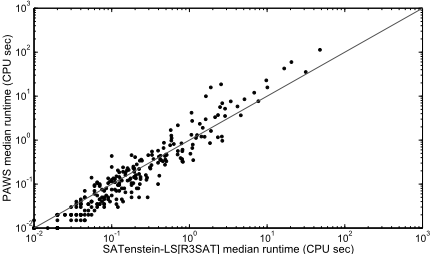
The performance metrics we have discussed so far only describe aggregate performance over the entire test set. One might wonder whether our SATenstein-LS solvers performed poorly on many test instances, but compensated for this weakness on other instances. Table 6 shows that this was typically not the case, comparing each SATenstein-LS solver's performance to each challenger on a per-instance basis. The SATenstein-LS solvers outperformed the best challengers on a large majority of the test instances on all benchmark sets except for R3SAT. On that distribution, PAWS was the challenger that outperformed our SATenstein-LS solver most frequently (62% of the time). Figure 1 shows that the performance of these two algorithms was quite highly correlated, and that, while instances that are rather easy for both algorithms tend to be solved faster by PAWS, SATenstein-LS[R3SAT] performs better on harder instances. We observed the same qualitative trend for other challengers on R3SAT. This phenomenon was even more pronounced for QCP and SW-GCP, but does not appear to have occurred for CBMC(SE), HGEN and FAC, where the correlation in solver performance was also considerably weaker.
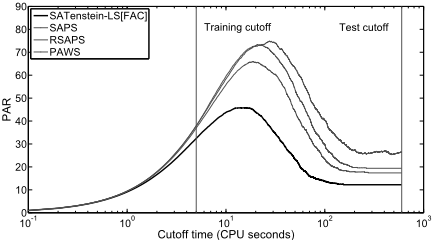
Our penalised average runtime measure is sensitive to the choice of test cutoff time, which sets the penalty. In particular, an algorithm could score well when the cutoff time is large, but could achieve much weaker PAR scores for smaller cutoffs. Reassuringly, we found that this problem did not arise for the SATenstein-LS solvers considered in our study. Specifically, the SATenstein-LS solvers outperformed their challengers in terms of PAR on all of our distributions regardless of the cutoff times used, and likewise the qualitative results from Table 5 were unaffected by cutoff time. Figure 2 gives an example of the data we examined to draw these conclusions, considering instance distribution FAC. We see that while the choice of cutoff time affected the raw PAR scores, for no cutoff would a challenger have outscored the SATenstein-LS solver. PAR first increased and then decreased with cutoff, because increasing the cutoff increases the penalty for unsolved instances (and thus also PAR), but decreases the score for solved instances (because the penalty for previously capped runs is replaced by the true runtime). Once all instances in a given test set are solved, PAR remains constant as cutoff increases.
To better understand the SATenstein-LS[D] solvers, we compared them with the SATenstein-LS instantiations corresponding to each challenger. 4 SATenstein-LS[QCP] uses blocks 1, 3, and 5 and an adaptive parameter update mechanism similar to that in AG2+. In block 3, selectHeuristic is based on R-Novelty+, and in block 1, diversification flips the variable with minimum variable weight as in VW1 [Prestwich, 2005]. SATenstein-LS[SW-GCP] uses blocks 1 and 3, resembling Novelty++ as used within G2. SATenstein-LS[R3SAT] uses blocks 4 and 5; it is closest to RSAPS, but uses a different tie-breaking mechanism. SATenstein-LS[HGEN] uses blocks 1, 3, and 5. In block 1 it is similar to G2 and in block 3 is closest to VW. In block 5 it uses the same adaptive parameter update mechanism as ANOV. SATenstein-LS[FAC] uses blocks 4 and 5; its instantiation closely resembles that of SAPS, but differs in the way the score of a variable is computed. Finally, SATenstein-LS[CBMC(SE)] uses blocks 1, 4, and 5, drawing on elements of GNOV and RSAPS.
| Distribution | GNOV | AG20 | AG2+ | RANOV | G2 | VW | ANOV | AG2p | SAPS | RSAPS | PAWS |
|---|---|---|---|---|---|---|---|---|---|---|---|
| QCP | 99 | 87 | 87 | 100 | 91 | 92 | 83 | 81 | 82 | 79 | 79 |
| SW-GCP | 100 | 98 | 97 | 100 | 100 | 100 | 63 | 93 | 100 | 100 | 100 |
| R3SAT | 55 | 55 | 64 | 96 | 44 | 100 | 72 | 55 | 99 | 99 | 38 |
| HGEN | 100 | 100 | 96 | 99 | 100 | 100 | 99 | 100 | 100 | 100 | 100 |
| FAC | 100 | 100 | 100 | 100 | 100 | 100 | 100 | 100 | 73 | 78 | 80 |
| CBME(SE) | 100 | 100 | 100 | 100 | 100 | 100 | 100 | 100 | 80 | 75 | 100 |
6 Conclusion
In this work we have advocated a new approach for constructing heuristic algorithms that is based on (1) a framework that can flexibly combine components drawn from existing highperformance solvers, and (2) a generic algorithm configuration tool for finding instantiations that perform well on given sets of instances. We applied this approach to stochastic local search algorithms for SAT and demonstrated empirically that it was able to produce new SLS-based solvers that represent considerable improvements over the previous state of the art in solving several widely studied distributions of SAT instances. Source code and documentation for our SATenstein-LS framework are available online at http://www.cs.ubc.ca/ labs/beta/Projects/SATenstein.
4 Due to space constraints, we describe our conclusions only at a high level. More detailed information about the SATenstein-LS configurations is given in [KhudaBukhsh, 2009].
Unlike the tragic figure of Dr. Frankenstein fromMary Shelley's novel, whose monstrous creature haunted him enough to quench forever his ambitions to create a 'perfect' human, we feel encouraged to unleash not only our new solvers, but also the full power of our automated solver-building process onto other classes of SAT benchmarks. Like Dr. Frankenstein we find our creations somewhat monstrous, recognising that our SATenstein solvers do not always embody the most elegant designs. Thus, we are currently working towards more detailed understanding of how our SATenstein solvers relate to previously-known SAT algorithms. Other interesting lines of future work include the extension of our solver framework to capture combinations of components from the G2WSAT architecture and dynamic local search algorithms, as well as preprocessors (as used, for example, in Ranov); the combination of SATenstein solvers trained on various types of SAT instances by means of an algorithm selection approach (see, e.g., [Xu et al., 2008]); and the investigation of algorithm configuration procedures other than ParamILS in the context of our approach. Finally, encouraged by the results achieved on SLS-algorithms for SAT, we believe that the general approach behind SATenstein is equally applicable to non-SLS-based solvers and to other combinatorial problems. To paraphrase the words of Mary Shelley's Victor Frankenstein, we hope that ultimately many effective solvers will owe their being to this line of work.
@inproceedings{ijcai2009p93,
  title     = {SATenstein: Automatically Building Local Search SAT Solvers from Components},
  author    = {KhudaBukhsh, Ashiqur R. and Xu, Lin and Hoos, Holger H. and Leyton-Brown, Kevin},
  booktitle = {Proceedings of the Twenty-First International Joint Conference on
               Artificial Intelligence, {IJCAI-09}},
  publisher = {International Joint Conferences on Artificial Intelligence},
  editor    = {Craig Boutilier},
  pages     = {517--523},
  year      = {2009},
  url       = {https://ijcai.org/proceedings/2009/93},
}
TY - CPAPER TI - SATenstein: Automatically Building Local Search SAT Solvers from Components AU - KhudaBukhsh, Ashiqur R. AU - Xu, Lin AU - Hoos, Holger H. AU - Leyton-Brown, Kevin T2 - Proceedings of the Twenty-First International Joint Conference on Artificial Intelligence, IJCAI-09 PB - International Joint Conferences on Artificial Intelligence PY - 2009 SP - 517 EP - 523 UR - https://ijcai.org/proceedings/2009/93 ER -Copied
Machine-readable versions of this paper, for tools and AI agents:





