
Learning HTN Method Preconditions and Action Models from Partial Observations
Proceedings of the Twenty-First International Joint Conference on Artificial Intelligence. Pages 1804-1809.
© 2009 International Joint Conferences on Artificial Intelligence
Abstract
To apply hierarchical task network (HTN) planning to real-world planning problems, one needs to encode the HTN schemata and action models beforehand. However, acquiring such domain knowledge is difficult and time-consuming because the HTN domain definition involves a significant knowledge-engineering effort. A system that can learn the HTN planning domain knowledge automatically would save time and allow HTN planning to be used in domains where such knowledge-engineering effort is not feasible. In this paper, we present a formal framework and algorithms to acquire HTN planning domain knowledge, by learning the preconditions and effects of actions and preconditions of methods. Our algorithm, HTN-learner, first builds constraints from given observed emph{decomposition trees} to build action models and method preconditions. It then solves these constraints using a weighted MAX-SAT solver. The solution can be converted to action models and method preconditions. Unlike prior work on HTN learning, we do not depend on complete action models or state information. We test the algorithm on several domains, and show that our HTN-learner algorithm is both effective and efficient.Hankz Hankui Zhuo, Derek Hao Hu, Chad Hogg, Qiang Yang, Hector Munoz-Avila
- [Amir, 2005] E. Amir. Learning partially observable deter- ministic action models. In Proceedings of IJCAI, pages 1433-1439, 2005. IJCAI
- [Blythe et al., 2001] J. Blythe, J. Kim, S. Ramachandran, and Y. Gil. An integrated environment for knowledge ac- quisition. In Proceedings of IUI, pages 13-20, 2001.
- [Borchers and Furman, 1998] B. Borchers and J. Furman. A two-phase exact algorithm for MAX-SAT and weighted MAX-SAT problems. J. Comb. Optim., 2(4), 1998.
- [Fikes and Nilsson, 1971] R. Fikes and N. J. Nilsson. STRIPS: A new approach to the application of theorem proving to problem solving. Artificial Intelligence Jour- nal, pages 189-208, 1971. IJCAI
- [Hogg et al., 2008] C. Hogg, H. Muñoz-Avila, and U. Kuter. HTN-MAKER: Learning HTNs with minimal additional knowledge engineering required. In Proceedings of AAAI, pages 950-956, 2008.
- [Ilghami et al., 2005] O. Ilghami, H. Muñoz-Avila, D. S. Nau, and D. W. Aha. Learning approximate preconditions for methods in hierarchical plans. In Proceedings of ICML, pages 337-344, 2005.
- [McCluskey et al., 2003] T. L. McCluskey, D. Liu, and R. M. Simpson. GIPO II: HTN planning in a tool-supported knowledge engineering environment. In Proceedings of ICAPS, pages 92-101, 2003.
- [Nau et al., 2005] D. S. Nau, T. Au, O. Ilghami, U. Kuter, H. Muñoz-Avila, J. W. Murdock, D. Wu, and F. Yaman. Applications of SHOP and SHOP2. IEEE Intelligent Sys- tems, 20:34-41, 2005.
- [Nejati et al., 2006] N. Nejati, P. Langley, and T. Konik. Learning hierarchical task networks by obervation. In Pro- ceedings of ICML, pages 665-672, 2006.
- [Reddy and Tadepalli, 1997] C. Reddy and P. Tadepalli. Learning goal-decomposition rules using exercises. In Proceedings of ICML, pages 278-286, 1997.
- [Xu and Muñoz-Avila, 2004] K. Xu and H. Muñoz-Avila. CaBMA: Case-based project management assistant. In Proceedings of IAAI, pages 931-936, 2004.
- [Xu and Muñoz-Avila, 2005] K. Xu and H. Muñoz-Avila. A domain-independent system for case-based task decompo- sition without domain theories. In Proceedings of AAAI, pages 234-240, 2005.
- [Yang et al., 2007] Q. Yang, K. Wu, and Y. Jiang. Learning action models from plan examples using weighted MAX- SAT. Artificial Intelligence Journal, 171:107-143, Febru- ary 2007.
References were extracted automatically from the PDF and may contain errors.
Full text extracted automatically from the PDF; figures, tables and equations may differ. The PDF is the version of record.
1 Introduction
In many real-world planning applications, HTN planning systems have shown their advantages in effectively using domain knowledge to solve planning problems [Nau et al., 2005]. However, for HTN planning to be applicable, domain experts must first encode the HTN schemata and action models beforehand. Acquiring such domain knowledge is difficult and time-consuming since the HTN domain definition involves a significant knowledge-engineering effort. Thus, it is an important problem to be able to develop learning algorithms to help acquire the domain knowledge for HTN planning.
The problem of learning some interesting aspects of HTN domain knowledge has captured the attention of many researchers. In particular, learning the applicability conditions from given structural traces of HTNs has been the subject of recurrent research interest. In the works of [Ilghami et al.,
| compared algorithms | action models | partial observab. | method preconditions |
|---|---|---|---|
| HTN-learner♭ | √ | √ | √ |
| HTN-MAKER♮ | × | × | √ |
| CaMeL, DInCAD♯ | × | × | √ |
| Icarus, XLearn† | × | × | √ |
- ♮: [Hogg et al., 2008].
- ♯: [Ilghami et al., 2005; Xu and Mu˜noz-Avila, 2005].
- †: [Nejati et al., 2006; Reddy and Tadepalli, 1997].
2005], an instance of this problem has been studied, albeit under the assumption that the preconditions and effects of actions in the domain are fully specified and there is complete observability of the states of the world. In [Xu and Mu˜nozAvila, 2005] another instance of the problem is studied under the assumption that an ontology indicating relations between the objects is given. In the works of [Nejati et al., 2006; Reddy and Tadepalli, 1997], approaches are developed to learn the hierarchical structure that relate the tasks and subtasks. Existing work on learning hierarchies elicits a hierarchy from a collection of plans and from a given action model. In [Hogg et al., 2008], the HTN-MAKER algorithm learns the decomposition methods for Hierarchical Task Networks. However, so far all of these studies assume the complete observability of the intermediate states of the plans and a complete action model being given. In real world situations, we note that such learning problems are even more difficult since the observed plan traces we use as training data may contain incomplete and inconsistent information.
We present a new algorithm which we call HTN-learner that learns the HTN method preconditions and the preconditions and effects of actions in HTN planning under partial observability. Table 1 shows the major difference between our proposed learning problem and those of the past works. Each column denotes whether the corresponding algorithm could learn the action models or the method preconditions, and whether it supports partial observability of the plan states. As input to HTN-learner, we assume that we have the decomposition structure in the form of task decomposition trees whose leaves are all primitive actions, which we explain in detail in Section 3. These trees are readily available in some real-world domains such as process planning, where human planners enter so-called Work-Breakdown Structures indicating the activities that must be accomplished for a project. These Work-Breakdown Structures can be mapped to hierarchical task networks [Xu and Mu˜noz-Avila, 2004]. The main problem for the automated reuse of this knowledge is that, whereas the instances of the structural relations are readily available for such domains, their applicability conditions are neither given nor expected to be given by the human planner.
We present a novel framework to acquire domain knowledge, including learning action models and method preconditions. Our algorithm runs in two steps. First, we build three kinds of constraints to encode the features of action models and method preconditions from the observed decomposition trees. Second, we solve these constraints using a weighted MAX-SAT solver [Borchers and Furman, 1998], and convert the result to action models and method preconditions.
In the following, we first present the related work in Section 2, and then define our learning problem in Section 3. After that, we give the detailed description of our main learning algorithm in Section 4. Finally, we give experimental results and discussion to show our algorithm is effective and efficient.
2 RelatedWork
2.1 HTN Planning
We are focusing on a variant of HTN planning called Ordered Task Decomposition [Nau et al., 2005], which is also the most common variant of HTN planning by far. In this variant the planning system generates a plan by decomposing tasks in the order they were generated into simpler and simpler subtasks until primitive tasks are reached that can be performed directly. Specifically, for each non-primitive task, the planner chooses an applicable method and instantiates it to decompose the task into subtasks. When the decomposition process reaches a primitive subtask, the planner accomplishes it by applying its corresponding action in the usual STRIPS fashion. The process stops when all non-primitive tasks are decomposed into primitive subtasks, and outputs an action sequence (i.e. a plan) as a solution.
2.2 Learning ActionModels
ARMS (action-relation modeling system) [Yang et al., 2007] presents a framework for automatically discovering STRIPS [Fikes and Nilsson, 1971] action models from a set of successfully observed plans. It gathers knowledge on the statistical distribution of frequent sets of actions in the example plans without assuming complete knowledge of states in the middle of observed plans. In knowledge acquisition for planning model learning, a computer system interacts with a human expert to generate the needed action models [Blythe et al., 2001; McCluskey et al., 2003], where the states just before or after each action are assumed to be known. [Amir, 2005] presented a tractable and exact technique for learning action models known as Simultaneous Learning and Filtering, where the state observations are needed for learning. While these systems can learn action models of various forms, they are mainly designed for learning for non-hierarchical planning algorithms.
2.3 HTNLearning
[Ilghami et al., 2005; Xu and Mu˜noz-Avila, 2005] propose eager and lazy learning algorithms respectively, to learn the preconditions of HTN methods. These systems require as input the hierarchical relationships between tasks, the action models, and a complete description of the intermediate states and learn the conditions under which a method may be used. Icarus uses means-end analysis to learn structure and preconditions of the input plans by assuming that a model of the tasks in the form of Horn clauses is given [Nejati et al., 2006]. HTN-MAKER also learns structures albeit assuming that a model of the tasks is given in the form of preconditons and effects for the tasks [Hogg et al., 2008].
3 ProblemDefinition
A Hierarchical Task Network (HTN) planning problem is defined as a quadruplet (s0, T, M, A), where s0 is an initial state which is a conjunction of propositions, T is a list of tasks that need to be accomplished, M is a set of methods, which specify how a high-level task can be decomposed into a totally ordered set of lower-level subtasks, and A is a set of actions, which corresponds to the primitive subtasks that can be directly executed.
In this definition, each task has a task name with zero or more arguments, each of which is either a variable symbol or a constant symbol. A method is defined as (m, t, PRE, SUB), where m is a unique method name with zero or more arguments, t is the head task the method decomposes, PRE are the preconditions of the method, and SUB is a list of subtasks into which the head task may be decomposed. The arguments of m consist of the arguments of the head task, the arguments of each of the subtasks, and all terms used in the preconditions. Each of the subtasks may be primitive, in which case they correspond to an action schema, or non-primitive, in which case they must be further decomposed. Each method precondition is a literal, and the set of method preconditions must be satisfied before the method can be applied. An action model a is defined as a = (o, PRE,ADD,DEL), where o is an action schema composed of an action name and zero or more arguments, PRE is a precondition list, ADD is an add list and DEL is a delete list [Fikes and Nilsson, 1971].
A solution to an HTN problem (s0, T,M,A) is a list of decomposition trees. In a decomposition tree, a leaf node is a fully instantiated action, and the set of actions can be directly executed from the initial state to accomplish the root level task. All intermediate level subtasks are also fully instantiated, and all preconditions of actions and preconditions of methods are satisfied. The roots of the trees correspond to the tasks in T .
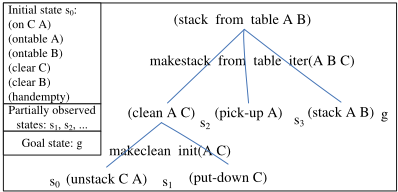
Our learning problem can be defined as: given as input a list of decomposition trees with partially observed states between the leaves of each decomposition tree, our learning algorithm outputs an HTN model including the action models and method preconditions. An example 1 of the input is shown in Figure 1. Figure 1 is an example of a decomposition tree with initial state or partially observed intermediate states (not shown in the figure) between leaves. The output of our algorithm is the action models and method preconditions.
1 'clean' is a task to move off all the blocks above '?x',
4 AlgorithmDescription
We first present an overview of the algorithm in Section 4.1, and then provide the detailed description of each step in Sections 4.2-4.6.
4.1 Algorithm Framework
Our algorithm takes a set of decomposition trees as input, and produces preconditions and effects of actions as well as method preconditions as output. To reach this aim, it first builds the various constraints from the observed state information, including state constraints, decomposition constraints and action constraints. Based on these constraints, it will build a set of clauses and view it as a weighted maximum satisfiability problem, which is solved by a weighted MAXSAT solver[Borchers and Furman, 1998]. The solution to this MAX-SAT problem is the HTN model including the set of action models and HTN method preconditions that best explains the set of observed decomposition trees. An overview of the algorithm is shown in Algorithm 1.
Algorithm 1 Algorithm overview of HTN-learner
Input: DTR: A set of decomposition trees with partially observed states between leaves.
Output: The HTN model H;
- 1: Extract the HTN schemata;
- 2: Build state constraints SC;
- 3: Build decomposition constraints DC;
- 4: Build action constraints AC;
- 5: Solve constraints usingweightedMAX-SAT, and convert the result to the HTN model H;
- 6: return H;
and 'makeclean init' is a method to be applied to 'clean'. 'stack from table' is a task to stack '?x' on '?y' when '?x' is on the table, and 'makestack from table iter' is a method to be applied to 'stack from table'. 'pick-up', 'put-down', 'stack' and 'unstack' are four actions to pick up, put down, stack and un-stack a block.
4.2 Step 1: Extracting the HTN Schemata
In this step, we extract the HTN schemata, including a predicate list, an action-schema list and a method-structure list. We use a straightforward process to do this step. Firstly, we scan all the decomposition trees and substitute all the objects with their corresponding variables, each of which is constrained by a type. Secondly, we collect (1) all the different predicates as a predicate list, each of which has its own arguments that are variables; (2) all the different actionschemas as an action-schema list, each of which is composed of an action name and zero or more arguments that are variables; (3) all the different decompositions, each of which is composed of a task and its corresponding subtasks, as a method-structure list. For example, from the decomposition tree in Figure 1, we can extract (1) a predicate list: {(on ?xblock ?y-block), (ontable ?x-block), (clear ?x-block)}; (2) an action-schema list: {(pick-up ?x-block),(stack ?x-block ?yblock), (unstack ?x-block ?y-block), (put-down ?x-block)}; (3) a method-structure list: {〈(makestack from table iter ?xblock ?y-block ?z-block), (stack from table ?x ?y) ((clean ?x ?z)(pick-up ?x)(stack ?x ?y))〉; 〈(makeclean init ?x-block ?y-block), (clean ?x ?y)((unstack ?y ?x)(put-down ?y))〉}, where a method-structure is described as "〈 method-name, task (subtask1 . . . subtaskk)〉".
4.3 Step 2: Building State Constraints
In a decomposition tree, if a predicate frequently appears before an action is executed, and its parameters are also parameters of the action, then the predicate is likely to be a precondition of the action. Likewise, if a predicate frequently appears before a method is applied, it is likely to be a precondition of the method; if a predicate frequently appears after an action is executed, it is likely to be an effect of the action. This information will be encoded in the form of constraints in our learning process. Since these constraints are built from the relations between states and actions, or states and methods, we call these constraints state constraints. The following is the process of building state constraints SC (PARA(p) denotes the set of parameters of p.):
- (1). By scanning all the decomposition trees, for each predicate p in the state where an action a is executed and PARA(p) ⊆ PARA(a), we build a constraint p ∈ PRE(a), the set of which is denoted as SCpa, which indicates the possible candidates of predicates that might be a precondition of action a.
- (2). For each predicate p in the state after an action a is executed and PARA(p) ⊆ PARA(a), we build a constraint p ∈ ADD(a), the set of which is denoted as SCap. SCap indicates the possible candidates of predicates that might be an effect of action a.
- (3). For each predicate p in the state where a method m is applied, we build a constraint p ∈ PRE(m), the set of which is denoted as SCpm.
As a result, we get three kinds of constraints SCpa, SCap and SCpm, which together form the state constraints SC. With SC, we build weighted state constraints WSC with the calWeight(SC) procedure that combines the instantiated constraints in SC into their corresponding variable-form constraints, and assigns weights to these variable-form constraints. The procedure of calWeight(SC) can be described by the following steps: (1) replace all the instantiated arguments in SC with their corresponding variables, denoted the results as C′ ; (2) calculate the output WSC of the procedure by WSC = {〈w, c〉|c ∈ C′ ∧ w = numberOf(c, C′ )}, where numberOf(c, C′ ) returns the number of c's appearances in C′ .
4.4 Step 3: Building Decomposition Constraints
In this step, we build decomposition constraints to encode the structure information provided by decomposition trees. If a task T can be decomposed into n subtasks st1, st2, . . ., stn, we find that a subtask sti often provides some preconditions of a method for subtask sti+1, making that method applicable. As a result, this method can be applied to the next subtask sti+1. Furthermore, we consider the constraint that the parameters of a precondition (or effect) should be included by the parameters of the action or method the precondition (effect) belongs to. As a result, the decomposition constraints DC can be built by the procedure as shown in Algorithm 2.
Algorithm 2 Build decomposition constraints: buildDecmpConstr(DTR)
Input: A set of decomposition trees with partially observed
states DTR; Output: Decomposition constraints DC;1: DC = ∅; 2: for each decomposition tree dtr ∈ DTR do 3: for each two subtasks sti and stj in dtr do 4: if i < j then 5: for k = 1 to ni do 6: PRS = PARA(aik ) ∩ PARA(mj ); 7: generate a set of predicates GP using PRS; 8: generate a constraint c and add it to DC; 9: end for 10: end if 11: end for 12: end for 13: return DC;In the fourth step of Algorithm 2, we consider two tasks sti and stj that have the same parent and sti occurs earlier than stj. In the fifth step, ni is the number of actions to accomplish the subtask sti, which is denoted as ai1, ai2, . . ., aini . In the sixth step, mj is the method which is applied to the subtask stj. In the seventh step, GP is generated by GP = {p|PARA(p) ⊆ PRS}. In the last step, the generated constraint c is: p ∈ GP → (p ∈ ADD(aik) ∧ p ∈ PRE(mj)) With DC, we build weighted decomposition constraints WDC by setting: WDC = calWeight(DC), which is similar to the procedure of calculating WSC. WDC can be solved directly by a weighted MAX-SAT solver.
4.5 Step 4: Building Action Constraints
To make sure that the learned action models are valid and reasonable and could reflect some characteristics of real-world action models, we need to further induce some constraints on different actions. These constraints are imposed on individual actions which can be divided into the following two types
[Yang et al., 2007]:
(1). An action may not add a fact (instantiated atom) which already exists before the action is applied. This constraint can be encoded as p ∈ ADD(a) ⇒ p ̸∈ PRE(a), where p is an atom, ADD(a) is a set of added effects of the action a, and PRE(a) is a set of preconditions of a.
(2). An action may not delete a fact which does not exist before the action is applied. This constraint can be encoded as p ∈ DEL(a) ⇒ p ∈ PRE(a), where DEL(a) is a set of delete effects of a.
These constraints are placed to ensure the learned action models are succinct, and most existing planning domains satisfy them. Nevertheless, our learning algorithm works perfectly without them.
These constraints compose the action constraints AC. We denote as wmax the maximal weight of all the constraints in WSC and WDC, and assign wmax as the weight of all constraints in AC. In this way, the weights of constraints in AC are not less than the ones in WSC or WDC, which suggests that the action constraints AC should be satisfied in many real applications, compared to the other two kinds of constraints.
4.6 Step 5: Solving the Constraints
By using Steps 2-4, three kinds of weighted constraints are built to encode the information of action models and method preconditions. Before the constraints can be solved by a weighted MAX-SAT solver, the relative importance of these three kinds of constraints must be determined. To do this, we introduce three new parameters βi (1 < i < 3) to control weights of each kind of constraints by: βi 1-βi wi, where 0 ≤ βi < 1, 1 ≤ i ≤ 3, and wi is a weight of the ith kind of constraint. Notice that, by using βi 1-βi , we can easily adjust the weight from 0 to ∞ by simply adjusting βi from 0 to 1. The weight wi will be replaced by βi 1-βi wi, and the resulting weighted constraints are solved by a weighted MAX-SAT solver. As a result, a true or false assignment will be outputted to maximally express the weighted constraints. According to the assignment, the HTN model can be acquired directly. For instance, if "p ∈ ADD(a)" is assigned true in the result of the solver, then p will be converted into an effect
- of the action a in the HTN model.
5 Experiment
5.1 Datasets
In this section, we performed experiments to evaluate our algorithm. In the experiment, we use the HTN domains called htn-blocks, htn-depots and htn-driverlog for training and testing, which are created as HTN domains based on the domains blocks world from IPC-2 2 and depots, driverlog from IPC3 3 respectively. We generate 200 decomposition trees from each domain for training the HTN model, and compare the result to its corresponding handwritten HTN model.
2 http://www.cs.toronto.edu/aips2000/
3 http://planning.cis.strath.ac.uk/competition/
of both systems.
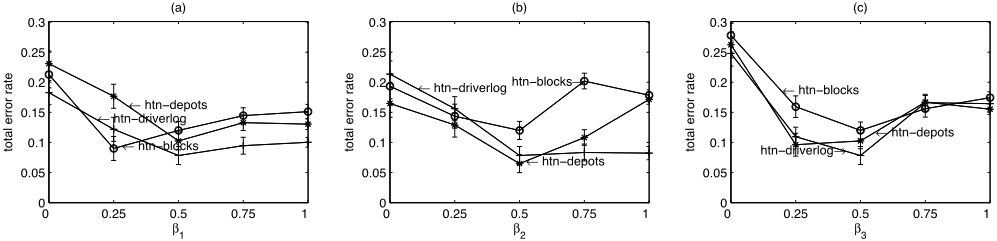
We now analyze the relative importance of the three types of constraints, to show that all of them are needed to help improve the learning result. Therefore, with respect to different βi, we train an HTN model by setting the percentage of observations as 1/4, and calculate its total errors Et. From Figure 3(a), we can see that Et first decreases when β1 increases, which means the state constraints should be more important to improve the correctness. Then, Et increases and keeps stable at a constant value, that is because when β1 reaches a high enough value, the importance of the two other kinds of constraints is reduced, and it plays a negative effect on our learning accuracy. From Figure 3(b), we can see that, Et decreases at first but increases quickly when β2 increases. After β2 reaches 0.5, Et becomes unstable with respect to different domains. This shows that, since the importance of other constraints decreases when β2 is high enough, exploiting the information of decomposition constraints is not good enough to extract useful rules to learn action models. The curve in Figure 3(c) is similar to Figure 3(a), except that it is sharper than the one in Figure 3(a) before β3 reaches 0.5, which suggests that the information from action constraints is stronger than that from state constraints before 0.5.
To test the running time of HTN-learner, we set the percentage of observations as 1/4 and test HTN-learner with respect to different number of decomposition trees. The testing result is shown in Table 2. The running time of our algorithm increases polynomially with the size of the input. To verify our claim, we use the relationship between the size of input and the CPU running time to estimate a function that could best fit these points. We've found that we are able to fit the performance curve with a polynomial of order 2 or order 3. We provide the polynomial for fitting htn-driverlog, which is 0.0110x2 - 0.0410x - 1.2000. We also observed that the total error rate decreases when the size of the input increase, and it remains below 0.12 in all cases where there are more than 140 decomposition trees available.
6 Conclusion
In this paper, we have presented a novel algorithm HTNlearner to learn the action models and method preconditions of an HTN model. Given a set of partially observed decomposition trees, HTN-learner builds a set of state, decomposition, and action weighted constraints, and solves them with a
5.2 Evaluation Metric
To evaluate our algorithm, we define two kinds of errors: soundness error and completeness error. If a precondition (or an effect) does not exist in the learned HTN model, while it did in the original model, then we call this situation a soundness error because this error will likely result in situations where the learned method (or action) is applied while the original one was not. If a precondition (or an effect of an action) exists in the learned model, while it is not in the original one, then we call this situation a completeness error because this error will likely result in a learned method (or action) not being applied in situations where the original one is applicable. We denote the soundness error rate of an HTN model as Es, the completeness error rate as Ec, and the total error rate of an HTN model as Et, where Et = Es + Ec. Then we calculate Es and Ec as follows: Es = ∑a Es(a) = ∑a soundness errors of a all possible conditions of a , and Ec = ∑a Ec(a) = ∑a completeness errors of a all possible conditions of a , where a can be an action or a method.
5.3 Experimental Results
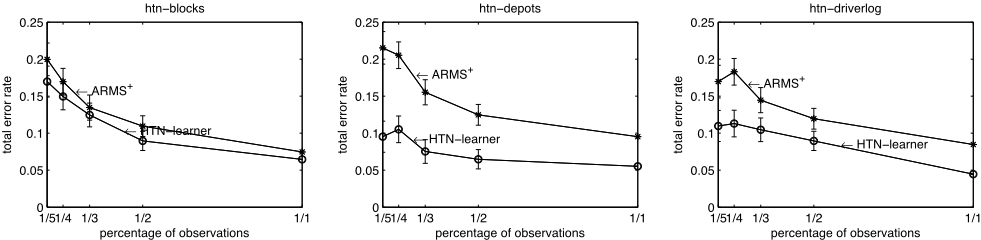
An alternative to HTN-learner also solving this problem would be to learn the action models with ARMS [Yang et al., 2007] and separately learn the method preconditions with an existing algorithm such as CaMeL [Ilghami et al., 2005]. To determine the importance of learning the action models and method preconditions simultaneously, we ran an experiment comparing HTN-learner against a hybrid system, that we call it ARMS+, which first uses ARMS to learn the action models and then uses the method-based constraints to learn the method preconditions.
The results of this experiment are shown in Figure 2. We varied the percentage of intermediate states provided from 1/5 to 1 and set each βi to 0.5. In all cases, the error rate of HTNlearner was less than that of ARMS+. This was expected, because constraints about the action models may provide information that may be exploited to find more accurate method preconditions, and vice versa. The differences are more significant on the more complex domains such as htn-depots, where combining the structural and action models provides additional useful constraints that would not be generated from the two separately. An increase in the number of intermediate states that are specified generally increases the accuracy MAX-SAT solver. The solution obtained is the HTN model that best explains the observed decomposition trees.
| number | htn-driverlog | htn-blocks | htn-depots |
|---|---|---|---|
| 20 | 3 | 5 | 8 |
| 40 | 8 | 13 | 18 |
| 60 | 34 | 43 | 63 |
| 80 | 65 | 98 | 98 |
| 100 | 102 | 73 | 132 |
| 120 | 91 | 112 | 121 |
| 140 | 165 | 146 | 189 |
| 160 | 203 | 175 | 188 |
| 180 | 264 | 198 | 240 |
| 200 | 283 | 234 | 323 |
We observed the following conclusions from our empirical evaluation in 3 benchmark domains: (1) Simultaneously solving the constraints reduces error in the learned HTN-model compared to first learning the action model and then learning the method's preconditions, (2) By imposing the three types of constraints, we can effectively reduce the hypothesis space of possible action models and method preconditions while using the input plan traces as an empirical basis, and (3) The running time of our algorithm increases polynomially and the error rate decreases with the size of the input. Our methods can reduce human efforts in acquiring HTN models and scale up planning in real-world applications.
Acknowledgment
We thank the support of Hong Kong CERG Grant HKUST 621307, NEC China Lab, and the National Science Foundation (NSF 0642882).
@inproceedings{ijcai2009p300,
  title     = {Learning HTN Method Preconditions and Action Models from Partial Observations},
  author    = {Zhuo, Hankz Hankui and Hu, Derek Hao and Hogg, Chad and Yang, Qiang and Muñoz-Avila, Héctor},
  booktitle = {Proceedings of the Twenty-First International Joint Conference on
               Artificial Intelligence, {IJCAI-09}},
  publisher = {International Joint Conferences on Artificial Intelligence},
  editor    = {Craig Boutilier},
  pages     = {1804--1809},
  year      = {2009},
  url       = {https://ijcai.org/proceedings/2009/300},
}
TY - CPAPER TI - Learning HTN Method Preconditions and Action Models from Partial Observations AU - Zhuo, Hankz Hankui AU - Hu, Derek Hao AU - Hogg, Chad AU - Yang, Qiang AU - Muñoz-Avila, Héctor T2 - Proceedings of the Twenty-First International Joint Conference on Artificial Intelligence, IJCAI-09 PB - International Joint Conferences on Artificial Intelligence PY - 2009 SP - 1804 EP - 1809 UR - https://ijcai.org/proceedings/2009/300 ER -Copied
Machine-readable versions of this paper, for tools and AI agents:





