
Delaying Commitment in Plan Recognition Using Combinatory Categorial Grammars
Proceedings of the Twenty-First International Joint Conference on Artificial Intelligence. Pages 1702-1706.
© 2009 International Joint Conferences on Artificial Intelligence
Abstract
This paper presents a new algorithm for plan recognition called ELEXIR (Engine for LEXicalized Intent Recognition). ELEXIR represents the plans to be recognized with a grammatical formalism called Combinatory Categorial Grammar(CCG). We show that representing plans with CCGs can allow us to prevent early commitment to plan goals and thereby reduce runtime.Christopher Geib
- [Avrahami-Zilberbrand and Kaminka, 2005] Dorit Avrahami-Zilberbrand and Gal A. Kaminka. Fast and complete symbolic plan recognition. In Proceed- ings of the International Joint Conference on Artificial Intelligence, 2005. IJCAI
- [Baldridge, 2002] Jason Baldridge. Lexically Specified Derivational Control in Combinatory Categorial Gram- mar. PhD thesis, University of Edinburgh, 2002.
- [Bui et al., 2002] Hung H. Bui, Svetha Venkatesh, and Ge- off West. Policy recognition in the Abstract Hidden Markov Model. Journal of Artificial Intelligence Re- search, 17:451-499, 2002.
- [Carberry, 1990] Sandra Carberry. Plan Recognition in Nat- ural Language Dialogue. ACL-MIT Press Series in Natu- ral Language Processing. MIT Press, 1990.
- [Clark and Curran, 2004] Stephen Clark and James Curran. Parsing the wsj using ccg and log-linear models. In ACL '04: Proceedings of the 42th Meeting of the Association for Computational Linguistics, pages 104-111, 2004.
- [Curry, 1977] Haskell Curry. Foundations of Mathematical Logic. Dover Publications Inc., 1977.
- [Geib, 2004] Christopher Geib. Assessing the complexity of plan recognition. In Proceedings of AAAI-2004, pages 507-512, 2004.
- [Geib, 2006] Christopher Geib. Plan recognition. In Alexan- der Kott and William McEneaney, editors, Adversarial Reasoning, pages 77-100.
- Chapman and Hall/CRC, 2006.
- [Ghallab et al., 2004] Malik Ghallab, Dana Nau, and Paolo Traverso. Automated Planning: Theory and Practice.
- Morgan Kaufmann, 2004.
- [Hockenmaier, 2003] Julia Hockenmaier. Data and Mod- els for Statistical Parsing with Combinatory Catagorial Grammar. PhD thesis, University of Edinburgh, 2003.
- [Kautz, 1991] Henry A. Kautz. A formal theory of plan recognition and its implementation. In James F. Allen, Henry A. Kautz, Richard N. Pelavin, and Josh D. Tenen- berg, editors, Reasoning About Plans, chapter 2. Morgan Kaufmann, 1991.
- [Pynadath and Wellman, 2000] David Pynadath and Michael Wellman. Probabilistic state-dependent grammars for plan recognition. In Proceedings of UAI-2000, pages 507-514, 2000.
- [Steedman, 2000] Mark Steedman. The Syntactic Process. MIT Press, 2000.
References were extracted automatically from the PDF and may contain errors.
Full text extracted automatically from the PDF; figures, tables and equations may differ. The PDF is the version of record.
1 Introduction
Given a plan library and a set of observations, the problem of identifying an agent's plans and goals on the basis of their observed actions is called plan recognition (PR), and is a well studied problem in AI. Much of the prior research on PR [Bui et al., 2002; Avrahami-Zilberbrand and Kaminka, 2005; Geib, 2006; Kautz, 1991] use algorithms that make early commitments to hypothesized root goals and sub-plans. This creates a problem. As [Geib, 2004] has pointed out, such early commitment can result in maintaining an exponential number of hypotheses. Many, of these hypotheses will be discarded later as being impossible. Thus, early commitment to hypotheses can needlessly increase runtime.
To address this problem, we will formulate PR based on Combinatory Categorial Grammars (CCGs)[Steedman, 2000], a grammatical formalism developed for use in natural language parsing(NLP). Using CCGs to represent plan libraries will require us to introduce the new idea of plan heads. We will show that making the correct choices about plan heads enables a least commitment approach to plan recognition and reduces runtimes.
In the rest of this paper, we will outline our approach to plan recognition. We then show how to represent plans in CCGs and define plan heads. We will then present a new, probabilistic plan recognition algorithm called ELEXIR(Engine for LEXicalized Intent Recognition) based on these ideas. We will discuss its theoretical complexity, and an empirical evaluation of its performance. These experiments will show that correct choices for plan heads enable significant computational saving.
We note, the relationship between PR and NLP is not a new idea, and there is previous work in using ideas from NLP in PR including [Carberry, 1990; Pynadath and Wellman, 2000]
and others. However, we know of no prior work using CCGs and headedness to control early commitment.
2 Intuitions and an Example
We are interested in probabilistic plan recognition, and will use weighted model counting to solve it. We assume as given a set of observations and a CCG specification of a plan lexicon defining the plans to be recognized. To perform PR, we advocate parsing the observations into the complete and covering set of explanations that organize the observations into one or more plan structures meeting the requirements defined in the plan lexicon. We then establish a probability distribution over the explanations to reason about the most likely goals and plans. To do this, we must encode the plans in CCGs. An example will help show how to do this.
Consider the simple abstract hierarchical plan drawn as a partially ordered AND-TREE shown in Figure 1. To execute
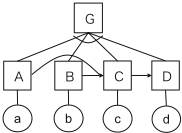
action G the agent must perform actions A, B, C, and D. A and B must be executed before C but are unordered with respect to each other, and finally D must be performed after C.
3 Representing Plans in CCG
To represent the example plan in a CCG, each observable action is associated with a set of categories.
Definition 3.1 We define a set of categories, C, recursively:
Atomic categories : A finite set of basic action categories. C = {A, B, ...}.
Complex categories : If Z ∈ C and {W, X, ...} nequal ∅ ⊂ C, then Z\{W, X, ...} ∈ C and Z/{W, X, ...} ∈ C.
Intuitively, complex categories can be thought of as functor categories that can take a set of arguments ({W, X, ...}) and produce a result (Z). The direction of the slash indicates where the functor looks for its arguments. We require the argument(s) to a complex category be observed after the category for forward slash, or before it for backslash.
Thus, an action with the category A\{B} is a function that results in performing action A in contexts where an action with category B has already been performed. Likewise A/{B} is a function that results in performing A if an action with category B is executed later.
We are now in a position to define a plan lexicon.
Definition 3.2 We define a plan lexicon as a tuple PL = 〈Σ, C, f 〉 where, Σ is a finite set of observable action types, C is a set of possible CCG categories, and f is a function such that ∀σ ∈ Σ, f (σ) → Cσ ⊆ C.
Cσ is the set of categories an observation of type σ can be assigned. As a short hand, we will often provide just the function that maps observable action types to categories to define a plan lexicon. For example,
defines one plan lexicon for our example plan. The following definitions will also be helpful:
Definition 3.3 We define a category R as being the root or root-result of a category G if it is the leftmost atomic result category in G. For a category C we denote this root(C)
Thus G is the root-result of (G/{D})\{A, B}. Further,
Definition 3.4 we say that observable action type a is a possible head of a plan for C just in the case that the lexicon assigns to a at least one category whose root-result is C.
In our lexicon c is the head for G.
This formulation of CCGs is closely related that of [Baldridge, 2002] in allowing sets of arguments to categories. Sets of arguments are critical for our treatment of partial ordering in the plan. For example, the first argument to c's category is the leftward looking set {A, B} representing the partial ordering of these actions before C. This definition also allows multiple categories to be associated with an observed action type. However, for ease of exposition, we will suppress notation for this if an observation only has a single category.
Next we must show how CCG categories are combined into higher level plan structures. In CCGs combinators [Curry, 1977] are used to combine the categories of the individual observations. We will only use three combinators defined on pairs of categories:
where X and Y are categories, and α and β are possibly empty sets of categories. Other Combinatory rules are sometimes used in NLP[Steedman, 2000], however, we leave the use of these combinators in the PR context for future work.
To see how a lexicon and combinators parse observations into high level plans, consider the derivation in Figure 2 that parses the sequence of observations: a, b, c.
Figure 2: Parsing Observations with CCGs
As each observation is encountered, it is assigned a category on the basis of the lexicon. Combinators then are used to combine the categories. First, a is observed and assigned A and no combinators can be applied. Next we observe b, and it is assigned B. Again, none of the combinators can be applied. Notice however, all the hierarchical structure from the original plan for achieving G is included in c's category. Therefore, once c is observed and assigned its category, we can use leftward application twice to combine both the A and B categories with c's initial category to produce G/{D}.
3.1 Designing Plan Lexicons
In the preceding discussion, we have avoided some of the representational questions in designing a plan lexicon. The critical choice made during lexicon construction is which action types will be the plan heads. Different choices for heads result in different lexicons. For example, the following is an alternative lexicon for G where d is the head rather than c.
We can also represent the plan for G with the following lexicon where a has two possible head categories for G:
There are also a number of still more complex lexicons where other choices are made for the heads.
Modeling issues that are similar to choosing heads for CCGs occur in traditional hierarchical task network (HTN) representations[Ghallab et al., 2004] in the form of choosing the sub-goal decomposition. With their long tradition in planning, decisions about what is and isn't a sub-goal in a single level of an HTN may seem quite intuitive. However, like choosing heads for a CCG this is a design decision for HTNs and can have serious impact on PR and planning algorithms. We will say more about how to choose CCG heads later in this paper.
Keep in mind, we want to use parsing of CCGs to build explanations for the observed actions. However, we don't want to make early commitments to goals. In contrast to traditional HTNs, CCG categories function as a tree and/or subtree spine crossing multiple levels of plan decomposition. We can use the "vertical slicing" of plans by categories to define the scope of our commitments in building goal and plan hypotheses. We state the following principle:
Principle of minimal lexically justified explanation: In
building explanations we never hypothesize any plan structure beyond that provided by the categories of the observed actions in the plan lexicon.
This principle clearly defines when, how much, and what kind of plan structures and hypothesis we can build. It enables a least commitment approach in that it limits plan hypothesis to those for which we have observed the head of the plan. The choice of heads for plans will now allow us to determine when commitments are made about goals, sub-goals, and plans. As we will see next, it also enables a simple algorithm for generating explanations for observations.
4 Building Explanations in ELEXIR
While we would like to use NLP parsing algorithms for explanation construction, there are differences between these problems that prevent this. In the case of PR, we can't bound apriori how many observations there will be. Further, we can't assume that all of the observations must contribute to a single goal. We can't even assume that we have seen all of the observations associated with the plan. Many well known parsing algorithms like CKY, even when modified for CCGs [Steedman, 2000], leverage some or all of these assumptions and are therefore unusable. Therefore we must provide our own algorithm for parsing action categories into explanations.
For ease of computation we will restrict our action grammars to only leftward applicable categories.
Definition 4.1 We define a set of categories C L as leftward applicable if and only if
- C L = C A ∪C C and
- C A is a set of atomic categories and
- C C is a set of complex categories of the form X{/Yi} ∗ {\Zj} ∗ such that X ∈ C A and ∀i, Yi ⊆ C A and ∀j, Zj ⊆ C A .
Intuitively all of the leftward looking arguments in a category must precede (be "outside") all of the rightward looking arguments. Thus (((A/{B})/{C})\{D})\{E} is a leftward applicable category but(((A/{B})\{C})/{D})/{E} is not. We will return shortly to discuss the reasons for this limitation.
Definition 4.2 We next define an explanation for a sequence of observation instances for each time instance σt1...σtn given a plan lexicon PL = 〈Σ,C L , f 〉 as a sequence of categories [c1...ci] that result from parsing the input stream on the basis of the plan lexicon.
We can now provide a simple algorithm to generate all the explanations for a set of observations. See Figure 3. The intuition for the algorithm is as follows. For each explanation and for each category that the current observation could be assigned, check that all of its leftward looking arguments are present in the current explanation. If so, we clone the current explanation, add the category to the explanation, and use application to remove all of its leftward looking arguments. Then for each category in the explanation that could combine with the new category using rightward composition or application, duplicate the explanation and execute the composition in the new copy. Add the new explanation to the set of explanations and repeat for the next observation.
To remain consistent with the plan lexicon, the algorithm cannot assign a category to an observation unless all of the category's leftward arguments have been observed. To do so
Procedure BuildExplanations(σt1...σtn) { ES = { [ ] }; FOR i = 1 to n ES ′ = ∅; FOR each exp = [c1...c j] ∈ ES FOR each c ∈ f (σti); IF all of c leftward arguments are in exp, and can be removed from exp in order, THEN LET [c1...ck] be exp with all of c's leftward arguments removed by function application and c ′ be the result of c with its leftward arguments removed. ES ′ = ES ′ ∪ [c1...ck, c] FOR each cm ∈ [c1...ck] such that there exists a combinator that will compose cm and c ′ resulting in c". exp ′ = remove(cm, [c1...ck, c] ES ′ = append(exp ′ , c"). END-for; END-if; END-for; END-for; ES = ES ′ ; END-for; return ES ; }would hypothesize explanations that violate the ordering constraints specified in the plan lexicon. Restricting our grammars to leftward applicable categories simplifies this test, captured in the IF clause at the center of the algorithm.
Thus, the algorithm incrementally creates the set of all explanations by assigning categories, discharging leftward looking arguments, and then applying each possible rightward looking combinator between the existing categories and the categories introduced by the current observation.
For example, given the original lexicon and the observations: a, b, c, d the algorithm produces [G] and [G / {D}, D] as the explanations. Note, the second explanation is included to account for the case where the D category will be used in some other, as yet unseen, plan. Under the assumption that a given category can only contribute to a single plan, if these categories are consumed at the earliest opportunity they will be unavailable for later use. Since all leftward arguments are discharged when assigning an observation a category, and each possible combinator is applied as later categories are added, this algorithm is complete and will produce all of possible explanations for the observations.
5 Computing Probabilities in ELEXIR
The above algorithm computes the exclusive and exhaustive set of explanations. Given this, if we can compute the conditional probability of each explanation, then the conditional probability for any particular goal is just the sum of the probability mass associated with those explanations that contain it. More formally:
Definition 5.1
where P(expi|obs) is the conditional probability of explanation expi. Therefore, we need to define how to compute the conditional probability for an explanation.
There are a number of different probability models used to compute the probability of a CCG parse in the NLP literature [Hockenmaier, 2003; Clark and Curran, 2004]. We will extend one described in [Hockenmaier, 2003]. For an explanation, exp, of a sequence of observations, σ1...σn, that results in m categories, c1, ..., cm, in the explanation, we define the probability of the explanation as:
Definition 5.2
Where ciniti represents the category initially assigned in this explanation to observation σi. Thus, the first product represents the probability of each observation having their assigned initial CCG categories. This is standard in NLP and assumes the availability of a probability distribution over the observation's set of categories.
The second term captures the probability that each category will not be combined into a larger plan but itself represents a separate plan. This is not part of traditional NLP models. In NLP it makes no sense to consider the probability of multiple interleaved sentences or fragments. However, this assumption does not hold for PR. It is more than possible for a given sequence of observations to contain multiple interleaved plans or to only cover fragments of multiple plans being executed (consider multi-day plans). Therefore, our system must be given a prior probability for each category that occurs as a root-result in the lexicon. The role of these priors in Definition 5.2 requires some discussion.
We will denote the multiset of all values of root(cj) for a given explanation, as expGoals, and the probability of this particular multiset of root-result categories being adopted as toplevel goals as P(expGoals). Keep in mind, in ELEXIR we want to allow for multiple instances of a given result in expGoals (it is acceptable for root(ci) = root(cj) where i nequal j).
We denote the set of categories in expGoals as Goals. Finally, we represent the assumed probability of an agent adopting a particular root-result c as a goal as P(c) with each instance of c in expgoals being chosen (or rejected) independently. This means the probability that there will be exactly n instances of category c in expGoals is given by P(c) n (1-P(c)).
This is almost certainly incorrect - intuitively the probability of multiple instances of a single goal decreases far more rapidly than this, making this an over estimate of the likelihood of the goals. The algorithm supports more sophisticated probability models, and this is an area for future work.
If we let |Goalsc| represent the number of instances of category c in expGoals:
Collecting all of the 1 - P(c) terms produces a product over all the categories in the lexicon and is therefore a constant:
Rewriting in terms of the instances in the explanation yields the second term seen in Definition 5.2.
6 Complexity Analysis of ELEXIR
Having completed the description of the algorithm and probability model, we briefly consider its theoretical complexity. In order not to be distracted by the number of possible explanations computed, we consider how efficient the algorithm is in computing a single explanation for n observations.
We begin by noting that testing for the equivalence of two categories (and hence for combinator applicability) for any particular CCG is a constant time operation. Since each category can be though of as a tree, testing equality is equivalent to doing an in-order traversal. However, since the CCG grammar is fixed, we know the size of the largest category, and can then treat this cost as a constant,C.
The algorithm has two stages, explanation building and computing probabilities. We discuss each separately.
Explanation Building 1) Discharging leftward arguments: Let K be the fixed size of the grammar's largest leftward looking argument set. Verifying that all K arguments have been seen costs CK operations for each of the possibly n - 1 previous categories. This results in a worst case O(n) cost.
- Applying combinators: Let J be the fixed number of combinators. The algorithmmust test each new category against each of the (in the worst case) n - 1 preceding categories. This results in nCJ tests for each observation for an O(n) cost.
Computing Probability Computing the first term of the probability can be done in constant time when the category is chosen. The second term requires a single multiplication for each of the categories in the explanation. The cost of this is bounded above by O(n).
Thus the worst case complexity for building a single explanation is O(n). We also note this is as efficient as any algorithm can be since each of the observations has to be considered. Therefore the effective runtime of ELEXIR hinges most critically on the number of explanations being built. We argue that a least commitment approach can control the number of explanations being built by correctly choosing plan heads. We will examine this claim in the next section.
7 Empirical Analysis of ELEXIR
To verify the correctness of our system and to test our hypothesis about the efficacy of headedness we have developed a testing harness that allows us to systematically vary a number of parameters that define the plans in the CCG plan lexicon. These parameters include:
- order: How many and what type of ordering constraints exist between the actions in the plans. This parameter can take on the following values:
- Total: actions in a sub-plan are totally ordered.
- First: each sub-plan has a designated first action. All other actions in the plan are ordered after it but are unordered with respect to each other.
- Last: each sub-plan has a designated last action. All other actions in the sub-plan are ordered before it, but are unordered with respect to each other.
- Unord: actions in a sub-plan are unordered.
- depth: The depth of each plan.
- num-roots: The number of plans in the lexicon.
- and-bf: The number of children for each sub-plan.
- headedness: Determines which sub-plan step will be the head. This ranges between 0.0 (leftmost/"first") and 1.0 (rightmost/"last").
To create these plans, num-roots complete hierarchical plans based on AND-trees obeying depth and and-bf were generated and ordering constraints were established over each sub-tree. These plans were then converted to a CCG lexicon by starting at the root of the plan and recursively descending the tree following the actions with the indices given by ⌈ (headedness * and-bf) ⌉ collecting siblings that are to the left and the right of the action. When a leaf is reached a CCG category is built maintaining the ordering constraints of the original plan. This process is repeated for all sub-plans not covered by the initial category.
Given a CCG plan library we generated observations to test the system by randomly selecting a root-result category and producing a plan instance for it based on the plan library. (For test cases with multiple plans this process was repeated and the resulting plan instances were interleaved, maintaining the ordering constraints in the individual plans.) ELEXIR is then timed computing the conditional probability of all the rootresults found by the algorithm given CCG plan library and the sequence of observations.
All of our experiments on our Allegro Common LISP 8.1 implementation of ELEXIR were conducted on a MacBook with 4Gb of main memory and 2 2.2-GHz CPUs. We report CPU time exclusive of any time used by garbage collection, the operating system or by other processes. For cases where the runtime registered as zero we report a runtime of 1 msec.
As a first exploratory test of the system we set roots to twenty, and-bf to three, and depth to two. We then ran a full factorial experiment on all values of the order factor and headedness at values of 0.001, 0.5, and 1.0. Each data-point had two interleaved plans resulting in a total of eighteen observations. ELEXIR achieved one hundred percent accuracy on this input data recognizing both plans in the input stream with the majority of the runs completing in under a second. These results verify the correctness of our implementation and its accuracy in the case of no noise or ambiguity.
7.1 Reducing Runtimes by Choosing Plan Heads
The central claim of this paper is that using CCGs and the correct choice of plan heads can delay commitment to plan and goal hypothesis and thereby reduce runtimes for PR systems. To validate these claims, we need to compare the system's runtimes varying the headedness of the plans. Synthetic data provide the perfect means for us to vary headedness of plans while controlling for other variables.
Notice that previous work in PR that make early commitments to plans and goals are effectively always operating with plans libraries that have a headedness value fixed at zero. If we fix headedness at zero, then each category is effectively a left most depth first tree with no leftward arguments. Thus when the first action of a plan is seen the whole left spine of the tree is introduced with the category, and all subsequent observations are also left most depth first trees. Thus, headiness values very close to zero make the same early commitment that we argued against in other PR systems.
This means we can use very low headedness values as the baseline for our experiments. If we see a drop in runtime as headedness is increased, this confirms our hypothesis that moving the head later in the plan delays commitments to the goal hypothesis and reduces the algorithm's runtime.
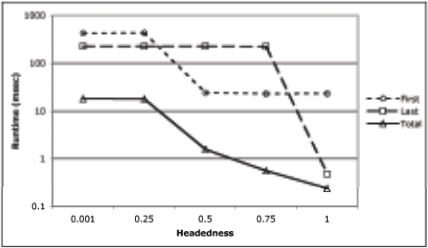
Figure 4 displays the results for a full factorial experiment where each test case was taken from a plan lexicon with numroots set to one hundred, and each plan had an andbf of four. The tested factors were order and headedness, and they varied between total, first,last and 0.001, 0.25, 0.5, 0.75, 1.0 respectively. All other factors were held constant at their previous values. By setting headedness to these values each of the children of each AND-node is, in turn, treated as the head of the plan. The steady drop in runtime across all values of order as the head of the plan is moved to the right provides very convincing evidence for our claims.
We see a significant decrease in runtime for all ordering cases as the head is moved later in the plan and commitment to plan structure is delayed. We note all of the gains for the order first case are almost immediate while the gains for the last case do not occur until much later. Considering the ordering constraints in the respective plans will explain this.
In the order last case, we do not see improvement in the runtime until the head of the plan is assigned to the last action. In this case, since all the leading actions are unordered with respect to each other, any commitment to the structure of the plan before the last action is equivalent in runtime, but delaying commitment to the plan structure until the final action results in significant savings.
In the case of the order first, a value of 0.001 for headedness aligns the head of the plan with the causally first action of the plan. As we move the head later in the plan we get an initial drop in runtime as one of the unordered actions is selected, but no significant later savings since the ambiguity associated with the unorded actions is being moved from one side to the other of the head action.
We did not identify headedness as having a significant effect in completely unordered plans. The lack of structure in these plans means that whenever an action in one of these plans is observed ELEXIR is required to consider an exceptionally large number of hypotheses, but moving the head does not restrict the number of hypotheses. This should not be seen as a significant limitation. We believe completely unordered plans are unlikely in the real world.
7.2 Discussion and Limitations
These experiments show that a PR algorithm based on CCGs and headedness is viable and provides a principled way to control early commitment. However, we have not provided an answer for how to choose plan heads during lexicon design. These decisions have to be made by considering three key factors:
- Criticality of early recognition: In cases where early recognition is critical, choosing a head that is early in the plan is better. Earlier heads allow earlier recognition and must be weighed against the runtime. We can certainly imagine domains where the need for early recognition outweighs the runtime costs.
- Runtime: In general, as we have shown, to minimize runtime, choosing actions that fall later in the plan as heads is better.
- Causal structure: We can see in these experiments aligning choices of plan heads with the causal structure produces the greatest computational wins.
Thus, all three of these features must be considered by the system builder when encoding a PR domain.
It is worth noting that the algorithm given here does have a significant limitation. It is unable to compute the probability for any plan for which the head has not been observed. Consider the first example CCG lexicon given for the initial example. Suppose the system is only given two observations [a, b]. Intuitively this should give us a significant amount of evidence for the goal G. However, the category with rootresult G is assigned to c, and c has not yet been observed. Therefore, the system is unable to consider G as an explanation for the observations.
We are working on developing a revised algorithm to address this limitation and consider this a significant area for future work. That said, there are domains where the speed of this algorithm and its ability to allow multiple different choices for plan heads make it worth considering.
8 Conclusions
In this paper, we have defined ELEXIR, a probabilistic plan recognition algorithm using CCGs to encode plans. We have analyzed the complexity of the algorithm, and described its empirical evaluation. We have also shown that CCGs provide a formal way to control the early commitment problem faced by other plan recognition systems.
Acknowledgments
The work described in this paper was conducted within the EU Cognitive Systems project PACO-PLUS (FP6-2004-IST4-027657) funded by the European Commission.
@inproceedings{ijcai2009p284,
  title     = {Delaying Commitment in Plan Recognition Using Combinatory Categorial Grammars},
  author    = {Geib, Christopher W.},
  booktitle = {Proceedings of the Twenty-First International Joint Conference on
               Artificial Intelligence, {IJCAI-09}},
  publisher = {International Joint Conferences on Artificial Intelligence},
  editor    = {Craig Boutilier},
  pages     = {1702--1706},
  year      = {2009},
  url       = {https://ijcai.org/proceedings/2009/284},
}
TY - CPAPER TI - Delaying Commitment in Plan Recognition Using Combinatory Categorial Grammars AU - Geib, Christopher W. T2 - Proceedings of the Twenty-First International Joint Conference on Artificial Intelligence, IJCAI-09 PB - International Joint Conferences on Artificial Intelligence PY - 2009 SP - 1702 EP - 1706 UR - https://ijcai.org/proceedings/2009/284 ER -Copied
Machine-readable versions of this paper, for tools and AI agents:





