
Higher-Order Potentialities and their Reducers: A Philosophical Foundation Unifying Dynamic Modeling Methods
Proceedings of the Twentieth International Joint Conference on Artificial Intelligence. Pages 262-266.
© 2007 International Joint Conferences on Artificial Intelligence
Abstract
In the development of disciplines addressing dynamics, a major role was played by the assumption that processes can be modelled by introducing state properties, called potentialities, anticipating in which respect a next state will be different. A second assumption often made is that these state properties can be related to other state properties, called reducers. The current paper proposes a philosophical framework in terms of potentialities and their reducers to obtain a common philosophical foundation for methods in AI and Cognitive Science to model dynamics. This framework provides a unified philosophical foundation for numerical, symbolic, and hybrid approaches.
- [Anderson and Lebiere, 1998] Anderson, J.R., and Lebiere, C. The atomic components of thought. Lawrence Erlbaum Associates, Mahwah, NJ. [Aristotle, 350 BC] Aristotle. Physica (translated by R.P. Hardie and R.K. Gaye). [Aristotle, 350 BC'] Aristotle. De Motu Animalium On the Motion of Animals (translated by A. S. L. Farquharson). [Ashby, 1960]
- Ashby, R. Design for a Brain. Chapman & Hall, London. Revised second edition, 1960.
- [Bosse et al., 2005] Bosse, T., Jonker, C.M., Meij, L. van der, and Treur, J. LEADSTO: a Language and Environment for Analysis of Dynamics by SimulaTiOn. In: Eymann, T. et al. (eds.), Proc. of MATES'05. LNAI, vol. 3550. Springer Verlag, 2005, pp. 165-178.
- [Descartes, 1633] Descartes, R. The World or Treatise on Light. Withdrawn from publication, 1633. Also in: Descartes: The World and Other Writings (edited by Stephen Gaukroger). Cambrige University Press.
- [Gelder and Port, 1995] Gelder, T.J. van, and Port, R.F. It's About Time: An Overview of the Dynamical Approach to Cognition. In: (Port and van Gelder, 1995), pp. 1-43.
- Giunti, M. Dynamical Models of Cognition. In: (Port and Gelder, 1995), pp. 549-572.
- [Gleitman, 1999] Gleitman, H. Psychology, W.W. Norton & Company, New York. [Laird et al., 1987]
- Laird, J.E., Newell, A., and Rosenbloom, P.S. Soar: an architecture for general intelligence. Artificial Intelligence, vol. 33, pp. 1-64.
- [Mach, 1942] Mach, E. The Science of Mechanics: A Critical and Historical Account of its Development. 9 th edition, trans. T.J. McCormack, LaSalle III. [Newton, 1729]
- Newton, I. The Mathematical Principles of Natural Philosophy, 1729. In: Newton's Principles of Natural Philosophy, Dawsons of Pall Mall, 1968.
- [Port and Gelder, 1995] Port, R.F., and Gelder, T. van (eds.) Mind as Motion: Explorations in the Dynamics of Cognition. MIT Press, Cambridge, Mass
- [Taylor, 1715] Taylor, B. Methodus Incrementorum Directa et Inversa.
References were extracted automatically from the PDF and may contain errors.
Full text extracted automatically from the PDF; figures, tables and equations may differ. The PDF is the version of record.
1. Introduction
Dynamics of the world shows itself by the occurrence of different world states, i.e., states at different points in time that differ in some of their state properties. In recent years, within Cognitive Science, dynamics has been recognised and emphasised as a central issue in describing cognitive processes [Port and Gelder, 1995]. Van Gelder and Port [1995] propose the Dynamical Systems Theory (DST) as a new paradigm that is better suited to the dynamic aspects of cognition than symbolic modelling approaches. However, as DST (which subsumes neural networks and many other quantitative approaches to adaptive and control systems), commits to the use of quantitative methods (differential and difference equations), it is often considered less suitable to model higher cognitive processes such as reasoning and language processing. DST is based on the state-determined system assumption: properties of a given state fully determine the properties of future states; cf. [Ashby, 1960], p. 25; [Gelder and Port, 1995], p. 6. This means that for state properties that are different in a future state, state properties in the given state can be found that somehow indicate or anticipate these differing (changed) properties. This idea closely relates to the concept of potentiality that goes back to Zeno and Aristotle [350 BC']: if a potentiality p for a state property a occurs in a given state, then in a next state, property a will occur. A potentiality is a kind of anticipatory state property: a state property anticipating the different state property (in the changed state).
In the current paper the notion of potentiality is used as a basis for a philosophical framework to analyse modelling methods that address dynamics. This framework is applicable to obtain philosophical foundations for both quantitative approaches (such as DST and neural networks) and qualitative or symbolic approaches (such as BDImodelling and production systems) to modelling of dynamics. Given that the framework is applicable to DST, which since long has proved its value for quantifiable areas within a wide variety of disciplines, also the scope of applicability of the proposed philosophical framework covers disciplines such as Physics, Chemistry, Biology, and Economics. For the cognitive and knowledge engineering area, it is shown how the framework can be applied to provide a foundation for symbolic modelling methods such as production systems and BDI-models. The framework easily describes both mental aspects and physical aspects of embodied cognitive agents and their relationship.
Below, first the notion of potentiality is briefly introduced (Section 2). Next, in Section 3 the notion of higher-order potentiality is discussed and illustrated by examples from Mathematics (higher-order derivatives and Taylor series). In Section 4 it is shown how higher-order potentialities play a role as a philosophical foundation of basic concepts in Physics (momentum, kinetic energy, force). Section 5 discusses the assumption that potentialities of some higher order can be reduced to lower level state properties. Sections 6 and 7 show how the framework can be applied to symbolic modelling methods: BDI-models and production systems. Section 8 shows how it can be applied to modelling of adaptive agents. In Section 9 the philosophical framework is related to the Dynamical Systems Theory, including neural networks and many other (quantitative) approaches to dynamic systems. Section 10 is a discussion.
2. Potentialities
Given a particular state that just changed with respect to some of its state properties, it is natural to ask for an explanation of why these new state properties occurred. In a state-based approach, as a source for such an explanation, state properties found in the previous state form a primary candidate. A main question becomes how to determine for a certain state that it is going to change to a different state, and, more specifically, how to determine (on the basis of some of the state properties in the given state) those state properties for which the new state will differ from the given one. This poses the challenge to identify state properties occurring in a given state that anticipate the next state: anticipatory state properties. If such state properties (historically sometimes called potentialities) are given, anticipation to change is somehow encoded in a state. The assumption on the existence of such properties is the crucial factor for the validity of the assumptions underlying dynamic modelling methods such as the Dynamical Systems Theory. 1 Aristotle did introduce such a type of concept; he called it potentiality (to move), or movable. 2 For example, following Zeno, the difference between an arrow at rest and the snapshot of a moving arrow at time t at position P is that the former has no potentiality to be at P', whereas the latter has. This explains why at a next instant t' the former arrow is still where it was, at P, while the latter arrow is (assuming no obstruction) at a different position P': Aristotle did not only consider changes of positions (due to locomotion), but also, for example, a young man becoming an old man, and a cold object becoming hot. For each of these types of changes a specific type of potentiality is considered; e.g., the potentiality to be at position P', the potentiality (of a cold object) to be hot. In general, if the potentiality p (occurring in a state S) to have state property a has led to a state S' where indeed a holds, then this state property a of state S' is called the fulfilment or actualisation of the potentiality p for a, occurring in state S. Notice that Aristotle considered both absolute potentialities, indicating a state property for the future state independent of this state property in the present state, and relative potentialities, indicating a difference (increase or decrease) in a future state property compared to the present state.
3. Higher-Order Potentialities
The effect of a potentiality on a future state can be described by relating its occurrence in the present state to the occurrence of a certain state property in the future state, usually under an additional opportunity condition (e.g., assuming no obstruction by influences otherwise). This
1 'As a working guide, the scientist has for some centuries followed the hypothesis that, given a set of variables, he can always find a larger set that (1) includes the given variables, and (2) is state-determined. Much research work consists of trying to identify such a larger set (…). The assumption that such a larger set exists is implicit in almost all science, but, being fundamental, it is seldom mentioned explicitly.' [Aristotle, 350 BC'], p. 28.
2 'We have now before us the distinctions in the various classes of being between what is full real and what is potential. (…) The fulfilment of what exists potentially, in so far as it exists potentially, is motion - namely, of what is alterable qua alterable, alteration: of what can be increased and its opposite what can be decreased (there is no common name), increase and decrease: of what can come to be and can pass away, coming to be and passing away: of what can be carried along, locomotion.'
(from [Aristotle, 350 BC], Book III, Part 1)
indicates what it is a potentiality for. A more complicated question is how to specify when (under which past and present circumstances) a potentiality itself will occur. For the case of empty space, where an object is assumed to have no interaction with other objects, a potentiality to change position is present because it was present at an earlier point in time and persisted until t (inertia of motion). However, if the potentiality in a new state is different from the earlier one, a question becomes why this is so. This leads to the question addressed in this section of how a changed potentiality can be explained.
The use of higher-order potentialities is an answer to this question. The idea behind higher-order potentialities is simple. To obtain an explanation of changed state properties over time, potentialities were introduced. Potentialities are also state properties that change over time. Therefore it would be reasonable to treat them just like any other state property that changes over time. This means that for a potentiality p (1) a socalled second-order potentiality p (2) is introduced to explain why p (1) may become changed over time. And of course this process can be repeated for p (2) , and so on. This leads to an infinite sequence of higher-order potentialities, p (1) , p (2) , p (3) , p (4) , …, where for each natural number n the potentiality p (n) is called an n-th-order potentiality. Using such higher-order potentialities, the idea is the following:
- for a certain point in time t0 the occurrence of a state property a is determined by the state at a previous time point t1 < t0, in particular, by the occurrence of the first-order potentiality p (1) for a at that time point t1,
- the occurrence of the first-order potentiality p (1) at t1 is determined by the state at a time t2 < t1, in particular by the occurrence of its own potentiality which is the second-order potentiality p (2) for a at t2, et cetera.
This process can be visualised as depicted in Figure 1.
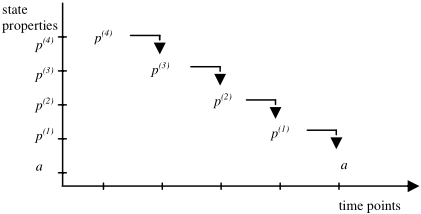
This shows how the concept of potentiality to explain change of a certain basic state property a can take the form of a large number of (higher-order) entities. Strange as the idea of an infinite number of higher-order potentialities may seem at first sight, in mathematical context (in particular in calculus) this has been worked out well (using infinite summations). Higher-order potentialities have been formalised in the form of higher-order) derivatives of a function. The (first-order) derivative of a function at a time point t gives an estimated measure of how the function will change its value in a next time point. The well-known Taylor series [Taylor, 1715] for sufficiently smooth functions (at least infinitely often differentiable to guantee the existence of the derivatives) shows how changes of the function value from t to t' (within some given neighbourhood of t) depend on all (higher-order) derivatives:
This shows how the (relative) potentiality at t, defined by the combination of all higher-order potentialities, determines the changed state at the future time points t'.
4. Potentialities Underlying Physics
In later times, successors of Aristotle, such as René Descartes (1596-1650), Christiaan Huygens (1629-1695), Isaac Newton (1643-1727) and Gottfried Wilhelm Leibniz (1646-1716), among others, have addressed the question how to further develop the phenomenon of dynamics (or change), in particular within Physics. They developed classical mechanics based on concepts that can be philosophically founded as certain types of potentialities.
Descartes [1633] took the product of mass and velocity of an object for its potentiality to be in a changed position, or 'quantity of motion'. Notice that this anticipatory state property 'quantity of motion' is a relative potentiality: the actualisation of a given quantity of motion entails being at another position as specified by this quantity relative to the current position. Descartes also expresses a law of conservation for this quantity of motion.
In modern physics this 'quantity of motion' concept is called linear momentum, or just momentum, and the conservation, for example, during elastic collisions, is called the 'law of momentum conservation'. Newton incorporated this notion in his approach to motion. This is one way in which a concept 'potentiality' (for change of position) was used as a philosophical basis to introduce formalised concepts in physics, thus providing one of the cornerstones of classical mechanics. Also the concept of 'quantity of motion', describing change of position, can change itself; this leads to a second-order potentiality. In his second law Newton [1729] uses the term 'impressed motive force' to express the change of motion. 3 This law expresses that the concept of force used by Newton directly relates to change of motion. For (quantity of) motion he gives the same definition as Descartes, i.e., momentum. For an impressed force a definition is given that refers to 'exerted action', and to the corresponding change of the object's state of motion. 4 He shows how this notion applies in the particular case of centripetal (i.e., directed to one point) force. 5 This shows that the concept 'force' used by Newton as an addition to state ontology can be given a definitional relationship to
3 'The change of motion is proportional to the motive force impressed; and is made in the direction of the right line in which that force is impressed.' [Newton, 1729]
4 'An impressed force is an action exerted upon a body, in order to change its state ...' [Newton, 1729]
5 'The motive quantity of a centripetal force is (…) proportional to the motion which it generates in a given time.' [Newton, 1729]
'motion generated in a given time'. This 'motion generated in a given time' can be philosophical founded as a secondorder potentiality for the first-order potentiality 'motion'. So, within classical mechanics, after the concepts 'momentum' and 'kinetic energy' which were added to the state ontology as specific types of concepts based on a (firstorder) potentiality, the concept 'force' can be considered a third anticipatory state property added to the state ontology, this time based on a second-order potentiality. Newton and also Leibniz developed mathematical techniques of calculus, such as differentiation and integration. Using these techniques, Newton's second law is formulated as F = dp/dt or F = d(mv)/dt. For a mass which is constant over time this is equivalent with F = ma with a the acceleration dv/dt; in this - most known form - the law was formulated by Euler 65 years after the Principia appeared. In 20 th century text books such as [Mach, 1942] the concept 'moving force' is defined in terms of acceleration, which is based on a secondorder potentiality for change of position. 6
As illustrated by the examples in Sections 3 and 4, the idea of use potentialities to analyse the change of states has successfully contributed to the development of wellrespected disciplines such as Mathematics and Physics.
5. Reducers Limiting a Potentiality Chain
Apparently, the use of potentialities may lead to an infinitedimensional vector of higher-order potentialities. As this can be difficult to handle, it makes sense to look for ways to break off this chain of higher-order potentialities. One possible option is to consider only changes that involve a finite number of higher-order potentialities. For example, for a falling object within a constant gravitation field, the second-order potentiality (the second-order derivative of the function measuring the distance) is constant (9.8 m/sec 2 ), and hence no third- or higher-order potentiality is needed. However, further away in the universe, if an object is approaching the earth, gravitation will increase over time, so this assumption of constancy will not always be fulfilled. However, as is also shown by the Taylor series, often an adequate approximation can be obtained by taking into account only the terms up to some n-th order, as the terms substantially decrease in absolute size; for example, assuming all derivatives bounded by some constant M, the effect of the n-th term is less then M/n!, so, as an approximation its contribution can be counted as zero.
In the same perspective, a more general way to get rid of the infinite vector of higher-order potentialities is when for some n the n-th-order potentiality is equivalent to a combination of lower level potentialities and/or basic state properties (this is called a reducer of the higher-order potentiality) and by means of this relation can be reduced to them. This is what happens in classical mechanics, and, in a more general context, in other cases where a differential equation can be found that relates a higher-order derivative to lower order derivatives and/or basic state properties.
6 'Moving force is the product of the mass value of a body with the acceleration induced in that body.' [Mach, 1942], p. 304
The domain of Physics illustrates this. Analysing the motion of planets around the sun, Newton found out that they can only follow their orbit if a second-order potentiality is assumed, in the direction of the sun. Newton calculated (using his calculus under development) in detail that this motive force was proportional to 1 divided by the square of the distance. For example, for an object in space with mass m approaching earth (with mass M), Newton's law of gravitation for the motive force on the object is as follows (here x is the distance between the object and the earth, and c is a constant): F = c mM/x 2 . Such a relation between the second-order potentiality force and basic state properties mass and distance shows how a higher-order potentiality can be reduced: in this case c mM/x 2 is a reducer for F.
As the example from Physics shows, a differential equation is a manner to reduce higher-order potentialities. This reveals another assumption underlying DST, in addition to the state-based system assumption, namely that for some n the n-th order potentiality can be reduced to lower level potentialities and/or basic state properties. Without this assumption no differential equations can be found, and without them DST will not work.
6. Potentialities and BDI-Models
Although traditionally only used within disciplines such as Mathematics and Physics, a natural question is whether the idea of higher-order potentialities is also suitable to obtain philosophical foundations for domains such as AI, Cognitive Science and Agent Systems. To describe the internal dynamics of agents, the concepts beliefs, desires and intentions have been introduced; e.g., [Aristotle, 350 BC']. From a historical perspective, the reason for introducing these concepts was not unlike the reason for introducing the concepts momentum and force within classical mechanics: they were needed as abstract notions to explain the change of states, in this case of living creatures. Aristotle describes how desire plays a role similar to that of the potentiality for an action. Here 'desire' is indicated as the source of motion of a living being. He shows how the occurrence of certain internal (mental) state properties (desires, 'the good') within the living being entail or cause the occurrence of an action in the external world, given an opportunity ('the possible') to actualise the potentiality for the action indicated by the desire.
In this section it is discussed how to philosophically found concepts such as desire and intention by potentialities. To start, the notion of intention is addressed. An intention can be founded by a potentiality for an action in the world (i.e., for a changed world state). Where do intentions come from? A common view is that, given some beliefs, intentions come from desires, by some form of selection process. In this interpretation a desire can founded by a potentiality as well, but not a potentiality for some state of the world, but a potentiality for an intention, which itself is also considered a potentiality, for an action (i.e., for a changed world state). Therefore this view identifies a desire as a second-order potentiality (for a changed world state). To the question where desires come from there seems to be no general answer. In some cases there may be reducers for it in terms of physical states, in other cases, e.g., norms or personality aspects may provide a third-order potentiality.
7. Potentialities and Production Systems
An often used method in AI and Cognitive Science is to specify how a state in a system may change is production systems. These are collections of production rules, denoted as ϕ → ψ with antecedent ϕ and consequent ψ ; here:
- ϕ indicates a (combined) state property for the current state
- ψ indicates one or more state properties for the next state
The idea is that if the combination of properties specified in the first description holds in a (current) state, then in a next state the properties specified by the second description will hold. This is illustrated by a simple model of agent behaviour based on beliefs desires and intentions. Consider an agent walking down a street and observing an ice cream sign across the street he believes the supermarket sells ice cream. Based on this belief (b1) the agent generates a desire (d) for ice cream. Given this desire, and the belief (b2) that the supermarket is reachable (by crossing the street) the agent generates the intention (i) of having ice cream. Given this intention and the belief (b3) that no traffic is on the street he actually crosses the street and obtains the ice cream (e). In this case the state ontology is described by six basic state properties: b1, b2, b3, d, i, e. The production system is:
Based on this a trace of subsequent states is made:
- Given a current state S, take the production rules for which the antecedent holds in the current state. This is the set of applicable rules.
- Collect the consequents of all applicable rules and obtain the next state S' by modifying S so that all these consequents hold in S' (and the rest of S is persisting).
So, for example, the subsequent states for a given initial state for which the three beliefs hold are as follows:
0 [b1, b2, b3]
1 [b1, b2, b3, d]
2 [b1, b2, b3, d, i]
3 [b1, b2, b3, d, i, e]
How can this be interpreted in terms of potentialities? For example, consider state 1. As in the next state, state 2, state property i holds, in state 1 the potentiality for i to hold has to be present. On the other hand, i occurs in state 2 because of the second production rule. Taken together this means that this production rule can be interpreted for state 1 as indicating that, due to the occurrence of both b2 and d in this state, also the potentiality p(i) for i occurs in state 1. Similarly the other production rules can be interpreted as indications of which potentialities occur in a given state. In general, according to this interpretation, a production system specifies for each state which potentialities occur: for each production rule ϕ → ψ, if in a state S its antecedent ϕ holds, then in this state S also the potentialities p(ψ) for ψ occur. Thus a production rule ϕ → ψ can be interpreted as an implication ϕ → p(ψ), describing a logical relationship between state properties in a given state, e.g., ϕ is a reducer for p(ψ). Since the idea of production rules is used in various other modelling approaches (e.g., knowledge-based systems, and cognitive architectures such as ACT-R [Anderson and Lebiere, 1998] and SOAR [Laird et al., 1987]), in principle it is possible to interpret such approaches in terms of potentialities as well.
8. Potentialities and Adaptive Agents
Adaptive agents are often modelled in numerical and algorithmic manners. In this sense modelling approaches for adaptive agents are in general closer to the DST modelling approach than to symbolic modelling approaches as often applied for other types of cognitive agents such as BDI agents. The potentiality-based analysis framework is applicable to obtain a philosophical foundation for both types of modelling approaches. As in Section 6 and 7 it was shown how symbolic models can be founded by potentialities, in this section adaptive agents are addressed, illustrated by a case study of Aplysia. Aplysia is a sea hare that is often used to do experiments. It is able to learn; for example, it performs classical conditioning in the following manner. This (a bit simplified) description is mainly based on [Gleitman, 1999], pp. 155-156. Initially the following behaviour is shown: a tail shock leads to a response (contraction), and a light touch on its siphon is insufficient to trigger such a response. Now suppose the following experimental protocol is undertaken. In each trial the subject is touched lightly on its siphon and then, shocked on its tail (as a consequence it responds). It turns out that after a number of trials (assumed three in the current example) the behaviour has changed: the animal also responds (contracts) on a siphon touch. The cause of this change in behaviour is, in short, that the learning trials strengthen the internal connection between sensory nand motor neurons. To obtain a potentiality-based analysis of this adaptive agent the following steps can be made.
- Introduce the basic world state properties: siphon touch, tail shock, contraction, weak connection between sensory neuron and motor neuron.
- Introduce a potentiality p for the contraction (based on the opportunity that a siphon touch occurs).
- Introduce a potentiality p' for p (based on the opportunity that both a tail shock and siphon touch occur).
- Introduce a potentiality p" for p' (based on the opportunity that both a tail shock and siphon touch occur).
- Introduce a potentiality p"' for p" (based on the opportunity that both a tail shock and siphon touch occur).
- Specify a reducer for p"' based on the untrained state of the connection between the relevant sensory and motor neurons.
Notice that in the analysis of the example the intermediate states during the adaptation process were founded by first-, second- and third-order potentialities p, p', p" that were not reduced, similar to the not reduced first-order potentiality momentum in classical mechanics as an intermediate state between the second order potentiality force, which is reduced, and position. However, if more detailed information from the neurological area is incorporated (i.e., about the physiological states of the synapses between certain neurons, e.g., sensory neuron SN2 and motor neuron MN, during the adaptation process), then all of the potentialities can be reduced; e.g., [Gleitman, 1999], pp. 155-156, see also Figure 2. Within a potentiality-based analysis this is incorporated as follows. Suppose s1, s2 and s3 are reducers of p, p', p" respectively, then the (higherorder) potentialities p', p", p"' become (first-order) potentialities for the world state properties s1, s2 and s3 respectively.
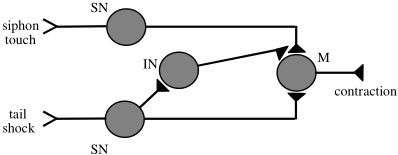
This shows how potentialities cover the foundation of both internal agent states that are used as functional states without direct physical grounding, and internal agent states that are considered as embodied and embedded in the physical world. Moreover, the relationship between these functionalist and physicalist perspectives can easily be analysed within the potentiality-based philosophical framework. For reasons of presentation, the example of an adaptive agent discussed in this section was kept relatively simple. However, the case can be extended easily to include, for example, numerical aspects, or more precise timing aspects such as in trace conditioning.
9. Potentialities and DST
Within Dynamical Systems Theory (DST; cf. [Ashby, 1960; Port and Gelder, 1995]), techniques used are difference and differential equations. The analysis based on potentialities covers the DST approach in the following manner.
- For the basic state properties, take value assignments to the basic variables used to describe a phenomenon in DST.
- For any n, for the nth-order potentiality for a basic state property, take the value assignment to the nth-order derivative of the variable.
- For the reduction relation of an nth-order potentiality, take the nth-order differential equation relating the value of the nthorder derivative to the values of lower-order derivatives and basic variables.
As an example, the gravitation case is covered as follows:
- Basic state properties: value assignments to x the position of the object, m mass of the object, M mass of the earth.
- First-order potentiality for basic state property mx: value assignment to first-order derivative p of mx (momentum p of the object): p = dmx/dt.
- Second-order potentiality for state property mx: value assignment to first-order derivative f of p, or, equivalently, second-order derivative f of mx (force f): f = dp/dt = d 2 mx/dt 2 .
- Reduction relation of the second-order potentiality f: f = c*mM/x 2 (or d 2 mx/dt 2 = c*mM/x 2 ).
As neural networks can be considered as a specific use of DST, the relationship of the potentiality-based view to DST also covers the relationship to neural networks and many other quantitative modelling methods.
10. Discussion
Dynamical Systems Theory (DST) has recently been put forward within Cognitive Science to model dynamics of cognitive processes, and proposed as an alternative for the symbolic/computational approach; for example, [Gelder and Port, 1995; Port and Gelder, 1995]. DST subsumes many quantitative approaches such as neural networks and other adaptive system modelling approaches. The notion of a state-determined system [Ashby, 1960] is central for DST; such a system is based on the assumption that properties of a given state fully determine the properties of future states. Within DST the notion of dynamical system that is assumed is based on world states at different points in time that are conceptualised by (real number) value assignments to continuous variables. The way in which properties of a present state determine properties of a future state is expressed by difference or differential equations. This is one specific way to achieve the state-determined system assumption, where derivatives play the role of potentialities: state properties that indicate how the state will change.
In other literature, such as [Giunti, 1995], the notion of dynamical system is more general, not (only) based on real number value assignments. Also in such systems a statedetermined system assumption can be incorporated by introducing potentialities to the state ontology that indicate in which respect the state is going to change. The notion of potentiality goes back to Zeno and Aristotle and was exploited by Descartes, Newton, Huygens and Leibniz, among others, to develop fundamental areas within Physics and Mathematics (classical mechanics and calculus).
In this paper, a philosophical framework has been introduced to analyse modelling methods for dynamics by (first- and higher-order) potentialities and reducers for them. It was shown how this framework provides unified philosophical foundations for both symbolic and mathematical approaches, approaches that are often seen as mutually exclusive. As a result, hybrid modelling approaches can be philosophically founded, in which both symbolic and mathematical aspects are covered. Examples of such approaches that make some first steps in that direction are cognitive modelling frameworks such as ACTR [Anderson and Lebiere, 1998], SOAR [Laird et al., 1987], and (recently) LEADSTO [Bosse et al., 2005].
Within Mathematics the same philosophical concept has been worked out in the nth-order derivatives of a function for all n, and the Taylor series to calculate changes of the function value. In many cases, after a few steps a reduction can be made in the sense that a higher-order potentiality is equivalent to a combination of basic state properties and/or lower level potentialities. Within DST this is where a differential equation comes in, reducing an n-th-order derivative to lower level properties: the assumption of reduction is another crucial assumption underlying DST.
The presented philosophical framework unifies the modelling of a wide variety of dynamic phenomena in the natural and artificial world, from cognitive phenomena to biological, chemical and physical phenomena. For example, in the Aplysia case study it was shown how modelling from a functionalist/mental perspective can easily be integrated at the underlying philosophical level with a perspective from the physical/neurological level. Thus it was shown how philosophical foundations of agents embodied in their physical environment are addressed in a unified manner.
@inproceedings{ijcai2007p40,
  title     = {Higher-Order Potentialities and their Reducers: A Philosophical Foundation Unifying Dynamic Modeling Methods},
  author    = {Bosse, Tibor and Treur, Jan},
  booktitle = {Proceedings of the Twentieth International Joint Conference on
               Artificial Intelligence, {IJCAI-07}},
  publisher = {International Joint Conferences on Artificial Intelligence},
  editor    = {Manuela M. Veloso},
  pages     = {262--266},
  year      = {2007},
  url       = {https://ijcai.org/proceedings/2007/40},
}
TY - CPAPER TI - Higher-Order Potentialities and their Reducers: A Philosophical Foundation Unifying Dynamic Modeling Methods AU - Bosse, Tibor AU - Treur, Jan T2 - Proceedings of the Twentieth International Joint Conference on Artificial Intelligence, IJCAI-07 PB - International Joint Conferences on Artificial Intelligence PY - 2007 SP - 262 EP - 266 UR - https://ijcai.org/proceedings/2007/40 ER -Copied
Machine-readable versions of this paper, for tools and AI agents:





