
Efficient Planning of Informative Paths for Multiple Robots
Proceedings of the Twentieth International Joint Conference on Artificial Intelligence. Pages 2204-2210.
© 2007 International Joint Conferences on Artificial Intelligence
Abstract
In many sensing applications, including environmental monitoring, we must cover a large space with limited resources. One approach is to use robots to move sensors around this space. Planning the motion of these robots - coordinating their paths in order to maximize the amount of information collected while placing bounds on their resources (e.g., path length or battery capacity) - is an NP-hard problem. In this paper, we present an efficient path planning algorithm that coordinates multiple robots, each having a resource constraint, that maximizes the informativeness of their visited locations. In particular, we use a Gaussian Process to model the underlying phenomenon, and use the mutual information between the visited locations and remainder of the space to characterize the amount of information collected. We provide strong theoretical approximation guarantees for our algorithm by exploiting the submodularity property of mutual information. In addition, we improve the efficiency of our approach by extending the algorithm using branch and bound and a region-based decomposition of thespace. We provide an extensive empirical analysis of our algorithm, comparing with existing heuristics on datasets from several real world sensing applications.
- Avrim Blum, Shuchi Chawla, David R. Karger, Terran Lane, Adam Meyerson, and Maria Minkoff. Approximation algorithms for orienteering and discounted-reward tsp. In FOCS, page 46, 2003.
- I-Ming Chao, Bruce L. Golden, and Edward A. Wasil. A fast and effective heuristic for the orienteering problem. Eur. Jour. of Op. Research, 88:475-489, 1996.
- Chandra Chekuri and Martin Pal. A recursive greedy algorithm for walks in directed graphs. In FOCS, pages 245-253, 2005.
- N. Christofides. Worst-case analysis of a new heuristic for the trav- eling salesman problem. Tech report,CMU, 1976.
- Amit Dhariwal, Bin Zhang, Beth Stauffer, Carl Oberg, Gaurav S. Sukhatme, David A. Caron, and Aristides A. Requicha. Net- worked aquatic microbial observing system. In IEEE ICRA, 2006.
- Dominique Feillet, Pierre Dejax, and Michel Gendreau. Traveling salesman problem with profits. Trans Sci, 39(2):188-205, '05.
- Carlos Guestrin, Andreas Krause, and Ajit Paul Singh. Near-optimal sensor placements in gaussian processes. In ICML, 2005.
- C. I-Ming, B.L. Golden, and E.A. Wasil. The team orienteering problem. Eur. Jour. of Op. Res., 88:464-474, 1996.
- David S. Johnson, Maria Minkoff, and Steven Phillips. The prize collecting steiner tree problem: theory and practice. In Symp. on Disc. Algorithms, pages 760-769, 2000.
- Andreas Krause, Carlos Guestrin, Anupam Gupta, and Jon Klein- berg. Near-optimal sensor placements: Maximizing information while minimizing communication cost. In IPSN, 2006.
- Gilbert Laporte and Silvano Martello. The selective travelling sales- man problem. Disc. App. Math, 26:193-207, 1990.
- Yun-Chia Liang, Sadan Kulturel-Konak, and Alice E. Smith. Meta heuristics for the orienteering problem. In Proc. of CEC, 2002.
- G. Nemhauser, L. Wolsey, and M. Fisher. An analysis of the approx- imations for maximizing submodular set functions. Mathematical Programming, 14:265-294, 1978.
- Carl Edward Rasmussen and Christopher K.I. Williams. Gaussian Process for Machine Learning. Adaptive Computation and Ma- chine Learning. MIT Press, 2006.
- R. Sim and N. Roy. Global a-optimal robot exploration in slam. In ICRA, 2005.
- Amarjeet Singh, Andreas Krause, Carlos Guestrin, William Kaiser, and Maxim Batalin. Efficient planning of informative paths for multiple robots. Technical Report CMU-ML-06-112, 2006.
- C. Stachniss, G. Grisetti, and W. Burgard. Information gain-based exploration using rao-blackwellized particle filters. In RSS, 2005.
References were extracted automatically from the PDF and may contain errors.
Full text extracted automatically from the PDF; figures, tables and equations may differ. The PDF is the version of record.
1 Introduction
Mobile robots carrying sensors can enable a large number of real-world, large-scale sensing applications. Consider, for example, the monitoring of algae biomass in a lake. High levels of pollutants, such as nitrates, can lead to the development of algal blooms. These nuisance algal blooms impair the beneficial use of aquatic systems, by blocking sunlight to underwater vegetation, consuming oxygen in the water, and producing surface scum and odors. Precise sensing of quantities, such as pollutants, nutrients, and oxygen levels, can provide biologists with a fundamental characterization of the state of such a lake. Unfortunately, such sensors are a high cost resource, and it is thus impractical to sufficiently cover the lake with these devices.In this setting, a set of robotic boats have been used to move such sensors to various locations in the lake [Dhariwal et al., 2006].
When monitoring algae biomass, or in many other realworld sensing tasks, planning the motion of such robots - coordinating their paths in order to maximize the amount of information collected - is a fundamental task. Often however, such robots have resource constraints, such as storage battery
William Kaiser UCLA
Maxim Batalin UCLA
energy, that limit the distance they can travel, or the number of measurements they can acquire.We thus seek to find informative paths for a collection of robots, placing a bound on the cost incurred by each robot, e.g., on the battery capacity.
To optimize the path of these robots, we must first characterize the notion of informativeness. Since we are addressing a spatial phenomena, a common approach in spatial statistics is to use a rich class of probabilistic models called Gaussian Processes (GPs) (c.f., Rasmussen and Williams 2006). Using such models, informativeness can be viewed in terms of the uncertainty about our prediction of the phenomena, given the measurements made by the mobile robots. In particular, we use the mutual information (MI) criterion of Guestrin et al. [2005] to quantify the reduction in uncertainty provided by the measurements made along the selected robot paths. Like many other notions of informativeness, mutual information is a submodular function [Guestrin et al., 2005], i.e., it satisfies an important diminishing returns property: More the locations that are already sensed, lesser will be the information gained by sensing a new location.
In this paper, we present the first efficient path planning algorithm (eMIP) that coordinates multiple robots, each having a resource constraint, in order to obtain highly informative paths, i.e., paths that maximize some given submodular function, such as mutual information. By exploiting the submodularity, we provide strong theoretical approximation guarantees for our algorithm.
The problem of optimizing the path of a single robot to maximize a submodular function of the visited locations has been studied by Chekuri and Pal [2005], who provide an algorithm with strong guarantees. We first provide an approach, sequential-allocation, for extending any single robot algorithm, such as that of Chekuri et al., to the multi-robot setting, with minimal effect on the approximation guarantee.
Unfortunately, the running time of the approach of Chekuri et al. is quasi-polynomial, i.e., exponential in log2 M, for M possible sensing locations, and is thus impractical. Using a spatial decomposition and branch and bound techniques, we develop a practical approach for the single robot case, with theoretical guarantees. Using sequential-allocation, we then extend our approach to the multi-robot case. Furthermore, we provide extensive experimental analysis of our algorithm on several real world sensor network data sets, including data collected by the robotic boats in a lake.
2 Problem Statement
Let us now define the Multi-robot Informative Path Planning (MIPP) problem: We assume that the domain of the phenomenon is discretized into finitely many sensing locations V. We associate with each location v ∈ V a sensing cost C(v) > 0. When traveling between two locations, u and v, a robot incurs a (not necessarily symmetric) traveling cost C(u, v) > 0. A robot will traverse a path in this space: an s-t-path P is a sequence of l locations starting at node s, and ending at t. The cost C(P) of path P = (s = v1, v2, . . . , vl = t) is the sum of sensing costs and traveling costs along the path, i.e., C(P) = ∑li=1 C(vi) + ∑li=2 C(vi-1, vi). For a collection of k paths P = {P1, . . . ,Pk}, one for each robot, let I(P) = I(P1 ∪ · · · ∪ Pk) be the sensing quality, which quantifies the amount of information collected by the k paths. The MIPP problem desires to find a collection P of k paths, with specified starting and ending nodes si and ti, such that each path has bounded cost C(Pi) ≤ B for some specified budget B, and that the paths are the most informative, i.e., I(P) is as large as possible. Formally, the problem can be defined as:
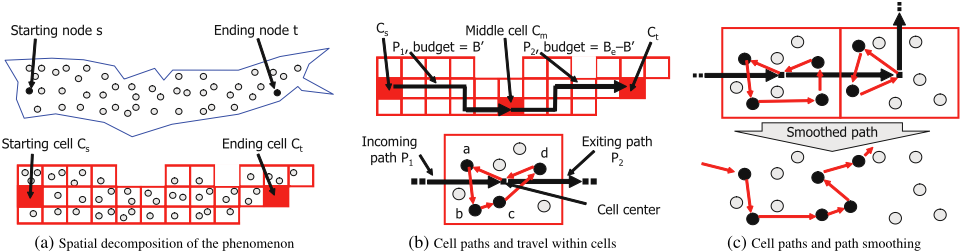
In our lake monitoring example, the single-robot problem instance is depicted in Fig. 1a, top. We try to find the most informative path P1 (in terms of predicting the algal content). The experiment cost C(vi) would correspond to the energy required for making a biomass measurement, whereas the travel cost C(vi-1, vi) would correspond to the energy consumption when traveling from location vi-1 to vi.
Quantifying informativeness. How can we quantify the sensing quality I? To model spatial phenomena, a common approach in spatial statistics is to use a rich class of probabilistic models called Gaussian Processes (GPs, c.f., Rasmussen and Williams 2006). Such models associate a random variable Xv with each location v ∈ V. The joint distribution P (XV) can then be used to quantify uncertainty in the prediction of unobserved locations, after acquiring some measurements. To quantify this uncertainty, we use the mutual information (MI) criterion of Guestrin et al. [2005]. For a set of locations P, the MI criterion is defined as:
where H(XV\P) is the entropy of the unobserved locations V \ P, and H(XV\P | XP) is the conditional entropy of locations V \ P after sensing at locations P. Hence mutual information measures the reduction in uncertainty at the unobserved locations. Hence, in our lake monitoring example, we would like to select the locations that most reduce the uncertainty in the algal content prediction for the entire lake.
Even if we do not consider the constraints in the length of the paths of the robots, the problem of selecting locations that maximize mutual information is NP-hard [Guestrin et al., 2005]. Fortunately, mutual information satisfies the following diminishing returns property of Guestrin et al. [2005]: The more locations that are already sensed, lesser will be the information gained by sensing a new location. This intuition is formalized by the concept of submodularity: A function f is submodular if ∀A ⊆ B ⊆ V and s ∈ V \ B, f(A ∪ s) - f(A) ≥ f(B ∪ s) - f(B). Another intuitive requirement is that the function f is monotonic, which means that f(A) ≤ f(B) for all A ⊆ B ⊆ V. Hence, more the sensing locations that are selected, higher will be the collected information.
Thus, we define our MIPP problem as one of optimizing paths of length at most B for k robots, such that the selected sensing locations maximize a monotonic submodular function I(·). Note that this definition of the MIPP problem allows our approach to be applied to any monotonic submodular objective function, not just mutual information. Guestrin et al. [2005] address the sensor placement problem, where a subset A ⊆ V of locations are selected in order to maximize the mutual information, without considering path costs. By exploiting the submodularity property of MI, they show that if the discretization V is fine enough and the GP satisfies mild regularity conditions, greedily selecting locations based on this criterion is near optimal. More specifically, the greedy algorithm (which we call GreedySubset in the following), after selecting the first k locations Ak, picks the location vk+1 = argmaxv I(Ak ∪ {v}) - I(Ak) and sets Ak+1 = Ak ∪ {vk+1}. GreedySubset hence iteratively adds locations which increment mutual information the most. Guestrin et al. [2005] showed that GreedySubset selects sets which achieve mutual information of at least (1-1/e) OPT -ε, where OPT is the optimal mutual information among all sets of the same size, and ε is a small error incurred due to the discretization. This result however only holds true in the unconstrained setting, where k arbitrary locations can be picked, and does not generalize to the MIPP problem. In this paper, we provide an efficient algorithm with strong approximation guarantees for the more difficult MIPP problem.
3 Approximation Algorithm for MIPP
The problem of optimizing the path of a single robot (i.e., k = 1) to maximize a submodular function of the visited locations has been studied by Chekuri and Pal [2005]. They proposed a recursive-greedy algorithm, which provides a O(log |P ∗ |) approximation guarantee, where |P ∗ | is the number of nodes visited in the optimal path P ∗ , which is no larger than the number of possible locations |V|. That is, their algorithmwill provide a path of length no more than B that visits locations yielding a submodular value of at least O(OPT/ log |P ∗ |), where OPT is the submodular value collected by the optimal path. Their algorithm provides the best approximation guarantee known for the single robot MIPP problem.
The recursive-greedy algorithm works by iterating over the possible middle nodes of the path, splitting the path into a left subpath and a right subpath. For each possible middle point, the algorithm is applied recursively on the left subpath. Then, their approach commits to the selected locations on the left side, and recurses on the right subpath, given these selected locations. This algorithm is "greedy" in that it commits to the nodes selected in the first subpath when optimizing the second subpath.
In the case of multiple robots, to our knowledge, no sub-exponential approximation algorithm has been proposed previously. In this paper, we first present an algorithm for the multiple robot setting that exploits any approximation algorithm for the single robot case, such as the recursive-greedy algorithm, and (almost) preserves the approximation guarantee. Our algorithm, sequential-allocation, works by successively applying the single robot path planning algorithm k times to get the paths for k robots. At stage i, in order not to double-count information from locations already visited in earlier stages, we supply a modified sensing quality function to the single robot procedure: Let Ai-1 be the nodes already visited by paths P1, . . . , Pi-1. Then the residual information, IAi-1 is defined as IAi-1 (P) = I(Ai-1 ∪P) - I(Ai-1). This residual information effectively commits to the nodes already visited by the algorithm until stage i - 1, before deciding the nodes to visit at that stage. The sequential allocation procedure is implemented in Line a1 of Algorithm 1.
Surprisingly, this straight-forward sequential application of the single robot path planning algorithm results in the following approximation guarantee:
Theorem 1. Let η be the approximation guarantee for the single path instance of the informative path planning problem. Then our sequential-allocation algorithm achieves an approximation guarantee of (1 + η) for the MIPP problem. In the special case, where all robots have the same starting locations (si = sj, ∀i, j) and finishing locations (ti = tj, ∀i, j), the approximation guarantee improves to 1/(1 - exp (-1/η)) ≤ 1 + η.
All proofs can be found in the longer version of this paper [Singh et al., 2006]. When using the recursive greedy algorithm from Chekuri and Pal [2005], the approximation guarantee η is O(log |P ∗ |) as discussed above. This result extends the analysis of Blum et al. [2003], who considered additive functions, to our submodular setting.
4 Efficient Algorithm for MIPP
Unfortunately, the running time of the recursive-greedy algorithm is quasi-polynomial. More specifically, the running time of the algorithm is O((MB)O(logM) ), where B is the budget constraint and M = |V| is the total number of nodes in the graph. So, even for a small problem with M = 64 nodes, the exponent will be 6, resulting in a very large computation time, making the algorithm impractical for real world sensing applications. In this section, we propose an efficient algorithm for MIPP, eMIP, which is based on and has similar approximation guarantees as the recursive-greedy algorithm, but is practical for real-world sensing tasks. Exploiting submodularity and using several branch and bound heuristics, we reduce the computation effort to within tractable limits. Our eMIP algorithm assumes that the traveling cost between arbitrary locations is given by their Euclidean distance. We discuss the algorithm only for the single robot instance of the problem, since it can be easily extended for multiple robots using Theorem 1.
4.1 Spatial Decomposition
Krause et al. [2006] empirically show, that in addition to submodularity, the mutual information criterion exhibits the following locality property: Two sets A and B of sensing locations which are sufficiently far apart are roughly independent. Hence, in order to obtain a large amount of information, a robot will have to visit several locations that are far from each other, rather than staying in one small area. We can thus think about planning informative paths as deciding which regions to explore, and then deciding which locations to sense in these regions. This motivates the decomposition of the sensing domain into cells, representing clusters of the sensing locations, and then run the recursive greedy algorithm on these cells instead of actual sensing locations. Fig. 1 presents an illustration of our approach.
Overview. Informally, our strategy will be the following:
- We decompose the sensing region (c.f., Fig. 1a, top) into a collection of non-overlapping cells ˜ V = {C1, C2, . . . , CN} (c.f., Fig. 1a, bottom). The distance between two cells is defined as the distance between the centroids of these cells. All nodes v ∈ V, representing sensing locations, are assigned to the cell Ci in which they are contained.
- We define a new optimization problem, the spatially decomposed MIPP problem, or SD-MIPP problem on ˜ V. In SD-MIPP, we jointly optimize over cell-paths in ˜ V (c.f., Fig. 1b, top), and over the allocation of measurements to the cells visited by the paths. When allocating measurements to a cell, we ignore the traveling cost within the cell (c.f., Fig. 1b, bottom). Since the cells are not excessively large, this simplification only leads to a small additional cost when the SD-MIPP solution is transformed back to original MIPP problem.
- We transfer the (approximate) SD-MIPP solution, consisting of a cell-path and an allocation of measurements to cells (c.f., Fig. 1c, top), back to the original MIPP problem. We then smooth the path using tour-opt heuristics (c.f., Fig. 1c, bottom). The resulting solution will have an approximation guarantee which depends on the diameter of the chosen cells.
More formally, the SD-MIPP problem is the following: Suppose, the budget ˜ B is split into a budget Bt for traveling between the cells, and a budget Be for making experiments at sensing locations within the visited cells. We want to find a path P ∗ = (Cs = Ci1 , . . . , Cil = Ct) with a travel cost of at most Bt. This travel budget is measured in terms of distances between centers of visited cells, and the cost of traveling within cells is defined as 0. In addition, for each visited cell Cij in P ∗ , we want to select a set of sensing locations Aj, such that the total cost C(A1 ∪ · · · ∪ Al) ≤ Be, and that the information I(A1 ∪ · · · ∪Al) is as large as possible. The optimal SD-MIPP solution P ∗ uses the optimal split of the budget ˜ B into Bt and Be. To simplify the presentation, we rescale the costs such that the cells form a uniform grid of quadratic cells with width L, and assume that the sensing cost Cexp is constant over all locations. These assumptions can easily be relaxed, but they allow us to relate the path costs to the number of cells traversed, to simplify the discussion.
Algorithm for SD-MIPP. We now present our algorithm for solving the optimization problem on ˜ V. In Section 4.2, we will discuss several details of efficient implementation. The complete algorithm works as follows: An outer loop (c.f., Line b1 in Algorithm 1) iterates through Bt ∈ {20 , 21 , 22 , . . . , ˜ B}, where ˜ B is the budget given to the SD-MIPP problem, allocating budget Bt out of the total budget ˜ B for traveling between the cells, and Be = ˜ B - Bt for making experiments within the visited cells. Stepping through the travel budget Bt in powers of 2 results in faster performance (log2 ˜ B instead of ˜ B iterations), and increases the required budget ˜ B by at most a factor of 2. The inner loop is formed by a recursive procedure, shown in Algorithm 2, which selects cells to visit, and allocates experiments to cells.
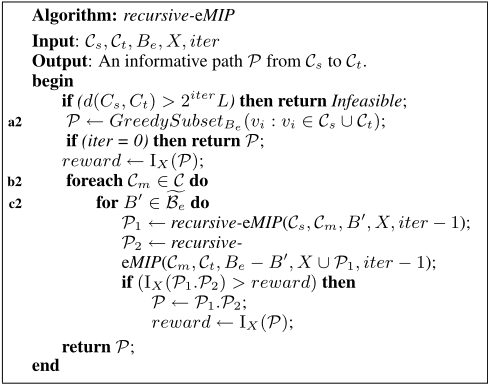
More specifically, this recursive-eMIP procedure takes as input a starting cell Cs, a finishing cell Ct, an experimental budget Be, a residual X indicating the locations visited thus far (initially empty), and a maximum recursion depth, iter, which is initialized to log2 Bt. We then:
- Iterate through all possible choices of middle cells Cm, and budget splits B′ ∈ ˜ Be to spend for making experiments on the path from Cs to Cm (c.f., Fig. 1b). The budget splits ˜ Be can either be linearly (more accurate) or exponentially (faster) spaced, as described below.
- Recursively find a path P1 from Cs to Cm, subtracting 1 from the maximum recursion depth, iter. This maximum recursion depth controls the maximum number of cells visited by P1. At the top level of the recursion, P1 will visit a maximum of Bt/2 cells, in the next level, the limit will be Bt/4 cells, and so on. When reaching a maximum recursion depth of 0, we use the GreedySubset algorithm (c.f., Section 2) to select the sensing locations Ai based on the residual information function IX constrained by budget B′ . Hereby, the residual X is a parameter of the recursion, and contains all nodes visited before considering the current cell. As an illustration, consider the black nodes selected in the middle cell Cm in Fig. 1b, bottom. These have been selected by the GreedySubset algorithm with budget B′ = 4, since they provide the maximum improvement in mutual information measured against the path P1 of Fig. 1b, top.
- Commit to the nodes visited in P1, and recursively
Algorithm: eMIP Input: B, k, starting / finishing nodes s1, . . . , sk, t1, . . . , tk Output: A collection of informative paths P1, . . . , Pk. begin Perform spatial decomposition into cells; Find starting and ending cells Csi and Cti ; X ← ∅; a1 for i = 1 to k do b1 for iter = 0 to ⌊log2 B⌋ do Be ← B - 2iter ; P ′ iter ←recursive-eMIP(Csi , Cti ,Be,X,iter); Smooth P ′ iter using tour-opt heuristics; Pi ← argmaxiter I(P ′ iter ); X ← X ∪ Pi; return P1, . . . , Pk; endfind a path P2 from Cm to Ct, with experimental budget Be -B′ . This path will also visit at most Bt/2 cells. We again greedily select the sensing locations at maximum recursion depth of 0, but now based on the residual information IX∪P1 , since we have committed to P1.
- Concatenate the nodes obtained in P1 and P2 to output the best path from the algorithm (c.f., Fig. 1c, top).
The recursive-eMIP procedure is based on the recursive greedy algorithm of Chekuri and Pal [2005], but exploits our spatial decomposition.
Linear vs. exponential budget splits. Step 1 considers different budget splits B′ ∈ ˜ Be to the left and right subpaths. Similar to the recursive greedy algorithm, one can choose ˜ Be = {0, 1, 2, 3, . . . , Be - 1, Be} to be linearly spaced. Since the branching factor is proportional to the number of considered splits, linear budget splits lead to a large amount of computation. An alternative is to consider only exponential splits: ˜ Be = {0, 1, 2, 4, . . . , Be}∪{Be, Be-1, Be-2, Be-4, . . . , 0}. Here the branching factor is only logarithmic in the experimental budget. Even though we are not guaranteed to find the same solutions as with linear budget splits, we can both theoretically and empirically show that the performance only gets slightly worse in this case, compared to a dramatic improvement in running time. In addition to these two ways of splitting the budget, we also considered one-sided exponential budget splits (i.e., ˜ Be = {0, 1, 2, 4, . . . , Be}), which halves the branching factor compared to the exponential splits defined above. Although we do not provide theoretical guarantees for this third possibility, we experimentally found it to perform very well (c.f., Section 5).
Solving the MIPP problem. Now we need to transfer the approximately optimal solution obtained for SD-MIPP back to MIPP. This is done by connecting all nodes selected in cell Ci to the cell's center, (as indicated in Fig. 1b bottom), then connecting all selected centers to a path (Fig. 1c top), and finally expanding the resulting tree into a tour by traversing the tree twice. This traversal results in a tour which is at most twice as long as the shortest tour connecting the selected vertices. (Of course, an even better solution can be obtained by applying an improved approximation algorithm for TSP, such as Christofide's algorithm [1976].) The following Theorem completes the analysis of our algorithm:
Theorem 2. Let P ∗ be the optimal solution for the MIPP problem with a budget of B. Then, our eMIP algorithm will find a solution ̂ P achieving an information value of at least I( ̂ P) ≥ 1-1/e 1+log2 N I(P ∗ ), whose cost is no more than 2(2√2B + 4L)(1 + L √2 Cexp ) in the case of linear budget splits (for ˜ Be) and no more than 2(2√2B +4L)(1+L √2 Cexp )N log2 32 in the case of exponential budget splits (for ˜ Be).
Running time analysis of eMIP is straightforward. The algorithm calls the routine recursive-eMIP log2 B times. If TI is the time to evaluate the mutual information I, then time for computing greedy subset Tgs (Line a2) is O(N 2C TI), where NC is the maximum number of nodes per cell. At each recursion step we try all the cells that can be reached with the available traveling budget (Line b2). For the possible experimental budget split, we try all (linearly or exponentially spaced) splits of Be ∈ ˜ Be among the two paths P1 and P2 (Line c2). The recursion depth would be log2(min(N, ˜ B)). The following proposition states the running time for eMIP.
Proposition 3. The worst case running time of eMIP for linearly spaced splits of the experimental budget is O (Tgs log2 B(NB)log2 N ), while for the exponentially spaced splits of the experimental budget it is O (Tgs log2 B(2N log2 B)log2 N )
Comparing this running time to that of the original Chekuri et al. algorithm (O((MB)O(log2 M) )), we note a reduction of B to log2 B in the base, and log of the number of nodes (log2 M) to log of the number of cells (log2 N) in the exponent. These two improvements turned the impractical recursive-greedy approach into a much more viable algorithm.
4.2 Branch and Bound
The spatial decomposition technique effectively enables a trade-off between running time complexity and achieved approximation guarantee. However, the eMIP algorithm still has to solve a super-polynomial, albeit sub-exponential, search problem.
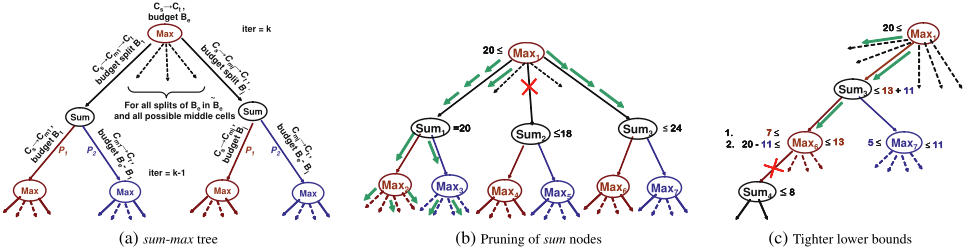
The problem structure can be represented by a sum-max tree as shown in Fig. 2a. The sum nodes correspond to combining the two paths P1 and P2 on either side of the middle cell Cmi . The max nodes correspond to selecting the best possible path for all possible experimental budget split in ˜ Be and all possible middle cells Cmi . Thus, each sum node will have two children, each one a max node, representing the best possible solution from paths P1 and P2 respectively. The root of the tree will be a max node selecting the best possible solution at the highest level. The depth of the tree, iter, depends on the traveling budget Bt, iter = ⌈log2 Bt⌉. As an initial pruning step, we note that since the middle cells have to lie on a path, we only need to consider those which are at most distance Bt/2 · L from the starting and finishing cell.
In order to avoid exploring the entire sum-max tree and waste computation considering possibly bad solutions, we follow a branch and bound approach. At each max node we derive upper bounds for all the child sum nodes. We can then prune all the sum node children with upper bounds lower than the current best solution. If any of the child sum nodes provides a solution better than the current best solution, then the current best solution for the parent max node is updated with the improved solution. Fig. 2b presents an illustration of this concept: After completely exploring branch Sum1, the current best solution, 20, is thus a lower bound for Max1. The upper bound for branch Sum2 is 18, which is lower than the current best solution of 20, and hence we can prune this branch and need not explore it further. Nodes such as Sum3 however, which have higher upper bounds (24) than the current best solution (20), need to be explored further. In order to improve the current best solution faster, at each max node we explore the sum nodes in the decreasing order of their upper bounds. (An additional heuristic that is very effective in practice is to explore only the top K sum nodes.)
Upper bound on the sumnodes. One approach for acquiring upper bounds on the sum nodes is to relax the path constraints, and then find the optimal set of reachable nodes for each path (P1 and P2). In order to compute upper bounds for P1 (P2) and their corresponding max nodes, we hence need to compute the best set of observations within all reachable nodes. Since this problem itself is NP-hard, we approximate it using the GreedySubset algorithm: For an allocation of k experiments to P1 (P2), we run the GreedySubset algorithm to select k nodes reachable (w.r.t. the remaining traveling budget) within this path. Since this algorithm guarantees a constant factor (1 - 1/e) approximation [Nemhauser et al., 1978], multiplying the resulting information value by (1 - 1/e)-1 provides an upper bound on the information achievable by the path (and hence the corresponding max node). In Fig. 2c for example, we use the greedy algorithm to get upper bounds 13 for Max6 and 11 for Max7, resulting in an upper bound of 13+11 = 24 for Sum3. We can even compute tighter online bounds for maximizing monotonic submodular functions, as discussed by Nemhauser et al. [1978].
Lower bound on the max nodes. In order to perform pruning on lower levels of the sum-max tree, we need lower bounds for the max nodes. Instead of having to explore one branch completely as described above, we have two ways for acquiring such lower bounds: Based on a heuristic algorithm, and based on the current best solution of the grandparent max node. We use the larger of two different lower bounds.
The first lower bound is based on a heuristic proposed for the (modular) orienteering problem in [Chao et al., 1996]. The solution obtained by the heuristic immediately provides a lower bound at each max node. The heuristic is applied to the actual sensing locations V, instead of the cells. Starting node and finishing node for the heuristic are selected greedily from the starting cell and the finishing cell respectively. The current traveling budget is added to the available experimental budget to calculate the budget constraint for the heuristic.
A second pruning bound for the max nodes is given by the difference between the lower bound (the current best solution) of the grandparent max node, and the upper bound on the other path originating from the parent sum node. This is illustrated in Fig. 2c: For the node Max6 and Max7, a lower bound of 7 and 5 respectively is calculated using the heuristic. The current lower bound at the grandparent max node (Max1) is 20. The parent sum node is explored further since the sum (24) of the upper bounds from each of the child max nodes (13 and 11 for P1 (Max6) and P2 (Max7) respectively) is greater than the current best solution (20) of the parent max node. A potentially tighter pruning bound is calculated by subtracting the upper bound of P2 (Max7 ≤ 11) from the current best solution of the grandparent max node (Max1 ≥ 20). This bound potentially allows to prune branches since, given the upper bound on the second path, improving on the current solution of the grandparent requires exceeding this pruning bound. In our example, this pruning bound (9) is tighter than the lower bound provided by the heuristic (7), and hence enabled pruning of branch Sum4 (with upper bound 8). This pruning would not have been possible when only using the lower bound calculated using the heuristic (7).
Before exploring the second path P2, the exact reward collected by the first path P1 can be used for calculating this additional lower bound. When exploring P1 however, the exact reward for P2 is not known, hence only the upper bound calculated using the greedy algorithm as described above can be used. In order to ensure that this lower bound is as tight as possible, we first explore the child of the sum node having more budget in the current budget split instead of always exploring P1, the path from starting cell to middle cell first.
Sub-approximation. Lower and upper bounds can be quite loose. We can address this issue, and further trade off collected information with improved execution time, by introducing a sub-approximation heuristic: instead of comparing the lower bound of a max node directly with the upper bound from the children's sum nodes when deciding which subproblems to prune, we scale up the lower bound by a factor of α > 1. This scaling often allows us to prune many branches that would not be pruned otherwise. Unfortunately, this optimistic pruning can also cause use to prune branches that should not be pruned, and decrease the information collected by the algorithm. Fortunately, we can prove that this approach will not decrease the quality of the solution by more than 1/α. Furthermore, in practice, for sufficiently small α values, this procedure can speed up the algorithm significantly, without much effect on the quality of the solution.
5 Experiments and Results
5.1 Data Sets
In order to evaluate the performance of our algorithm, we tested it on three real world datasets. Our main set of experiments are on measurements of the biomass content in Lake Fulmor, James Reserve [Dhariwal et al., 2006]. We used data collected by a boat carrying a temperature sensor around the lake, of width around 50 meters and length around 250 meters. Temperature was previously found to be strongly correlated with the algal bloom in the lake. The average speed of the boat was approximately 0.4 m/s. Half of the total measurements (218 different sensing locations) were used to learn a nonstationary Gaussian Process model by maximizing the marginal likelihood [Rasmussen and Williams, 2006], and the rest of the measurements were used for experimentation. We divided the lake into 22 cells, with distance between adjacent cell approximately 21 meters. Based on the average speed, and motivated by a typical measurement duration of roughly 25 seconds, we set the experiment cost to be 10.5 meters.
As our second dataset, we used the existing deployment of 52 wireless sensor motes to learn the amount of temperature variability at Intel Research Berkeley. We divided the
10 5
complete region into a uniform grid containing 20 equal sized cells, and determined the experimental cost to be 9m (distance to travel between adjacent cells). We learned a GP model as discussed by Krause et al. [2006].
Thirdly, we explored the performance of our algorithm on a precipitation dataset collected from 167 regions during the years 1949-1994. We followed the preprocessing and model learning described by Guestrin et al. [2005].
5.2 Single Robot Experiments
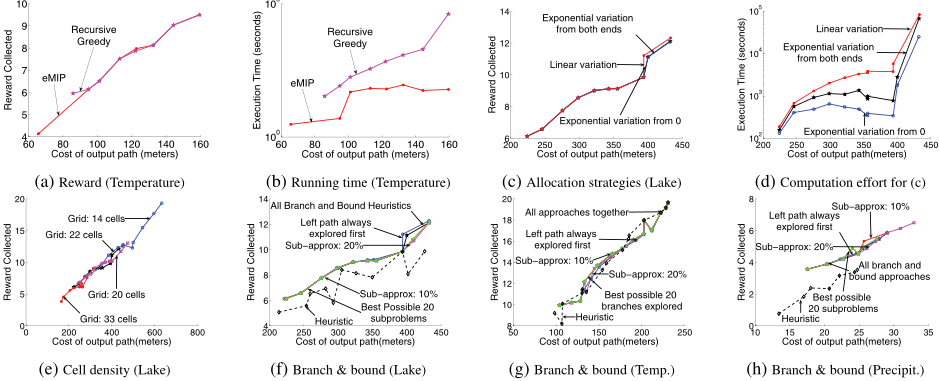
We first analyze the performance improvement of our eMIP algorithm compared to the recursive-greedy procedure [Chekuri and Pal, 2005]. Fig. 3a presents trade-off curves comparing path costs and collected reward, for different budget values B on a subset of temperature data set containing only 23 nodes as recursive-greedy was intractable on larger datasets. Fig. 3b presents the corresponding running times. We can see that the eMIP algorithm achieves (almost) the same amount of mutual information as recursive-greedy, but at several orders of magnitude lower running time. Since the recursive greedy algorithm is essentially a search procedure with greedily restricted search space, this result also indicates that an exhaustive search over all paths is intractable.
We then compare the impact of restricting ourselves to the exponentially spaced experimental budget allocation. Figures 3c and 3d present the results on the lake data set. As expected, linear variation achieves very slightly larger collected mutual information than the exponential variation. However, the computation times for exponential variation are several orders of magnitude smaller than for linear variation.
Our next experiment considers the effect of varying the coarseness of spatial decomposition. Fig. 3e shows the results of this experiment on the lake data, indicating that the mutual information is largely insensitive to the coarseness of the cells. On the other hand, the computational complexity decreases drastically as fewer cells are used (c.f., Proposition 3).
We performed the same experiments on both the temperature and precipitation data. Detailed results are omitted here due to space limitations, but they confirm the above insights. In order to analyze the impact of several branch and bound heuristics, we plotted trade-off curves for varying budgets, for the lake (Fig. 3f), temperature (Fig. 3g) and precipitation data (Fig. 3h). We find that the mutual information collected is rather insensitive to sub-approximation (up to 20%), as well as to the restriction to 20 best sub-problems (exploring only the 20 best sum nodes per branch). We also compared eMIP to a heuristic search algorithm [Chao et al., 1996]. This heuristic had been empirically found to be one of the best heuristics for the similar problem with fixed reward on each node [Liang et al., 2002], so we would expect it to also perform well in the submodular case. We can see that, while for the smaller temperature data set, the heuristic achieves comparable performance, for both larger data sets (lake and precipitation), eMIP strongly outperforms the heuristic.
5.3 Multiple Robot Experiments
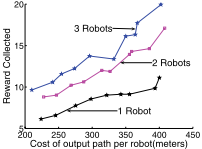
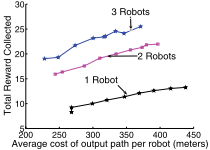
Fig. 4a shows the comparison of collected reward when multiple robots are available to move the sensors around. As the number of robots are increased, the collected reward exhibits the expected diminishing return, due to the submodularity of mutual information. Fig. 4b presents the same analysis when the robots can start at different locations. Here, four locations, at four corners of the lake, were pre-selected as possible starting locations. The three robots greedily selected the starting location leading to the largest increase in mutual information.
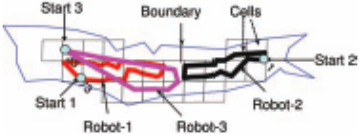
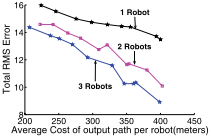
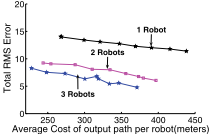
As expected, the first two robots choose starting locations on opposite ends of the lake and collect roughly independent information. With addition of the third robot, the diminishing returns in collected reward can again be observed. Figures 4c and 4d show the predictive RMS error for this experiment. Analogously to the information value, the RMS error decreases more quickly if the three robots start at different locations, and the biggest improvement as as expected is in the step from one to two robots. Fig. 5 shows the chosen paths for the case of three robots, each starting from different locations.
6 RelatedWork
A related problem to MIPP is one where each node has a fixed reward, and the goal is to find a path that maximizes the sum of these rewards (Traveling Salesman Problem with Profits (TSPP) [Feillet et al., 05]). Such sum is a modular function, rather than the submodular function addressed in this paper. A subcategory of TSPP, the Orienteering Problem (OP) is defined to maximize the collected reward while keeping the associated cost is defined less than given budget B [Laporte and Martello, 1990]. Multi-robot version of OP is studied in literature as the Team Orienteering Problem [IMing et al., 1996]. For the case of unrooted version of OP (when no starting location is specified), the approximation guarantees known for Prize Collecting TSP and k-TSP can be easily extended [Johnson et al., 2000]. Blum et al. [2003] gave the first constant factor approximation for the rooted OP in general undirected graphs. They also extended their algorithm for Multi-path OP. For OP with submodular reward fuction, the approach of Chekuri and Pal [2005], discussed in Section 3, provides the best approximation guarantee, but has a quasi-polynomial running time. In the robotics community, similar work has been developed in the context of simultaneous localization and mapping (SLAM). Stachniss et al. [2005] develop a greedy algorithm, without approximation guarantees, for selecting the next location to visit to maximize information gain about the map. In contrast, Sim and Roy [2005] attempt to optimize the entire trajectory, not just the next step, but their algorithm introduces some approximation steps without theoretical bounds. We also expect our approach to be useful in the SLAM setting.
7 Conclusions
In this paper, we presented the first efficient path planning algorithm that coordinates multiple robots, each having a resource constraint, in order to obtain highly informative paths, i.e., paths that maximize some given submodular function, such as mutual information. We first described sequential-allocation, an approach for extending any single robot algorithm to the multi-robot setting, with minimal effect on the approximation guarantee. Then, building on the, impractical, single robot approach of Chekuri and Pal [2005], we developed eMIP, a practical algorithm for obtaining an informative path for a single robot with theoretical guarantees, that exploits spatial decomposition and branch and bound techniques. Using sequential-allocation, we then extended our approach to the multi-robot case. Furthermore, we provided extensive experimental analysis of our algorithm on several real world sensor network data sets, including data collected by robotic boats in a lake, demonstrating the effectiveness and practicality of our methods.
(d) Multi-robot: RMS, different start
Acknowledgements This work was supported by NSF Grant Nos. CNS-0509383, CNS-0625518, ANI-00331481 and a gift from Intel Corporation. Carlos Guestrin was partly supported by an Alfred P. Sloan Fellowship and an IBM Faculty Fellowship. We would like to thank Bin Zhang for providing the lake data set.
@inproceedings{ijcai2007p355,
  title     = {Efficient Planning of Informative Paths for Multiple Robots},
  author    = {Singh, Amarjeet and Krause, Andreas and Guestrin, Carlos and Kaiser, William J. and Batalin, Maxim A.},
  booktitle = {Proceedings of the Twentieth International Joint Conference on
               Artificial Intelligence, {IJCAI-07}},
  publisher = {International Joint Conferences on Artificial Intelligence},
  editor    = {Manuela M. Veloso},
  pages     = {2204--2210},
  year      = {2007},
  url       = {https://ijcai.org/proceedings/2007/355},
}
TY - CPAPER TI - Efficient Planning of Informative Paths for Multiple Robots AU - Singh, Amarjeet AU - Krause, Andreas AU - Guestrin, Carlos AU - Kaiser, William J. AU - Batalin, Maxim A. T2 - Proceedings of the Twentieth International Joint Conference on Artificial Intelligence, IJCAI-07 PB - International Joint Conferences on Artificial Intelligence PY - 2007 SP - 2204 EP - 2210 UR - https://ijcai.org/proceedings/2007/355 ER -Copied
Machine-readable versions of this paper, for tools and AI agents:





