
An Inductive Database for Mining Temporal Patterns in Event Sequences
Proceedings of the Nineteenth International Joint Conference on Artificial Intelligence. Pages 1640-1640.
© 2005 International Joint Conferences on Artificial Intelligence
Abstract
- [De Raedt and Kramer, 2001] L. De Raedt and S. Kramer. The levelwise version space algorithm and its application to molecular fragment finding. In Proc. of IJCAI, 2001. IJCAI
- [Dousson and Duong, 1999] C. Dousson and T. Vu Duong. Discovering chronicles with numerical time constraints from alarm logs for monitoring dynamic systems. In Proc. of IJCAI 1999, pages 620-626, 1999. IJCAI
- [Imielinski and Mannila, 1996] T. Imielinski and H. Man- nila. A database perspective on knowledge discovery. Communications of the ACM, 39:58-64, 1996.
- [Lee and De Raedt, 2003] S. D. Lee and L. De Raedt. Database Support for Data Mining Applications, volume 2682 of LNCS, chapter Constraint Based Mining of First Order Sequences in SeqLog. Springer-Verlag, 2003.
- [Mannila et al., 1997] H. Mannila, H. Toivonen, and A. Inkeri Verkamo. Discovery of frequent episodes in event sequences. Data Mining and KD, 1(3), 1997.
- [Yoshida et al., 2000] M. Yoshida, T. Iizuka, H. Shiohara, and M. Ishiguro. Mining sequential patterns including time intervals. In Data Mining and KD, 2000.
References were extracted automatically from the PDF and may contain errors.
Full text extracted automatically from the PDF; figures, tables and equations may differ. The PDF is the version of record.
1 Introduction
Data mining aims at discovering previously unknown and potentially useful information from large collections of data. The discovered knowledge, in the form of patterns, is extracted without any extra information about data. A pattern is a representation of a concept (rules describing properties of data, clusters in databases, etc.) that generalizes some data in a database.
Imielinski and Mannila [Imielinski and Mannila, 1996] designed a data mining formalization framework named inductive database (IDB). The main goal of IDBs is to manage knowledge discovery applications just as database management systems successfully manage business applications. IDBs contain patterns in addition to data. The data mining process is modeled as an interactive process in which users can query data as well as patterns. IDBs represent also a good way to take advantage of the efficiency of database algorithms by using jointly data mining and database algorithms.
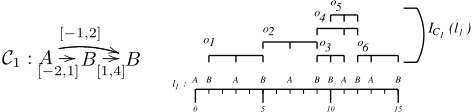
Some IDBs implementations [Lee and De Raedt, 2003] use sequences of symbols as data and complex sequences of symbols as patterns (sequences with gaps). In many problems one often needs to discover patterns which are more sophisticated than a simple sequence of symbols. To this end, we propose to extend IDB patterns by adding numerical constraints. In this proposal, the data are event sequences and the patterns are chronicles. A chronicle is composed of events and numerical temporal constraints, in the form of numerical intervals, on delays between their occurrences. Figure 1 illustrates a chronicle C1 and an event sequence l1.
A chronicle is recognized in an event sequence as follows: a set oi of events of the sequence l1 instantiates the chronicle C1 if every event of C1 is instantiated by an event of oi respecting type and temporal constraints. A set oi is called a chronicle instance of C1. For example, the event sequence l1 has six instances of the chronicle C1: |IC1 (l1)| = 6.
2 Time in data mining
Several solutions have been proposed to tackle the problem of time integration in data mining. Some pattern extraction techniques use symbol ordering as a model of time. For instance, Winepi and Minepi [Mannila et al., 1997] extract patterns represented by serial or parallel sequences of symbols. SeqLog [Lee and De Raedt, 2003] extracts ordered sequences
/
/
Figure 1: A chronicle C1 of size 3: intervals labeling edges represent bounds on the distance between event times as -2 ≤ tB -tA ≤ 1. Right, 6 instances of C1 in a sequence l1.
of symbols with gaps. Parallel and serial notions can also be expressed in chronicles. In addition, they can state numerical constraints on delay between events.
/
/
/
Time can be also represented by a special numerical attribute. For instance, Yoshida [Yoshida et al., 2000] extracts frequent itemsets containing a temporal feature. Their algorithm extracts "delta-patterns" that are ordered lists of itemsets with time intervals between two successive itemsets (as {b,c} ) which specify the numerical temporal constraints between the itemsets. However, interval bounds of delta-patterns are always positive
for instance: {b} [17,19] {a,c} [5,12]/ whereas interval bounds of chronicles can be negative.
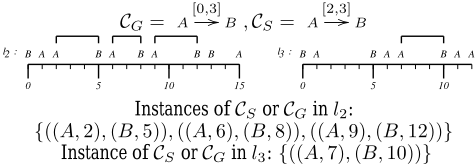
Our goal is to discover chronicles that are frequent in some event sequences and infrequent in other ones. For instance, let l2 and l3 be the event sequences of figure 2. A complex query such that freq(C, l2) ≥ 3 ∧ freq(C, l3) ≤ 1 asks for the set of chronicles that are frequent in l2 and infrequent in l3 according respectively to thresholds 3 and 1. Chronicles CS and CG (fig. 2) satisfy this query because both cover three instances in l2 and only one in l3.
/
/
*
*
Furthermore, we introduce a generality relation between chronicles: a chronicle C is more general than a chronicle C ′ (noted C ⊑ C ′ ) if there is a match between C and C ′ such that every event of C is matched to an event of C ′ and the temporal constraints of C contains the corresponding constraint in C ′ . Thus, we can note that CG ⊑ CS (fig. 2) and that there is no solution chronicle more specific than CS or more general than CG.
3 Frequency of chronicles in a sequence
The most used interest measure for patterns mining is based on frequency. The use of a generality relation makes chronicle search based on frequency easier, but only on the condition that constraints on frequency satisfy monotonicity or anti-monotonicity properties. Let C be more general than C ′ . The threshold constraints on frequency satisfy one of these properties if the frequency of C is equal or greater than the frequency of C ′ in an event sequence. To ensure these properties for some frequency measure, we introduce a recognition criterion Q that specifies how instances of some chronicle are selected in a sequence and consequently how the frequency of this chronicle is computed.
Some recognition criteria have been defined in the literature. The minimal occurrences criterion [Mannila et al., 1997] selects all the shortest instances of an episode (a partially ordered collection of events occurring together). The earliest distinct instances criterion, Qe&d [Dousson and Duong, 1999], selects all the instances such that two instances of a same chronicle have no common events and occur as early as possible in the event sequence according to a total order on instances. Let freqQe&d (C1, l1) be the frequency of C1 computed on the event sequence l1 (fig. 1). The recognition criterion Qe&d recognizes the set of instances E = {o1, o3, o6} and the value of freqQe&d (C1, l1) = |E| = 3.
4 Queries on event sequences
Let P and N be two sets of event sequences and T be a set of frequency thresholds. Every event sequence l has a threshold Tl. If l is an element of P (resp. N) then Tl is a minimum (resp. maximum) frequency threshold. Our goal is to extract some phenomenon in the form of chronicles. These are frequent in at least one event sequence of P and infrequent in every event sequence of N. A query has the general form:
The computation of frequent and maximally specific chronicles, FmcQ(l, Tl), in an event sequence l according to a threshold Tl is performed by the levelwise algorithm of FACE [Dousson and Duong, 1999] that we have adapted to the task. The method consists in computing all the Fmcs from the different event sequences separately (with FACE), memorizing them, and merging them to get the solutions of the query: this method is efficient if we consider a set of queries that use the same sets T and (P ∪N). We use Mitchell's algorithm to merge these Fmcs. This algorithm is extensively used to compute the version spaces of symbol sequences [De Raedt and Kramer, 2001]. It computes the bounds of the version space from a conjunction of constraints. Query (1) is rewritten in such a way as to use Mitchell's algorithm:
where FmcQ(E, T ) = ⋃l∈E FmcQ(l, Tl).
For each chronicle from FmcQ(P, T ), the version space of a conjunction of constraints is computed by Mitchell's algorithm. The union of these version spaces gives the solutions set to query (2). One of the main interests of this method is that it needs to compute only once the Fmcs in each sequence.
5 Conclusion
We have presented an original method that extracts temporal information in the form of patterns named chronicles. These patterns use numerical temporal constraints on events. Furthermore, they provide a way to express sequentiality and parallelism between events and they generalize temporal patterns used by Mannila and De Raedt [Mannila et al., 1997; Lee and De Raedt, 2003], among others. Chronicles are extracted by querying an IDB that contains event sequences and chronicles. The user sets the minimum or maximum frequency thresholds of searched chronicles in event sequences.
Our contribution introduces the notion of recognition criterion that generalizes the specification of pattern frequency computation on temporal data. Furthermore, we use a generality relation on chronicles that enables us to adapt version space algorithms to manage numerical temporal constraints. These algorithms require the prior computation of frequent and maximal chronicles for each event sequence used in the query. This computation is performed by a data mining tool that we have adapted to the task. Our approach can compute the complete and correct set of solutions.
@inproceedings{ijcai2005p304,
  title     = {An Inductive Database for Mining Temporal Patterns in Event Sequences},
  author    = {Vautier, Alexandre and Cordier, Marie-Odile and Quiniou, Rene},
  booktitle = {Proceedings of the Nineteenth International Joint Conference on
               Artificial Intelligence, {IJCAI-05}},
  publisher = {International Joint Conferences on Artificial Intelligence},
  editor    = {Leslie Pack Kaelbling and Alessandro Saffiotti},
  pages     = {1640--1640},
  year      = {2005},
  url       = {https://ijcai.org/proceedings/2005/304},
}
TY - CPAPER TI - An Inductive Database for Mining Temporal Patterns in Event Sequences AU - Vautier, Alexandre AU - Cordier, Marie-Odile AU - Quiniou, Rene T2 - Proceedings of the Nineteenth International Joint Conference on Artificial Intelligence, IJCAI-05 PB - International Joint Conferences on Artificial Intelligence PY - 2005 SP - 1640 EP - 1640 UR - https://ijcai.org/proceedings/2005/304 ER -Copied
Machine-readable versions of this paper, for tools and AI agents:





