
Updating Action Domain Descriptions
Proceedings of the Nineteenth International Joint Conference on Artificial Intelligence. Pages 418-422.
© 2005 International Joint Conferences on Artificial Intelligence
Abstract
How can an intelligent agent update her knowledge base about an action domain, relative to some conditions (possibly obtained from earlier observations)? We study this question in a formal framework for reasoning about actions and change, in which the meaning of an action domain description can be represented by a directed graph whose nodes correspond to states and whose edges correspond to action occurrences. We define the update of an action domain description in this framework, and show among other results that a solution to this problem can be obtained by a divide-and-conquer approach in some cases. We also introduce methods to compute a solution and an approximate solution to this problem, and analyze the computational complexity of these problems. Finally, we discuss techniques to improve the quality of solutions.
- [Alferes et al., 2000] J. J. Alferes, J. A. Leite, L. M. Pereira, H. Przymusinska, and T. C. Przymusinski. Dynamic Up- dates of Non-Monotonic Knowledge Bases. Journal of Logic Programming, 45(1-3):43-70, 2000.
- [Eiter et al., 2002] T. Eiter, M. Fink, G. Sabbatini, and H. Tompits. On properties of update sequences based on causal rejection. TPLP, 2(6):721-777, 2002.
- [Gelfond and Lifschitz, 1998] M. Gelfond and V. Lifschitz. Action languages. ETAI, 3:195-210, 1998.
- [Giunchiglia and Lifschitz, 1998] E. Giunchiglia and V. Lif- schitz. An action language based on causal explanation: Preliminary report. In Proc. AAAI, pp. 623-630, 1998.
- [Katsuno and Mendelzon, 1991] H. Katsuno and A. O. Mendelzon. On the difference between updating a knowl- edge base and revising it. In Proc. KR, pp. 387-394, 1991.
- [Li and Pereira, 1996] R. Li and L. M. Pereira. What is be- lieved is what is explained. In Proc. AAAI, pp. 550-555.
- [Liberatore, 2000] P. Liberatore. A framework for belief up- date. In Proc. JELIA, pp. 361-375, 2000.
- [Pereira et al., 1991] L. M. Pereira, J. J. Alferes, and J. N. Aparicio. Contradiction removal within well-founded se- mantics. In Proc. LPNMR, pp. 105-119, 1991.
- [Sakama and Inoue, 2003] C. Sakama and K. Inoue. An abductive framework for computing knowledge base up- dates. TPLP, 3(6):671-713, 2003.
- [Winslett, 1990] M. Winslett. Updating Logical Databases. Cambridge University Press, 1990.
- [Zhang et al., 2002] D. Zhang, S. Chopra, and N. Foo. Con- sistency of action descriptions. In Proc. PRICAI, 2002.
References were extracted automatically from the PDF and may contain errors.
Full text extracted automatically from the PDF; figures, tables and equations may differ. The PDF is the version of record.
1 Introduction
This paper discusses how an intelligent agent can modify her knowledge of the world, subject to some given conditions, in particular, when some new knowledge about the world is added. The given conditions can be domain-dependent (e.g., assertions obtained from earlier observations), or domainindependent (e.g., general properties of a knowledge base). The goal is to obtain a consistent knowledge base with minimal changes only to a variable part of the existing knowledge base such that the given conditions are satisfied.
We study the problem of knowledge base updates, briefly described above, in the context of reasoning about actions and change, so the agent's knowledge base is about domains of actions. For instance, consider an agent having the following knowledge, D, about a TV with remote control:
- If the power is off, pushing the power button on the TV turns the power on.
- If the power is on, pushing the power button on the TV turns the power off.
- The TV is on whenever the power is on.
- The TV is off whenever the power is off.
∗Work supported by the Austrian Science Fund (FWF) grant P16536-N04 and the European Commission IST programme grants FET-2001-37004 WASP and IST-2001-33123 CologNeT.
Note that she does not know how a remote control works (e.g., she does not know the effect of pushing the power button on the remote control). Suppose that later she obtains the following information, Q, about remote controls:
- If the power is on and the TV is off, pushing the power button on the remote control turns the TV on.
- If the TV is on, pushing the power button on the remote control turns the TV off.
A desired condition, C, for the effective use of this TV system is the following:
Pushing the power button on the remote control is always possible.
If Q is added to D, then condition C is not satisfied: when the power and the TV are on, pushing the power button on the remote control is not possible, since Item 2 of Q and Item 3 of D above contradict. The question is then how the agent can update D by Q relative to C.
We describe domains of actions, like D above, in a fragment of the action language C [Giunchiglia and Lifschitz, 1998], by "causal laws." For instance, the direct effect of the action PushPBTV stated in Item 1 of D in the example above is described by the causal law
which expresses that the action PushPBTV causes the value of the fluent PowerON to change from false to true; the indirect effect of this action stated in Item 3 of D is described by the causal law
which expresses that if the fluent PowerON is caused to be true, then the fluent TvON is caused to be true as well. An action (domain) description is partitioned into two: Du (invariable) and Dm (variable). The meaning of an action description can be represented by a "transition diagram"-a directed graph whose nodes correspond to states and whose edges correspond to action occurrences.
We describe given conditions, like C above, in an action query language, similar to R [Gelfond and Lifschitz, 1998], by "queries". For instance, condition C above can be described by the query
The main contributions of this paper briefly are as follows:
- Given an action description D = (Du,Dm), a set Q of causal laws, and a set C of conditions, what is an update of D by Q relative to C? We answer this question in Section 3.
- Given an action description D = (Du,Dm), a set Q of causal laws, and a set C of conditions, consider the problem of computing an update of D by Q relative to C. We show that this problem is difficult in general (both ΣP3 - and ΠP3 -hard), and that already checking a given solution is ΠP3 - complete. We also show that, under some conditions, these two problems are easier (Section 5).
- We provide conditions under which computing a solution to the problem above can be structurally decomposed. For instance, if the inputs of the problem satisfy the disjointness property, a divide-and-conquer approach is feasible (Section 4). We introduce methods to compute solutions and to compute "near-solutions" approximating them (Section 6).
Variations of the problem of updating knowledge bases have been studied in the AI literature, e.g., [Winslett, 1990; Katsuno and Mendelzon, 1991; Pereira et al., 1991; Li and Pereira, 1996; Liberatore, 2000; Eiter et al., 2002; Sakama and Inoue, 2003]. The problem addressed in this paper is more general (see Section 7 for a more detailed comparison).
2 Preliminaries
Transition diagrams. We start with a (propositional) action signature that consists of a set F of fluent names, and a set A of action names. An action is a truth-valued function on A, denoted by the set of action names that are mapped to t. A (propositional) transition diagram of an action signature L = 〈F,A〉 consists of a set S of states, a function V : F×S → {f, t}, and a subset R ⊆ S×2A ×S of transitions. We say that V (P, s) is the value of P in s. The states s′ such that 〈s, A, s′ 〉 ∈ R are the possible results of the execution of the action A in the state s. We say that A is executable in s,
if at least one such state s′ exists.
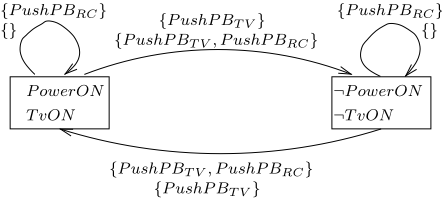
A transition diagram can be thought of as a labeled directed graph. Every state s is represented by a vertex labeled with the function P ↦→ V (P, s) from fluent names to truth values. Every triple 〈s,A, s′ 〉 ∈ R is represented by an edge leading from s to s′ and labeled A. An example of a transition diagram is shown in Figure 1.
Action description languages. We consider a subset of the action description language C [Giunchiglia and Lifschitz, 1998] that consists of two kinds of expressions (called causal laws): static laws of the form
where L is a literal (an expression of the form P or ¬P , where P is a fluent name) and G is a propositional combination of fluent names, and dynamic laws of the form
caused PowerON after PushPBTV ∧ ¬PowerON
caused ¬PowerON after PushPBTV ∧ PowerON
caused TvON if PowerON
caused ¬TvON if ¬PowerON
inertial PowerON , ¬PowerON
inertial TvON , ¬TvON
Figure 2: An action description.
where L and G are as above, and U is a propositional combination of fluent names and action names. In (3) and (4) the part if G can be dropped if G is True.
An action description is a set of causal laws. For instance, the knowledge base about a TV system, D, of the agent in the previous section, can be described by causal laws in Figure 2. Thereby, an expression of the form:
where P is a fluent name stands for the dynamic laws
describing that the value of the fluent P stays the same unless some action changes it.
The meaning of an action description can be represented by a transition diagram. Let D be an action description with a signature L = 〈F, A〉. Then the transition diagram 〈S, V, R〉 described by D is defined as follows:
- (i) S is the set of all interpretations s of F such that, for every static law (3) in D, s satisfies G ⊃ L,
- (iii) R is the set of all triples 〈s,A, s′ 〉 such that s′ is the only interpretation of F which satisfies the heads L of all
- static laws (3) in D for which s′ satisfies G, and
- dynamic laws (4) in D for which s′ satisfies G and s ∪ A satisfies U .
The laws included in (iii) above are those that are applicable to the transition from s to s′ caused by executing A. For instance, the transition diagram described by the action description of Figure 2 is presented in Figure 1. We say that an action description is consistent if it can be represented by a transition diagram with nonempty state set.
In the following we suppose that an action description D consists of two parts: Du (unmodifiable causal laws) and Dm (modifiable causal laws). Therefore, we sometimes denote an action description D by the pair (Du, Dm).
Action query languages. To talk about observations of the world, or assertions about the effects of the execution of actions, we use an action query language similar to R [Gelfond and Lifschitz, 1998]. We consider a language with static queries of one of the two forms:
where F is a propositional combination of fluent names, and dynamic queries of the form:
where F is a propositional combination of fluent names, and each Ai (0 ≤ i ≤ n) is an action. A query is a propositional combination of both kinds of expressions.
As for the semantics, let T = 〈S, V,R〉 be the transition diagram representing an action description D. A history of T of length n is a sequence
where each 〈si, Ai+1, si+i〉 (0 ≤ i < n) is a transition in R. The satisfaction relation between a state s in S and a query q relative to D (denoted D, s |= q) is defined as follows:
- (i) if q is a static query (5), it is satisfied at s if the interpretation P ↦→ V (P, s) satisfies F ;
- (ii) if q is a static query (6), it is satisfied at s if, for each state s′ ∈ S, the interpretation P ↦→ V (P, s′ ) satisfies F ;
- (iii) if q is a dynamic query (7), it is satisfied at s if, for every history s = s0,A0, s1, . . . , sn-1,An, sn of T of length n + 1, the interpretation P ↦→ V (P, sn) satisfies F ;
- (iv) for any other q, satisfaction is defined by the truth tables of propositional logic.
We remark that holds F ≡¬holds ¬F, but not so for a static query of form (6), i.e., always F ̸≡¬always ¬F .
For a set C of queries, we denote by S D C the set of all states s∈S such that D, s |= q for every q ∈C, and by S D ¬C the set S \SD C . We say that D entails C (denoted D |=C) if S =S D C . For instance, a set of queries containing the query
is not entailed by the action description in Figure 2, because the query above is not satisfied at the state where both fluents TvON and PowerON are mapped to t. On the other hand, this action description entails the queries:
Queries allow us to express various pieces of knowledge about the domain (possibly acquired from earlier observations), like the following.
- Existence of certain states: There exists a state of the world where a formula F holds (assuming consistency of D):
- Executability of actions: An action sequence A0, . . . , An is executable at every state:
As in (2), this query can be abbreviated as
- Mandatory effects of actions: A sequence A0, . . . , An of actions will always have certain effects in a given context:
Here F describes the effects and G the context. For instance, the query
expresses that the result of executing {PushPBRC} at any state where TvON is mapped to t is a state where TvON is mapped to f. Note that queries of this form allow us to express all possible executions of a conformant plan 〈A0, . . . ,An〉 to reach a goal specified by F from an initial state described by G.
- Possible effects of actions: A sequence A0, . . . , An of actions may have certain effects in a given context:
like in (10). Here F describes the effects and G the context. Queries of this form allow us to express, e.g., the observation that executing 〈A0, . . . ,An〉 in some initial state described by G leads to a state where F holds (e.g., as for (10), that the TV is on). Formula G may describe a collection of states.
3 ProblemDescription
We define an Action Description Update (ADU) problem by an action description D = (Du, Dm), a set Q of causal laws, and a set C of queries, all with the same signature. We say that an action description D′ accomplishes an (action description) update of D by Q relative to C, if
- (i) D′ is consistent,
- (ii) Q∪Du ⊆D′ ⊆D∪Q,
- (iii) D′ |= C,
- (iv) there is no consistent action description D′′ such that D′ ⊂D′′ ⊆D∪Q, and D′′ |= C.
Such a D′ is called a solution to the ADU problem (D, Q, C).
Condition (i) expresses that an action description update modeling a dynamic domain, such as the TV system in Section 1, must have a state. According to Condition (ii), new knowledge about the world and the invariable part of the existing action description are kept, and causal laws in the variable part are considered to be either "correct" or "wrong", and in the latter case simply disposed.
Condition (iii) imposes semantical constraints C on D′ , which comprise further knowledge about the action domain gained, e.g., from experience. It is important to note that C can be modified later for another action description update. If Q is a revision (containing more precise knowledge about the domain), then reasonably C should contain all conditions corresponding to observations made about the domain, while other conditions may be kept or dropped; on the other hand, if Q is a change of the world per se, then conditions corresponding to observations might be dropped.
Finally, Condition (iv) applies Occam's Razor to select solutions as simple as possible. Simplicity is measured by a smallest set (in terms of inclusion) of causal laws which need to be dropped.
We call any D′ which satisfies (i)-(iii) a near-solution of the ADU problem (D, Q, C).
Example 1 For instance, take D the action description in Figure 2, with Dm containing the first four causal laws; consider Q to be the set containing the following two causal laws:
and let C be the set containing queries (2), (10), and
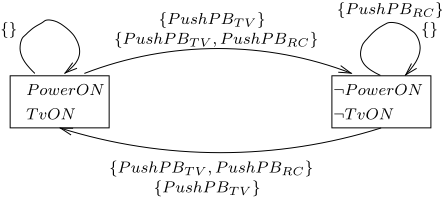
The transition diagram described by D ∪ Q is shown in Figure 3. Here we can see that at the state where both PowerON and TvON are mapped to t, the action PushPBRC is not executable. Therefore, D∪Q is not a solution. In fact, a solution to the ADU problem (D,Q,C) is obtained by dropping the static law (1) fromD∪Q. ✷
4 Properties of Updates
We first consider some basic properties of solutions to an ADU problem. To this end, we define the subsumption relation between an action description D and a causal law, both with the same signature L = 〈F,A〉, as follows:
- A static law (3) is subsumed by D if, for every state s in the transition diagram described by D, the interpretation of F describing the state s satisfies G ⊃ L;
- a dynamic law (4) is subsumed by D if, for every transition 〈s,A, s′ 〉 in the transition diagram described by D, the following holds: if the interpretation of F∪A describing the state s and the action A satisfies U, then the interpretation of F describing s′ satisfies G ⊃ L.
A set Q of causal laws is subsumed by an action description D, if every law in Q is subsumed by D. A causal law is tautological, if it is subsumed by every action description D.
Proposition 1 (Subsumption) Let (D,Q,C) be an ADU problem, such that D is consistent and D |= C. If D subsumes Q then D ∪ Q is a solution to (D, Q, C).
From this result, we obtain the following corollaries.
Corollary 1 (Void Update) Let (D, ∅, C) be an ADU problem. If D is consistent and D |= C, then D is the unique solution to (D, ∅, C).
Corollary 2 (Idempotence) Let (D, D, C) be an ADU problem, such that D is consistent and D |= C, then D is a solution to (D, D, C).
Corollary 3 (Addition of Tautologies) Let (D,Q, C) be an ADU problem, such that D is consistent and D |= C. If Q is tautological, i.e., every causal law of Q is a tautology, then D ∪ Q is a solution to (D, Q, C).
Notice that a similar property fails for logic programming updates as in [Alferes et al., 2000; Eiter et al., 2002].
We next consider a structural property of solutions and near-solutions, which can be exploited for a syntactical decomposition of an ADU problem, in a divide-and-conquer manner. Because of the involved semantics of transitions and causation, in general some prerequisites are needed. For any action signature L=〈F,A〉, we denote by LX the part of it which appears in X. We say that an action description D permits NOP, if there is some transition 〈s, ∅, s′ 〉 in the transition diagram described by D. A query F occurs positively (resp. negatively) in a set C of queries if F occurs in the scope of an even (resp. odd) number of negations, ¬, in a query in C.
Theorem 1 (Disjointness) Let (D,Q,C) be an ADU problem with signature L=〈F,A〉. Let {D0 ,D1 }, {Q0 ,Q1 }, and {C 0 , C 1 } be partitionings of D, Q, and C, respectively, such that (i) LD0 ∩LD1 =∅, (ii) LQ0 ⊆LD0 ∧ LQ1 ⊆LD1 , and (iii) LC0 ⊆LD0 ∧ LC1 ⊆LD1 .
- (i) Let Xi be a near-solution to (Di ,Qi ,C i ), for i = 0, 1. Suppose that, for i = 0, 1, X i permits NOP if some dynamic query occurs negatively in C 1-i . Then X0 ∪ X1 is a near-solution to (D, Q, C).
- (ii) Let X be a near-solution to (D,Q,C), and let {X0 ,X1 } be a partitioning of X such that X 0 ⊆D0 and X1 ⊆D1 . Suppose that, for i = 0, 1, X i permits NOP if some dynamic query occurs positively in C 1-i . Then, for i = 0, 1, X i is a near-solution to (Di , Qi , C i ).
Informally, the permission of NOP in Theorem 1 is needed to ensure that the transition diagrams of near-solutions to the sub-problems can be "combined". Here are two useful consequences of Proposition 1:
Corollary 4 Let (D,Q,C) be an ADU problem, and let {D0 , D1 }, {Q0 , Q1 }, {C 0 , C 1 } be partitionings of D, Q, C, respectively, satisfying Conditions (i)-(iii) of Theorem 1.
- (i) Suppose that no dynamic query occurs in C. If, for i = 0, 1, Xi is a solution to (Di , Qi , C i ), then X0 ∪X1 is a solution to (D,Q,C). Furthermore, every solution to (D, Q, C) can be represented in this form.
- (ii) If no dynamic query occurs in C 1 , and X1 is a solution to (D1 , Q1 , C 1 ) permitting NOP, then, for every solution X0 to (D0 , Q0 , C 0 ), X0 ∪X1 is a solution to (D, Q, C).
Example 2 Consider the ADU problem (D∪D′ ,Q,C), with D, Q, and C as in Example 1, and D′ consisting of the causal laws:
inertial LightON , ¬LightON , (11)
caused LightON after SwitchLight ∧¬LightON, (12)
caused ¬LightON after SwitchLight ∧LightON. (13)
Since X0 = D ∪ Q \ {(1)} is a solution to (D, Q, C) (Example 1), X 1 = D′ is a solution to (D′ , ∅, ∅), and D′ permits NOP, by Corollary 4 (ii) X 0 ∪ X1 = (D∪D′ ∪Q) \ {(1)} is a solution to (D∪D′ , Q, C). ✷
5 Computational Complexity
An important subtask in solving ADU problems is checking whether a set of queries is entailed by an action description.
Theorem 2 Given an action description D and a set C of queries, deciding D |= C is (i) ΠP2 -complete in general, and (ii) PNP ‖ -complete if C does not involve dynamic queries.
Here PNP ‖ means polynomial-time with a single parallel evaluation of calls to an NP oracle.
Proof. (Sketch) W.l.o.g., C contains a single query c. As for the membership part of (ii), deciding whether D |= a for a static query a of form (5) is polynomial and of form (6) is in coNP. Hence, for a Boolean combination c of such queries a1, . . . , an, deciding whether D, s |= c is feasible in polynomial time with a single parallel evaluation of NP oracles. For (i), deciding whether D, s ̸|= d for a given state s and a dynamic query d of form (7) is in NP. Thus D, s ̸|= d for a general query d is decidable in polynomial time with an NP oracle, which means deciding D ̸|= d is in NPNP = ΣP2 .
Hence, deciding D |= d is in ΠP2 = co-ΣP2 . The hardness results follow from transformations from deciding whether (i) a Boolean combination of Quantified Boolean Formulas (QBFs) of the form ∃XEj, 1≤j ≤m, is true and (ii) a QBF of the form ∀X∃YE is true, respectively. ✷
As for finding solutions, we note that deciding whether D∪ Q is a solution to an ADU problem (D,Q,C) has the same complexity as deciding D |= C in general. Deciding the existence of an arbitrary solution is harder.
Theorem 3 Deciding if a given ADU problem (D, Q, C) has a solution (or a near-solution) is (i) ΣP3 -complete in general, (ii) ΣP2 -complete if C does not involve dynamic queries, and (iii) NP-complete if C = ∅.
Proof. (Sketch) Let D = Du ∪ Dm. We can guess a nearsolution D′ such that Du ∪ Q ⊆ D′ ⊆ Du ∪ Q, along with a state s for D′ (to witness consistency), and check D |= C for (i) and (ii) in polynomial time with the help of (i) a ΣP2 -oracle and (ii) an NP-oracle respectively. This proves membership in (i) ΣP3 , (ii) ΣP2 , and (iii) NP, respectively. The hardness results follow from transformations from deciding whether (i) a QBF of the form ∃XF is true, (ii) a QBF of form ∃Z∀XF is true, and (iii) a QBF of the form ∃Z∀X∃Y F is true. ✷
Similarly, testing arbitrary solution candidates has higher complexity than testing D ∪ Q.
Theorem 4 Given an ADU problem (D, Q, C) and an action description D′ , deciding whether D′ is a solution for it is (i) ΠP3 -complete in general, (ii) ΠP2 -complete if C does not involve dynamic queries, and (iii) coNP-complete if C = ∅.
Hence, even recognizing solutions is quite hard. However, recognizing near-solutions is easier (ΠP2 -complete in general, PNP-complete if C has no dynamic queries, and polynomial if C = ∅). This follows easily from Theorem 2.
6 Computing Solutions
With an oracle for near-solutions, we can incrementally compute a solution to an ADU problem (D,Q,C) where D = (Du,Dm), in polynomial time as follows:
- If ((Du,Dm),Q,C) has a near-solution then D′ := ∅ else halt;
- For each qi ∈ Dm = {q1, . . . , qm} do Diu =Du ∪D′ ∪ {qi}; Dim = {qi+1, . . . , qm}; if ((Diu , Dim), Q, C) has a near-solution then D′ :=D′ ∪ {qi};
- Output Du ∪D′ .
✷
By virtue of Theorems 3 and 4, no substantially better algorithm of this type is likely to exist, since computing a solution is both ΣP3 - and ΠP3 -hard, and thus needs the power of a ΣP3 oracle. If a near-solution Dn for (D,Q,C) is known, we may compute, starting from it, a solution in the manner above (assuming Dn = {q1, . . . , qk}, set D′ = Dn and i = k + 1).
Near-solutions to a given ADU problem may be nondeterministically computed as in the membership part of Theorem 3, or obtained from a QBF encoding using a QBF solver. We present here a different computation method, using "update descriptions" and "update fluent sets."
Let D = (Du, Dm) be an action description with signature 〈F, A〉. The update description of D is the action description obtained from D as follows:
- Extend 〈F,A〉 by a set H of k = |Dm| new fluents (called update fluents) H1, . . . , Hk;
- label each static law (3) in Dm with a fluent Hi ∈H:
and each dynamic law (4) in Dm with a fluent Hi ∈H:
such that no two laws are labeled by the same fluent Hi;
- for each Hi labeling a law, add the dynamic law:
Let D= (Du, Dm) be an action description and C be a set of queries with the same signature. Let E be the update description of D, with a set H of update fluents. Let 〈S E , V E , RE 〉 be the transition diagram described by E. An update (fluent) set for E relative to C is a subset M of H such that
- (i) M is a hitting set for S E ¬C (i.e., it contains for each state s ∈ SE ¬C some fluent which is true at s);
- (ii) H \M is contained in some state in S E C .
With the notions above, we can find a near-solution to an ADU problem (D, Q, C), where D = (Du, Dm), as follows:
- If D∪Q is consistent and D∪Q |= C, output D∪Q.
- Otherwise, construct the update description E of D∪Q = (Du ∪ Q, Dm).
- Take a minimal update set M for E relative to C, if one exists; otherwise, takeM=H.
- Identify the set W of causal laws in Dm labeled by the elements of M.
- Output Du ∪ (Dm \W) ∪Q.
Proposition 2 Let (D, Q, C) be an ADU problem, with D = (Du,Dm). If there is a nonempty update set for the update description of D∪Q = (Du ∪Q, Dm) relative to C, then the method above generates a near-solution to (D, Q, C).
Example 3 Consider the ADU problem (D, Q, C) presented in Example 1. Note that D ∪ Q ̸|= C (as explained in Example 1). We obtain the following update description E of (Du ∪ Q, Dm), which contains Du ∪ Q and the laws:
- caused PowerON after PushPBTV ∧ ¬PowerON , H1,
- caused ¬PowerON after PushPBTV ∧ PowerON , H2,
- caused TvON if PowerON , H3,
- caused ¬TvON if ¬PowerON , H4,
According to the transition diagram described by E,
The only minimal update set for E relative to C is {H3}. We thus remove fromD∪Q the law labeled by H3, i.e., (1). The result is a near-solution and also a solution to the problem. ✷
Example 4 Take D to be the action description of Example 1, with the following causal laws added to Dm:
- caused TvON after PushPBTV ∧ ¬PowerON ,
- caused ¬TvON after PushPBTV ∧ PowerON .
Take Q and C as in Example 1. The transition diagram described by D ∪ Q is shown in Figure 3. Due to the same reasons mentioned in Example 1, D ∪ Q ̸|= C. The update description E of (Du ∪ Q,Dm) consists of the update description presented in Example 3 and the causal laws:
According to the transition diagram described by E,
The minimal update sets for E relative to C are {H3,H4} and {H3,H5}. We may choose either one and, by removing from D ∪ Q the corresponding two causal laws, we get a near-solution to the problem. None of the near-solutions is however a solution, as removing (1) is sufficient. ✷
7 Discussion
Related work. Despite conceptional similarities to model based diagnosis, for space reasons, we focus our discussion on more closely related approaches. Updating knowledge bases has been studied extensively in the context of both databases and AI, with different approaches, and in various representation frameworks, e.g., [Winslett, 1990; Katsuno and Mendelzon, 1991; Pereira et al., 1991; Eiter et al., 2002; Sakama and Inoue, 2003; Li and Pereira, 1996; Liberatore, 2000]. The last three are related more closely.
[Sakama and Inoue, 2003] is similar to our work in that it also studies update problems in a nonmonotonic framework (yet in logic programming) and considers the same criterion of minimal change. It deals with three kinds of updates to a knowledge base D: theory update of D by some new information Q, inconsistency removal fromD, and view update of D=(Du,Dm) by some new information Q. In the context of reasoning about actions and change, these kinds of updates are expressible as ADU problems (D,Q, ∅), (D, ∅, ∅), and ((Du, Dm∪Q), ∅, ∅). Sakama and Inoue show that checking for solution existence is NP-hard for each problem; this complies with Theorem 3 (iii). An important difference to [Sakama and Inoue, 2003] is that in an ADU problem (D, Q, C), conditions C may not be directly expressed in D. Moreover, the semantics of an action description D in C is a transition diagram, and only captured by all answer sets of a logic program corresponding to D by known transformations.
[Li and Pereira, 1996] and [Liberatore, 2000] study, like we do, theory update problems in the context of reasoning about actions and change, based on an action language (but language A instead of C). New information, Q, contains facts describing observations over time (e.g., the action PushPBRC occurs at time stamp 0). The action language C we use is more expressive than A in that it accommodates nondeterminism and concurrency, and the changes in the world are not only due to direct effects of actions. To formulate temporal observations, we can extend our query language by queries of the forms
where E is an action name, P is a fluent name, and ti is a time stamp; a state s satisfies a query (17) resp. (18) if, for some history (8) such that s=s0, E is in Ai+1 resp. si satisfies P.
Our notion of consistency of an action description D (in essence, the existence of a state) is different from that of Zhang et al. [2002]. They describe action domains in propositional dynamic logic, and require for consistency the existence of some model of an action description. Different from the setting here, conflicting action effects may prevent any model. With the extension of our query language discussed above, other forms of consistency studied in [Zhang et al., 2002] can be achieved in our framework, by describing possible scenarios or formulas as queries.
Repair of action descriptions. We can sometimes improve solutions (and near-solutions) to an ADU problem (D, Q, C) by considering a slightly different version of the problem. We may take the view that a causal law is not completely wrong, and for instance holds in certain contexts. Suppose that Q is a dynamic law of the form:
where L′ is a literal, G′ is a propositional combination of fluents, and A′ is an action. We can obtain an action description D∗ from D, which describes the same transition diagram as D, by replacing each dynamic law (4) in Dm with:
Here, we can observe that for each solution D′ to (D,Q,C) some solution D∗′ to (D∗ ,Q,C) exists which contains D′ . Therefore, such a method can be useful to prevent "complete removal" of some laws from the given action description. Similar methods are also useful for repairing an action description, e.g., if some dynamic laws (4) in the action description have missing formulas in U. The study of such techniques is a part of future work.
@inproceedings{ijcai2005p138,
  title     = {Updating Action Domain Descriptions},
  author    = {Eiter, Thomas and Erdem, Esra and Fink, Michael and Senko, Ján},
  booktitle = {Proceedings of the Nineteenth International Joint Conference on
               Artificial Intelligence, {IJCAI-05}},
  publisher = {International Joint Conferences on Artificial Intelligence},
  editor    = {Leslie Pack Kaelbling and Alessandro Saffiotti},
  pages     = {418--422},
  year      = {2005},
  url       = {https://ijcai.org/proceedings/2005/138},
}
TY - CPAPER TI - Updating Action Domain Descriptions AU - Eiter, Thomas AU - Erdem, Esra AU - Fink, Michael AU - Senko, Ján T2 - Proceedings of the Nineteenth International Joint Conference on Artificial Intelligence, IJCAI-05 PB - International Joint Conferences on Artificial Intelligence PY - 2005 SP - 418 EP - 422 UR - https://ijcai.org/proceedings/2005/138 ER -Copied
Machine-readable versions of this paper, for tools and AI agents:





