
When Evolving Populations is Better than Coevolving Individuals: The Blind Mice Problem
Proceedings of the Eighteenth International Joint Conference on Artificial Intelligence. Pages 647-651.
© 2003 International Joint Conferences on Artificial Intelligence
Abstract
This . paper is about the evolutionary design of multi-agent systems. An important part of recent research in this domain has been focusing on collaborative coevolutionary methods. We expose possible drawbacks of these methods, and show that for a non-trivial problem called the "blind mice" problem, a classical GA approach in which whole populations are evaluated, selected and crossed together (with a few tweaks) finds an elegant and non-intuitive solution more efficiently than cooperative coevolution. The difference in efficiency grows with the number of agents within the simulation. We propose an explanation for this poorer performance of cooperative coevolution, based on the intrinsic fragility of the evaluation process. This explanation is supported by theoretical and experimental arguments.
- [Goldberg, 1989] David E. Goldberg. Genetic Algorithms in Search, Optimization and Machine Learning. Addison- Wesley, 1989.
- [Gomez and Mikkulainen, 1997] F. Gomez and R. Mikku- lainen. Incremental evolution of complex general behav- ior. Adaptive Behavior, 5:317-342, 1997.
- [Holland and Reitman, 1978] J. H. Holland and J. S. Reit- man. Cognitive systems based on adaptive algorithms. In D. A. Waterman and F. Hayes-Roth, editors, Pattern Di- rected Inference Systems, pages 313-329. Academic Press, 1978.
- [Kitano et al., 1995] H. Kitano, M. Asada, Y. Kuniyoshi, I. Noda, and E. Osawa. Robocup: The robot world cup initiative. In Proceedings of /JCAI-95 Workshop on Enter- tainment and AI/ALife, 1995.
- [Koza, 1992] John Koza. Genetic Programming. MIT Press, 1992.
- [Luke, 1998] Sean Luke. Genetic programming produced competitive soccer softbot teams for robocup97. In John Koza, editor, Proceedings of the Third Annual Genetic Programming Conference (GP98), pages 204-222, 1998.
- [Miconi, 2001] Thomas Miconi. A collective genetic al- gorithm. In Proceedings of the Genetic and Evolution- ary Computation Conference (GECC0-2001 ), pages 876- 883.
- Morgan Kaufmann, 2001.
- [N.Zaera et al., 1996] N.Zaera, D.Cliff, and J.Bruten. (not) evolving collective behaviours in synthetic fish. In Pro- ceedings of the Fourth International Conference on Simu- lation of Adaptive Behavior (SAB96), pages 635-644. MIT Press, 1996.
- [Potter and DeJong, 1994] M.A. Potter and K. A. DeJong. A cooperative coevolutionary approach to function optimiza- tion. In Proceedings of The Third Parallel Problem Solving from Nature, pages 249-257. Springer-Verlag, 1994. [Wiegand et al., 200 1
- R. Paul Wiegand, William C. Liles, and Kenneth A. DeJong. An empirical analysis of collab- oration methods in cooperative coevolutionary algorithms. In Proceedings of the Genetic and Evolutionary Computa- tion Conference (GECC0-2001), pages 1235-1242.
- Mor- gan Kaufmann, 2001.
- [Yong and Mikkulainen, 2001] C.H. Yong and R. Mikku- lainen. Cooperative coevolution of multi-agent systems. Technical Report AI01-287, University of Texas at Austin, 2001.
References were extracted automatically from the PDF and may contain errors.
Full text extracted automatically from the PDF; figures, tables and equations may differ. The PDF is the version of record.
1 Introduction
Evolutionary algorithms are methods that apply the principles of darwinian evolution to the generation and adaptation of artificial, logical entities (function parameters, rulesets, pro grams .. . ). Their usability as a search technique has been sup ported both analytically (e.g. the Schema Theorem [Gold berg, 1989] for genetic algorithms), and empirically by un countable applications. However, the overwhelming majority of these applications are about the generation of individuals.
Collective evolution, that is, the generation and/or adapta tion of collaborating populations of agents, has attracted com paratively less attention. There has been significant research in this domain though, especially over the last decade. This research led to algorithms of ever-growing complexity. This paper will first describe some of the work in that field, and more particularily the principle of cooperative coevolution, which seems to be the most popular type of method today.
We then expose what we feel are possible drawbacks of co operative evolution, and propose a simpler way to adapt the canonical genetic algorithm to the generation of populations. We describe an experiment, based on the "blind mice" prob lem, and show that while an adapted genetic algorithm works pretty well with that problem, cooperative coevolution has more difficulties. Finally, we give an explanation for these difficulties and for the difference in behaviour with the sim pler genetic algorithm.
2 (Some of the) Related work
The simplest way to evolve a team of collaborating agents is to have all agents be identical, that is, to have homogeneous populations. These methods are not really different from in dividual evolution, except at evaluation time: to evaluate a given genotype, N agents are created out of this genotype in stead of just one, and the resulting population is evaluated. Then start again with a different genotype, etc. While being very rigidly constrained, this method makes perfect sense in situations where one does not need heterogeneity at all. This method was used by [N.Zaera et al., 1996] to evolve small groups of fish-like animats, controlled by neural networks, to perform extremely simple tasks (dispersion, aggregation, etc.).
A similar method was used by [Luke, 1998] to evolve com petitive teams of soccer players for the Robocup competition [Kitano et al., 1995]. The author used an adapted version of Genetic Programming [Koza, 1992]. There was also an at tempt at introducing a limited degree of heterogeneity by de composing teams into small sub-teams (defenders, attackers, etc.) and evolving different program trees for each such sub teams. However, because of the enormous search space (and of the delays imposed by the Robocup server software), this approach proved intractable in practice: GP runs took days to produce meaningful results. Lack of time thus prevented the semi-heterogeneous teams from outperforming homogeneous teams.
A way to obtain some degree of heterogeneity is to have only one population and make it change gradually over time, replacing some agents by others based on some evaluation method. These new agents can be obtained by crossover or by duplication with mutation. If there is a way to evaluate the impact of one given individual, it is perfectly possible to per form a simple genetic algorithm over the population. This is, in essence, the idea behind classifier systems ([Holland and Reitman, 1978]), where a set of rules cooperate to control an animat, and where individuals are evaluated after the animat's performance through a credit-sharing system.
In the same vein, we proposed a simple scheme in ([Mi coni, 2001]), in which all agents were given an arbitrary in dex, and agents of index K could only mate with agents whose indices fell within the [K-r; K+r] range. Evaluation occured simply by replacing one of the two parents by the offspring, then the second parent, and keeping the best of these two pop ulations (with the possibility of discarding any changes if it decreased the performance of the system). This simple algo rithm led to the emergence of sub-species that appeared, grow and shrank according to the needs of the population. An inter esting feature of this algorithm was its incrementality, which allowed for long-term, adaptive evolution of the system.
Trying to obtain fully heterogeneous systems brings us to another level of complexity, right into the realm of coopera tive coevolution. While coevolution has been most frequently applied in a competitive way (by confronting individuals to each other and using the result of this confrontation as an evaluation for individuals), it can also be used in a cooper ative way, in order to evolve sets of collaborating agents.
In cooperative coevolutionary [Potter and DeJong, 1994] methods, each agent within the system is actually taken from a hidden subpopulation, or pool. To evaluate a given indi vidual, it is associated with a set of collaborators (one from each other pool) and the resulting population is evaluated as a whole. The resulting score is then attributed to the currently evaluated individual. Based on this evaluation method, the classical GA cycle (evaluate, select and reproduce) is applied to each pool in turn, as many times as needed. In the first ver sion of the cooperative coevolutionary algorithm (CCGA-1) collaborators are chosen by taking the best individual from every pool. However, in the CCGA-2 version, evaluation is refined by re-evalluating every agent with random collabora tors, then taking the better score obtained between these two evaluations. The number of collaborators, the way these col laborators are chosen, the way the overall score is computed (averaging the different scores, or taking the best score, or taking the worst score, etc.) are important parameters that can influence the performance of the algorithms. The influ ence of these parameters has been studied to some extent by [Wiegand et al., 2001], but this study applied only to simple function optimization problems with only two variables.
As happens frequently with good ideas, cooperative coevo lution has been (re-)discovered a number of times under dif ferent names. Enforced subpopulations (ESP), for example, are exactly like cooperative coevolution, in which each agent is evaluated with only one set of collaborators: the best agents from all other pools. In other words, ESP is the CCGA-1 al gorithm. While this method was initially devised for the evo lution of neural networks [Gomez and Mikkulainen, 1997], it was successfully applied to multi-agent evolution by [Yong and Mikkulainen, 2001], who used it in a predator-prey sim ulation. The algorithm managed to find efficient strategies for predators, such as having two predators "chase" the prey while another one blocked it.
For some reason, the idea of simply using the standard ge netic algorithm to whole populations seems to have fallen slightly out of fashion . The most probable reason is that it is simply too obvious to be talked about. The second rea son is that it does have intrinsic drawbacks, such as a more massive search space. The third one is that it requires a few modifications to be adapted to the evolution of populations. All these aspects are discussed in section 3.2.
3 Two methods for evolving heterogeneous populations
3.1 Cooperative coevolution
Cooperative coevolution is quite an elaborate mechanism. In tuition indicates (and evidence confirms) that by focusing on each and every agent, it requires a huge number of evaluations to converge towards a solution. This algorithm concentrates on optimizing each individual agent in regard with the rest of the population; it is rather different from the more holistic approach of traditional GAs, in which full genomes are ma nipulated, and the (co-)adaptation of genes emerges naturally from selection, crossover and mutation - at least, in theory.
Why would it not be possible to simply use traditional GAs for the generation of multi-agent systems, regarding whole systems (not just each agent within them) as individuals? A simple answer is that this approach leads to very large geno types, since the genotype for an "individual" has to code for several agents instead of just one, and the resulting search space might become intractable for GAs. Cooperative coevo lution can thus be seen as a simple way to decompose a big problem into several smaller ones, even though these smaller problems are still strongly interlaced with each other.
However cooperative coevolutionary algorithms seem to have an important drawback: they basically evaluate each agent by assessing its impact on the performance of the whole system. The problem is that when the number of agents within the system grows, the influence of one single agent over the system's performance tends to decrease, thus possi bly making its assessment more difficult. This may become troublesome when the problem has a stochastic component, as is the case in many simulations. In this case, evaluating the same population several times can lead to different re sults. The consequence of this may be more important than one might think, as we will see below.
But first, it might be interesting to see how classical genetic algorithms can be adapted to the evolution of populations, and whether these population-oriented genetic algorithms can compete with cooperative coevolution.
3.2 Population-oriented genetic algorithms
Genetic algorithms work by evaluating individuals, selecting some of them according to their performance, crossing them together and mutating them, and starting over again. It is pos sible to apply exactly the same method to whole multi-agent systems. We can evaluate populations, cross them together (thus creating new populations that inherit agents from both parents), mutate them by changing one of their agents, etc.
However, the fact is that multi-agent systems are not simple individuals. They do have an obvious level of decomposition (the agent), and this can be exploited in several ways.
The most obvious idea is that in order to cover the search space efficiently, one must not only make new populations out of existing agents, one must also create new agents. To do this, we may introduce an inner crossover operator that allows us to cross two agents together. Thus, when creating a new population by importing agents from both parents, some of these imported agents would actually the result of an inner crossover between agents from the parents.
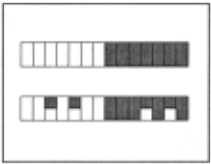
It is possible to make an analogy with traditional GAs: from the viewpoint of the whole population, these "crossed" agents have some similarity with bit-wise mutations in the standard genetic algorithm. They are part of the children's genotype, yet they were not present in any of the parents' genotypes. However, these are not exactly random mutations, since the genetic material still comes from the parents' geno types. This suggests that at first sight, "inner crossover" rate should be slightly higher than the usual mutation rate in a classical GA (usually about 2%-5% for each bit).
Another possibility is to enhance traditional crossover by occasionally swapping agents between populations in the fi nal offspring. This, too, could allow for a better covering of the search space. However, we will not explore that possibil ity in the present paper.
4 Application: The Blind Mice problem
4.1 Description of the experiment
The experiment presented here is based on the "blind mice" problem. A flock of mice, controlled by simple feed-forward neural networks, have to escape a number of cats running af ter them in a toroidal world.
Now the "game" has three very simple rules:
- The cats can see the mice and always run after the closest mouse around.
- The mice run faster than the cats.
- The mice can not see the cats. Neither can they see each other (they are "blind"). Their only input is a pair of numbers: the X and Y coordinates of the center of the flock.
When a cat touches a mouse, the cat is teleported to an other, random location, and the population's "catch counter" is increased; . nothing else is changed, and the simulation is not interrupted in any way.
Let us consider these rules: they seem to make the prob lem extremely difficult for the mice. How is it possible to escape predators that can see you, but that you can't see? Running around as fast as possible will just make them bump into any cat coming from the opposite direction. The same is true for random movement strategies. Given the enormous asymmetry of information between mice and cats, the sur vival chances of the poor rodents appear to be desperately thin. Even for a human designer, finding a solution to this problem is not a trivial task. Yet, as we will see below, evo lution managed to come up with an elaborate solution to this problem.
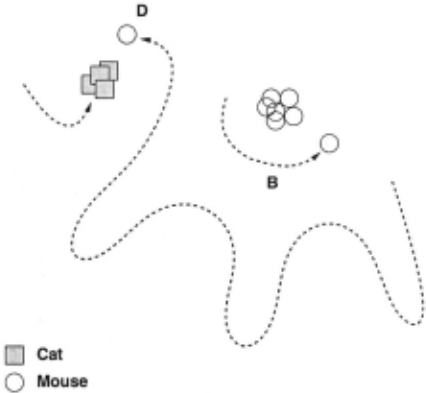
In our experiments, the mice are controlled by simple feed forward neural networks with 2 inputs, 2 outputs and 5 hidden neurons. The two inputs are the coordinates of the center of gravity of the flock, that is, the sum of the X- (resp. Y-) co ordinates of all mice, divided by the number of mice. The two outputs are two real numbers in the [-3.0; +3.0] range, indicating the horizontal and vertical speed of the mouse. All weights are real numbers in the [-1.0; +1.0] range. All simu lations use 4 cats.
4.2 The evolved strategy
There seems to be an optimal strategy for this problem. This strategy emerged in all successful runs, sometimes with vari ants. This strategy is described in Figure 2. No other strategy led to a really efficient behaviour.
Let us explain this strategy: as we can see, most mice are aggregated together and move in a tight flock. This minimizes the probability that a "stray" cat might touch them, but it is not sufficient in itself to ensure a minimal catch rate. The really important behaviour is that of the mouse labelled D (the "Dancer").
This mouse has a strange behaviour: it seems to revolve around the rest of the flock, but not in a strictly circular fash ion. Instead, it constantly bounces around the flock, always staying at a respectable distance from it, and moving very fast along its path. The purpose of this behaviour becomes obvi ous when one sees the position of the cats: they are all fol lowing this "dancing" mouse, because it is simply the closest to them, thus leaving the rest of the flock alone.
In other words, the purpose of this dancing behaviour is simply to attract all the cats. The dancer moves very fast (so that it cannot be touched by cats), but along a sinuous path, so that:
- It can "drag" cats more efficiently in the initial stage, when cats and mice are at random position
- It never gets too far from the cats, which allows the cats to follow it endlessly even though it runs much faster than them.
The final touch of this strategy can be seen in the be haviour of the mouse labelled B (as "Balance"), even though it didn't appear in all successful runs. This mouse also re volves around the flock, but much closer to it. In some runs it moves around the flock in a circular fashion, in other runs it bounces around it, but it usually stays on the opposite side of the flock with respect to the dancer. We believe that this mouse has a "balancing" role, in that it counterbalances the effect of the Dancer on the position of the center of gravity of the population, thus allowing the flock to be more stable.
Many variants appeared, such as having several dancers, or no balancer. But the essential traits of the strategy were consistent: aggregation of most mice, except for one or a few to attract the cats away from the flock.
Note that this strategy is very interdependent: each agent's performance is highly dependant on other agents' behaviour. This is even more true when you consider that in order to behave that way, they must calculate their trajectories out of only one input: the position of the center of gravity of the whole flock, which is based on the position of all other agents. This fact plays a significant role in the results described be low.
5 Experimental results
5.1 Experimental settings
We used two algorithms for this problem: a simple genetic algorithm, adapted with an inner crossover operator (as de scribed above), and a full-featured cooperative coevolution ary algorithm. Both methods were used with 7, then with 15 mice. We used 100 populations of 7 (resp. 15) mice for the first algorithm, and 7 (resp. 15) pools of 100 mice for the sec ond one. Each algorithm was run several times with different random seeds.
In the first algorithm, reproduction of populations occured through tournament selection and 1-point crossover at a rate of 60%. Every time two populations were thus crossed to gether, an inner crossover rate of 10% was applied, mean ing that each mouse in the offspring had a 10% chance to be the result of the crossing of the parents' corresponding mice. In the second algorithm, reproduction within each pool oc cured by tournament selection and 1-point crossover at a rate of 30%, which proved to be the most efficient. In both al gorithms, mutation appeared only when crossing two mice together, by choosing a new random value for a connection weight with a 5% probability.
Note that in both method, we use a limited form of elitism, in that the best individual from a given generation was pre served in the next generation. This ensured better perfor mance - and made the obtained results even more puzzling, as explained below.
Finally, cooperative coevolution specifies that each agent must be evaluated with a set of collaborators. Several sets of collaborators can be used in turn in order to refine the evalua tion, and the final result can be calculated from these succes sive evaluations in various ways (average, best, random . . . ) However, we found that with this problem, increasing the number of collaborators (and thus the number of evaluation rounds) brought absolutely nothing, and was even damag ing if the final score was anything else than the best score found. The most successful method was simply to evaluate each mouse by joining it with the best individual from each pool, exactly as in the enforced subpopulations algorithm. This is not a surprising result, however, as we will explain it below.
5.2 Comparison of results
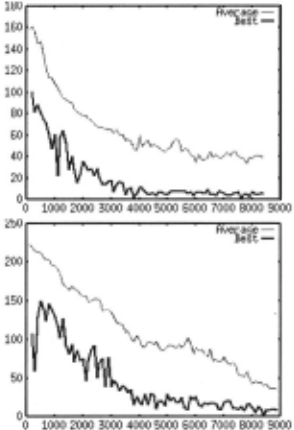
The first algorithm (simple genetic algorithm with two levels of crossover) proved remarkably efficient with this problem. All runs led to the strategy described in section 4.2, whatever the number of mice within the simulation, although of course it took more time with 15 mice than with 7. Two typical runs, with respectively 7 and 15 mice, are described in Figure 3.
Cooperative coevolution led to different results. With 7 mice, in some runs, the algorithm failed to evolve any com petitive behaviour. In other runs it managed to find the good strategy, but took more evaluations than with the previous al gorithm. Many runs, however, achieved performance compa rable with that of the simple genetic algorithm. With 15 mice, the success rate was much lower. Most runs did not converge after 10000 evaluations. Others converged, then suddenly di verged quickly. All the runs, with 7 or 15 mice, exhibited a intriguing pattern of oscillation.
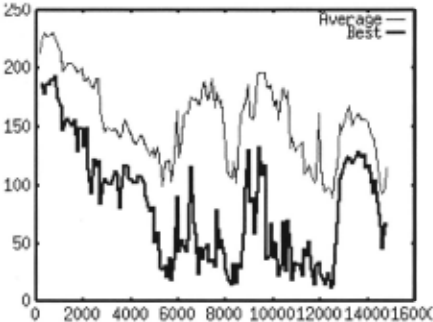
The fitness curve described in Figure 4 shows a good ex ample of this pattern. It is the result of the most successful run with 15 mice. The population seems to converge towards a better behaviour, but then it suddenly diverges and seems to loose all that had been found. The pattern starts again a few cycles later.
This is not what one could expect. In this algorithm, the population remains quite stable, being composed of the best individual from each pool. Only one individual can be changed at each cycle, and only for a better one, since the best individual from previous generation is preserved. So how do we explain these brutal changes in fitness happening every now and then?
Our explanation is that this pattern is the result of coop erative coevolution's main drawback: when the number of agents grow, and when the result of evaluation undergoes im portant stochastic variations, its performance is bound to de crease.
What happens is that at some point, the algorithm does find a "good" population, and keeps optimizing it by replacing each agent by a better one in tum - as it should do. But then at some point, because of the stochastic variations in the evalu ation process, one of these "good" agents is found to perform not as well as another, non-optimal one. In classical evo lutionary algorithms, these occasional mistakes are blurred over a large number of trials and errors, and besides, one population's performance has no impact on another's. But in cooperative coevolution, this exceptional case is sufficient to wreck the behaviour of the whole population, because it can replace an essential agent (say, a Dancer) by a poorly performing agent (say, a random wanderer).
Then other agents from other pools are evaluated in tum, but since the conditions have changed dramatically, other agents are selected instead of the previous, quasi-optimal ones. Thus, an error in the selection of one agent has an influence over all other pools. When the evaluation cycle comes back to the first pool, the previously essential agent may not be selected again, because the rest of the population has co-adapted towards a different state. However, it is pos sible that the this agent is selected again, thus resulting in a sharp increase in performance - until the next "error" in the evolutionary process. This seems to cause the up-and-down oscillations in the fitness curve.
There is little we can do about this problem. As we said, increasing the number of collaborators in a classical way (that is, by selecting random sets of collaborators) simply does not work, which is understandable: in this problem, the solution requires highly interdependent behaviours. An agent's per formance can only be good if other agents play their role. Evaluating each agent by fitting it in a random population is not likely to help reach this state. In a problem with many strongly interdependant agents, adding random collaborators doesn't seem to be a helpful solution. 1
We could devise more elaborate schemes (e.g. using the second-best from each pool as a second set of evaluators) but that would not suppress the problem. It seems that in prob lems with a non-deterministic component, cooperative coevo lution is essentially fragile, or at least, more so than the stan dard genetic algorithm.
6 Conclusion
We have described possible pitfalls in cooperative coevolu tion, and we have proposed a way to apply the canonical ge netic algorithm to populations of agents. We have applied both algorithms to a non-trivial problem, the blind mice prob lem, that is both conceptually simple and non-trivial to solve. For this problem, the populations-oriented genetic algorithm significantly outperformed cooperative coevolution. We pro posed an explanation for the difference in results, based on the intrinsic fragility of cooperative coevolution in regard to excessive stochastic variations in the evaluation proces.
As a final note, an old French proverb goes: "Quand le chat n'est pas Ut, les souris dansent" (When the cat is away, the mice dance). Artificial evolution has demonstrated that the opposite can be true as well.
@inproceedings{ijcai2003p95,
  title     = {When Evolving Populations is Better than Coevolving Individuals: The Blind Mice Problem},
  author    = {Miconi, Thomas},
  booktitle = {Proceedings of the Eighteenth International Joint Conference on
               Artificial Intelligence, {IJCAI-03}},
  publisher = {International Joint Conferences on Artificial Intelligence},
  editor    = {Georg Gottlob and Toby Walsh},
  pages     = {647--651},
  year      = {2003},
  url       = {https://ijcai.org/proceedings/2003/95},
}
TY - CPAPER TI - When Evolving Populations is Better than Coevolving Individuals: The Blind Mice Problem AU - Miconi, Thomas T2 - Proceedings of the Eighteenth International Joint Conference on Artificial Intelligence, IJCAI-03 PB - International Joint Conferences on Artificial Intelligence PY - 2003 SP - 647 EP - 651 UR - https://ijcai.org/proceedings/2003/95 ER -Copied
Machine-readable versions of this paper, for tools and AI agents:





