
Evaluating Significance of Inconsistencies
Proceedings of the Eighteenth International Joint Conference on Artificial Intelligence. Pages 468-477.
© 2003 International Joint Conferences on Artificial Intelligence
Abstract
Inconsistencies frequently occur in knowledge about the real-world. Some of these inconsistencies may be more significant than others, and some knowledgebases (sets of formulae) may contain more inconsistencies than others. This creates problems of deciding whether to act on these inconsistencies, and if so how. To address this, we provide a general characterization of inconsistency, based on quasi-classical logic (a form of paraconsistent logic with a more expressive semantics than Belnap's four-valued logic, and unlike other paraconsistent logics, allows the connectives to appear to behave as classical connectives). We analyse inconsistent knowledge by considering the conflicts arising in the minimal quasi-classical models for that knowledge. This is used for a measure of coherence for each knowledgebase, and for a measure of significance of inconsistencies in each knowledgebase. In this paper, we formalize this framework, and consider applications in managing heterogeneous sources of knowledge.
- [Belnap, 1977] N Belnap. A useful four-valued logic. In G Epstein, editor, Modern Uses of Multiple-valued Logic, pages 8-37. Reidel, 1977.
- [Benferhat et al., 1993] S Benferhat, D Dubois, and H Prade. Argumentative inference in uncertain and inconsistent knowledge bases. In Proceedings of Uncertainty in Arti- ficial Intelligence, pages 1449-1445.
- Morgan Kaufmann, 1993.
- [Besnard and Hunter, 1995] Ph Besnard and A Hunter. Quasi-classical logic: Non-trivializable classical reason- ing from inconsistent information. In Symbolic and Quan- titative Approaches to Uncertainty , volume 946 of LNCS, pages 44-51, 1995.
- N C da Costa. On the theory of inconsistent formal systems. Notre Dame Journal of Formal Logic, 15:497-510, 1974.
- [Dubois et al., 1994] D Dubois, J Lang, and H Prade. Pos- sibilistic logic. In Handbook of Logic in Artificial Intelli- gence and Logic Programming, volume 3, pages 439-513. Oxford University Press, 1994.
- [Grant, 1978] J Grant. Classifications for inconsistent theo- ries. Notre Dame Journal of Formal Logic, 19:435-444, 1978.
- [Hunter, 2000] A Hunter. Reasoning with conflicting infor- mation using quasi-classical logic. Journal of Logic and Computation, 10:677-703, 2000.
- [Hunter, 2001] A Hunter. A semantic tableau version of first- order quasi-classical logic. In Symbolic and Quantitative Approaches to Uncertainty, volume 2143 of LNCS, pages 544-556, 2001.
- [Hunter, 2002] A Hunter. Measuring inconsistency in knowl- edge via quasi-classical models. In Proceedings of the National Conference on Artificial Intelligence (AAA/'02), pages 68-73. MIT Press, 2002.
- [Levesque, 1984] H Levesque. A logic of implicit and ex- plicit belief. In Proceedings of the National Conference on Artificial intelligence (AAAJ' 84 ), pages 198-202, 1984.
- [Lozinskii, 1994] E Lozinskii. Information and evidence in logic systems. Journal of Experimental and Theoretical Artificial Intelligence, 6:163-193, 1994.
- [Marquis and Porquet, 2001] P Marquis and N Porquet. Computational aspects of quasi-classical entailment. Jour- nal of Applied Non-classical Logics, 11:295-312, 2001.
- [Shafer, 1976] G Shafer. A Mathematical Theory of Evi- dence . Princeton University Press, 1976.
References were extracted automatically from the PDF and may contain errors.
Full text extracted automatically from the PDF; figures, tables and equations may differ. The PDF is the version of record.
1 Introduction
An approach to measuring inconsistency is to use proposi tional quasi-classical (QC) logic [Hunter, 2002]. In this, each inconsistent set of formulae is reflected in the QC models for the set, and then the inconsistency is measured in the models. Obviously, this is not possible in classical logic, or indeed many non-classical logics, because there is no model of an inconsistent set of formulae. QC logic, a form of paraconsis tent logic, can model inconsistent sets of formulae. There are other paraconsistent logics that we could consider, for exam ple Belnap's four-valued logic [Belnap, 1977], or Levesque's 3-interpretations [Levesque, 1984], or Grant's generalizations of classical satisfaction [Grant, 1978], but these, as we will il lustrate, involve the consideration of too many models. This increases the number of models that need to be analysed and it underspecifies the nature of the conflicts.
However, the original proposal for measuring inconsis tency based on QC logic does not provide an evaluation of the significance of inconsistencies. As an illustration of the need to evaluate significance, consider two news reports on a World Cup match, where the first report says that Brazil beat Germany 2-0, and the second report says that Germany beat Brazil 2-0. This is clearly a significant inconsistency. Now consider two news reports on the same football match, where the first report says that the referee was Pierluigi Collina and the second report says that the referee was Ubaldo Aquino. This inconsistency would normally be regarded as relatively insignificant.
In this paper, we extend the idea of measuring inconsis tency via QC models by giving a new framework for measur ing the significance of inconsistencies in a knowledgebase. To do this, we review aspects of QC logic and a measurement of inconsistency based on it. We then present our frame work for evaluating the significance of inconsistencies. We show this leads to a generalization of a four-valued seman tics where instead of a single truth value to denote inconsis tency, we have an infinite sequence of inconsistent truth val ues Bi where i E [0, 1]. We then discuss how we can use QC logic together with significance functions for reasoning and analysing with heterogeneously sourced information such as news from different newsfeeds.
2 Review of QC Logic
We review the propositional version of quasi-classical logic (QC Logic) [Besnard and Hunter, 1995; Hunter, 2000].
Definition 1 The language of QC logic is that of classical propositional logic. We let .C denote a set of formulae formed in the usual way from a set of atom symbols A, and the con nectives{-. , V,A}. Iff E p(.C), then Atoms(f) returns the set of atom symbols used in r.
Definition 2 Let a be an atom, and let ,...., be a complementa tion operation such that ,...., a is -.a and ,...., ( ·a) is a. The "' operator is not part of the object language, but it makes some definitions clearer.
Definition 3 Let a 1 V .. V an be a clause that includes a disjunct ai and n > 1. The focus of a1 V .. V an by ai, denoted ® (a1 V .. Van, ai). is defined as the clause obtained by removing aifrom a1 V .. V an.
Example 1 Let a V /3 V 1 be a clause where a, /3, and 1 are literals. Hence, ® (a V /3 V / , /3) =a VI·
Focus is used to capture a form of resolution in the seman tics of QC logic. A model in QC logic is a form of Herbrand model.
Definition 4 Let A be a set of atoms. Let 0 be the set of objects defined as follows, where +a is a positive object, and -a is a negative object.
We call any X E p(O) a QC model. So X can contain both +a and -a for some atom a.
For each atom a E .C, and each X E p(O), +a E X means that in X there is a reason for the belief a and that in X there is a reason against the belief ·a. Similarly, -a E X means that in X there is a reason against the be lief a and that in X there is a reason for the belief ·a. This effectively gives us a four-valued semantics. Though for non atomic formulae the semantics, defined next, is significantly different to [Belnap, 1977].
Definition 5 Let F=s be a satisfiability relation called strong satisfaction. For a model X, we define f= s as follows, where a 1, ... , an are literals in .C, n > 1, and a is a literal in .C.
X f= 8 a iff there is a reason for the belief a in X
For a, /3, i E .C, we extend the definition as follows,
X Fs a 1\/3 iff X Fs a and X Fs /3
X Fs ··a VI iff X Fs a VI
X Fs ·(a 1\ /3) VI iff X Fs ·a V ·/3 VI
X Fs ·(a V /3) VI iff X Fs (·a 1\ ·/3) VI
X Fs a V (/3 1\ 1) iff X Fs (a V /3) 1\ (a V 1)
X f= s a 1\ (!3 V 1) iff X f= s (a 1\ !3) V (a 1\ 1)
Definition 6 For X E p(O) and b. E p(.C), let X Fs b. denote that X f= s a holds for every a in b.. Let QC( b.) = {X E p( 0) I X Fs b.} be the set of QC models for b..
A key feature of the QC semantics is that there is a model for any formula, and for any set of formulae.
Example 2 Let b. = { ·a V ·/3 V 1, ·a V 1, ·1 }, where a,/3,1 E A, and let X = {-a, -/3, 4}. So X f=s ·a, X Fs ·/3 and X Fs ·f. Also, X Fs"' f. Hence, X Fs ·a V 1, and X Fs ·a V ·/3, and so, X Fs ·a V ·/3 VI· Hence every formula in b. is strongly satisfiable in X.
Strong satisfaction is used to define a notion of entail ment for QC logic. There is also a natural deduction proof theory for propositional QC logic [Hunter, 2000] and a semantic tableau version for first-order QC logic [Hunter, 2001]. Entailment for QC logic for propositional CNF for mulae is coNP-complete, and via a linear time transformation these formulae can be handled using classical logic theorem provers [Marquis and Porquet, 2001].
The definitions for QC models and for strong satisfaction provide us with the basic concepts for measuring inconsis tency. QC logic exhibits the nice feature that no attention needs to be paid to a special form that the formulae in a set of premises should have. This is in contrast with other para consistent logics where two formulae identical by definition of a connective in classical logic may not yield the same set of conclusions. For example, in QC logic, !3 is entailed by both { ( ·a ___. !3), ·a} and {a V !3, ·a} and 1 is entailed by { 1 1\ ·1} and { 1, ·1}. QC logic is much better behaved in this respect than other paraconsistent logics such as Cw [da Costa, 1974], and consistency-based logics such as [Benfer hat et al., 1993]. Furthermore, the semantics of QC logic directly models inconsistent sets of formulae.
Definition 7 Let b. E p(.C). Let MQC(b..) ~ QC(b..) be the set of minimal QC models for b., defined as follows:
Example 3 Consider the following sets of formulae.
Whilst four-valued logic [Belnap, 1977] also directly mod els inconsistent sets of formulae, there are too many Bel nap models in many situations. Consider for example {a V /3, ·a}. There is one minimal QC model {-a, +/3}, but there are a number of Belnap models that satisfy this set. QC logic has a reduced number of models because of the constraint in the definition of strong satisfaction for disjunc tion that ensures that if the complement of a disjunct holds in the model, then the resolvent should also hold in the model. This strong constraint means that various other proposals for many-valued logic will tend to have more models for any given knowledgebase than QC logic. In particular, the short comings of Belnap's four-valued logic also apply to three valued logics such as 3-interpretations by [Levesque, 1984], and a similar proposal by [Grant, 1978].
3 Measuring coherence of QC models
We now consider a measure of inconsistency called coher ence [Hunter, 2002]. The opinionbase of a QC model X is the set of atomic beliefs (atoms) for which there are reasons for or against in X, and the conflictbase of X is the set of atomic beliefs with reasons for and against in X .
In finding the minimal QC models for a set of formu lae, minimization of each model forces minimization of the conflictbase of each model. As a result of this min imization, if b. E p(.C), and X, Y E MQC(b..), then (1) Conflictbase(X) = Conflictbase(Y) and (2) either Opinionbase(X) = Opinionbase(Y) or Opinionbase(X) is not a subset of Opinionbase(Y).
Increasing the size of the conftictbase, with respect to the size of the opinion base, decreases the degree of coherence, as defined below.
Definition 9 The Coherence function from p( 0) into [0, 1 ], is given below when X is non-empty, and Coherence(0) = 1.
If Coherence( X) = 1, then X is a totally coherent, and if Coherence(X) = 0, then X is totally incoherent, otherwise, X is partially coherent/incoherent.
Example 4 Let X E MQC( { ·a 1\ a, (31\ ·/3, 11\ 'I}), Y E MQC( {a, ·a V ·/3, (3, 1} ), and Z E MQC( { ·a, (3, 'I 1\ 1} ). So Coherence( X) = 0, Coherence(Y) = 1/3, and Coherence(Z) = 2/3.
Different minimal QC models for the same knowledgebase are not necessarily equally coherent.
ExampleS Let 6,. = {a ,·a,/3 V 1,/3 V 6}, and let X = {+a, -a, +/3} and Y = {+a, -a, +1, +6}. So MQC(b) = {X, Y}, and Coherence(X) = 1/2 and Coherence(Y) = 2/3.
We extend coherence to knowledgebases as follows.
Definition 10 Let 6.. E p(.C). Assign Coherence(b) the maximum value in {Coherence(X) I X E MQC(b)}.
Example 6 Let 6.. = {a 1\ ·a, f3 1\ ·/3, a V f3 V (r 1\ 6)} andb' = {a/\·a,aV/3}. HereCoherence(b) = Coherence(b') = 1/2.
Example 7 Let 6.. = { ¢ 1\ ·¢, a V (/3 1\ 1 1\ 6)} and 6..' = { ¢ 1\ ·¢, (a 1\ !3) V ( 11\ 6)}. Also let X 1 = { +¢, -¢,+a}, x2 = { +¢, -¢, +/3, +1, +6}, yl = { +¢,-¢,+a, +/3}, and Y2 = { +¢, -¢, +1, +6}. So, MQC(b) = {X1, X2} and MQC(b') = {Y1, Y2}. Also, Coherence(XI) = 1/2, Coherence(X2) = 3/4, Coherence(Y1) = 2/3, and Coherence(Y2) = 2/3. So Coherence(b) > Coherence(b').
4 Significance functions
We now present a new framework for measuring the signif icance of inconsistencies arising in QC models, and thereby in sets of formulae. The approach is based on specifying the relative significance of incoherent models using the notion of a mass assignment which is defined below.
Definition 11 Let n E p( 0) such that Coherence( D) = 0. A mass assignment mfor n is a function from p(D) into [0, 1] such that:
We have the constraint Coherence(D) = 0 to ensure that for all a E A, we have +a E D iff -a E D. Condition I ensures mass is only assigned to models that contain conflicts and condition 2 ensures the total mass distributed sums to 1. Given some n E p(O), a mass assignment can be localized on small subsets of n, spread over many subsets of n, or lim ited to large subsets of n. A mass assignment can be regarded as a form of metaknowledge, and so it needs to be specified for a domain, where the domain is characterized by n, and so the possible models of the domain are subsets of n.
Example 8 Let n = {+a, -a, +/3, -/3}. A mass as signment m is given by m( {+a, -a}) 0.2 and m( { +/3, -/3} = 0.8. Another mass assignment m' is given by m'({+a, -a}) = 0.2, m'({+a, -a, -/3}) = 0.6, and m'( {+a, -a, +/3, -/3}) = 0.2.
A significance function gives an evaluation of the signifi cance of the conflicts in a QC model. This evaluation is in the range [0, 1 J with 0 as least significant and 1 as most signifi cant.
Definition 12 Let m be a mass assignment for D. A signif icance function for n, denoted Sn, is a function from p(D) into [0, 1 ]. A mass-based significance function for m, de noted SrJ:, is a significance function defined as follows for each X E p(D).
The definitions for mass assignment and mass-based sig nificance correspond to mass assignment and belief functions (respectively) in Demspter-Shafer theory [Shafer, 1976]. However, here they are used to formalise significance rather than uncertainty. To ease reading in the following, we drop the superscript and subscript for significance functions.
Proposition 1 Let m be a mass assignment for D. If S is a significance function for m, then the following property of simple cumulativity holds for all X, Y E p(D): X ~ Y implies S(X) :::; S(Y).
Given that simple cumulativity holds, we see that specify ing significance in terms of mass assignment is more efficient than directly specifying the significance.
Proposition 2 Let m be a mass assignment for D. Let S be a mass-based significance function for m. For all X , Y E p(D),
So mass-based significance is not additive. Also the re maining significance need not be for the complement of X (ie, xc). Some may be assigned to models not disjoint from X. We now consider some constraints on mass assignments that give useful properties for mass-based significance.
Definition 13 Let m be a mass assignment for D. m is focal if! for all X E p(D) m(X) ~ 0 when Coherence(X) = 0 and m(X) = 0 when Coherence( X) > 0. m is solo iff for all {+a, -a} E p(D) m( {+a, -a}) ~ 0 and for all other X E p(D), m(X) = 0.
A focal mass assignment puts the mass onto the totally in coherent models, and a solo mass assignment puts the mass on the smallest totally incoherent models.
Proposition 3 If m is a solo mass assignment for n, then m is focal mass assignment for n.
Significance is additive for totally incoherent models when the mass assignment is solo.
Proposition 4 Let m be a solo mass assignment for n. Let S be a mass-based significance function for m and let X E p(D) . .lfCoherence(X) = 0, then S(X) + S(Xc) = 1.
A useful feature of a focal mass-based significance func tion is that as the number of conflicts rises in a model, then the significance of the model rises. This is formalized by the following notion of conflict cumulativity. It does not hold in general (see Example 9).
Proposition 5 Let m be a focal mass assignment for st. If S is a significance function for m, then the following prop erty of conflict cumulativity holds for all X, Y E p(fl): Conflictbase(X) ~ Conflictbase(Y) implies S(X) :::; S(Y).
Example 9 Let n = {+a, -a, +{3, -{3, +1, -')'}. Let X= {+a, -a, +1} andY = {+a, -a, +{3, -{3} Let m be an mass assignment for n such that m(X) = 0.6 and m(Y) = 0.4. So we have Conflictbase(X) ~ Conflictbase(Y), but S(X) 1, S(Y).
In general, S(X) :::; S(Y) holding does not necessar ily imply Conflictbase(X) ~ Conflictbase(Y), nor does it necessarily imply Conflictbase(Y) ~ Conflictbase(X) . Also Opinionbase(X) ~ Opinionbase(Y) does not neces sarily imply S(X) :::; S(Y), nor does it necessarily imply S(Y) :::; S(X). This is illustrated in the next example.
Example 10 Let n = {+a, -a, +{3, -{3} and let m be an mass assignment for n where m(X) = 0.2 and m(Y) = 0.8. We consider four cases: ( 1) If X = {+a, -a} and Y = { +{3, -{3}, then S(X) :::; S(Y) but Conflictbase(X) rl:_ Conflictbase(Y); (2) If X = {+a, -a} and Y = {+a, -a, +{3, -{3}, then S(X) :::; S(Y) but Conflictbase(Y) rl:_ Conflictbase(X); (3) If X = {+a, -a, +{3, -{3} and Y = {+a, -a, +{3}, then Opinionbase(X) ~ Opinionbase(Y) but S(X) 1, S(Y); (4) If X = {+a, -a} and Y = {+a, -a, +{3}, then Opinionbase(X) ~ Opinionbase(Y) but S(Y) 1, S(X).
We now extend the significance functions to knowledge bases. Since MQC(~) is not necessarily a singleton, the sig nificance for a set of formulae ~ is the lowest significance obtained for an X E MQC(~). This means we treat the infor mation in ~ as a "disjunction" of QC models, and we regard each of those models as equally acceptable, or equivalently we regard each of those models as equally representative of the information in ~.
Definition 14 Let~ E p(.C). We extend the definition for a significance function S to knowledgebases as follows:
Some knowledgebases have zero significance. Clearly, if ~ If l.., then S(~) = 0.
Example 11 Let S1 = {+a, -a, +{3, -{3, +')', -')' }. Let m( {+a, -a}) = 0.6, m( {+a, -a, +{3}) = 0.3, and m({+{J,-fJ,+I}) =0.1. SoS({a/\·a,{JV')'}) =0.6
In order to determine the set n for which a mass function is defined, we can use the delineation function as follows.
Definition 15 For~ E p(.C), Delineation(~) = {+a, -a I a E Atoms(~)}.
Example 12 Let ~~ = { ·a, a V {3, ·fJ}, ~2 = {a V {3, -.a 1\ a}, and ~3 = {{3, ·a V ·fJ}. Let n =
Delineation(~ 1 U ~2 U ~3 ) = {+a, -a, +{3, -{3}. Also let m( {+a, -a, +{3, -{3}) = 0.2 and m( {+a, -a}) = 0.8. So S(~I) = 1, S(~2) = 0.8, and S(~3) = 0.
Since the conflictbase is common for all minimal QC mod els for a knowledgebase, we obtain the following.
Proposition 6 Let~ E p(.C) and let m be a focal mass as signment for Delineation(~). If Sis a significance function form, then for all X, Y E MQC(~), S(X) = S(Y).
The next two results capture notions of monotonicity for mass-based significance.
Proposition 7 Let~ E p(.C) and a E .C. Let m be a mass assignment for Delineation ( ~ U {a}). If S is a significance function form, then S(~) :::; S(~ U {a}).
Proposition 8 Let ¢>, '1/J E .C. Let m be a mass assignment for Delineation ( { ¢, '1/J} ). Let S be a significance function for m. If for all X E p(O), X l=s ¢>implies X l=s '1/J, then S( {'1/J}) :::; S({ ¢>} ).
In this section, we have augmented the measurement of in consistency in QC models with an evaluation of significance. In the next section, we provide a semantics.
5 Semantics for mass-based significance
A mass assignment can be regarded as transforming the four valued semantics of QC logic into a many-valued logic.
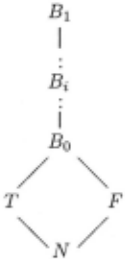
Definition 16 The knowledge lattice is a pair (K, ::S) where K = {N,T,F} U B*, and B* ={En In E [0, 1]}, and+ is a (commutative and associative) addition operation over truth values, and the ordering relation ::S is defined by condi tions ( 1) to ( 4) below, where x ~ y denotes x ::S y and y ::S x and x -< y denotes x ::S y and y -/!-_ x.
- ( 1) N -< T and N -< F and T -/!-_ F and F -/!-_ T and T -< Bo and F -< Bo
(2) for all Bi, Bj E B*, i :::; j iff Bi ::S BJ
- for all Bi, BJ, Bk E B*, k = i + j iff Bk ~ Bi + BJ
- for all Bi E B*, Bi ~ (Bi + T) and Bi ~ (Bi +F) and Bi ~ (Bi + N)
The knowledge lattice is illustrated in Figure 1. It is a dis tributive lattice. The key difference between Belnap's lattice and ours is the value Both has been split into a chain of truth values Eo, .. , B1 . If we equate the truth values {N, T, F, Eo} with the Belnap truth values {Neither, True, False, Both}, respectively, then Belnap's four-valued lattice is a sublattice of the knowledge lattice.
Definition 17 A many-valued model is a tuple (K, :::), t) where (K, ::S) is the knowledge lattice and t is a truth as signment function from the set of atoms A to K.
In the following, we restrict consideration to solo mass as signments, though this restriction can be relaxed with slightly more complex definitions.
Definition 18 Let m be a solo mass assignment for n, and let (K, :::), t) be many-valued model. We describe (X, m) and
(K, ::$, t) as being isomorphic models when X ~ D and the following conditions hold:
We can define a valuation function that extends a truth as signment to any formula by an inductive definition on the structure of o. However, for brevity, we will adopt a shortcut based on the Fs relation.
Definition 19 Let (X, m) and (K, ::$, t) be isomorphic mod els. A valuation function, denoted vt, from .C to K is defined so that vt ( o) = t( o) when o is an atom, and as follows when o is non-atomic.
Since we could have defined the valuation function equiv alently in an inductive definition on the structure of the for mulae, we can obtain propositions such as the following that relate the valuation function applied to a formula and applied to its subformulae.
Proposition 9 Jf(K, ::$, t) is a many-valued model and o 1 V 02 is a clause, then: (I) vt ( 01 V o2) :::::: Bi iff Atoms( { 01}) =/ Atoms({o2}) andt(ol) = Bi 1 andt(o2) = Bi 2 and Bi:::::: (Bh + Bi 2 ); (2) Vt(ol V o2):::::: T ifft(ol):::::: T ort(o2):::::: T; (3) vt(ol V 02) :::::: F iff [t(o1) t F and t(o2) :::::: F] or [t(o1) :::::: F and t(o2) t F]; and (4) Vt(ol V o2) :::::: N iff [t(o1):::::: N andt(o2) ':/: T] or [t(ol) ':/: T andt(o2):::::: N].
Example 13 Let X = { +o, -o, +{3, -{3, +'T'} with mass m( { +o, -o}) = 0.2 and m( { +{3, -{3}) = 0.8. Lett be a truth assignment where (X, m) and (K, ::$, t) are isomorphic models, then t(o) = Bo.2. t({3) = B0.s, and t('T') = T.
Example 14 Let X = { +o, -o, +{3} with mass assigned by m( { +o, -o}) = 0.2 and m( { +{3, -{3}) = 0.8. Lett be a truth assignment where (X, m) and (K, ::$, t) are isomorphic models, then t(o) = Bo.2. t({3 ) = T, t('T') = N.
This semantics relates to QC logic strong satisfaction rela tion with the mass-based significance function as follows .
Proposition 10 Let m be a solo mass assignment for D. Also let X ~ D and t be a truth assignment where (X, m) and (K, ::$, t) are isomorphic models. If¢ E .C, then Vi(¢) t T iff X Fs ¢.
Proposition 11 Let ¢ E .C. Let X E M QC( { ¢} ), where Coherence(X) = 0, and let m be a solo mass assignment for D. Let (K, ::$, t) be a many-valued model where X ~ D and (X, m) and (K, ::$, t) are isomorphic models. LetS be a significance function for m.
The semantics therefore extends QC logic so that in case of inconsistency, the Bi truth value reflects the significance of the inconsistency, where B0 is the least significant and B1 is the most significant. It is straightforward to extend this semantics to focal mass assignments.
6 Significance of inconsistencies in news
In this section, we consider news reports. Having some un derstanding of the "degree of inconsistency" of a news report can help in deciding how to act on it. Moreover, inconsisten cies between information in a news report and domain knowl edge can tell us important things about the news report. For this we use a significance function to give a value for each possible inconsistency that can arise in a news report in a given domain. We may also use significance in the follow ing ways: (1) to reject reports that are too inconsistent; (2) to highlight unexpected news; (3) to focus on repairing signifi cant inconsistencies; and (4) to monitor sources of informa tion to identify sources that are unreliable.
How we use the significance function depends on the ap plication. In our simple example below, we assume a news report is a set of ground predicates. Each term is used to rep resent a piece of information in a news report and may be equivalent to a word, or number, or a simple phrase. The predicate symbol is used to tag or categorise each piece of information.
Example 15 Each ofrl - rs is a news report:
r1 = { temp(30C), pptn(snow), pollen(high)} r2 = {temp(30C),pptn(snow),pollen(low)} r3 = {temp(10C),pptn(snow),pollen(high)} r4 = {temp(10C),pptn(snow),pollen(low)} rs = { temp(OC) , pptn(snow) , pollen(high)}A potential inconsistency that can arise in a news report is any set of literals that may be rebutted by the domain knowl edge.
Definition 20 Let <I> be a news report and let ~ be domain knowledge. For { ¢1, .. , ¢n} ~ <I>, { ¢1, .. , ¢n} is rebutted by ~iff~ f-- ·(¢1 /\ · · · /\ ¢n).
Example 16 Domain knowledge for weather reports may in clude:
(clause 1) (clause 2) (clause 3) ·temp(30C) V ·pptn(snow) ·temp(10C) V · pptn(snow) ·pollen(high) V ·pptn(snow)So with the report r 1 in Example 15, we get that {temp(30C) , pptn(snow)} is rebutted by clause 1, and that {pollen(high) , pptn(snow)} is rebutted by clause 3.
Example 17 Continuing Example 15, we adopt the mass as signment as follows:
m( { + temp(30C), - temp(30C), +pptn(snow) , - pptn(snow)}) = 0.6 m( { +temp(10C) , - temp(10C) , +pptn(snow), -pptn(snow)}) = 0.3 m( { +pollen(high), -pollen(high), +pptn(snow) , -pptn(snow)}) = 0.1So the reports r 1 to r 5 in Example 15, together with the do main knowledge in Example 16, denoted here by ~' gives the following significance evaluations. S(~ u fi) = 0.7, S(~ u r 2) = o.6, S(~ u r 3) = 0.4, S(~ u r4) = o.3, S(~ U f 5 ) = 0.1. If we set the threshold of acceptability for a news report r i at a significance evaluation of0.3, then only r 4 and r 5 would be acceptable, the others would be rejected.
This small example illustrates how we may find some in consistencies acceptable and others unacceptable, thereby se lect some news reports in preference to others. For larger examples, it may be necessary to specify a mass assignment for many possible incoherent models. One solution for this is to generate a mass assignment from a partially specified mass assignment. Mass is assigned to particular models and then mass for further models is obtained by interpolation. In particular, domains with some numerical data, such as sport reports or weather reports, can be addressed with this ap proach. For example, if we are only interested in inconsisten cies about temperature, and we have a range of possibilities from rain(lcm) , ... , to rain(50cm), then the mass could be assigned to two models such as { +rain(lcm), -rain(lcm)} and { +rain(50cm), -rain(50cm)}, and then the remaining mass assigned by interpolation.
7 Discussion
Whilst a number of approaches to handling inconsistent in formation touch on the issue of measurement of inconsis tency, the topic is underdeveloped. Information theory can be used to measure the information content of sets of inconsis tent formulae [Lozinskii, 1994]. This increases with additions of consistent information and decreases with additions of in consistent information. However, it does not provide a direct measure of inconsistency since for example, the value for {a} is the same as for {a, ·a, ,B}. Another approach to handling inconsistent information is that of possibility theory [Dubois et al., 1994]. Let(¢, a ) be a weighted formula where ¢ is a classical formula and a E [0, 1] . A possibilistic knowledge base B is a set of weighted formulae. An a-cut of a possibilis tic knowledgebase, denoted B ?.a· is {('lj;, .B) E B I .B 2:: a }. The inconsistency degree of B , denoted Inc(B) , is the max imum value of a such that the a-cut is inconsistent. How ever, this approach does not discriminate between different inconsistencies. For this, there is a need for an underlying paraconsistent logic such as QC logic.
@inproceedings{ijcai2003p70,
  title     = {Evaluating Significance of Inconsistencies},
  author    = {Hunter, Anthony},
  booktitle = {Proceedings of the Eighteenth International Joint Conference on
               Artificial Intelligence, {IJCAI-03}},
  publisher = {International Joint Conferences on Artificial Intelligence},
  editor    = {Georg Gottlob and Toby Walsh},
  pages     = {468--477},
  year      = {2003},
  url       = {https://ijcai.org/proceedings/2003/70},
}
TY - CPAPER TI - Evaluating Significance of Inconsistencies AU - Hunter, Anthony T2 - Proceedings of the Eighteenth International Joint Conference on Artificial Intelligence, IJCAI-03 PB - International Joint Conferences on Artificial Intelligence PY - 2003 SP - 468 EP - 477 UR - https://ijcai.org/proceedings/2003/70 ER -Copied
Machine-readable versions of this paper, for tools and AI agents:





