
Broadcast News Navigator (BNN) Demonstration
Proceedings of the Eighteenth International Joint Conference on Artificial Intelligence. Pages 1639-1639.
© 2003 International Joint Conferences on Artificial Intelligence
Abstract
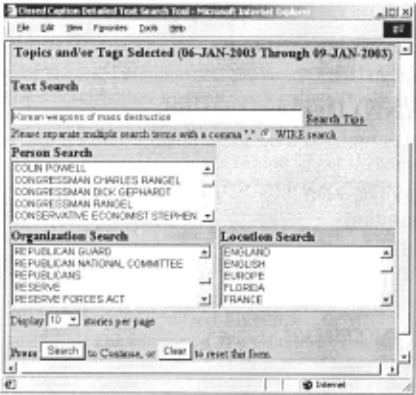
The Broadcast News Navigator (BNN) is a fully implemented system that incorporates image, speech, and language processing together with visualization and user preference modeling to support intelligent, personalized access to broadcast news video. The demonstration will illustrate the use of the system's underlying machine learning enabled story segmentation and processing, called the Broadcast News Editor (BNE). A live, scenario-based demonstration will illustrate the use of named entity search, temporal visualization of entities, story clustering and geospatial story visualization, discovery of entity relations, and personalized multimedia summary generation. By transforming access from sequential to direct search and providing hierarchical hyperlinked summaries, we will demonstrate how users can access topics and entity specific news clusters nearly three times as fast as direct search of digital video. In short, we will demonstrate intelligent news on demand enabled by a suite of AI technologies.
- [Aberdeen et al., 1995] Aberdeen, J., Burger, J., Day, D., Hirschman, L., Robinson, P., and Vilain, M. 1995. Description of the Alembic System Used for MUC-6. In Proceedings of the Sixth Message Understanding Conference, 141-155 . ARPA/ITO, 6-8 . Columbia, MD.
- [Boykin and Merlino, 2000] Boykin, S. and Merlino, M. Feb . 2000. A. Machine learning of event segmentation for news on demand. Communications of the ACM. Vol 43(2): 35-41.
- [Merlino and Maybury, 1999] Merlino, A. and Maybury, M. 1999. An Empirical Study of the Optimal Presentation of Mul- timedia Summaries of Broadcast News.
- Mani, I. and Maybury, M. (eds.) Automated Text Summarization, MIT Press.
- Maybury 2003]
- Maybury, M. 2003. Broadcast News Understanding and Navigation. Innovative Applications of Artificial Intelligence. Acapulco, Mexico. 12-14 August, 2003
References were extracted automatically from the PDF and may contain errors.
Full text extracted automatically from the PDF; figures, tables and equations may differ. The PDF is the version of record.
1 Intelligent Segmentation
Fundamental to BNN is the exploitation of text, audio, and imagery streams and associated cues which are used to detect story and commercial segment boundaries and to select media elements to use for summaries and mul timodal displays. We will demonstrate how certain cross media cues such as language content (e.g., frequent weather or sports terms, funding and/or copyright no tices), discourse cues (e.g., "coming up next"), music (e.g., characteristic jingles), silence indicating breaks to commercial, and visual cues (e.g., logos, anchor booth vs report shots) help signal program start/end, anchor/report shots, commercials, and/or story shifts. Underlying BNN is a set of machine learned, time-enhanced finite state automata modeling news structure that take into account the above cues and probabilistic, temporal models of event occurrence [Boykin and Merlino, 2000].
3 Relevancy Feedback
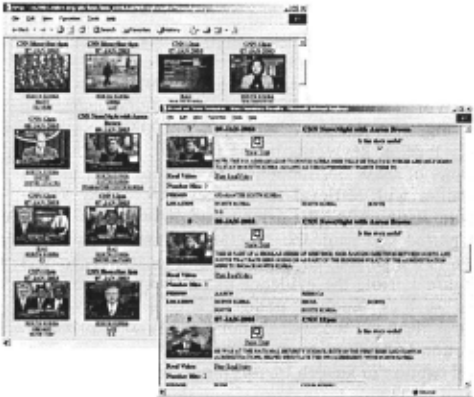
Users can navigate directly from the Story Skim of Fig ure 2 on the left to a "Story Details" display as shown on the right. "Story Details" include the key frame, one line summary (the story line containing the most named enti ties), all extracted named entities, and pointers to video source, transcript, and relevant stories. The user can ei ther review the story or engage in further query refine ment, accomplished with an underlying Local Context Analysis (LCA) algorithm.
4 Visualization and Discovery
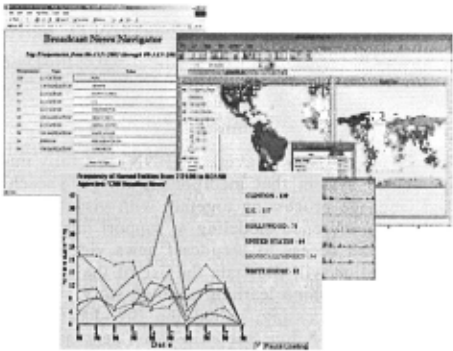
As shown in Figure 3, users can visualize named entity frequencies by collection, source, or date range, visualize temporal occurrences, and display story occurrences associated with geospatial regions, animated over time. Finally, users can interactively run data mining algo rithms to discover relationships among named entities (e.g., people associated with locations or organizations), and automatic detection of topic clusters . In addition, users can set profiles that specify their media (e.g., text summary, image key frames, summary), and navigation preferences (e.g., overviews or not, links to related sto ries). We demonstrate live how BNN users can find video stories and answer questions about two to three times as fast as with original sources, with no performance loss.
Acknowledgments
BNN is the product of numerous contributors including Stanley Boykin, Andy Merlino, Warren Grieff, Jay Ponte, Chris Clifton, and Chad McHenry.
@inproceedings{ijcai2003p288,
  title     = {Broadcast News Navigator (BNN) Demonstration},
  author    = {Maybury, Mark T.},
  booktitle = {Proceedings of the Eighteenth International Joint Conference on
               Artificial Intelligence, {IJCAI-03}},
  publisher = {International Joint Conferences on Artificial Intelligence},
  editor    = {Georg Gottlob and Toby Walsh},
  pages     = {1639--1639},
  year      = {2003},
  url       = {https://ijcai.org/proceedings/2003/288},
}
TY - CPAPER TI - Broadcast News Navigator (BNN) Demonstration AU - Maybury, Mark T. T2 - Proceedings of the Eighteenth International Joint Conference on Artificial Intelligence, IJCAI-03 PB - International Joint Conferences on Artificial Intelligence PY - 2003 SP - 1639 EP - 1639 UR - https://ijcai.org/proceedings/2003/288 ER -Copied
Machine-readable versions of this paper, for tools and AI agents:





